Jump to ratings and reviews
Rate this book

Genius

Rate this book
Ted Marx works hard at his career as a quantum physicist. But lately the demands of his job have begun to overwhelm him. Then Ted makes a startling discovery: his wife's father once knew Einstein and claims that Einstein entrusted to him a final, devastating secret—a secret even more profound and shattering than the work that led to the first atom bombs. If Ted can convince his father-in-law to tell him what Einstein had to say, his job will be safe. But does he dare reveal Einstein's most dangerous secret to those who might exploit it? In their comic book Genius, acclaimed duo Teddy H. Kristiansen and Steven T. Seagle have created an exploration of the heights of intellectual and scientific achievement and the depths of human emotion and confusion.

128 pages, Paperback

First published July 9, 2013

Loading...
Loading...

About the author

Steven T. Seagle

498 books51 followers
Steven T. Seagle is an American writer who works in the comic book, television, film, live theater, video game, and animation industries.

Ratings & Reviews

What do you think?
Rate this book

Friends & Following

Create a free account to discover what your friends think of this book!

Community Reviews

5 stars
57 (10%)
4 stars
209 (37%)
3 stars
222 (39%)
2 stars
67 (11%)
1 star
6 (1%)
Displaying 1 - 30 of 123 reviews
Profile Image for Whitney Atkinson.
1,087 reviews13.2k followers
July 16, 2017
2.5 stars

I kept waiting for this book to get good, but it was just... lukewarm. The art was cool, but the font was difficult to read half the time and the entire plot was just slow and unimpressive. I like that the main character is a physicist, but his struggle was very surface-level and I couldn't really connect to this. I felt like his wife had a more compelling storyline, but she got brushed aside, and you ultimately never really find out what happens to her, or the rest of the main character's family. The presence of Einstein in this was interesting but this is more of a contemporary story about a guy's struggle at work than actual science or moral struggles. Idk.
Profile Image for Calista.
5,437 reviews31.3k followers
January 10, 2020
I have been trying to read all the First Second comics and I picked this up ILL from the library. I have to say that this wasn't my story.

I don't care for the artwork, but I have to say that it sets the melancholia very well for the book. The story is a man who has always be extremely smart is now an older man with a family and he works with other brilliant people. He needs and idea to keep his job and he needs his job to keep his insurance to take care of his wife with cancer. He can't come up with an idea. He discovers that his cranky father-in-law knew Einstein and Einstein told him a secret he has kept all this life. Our character scares the secret out of him and it rocks his world. He understands this new idea would change the whole world and how we think.

It's an interesting premise and I'm glad it was published, but I wasn't the intended audience for this.
Profile Image for Sam Quixote.
4,836 reviews13.5k followers
June 22, 2013
Ted Halker is a physicist with a genius level intellect. As a child he was skipped ahead several grades because of his above-average intelligence. As a teenager, he imagined wild theories about the universe and went on to get his physics degree at a prestigious school. Cut ahead a couple decades and Ted is now middle-aged, married with a teenage son and a pre-teen daughter, with his elderly and sick father-in-law living with them too.

Ted’s working at a scientific journal and the promise he showed as an early 20-something starting out on his physics career, following in the footsteps of his hero, Albert Einstein, has all but gone. But he’s been treading water too long - he needs to come up with a big idea to keep his job. And he really needs to keep his job for the health insurance now that his wife’s been diagnosed with a brain disorder. Then he finds out his father-in-law knew Einstein back in the 1930s and Albert told him - and only him - an earth-shattering idea...

I found this book a bit contrived to fully enjoy - Ted idolises Einstein and then finds out that his father-in-law knew Einstein and that he told him something he told no-one else. Not that we find out what that idea is, because we don’t, just take it as read that this senile old man has remembered it clearly and repeats it to his son-in-law at just the right moment that he needs a big discovery to keep his job. It’s all so very convenient!

The book makes a point of differentiating between brain knowledge and heart knowledge, and that Ted has plenty of brain knowledge but not enough of the other. Knowledge as opposed to knowing. Guess what he learns more about at the end of the book? That and his wife having a brain disease all felt like very heavy-handed storytelling.

I will say that Ted did seem like a real person though - Steven Seagle wrote him as a believable, convincing character. Not the most likeable guy, but we don’t read fiction to make friends now do we? If the character seems believable, the writer has done his job. Or at least part of it as I wasn’t that engrossed in Ted’s story.

Teddy Kristiansen’s artwork looks very arty, all thin lines and scribbles and flashes of formless paint and watercolours - imagine Eddie Campbell’s stuff and you’ve got it. You either like that style or you don’t. I wasn’t blown away by it and Kristiansen can’t believably make the characters appear to talk but it didn’t make me dislike the book any bit.

Genius is a bit clunky in places where the themes and metaphors really get laid onto the reader in a slightly artless way despite its overtly arty visuals. Is the story of Ted coming to terms with his own limitations despite being labelled a genius at an early age, a story you need to read? Not really. It’s ok, but not a particularly exceptional comic book.
Profile Image for Melissa Chung.
965 reviews320 followers
August 4, 2016
4 stars! Semi- autobiographical about Einstein.

In this graphic novel we meet Ted Marx. As a kid he was so smart that he skipped 2 grades. He was a kid genius. We see Ted grow up, get a wife, start a family and work as a physicist like his humanized god.

As a physicist you either keep coming up with ideas or get canned. Ted is worried about nit having anymore good ideas. on top of that, his wife is sick. She might have a tumor behind her eye. They need the insurance. ..Ted has to come up with something!

I really liked this story. You learn a little bit about Einstein and you learn about the struggles of being smart. There are some funny bits between Ted and his very old and slightly senile father in law. Some sweet moments between Ted and his kids and some scary moments between Ted and his wife. A little bit of everything.
Profile Image for Jacob.
141 reviews
October 18, 2017
A sort of experimental graphic novel of a man who breaks through a midlife crisis (several crises, really). It was though-provoking, if not earth-shattering. And I did appreciate the ending when he "finds himself" again.
Profile Image for Jessica at Book Sake.
646 reviews79 followers
July 9, 2013
The first few pages into this book, I was worried. I thought it was going to be some high concept mental ride into the intellectual amorphous opaque. Whatever that means. Good news though, it quickly proved me wrong and became a very human story. It’s the story of a genius who has become the old guard and is being out-shined by young whippersnappers. This could be a story about any working schlep trying to impress the boss and take care of his family.
The book is full of dramatic moments. These are honest moments and will make people think twice about comics only being about superheroes. Genius shows the kinds of feats comics are capable of achieving and why they are a viable storytelling medium for adults.

The art also turns comic art on its head. It is minimal. Backgrounds, establishing shots, and other ‘critical’ storytelling devices are in short supply, but the art is easy to follow. Emotions shoot off the page. There are some times when you aren’t sure exactly where you are. Inside, outside, in a dream? Sometimes it doesn’t matter and sometimes it elevates the storytelling.

The story ends up using a device that I both love and hate. The ending that isn’t an ending. There is no closure. On one hand it lets the reader continue ‘living’ in the world of the story, making up their own outcomes. However it tends to leave one incomplete. Many an Oscar nominee follows this design, so what do I know?

Reviewed by Chris for Book Sake.
Book received for free from publisher for review.
Profile Image for First Second Books.
560 reviews599 followers
first-second-publications
August 21, 2013
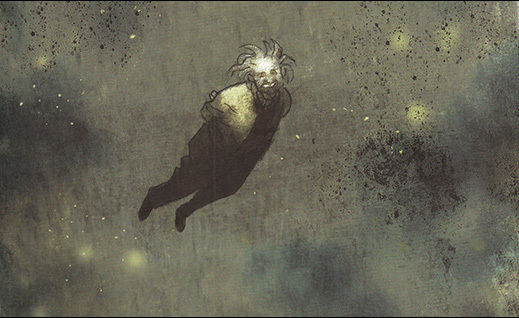
The first thing about this book I want to say is the first thing you see when you look at the book -- the cover! It's great -- our designer, Colleen AF Venable, did a really wonderful job on this one. Ghostly Einstein floats in main-character Ted's mind all through the story, and that's exactly what he's doing on the book cover, too.

Who doesn't love books about science and ethics? This is a really interesting discussion of what would happen if you were possessed of a world-changing scientific secret.

Would you make that choice to change the world?
Profile Image for Brent.
2,273 reviews195 followers
March 21, 2018
Genius is a graphic novel for grown-up and middle-aged folks, unlike most of the fare published by FirstSecond. If you like these creators, you will like this: I do, and did. Not TOO much Einstein here, though: he serves as a historical source of inspiration for the working-stiff protagonist. Kristiansen is always graphically interesting, and this continuing collaboration between writer and artist makes good comics.
Profile Image for Chrissy.
1,012 reviews
January 18, 2013
It turned out there were two kinds of knowledge: brain knowledge and heart knowledge.

From the time he was a young boy, Ted always felt that he stood out from the crowd. He was extensively tested as a child and was found to perform at extraordinary levels of genius. He skipped two grades in school and never failed to amaze everyone with his unbelievable grasp of theories and concepts that should be so far beyond the scope of his young mind.

But even back then, just as now, Ted has noticed that he seems to lack the kind of genius and knowledge that allows him to do the simple things in life. Like, when he tries to converse with his young teenage son about the details of the birds and the bees, for example. When Ted was this age, he was working on his solution to the question of the decomposition of finite time -- he wasn't interested in the sexual things involving young women that he needs to explain now to his son. Or, for another example, when Ted's wife learns that she has a brain tumor and must undergo an extensive, dangerous expanse of treatment to try and heal the disease. How can Ted find a way to emote to his wife -- to help his wife through this tragic time, when he can't quite find a way to grasp that which he deems "knowledge of the heart"?

Ted's boss at work says that his genius seems to be lacking inspiration lately, and threatens to let Ted go from the job if he fails to present something revolutionary to the scientific community -- soon. With his wife undergoing expensive medical procedures, Ted knows he definitely cannot afford to lose this job -- so when Ted's aging father-in-law, Francis, reveals that he once worked as a bodyguard for Einstein himself, Ted is intrigued. Francis says that Einstein entrusted him with a revolutionary, life-shattering, mind-blowing secret that he never entrusted to anyone else in his lifetime -- and this is a secret that Francis intends to take to the grave, no matter what.

Ted knows that if he could coerce his father-in-law to share Einstein's secret, he could in turn produce this knowledge in front of his boss at work, gaining him respect in the scientific community once again and keeping his paycheck and medical benefits that he cannot afford to lose right now. But, if Ted is finally able to learn something so intimate from the mind of Einstein, will he really be able to turn it over to his manipulative, exploitative boss to be mishandled and misused in any way he pleases?

I was absolutely not expecting to adore GENIUS as much as I did -- especially since I have very little experience with the medium of graphic novels and really had low expectations of a novel propelled heavily through the use of drawings. But, I am amazed at just how much insight and emotion can be conveyed in this manner, and I admit that GENIUS completely changed the way in which I think about graphic novels in general.

I admit, the drawings themselves were not entirely amazing -- not technically, at least -- but I think they worked to really *emote* throughout the story, which made me feel so much more connected to Ted and all of his struggles. The use of color, especially, worked to highlight the angst, frustration, isolation, and fear as they were released at just the right points of the story.

One thing I loved was the distinction Ted made between "brain knowledge" and "heart knowledge". He expressed his remarkable genius at theoretical physics and his detailed work in formulating complex formulas to solve amazing scientific problems, but at the same time he knew that he was unable to convey and understand things that seemed so simple to others. He had tremendous difficulty relating to his children and his wife, he was unable to really relate and convey emotions to others, and he found it impossible to provide emotional support when needed to those around him. I adored his character, for this reason, and I felt that I could really relate to his struggles in trying to grasp the things relating to "heart knowledge".

I also enjoyed the segments in which Ted marveled at the magnificent things the mind has accomplished but then noted that the great minds have not yet been able to answer the simple questions or to solve so many simple problems in life. Man may be able to conceptualize space and time and create fantastic medical equipment and send a man to the moon, but at the same time, man does not necessarily have the means to cure the disease that created the tiny tumors on his wife's brain. It was endearing to read Ted's musings on the limitations of the human brain, and it made him seem more likeable, to me, as a character.

I can see how the ending might be taken as a bit of a disappointment, given the prestige of his previous position and the build up of the escalated struggle to unveil Einstein's mysterious secret. But, at the same time, I feel that the ending, although slightly anticlimatic, was necessary and fitting to the rest of the story. I loved Ted's realization at the end of the book, and I was thoroughly pleased with GENIUS.

I would readily recommend this to anyone who has ever felt displaced from the social world -- so wrapped up in the universe of the mind that the simple things feel so out of reach.

Five stars, two thumbs up. I loved it.
Profile Image for Blair.
Author 2 books49 followers
February 20, 2014
A nicely done graphic novel that looks at the perhaps more mundane struggles of a 'genius' physicist who wants to find out about a secret idea of Einstein's to help him in his own stalled career. Seagle concentrates on his domestic life with his wife and children to good effect.
Profile Image for Russell.
104 reviews
May 18, 2014
Michael Kindness finds a book, says Russell check this out. It's bought and read less than 24 hours later. Happy tears at the Denver airport. A million thanks!!
Profile Image for Seth T..
Author 2 books977 followers
November 2, 2015
Finally, a book that understands what it’s like.

I’m kidding. Mostly. Probably. The fact is a lot of us can probably relate in at least some manner to Ted Halker, his sense of alienation, and his frustrating struggle to live up to his potential—especially while others may seem to live up to theirs almost effortlessly. I may not be a genius (or maybe I am!), but I’ve lived Ted’s trials with exactitude. If you don’t count the particulars of his plotline.

Genius by Steven T. Seagle and Teddy Kristiansen
[Truth.]

The question of potential and potentialities looms over Seagle and Kristiansen’s latest collaboration, Genius. The book’s eponymous genius, Ted, is haunted by what he could be if only he would be what he could be. He’s likewise stalked by the undeterrable weaving of fate and the question of how his actions in the present might deterministically prompt the ultimate form of that tapestry.

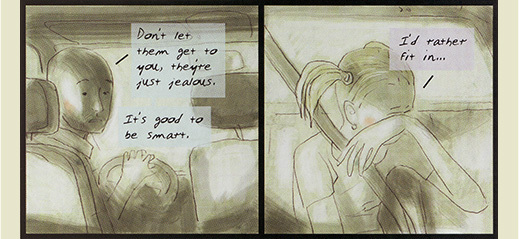
It’s a trim book and an easy read, but it tussles with concepts that lend their own formidable weight to the whole enterprise. The questions of ethics, will, determinism, responsibility, and sacrifice form the bedrock of (if not all then many) introductory philosophy courses—because, after all, these are the questions that plague our human existence. Their answers (and even more: the demurring to answer) have ranging effects in the personal, familial, and community spheres. Seagle and Kristiansen avoid specifics for the most part but do suggest an angle of descent for approaching broadly the ethics of circumstance. It’s likely that the creative team’s purpose was more to provoke the question in their readers than it was to propose a solution—and so far as this is their goal, I believe most will find their book a success. They leave plenty of room for discussion, neither making Ted a paragon nor a villain for his final solution. I imagine that every book club to discuss Genius will ask in some form or another the question, “What would you have done in Ted’s place?” A kind of Sophie’s choice gimme of a question that is nonetheless appropriate for all its cliched guise of introspection.[1]

Writing a story about a character who is a genius is probably the most difficult kind of story there is to write. Creating a believable character who is substantially different from the author is never easy and falls apart in any number of aspects that are just plainly beyond the writer’s grasp. We see this all the time when a man is writing a female protagonist, when a white woman is writing a black woman, when a straight woman is writing a gay man, when an atheist is writing a believer, or vicey-versa. Writing someone who is not you is incredibly difficult to accomplish in a manner that could be mistaken for verisimilitude. But in each of these cases, a little bit of empathy can go a long way toward selling the illusion. The old trick of using one’s imagination to walk a mile or kilometer or league in another’s soles really can help bridge the gulf between author and character. The problem with writing a genius is that no amount of empathy or imagination can make your character smarter than that character’s author. Because of this, it’s rare to encounter a figure within the literary tradition who actually feels like the genius he or she is meant to be.

Genius by Steven T. Seagle and Teddy Kristiansen
[Still, whatever the case, floating Einstein will always be a genius.]

To ease the tension and help prompt the myth of intellectual brilliance, writers have a number of tricks at their disposal—gimmicks that can help sell the heroic smarts of their protagonists. A small list of a number of these:

• The character will tell you that they are a genius. Or at least passingly mention their IQ or how Mensa is beneath them.
• The character will give you simple-but-quirky explanations for everyday things as proof of their above average intellect.
• They will have a genius-person job.
• They will scribble equations on things. It doesn’t matter whether the equations are legit or related to their field of study or accurate. All that matters is that the equations are scribbled—because without either familiarity with the equation being scribbled or what the variables represent, the reader will just have to take on faith that the complexity is relevant and accurate.
• Jargon, doesn’t even have to be real. Quantum gyrations. Planck strings. Acoustic radiation. Perpentudinal ethnoplexies. (See also 97% of all sci-fi stories.)
• Name dropping of peers. Einstein. Schroedinger. Dirac. Quine. Russell.
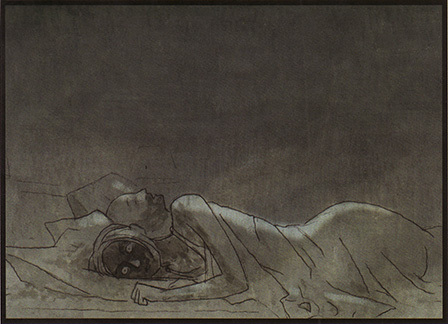
There are other gimmicks, but these are common. And better, they’re generally acceptable ways to aid in the reader’s suspension of disbelief. And I’m not complaining, really. How much worse would it be for an ostensibly popular work to essay a completely believable and legitimately genius protagonist? Only the slimmest percentage of the readership would understand any of it.[2]

Genius by Steven T. Seagle and Teddy Kristiansen
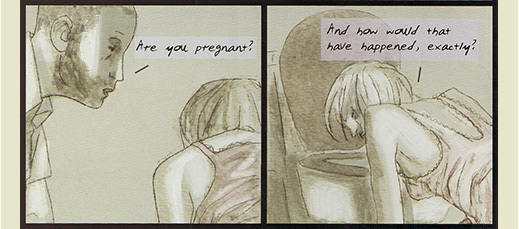
[Smart guy being oblivious to female biology, however: that is a sure marker of genius.]

So when we discover that Seagle and Kristiansen rely on the standard bag of tricks, it’s at first understandable if still a bit disappointing. (I really want to read about a genius and actually rationally believe he is a genius, but still enjoy reading about him. Chimeric, I know.) But after a few pages, we realize that it doesn’t matter so much. We’re not going to be asked to believe that Ted will solve impossible equations like Matt Damon in Good Will Hunting. We’re not going to see Ted put into a situation where his genius will be put on display. We’re not going to be asked to believe it when Ted contradicts scientific theory and changes the world for the next century. That’s the stuff of biographies and isn’t what the creative team has on its plate for Genius.

Instead, and amusingly (probably), Seagle and Kristiansen propose a very mundane problem—one sadly enough encountered by non-genius people every day. Ted’s intellect allows him an improbable out, if he will take it, but otherwise this is really the tale of every one of us in some respect. Potential and potentialities. Ted’s story is about the weighing of consequences and “being man enough”[3] to take responsibility for the results of our judgments. It’s about who we are and who we might become. It might be the story of a genius but it doesn’t need to be. And while Seagle and Kristiansen involve Albert Einstein’s ghost rather often and rather effectively, he’s really only the crutch Ted needs to become what he might become. Scientist as catalyst.

Genius by Steven T. Seagle and Teddy Kristiansen
[This panel was harrowing to me. Been there, done that.]

So here’s a funny thing about Seagle/Kristiansen books. I always want to read them until I pick them up. I read that a new collaboration is to be published and I get excited, remembering how much I enjoyed their last creation. Then I get the book, thumb through it, and decide that maybe I’ll wait a while and read it when I’m in the mood. There’s no real justification for it save for Kristiansen’s palette. The artist uses downbeat colours that are dingied and desaturated. If a range of colours could be given a name, Kristiansen’s would be named Eeyore. There is none of that cheery blossom of wonder that fills Miyazaki’s works, none of that alternating between soft and bold that marks Glyn Dillon’s latest. Even Frank Miller’s Dark Knight, which often has a similar monotone of blues and greys, employs its hues to bursting dramatic effect.

So in a sense, I’m always predisposed to not enjoy these Seagle/Kristiansen ventures. Which is great because I always end up deeply appreciating their work and thinking that Kristiansen is probably the perfect artist to bring Seagle’s stories to visual life. Despite my initial reluctance, I always discover myself pretty amazed at what Kristiansen can do, and while reading I never find myself feeling the visual tone unwieldy or too depressing. So you’d think I would learn. I probably won’t (I’m not that kind of genius), but I really ought to.

Genius, for all its slim page count (126 pages!), is a lovely and thoughtful work. I’m hoping that by year’s end, the book will be Number 15 in my best-of-the-year list—because that would mark 2013 a truly phenomenal year for comics. As it is, I don’t doubt that Genius will land in my Top 5 (even as Kristiansen and Seagle’s The Red Diary did for 2012). I’m enthusiastic for the book. Because it’s Good. And even probably Very Good.

The One Thing I Hated
This is almost a triviality, but a triviality that was so pervasive that it constantly threatened my reading of the book. Genius uses a handful of typefaces rather than hand-lettering. No big deal, that. Almost everything these days uses custom fonting and you’ll hear no complaint from me. If I were to put out a book, I’d probably do the same. The problem with Genius is not that it uses typefaces but with one of the typefaces used.

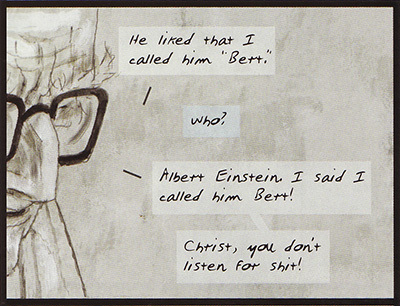
Particularly with respect to lowercase Ts and Rs. Here’s the first panel I noticed the problem:

Genius by Steven T. Seagle and Teddy Kristiansen

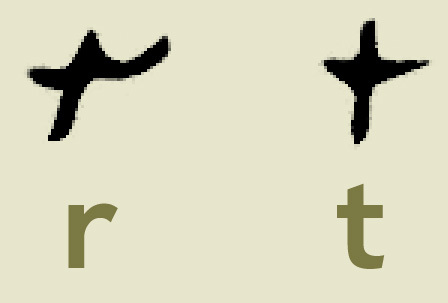
The Rs and Ts are so similar that I thought Ted’s father-in-law was calling Albert Einstein Bett and referring to his real name as Albett. The guy’s suffering a bit of dementia, so it’s not impossible. But he’s not calling Einstein “Bett.” It’s only the font that makes it look like that. Here’s an up-close comparison of the two letters:

Genius by Steven T. Seagle and Teddy Kristiansen

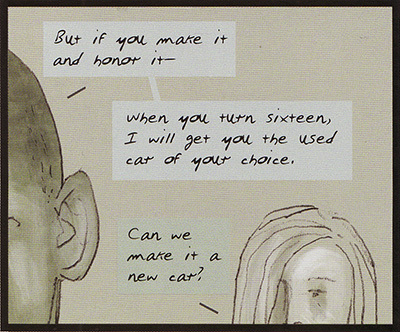
They’re different, but not remarkably so. My wife stumbled on the lack of distinction earlier than me in this panel where Ted makes a deal with his son. She was baffled at why Ted would offer his son a used cat.

Genius by Steven T. Seagle and Teddy Kristiansen
[The idea of Ted offering his son a used cat
is actually way funnier than his actual offer.]

Again, it’s not a big deal, but I’m disappointed that the issue exists at all.
_______

[Review courtesy of Good Ok Bad.]
_______

Footnotes
1) Cliched because what moderator on earth would avoid such an obvious line of group inquiry. Guise because what impossibly slim percentage of book club members discussing Genius are actually going to themselves be geniuses and therefore be able to calculate the complications of Ted’s position?

2) One of the greatest praises of Ottaviani’s Feynman is that he renders Richard Feynman’s legitimate genius in a readable, easy-going way (thanks in part to Feynman’s own work in rendering himself approachable). This becomes the more evident when Ottaviani unleashes an unexpurgated Feynman on the reader in the form of for-reals science in a concluding lecture, wherein Feynman endeavors to explain QED to an audience (and the reader). It’s mostly impenetrable to the average reader, but because it’s a short moment, it drives home Feynman’s intellect and imagination in a way that gimmicks could never do.

3) I do not invoke Manliness because I carry any special affection for the concept but only because Ted’s father-in-law values manliness and balls and real men et cetera.
Profile Image for Jonathan Maas.
Author 31 books369 followers
February 11, 2020
Vintage Steven T. Seagle - for better or for worse.

For better - great, unique tale that keeps you turning the page.

For worse - and I say this with a grain of salt because it is his style - but it has that Seagle impact that is not always fun.

The characters are subtly and realistically alienated from one another.

The main character has genius levels of talent yet finds a way to be not quite happy and underrealized.

And you believe it because Seagle writes it so well, and Teddy Kristiansen draws so well.

Incredible tale, I highly recommend it, but I am going to take a little break before I read another Seagle tale!
Profile Image for Tony Laplume.
Author 57 books41 followers
April 14, 2018
An interesting glimpse at discovering what’s really important in life, from the writer and artist of the innovative Superman graphic novel it’s a bird...

Genius is the story of a man who is falling through the cracks of his own life. He’s struggling to relate to his kids, can barely remember what his wife tells him, and at work he’s about to be fired because he’s run out of ideas. Basically he’s outliving his potential. Potential is perhaps one of the most damning things someone can possess. Either it’s something you’ll be able to coast on the rest of your life, or it hangs around your neck like an albatross.

And being labeled a genius? Labels are a funny thing. Everyone ends up with one eventually. If you’re really lucky, you’ll end up with one other people find useful, whether it’s accurate or not. Some are easier to come by. If you’re so smart at school that you’re repeatedly advanced in classes, people will notice, and you’ll be drafted for smart people work.

Which, at least according to Genius, can end up becoming a curse. If you stop thinking big, you’ll become expendable, forget about potential. Sometimes results are necessary.

But what are results? That’s the real topic of the graphic novel. Ted Halker discovers that results are probably different than he’d been expecting, all his life. He makes a deal with his son about sex. He finds out his wife is dying. And his father-in-law knew Einstein.

And he has a secret, one that would Change Everything. But what can Ted do with it, once he works it out of the old man?

Well, he ends up losing his job. He keeps the secret to himself. He ends up taking a job as a high school physics teacher. “But wouldn’t that be a waste of your talents?”

Here’s the thing. Aren’t talents wasted all the time? Aren’t they overlooked? Aren’t they ignored? Isn’t it easier to pretend they don’t exist? Ted himself embodies this. He loses his “genius job” because he’s no longer capable of proving it. Because potential eventually needs proof. Even Einstein needed a Year of Miracles.

But is Genius itself a work of genius? I wish it were. I wish it was bold instead of tentative. What it delivers is a vague sense that “when one door closes another one opens.” In other words, it’s a literary platitude, and not really insightful about it. It raises a fascinating subject (a lost Einstein theory), but then tries to pawn it off as something “too big to be revealed.” Is really just an excuse to say life is more ambiguous than we sometimes like to think?

It just feels like more of a sketch than a story. As a story it might have been something much more. As a sketch it’s thought-provoking, but nothing more. Ted’s results are left ambiguous, too. That’s about where it becomes a sketch rather than a story. A sketch can be considered artful, and in the end, that’s what this is, and the best way to recommend it. But great art is more than artful.
Profile Image for Jamais.
Author 15 books3 followers
June 12, 2013
Einstein has been doing a lot of guest-starring lately. Ted Carmichael is a certified //Genius// on the cutting block. He hasn’t published in a while in the publish-or-die world of science, he is unsure of his place in the family, and his son is having the customary problems at school. Worse, he finds that his amnesiac father hides a secret from Einstein himself. This is causing Ted to suffer migraines, forcing him to find a solution to his life crises or the pressure may literally kill him.

This was an unusual book. Te story is low-key, with the emphasis on Ted’s life rather than some major plot, and the solution he finds to his problem is nicely simple compared to so many other books. The art is absolutely incredible, ranging from utterly simple to gorgeous. Although the story itself has some minor bugs, and it is strange to see Ted act out of character too many times to allow for due to his migraines, it marches on. Nonetheless, this is a good solid story without any superheroes and the imaginary sequences work , especially the conversation with Einstein. This was a fun read, and one you need near.

As originally written by Jamais Jochim for the http://sanfranciscobookreview.com/.
Profile Image for Elia.
1,239 reviews25 followers
December 26, 2012
Being a genius is no guarantee that life will be good. In fact, Ted Halket is a certified genius - a physicist, a child prodigy, and his life is completely falling apart.
He is in danger of losing everything he has in the world and the key to his future might just be a secret that the great Albert Einstein may or or may not have once told his father in law - a man slipping slowly in and out of reality while in the advanced stages of senile dementia. So what is a genius to do?
That's the story told in Genius - a story told in flash backs, dreams and interactions between characters and illustrated in a insubstantial, ephemeral, runny watercolor sort of a way that literally blurs the lines between reality and fantasy.
It's not a bad story. It's not a great story either. There's some humor and some genuinely touching moments, but I personally hated the art work, which in a graphic novel becomes very distracting to me. It's not bad, but it's also not a work of genius.
Profile Image for Kirsten.
2,137 reviews118 followers
November 12, 2013
Ted Marx is, or was, a legitimate genius. He skipped two grades, he became a physicist, and he wrote a groundbreaking paper in his 20s, establishing himself as a wunderkind in his field. Problem is, Ted hasn't had a good idea pan out in more than ten years, and his job is on the line. His wife's having these headaches. He doesn't quite get his kids, at all. And he's not sure who he is anymore. Then his father-in-law reveals that he once was Einstein's bodyguard, and Einstein told him something he was to never reveal to anyone. Ted can't help be see this as a potential lifeline. but will his father-in-law reveal the secret? And what will Ted do with that knowledge?

I really loved the style of the art, and I also just loved the interactions between Ted and his family. He's a good guy, but he's so distracted, and this is depicted in really wonderful ways, both in the art and in the rhythm and pacing of the dialog. I thought the ending was just a little pat, but overall this was great.
Profile Image for Elizabeth A.
2,172 reviews119 followers
July 3, 2014
This is a graphic novel about Ted. Ted is a physicist who was labeled a genius as a kid (he skipped two grades), but he is not living up to his potential. He stumbles upon the fact that his father-in-law, Francis, knew Einstein, and that Einstein entrusted Francis with a secret idea, one that would blow our minds and change physics as we know it. Can Ted pry this secret out of his father-in-law?

It must be hard to labor under the assumption one is a genius. I wouldn't know, but it must be tough to have Einstein as the bar set for you. I liked the sketchy monochromatic art, but found myself not caring about Ted at all. I did however love the crotchety old father-in-law.
Profile Image for Krishna Naidoo.
59 reviews2 followers
August 29, 2013
This was an astonishingly quick read. I think that's a testament to how engaging it was; I was able to finish this in one sitting in less than an hour. The story is about a genius theoretical physicist who's struggling to come up with any new ground breaking theories which he's in desperate need of to keep his job. Ultimately he's confronted with an idea Einstein never told anyone. An idea that could save his career and at the same time completely change the face of physics. There are other complications which I don't want to give away.

It's definitely worth a read.
Profile Image for Jen.
389 reviews8 followers
February 15, 2014
I'm not sure how I feel about this book, was going to give it a 2 but I guess it actually deserves a 3. I like a good graphic novel now and then. Some poignant lines and some really representative artwork. But I just felt meh when I finished. I still think it is worth the short time it takes to read.
Profile Image for George Ilsley.
Author 12 books326 followers
October 28, 2019
I liked the story here, and the art, but am deducting stars because of a muddy presentation and the illegible font. Who would choose a font where the r and the t are almost identical? You end up with this mess — a boy played with a ++uck. Einstein’s nickname was Be++. Many o+he+ le++e+s had more verticality that the “t”.
What a shame. The presentation handicapped the material.
Profile Image for Stacey.
700 reviews
December 9, 2012
did not love the drawing style. I also expected more einstein. just felt unpleasant while reading it.
Profile Image for Rita Shaffer.
455 reviews12 followers
September 28, 2017
I guess this is a 2.5 ... interesting idea, but I felt like things were lacking.
Profile Image for Jason Brown (Toastx2).
357 reviews19 followers
November 30, 2021
You have to see the big picture to build a sand castle... But you have to appreciate the small picture to understand the sand.'

Genius is a graphic novel masterwork when the proper lenses are worn. I read it years ago and again last week. Both times, my heart hurt afterward, but the first time, my head space was not the same. It was a 'good not great' offering which I enjoyed but had no need to discuss. My life was less complicated and I was closer to my Big idea years.

Now I have children and global fears that live in the spaces of my heart where I once held invincibility and cast iron resolve. I understand the narrative of Genius so much better than I really want to.

I never wrote a review before because I was only seeing the sand castle, not the components that allow the castle to exist.. Hats off to Steven Seagle and Teddy Kristiansen for this amazing graphic novel.

Details matter, so here are a few.

Ted was always 'Smart'. The terms brilliant and genius were tossed around and his parents skipped him grades to ensure he would not get bored. When school was over and he was adequately debased by his older peers, his genius presented itself as unique ideas and perspectives. He landed in a think tank to take on concepts which would advance humanity through the evolution and revolution of our culture states.

Quantum Physics... Big ideas, Big sand castles, Big impact.

As Ted watches his career falter, he watches his worth be replaced by younger fresher minds. He learns something which will change his world and provide laser focus on the small picture, the sand itself.

His ailing father in law tells him he knows a secret. Francis, was a body guard for Albert Einstein, and over the years they would chat to pass the time. Albert shared with hime a secret that he could no longer bottle up, sharing it instead with a man who could never understand it and would never disclose it.

Over the years, Ted himself has evolved. He evolved from single to married, childless to fatherhood. As he ages and his life becomes more complex, the creative faucet turns off and Ted's Big ideas become fragile. They crumble and fall apart, or never arrive at all.

Perhaps this secret could change everything.

--

Disclosure: This Graphic Novel was provided to me by the publisher for review purposes. Recieved in 2013 but didn't write a review till 2017.. Sorry about that, but resonance matters and no resonance existed. Had it continued to 'not click', the missing review would continue to exist rather than the non missing review which replaced the nothingness. So kudos, this review is unofficially metaphysical.
Profile Image for Becky.
843 reviews16 followers
October 16, 2013
This book is like that facebook friend that posts statuses saying things like, "I can't take life anymore. I don't want to talk about it."

Ted is a "genius," proof of which is given by the fact that he skipped two grades, never had a wet dream, and wrote a paper in graduate school. He's so different! Anyway, now Ted is an adult with a wife and two kids and he hasn't achieved anything at work. His dementia-addled father-in-law lives with the family and drops a comment about a secret Einstein told him when he was his bodyguard just as Ted's wife's doctor finds a mass in her brain and Ted is coming up to a not-good performance review. Ted must know Einstein's secret in order to save his job! After bugging Dad for a while, he gets it, this great secret that will change everything. Dare Ted take credit for it, and release it to the world? That question takes up like, eight pages of images that look like overexposed film, and then he decides nah, nevermind, he'll just teach. The end.

I didn't buy it. I didn't buy that Ted was such a genius, that Einstein had a secret, that Ted wouldn't have told everyone the secret if he actually knew it. And I especially don't buy it because the book doesn't even hint at what will be changed or influenced or whatever by said secret. I realize that the problem with writing a book like this is that, of course, the author is not going to have some huge physics knowledge that will change the world, much like a movie about a fictional best song ever written would be just really hard to pull off. But come on. Can't you even speculate what the consequences would be? Overexposed film? This book can't really be about a moral dilemma, because I don't believe there was one. If you had a secret that could ___, would you tell it? Come on guy, fill in the blank. The blurb for the books tells more than it does. Reach farther.

I also didn't care for much of the illustrating. None of the characters had eyes. They were closed eyes, or dots, or shadowy places, like they were all dead. And, ooooh, maybe they are.
This entire review has been hidden because of spoilers.
Profile Image for Matt Graupman.
1,098 reviews20 followers
November 30, 2017
Greatness is subjective and frustratingly ephemeral. That may not be a new concept but for Ted, the genius-level physicist in Steven T. Seagle’ and Teddy Kristiansen’s (appropriately-titled) graphic novel “Genius,” it’s still a hard-earned lesson. Raised to believe that he can make an impact on science equal to that of his idol, Albert Einstein, he finds himself lacking inspiration, plagued by self-doubt, and up against a deadline that will determine the future of his career. When a convenient solution to his predicament arises, he’s forced to ask himself: is it right to compromise one’s ethics in the pursuit of greatness, or is it more noble to accept one’s limitations? In much the same way, “Genius” reaches for greatness and falls a little short.

Kristiansen’s artwork in “Genius” is the element that gets closest to transcendence; it’s lush and gloomy and ghostly (honestly, it was why I bought the book from the used bookstore in the first place). Ted’s ennui is palpable in every muddy, monochromatic panel. Unfortunately, the lettering isn’t as well done, alternating between clunky typewritten narration and sloppy, tough-to-decipher handwritten dialogue. Seagle’s writing is a little scattershot; I thought his more philosophical sections were very lovely but his plotting wasn’t as confident (and the character of Ted’s son felt really out-of-place and tonally jarring). Much like Ted, Seagle and Kristiansen obviously have talent but they’re unable to put it together in a way that really sings, so to speak.

“Genius” is very good, not terrible or great, but very good. There’s nothing wrong with that. Not every graphic novel rises to the level of a Nate Powell or Adrian Tomine or Dan Clowes book, nor does it have to. Measuring yourself against others is the easiest way to devalue your work (I wish I could remember that more often) and “Genius” reminds us that the only one that can truly hold you back is yourself.
Profile Image for Cindy Hudson.
Author 16 books26 followers
September 12, 2013
At an early age Ted was identified as a genius, which got him moved ahead at school and an early job at a think tank where lots of super-smart people like him were working. But while he’s always been a standout intellectually, he’s also always felt socially awkward.

Years into his career he finds himself pressured to come up with profound ideas that will get published and garner recognition, while at the same time he struggles to connect with his teen-aged son. He feels that both his job and his family are slipping away and he’s not sure how to make a difference with either.

Ted’s drive to seek answers pushes him into conflict with his ailing father-in-law, a man who has a secret that may just help Ted find what he is looking for. But is he willing to betray a confidence to achieve what he wants?

Genius, a graphic novel by Steven T. Seagle and Teddy Kristiansen, looks at the social isolation and pressure that can be put on someone who excels at what he does, whether that is solving complex physics issues or performing in the arts or any other occupation where the emphasis is on output.

Ted is pulled between his job and his family. He needs both the income and the health insurance from his work, as his wife is being treated for a serious illness. When he discovers his father-in-law’s secret, he can think of nothing but exploiting the information, knowing it would keep things stable at work for a while. Yet betraying the confidence would go against what he believes about himself. In the end, Ted’s genius helps him find a solution that works for everyone.

The publisher provided me with a copy of this book in exchange for my honest review.
Profile Image for Julie N.
807 reviews26 followers
July 27, 2013
I was so excited about the chance to review this book (thank you, NetGalley). It's a graphic novel that follows a stalled physicist who is battling feelings of inadequacy and mental stagnation, along with feelings of incompetence at home in his relationships with his teenage son and his father-in-law. His contentious relationship with his father-in-law takes a turn when his father-in-law reveals that he knew Einstein and was trusted with one of Einstein's last secrets.

Writing/Art
With this being a graphic novel, I think the art was equally as important as the writing. The two work well together. I thought the family dynamics were especially well captured both in writing and in images. I wasn't necessarily blown away by either, unfortunately. Nothing particularly wrong with either, but nothing particularly unique or impressive.

Entertainment Value
I feel like the real appeal of the book lies in the relationships, particularly those between Ted, our main character, and his son and between Ted and his father-in-law. I also found Ted's job issues, his feelings of stagnation and creative block, to be especially relatable.

Overall
I highly recommend this as a cross-over book. I think it will appeal to both adults and teens and has points that will appeal and relate to a wide range of ages. It's an easy read, but has some deep thoughts about science, the creative process, and family.

Thanks again to NetGalley for providing me with a digital copy to review.
Profile Image for Davenport Public Library Iowa.
674 reviews88 followers
October 29, 2013
Steven T. Seagle and Teddy Kristiansen’s Genius tells the story of Ted Max, a genius weighed down by expectations and overwhelmed in his interpersonal relationships. Once a promising quantum physicist, his life seems to have come to a halt. He cannot think of any new ideas at work and is facing losing his job at a think tank. His wife has been diagnosed with a life-threatening illness and he doesn’t know how to interact with his budding genius daughter and future frat boy son. And to make matters worse, his crotchety father-in-law won’t tell Ted the secret that Albert Einstein entrusted him with when he was “Bert’s” bodyguard. With no relief in sight, Ted begins to see himself unravel.

There has been a biographical graphic novel trend in publishing the last few years, but despite Albert Einstein’s strong presence in this graphic novel, this is not a biography. Seagle uses Einstein as a memory or an absence in Ted’s life. Kristiansen’s absorbing, lush pastel watercolor illustrations pair well with Seagle’s sparse and straightforward text, and make Einstein’s presence known throughout the novel. There is a sense when you read the book that you’re able to see some of the beautiful inner thoughts of a quantum physicist who has a difficult time voicing his feelings. I was much more touched by this book than I expected, and really felt Ted’s frustration with trying to live in the present when the future beckons and the past haunts. Ted many not be an everyman, but I think that most of us struggle with similar worries and heartbreaks.
Displaying 1 - 30 of 123 reviews