

What do you think?
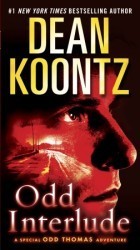
Odd Thomas #4.5
Odd Interlude
There's room at the inn. But you might not get out.
Nestled on a lonely stretch along the Pacific coast, quaint roadside outpost Harmony Corner offers everything a weary traveler needs—a cozy diner, a handy service station, a cluster of motel rooms…and the Harmony family homestead presiding over it all. But when Odd Thomas and company stop to spend the night, they discover that there’s more to this secluded haven than meets the eye—and that between life and death, there is something more frightening than either.
Nestled on a lonely stretch along the Pacific coast, quaint roadside outpost Harmony Corner offers everything a weary traveler needs—a cozy diner, a handy service station, a cluster of motel rooms…and the Harmony family homestead presiding over it all. But when Odd Thomas and company stop to spend the night, they discover that there’s more to this secluded haven than meets the eye—and that between life and death, there is something more frightening than either.
253 pages, Mass Market Paperback
First published December 1, 2012
About the author
Dean Koontz
902 books40.8k followersAcknowledged as "America's most popular suspense novelist" (Rolling Stone) and as one of today's most celebrated and successful writers, Dean Ray Koontz has earned the devotion of millions of readers around the world and the praise of critics everywhere for tales of character, mystery, and adventure that strike to the core of what it means to be human.
Dean, the author of many #1 New York Times bestsellers, lives in Southern California with his wife, Gerda, their golden retriever, Elsa, and the enduring spirit of their goldens, Trixie and Anna.
Facebook: Facebook.com/DeanKoontzOfficial
Twitter: @DeanKoontz
Website: DeanKoontz.com
Dean, the author of many #1 New York Times bestsellers, lives in Southern California with his wife, Gerda, their golden retriever, Elsa, and the enduring spirit of their goldens, Trixie and Anna.
Facebook: Facebook.com/DeanKoontzOfficial
Twitter: @DeanKoontz
Website: DeanKoontz.com
Ratings & Reviews
Friends & Following
Create a free account to discover what your friends think of this book!
Community Reviews
Displaying 1 - 30 of 711 reviews

January 15, 2019
Basically, I could start every review of an Odd Thomas book with the following sentence:
It started off a little slow and strange, so it took a while to get into . . .
After that, there is no telling which way it will go. The last two entries were okay, but I was wondering if the series had jumped the shark for me.
Enter the Interlude!
A story in three parts - not really sure why it was three shorter segments instead of one regular entry in the series. This volume compiled the three interludes and it sure felt like one regular novel. Perhaps it was just so he could release this one in a serial format? I will probably do a little research into this.
But, format aside - this story was fantastic! It recaptured some of the early Odd magic - strong on interesting characters and bizarre happenings. Also, if you like crazy sci-fi horror monsters and terrifyingly suspenseful thrills, it is all here.
I suppose you could read this book without reading the rest of the series, but I really wouldn't recommend it. I think you would just be missing too much of the back story to get into it. But, I could be wrong!
It started off a little slow and strange, so it took a while to get into . . .
After that, there is no telling which way it will go. The last two entries were okay, but I was wondering if the series had jumped the shark for me.
Enter the Interlude!
A story in three parts - not really sure why it was three shorter segments instead of one regular entry in the series. This volume compiled the three interludes and it sure felt like one regular novel. Perhaps it was just so he could release this one in a serial format? I will probably do a little research into this.
But, format aside - this story was fantastic! It recaptured some of the early Odd magic - strong on interesting characters and bizarre happenings. Also, if you like crazy sci-fi horror monsters and terrifyingly suspenseful thrills, it is all here.
I suppose you could read this book without reading the rest of the series, but I really wouldn't recommend it. I think you would just be missing too much of the back story to get into it. But, I could be wrong!

June 14, 2019
Ahhh Odd, I do love this character, just a nice regularly fry cook with a sixth sense. I'm glad I've now got myself back into this series.
This is a YA series, and everything centers around Odd Thomas and his adventures. This is the fifth book in the eight book series and I was pleased that while book four felt like it had hit a slump, this book seems to be working it's way out of it.
I'm looking forward to reading the last three books and seeing what else our Odd gets up too.
Solid three star read, easy, non taxing poolside reading.
This is a YA series, and everything centers around Odd Thomas and his adventures. This is the fifth book in the eight book series and I was pleased that while book four felt like it had hit a slump, this book seems to be working it's way out of it.
I'm looking forward to reading the last three books and seeing what else our Odd gets up too.
Solid three star read, easy, non taxing poolside reading.

November 16, 2013
Why have I not read Dean Koontz until now? Cowardice. I incorrectly assumed his works would be disgusting and night-mare provoking. One of those that saturate the bookstores with their evil masochism and leave you so viscerally shaken up that you hate humanity and wish you lived on a different planet. I took a chance on Odd Thomas because I knew the name. I found that Koontz’s writing is suspenseful, sarcastic, refreshing and flawless.
Populating his work with aliens, ghosts, artificial intelligence, mind-control and regular science fiction things, Koontz in my mind distinguishes himself from other writers in this genre by mixing eerie material with original comparisons and humor. Look at this one for example, “The interior of the SUV reeks of aftershave so flowery that you might think nobody would use it except bearded ladies after they retire from carnival sideshows and are then able to shave without jeopardizing their livelihoods.”
These witty descriptions are so prolific, tangential and off-beat that you must chuckle, and chuckling reduces the fear factor. Yes, there is violence, but the violence is tempered by a lot of frozen turkeys. Odd Thomas is caring, cowardly in his bravery, and generally unhappy about his forced calling as supernatural investigator. A stand-out fry cook that everyone should meet by an expertly imaginative author.
Populating his work with aliens, ghosts, artificial intelligence, mind-control and regular science fiction things, Koontz in my mind distinguishes himself from other writers in this genre by mixing eerie material with original comparisons and humor. Look at this one for example, “The interior of the SUV reeks of aftershave so flowery that you might think nobody would use it except bearded ladies after they retire from carnival sideshows and are then able to shave without jeopardizing their livelihoods.”
These witty descriptions are so prolific, tangential and off-beat that you must chuckle, and chuckling reduces the fear factor. Yes, there is violence, but the violence is tempered by a lot of frozen turkeys. Odd Thomas is caring, cowardly in his bravery, and generally unhappy about his forced calling as supernatural investigator. A stand-out fry cook that everyone should meet by an expertly imaginative author.

March 10, 2013
Welcome to Harmony Corner - stop in and stay a while!
I love Odd Interlude!!!! Featuring Demon Seed humor, references to a "puppet master", Hal 9000, Twenty Thousand Leagues Under the Sea and The Lottery by Shirley Jackson. Fans are treated to a Fort Wyvern connection - the setting for Koontz's Moonlight Bay AKA Chris Snow Series.
How interesting that this little volume ends up being one of the very best in the Odd Thomas series. Originally released as three e-book novellas, the story was used to promote Odd Apocalypse and serves as a bridge between Odd Hours and Odd Apocalypse. Odd Interlude picks up immediately where Odd Hours ended and alludes to events that will occur in Odd Apocalypse.
I am able to relate to the character named Jolie Harmony because I am also a wise ass. I think Interlude really has become my #1 favorite of the Odd Thomas Series. For a small volume, it delivers so much fun! Being such a thin book , I can typically enjoy at least one Odd Interlude re-reading each year.
Favorite Passages:
I wasn't born to kill. Like all of us, I was born for joy. This broken world, however, breaks most of us, grinding relentlessly on its metaled tracks.
________
Most people unconsciously blind themselves to the true nature of existence, because they fear knowing that this world is a place of mystery and meaning. It's immeasurably easier to live in a world that's all surfaces, that means nothing and demands nothing of you.
________
Lifting its head, the triumphant cat stares at me, blood and saliva drizzling from its mouth, and says, "Sleep . . . sleep."
________
When he looks up from his work with the push broom, it's a Phantom of the Opera moment. A grisly scar extends from his left ear, across his upper lip, through his lower lip, to the right side of his chin. Whatever the cause of the wound, it appears as if it might have been sewn up not by a doctor but instead by a fisherman using a hook and a length of leader wire.
With no apparent self-consciousness about the appearance, he says, "Hello there, son," and favors me with a grin that would make Dracula back off. "You're up even before Wally and Wanda have thought about goin' to bed."
"Wally and Wanda?"
"Oh, sorry. Our possums. Some say them two is just big ugly red-eyed rats. But a marsupial isn't no rat. And ugly is like they say about beauty - it's in the eye of the beholder. How you feel about possums?"
"Live and let live."
"I make sure Wally and Wanda get the throw-away food from the diner each and ever night. It makes 'em fat. But their life is hard, what with mountain lions and bobcats and packs of coyotes with a taste for possum. Don't you think possums have a hard life?"
"Well, sire, at least Wally has Wanda and she has Wally."
Abruptly his blue eyes glimmer with unshed tears and his scarred lips tremble, as if he is nearly undone by the thought of possum love.
He appears to be about forty, though his hair is iron gray. In spite of the horrific scar, he has an avuncular quality suggesting that he's as good with children as he is kind to animals.
"You've gone right to the very heart of it. Wally has Wanda, and Donny has Denise, which makes anythin' tolerable."
Stitched on the breast pocket of his uniform shirt is the name DONNY.
________
"I think television is a pathway."
________
"There's no real harmony in Harmony Corner."
She says, "But there's a corner in it. Make sure you're not trapped there, young man."
________
I am halted by a mental image of a blond girl: eyes glittering feverishly, lips peeled in a snarl, perfect matched-pearl teeth, between several of which are stuck shreds of bloody meat, the flesh of something she has eaten raw. She's got a huge two-tined fork in one hand and a wicked carving knife in the other, eager to slice my abdomen as if it were a turkey.
________
She abides in silence.
________
My past and my future constrain me. By past I mean my losses, and by future I mean the hope of regaining what has been lost.
________
________
My only armor is my belief that life has meaning and that, when my last sun has set and my last moon has risen, when the dawn comes that marks the moment when I am born with the dead, there will be mercy.
________
"Listen to me, butthead, I don't lie. I'm a mess, if you have to know, I'm a train wreck, but I don't lie, so you can just shut-up, you can just stuff it where the sun don't shine."
I'm shaking. Head to foot. I can't help shaking. It's not fear. It's not rage, either, or not only rage. It's also frustration and a sense of injustice and violation. I'm sick of it. And if he says the wrong thing, I'll start smashing everything in this room that I can smash until he finally has to come out here and show himself so I can try to smash him, too, the sonofabitch.
Sometimes, when I feel this way, night or day, I go down to the beach and take off most of my clothes and leave them where they can be found, above the tideline. I swim out into the waves where the sun is broken into a billion bright pieces that look sharp enough to cut me.
________
"The shortcoming in your social skills that I have identified is this: Jolie Ann Harmony, you are sarcastic . You are a wise-ass child."
"That's not a shortcoming. That's a defense mechanism."
________
Both the tractor and the tree have caught fire, after all, and flames seethe up through the branches, which across decades have been sculpted by the wind into elegant southeast-leaning forms that are reminiscent of lines of Japanese calligraphy. Whatever the wind has written over time, fire rapidly erases and disperses as oily black smoke.
________
Because I rarely forget anything, my brain is so packed with useless information that it constantly makes connections between bits of data that are at best tenuously linked.
________
Just then, Jolie Harmony speaks to me: "Are you there, Harry Potter? This is Jolie. Are you there?"
________
I decide to accept everything that Jolie tells me, because the whole story sounds too crazy to be anything but the truth.
My unusual life has taught me that the world is profoundly more complex and far stranger than most people are able - or willing - to recognize. What most people call truth is merely the surface, and under it lies a great depth of truth that they do not perceive. A large part of my time is spent coping with the spirits of the lingering dead, poltergeists, eerie creatures that I call bodachs, prophetic dreams, and all kinds of one-off moments of supernatural weirdness, as well as with horrendous human miscreants of every imaginable variety; consequently, it strikes me as refreshing, almost prosaic, to be caught up in a supernatural-free incident
_______
Piles of bones litter the filthy floor. Ham bones, beef bones, chicken bone, and others. Some have been broken as if to facilitate access to the marrow.
_______
The cooktop is encrusted with charred food and filth, less like a stove than like the unholy altar of some primitive temple with a long, cruel history of grisly sacrifices.
_______
_______
In this house of secrets, I feel displaced in time and space,
________
Even now, as I ascend from the first floor to the second, I feel as if I am descending, as if there is no up in this house, no forward or back, no sideways, only down.
________
He opens his wide greedy mouth of ragged teeth in what appears to be a silent scream but is instead a call. The call is psychic, a command - Feed me - and I feel it pulling at me as a riptide pulls a swimmer under, into drowning depths.
________
She is a girl who feels things strongly, and though cynics might mock her for that, I never will, as it is perhaps the best of graces: to feel deeply, to care profoundly.
________
She tells Jolie that I am one of those wanderers of legend, who goes where he feels he must and, in the going, finds those who need him, and in finding those who needs him, fulfills his destiny. This sounds more grand to me than the truth of my life, but this touch of myth enchants the girl and mellows her sadness with mystery.
________
But the universe in its immensity is nevertheless of a piece, and what applies to one end of it applies at the other. No doubt misery, like happiness and hope, is found throughout the stars.
________
I love Odd Interlude!!!! Featuring Demon Seed humor, references to a "puppet master", Hal 9000, Twenty Thousand Leagues Under the Sea and The Lottery by Shirley Jackson. Fans are treated to a Fort Wyvern connection - the setting for Koontz's Moonlight Bay AKA Chris Snow Series.
How interesting that this little volume ends up being one of the very best in the Odd Thomas series. Originally released as three e-book novellas, the story was used to promote Odd Apocalypse and serves as a bridge between Odd Hours and Odd Apocalypse. Odd Interlude picks up immediately where Odd Hours ended and alludes to events that will occur in Odd Apocalypse.
I am able to relate to the character named Jolie Harmony because I am also a wise ass. I think Interlude really has become my #1 favorite of the Odd Thomas Series. For a small volume, it delivers so much fun! Being such a thin book , I can typically enjoy at least one Odd Interlude re-reading each year.
Favorite Passages:
I wasn't born to kill. Like all of us, I was born for joy. This broken world, however, breaks most of us, grinding relentlessly on its metaled tracks.
________
Most people unconsciously blind themselves to the true nature of existence, because they fear knowing that this world is a place of mystery and meaning. It's immeasurably easier to live in a world that's all surfaces, that means nothing and demands nothing of you.
________
Lifting its head, the triumphant cat stares at me, blood and saliva drizzling from its mouth, and says, "Sleep . . . sleep."
________
When he looks up from his work with the push broom, it's a Phantom of the Opera moment. A grisly scar extends from his left ear, across his upper lip, through his lower lip, to the right side of his chin. Whatever the cause of the wound, it appears as if it might have been sewn up not by a doctor but instead by a fisherman using a hook and a length of leader wire.
With no apparent self-consciousness about the appearance, he says, "Hello there, son," and favors me with a grin that would make Dracula back off. "You're up even before Wally and Wanda have thought about goin' to bed."
"Wally and Wanda?"
"Oh, sorry. Our possums. Some say them two is just big ugly red-eyed rats. But a marsupial isn't no rat. And ugly is like they say about beauty - it's in the eye of the beholder. How you feel about possums?"
"Live and let live."
"I make sure Wally and Wanda get the throw-away food from the diner each and ever night. It makes 'em fat. But their life is hard, what with mountain lions and bobcats and packs of coyotes with a taste for possum. Don't you think possums have a hard life?"
"Well, sire, at least Wally has Wanda and she has Wally."
Abruptly his blue eyes glimmer with unshed tears and his scarred lips tremble, as if he is nearly undone by the thought of possum love.
He appears to be about forty, though his hair is iron gray. In spite of the horrific scar, he has an avuncular quality suggesting that he's as good with children as he is kind to animals.
"You've gone right to the very heart of it. Wally has Wanda, and Donny has Denise, which makes anythin' tolerable."
Stitched on the breast pocket of his uniform shirt is the name DONNY.
________
"I think television is a pathway."
________
"There's no real harmony in Harmony Corner."
She says, "But there's a corner in it. Make sure you're not trapped there, young man."
________
I am halted by a mental image of a blond girl: eyes glittering feverishly, lips peeled in a snarl, perfect matched-pearl teeth, between several of which are stuck shreds of bloody meat, the flesh of something she has eaten raw. She's got a huge two-tined fork in one hand and a wicked carving knife in the other, eager to slice my abdomen as if it were a turkey.
________
She abides in silence.
________
My past and my future constrain me. By past I mean my losses, and by future I mean the hope of regaining what has been lost.
________
________
My only armor is my belief that life has meaning and that, when my last sun has set and my last moon has risen, when the dawn comes that marks the moment when I am born with the dead, there will be mercy.
________
"Listen to me, butthead, I don't lie. I'm a mess, if you have to know, I'm a train wreck, but I don't lie, so you can just shut-up, you can just stuff it where the sun don't shine."
I'm shaking. Head to foot. I can't help shaking. It's not fear. It's not rage, either, or not only rage. It's also frustration and a sense of injustice and violation. I'm sick of it. And if he says the wrong thing, I'll start smashing everything in this room that I can smash until he finally has to come out here and show himself so I can try to smash him, too, the sonofabitch.
Sometimes, when I feel this way, night or day, I go down to the beach and take off most of my clothes and leave them where they can be found, above the tideline. I swim out into the waves where the sun is broken into a billion bright pieces that look sharp enough to cut me.
________
"The shortcoming in your social skills that I have identified is this: Jolie Ann Harmony, you are sarcastic . You are a wise-ass child."
"That's not a shortcoming. That's a defense mechanism."
________
Both the tractor and the tree have caught fire, after all, and flames seethe up through the branches, which across decades have been sculpted by the wind into elegant southeast-leaning forms that are reminiscent of lines of Japanese calligraphy. Whatever the wind has written over time, fire rapidly erases and disperses as oily black smoke.
________
Because I rarely forget anything, my brain is so packed with useless information that it constantly makes connections between bits of data that are at best tenuously linked.
________
Just then, Jolie Harmony speaks to me: "Are you there, Harry Potter? This is Jolie. Are you there?"
________
I decide to accept everything that Jolie tells me, because the whole story sounds too crazy to be anything but the truth.
My unusual life has taught me that the world is profoundly more complex and far stranger than most people are able - or willing - to recognize. What most people call truth is merely the surface, and under it lies a great depth of truth that they do not perceive. A large part of my time is spent coping with the spirits of the lingering dead, poltergeists, eerie creatures that I call bodachs, prophetic dreams, and all kinds of one-off moments of supernatural weirdness, as well as with horrendous human miscreants of every imaginable variety; consequently, it strikes me as refreshing, almost prosaic, to be caught up in a supernatural-free incident
_______
Piles of bones litter the filthy floor. Ham bones, beef bones, chicken bone, and others. Some have been broken as if to facilitate access to the marrow.
_______
The cooktop is encrusted with charred food and filth, less like a stove than like the unholy altar of some primitive temple with a long, cruel history of grisly sacrifices.
_______
_______
In this house of secrets, I feel displaced in time and space,
________
Even now, as I ascend from the first floor to the second, I feel as if I am descending, as if there is no up in this house, no forward or back, no sideways, only down.
________
He opens his wide greedy mouth of ragged teeth in what appears to be a silent scream but is instead a call. The call is psychic, a command - Feed me - and I feel it pulling at me as a riptide pulls a swimmer under, into drowning depths.
________
She is a girl who feels things strongly, and though cynics might mock her for that, I never will, as it is perhaps the best of graces: to feel deeply, to care profoundly.
________
She tells Jolie that I am one of those wanderers of legend, who goes where he feels he must and, in the going, finds those who need him, and in finding those who needs him, fulfills his destiny. This sounds more grand to me than the truth of my life, but this touch of myth enchants the girl and mellows her sadness with mystery.
________
But the universe in its immensity is nevertheless of a piece, and what applies to one end of it applies at the other. No doubt misery, like happiness and hope, is found throughout the stars.
________

February 28, 2017
I started reading Dean Koontz's Odd Thomas series in fall 2014, months before I began blogging in earnest. I read Odd Hours in November of that year — so it has been a while. I liked Odd Hours but didn't love it; I'd become burned out on the adventures of ole Oddie. His awkward self-deprecating humor, his dorky inner dialogue, his constant insistence that he's no hero, he's so humble, blah blah blah. It got old. Truthfully, I don't like Odd. I've never liked Odd. He's the outlet through which Dean Koontz expresses political and social views. It's annoying.
That said, I do like the adventures Odd finds himself on, and up to this point I've found this series to be . . . fairly enjoyable. I liked the first novel, hated Forever Odd, absolutely adored Brother Odd, and felt Odd Hours was average. 2/4, let's say. I am tired of this series hanging over my head like the sword of Damocles, so 2017 is the year I will finish Koontz's magnum opus.
I'd heard nothing but good things about Odd Interlude; by and large I agree with the general consensus. This is damn good stuff. Originally published as three e-novellas to promote Odd Apocalypse, I read the print copy (which houses all three novellas), so I find myself thinking of Odd's side journey as a novel unto itself.
This story is apparently not essential to Odd's main journey, but I wish it were. The writing is tight; it's lean and mean, and it features some of the finest characters I've come across in this series thus far. I loved Jolie, and I loved that Koontz gives the reader a break from Odd's constant (and occasionally tiring) inner dialogue by letting the reader into the spunky girl's head. She was a delight to read about. It makes me a little sad, knowing I probably won't see her again in this book's sequels.
Like any Koontz story, this one contains a certain amount of cheese — moments that will make the reader's eyes roll . . . or maybe that's just me? Those occasions are few and far between in Odd Interlude, but they are there (one example: Odd's lamenting that kids these days don't know who the dog Lassie is, and are only aware of Marley: what twenty-one year old guy thinks this way?) and I docked half a star for them. I took off another half star for the predictable ending. This is Koontz after all, and the good guy always wins. Some people dig that, but I prefer not knowing in which direction the story is going.
Overall, I was very impressed with Odd Interlude. A few moments scared me in a way I haven't been scared by Koontz since reading The Taking, or maybe Hideaway. I cannot wait to check out Odd Apocalypse.
That said, I do like the adventures Odd finds himself on, and up to this point I've found this series to be . . . fairly enjoyable. I liked the first novel, hated Forever Odd, absolutely adored Brother Odd, and felt Odd Hours was average. 2/4, let's say. I am tired of this series hanging over my head like the sword of Damocles, so 2017 is the year I will finish Koontz's magnum opus.
I'd heard nothing but good things about Odd Interlude; by and large I agree with the general consensus. This is damn good stuff. Originally published as three e-novellas to promote Odd Apocalypse, I read the print copy (which houses all three novellas), so I find myself thinking of Odd's side journey as a novel unto itself.
This story is apparently not essential to Odd's main journey, but I wish it were. The writing is tight; it's lean and mean, and it features some of the finest characters I've come across in this series thus far. I loved Jolie, and I loved that Koontz gives the reader a break from Odd's constant (and occasionally tiring) inner dialogue by letting the reader into the spunky girl's head. She was a delight to read about. It makes me a little sad, knowing I probably won't see her again in this book's sequels.
Like any Koontz story, this one contains a certain amount of cheese — moments that will make the reader's eyes roll . . . or maybe that's just me? Those occasions are few and far between in Odd Interlude, but they are there (one example: Odd's lamenting that kids these days don't know who the dog Lassie is, and are only aware of Marley: what twenty-one year old guy thinks this way?) and I docked half a star for them. I took off another half star for the predictable ending. This is Koontz after all, and the good guy always wins. Some people dig that, but I prefer not knowing in which direction the story is going.
Overall, I was very impressed with Odd Interlude. A few moments scared me in a way I haven't been scared by Koontz since reading The Taking, or maybe Hideaway. I cannot wait to check out Odd Apocalypse.
August 11, 2026
This one lost me too, but not the same way book four did. That one felt thin and rushed. This one felt like it was reaching in a few directions at once and I couldn't always tell which one it wanted to land on.
The extra supernatural stuff is genuinely fun. Koontz leans further into the weirder edges of what Odd's world can hold, and there's a real sense of the mythology expanding rather than repeating itself. That part worked for me.
Where it got shaky was the idea of more than one Odd in play. I get what it's reaching for, and there's something clever buried in there, but it also stretches the internal logic of the series in a way that felt more like a stunt than a natural next step. I'm still deciding how I feel about it, which is either a good sign or a bad one.
Rounding up to three stars because the atmosphere and the new mythology earned it, even if the execution wobbled. Truthfully sits closer to two and a half for me.
The extra supernatural stuff is genuinely fun. Koontz leans further into the weirder edges of what Odd's world can hold, and there's a real sense of the mythology expanding rather than repeating itself. That part worked for me.
Where it got shaky was the idea of more than one Odd in play. I get what it's reaching for, and there's something clever buried in there, but it also stretches the internal logic of the series in a way that felt more like a stunt than a natural next step. I'm still deciding how I feel about it, which is either a good sign or a bad one.
Rounding up to three stars because the atmosphere and the new mythology earned it, even if the execution wobbled. Truthfully sits closer to two and a half for me.
April 18, 2025
4,5
Nie czytać przed dylogią Moonlight Bay, bo akcja dzieje się bardzo blisko i można coś sobie zaspojlerować :)
Nie czytać przed dylogią Moonlight Bay, bo akcja dzieje się bardzo blisko i można coś sobie zaspojlerować :)

April 8, 2024
A slightly different Odd Thomas adventure. I liked it!

September 21, 2016
This was my favorite of the series so far. So many parts that made me laugh out loud and an interesting story, which went more into science fiction and fantasy than the previous books. 4.5 stars
May 3, 2013
Although I was not excited about a different point of view in the book, Which I personally deem it uncharacteristic of Odd Thomas novels, I understand why Mr. Koontz did this to keep the mystery and excitement of the story moving. As the last Odd Thomas book I read (Odd Apocalypse) I wasn't sure if I was going to like the story but as always by the end he had his genius grasp on me and my three star review transformed into four.
I feel that Odd Thomas is such a fantastic character that he writes the stories along with Dean Koontz and that it is almost impossible for it to go wrong.
I feel that Odd Thomas is such a fantastic character that he writes the stories along with Dean Koontz and that it is almost impossible for it to go wrong.

March 10, 2013
Dean Koontz used to be a buy on sight author for me. The last few stand alone novels were extremely bad. I was hoping the continuation of Odd Thomas would get back into Koontz. Unfortunately I stopped reading about halfway through. Koontz nowadays insists on writing stories that take place over a short amount of time boring the reader with every last minute detail of a scene and thought to fill the pages. The days of Lightning and Watchers are sadly over.

June 7, 2014
This book bills itself as "A Special Odd Thomas Adventure." Its main character describes it as a "detour from the main arc of my journey." In this list of the works of Dean Koontz, extremely prolific horror maven that he is, it is listed separately from the canonical series of (so far) seven Odd Thomas novels. And before being published in a single paperback volume, it was originally rolled out as a three-part series of novellas. Its publication date puts it between Odd Apocalypse and Deeply Odd. But both in canon order and on the author's website, it fits between Odd Hours and Odd Apocalypse. To make it simple for myself, I'm going to think of it as the fifth Odd Thomas novel, taking place within about 24 hours after the events of Odd Hours. Feel free to disagree.
This book is an exception to the rule as Odd Thomas adventures go, even apart from its origin as an e-book serial. Until now, Odd has used his paranormal abilities—seeing dead people, psychic magnetism, the occasional prophetic dream, etc.—mainly to stave off merely mortal monsters. His powers have helped him to stay alive while killing evil people before they can carry out their plans to cause death on an even more massive scale. He cut short an attempt to shoot up and bomb a shopping mall. He saved a hostage from a witchy woman and her wacko minions. He protected a schoolful of monks, nuns, and disabled children from a mad scientist's killer experiment. And he defused a conspiracy to nuke several American cities and use the chaos to take over the country. Though the mysterious power that keeps pulling him from one crisis to another has been picking up speed and magnitude like an avalanche—though Odd very reasonably suspects that he can't survive much more of this—he can at least take comfort in the fact that, apart from his psychic powers, he has only had to cope with normal human wickedness. More or less.
Well, there was that hint about reanimated corpses in Forever Odd. And those quantum bone beasties in Brother Odd did defy rational explanation. And he hasn't really had time to sort out that business about passing dreams to other people by touch, which started happening in Odd Hours. And there is definitely something off-bubble about his new companion, the mysterious Annamaria. But still, nothing on his resume so far would seem to qualify him to go up against extraterrestrials with mind-control powers, or a self-aware computer program that presides over a mothballed secret government project in a vacuum-sealed bunker strewn with desiccated corpses. Luckily, Odd's winning strategy has always been to roll with it.
Odd and Annamaria have just left Magic Beach, California, in a borrowed Mercedes, hoping to make it to Santa Barbara before anyone spots the hero who stopped World War III. Instead, just an hour or two down the Pacific Coast Highway, the pull of death leads them to stop at a wide spot on the road called Harmony Corners. Almost immediately, Odd picks up on something weird going on. "There's no real harmony in Harmony Corner," he says. Annamaria warns him, "But there's a corner in it. Make sure you're not trapped there, young man."
The people of Harmony Corner—really, just one big extended family—have been prisoners in their own home for the past five years. The presence that terrorizes them is a man, and then again he isn't. He can listen to their thoughts, sift through their memories, plant false memories in their place. He can take control of their bodies, jumping from one person to another. He can kill them with a thought, or force them to kill each other by direct mind-control; but mostly, he just terrorizes them into doing whatever he wants, by threatening to punish them (or to make them punish themselves) if they step out of line. No one can help these people. Police and rescue, if called for help, could be sent away with false memories. Until Odd and Annamaria came along, no one has ever been able to resist the bad guy's mind control. Anyone who even showed the slightest ability to do so has been killed. And one of those people—a twelve-year-old girl named Jolie Ann Harmony—will certainly be killed by the end of the day, simply for helping Odd Thomas.
So, as little as he likes killing, it's up to Odd to kill this guy. He's got to do it today. And while doing it, he's got to avoid members of the Harmony family, who will either kill him or be killed by him the moment the villain sees him through their eyes. Somehow, he has to get into the mansion, where he will face scenes of stomach-turning horror and freaky alien menace. And the only people who have his back are a wise-ass tomboy and an AI with an IQ just short of HAL 9000. You don't want these pod bay doors to open. Clever and resourceful though he always is, Odd won't get through this adventure without troubling his conscience. The things he has to do to save Jolie, himself, and Harmony Corner will seem extreme even for him.
Dean Koontz's career as an author of horror stories rivals that of Stephen King, both in longevity and in productivity. From 1968 till the present day, he has dreamed up many nightmares for readers to share. I don't think I would have the stomach to read most of them. But this particular series of horrors is moderated by the presence of a paladin-like character in Odd Thomas, who is gradually and reluctantly learning to accept his mission to terminate fiends with extreme prejudice. Like all the Odd stories until now, this one is decidedly odd—creepy, weird, violent, fast-paced, yet at the same time contemplative, touched by warm humanity and a reverence for sacred mystery. Odd, who in this outing for the first time shares narrating duties with another character, is not an egotistical tough-guy hero, but a soft-spoken, humble one who often reveals charming character details and lends the benefit of compassion and understanding even to the less sympathetic characters. In Odd Hours, for example, he holds the hand of one villain he has shot while she dies; another thanks him for not making fun of his bad teeth, shortly before Odd kills him. He's not just a holy killing machine, as his suffering conscience bears witness. But in his well-calibrated blend of strength and weakness, Odd is a beautiful being.
This book is an exception to the rule as Odd Thomas adventures go, even apart from its origin as an e-book serial. Until now, Odd has used his paranormal abilities—seeing dead people, psychic magnetism, the occasional prophetic dream, etc.—mainly to stave off merely mortal monsters. His powers have helped him to stay alive while killing evil people before they can carry out their plans to cause death on an even more massive scale. He cut short an attempt to shoot up and bomb a shopping mall. He saved a hostage from a witchy woman and her wacko minions. He protected a schoolful of monks, nuns, and disabled children from a mad scientist's killer experiment. And he defused a conspiracy to nuke several American cities and use the chaos to take over the country. Though the mysterious power that keeps pulling him from one crisis to another has been picking up speed and magnitude like an avalanche—though Odd very reasonably suspects that he can't survive much more of this—he can at least take comfort in the fact that, apart from his psychic powers, he has only had to cope with normal human wickedness. More or less.
Well, there was that hint about reanimated corpses in Forever Odd. And those quantum bone beasties in Brother Odd did defy rational explanation. And he hasn't really had time to sort out that business about passing dreams to other people by touch, which started happening in Odd Hours. And there is definitely something off-bubble about his new companion, the mysterious Annamaria. But still, nothing on his resume so far would seem to qualify him to go up against extraterrestrials with mind-control powers, or a self-aware computer program that presides over a mothballed secret government project in a vacuum-sealed bunker strewn with desiccated corpses. Luckily, Odd's winning strategy has always been to roll with it.
Odd and Annamaria have just left Magic Beach, California, in a borrowed Mercedes, hoping to make it to Santa Barbara before anyone spots the hero who stopped World War III. Instead, just an hour or two down the Pacific Coast Highway, the pull of death leads them to stop at a wide spot on the road called Harmony Corners. Almost immediately, Odd picks up on something weird going on. "There's no real harmony in Harmony Corner," he says. Annamaria warns him, "But there's a corner in it. Make sure you're not trapped there, young man."
The people of Harmony Corner—really, just one big extended family—have been prisoners in their own home for the past five years. The presence that terrorizes them is a man, and then again he isn't. He can listen to their thoughts, sift through their memories, plant false memories in their place. He can take control of their bodies, jumping from one person to another. He can kill them with a thought, or force them to kill each other by direct mind-control; but mostly, he just terrorizes them into doing whatever he wants, by threatening to punish them (or to make them punish themselves) if they step out of line. No one can help these people. Police and rescue, if called for help, could be sent away with false memories. Until Odd and Annamaria came along, no one has ever been able to resist the bad guy's mind control. Anyone who even showed the slightest ability to do so has been killed. And one of those people—a twelve-year-old girl named Jolie Ann Harmony—will certainly be killed by the end of the day, simply for helping Odd Thomas.
So, as little as he likes killing, it's up to Odd to kill this guy. He's got to do it today. And while doing it, he's got to avoid members of the Harmony family, who will either kill him or be killed by him the moment the villain sees him through their eyes. Somehow, he has to get into the mansion, where he will face scenes of stomach-turning horror and freaky alien menace. And the only people who have his back are a wise-ass tomboy and an AI with an IQ just short of HAL 9000. You don't want these pod bay doors to open. Clever and resourceful though he always is, Odd won't get through this adventure without troubling his conscience. The things he has to do to save Jolie, himself, and Harmony Corner will seem extreme even for him.
Dean Koontz's career as an author of horror stories rivals that of Stephen King, both in longevity and in productivity. From 1968 till the present day, he has dreamed up many nightmares for readers to share. I don't think I would have the stomach to read most of them. But this particular series of horrors is moderated by the presence of a paladin-like character in Odd Thomas, who is gradually and reluctantly learning to accept his mission to terminate fiends with extreme prejudice. Like all the Odd stories until now, this one is decidedly odd—creepy, weird, violent, fast-paced, yet at the same time contemplative, touched by warm humanity and a reverence for sacred mystery. Odd, who in this outing for the first time shares narrating duties with another character, is not an egotistical tough-guy hero, but a soft-spoken, humble one who often reveals charming character details and lends the benefit of compassion and understanding even to the less sympathetic characters. In Odd Hours, for example, he holds the hand of one villain he has shot while she dies; another thanks him for not making fun of his bad teeth, shortly before Odd kills him. He's not just a holy killing machine, as his suffering conscience bears witness. But in his well-calibrated blend of strength and weakness, Odd is a beautiful being.

September 28, 2017
I read the first three Odd Thomas books and then quit for a while. I thought I might pick up with this shorter work in the series. Odd Thomas stops at a small town where the people are essentially held prisoner by a being with psychic powers. Some good writing and an entertaining story. I thought the ending came a little easily considering the build up but it was enjoyable and a quick read.

May 12, 2016
This is fast and easy to read with a simple plot. Odd Thomas(22) is the hero for Annamarie(18 - pregnant) and Jolie Harmony(12) to escape and defeat Dr. Norris Hiskott (phantom) in Harmony Corner. I listened using a CD making Odd Thomas humor and other character tones excellent.
July 12, 2024
This interlude from the main story, set between books four and five, takes Odd into a SF/horror scenario I found very entertaining.
I’m not going to waste my breath writing any more; by this point, you’re either reading the series or not.
I’m not going to waste my breath writing any more; by this point, you’re either reading the series or not.

August 11, 2020
I usually don't like 'extra stories' although a lot of authors are doing them now. Generally I find the writing in these little side stories to be uninspired or unimportant. I decided to take a chance on Oddie and Mr. Koontz though and I'm glad I did. It's a decent story with good characters and I enjoyed it.
I will add, with all humility, that I was initially confused by the numbering. 4.1, 4.2, 4.3 and then 4.5. That's what the Overdrive had listed with no clarification. I was like, where is 4.4?
In fact --which became clear with a little googling-- this was a three part serial for the New York Times. Overdrive has all 3 sections... individually. 4.5 is all them in one place and available for Kindle, which the subsections are not.
So sometimes I am capable of figuring out what mystifies me despite the fog of old age and the pandemic.
Anyway, good story, worth reading.
I will add, with all humility, that I was initially confused by the numbering. 4.1, 4.2, 4.3 and then 4.5. That's what the Overdrive had listed with no clarification. I was like, where is 4.4?
In fact --which became clear with a little googling-- this was a three part serial for the New York Times. Overdrive has all 3 sections... individually. 4.5 is all them in one place and available for Kindle, which the subsections are not.
So sometimes I am capable of figuring out what mystifies me despite the fog of old age and the pandemic.
Anyway, good story, worth reading.

April 19, 2022
The Odd Thomas series is one of my favourite series, but I read the main series without reading Odd Interlude. It worked perfectly fine without having read Odd Interlude – there were references but I was never confused – yet curiosity has me, years later, reading the book to see exactly what happened.
While this quick interlude was an enjoyable read, it did not wow me in the way the main series did. It was a nice detour with the Odd Thomas feel to it, a story that had me devouring it in no time, yet it felt a little too easy considering the other books in the series. It is worth reading if you’re a fan of Odd Thomas and want to know about every adventure, but the main series can be read without this one.
All in all, I’m glad I finally sated my curiosity. Despite my curiosity being satisfied, I won’t be adding this to my favourite list.
While this quick interlude was an enjoyable read, it did not wow me in the way the main series did. It was a nice detour with the Odd Thomas feel to it, a story that had me devouring it in no time, yet it felt a little too easy considering the other books in the series. It is worth reading if you’re a fan of Odd Thomas and want to know about every adventure, but the main series can be read without this one.
All in all, I’m glad I finally sated my curiosity. Despite my curiosity being satisfied, I won’t be adding this to my favourite list.

February 8, 2013
This is the 7th or 8th Odd Thomas book and he's the most wonderful character. This book is as fantastic as all the others. At some point I seem to remember Mr Koontz saying he'd no longer be writing Odd Thomas books, but I'm so glad he continues to!
Odd has a sixth sense that makes him aware of some horrible event, some horrible evil, before it takes place. As heinous as the situations he walks into are, he feels its his moral duty to try to diffuse them before lives are destroyed; always at the greatest risk and danger to his own life.
Each book is written 1st person as an ongoing memoir, that he mentions, more than once, will not be released until after his death. Thus implying that Odd will eventually die (boo hoo!).
Koontz is my favorite contemporary writer. I've read everything he's written and my wife and I saw him speak last year. In his writings he seems like a lovely, peaceful man (despite the subject matter usually being the so frightening). I keep a list of quotes and after every Koontz book I read, I go back to the pages I've marked and copy my favorite quotes to my list. Odd Thomas always has profound, inspiring observations about life and people.
Odd has a sixth sense that makes him aware of some horrible event, some horrible evil, before it takes place. As heinous as the situations he walks into are, he feels its his moral duty to try to diffuse them before lives are destroyed; always at the greatest risk and danger to his own life.
Each book is written 1st person as an ongoing memoir, that he mentions, more than once, will not be released until after his death. Thus implying that Odd will eventually die (boo hoo!).
Koontz is my favorite contemporary writer. I've read everything he's written and my wife and I saw him speak last year. In his writings he seems like a lovely, peaceful man (despite the subject matter usually being the so frightening). I keep a list of quotes and after every Koontz book I read, I go back to the pages I've marked and copy my favorite quotes to my list. Odd Thomas always has profound, inspiring observations about life and people.

February 18, 2013
Fun little read, the first person narration from two different characters was at times annoying, especially since both characters seemed all too similar, but was all explained in the end.

December 10, 2024
A pleasant interlude and a welcome divergence for those looking for something different, but I was mentally falling asleep for this one.
TL; DR: A strangely sci-fi heavy placeholder in the middle of the regular series, Odd Interlude maintains the tone of the mainline books, but without the same elegance.
I've said I enjoy the way Koontz writes and this continues here, but I do understand people's complaints of the tone.
Characters: Nice new characters, but due to a short story and other factors, there's no growth to be had and I can't get attached to anyone. I was a little disappointed with how little Annamaria appeared, as well as how much of a nonfactor she was in Odd's decision-making. It was just kind of awkward. It felt like Odd was less Odd, but other characters were more Odd. I'll elaborate more momentarily.
Setting: Strangely unsatisfying; this really only felt compelling to me in the final confrontation, otherwise it felt kind of weak, though this may again be the result of the novella aspect.
Story: It's ok I guess; this story was kind of doomed for me the moment aliens were mentioned. I know it's a fault of my own, but there is little that involves space or aliens that interests me. When any mention of space happens, my eyes glaze over and I start counting pages. It's not intentional, but it's not for me. Plus it just doesn't fit in Odd's world as I've imagined it.
Writing: Weaker than previous books and harmful to the tone of the series I think. As I said before, Odd doesn't feel like the same character here. It's strange and I'm not sure how to put it, but this is just a bit awkward to read. On the opposite side, we get another perspective that doesn't feel unique at all; it's almost as if it's just Odd's voice from a different character, and not nearly as comfortable to listen to.
This was definitely the weakest of the Odd saga I've read so far. I'm hopeful it picks back up, as I'm assuming Koontz is at his prime in long form storytelling, but a little disappointed here, unfortunately.
3.3 🌟
TL; DR: A strangely sci-fi heavy placeholder in the middle of the regular series, Odd Interlude maintains the tone of the mainline books, but without the same elegance.
I've said I enjoy the way Koontz writes and this continues here, but I do understand people's complaints of the tone.
Characters: Nice new characters, but due to a short story and other factors, there's no growth to be had and I can't get attached to anyone. I was a little disappointed with how little Annamaria appeared, as well as how much of a nonfactor she was in Odd's decision-making. It was just kind of awkward. It felt like Odd was less Odd, but other characters were more Odd. I'll elaborate more momentarily.
Setting: Strangely unsatisfying; this really only felt compelling to me in the final confrontation, otherwise it felt kind of weak, though this may again be the result of the novella aspect.
Story: It's ok I guess; this story was kind of doomed for me the moment aliens were mentioned. I know it's a fault of my own, but there is little that involves space or aliens that interests me. When any mention of space happens, my eyes glaze over and I start counting pages. It's not intentional, but it's not for me. Plus it just doesn't fit in Odd's world as I've imagined it.
Writing: Weaker than previous books and harmful to the tone of the series I think. As I said before, Odd doesn't feel like the same character here. It's strange and I'm not sure how to put it, but this is just a bit awkward to read. On the opposite side, we get another perspective that doesn't feel unique at all; it's almost as if it's just Odd's voice from a different character, and not nearly as comfortable to listen to.
This was definitely the weakest of the Odd saga I've read so far. I'm hopeful it picks back up, as I'm assuming Koontz is at his prime in long form storytelling, but a little disappointed here, unfortunately.
3.3 🌟

August 18, 2020
This is several short stories that when stitched together make enough for a shorter book.
Technically this takes place after, immediately after, the events in 'Odd Hours' but really it can be read anytime or even bypassed entirely. I'll probably skip the graphic novels this time around but wanted as much Odd as I could get.
Interlude picks up Odd, Annamaria and the two dogs stopping to get some much needed rest after the adventures had in Hours. Except, this roadside restaurant, gas station and rental cabin facility on the coast wasn't as much chosen at random as Odd's talent has drawn him here so soon, so weary, to a place where Odd will face his oddest adventures yet. Can he bring harmony to the Harmony family and truck stop? Will he ever discover who and to what purpose Annamaria is up to? The story is out of this world excitement.
Technically this takes place after, immediately after, the events in 'Odd Hours' but really it can be read anytime or even bypassed entirely. I'll probably skip the graphic novels this time around but wanted as much Odd as I could get.
Interlude picks up Odd, Annamaria and the two dogs stopping to get some much needed rest after the adventures had in Hours. Except, this roadside restaurant, gas station and rental cabin facility on the coast wasn't as much chosen at random as Odd's talent has drawn him here so soon, so weary, to a place where Odd will face his oddest adventures yet. Can he bring harmony to the Harmony family and truck stop? Will he ever discover who and to what purpose Annamaria is up to? The story is out of this world excitement.
December 16, 2024
I read this in a short time frame while sleep deprived and coming off reading two other books, so it's hard to tell if that affected my reading experience or not, but overall, I did not have a good time. This book was creepy and interesting at times, but I found myself rolling my eyes a whole lot. First off, as the title implies, this is not a main entry in the series, yet, we get an encounter with an alien species, something that is out of this world (no pun intended) and instead of making a fully fledged story from that, the author instead decides to cramp it into a lackluster novella.
Why do I dislike it so much? Two reasons - first, I'm now five books into the Odd Thomas series and I'm tired of this man having absolutely no character arc at all. What's worse is that I get the vibe that Dean Koontz is preventing a character arc intentionally. I can't stop myself from talking about what's wrong with this story without mentioning direct spoilers, so be warned. In the first book, Odd's love interest is killed which leads to Odd being in a very dark place. This makes sense, as Odd has an insane amount of trauma and the only two things that keep him going are his love interest and his belief that his ability is meant to be used to help people. So when the love interest dies, he is plunged into darkness. This makes sense! I get it! But it is now the fifth book, and these books take place over the course of two years, so it's pretty exhausting to read these books and not get the slightest sense that Odd is A) moving on with his life or B) learning anything from these adventures. He ends every book in the same place he started it in. Now, I don't think Dean Koontz is an idiot, like I said before, I think this is intentional and as someone who has struggled with depression, grief and trauma in the past, it is not unrealistic. However, this hinders the reading experience. If you read this story in isolation, you might not even pay much attention to this issue, but he has been the exact same person the past three books.
The second issue is much more egregious; Koontz manages to use a whole lot of words to say a whole lot of nothing. I read a lot of Dean Koontz in my infancy as a writer and I think that created some weird issues where I thought I needed to use flowery language and many words to describe something that can be summarized in one sentence. Now, I'm all for big words and complex sentences, but we don't need them on every line on every page. There are times when Odd, the narrator, goes completely off topic from the situation, which would be fine if it was RELEVANT TO THE STORY! There are times when he is in danger and his mind is wandering, regurgitating information that we were already given ten pages ago but with more flowery language and longer sentences. Now, this isn't a long story, it is only 250 pages, but if you cut out all the unnecessary sentences and weird preachy monologues, then the story would only be 100 pages. It's insane to me because I don't remember Koontz's writing being like this in previous books, but it's also been a few years since I've read a Koontz novel and I've matured a lot as a reader in those years, so maybe this is just something I'm noticing now.
There is a whole chapter that was useless. I finished it and thought, what was the point of that? Now, not every sentence has to be dripping with relevance, but this is a novella and time is short, and something that drives me insane is that there are parts where, for the sake of time, the author condenses important scenes or important dialogue to just brief summaries. For example, when we discover that ALIENS are behind the mysterious threat in this town, we are not told this by the character who has this knowledge himself, but rather we are told it second hand by another narrator in a brief three paragraph summary. The author couldn't spare ten pages for some good exposition but could dedicate a whole chapter to a character sitting around and worrying with nothing else happening? We just discovered A) aliens are real and B) they are behind the chaos in this town, yet that wasn't an important scene or interaction?
This is what Koontz wrote - "I don't like spectacles other than the most gentle displays of nature, such as color-splashed sunsets, and the more frivolous works of humanity, like fireworks. Otherwise spectacle is always twined with damage and nearly always with loss, the former partial and perhaps repairable, but the latter absolute and beyond recovery. We've lost so much in this world that every new loss, whether large or small, seems to be a potentially breaking weight on the already swayed back of civilization. Nevertheless, I'm riveted by the massive truck, a ProStart, shuddering across the brink of the first slope, angling down so sharply that for a moment it appears about to tip forward, stand on end, and slam onto its back. But quickly it rights itself and rushes seaward as though an eighteen-wheeler cruising overland, breaking a trail through the tall wild grass, is as natural as a white-tailed deer making the same journey."
This is what he meant - "Normally I don't like spectacle, but I found slight exhileration when the semi-truck crashed through the fence and broke apart."
Not twenty pages later we get, "All his barriers come right down, he doesn't care what's classified, and he pours out his heart to me. I use the word heart figuratively, because the truth is he doesn't have one. To avoid like a thousand-page talking-head scene, what I'll do is, I'll condense it for you.
My mother has been teaching me to be concise and all."
So, we get like five paragraphs of Odd rambling about something he could've described in a sentence, but not long after this, Koontz decides that the revelation of what's been causing the madness in the town and the revelation of aliens being real and the direct cause of the bloodshed isn't important enough to be given a proper scene? And you know what? Right after the sentence above, the narrator spends a page and a half talking about HER MOTHER'S HOMESCHOOLING TACTICS! What the hell!
What makes this so infuriating is that the two narrators are aware they go off topic and they don't care. These books are framed as memoirs of a real person, and towards the end of the story it is explained the reason why we got chapters with our other narrator is because she wrote and sent them to our protagonist after the events of the story, which is how we know what's going on with the other character. That's okay, I guess, I don't really care about that, but when they're talking about this character writing her chapters and sending them to the protagonist, they specifically tell her to ramble because it's more authentic. It's like Koontz recognized that this was an issue and instead of dealing with it he just slapped a lame-ass excuse on it.
The worst part is that this could've been such an enjoyable story if it wasn't for these issues! It's like Koontz is insecure his writing doesn't sound full enough so he has to filibuster for ninety percent of the book and it made the story one of the most unreadable things I have ever touched. I have other Dean Koontz books on my shelf and this story is making me consider throwing them all out and giving up on him forever.
You don't have to read this story to understand the rest of the series, so just skip it. It's not worth the brain cells you're going to burn reading it.
Why do I dislike it so much? Two reasons - first, I'm now five books into the Odd Thomas series and I'm tired of this man having absolutely no character arc at all. What's worse is that I get the vibe that Dean Koontz is preventing a character arc intentionally. I can't stop myself from talking about what's wrong with this story without mentioning direct spoilers, so be warned. In the first book, Odd's love interest is killed which leads to Odd being in a very dark place. This makes sense, as Odd has an insane amount of trauma and the only two things that keep him going are his love interest and his belief that his ability is meant to be used to help people. So when the love interest dies, he is plunged into darkness. This makes sense! I get it! But it is now the fifth book, and these books take place over the course of two years, so it's pretty exhausting to read these books and not get the slightest sense that Odd is A) moving on with his life or B) learning anything from these adventures. He ends every book in the same place he started it in. Now, I don't think Dean Koontz is an idiot, like I said before, I think this is intentional and as someone who has struggled with depression, grief and trauma in the past, it is not unrealistic. However, this hinders the reading experience. If you read this story in isolation, you might not even pay much attention to this issue, but he has been the exact same person the past three books.
The second issue is much more egregious; Koontz manages to use a whole lot of words to say a whole lot of nothing. I read a lot of Dean Koontz in my infancy as a writer and I think that created some weird issues where I thought I needed to use flowery language and many words to describe something that can be summarized in one sentence. Now, I'm all for big words and complex sentences, but we don't need them on every line on every page. There are times when Odd, the narrator, goes completely off topic from the situation, which would be fine if it was RELEVANT TO THE STORY! There are times when he is in danger and his mind is wandering, regurgitating information that we were already given ten pages ago but with more flowery language and longer sentences. Now, this isn't a long story, it is only 250 pages, but if you cut out all the unnecessary sentences and weird preachy monologues, then the story would only be 100 pages. It's insane to me because I don't remember Koontz's writing being like this in previous books, but it's also been a few years since I've read a Koontz novel and I've matured a lot as a reader in those years, so maybe this is just something I'm noticing now.
There is a whole chapter that was useless. I finished it and thought, what was the point of that? Now, not every sentence has to be dripping with relevance, but this is a novella and time is short, and something that drives me insane is that there are parts where, for the sake of time, the author condenses important scenes or important dialogue to just brief summaries. For example, when we discover that ALIENS are behind the mysterious threat in this town, we are not told this by the character who has this knowledge himself, but rather we are told it second hand by another narrator in a brief three paragraph summary. The author couldn't spare ten pages for some good exposition but could dedicate a whole chapter to a character sitting around and worrying with nothing else happening? We just discovered A) aliens are real and B) they are behind the chaos in this town, yet that wasn't an important scene or interaction?
This is what Koontz wrote - "I don't like spectacles other than the most gentle displays of nature, such as color-splashed sunsets, and the more frivolous works of humanity, like fireworks. Otherwise spectacle is always twined with damage and nearly always with loss, the former partial and perhaps repairable, but the latter absolute and beyond recovery. We've lost so much in this world that every new loss, whether large or small, seems to be a potentially breaking weight on the already swayed back of civilization. Nevertheless, I'm riveted by the massive truck, a ProStart, shuddering across the brink of the first slope, angling down so sharply that for a moment it appears about to tip forward, stand on end, and slam onto its back. But quickly it rights itself and rushes seaward as though an eighteen-wheeler cruising overland, breaking a trail through the tall wild grass, is as natural as a white-tailed deer making the same journey."
This is what he meant - "Normally I don't like spectacle, but I found slight exhileration when the semi-truck crashed through the fence and broke apart."
Not twenty pages later we get, "All his barriers come right down, he doesn't care what's classified, and he pours out his heart to me. I use the word heart figuratively, because the truth is he doesn't have one. To avoid like a thousand-page talking-head scene, what I'll do is, I'll condense it for you.
My mother has been teaching me to be concise and all."
So, we get like five paragraphs of Odd rambling about something he could've described in a sentence, but not long after this, Koontz decides that the revelation of what's been causing the madness in the town and the revelation of aliens being real and the direct cause of the bloodshed isn't important enough to be given a proper scene? And you know what? Right after the sentence above, the narrator spends a page and a half talking about HER MOTHER'S HOMESCHOOLING TACTICS! What the hell!
What makes this so infuriating is that the two narrators are aware they go off topic and they don't care. These books are framed as memoirs of a real person, and towards the end of the story it is explained the reason why we got chapters with our other narrator is because she wrote and sent them to our protagonist after the events of the story, which is how we know what's going on with the other character. That's okay, I guess, I don't really care about that, but when they're talking about this character writing her chapters and sending them to the protagonist, they specifically tell her to ramble because it's more authentic. It's like Koontz recognized that this was an issue and instead of dealing with it he just slapped a lame-ass excuse on it.
The worst part is that this could've been such an enjoyable story if it wasn't for these issues! It's like Koontz is insecure his writing doesn't sound full enough so he has to filibuster for ninety percent of the book and it made the story one of the most unreadable things I have ever touched. I have other Dean Koontz books on my shelf and this story is making me consider throwing them all out and giving up on him forever.
You don't have to read this story to understand the rest of the series, so just skip it. It's not worth the brain cells you're going to burn reading it.
This entire review has been hidden because of spoilers.

April 4, 2013
I love this series, Odd Thomas by Dean Koontz, this was a nice "get away" a quick read. Here is a quote I liked from it: "Yet the human heart is disheartened by the most unreasonable self-judgments, because even when we take on giants, we to often confuse failure with fault, which I know to well. The only way back from such a bleak despondency is to shape humiliation into humility, to strive always to triumph over the darkness while never forgetting that the honor and the beauty are more in the striving than in the winning. When triumph at last comes, our efforts alone could not have won the day without that grace which surpasses all understanding and which will, if we allow it, imbue our lives with meaning." Dean Koontz - (as Odd Thomas) - "Odd Interlude".

August 19, 2017
I have been in love with Odd Thomas since I read the first book. I was a little wary about this one because it's so short, but it surpassed all my expectations. From the beginning, the plot drew you in and there was nonstop action until the end. For the first time, there's another voice along with Odd Thomas' and I must admit that I thought maybe it would diminish the tone of the story. That was not the case at all and I find myself hoping that Jolie will be in a future installment of the Odd series. This is definitely a must read for those who enjoy Odd Thomas and if anyone hasn't started the series, what are you waiting for?!

January 15, 2013
This is a nice little adventure that fits chronologically between two of the previous novels. I was quite surprised to find parts that were narrated by a different view-point charcater, though that is nicely explained in the end... along with much sly use of the word "discursive." Another feature is that much of the book is set at Fort Wyvern, home to Christopher Snow, who is by far my favorite Koontz character. I actually liked this one quite a bit more than the last couple of entries in the main Odd sequence.

April 27, 2016
This is a wonderful little side story between two of the Odd Thomas novels. I think of it as an amusing excursion. Odd meets some interesting characters. One "character" is an artificial intelligence, nicknamed "Ed", with even a sense of humor. By far the most delightful character is Jolie Harmony, a young girl of 12 with wisdom beyond her years. Odd is once again the "doer of good deeds" as the Wizard of Oz would say. He's been drawn to Harmony Corners to help set the Harmonies free of something that has been terrorizing them for several years.

February 15, 2018
Een heel ander verhaal dan ik gewend ben.
Odd Thomas is met Annemarie beland op een plek genaamd Harmony Corner. Een plek voor truckers en toeristen. Geleidt door de familie Harmony. Maar er is meer dan je op het oog ziet en Odd zou Odd niet zijn als hij daar belandt voor een helpende hand. Een hand die niet gewenst is, maar wel gewild.
Een verhaal met een andere insteek, maar wel de schrijfstijl van Koontz. Maar toch had ik moeite met het verhaal en was het dit keer voor mij voorspelbaar. Maar toch raar ik het aan om te lezen en zeker als je de Odd boeken wilt hebben, moet deze erbij.
Odd Thomas is met Annemarie beland op een plek genaamd Harmony Corner. Een plek voor truckers en toeristen. Geleidt door de familie Harmony. Maar er is meer dan je op het oog ziet en Odd zou Odd niet zijn als hij daar belandt voor een helpende hand. Een hand die niet gewenst is, maar wel gewild.
Een verhaal met een andere insteek, maar wel de schrijfstijl van Koontz. Maar toch had ik moeite met het verhaal en was het dit keer voor mij voorspelbaar. Maar toch raar ik het aan om te lezen en zeker als je de Odd boeken wilt hebben, moet deze erbij.

January 17, 2013
Another good Odd Thomas story. This is really a morsel of a story. A good story mind you but one that does not quite satisfy as much as some of the others. The ending of our villian comes awfully quick and easy. I would have loved to see more of the climax of this novel.
This is still a must read for all Dean Koontz and odd Thomas fans, this also might be a must read for Christopher Snow fans for this tale is told very near Moonlight Bay and Fort Wyvern.
This is still a must read for all Dean Koontz and odd Thomas fans, this also might be a must read for Christopher Snow fans for this tale is told very near Moonlight Bay and Fort Wyvern.

December 16, 2014
Sometimes a reader needs to escape into the adventures of a doomed hero with a sense of humor and an indomitable will. Especially when the champion's companion is the ghost of a white German shepherd.
June 14, 2026
I wasn’t expecting too much from Odd Interlude; it being an internet-released filler story to build anticipation for book five of the Odd Thomas series proper, but it wasn’t too bad.
This book feels more like a Koontz stand-alone novel than part of the Odd series, which just adds to my feeling of the series drifting further and further away from the original character. This story’s happenings and elements are very much the bread and butter of a usual Dean Koontz novel, but that actually makes Odd Thomas feel quite miscast, like the story was shoehorned in around him instead of using an original and more suitable character for the role. This is a good read for any Koontz fan; it will hit all the addiction points you expect and love. It flies by at a blistering pace, has interesting characters, bad guys and elements. If it were a stand-alone book with a different main character, it would have been a four-star read, but it should have been longer as it felt rushed and somewhat unpolished at times.
Ok, now to the huge gripe I have with this one. This series is essentially a collection of memoirs of Odd Thomas’ experiences, told from first-person point of view from Odd’s perspective. And yet, from the midpoint of this book, we enter the first-person perspective of another character. This annoyed the hell out of me. How can a memoir be from someone else's point of view? It dawned on me pretty quickly that the author would explain it away by revealing that this additional character provided Odd her part in the story in writing after the events. Which is fine, and yes, that’s exactly what Koontz did, but waiting until the very last pages to do it, while leaving me stewing over what appeared to be such a terrible faux par for half the book, was unforgivable. Koontz could have easily revealed the origin of this new perspective on its appearance without detriment to the story, and it would have saved me ranting about it at length to my poor wife.
This book feels more like a Koontz stand-alone novel than part of the Odd series, which just adds to my feeling of the series drifting further and further away from the original character. This story’s happenings and elements are very much the bread and butter of a usual Dean Koontz novel, but that actually makes Odd Thomas feel quite miscast, like the story was shoehorned in around him instead of using an original and more suitable character for the role. This is a good read for any Koontz fan; it will hit all the addiction points you expect and love. It flies by at a blistering pace, has interesting characters, bad guys and elements. If it were a stand-alone book with a different main character, it would have been a four-star read, but it should have been longer as it felt rushed and somewhat unpolished at times.
Ok, now to the huge gripe I have with this one. This series is essentially a collection of memoirs of Odd Thomas’ experiences, told from first-person point of view from Odd’s perspective. And yet, from the midpoint of this book, we enter the first-person perspective of another character. This annoyed the hell out of me. How can a memoir be from someone else's point of view? It dawned on me pretty quickly that the author would explain it away by revealing that this additional character provided Odd her part in the story in writing after the events. Which is fine, and yes, that’s exactly what Koontz did, but waiting until the very last pages to do it, while leaving me stewing over what appeared to be such a terrible faux par for half the book, was unforgivable. Koontz could have easily revealed the origin of this new perspective on its appearance without detriment to the story, and it would have saved me ranting about it at length to my poor wife.
Displaying 1 - 30 of 711 reviews