François Bourgeon is a French comics artist, author of several noted European comic books. Bourgeon was originally educated as a master stained glass artist, but difficulties in finding employment and a passion for drawing altered his course onto a different career. Getting illustrations published in magazines from 1971 eventually led him to pursue graphic storytelling and to develop his craft over the next few years. When the Les passagers du vent (The Passengers of the Wind) series was serialised in Circus magazine in 1979, it became recognised as one of the most important European comic series of its era. His graphic novels have ranged from nautical and medieval historical fiction to science fiction, and characteristically, within settings of violence and sexuality, epic stories revolve around strong female characters. He lives in Cornouaille in Brittany. (Source: Wikipedia)
François Bourgeon is one of the biggest names in the whole bande-dessinée tradition, and yet his fame really only rests on two series – Les Passagers du vent, which débuted in 1979, and Les Compagnons du crépuscule, from 1984. Bourgeon is far from the only comics author to be artist, colourist, writer and lettrist all in one, but he is unusual in having so conspicuously mastered all these aspects of the medium. For me his style comes across as a pure distillation of the whole Franco-Belgian tradition – a very clear, precise line, a rich colour palette, complex panel compositions, a sensitivity to violence, an affinity with magic and the occult, and a potent evocation of sexuality embedded in a rich narrative context.
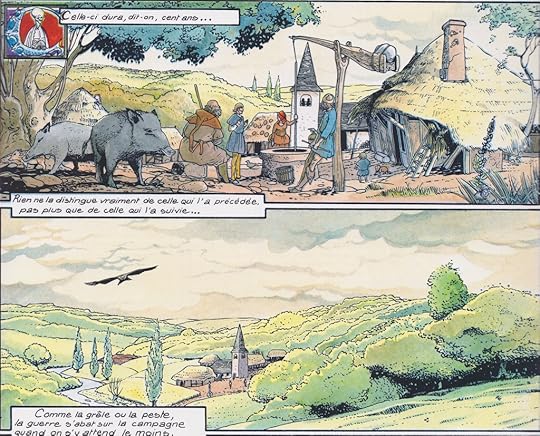
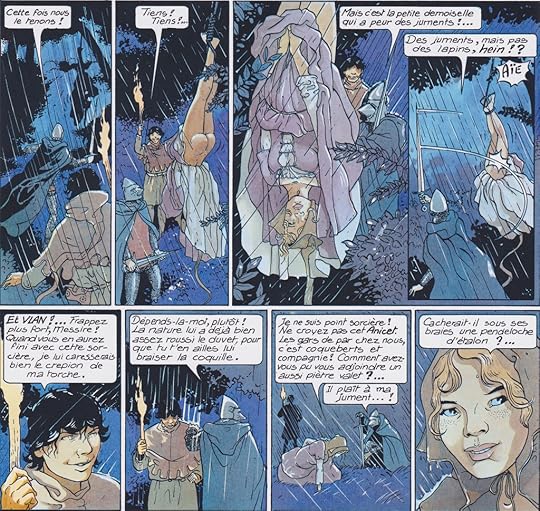
This opening volume of Les Compagnons du crépuscule was the first thing I read by him, and it was a heady experience – a total sensory immersion in rural France during the Hundred Years' War, as filtered through the traditions and magic of Breton folklore. As in many of his stories, Bourgeon starts with a young girl – here, the naïve and spunky redhead Mariotte, whose village is destroyed by a marauding band of soldiers. Joining her are a knight with a disfigured face, who never removes his helmet, and a local boy called l'Anicet. Together they ride through a mythical, blasted version of France that has been twisted by years of fighting.
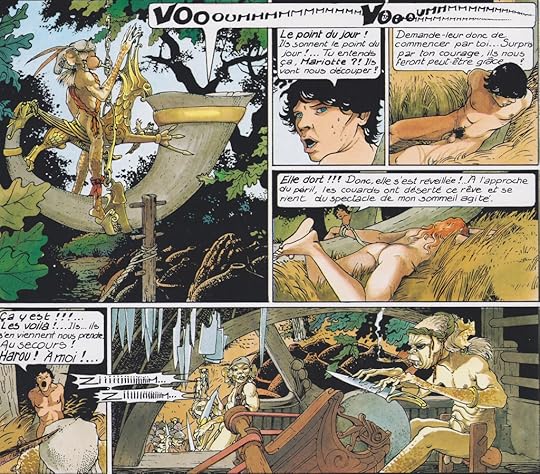
The first time I read this I was baffled by the sudden change in story that takes place two-thirds of the way through – it's one of the craziest examples of genre-shifting since From Dusk Till Dawn, in this case from historical picaresque to some kind of epic fantasy. The rigorously detailed and realistic depictions of navigating medieval forests and picking your way through war-torn townships give way to an eerie, dark fantasy-inflected tale revolving around those pixies of Breton mythology known as lutins.
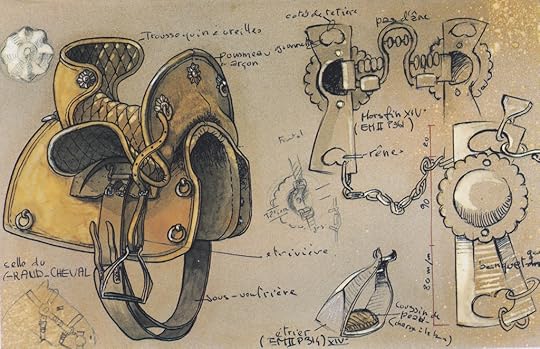
One of the things that marks Bourgeon's work is his attention to historical detail. When he draws Mariotte's layered skirts, the chevalier's saddlebags, or a nearby hand-plough, you can bet that he has researched every detail of what they would have looked like at this time. This edition includes some of his preparatory sketches at the back, where you can see him researching all these little points of visual context.
The series only gets weirder as it goes on, drawing in a troop of acrobats, three sirens, a pilgrim, and the contemporary Celtic troubadour Melaine Favennec. But I have a special place in my heart for this first volume, which is such a riotous mash-up of medieval history, quest narrative, and premodern fairytale – a great example of how comic art at its best can send you on a trip so stimulating it's almost synaesthetic.
{Read Catalan but took deal on group of Stuuds since collect series} FormNormFlexibleRabats ¦ A.I. 08/1986 N°3608 ¦ D.L. 09/1986 [_‖_]"studio (A SUIVRE)" flaps = ⁸⁰׳⁰cm panorama[_‖_]
I was confused throughout the entirety but the second tome helped me understand the overall story and characters better.
Fantastisk, flotte fede tegninger, mørk mørk historie, stærke kvindelige karakterer, bevægelse ml drøm og virkelighed er så god og tager ikke over. Spændende historie. Blandt favoritterne , lige købt som samlet trilogi trods “gammel” historie. Blandt favoritterne , holder 100% stadigvæk
Les Compagnons du crépuscule est indispensable pour les amateurs de BD. Il s'agit d'un chef d'oeuvre tant au niveau de la recherche sur le Moyen Age, qu'au niveau des dessins et du scénario.
Je le recommende à tout le monde sauf aux personnes commençant à aimer la BD franco-belge. C'est une BD à découvrir un peu plus tard?
Bourgeon on ranskalainen sarjakuvataiteilija, joka on luonut useampiakin albumisarjoja. Näistä ainoa suomennettu on Hämärän matkamiehet -sarja, jonka ensimmäinen osa julkaistiin 1983. Bourgeon vastaa albumeissaan kaikesta eli tarinasta, kuvituksesta, värityksestä ja tekstauksesta itse.
Hämärän matkamiehet sijoittuu jonkilaiseen keskiaikaiseen fantasiamaailmaan. Mariotte ohjeistaa kiertelevän sotilasjoukon kotikyläänsä saamaan ruokaa ja kenties lepoakin. Kotiin palattuaan Mariotte löytää kaikki teurastettuina. Ainoastaan Anciet niminen poika roikkuu elossa hirressä varvastellen tynnyrin päällä. Omituinen ritari pelastaa pojan ja ottaa tämän mukaansa palvelijakseen. Mariotte lyöttäytyy parivaljakon matkaan.
Matkalla kolmikko joutuu kummallisen suokansan vangiksi ja pääsee vapauteen tappamalla kansaa kiusanneen pedon.
Näin kirjotettuna tarina kuullostaa perusfantasialta, mutta sisältö on huomattavasti vivahteikkaampaa. Ancietin ja Marioten välillä vallitsee jonkinasteinen eroottinen lataus. Bourgeon viljelee varsin viljalti niin alastomia vartaloita kuin suoria ja epäsuoria vihjauksia.
Kuvallinen kerronta on pikkutarkkaa, toimivaa ja paikoitellen erittäinkin hienoa. Tarina on kuitenkin yksinkertaisuudestaan huolimatta sekava. Unet ja näyt ovat iso osa tarinaa, mutta ne sotkeutuvat ja kietoutuvat tarinaan muodostaen hieman epäselvän kokonaisuuden. Paikoitellen kerrontaa viedään melkoisten puhekuplaoksennusten avulla eteenpäin. Nämä kohdat tuntuivat puuduttavilta lukea.
Loppujen lopuksi kuitenkin aivan mielenkiintoinen avaus tälle sarjalle. Loput kolme albumia odottavatkin jo hyllyssä.
A girl lives in the woods alone with her grandmother, tormented by the local peasant children and accused of being a witch. One day she gives a passing band of marauders directions to the village, unknowingly leading to it's doom. Kicked out of her home for her act, she follows the peasant boy and a disfigured knight. One night in the woods they accidentally trample an imp hamlet and the children are held hostage by the imps until either the knight slays the beast that torments them or day breaks and they eat the children. The three humans are convinced they're in a dream, though they aren't sure who's, and a debate on the nature of dreams ensues. The knight slays the bear and they wake up remembering little of the knight before and continue their journey.
Interesting story and good art, though it's extremely horny in that 70s euro way. The translation sucked though (I think it might've been some online fan translation as opposed to something official–god i hope so) and I had to guess at a lot of what was going on.
Keskiaikaan* sijoittuva tarina kertoo kolmen varsin erilaisen henkilön yhteisestä matkasta. Kostoa janoava salaperäinen ja nimetön ritari, nuori mies Anicet ja nuori nainen Mariotte päätyvät albumin alkupuolella yhteen, kun sotajoukot terrorisoivat maaseutua. Heidän matkansa aikana tarina siirtyy vaivihkaa fantasia-/unimaailmaan.
Väkivaltaa esiintyy tarinassa paikoin, joko kuvattuna tai kerrottuna, ja alastomuutta vieläkin enemmän. Muutenkin teoksessa tuntui alati olevan läsnä eroottinen, tai pikemminkin lihallinen, pohjavire. Nämä tekevät albumisarjasta selvästi aikuisille suunnatun. Piirrosjälki on siistiä, yksityiskohtaista ja tyyliltään realistista. Nättiä mutta ei mitenkään persoonallista.
Anicetin ja Mariotten hahmot ja heidän välinen asetelma toivat mieleeni (erityisesti vanhimpien Valerian -albumien) Valerianin ja Laurelinen: hiukan hölmösti ja ylimielisesti käyttäytyvä mies sekä sanavalmis ja aktiivinen nainen, joiden välillä on kinastelun ohella myös jonkinlaista flirttiä.
*Kenties n. 1340-1350 -lukujen Ranskaan, sillä sarjan albumeissa viitataan satavuotiseen sotaan sekä 3. osassa erään hahmon nuoruusmuisteluissa Filip Kauniin kuolemaan.
Pikkutarkkaa piirrosta, mutta silti sujuvaa unohtamatta seksikästä naispääosaa. Mutta tarina tökki, ippasta päälle puolenvälin jälkeen paljonki. Alku oli kiinnostavaa ritari-seikkailua ja tuon ajan kuvausta, mutta helvettiä ne keijukaiset ja muut fantasiamöllöt piti sinne mukaan tuoda. Anna seuraavalle osalle kuitenkin mahdollisuuden.
Delen 1-3. Vermakelijk, vol spotternij. Drie verhalen over outsiders op het Franse platteland, ergens tijdens de honderdjarige oorlog. Sex en de dood kleuren de verhalen in, bovennatuurlijke elementen vullen dat aan. Het plot van het dikke derde deel is niet sterk, maar vier sterren zijn dik verdiend.
Я відверто нудьгував, коли читав перший том цієї серії. Кажуть, що це класика БД.
Історія про те, як спотворений лицар мандрує разом із двійком селян. Інколи потрапляють в халепу. Хай навіть халепа і вигляда як сон. Але це не сон. Мабуть.
Малюнок то неймовірний, то страшненький (не в плані жаху від споглядання, а в плані виконання).
Le premier tome du cycle Les compagnons du Crépuscule. Selon moi le meilleur des trois et le plus onirique, entre guerre de cent ans et monde et mythologie celtiques.