

What do you think?

GEO Epoche Nr. 57 - Deutschland unter dem Hakenkreuz Teil 1 - 1933-1936
Die geblendete Nation
Deutschland, Anfang 1933: ein Land, gedemütigt durch die Niederlage im Weltkrieg, geschwächt von einer Wirtschaftskrise, von Ränkespielen der Parteien zermürbt. Eine Republik, in der Millionen Menschen keine Arbeit haben, Tumulte auf den Straßen üblich sind. In diesem schwankenden Staat erklärt sich der Vorsitzende der NSDAP zum Heilsbringer: Adolf Hitler verspricht den Deutschen, ihnen Arbeit, Wohlstand, Frieden zu bringen. Und viele glauben ihm.
Deutschland, Anfang 1933: ein Land, gedemütigt durch die Niederlage im Weltkrieg, geschwächt von einer Wirtschaftskrise, von Ränkespielen der Parteien zermürbt. Eine Republik, in der Millionen Menschen keine Arbeit haben, Tumulte auf den Straßen üblich sind. In diesem schwankenden Staat erklärt sich der Vorsitzende der NSDAP zum Heilsbringer: Adolf Hitler verspricht den Deutschen, ihnen Arbeit, Wohlstand, Frieden zu bringen. Und viele glauben ihm.
- GenresHistory
170 pages
First published October 1, 2012
Ratings & Reviews
Friends & Following
Create a free account to discover what your friends think of this book!
Community Reviews
Displaying 1 - 2 of 2 reviews

June 20, 2021
Diese erschütternden Jahre deutscher Geschichte werden in der Ausgabe sehr anschaulich, faszinierend, kompakt und informativ dargestellt. Spannend und abwechslungsreich, wie auch die anderen Zeitschriften der Reihe. Empfehlenswert, um seinen Horizont zu erweitern.

April 17, 2017
Anyone who has traveled in German-speaking Europe has seen the GEO magazines in train station or airport news kiosks. GEO Epoche is their “Magazine for History.” Each issue focuses on a specific event, age or trend and usually has an interesting DVD attachment. I’ll admit to owning many of them, but this is the first time I’ve read one from cover-to-cover.
Germany under the Swastika: the First 1000 Days of the Dictatorship is informative and interesting, even for those who know much about this history. It is a great primer divided into an opening photographic and ten thematic essays plus a fascinating collection of first person quotes titled “Exodus of the Intellectuals.” Of the thematic essays, the annotated timeline of the “Röhm Putsch,” the myth of the economic impact of the Autobahns, the cultural mechanics of Gleichschaltung, the retaking of the Rheinland, and the 1936 Olympics were the highlights.
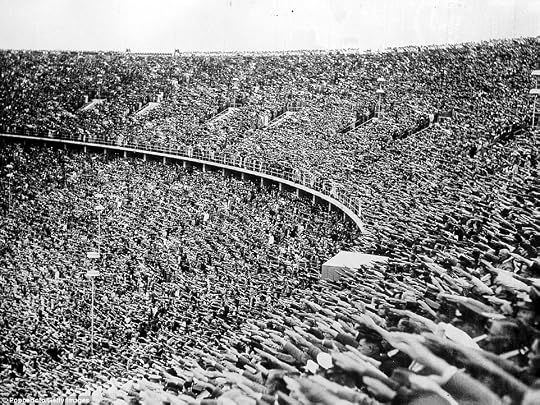
One of the more disturbing photos in the magazine from the opening ceremony of the 1936 Olympics noted, "Those who remained seated were arrested by the police."
I particularly—and surprisingly—liked the fact that each essay was written by a non-specialist. It gave every story, no matter how familiar I was with it, a fresh perspective. It was kind of like going to a museum with someone who is interested and keen to learn. Most of the author designations included a comment on what surprised them: the depth of the legitimacy crisis Hitler faced prior to the Night of the Long Knives in 1934, how propaganda-driven lies fooled the world about the economic condition of the Nazi state, the number and type of camps—from youth to types of professions—that were used to achieve Gleichschaltung.
I would highly recommend this to teachers of third and fourth year German. The volume is written in very accessible language.
Given the fact that it is always dangerous to compare current events with the history of Nazism—as the blundering Sean Spicer demonstrated this past week—we must be careful about comparing the first 1000 days of Nazi rule to the current U.S. administration. But, please bear with me here, for those who have lived in the Los Angeles area, they are likely familiar with the real estate term applied to the areas near Beverly Hills, but not in it. Those who try to associate themselves with the glamor of its reputation call the location of their homes or apartments Beverly Hills-adjacent. There’s a whole running joke of this or that being -adjacent. For example, when Kellyanne Conway spoke of “alternative facts,” her inarticulate phrase could also be considered truth-adjacent. You can play this game with just about anything. As I read this collection of essays, I did not conclude that the Trump administration has Nazi policies or perspectives, but it did occur to me over and over again that many of their ideas and actions are eerily Nazi-adjacent.
Germany under the Swastika: the First 1000 Days of the Dictatorship is informative and interesting, even for those who know much about this history. It is a great primer divided into an opening photographic and ten thematic essays plus a fascinating collection of first person quotes titled “Exodus of the Intellectuals.” Of the thematic essays, the annotated timeline of the “Röhm Putsch,” the myth of the economic impact of the Autobahns, the cultural mechanics of Gleichschaltung, the retaking of the Rheinland, and the 1936 Olympics were the highlights.
One of the more disturbing photos in the magazine from the opening ceremony of the 1936 Olympics noted, "Those who remained seated were arrested by the police."
I particularly—and surprisingly—liked the fact that each essay was written by a non-specialist. It gave every story, no matter how familiar I was with it, a fresh perspective. It was kind of like going to a museum with someone who is interested and keen to learn. Most of the author designations included a comment on what surprised them: the depth of the legitimacy crisis Hitler faced prior to the Night of the Long Knives in 1934, how propaganda-driven lies fooled the world about the economic condition of the Nazi state, the number and type of camps—from youth to types of professions—that were used to achieve Gleichschaltung.
I would highly recommend this to teachers of third and fourth year German. The volume is written in very accessible language.
Given the fact that it is always dangerous to compare current events with the history of Nazism—as the blundering Sean Spicer demonstrated this past week—we must be careful about comparing the first 1000 days of Nazi rule to the current U.S. administration. But, please bear with me here, for those who have lived in the Los Angeles area, they are likely familiar with the real estate term applied to the areas near Beverly Hills, but not in it. Those who try to associate themselves with the glamor of its reputation call the location of their homes or apartments Beverly Hills-adjacent. There’s a whole running joke of this or that being -adjacent. For example, when Kellyanne Conway spoke of “alternative facts,” her inarticulate phrase could also be considered truth-adjacent. You can play this game with just about anything. As I read this collection of essays, I did not conclude that the Trump administration has Nazi policies or perspectives, but it did occur to me over and over again that many of their ideas and actions are eerily Nazi-adjacent.
Displaying 1 - 2 of 2 reviews