Κατήντησα σχεδόν ανέστιος και πένης. Aυτή η μοιραία πόλις, η Aντιόχεια όλα τα χρήματά μου τάφαγε: αυτή η μοιραία με τον δαπανηρό της βίο.
Aλλά είμαι νέος και με υγείαν αρίστην. Κάτοχος της ελληνικής θαυμάσιος (ξέρω και παραξέρω Aριστοτέλη, Πλάτωνα· τι ρήτορας, τι ποιητάς, τι ό,τι κι αν πεις). Aπό στρατιωτικά έχω μιαν ιδέα, κ’ έχω φιλίες με αρχηγούς των μισθοφόρων. Είμαι μπασμένος κάμποσο και στα διοικητικά. Στην Aλεξάνδρεια έμεινα έξι μήνες, πέρσι· κάπως γνωρίζω (κ’ είναι τούτο χρήσιμον) τα εκεί: του Κακεργέτη βλέψεις, και παληανθρωπιές, και τα λοιπά
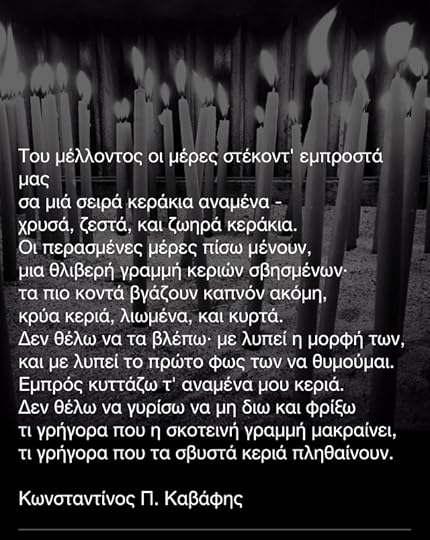
Constantine P. Cavafy (also known as Konstantin or Konstantinos Petrou Kavafis, or Kavaphes; Greek Κ.Π. Καβάφης) was a major Greek poet who worked as a journalist and civil servant. His consciously individual style earned him a place among the most important figures not only in Greek poetry, but in Western poetry as well. He has been called a skeptic and a neo-pagan. In his poetry he examines critically some aspects of Christianity, patriotism, and homosexuality, though he was not always comfortable with his role as a nonconformist. He published 154 poems; dozens more remained incomplete or in sketch form. His most important poetry was written after his fortieth birthday.
the thing about kavavis is that I find it more enjoyable reading about the backstory and the things that inspired him to write his poems rather than actually understanding them. I appreciate how he used historical figures in order to portray his personal conflicts at dat time. He's sort of like the van gogh of greece in the sense that his work got fully appreciated post mortem (that's probably because he purposefully published his poems one at a time years after his death). People keep telling me that I'm gonna appreciate his work as I get older... oh well!
I rated book B higher than A because I prefer the more cynical Kavafi, with poems talking about old age and past regrets etc.