The short story "Separating" by John Updike tells the story of a husband and wife who decide to divorce. The thing that is not easy for both, not about separation, but about how to talk and tell their children that they will get a divorce.
"Separating" is one of 18 stories Updike wrote about the Maple family, considered a loosely autobiographical account of a dissolved marriage that spans over two decades. "Separating" is part of John Updike's 1979 collection "Too Far to Go."
The story was first published in The New Yorker in 1975.
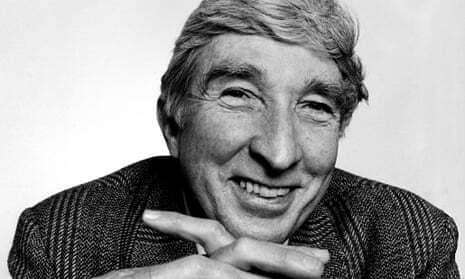
John Hoyer Updike was an American writer. Updike's most famous work is his Rabbit series (Rabbit, Run; Rabbit Redux; Rabbit Is Rich; Rabbit At Rest; and Rabbit Remembered). Rabbit is Rich and Rabbit at Rest both won Pulitzer Prizes for Updike. Describing his subject as "the American small town, Protestant middle class," Updike is well known for his careful craftsmanship and prolific writing, having published 22 novels and more than a dozen short story collections as well as poetry, literary criticism and children's books. Hundreds of his stories, reviews, and poems have appeared in The New Yorker since the 1950s. His works often explore sex, faith, and death, and their inter-relationships.
Why. It was a whistle of wind in a crack, a knife thrust, a window thrown open on emptiness. The waiting white face was gone, the darkness was featureless.
Human emotions always traverse the complex path of obscurity and ambiguity, and our actions also go hand-in-hand with them, in a sense that they are accomplices with the emotions since they are governed by the emotions. More often than not, it seems that our emotions are like a river of somewhat and sometimes uncontrolled energy which may manifest itself in the form of exasperation or pleasure, love or hate, darkness or virtuousness; but they hardly reveal themselves in binaries, for the river flows through the muddy and unclear path in congruence with the life itself. Human heart of full of darkness, but is humanity capable of expressing it fully? Can the wilderness of humanity be disseminated through its existence? The over articulated debate about good-evil, hero-antihero shows naïve and ingenuous understanding of human life, for the life moves in greys rather than black and white.
The way human beings deal with our choices, pain and grief is the cornerstone of human psychology. We try to defend our choices till our last breath, based upon premises which may be true or not, for what is truth inherently, don’t we define our own version of truth and protect it, thereby safeguard our choices, based upon our truth, from the probing eyes of existence. These premises that we devise for ourselves define our character however we usually misjudge such character to be immutable and uncommon since the very premises may change with time. And perhaps that underlines our entire existence- we make choices as per our notions and the exact notions may very well be changed as per our convenience; and perhaps that makes us the intelligent beings, though our own shame laugh wickedly at our fallibility.
Separating is a powerful short story about the Maples to deal with their separation. They devise ways and means to announce this dreadful decision to their children. Although they have seen that their friends make unbelievable improvement in their domestic lives as if the marriage makes a last effort just before its dissolution, but the Maples have come beyond it and separation is the well thought decision they have arrived to, or is it so? The physical appearance of their house, its tennis court, resembles the mood of this purposeful desolation. While the wife (Joan) wants that each child should be told alone about this impending but pre deliberated act, as if the children would be better equipped to withstand the absurdity of it and their own shame in dealing with it and perhaps won’t make their parents embarrassed. But plan of Joan turns one obstacle for the husband (Richard) to multiple now as if he must deal with four knifelike walls in negotiating this uncomfortable but unavoidable situation.
The author has been able to portray Richard as an insensitive man till this point as if he is emotionally detached from everyone and everything and there is just one motive of his life, that is go away from this chaos and mayhem. The author’s pen has treated the children brutally as they don’t get any chance to express themselves, actively or otherwise and it seems they would be robbed off from the world which appears theirs till this juncture. Richard and Joan acted as a shield for the children, that has safeguarded them from the truth until they get acquainted with life well enough to withstand the probing eyes of the truth. He and Joan stood as a thin barrier between the children and the truth. Each moment was a partition, with the past on one side and the future on the other, a future containing this unthinkable now.
However, the author plays a subtle trick and allows one of the children to spring up from the oblivion and expresses his exasperation which has little to do with the separation of his parents. The wife, Joan, eventually manages to get the attention of the author and she laces her emotions with pretense of logic to assuage the prodding curiosity of the children unlike the husband who finds it hard to cope up with the situation. Gradually, Richard loses his emotional stability, and the words of the author rise from the dungeons of nothingness to put him against a mountain of darkness; the entire sympathy of the reader is being sucked and poured towards Richard, the other characters watch it with eyes of expectation but the omnipotent author sways them away with disdain.
Updike once again pulls off a trick through his invincible and untamed pen and at the fag end of the story, the reader is taken aback by secrets revealed by the unconquerable pen of the author, and one of the children shatters the universe of Richard with just one word in just a snap of finger. The reader is contempt fully thrown off and the trifling and inconsequential ground he may be covering has been snatched away from him to feel checkmated along with Richard by the potency of the author. The notions of good-evil, hero-antihero are being subverted by the author to infuse the attributes of realism into prose since reality always work in grey and it’s beyond the famed but spurious distinction. The reader feels a sense of serene but immense hollowness making its way through his soul as if he is alone in this enormous universe, so distanced and far away that nothing could touch his heart.
What appears to be simple story of a couple planning to cope up with its separation is essentially turns out to be deep and engrossing portrait of human relationship going through existential crisis amidst the soup of human emotions. Though the story has autobiographical traits of the author but, to our astounded horror, essentially it transpires into our story, everyone’ story. The short story emphasizes upon the irrationality of human emotions and reiterate the fact that reality may be stranger then fiction.
John Updike writes with his distinctive prose style which is underlined with a carefully crafted rich vocabulary to give a distinct impact of irony but with a tinge of omnipotence of the mighty pen o him. The reader may feel a sense of opulence and exorbitance which is used to give extraordinary appeal to the ordinary things as the author himself maintains that his style is an attempt "to give the mundane its beautiful due, however the universe of Updike never really takes flight off the realism. The authority he commands over prose invariably forces the reader to compare him to Proust and Nabokov.
It is my read of Updike and I immensely enjoyed it, I got to know about it through The Short Story Club.
I am once again introduced to a famous American writer by a short story read with the Short Story Club. John Updike is better known for his Rabbit series. I admit that my curiosity towards the series is limited to checking if the main character is an actual rabbit. It is not, if you were wondering, it is a family saga of some sort. Coming back to this short story, a long married husband and wife ponder how to inform their four children of their Separation. After they thing, they manage to do it and feelings come out, or stay hidden. It is a painful story, as many of the good ones are.
Why. It was a whistle of wind in a crack, a knife thrust, a window thrown open on emptiness. The waiting white face was gone, the darkness was featureless.
It is painfully, beautifully sharp, reading of “purposeful desolation”. It’s almost too real, despite occasionally weak characterisation. The outward state of the house and grounds occasionally parallels inner feelings, but more often, cruelly contrasts with them - the opposite of a sacrament.
“All that June the weather had mocked the Maples’ internal misery with solid sunlight - golden shafts and cascades of green in which their conversations had wormed unseeing, their sad murmuring selves the only stain in Nature.”
As the title implies, this short story is about a couple who are separating. As it’s Updike, they’re well-off country-club types. Joan and Richard “had shaped the strategy of their dissolution”, specifically, how and when to break the news to their four children, aged between 13 and 19. It's notable that the story is titled “Separating” (not “Separation” or “Separated”): it’s a process, not a single event.
When does the end begin?
“‘If I could undo it all, I would.’ ‘Where would you begin?’” Richard and Joan are on fairly amicable terms, each one reluctantly determining how best to minimise the inevitable damage of the collapse of their marriage. We know little of what brought them to this point, other than an extra-marital relationship. It’s no longer relevant how it came about, whether it was the first and only affair, and how it came to light. This ambiguity of ignorance makes it harder for the reader to be judgemental (but if you read The Maples Stories, apparently you see the whole trajectory of their messy marriage).
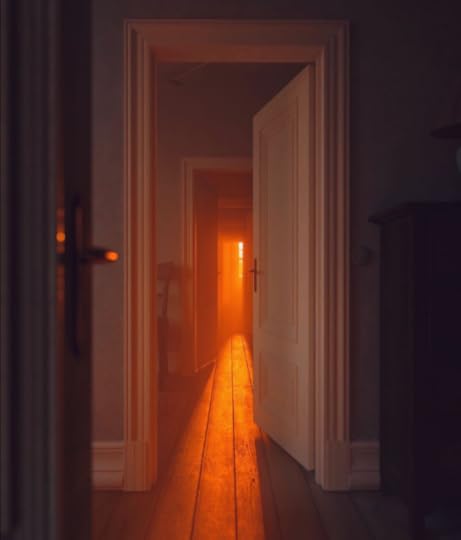
Image: Distant light, beyond doors and partitions. By Morten Lasskogen (Source)
“All spring he had moved through a world of insides and outsides, of barriers and partitions… Each moment was a partition, with the past on one side and the future on the other, a future containing this unthinkable now. Beyond four knifelike walls a new life for him waited vaguely.”
Tonight is the night. It doesn’t go quite to plan. How could it? Nor should it. “The partition between his face and the tears broke.” The way it unfolds fits the quiet uncertainty of what’s to come.
“He met only moonlight on the road; it seemed a diaphanous companion, flickering in the leaves along the roadside, haunting his rear-view mirror like a pursuer, melting under his headlights.”
The final paragraph is puzzling, symbolic, short, brutal, and more of a (metaphorical) stab in the back than a plot twist.
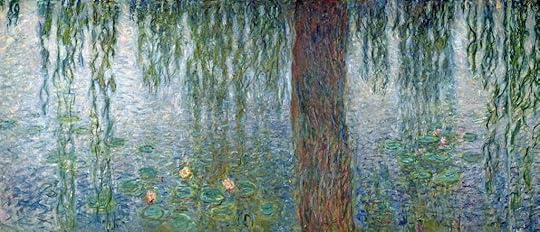
Image: Detail from Monet’s “Morning with Weeping Willows” (Source)
Weeping
I was really struck by Richard being unable to hide or stop his tears - even more so when I reminded myself this was written nearly half a century ago - and because it’s something I’ve struggled with recently. In the vale of tears, one wants a veil for tears. In Christian theology, “vale of tears” refers to the tribulations of life that we can only be freed from by dying and going to heaven. Back on earth, Richard’s “partition” fails him; I find a supposedly faulty camera and mic can be more reliable screens.
How do couples break the news of their impending separation to their children? In a few pages, Updike provided a searing account of the emotional upheaval wrought by this ordeal.
Joan and Richard Maples thought long and hard about when and how to break the news as gently as they could. Joan insisted that each child be given the news individually. And when the day arrived, Richard was a total wreck compared to Joan who was calm and marvelously controlled. For Richard, the unpleasant but last hurdle to a new life for him was akin to scaling ‘four knife-sharp walls, each with a sheer blind drop on the other side.’
What stood out for me is the comparison Updike held up between the dissolution of the marriage and nature’s ‘annual stunt of renewal.' The couple’s ‘gray dialogue’ was set against the ‘golden shafts’ of summer. Even the couple’s name, ‘Maples,’ (which recalled the vibrant red of maple leaves) seemed incongruent with the death of their marriage. In his effort to comfort his younger son, Richard took him for a walk and pointed to the blue river and emerald marsh, and said, ‘It goes on being beautiful. It’ll be here tomorrow.’ I thought this rather poignant in light of what will no longer be there tomorrow for this family.
This is my first foray into Updike’s writing. I am impressed by the superb mastery of his prose. There are lines I read and re-read for their elegance and beauty. Thank you, Cecily, for putting this story on my radar and introducing me to John Updike.
4★ “Richard had thought to leave at Easter; Joan had insisted they wait until the four children were at last assembled, with all exams passed and ceremonies attended, and the bauble of summer to console them.”
Richard and Joan are separating. Not divorcing, separating. Their children range from thirteen to nineteen, all seemingly pretty well-adjusted and independent. Now that the parents have agreed to separate, their challenge is when to tell their kids.
It’s beautiful early summer weather when nineteen-year-old daughter Judith returns from her stay in England. Joan thinks they should let her settle back home before they say anything.
“Wait a few days, let her recover from jet lag, had been one of their formulations, in that string of gray dialogues—over coffee, over cocktails, over Cointreau—that had shaped the strategy of their dissolution, while the earth performed its annual stunt of renewal unnoticed beyond their closed windows.”
The “strategy of their dissolution” is to wait until the family is together and the children are all looking forward to summer – an upbeat moment. Presumably that will lessen the blow.
The story is Richard’s. He continues to mend and fix and complete the household maintenance tasks from Joan’s list as he dreads the day to come. Odd things around the place trigger old memories, making it harder for him to think about moving out.
As the family gets together, each of the six people react differently. No tempers are lost, no tantrums are thrown, but comments are made. The parents say, of course, that they have always especially loved their children.
“[Fifteen-year-old] John was not mollified. ‘What do you care about us?’ he boomed. ‘We’re just little things you HAD.’”
Judith, the eldest, wants to know why they don’t just get divorced.
This is another good read from the Goodreads Short Story Club which you can join and then follow the discussions for each story. There’s no requirement to participate, but the conversations are always interesting.
It was a brilliant summer day, but Richard and Joan's relationship was crumbling as much as the clay on the tennis court. How were they going to tell their four children that they were separating?
"Separating" is a semi-autobiographical story from John Updike's 1979 collection "Too Far to Go." The story was first published in The New Yorker in 1975. It was interesting to see how the six family members each reacted during this difficult time. 3.5 stars, rounded up.
An interesting short story in which a couple are breaking up their marriage in a seemingly well controlled manner as they work out when best to tell their four children.
The husband, Richard, is completing all the little tasks that need doing around the house in preparation for when he leaves. The wife, Joan, seems totally in control as she hands out the tasks and plans a strategic campaign for telling each child. The actual event of course is not so straight forward and there is argument, accusation and tears.
As a reader I felt all I could do was observe since there are insufficient facts about the why and the wherefore to make a real judgement for or against either partner. It is simply an intriguing observation of how one family's way of life ended.
A very affecting story. A couple is separating; a family is splitting. Updike pauses at the pain, and makes you feel the rupture.
It’s beautifully done, and reminded me of his poem Dog's Death which I read long ago and have never been able to forget. I think it’s the simple, searing emotions expressed in each work.
I was not a fan of Rabbit, Run, but I would like to try more of Updike’s stories.
A couple is separating. This is the story of the breaking the news to their four children and how each of them reacts. We get deeper insight from the husband/father as he reflects on things due to the pov. This leads us to the ending, my favorite part of the story.
I really enjoyed the author's writing style. It was so ordinary and that in my opinion was what made the story so catching. The ability to imagine the story truly happening behind some apartmen's closed door. The characters' portrayal was so great on such limited space of a short story. Really liked it.
Separating is a short story by John Updike. A middle-aged couple breaks the news of their trial separation to their children. The females remain cool, calm and collected while the males react with tears and hysteria. It’s hard to create empathy for characters in ten pages that feel like part of a longer, abandoned work.
John Updike's writing style is different from other writers. His sentences are short and crisp and feature the POVs of multiple characters. It wasn't hard to catch the initial plot of the story - the divorce. What followed suit was a tumult of expressions, ideas, thoughts, and emotions that though expressed in the simplest of words and shortest of sentences held quite an impact. I think I'll have to reread the story at least one more time to get a hold of the true feelings of passion explored by the characters through all the agitation and disturbance in the atmosphere of the story. Separation is not a simple topic and may however simple, easy-going and lively they are shown on the screen, the reality is hard to swallow. Today for the first time the idea of separation has hit me and shook me with its pain. I have understood that it's not a straightforward business but a messy muddle where everyone gets dirty.
The story is short enough there's not much I can say without spelling out plot details. Suffice it to say this is a story about a father informing his children about a divorce, their reactions and how it affected him. The final two paragraphs of this story are amongst the truest expression of sorrow and loss I have ever read.
In this story Richard and Joan decide to separate. Time passes and the interactions between the couple and their children are shown. In the final scene of a story, one of the children asks their father why, and Richard comes to the realization that he has forgotten why he and his wife need to separate. This gives insight into decisions, follow through, and truth.
First story in a long time that actually made me cry. If you are looking for the definition of a failed marriage and broken family then you have one right here. The life in a small town America might not be that idyllic after all.
3 მოთხრობას და ამ აბზაცს 5: "Why. It was a whistle of wind in a crack, a knife thrust, a window thrown open on emptiness … Richard had forgotten why." ❤️❤
I've been wanting to read Updike ever since he was recommended in our book group. So, I was glad to be reading this.
Normally, the inner struggles would be told via stream of consciousness of the person undergoing it. This story is all about the struggle, predicament, and guilt of Richard. He as the initiator of this situation, is the most affected and it shows. Perhaps the reason why a third person narration didn't diminish the description of the struggle he goes through. The story then is the apparent responses in him, the tears, the pre-occupation with the lock, the sleepless anxiety and even the disappointing relief he feels when there are no major earth-shattering responses. The boys take it hard, it seems...the women seemingly more resilient. These are interesting perspectives. Wonder how it would have played out in a different era, in a different culture or even if it was Joan who perhaps initiated the move. The story leaves you to muse over these and also re-inforces, that children are a reason most marriages limp back to existence.
It's a June story, aptly chosen. I am encouraged to read more of Updike.
‘Separating’ is not an easy read. It reads as Richard’s story as he battles the guilt and anguish that come from giving up on his life long project, on leaving his family. His attempts to gain some comfort by fixing up the house and garden, not renewing, but seemingly making up for the neglect he has shown to them over time before leaving. It also involves his plans to tell his children, making sure they are alright and that everything is squared up before going. It seems like a desperate attempt to give him peace of mind. All seems to be working out for him with just one son to tell. But then……….
A fascinating story that describes everything Richard does but manages to capture the inner emotions playing out in his head. I found the last part, from Richard waking up to go and pick up Dickie at the station totally stunning with so many things that take the whole story to the next level as the cracks begin to show and make such a simple interpretation inadequate. In change there is loss. It was stunning enough to keep me thinking for the best part of the evening, and then some.
I loved this story mainly because it looks at a common phenomenon — separation — from a new and less common angle: it focuses on the process of telling others (especially the children) rather than on the reasons behind the separation itself. We see that although the idea of separation is Richard’s, it is Joan who plays the reasonable, composed role in the process. She handles it very well, while Richard — along with the two sons — seems more emotional in dealing with the situation compared to the women.
Throughout the story, there are hints that Richard has another woman in mind, and that this relationship probably played a part in his decision to leave Joan. However, Updike deliberately focuses less on scandal and more on the emotional confusion, guilt, and emptiness of the decision. In fact, he very artistically shows that in most real separations, there is never just one reason. That is why, when Richard’s son asks “Why?”, it is not an easy question to answer: in real life, “why” is messy, not dramatic. This quiet, painful complexity is what makes the story feel so real and heartbreaking — rather than like a soap opera.
"You cannot climb back down; you can only fall." Hey, can someone explain the ending to me? What is the significance of Dickie kissing Richard on the lips passionately?