The Hudson's Bay Company is about to exercise its uncontested monopoly over the lands drained by Hudson Bay. The first step is to find a new source of beaver pelts and profits, and the only hope lies in the unmapped territory held by the Blackfoot-speaking Indian tribes. The new governor mounts an expedition into the heart of this unknown land, a journey that will test the mettle of a new generation of Hudson's Bay Company men.
As with any 500pp. "epic" I am alway a bit hesitant. As a buddy said: "All books should be 200pp. or less". Though, I don't fully agree, I see the logic. Nobody wants to find themselves 100-200pp. into a 500pp. book and wondering why they bothered in the first place - thus starting the "should I plow thru and finish this?" debate. Thankfully, at no point did I want to put down "The Trade" and it was fully worth the 500pp. investment of time/energy.
"The Trade" delivers the goods, no pun intended. I love historical fiction and fictionalized-history. "The Trade" centers around real characters involved in the 19thC fur-trade out of central Canada. Not a whole lot exists in terms of actual historical knowledge of these people and their lives, so the author took to the task of re-creating the more intimate details of their lives within the context of the monopolistic fur-trade which brutalized whites, Indians and "half-breeds" alike (not to mention the beaver and buffalo). The author does a great job of demonstrating the fact that in such an environment there are no "heroes" nor "villains" and that both exist in all of us - that includes the often-glorified Natives. Non-Fiction Textbook History too often descends into such a boring pattern and loses the humanity of characters involved (I refer anyone to "Lies My Teacher Told Me" for a great synopsis of this phenomenon). "The Trade" shows the good and bad that exists in everybody affected by the fur trade and does a solid job of showing the first-hand effects of such a trade.
Highly recommended for fans of history, fictionalized-history and epics.
I enjoyed this book on a number of levels. It is a great example of some of the best that CanLit has to offer. It is well written and interesting and filled with engaging characters. It is also an excellent example of historical fiction. It is set against a backdrop of actual events and all of the main characters are real people active in western Canada during the fur trade era. These events, people, their lives and their behaviors are well known to historians. The author admits that much of the conversations and day-to-day thoughts and actions of the people is fictionalized, however, the characters behave in ways that seem entirely reasonable given what is known about them. My only complaint about the book is that in covering such a large span of time in so few pages, the narrative seems a bit choppy in places. However, I would highly recommend the book to anyone with an interest in CanLit, Canadian history and historical fiction.
An easy book to read and enjoy, but I think it suffers from sticking too much to history. I could not identify a protagonist or a goal, no story. This behemoth called "The Trade" kept getting in the way. Still, a much more pleasurable way to learn history than reading a history book, maybe even more authentic.
The Trade is a grand, sprawling saga of the north-western fur trade in the first half of the nineteenth century. Historical drama shines through the narrative, but this is a novel not a text, and the focus is on vivid characters, on the harsh brutality that gives the plot grit, and on the complexity of the human relationships that mark the interplay of aboriginal communities and the English and Metis traders. Stenson has more recently written the Great Karoo, a novel about Albertans caught up in the Boer War, and that book dragged often. But The Trade is driven more powerfully by unforgetable characters like One-Pound-One, the temper-flaring founder of what became Edmonton, and his friend Ted Harriott, who could never escape the tragedy that he felt dominated the trade after the death of his young Indian wife. This is a book that will captivate you, tell you much about what really shaped Canada, and stay with you as you consider the aboriginal place in our future society.
Decent read. I added this to my TBR list in 2018 and finally got around to purchasing it in late 2023.
Story of One Pound One and his subordinate Harriott and how they move up in the ranks of the 19th Century Hudson's Bay Company monopoly. One Pound One is an excellent character and I enjoyed him throughout the text. Harriott is reserved, unambitious and frequently troubled - disappointing to himself and ultimately to the reader, but such is life. Secondary characters include The Governor, Harriott's wife Margaret, and the half white, half Native Jimmy Jock/Jamey Jock/Jimmy Jug. Jimmy Jock reminded me of a much milder version of Lonesome Dove's Blue Duck - he is crafty, somewhat mysterious, and untrustworthy.
Stenson definitely did his research to publish this, as he reiterates in the Acknowledgements. Having myself read The Company by Stephen R. Bown, Stenson's novel is perfectly historically accurate. He does an excellent job putting the reader into 19th Century Canadian prairie life, describing both the Indian camps and the HBC forts, as well as the hierarchy of the HBC.
The 7 sections (instead of traditional chapters) are broken up into short stories told from the fictional William Gladstone to the "Editor of the Rocky Mountain Echo." This was a format I had seen before in Russel Banks' Cloudsplitter which was one of the few books I was unable to finish - Stenson does a much better job using this unorthodox narration. The short story-esque format means there's a climax and ending in each of the sections. Despite character continuity throughout, the sections themselves sadly became softer toward the end. I enjoyed most Sections 1 (Bow River Expedition) and 4 (Piegan Post), but it seemed the action somewhat peaked there. Section 5 (The Missionary) was well-written and a unique take on good vs evil (rum) philosophy, (I felt I was in the room during Rundle's last evening at Rocky Mountain House with Harriott) but again - was short on action compared to the earlier parts. Section 6 (The Artist) was exclusively letters and it somewhat derailed the momentum heading into the final section.
Highly recommended to readers interested in the Hudson's Bay Company but not wanting to read something as dry as a nonfiction work. Western readers would also enjoy this.
Alberta (and various forts) -- Canada -- (1822-1867)
"I have seen and been part of things on this river that I would never forgive if I were God. (408)"
The blurb on the back informs us that this novel exists "between the lines of official history" and I have no doubt that this fiction is closer to the truth.
I don't know any of the main characters of Canadian history, but I have a general idea about how things went during American and the Native American encounters, so I find the distant corporate greed, the willingness to trade natural resources for guns and alcohol, the condemned yet widespread "interbreeding" between races, and the hostility between whites and inter-enemy tribes to be realistic and --given the remote frozen locations-- more realistic than what the official propaganda would have sold. As a painter/artist in the novel acutely observes to his Dearest:
"I think we'll have to dress the characters up a bit, make them more the wilderness heroes the public will expect and want...for otherwise I wouldn't sell a one! (439)"
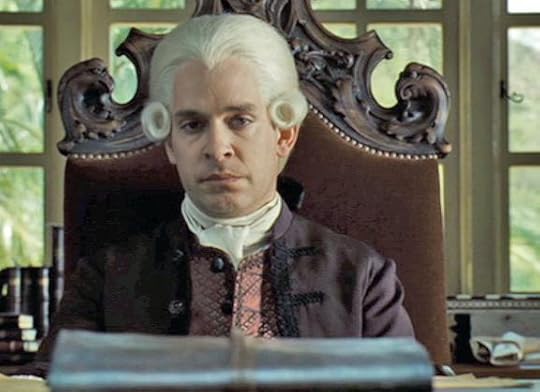
The tempo of the reading took a bit for me to get adjusted to, but once I got it, it just added to the flavor of the story. Almost immediately after reading the introduction of the Governor I had the image in my mind of Lord Cutler Beckett from the Pirates of the Caribbean.
It's not my normal type of reading, but I enjoyed it. The hopeless missions, the rage and rum keeping men alive, the remote wilderness. I recommend this novel to anyone who likes Westerns (just replace dust and sun with snow and ice) or anyone interested in peculiar types of madness brought on by isolation, desperation, and extreme conditions.
This novel reflects the history of where I grew up, and still live today. I never expected the history to be cheerful and flattering, but knowing the details of how grim it was is painful. But nowhere near as painful as it must have been for the people living through it.
At the beginning of this novel, I was lost. I had no idea where I was, or who was around me. Slowly I started to recognize characters, which was somewhat comforting, but only because of their familiarity.
I suppose the author set out to show me how lost the European small boat rowers felt, young, isolated, disadvantaged men suffering under the whip of the "bully" whose job was to keep them terrified and straining to move faster and faster, till exhaustion and beyond. Once out on the prairie, they were as terrified of the sight of the wide open expanse as they were of the whip, so they still couldn't imagine running off to freedom.
We also got to see how conflicted the Indian and Metis guides must have felt, leading these enemies into their territory, putting their people at risk.
The bosses of this operation were equally driven and terrified because they knew they had no options. If they lost their extremely difficult jobs, they'd either get much worse jobs, or have to return to England, where they had no skills, no status, no future.
The hardships these characters face astound me. I cannot imagine putting on snow shoes, and trudging over the Rocky Mountains, in the dead of winter, and actually surviving. Of course, not all of them did.
This novel is a vivid depiction of the history, creating a world where the reader is exposed to the pain, fury, disgust, tedium of long travel, that the actual people in that time frame would have endured.
How the Hudson Bay Company had an invisible power on the destiny of those who shaped this land. All this story is about the west or the Rupert's land. The governor, represented the cruel indifference of the company. The fur had to be brought to the forts to make some profit, in exchange to guns and rum for the Indians. Many competitions among the indians from the Missouri to the Athabasca happened in gruesome fights, for the Trade. The Metis have their life written in the Trade as well, and we never will emphasize enough that there would be no Canada today without the role that the Metis played. The reader gets attached to the characters like Harriot, shy and diplomat; his first wife, maybe a wendigo on this land, because of the Trade; One pound one, tough as a nail but so human, etc. Many true little anecdotes and overall an interesting perspective on the not so great Hudson Bay company. "If the Company is the body, the rivers are the the blood" Fred Stenson
(4 stars because English will never be my first language...)
3.5 stars. The “trade” of the title is the fur trade. This historical novel follows the lives and careers of several men who worked for the Hudson’s Bay Company in the 1800’s. I was hoping for trappers and voyageurs and a bit more excitement. But most of the action (or lack of) occurs within the trading posts and involves the men responsible for buying the furs that the Indians would bring in. Snow storms, brave and/or frail wives, missionaries, and plenty of rum add some life and color to the book. I found it all very informative but overall it seemed a bit dryer than I would have preferred.
I love historical quasi fiction. The characters in this book were real and much of the storyline was extracted from letters and documents. It was an in depth description of the Hudson Bay Company and the way trading with the indigenous tribes took place. It was very very interesting and dispelled many myths of how relationships between the traders and tribes were. It was also very timely to today with the description of rampant prairie fires and the devastation to the buffalo herds. If you love Canadian history, its a good read. For someone wanting a good story, it could go on for a bit longer then is comfortable in a smooth tale.
The cottage book shelf had something good after all. I picked this up with little hope of something good to read and was most pleasantly surprised.
I didn't know a thing about the history and learned a lot more about Edmonton than I ever knew. When I got the chance I looked up some of the names and places and was surprised to find they were related.
Picked up this instead of a more recent book at the library. Glad I did. Worried early in the book about the use of capital h Halfbreeds. Thought the book would reflect the racist attitudes of 1850s. I was wrong about that. Some of The strongest characters in the book are Metis. Good story. Engaging and sympathetic writing
An interesting concept for a novel, but as I kept reading I realized there wasn't going to be much of a plot. The narrative is very slow and I just could not get into it. Ultimately I gave up. If you have a deep interest in the Canadian Fur Trade, you will likely enjoy this novel, but it was not for me.
I have read this book multiple times and will read again. The book could be tightened up and made a bit shorter. I enjoyed the look at the history and how hard and u privileged the earlier settlers lives were. Those of us who live wonderful lives in these beautiful western cities owe a debt to these people
An excellent read, taking you whole-heartedly into the raw world of the fur trade in the 1800s. Stenson pulls no punches, and plays no favourites - the first nations and the English are depicted equally - both are bloody, savage and unprincipled.
Riveting, fast moving, deep. I highly recommend this book if you want to be totally captured and swept away by a moving tail of the drama and intrigue of Canada's beginnings. The Trade will capture your imagination on life in the woods during early days of the N. American fur trade.
This was a well written book that spans 4 decades of the fur trade. It challenges our romantic view of traders and voyageurs. There are no heroes or villains, although some are more villainous than others without doubt. The book not only reveals the reality of life during these hard time, it also explores what it is to be human in many ways.
Fred Stenson’s 2000 novel The Trade was a finalist for the Scotiabank Giller Prize, which I think is pretty neat considering the novel focuses on the fur trade, and as you might well imagine, the fur trade is not usually a sexy or glamorous topic. I say “usually” because Stenson does include some sexy-glam, but not nearly enough to titillate a Giller jury (though maybe I’m projecting here, as the Giller has recognized a fair number of novelists writing historical fiction: Margaret Atwood, Michael Crummey, Guy Vanderhaeghe, Anne Michaels, Wayne Johnston, Jane Urquhart, John Bemrose, Elizabeth Hay, and most recently, Joseph Boyden). So maybe my point is less that historical fiction is unpopular and unrecognized, and more that it is a triumph of the Canadian h.f. novelist. In this case Stenson takes what grade seven history turned into a mind-numbingly-dull exercise in remembering that the NorthWest Company and the Hudson’s Bay Company merged in 1822, and turns it into a fascinating and engaging narrative of deceit, violence, betrayal and madness.
My favourite part? When a cat adopts orphaned bunnies only to watch while the bunnies get eaten. A microcosm for the rest of the narrative that sees (somewhat unconvincingly innocent) good-hearted and sincere men turned violent, or become objects of extreme and disproportionate violence. Stenson ultimately lays the blame for the violence of the fur trade at the hands of “colonialism,” but does so by personifying the ruthless economy of colonialism in the HBCo governor. This sleight, whereby colonialism is not blamed for the devastation of the land, the buffalo and indigenous people, but rather the governor is, remains a problem for me.
That said, Stenson does well to draw attention to the complexity and pervasiveness of colonial violence by including a missionary and an artist-in-the-field-reporter (I should say that the epistolary narratives of the missionary and artist are distracting and awkward inclusions at the end of a narrative that has otherwise been third-person omniscient) as a way of gesturing to the ways colonialism, Christianity and archival “truth” (in the form of paintings and written histories) sustain one another.
For a lad like myself who grew up on the US-Canadian border, and canoed the Boundary Waters with his dad, I was thrilled at the map which is the first page of the book, with all the river routes, lakes, and forts running from Lake Superior in the center of the continent to the West Coast.
I wish I had picked "The Trade" up a year ago to read it aloud to my now-late father; he would so have also enjoyed.
The recommendation came from a fellow from the Banff, Canada area with whom I take a hike from time-to-time. He recommended this one to me after he started talking about the new movie, "The Revenant", and I countered with Peter Newman's extraordinary trilogy-history of the Hudson's Bay Company (HBC), which gives great background to the characters of "The Trade".
The Trade is an excellent treatment of early 19th century Canada just after the Lewis & Clark Expedition. The HBC had already been extracting furs from the forests for over 100 years, but L&C broke its monopoly from the south and created a competition in the Fur Trade between the Americans and Canadians with a huge impact on the Indian tribes who lived on both sides of the border. The result of all this was to create an environmental disaster with the elimination of the bison herds and beaver populations in the mad rush to maximize immediate profits from their hides and pelts.
That is the background to this story of the destruction of human relationships - both between tribes, tribes and traders, and company employees themselves - when a non-regulated business has free rein in its practices.
The history of the HBC is the history of Canada, and author Stenson has done a tremendous job of compressing 40 years (1820-60) of those complexities and relationships into a very satisfying read. This is a truth-telling experience.
This is the story of the Canadian fur trade between the years 1822 and 1848. The Hudson Bay Company has merged with it's rival, The North West Company, and since the best fur trapping in eastern Canada has mostly tapped out, they are forced to look to the West, a largely unmapped region of Canada, mostly in present day Saskatchewan. The Company sends out contingents of fur traders to the indigenous tribes of the area. The story itself is told through the eyes of several people including John Rowand, a bitter Company man who was not chosen to lead an expedition, Ted Harriot, a clerk in the company, and Jimmy Jock Bird, who has made his life as a sort of middleman between the traders and the tribes. The characters, particularly Harriot, has to live through some severe hardships, some dealing with the nature of the Company business such as long treks through bitter snow and ice but also in his personal life.
But the real story here is about the evolutionary changes upon the land and among the various interacting societies. The book is told in just a few long chapters, each dealing with a different theme. For example, one chapter, called "The Missionary" deals with the issue of a Methodist missionary coming to teach the native population about his religion. He is successful to some extent but not in the way he hopes. I found the novel to be educational from many perspectives; afterall when I think fur trade and mountain men, I think western America. The writing was well done and very much in the "literary" mold. The characters were OK but to me they were a bit flat. I understand they are true historical characters so perhaps the author wasn't as free to manuever them the way he might have liked. The result, though, was a definite feeling of realness, and not some contrived plot built for pure entertainment.
This is the first novel I have read about the fur trade in Canada, and for that reason, among others, I found the book compelling. The novel begins in 1822, following the merger of the rival Hudson's Bay Company and North West Company, and spans four decades. The new Governor, an ambitious, unscrupulous and brutal man, stakes his reputation on the expansion of the fur trade to the west., and orders the Bow River Expedition to find new sources of beaver and to establish trading relationships with western Indian communities. Central to the novel is a young and enthusiastic officer, Ted Harriot, who is deeply in love with his Metis cousin Margaret. Harriot is asked to lead the third expedition to the southwest, and views this as an opportunity to advance his own standing with the Company. Harriot loses his idealistic zeal when he realizes that he has been set up to fail, and perhaps to die, by the Company he had hoped to impress. Harriot is crushed further by the madness and death of his beloved Margaret, a consequence of the Governor's determination to make her his mistress.
This novel deals with several overarching themes including the fierce competition, brutality and abuse of power associated with the fur trade; the attempt to impose European mores, culture and religion in the colonies and the conflicts this involved; discrimination against "half-breeds" and the eventual Metis uprising; and hostilities with Americans over land and resources. These themes are brought to life through vivid and almost cliched characters such as the vindictive Governor, the bitter and determined Metis leader- Jimmy Jock Bird, and the brutal but endearing One Pound One.
Epic historical fiction set in the English fur trade communities in Canada and upper United States starting in about 1822 that will give you more talk of beaver pelts than you will ever want or need in a novel. This book is too long for one thing. Over 500 pages with a story spread out over four decades, but involving a couple of major characters and their adventures among the cold, the isolation, the Indians, the Americans and of course, the beavers. Trimmed down, it would have been more enjoyable for me, and picked up a little flow and steam to propel itself forward rather than season after season, winter after winter with the characters going through very similar experiences. Still, an interesting snapshot on a time and place I don't know a bunch about, but have always been sort of interested in. And if you like talk of beaver pelts and their value? THE TRADE is for you!
While the book started out with some promise it gradually slumped into the pit of popular detritus. I am so bored of reading "real" details from recent authors who seem to think that readers will be shocked by the brutality of "how life really was" back in the day. I don't care about your whores, your dirt, your commonplace vulgarity, modern shock authors. I am neither ignorant of the conditions and occurrences of the actual past, nor am I unfamiliar with raw elements in my books. This isn't new but it is now mishandled. Ugh.
I was sure I'd like this novel because I've read many other books about the fur trade, the settling of Canada and the United States, turf wars between Native Americans and settlers, and historical fiction in the vein of this story.
Unfortunately, I found it too dry, with too much detail of the battles and suffering, and with too many character and with too much switching back and forth between places and times. I did finally read it to the end, but it was a struggle.
I'm sure some fans of historical fiction will find this to be a wonderful book, but it just never drew me in.
I thought this book was very well written. The author brilliantly brought the characters of Harriot and One Pound One to life. I haven't read Canadian historical fiction until now. I'm pretty sure it's about to become a new passion. Fascinating story of the opening of the west in Canada from the viewpoint of 'the Trade' conducted by the Hudson Bay Company with various Indian tribes.
A surprise I picked up at B&N without knowing anything about it. Written by a Canadian, it's an historical novel about the fur trade in Canada in the 1820s, 30s and 40s. Transports you to that time. Some lively, believable, unique characters. The prose is plain and the structure of the novel is a little too contrived, but it's a lovely read nevertheless.
I have a double major in English and Canadian history, and I love historical fiction, so when my friend offered to lend me this, I jumped on it. However, as a novel, it suffers from excessive telling and info-dumping. I read a couple of chapters, then flipped through it to see if it got any better, and it didn't. Yawn.