Everyone in Oasis City worships the fennec fox as a sacred animal, except for the one woman forced to marry him. Enchantress Hiresha believes her fiancé is possessed by nothing more divine than fleas, and she also objects to the wedding venue: the afterlife. Priests will trap her in an airless sarcophagus with the fox. She has only four days of engagement left to live.
Her escape attempt ends in disaster, leaving her at the mercy of the city's vizier as well as her own pathological sleepiness. She wishes she could trust help from the Lord of the Feast, a past acquaintance with forbidden magic. He warns her that a sorcerer with even fewer scruples than himself may have arranged her marriage, to murder her. To find the truth before it's too late for her and the fox, she must slip off her silk gloves and break into pyramid tombs.
A.E. Marling writes on pages, cards, and buildings. A member of Science Fiction and Fantasy Writers of America, A.E. has published several novels and written names and flavor text for Magic: the Gathering. In the past he also shone words in light on buildings as a projection activist (@AEMarling).
My first ever Kindle Paperwhite book. Well, not quite first ever. I tried another book that was so awful, I couldn't even finish beyond the first chapter. And by 'awful,' I mean that I think I read something similar when I used to grade 9th-grade English papers, only they were a bit less misogynist. But I'll save that for another time. I just point out by way of comparison that diving into Fox's Bride ended up being a relief, an example that it is possible to be creative, to build a beautiful world and to create dimensional characters.
Fox is the second in a series, but because of my unfamiliarity with the Kindle, I read it out of order. Luckily, Marling writes a stand-alone story. It opens with a sleep-plagued older enchantress visiting a foreign city with her bodyguard, known as a Spellsword. She's at a reception with the city's elite when one of the local gods, a trickster embodied by a fennec fox, singles her out from among the crowd. The priests interpret this to mean the trickster has found his new bride. Initially annoyed, it becomes serious when she learns being the bride means both her and the 'god' will be sealed in a sarcophagus as part of the marriage ceremony.
I found characterization to be interesting and done well. The jewel enchantress, Hiresha, is experienced and confident in both craft and social position. It's rather enjoyable to have a female lead that isn't twenty, who believes in sculpting her life as she would a jewel: "There is nothing more vulgar than the unplanned,' Hiresha said. "A life isn't great by chance, but by design.'" A classic character flaw, she is going to have to learn that not everything can be planned, and adaptability is an asset. Her guard, Chaundur, is both younger and naive, maintaining confidence in his upbringing and faith. I thought Marling did a very nice job at capturing his certainty without him seeming merely thoughtless: "A pang race through him, knowing that Hiresha would soon leave this world for the gods' realm. Don't be selfish, he thought, she goes to a better life." The fennec is adorable and will no doubt incite a new trend in the exotic pet trade. Characters are lovely and dimensional; filled with conflicting desires to honor their gods, live by a personal code, respect others' culture and fulfill their own dreams. And... and... The writing was extremely satisfying, falling somewhere closer to Valente in the kind of detail that is full of visual imagery. Consider:
"Hiresha wore a defiance of purple." "The sky stream connected with other ribbons of water, all leading to a shimmering blue globe that floated above the center of the city."
One of the few faults were an occasional jump in scene or a tendency to pick the purplish word over the commonplace, obscuring interpretation. For instance, at one point, "the spellsword yelled for him and bellowed." Rather redundant. Or "For all she knew, they could be succeeding where she had failed by escaping into the desert." Since Hiresha is not the one escaping into the desert, it struck me as awkwardly worded. There's a few more instances like that that mostly caused confusion in action/scene jumps, so they stood out a little more than it would have otherwise.
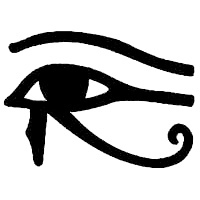
A stylized eye often signals the next section and a character identity. I thought it was a nice visual.
The world seemed rather similar to Egyptian culture, with temples, mummies and polytheism, enabling the reader to quickly grasp the essentials and focus on the details. "After the local fashion, he had painted his eyes with the insignia of a god: two scorpion tails curved upward over his cheeks." Marling adds a delightful magical twist with rivers running in midair, and the power of the gods to create floating temples. Hiresha's skill is in creating magic-imbued jewels using dream imagery. The magical talents remind me a little of the ones in Sanderson's The Alloy of Law, as they are based on Attraction and Lightening and so forth. It's rather fun to have fantasy that takes magic in unconventional directions.
There is the whiff of an emotional romantic triangle, normally a scenario that lends itself to vigorous eyerolling, but I thought Marling handled it well. Although it somewhat reflects the classic good-boy versus bad-boy set-up, there's enough dimensionality to all of the characters, and it is not a true primary storyline. It helps that Hiresha posits her dilemma in terms of responsibility, planning and the forbidden instead of angsty pining.
Overall, I recommend it. I think it would appeal to fans of The Hundred Thousand Kingdoms as well as those who enjoy a female-centered adventure and an Egyptian like settings.
Fox's Bride is unusual, at times bordering on bizarre. Just the title gives that away. Yes, a woman is really supposed to marry a fox - the fox is an incarnation of one of the gods, but for all other purposes, it's a fox.
Then we have an enchantress (the bride) who can only work magic in her sleep, and spends much of the time struggling to stay awake. She infuses jewels with various purposes while asleep, and these jewels can be used in the waking world to protect, etc. The magic system is kind of interesting, and the story gets there too, when the enchantress uncovers an ancient evil that she has to deal with in order to free herself.
The story takes place in an Egyptian-like city, with pyramids that are the tombs of gods. I think. The city and world is still fuzzy to me. Some of the imagery was difficult to decipher, and I felt like I needed to turn upside down to get it. Like I said, it borders on bizarre!
I found the first half of the book hard to get into, especially because the world-building was so off-the-wall. It was also difficult to relate to a somnolent main character who was mostly passive at first. But sometime during the second half, I finally got into the story and stopped being confused. I believe that happened right around the time that the enchantress began to take action and throw a lot of jewels around. I quite enjoyed the tomb-raiding scenes.
If you're looking for a fantasy that's different, this could be for you. I don't think the writing style is for me, though. I prefer to see a world clearly, with all its detail, and that never happened here. After finishing the book, I still find it confused and hazy, like I never saw it come into focus. I still have questions about some loose ends as well, argh. Still, I'm glad I persevered to the end, and that I care enough to wonder about those loose ends.
Those familiar with me on Goodreads will know that I rarely review books. More often, I recommend them, suggesting the type of person who might best enjoy the story. Some people will love a book that boggles another. It is ever my goal to match books to readers who will enjoy them, will be swept be swept away in an adventure of imagination, gripping the corners of their sweat-slick electronic readers with white knuckles all night and into the unmentionable hours of the morning.
Is Fox's Bride the right story for you? First of all, you should love fantasy books. And speaking of taking delight in fantasy, I have asked hundreds of people and collected the reasons why the genre is great.
If you love detailed magics that obey their own laws, you may like Fox's Bride. If you love the idea of a weekend adventure to another world, to an oasis city with bazaars, brass tomb towers etched with hieroglyphs, and enchanted rivers floating through the sky, then you may like Fox's Bride. If you love your protagonists flawed but learning to become better people, then you may like Fox's Bride. If you prefer your stories to be personal, to revolve around a few characters in peril rather than a few continents at war, then Fox's Bride may be for you. If you love your novels to both glitter with visuals as well as contain the ever-nearing thump-thump of horror, then Fox’s Bride may be your book.
I do not presume that Fox's Bride will suit everyone's tastes, but if you're looking for a new journey of imagination, please indulge in the Goodreads excerpt (green button under the illustration on the book page). If the sample shines your shield, then you can find Fox's Bride on Amazon.
This novel is the second dark fantasy featuring Enchantress Hiresha. These aren't serial novels or part of a trilogy or anything--while I think the first book, Brood of Bones, does better with introducing Hiresha, a reader should be able to jump right in on this one and not be lost.
Fox's Bride starts off with a funny, absurd situation. While attending a social event at the pharaoh's Water Palace, in a country that feels much like ancient Egypt, Hiresha suddenly is approached by a fennec fox who circles her three times. Turns out that the fennec is an incarnation of a god and ages-deceased pharaoh called "the Golden Scoundrel" who has chosen hundreds of brides over the years, and Hiresha is the next. Despite her angry protests and lack of belief in this particular cultural practice, she's stuck, and in just a few days will be sacrificed alongside a husband who is prone to pooping on things and biting people. This doesn't fit into her plan of fixing her narcolepsy and marrying her companion Spellsword Chandur at all!
While the stakes from Hiresha's point of view are mostly limited to saving her own life, there's a larger mystery in play that affects the entire City of Oasis, and we discover this along with Hiresha, her attendant Maid Janny, and Chandur (she had a different Spellsword companion in Brood of Bones). A number of new characters are introduced such as the pharaoh, her vizier, and a dying priest named Inannis who are also caught up in the villain's web of control. Mysterious possible love interest Tethiel, Lord of the Feast, introduced in Brood of Bones, also makes a couple of appearances. I'd like to see more of him--romance aside, he's an interesting character.
City of Oasis, along with having the vibe that naturally comes of the presence of pyramids and hieroglyphs, also has a healthy dose of unusual magic, such as: sailing ships that ply the desert, a huge sphere of a lake floating in the air, dark magic that captures the spirits of the dead and the living, and Hiresha's own magic, which involves enchanting gems in her sleep. Each important part of the story involves magic in some way, from chase scenes to trap-filled pyramids to one-on-one battles where a huge two-handed sword made of heavy stone is swung around.
Fox's Bride is told in the third person, which is a change from the first person Brood of Bones. Hiresha's companions Janny and Chandur both get some time in the point-of-view spotlight this time around. Janny's a chubby, middle-aged bawd, and while she's a one-note character, I hadn't seen that particular type in a novel before. Chandur takes a fortune teller's prophecy from earlier in his life as writ, constantly bending his perceptions of events after the fact to fit it. The fennec is a character in his own right, and a fun one. I have my doubts whether he behaves like a fennec would, especially toward the end, but I came to like him and feel for him much like Hiresha did as the story went along. (He's lucky to know someone who can magically cure his fleas!) On the downside, Inannis's role seems too slight for his word count and/or his prominence in the first couple of chapters, and Janny gets shuffled aside late in the story, but otherwise the secondary characters are quite well done. I'd definitely like to see more of Tethiel.
Hiresha herself has learned to make an advantage of her narcoleptic disability, while still feeling and deploring its effects on her while she's awake. She comes to some realizations about herself over the course of this novel. Be careful what you wish for.... She doesn't come across as brusquely as in the first novel, which I'm not sure is a factor of the author's softening her in this one, or the third person narration, or what.
I have to praise the presentation of Fox's Bride, since it goes over and above a lot of self-published novels. The cover art featuring Hiresha and the fennec, while not quite as good as Brood of Bones's, in my opinion, is obviously commissioned (vs. "slap a title over a stock photo, all done"), and is attractive and colorful. The section breaks are nicely in keeping with some of the imagery in the story. Well done!
Fox's Bride is an unusual blend of humor and horror, of magic bright and dark, of romance twisted and pure, with characters I look forward to following in future books.
While I thoroughly enjoyed the first Enchantress book (Brood of Bones) I found Fox's Bride even more compelling as we watch the protagonist, Hiresha, learn to fend for herself. In the first book we get a very strong sense of Hiresha's desire to protect others. She's willing to sacrifice everything to protect her city, and it does make a compelling story. But watching Hiresha shed the guilt she attaches to defending herself and finally decide that she should be allowed to use her magic to protect herself too is an even more compelling story, and AE Marling tells it well. Read the first book to get to know Hiresha's world, magic, and compassion, and read the second to watch a character, well two characters actually, turn from bystanders in their own lives, to full fledged determiners of their own destinies.
A very different experience from the first book. We see Hiresha's world through her young swordsman's disturbingly innocent eyes, and Hiresha herself is forced to stretch her personal boundaries as well as her use of magic. I got lost in a few of the action scenes, and the pacing is uneven at times, but few storylines can successfully swings between as many different genre elements as Hiresha's story tumbles through-- ranging, for example, from farce to mystery to horror all in the space of a single chapter.
Fox’s Bride is the second installment in AE Marling’s Lands of Loam series, following the adventures of the Enchantress Hiresha. (I reviewed Brood of Bones, the first book in the series, a while back). Having read the first book, I expected another high fantasy adventure with a strong sense of humor and a lot of originality.
That is exactly what I got.
Mr. Marling stands out for his use of language and plot-wrangling ability. His world-building is also strong, giving us a fantasy setting which seems both comfortingly familiar and fascinating in its departures from the norm. His character’s power as an Enchantress is well-defined and limited, making her seem all the more ingenious when she comes up with ways to improve upon it.
Without a doubt, Mr. Marling stands among the best indie authors I’ve read. Fox’s Bride, much like Brood of Bones, is an indie book not to be missed.
This author is so fun, clever and awesome! I love the world he thrusts you into. I think a lot of fantasy has the knights/dragons/Celtic vibe. This set of books has more the desert/Egyptian/jewels thing going. This book in the series is a fast paced and wild ride. My favorite part is the main character, an enchantress who is a little rude, a little narcoleptic, and a lot of fun. The special brand of magic she uses (only while sleeping) makes for some very interesting and sticky situations. Loved it!
Fox's Bride begins with a ridiculous premise and has a lot of amusing points throughout. Compared to the first book, Fox's Bride is much more humorous and slightly less serious in nature. Still well written, full of glittering descriptions, and chock full of action. Hiresha gets to be pretty badass, there's what is essentially a D&D dungeon, and the monsters are delightfully terrifying.
"Fox's Bride" follows Hiresha, an elder enchantress afflicted by a disorder, somnolence, which leaves her chronically fatigued and requiring excessive amounts of sleep to function. As an elder enchantress, she has the ability to enchant various precious gemstones with spells, with applications ranging from healing and regeneration to magical artifact creation.
We meet Hiresha as she attends a function at the Water Palace in Oasis Empire, of which she is not a native, where she awaits commissions from noblemen requiring her healing expertise. However, her routine is soon derailed when "the Golden Scoundrel," the God Incarnate in a fennec fox, approaches and proposes marriage. Hiresha intends to refuse the proposal but soon learns that this will not be tolerated – to make matters even worse, the marriage ceremony takes place in the afterlife following a ritual at the end of the year, a mere four days away.
So, Hiresha, with assistance from her loyal bodyguard Chandur and maid Janny, plans to escape from the Oasis Empire. She expects the priests will pursue her out of the city, but hopes to have a head start. However, there is trouble brewing amidst the priests of the Golden Scoundrel, and it soon will attract more attention to Hiresha than she can handle. When the fennec fox, the God Incarnate, turns up missing, Hiresha and Chandur find themselves enemies of the state, with their lives hanging in the balance. Now, Hiresha must find the fennec and the thief who stole him, all while still trying to save her life and that of her young bodyguard. Yet there is no telling who is friend or foe in Oasis City, and Hiresha does not know whom to turn to for help.
Plot and Pacing
The story started off a little bemusing for me, but this was only the first chapter or so. It may well have been my fault, since I confused the two books, believing that this was the first in the series. As such, there were plenty of references with little explanation as to whom/what they were or why they were important to the narrative. Perhaps this will not be problematic for people who read the books in order (I cannot say, as I've yet to read the first), but a brief recap would make the narrative stronger.
Otherwise, the plotting was tight and skillful, with no glaring inconsistencies or holes. However, I found the pacing came in spurts, with lots of stops and starts. Some sequences contained broken action or suspense. For example, the scene on the land-ship when Chandur calls for Hiresha's help is an instance in which the action could have been knitted tighter together. Chandur is in the midst of a battle scene, at which he calls below deck for Hiresha to come out. The point of view then switches to Hiresha, utterly destroying the tension of the sequence—but there is very little payoff. Hiresha's POV inserted here was intended, I believe, to add a bit of suspense to the moment, but it fails in this regard and only serves to break Chandur's action sequence – which is where the true action and tension lies at this point in the plot. When Hiresha finally arrives on-scene, there's no explanation, no payoff to the delay (we know what kept her, but not how she overcame this obstacle, and therefore her POV becomes unnecessary here; we learn nothing, so if Hiresha has nothing to add to the narrative, her scene should be edited out) and serves no point except, perhaps, to extend and divide the battle sequence with Chandur.
Another example, this one of broken suspense, came nearer the end, in the Royal Embalmer's tomb with the Soultrapper. We come out of a charging action sequence several chapters long to find ourselves locked in a tomb with Hiresha, Chandur, the villain and his henchmen. There's no way out, the protagonists are outnumbered and ill-equipped, and help will not come in time enough to save them. This should have been a very tense and suspenseful moment, but instead the narrative takes a strange turn. The tension and suspense die, and I found myself wondering just how long this odd plot point would go on. I couldn't wait for it to end and kept urging the characters to "snap out of it already!" – especially Chandur (see characterization and POV for more on this). I sighed in relief when it was finally finished – not because I truly felt for the characters in that moment, but because I wanted to get back to the actual plot and confront the villain, even if the narrative was reaching its climax and falling action by that time.
Now, that is not to say that I expect every moment to be full of tension and suspense, battles and confrontation. However, this was a sudden screeching halt in what previously had been a mad dash race to the finish line. What's more, it continued for chapters on end, and seemed like a queer diversion for characterization purposes from what should have been the culmination of the plot.
I would have suggested a complete rewrite of that scene to remove the characterization elements (which would fit better elsewhere, anyway), or at least edited-out large chunks of it so the plot didn't stall for so long.
Characterization and POV
[Hiresha]
I liked Hiresha. She was practical, smart and adaptable. I got a sense of what made her tick, what she wanted in life, why she so desperately clung to her plans, and what she feared most of all. Yet, she was willing to adapt and change as necessary. She was clever and cool, and even at her most vulnerable and helpless, she was fearless in the right way.
[Chandur]
Chandur got on my nerves quite a bit. I wish I knew how old he was so I could appropriately judge his character, but the best I could glean was that he was school-aged, trained but not yet a master, perhaps eighteen-plus but at least sixteen.
Chandur's problem is his immaturity, his inability to own his own choices and seize control of his life and the consequences of his actions. Throughout the narrative he speaks of his "fate," of what will happen because it must. He expects others to do for him when he is unable to do for himself because fate says so. He's wishy-washy, and although I understand he's young and confused, most often I wanted to punch him in the eye in the vain hopes it would give him some perspective.
What's even worse with Chandur's character is that he gets away with this behavior. He never learns his lesson. He never has to face the fact that his cowardice in relying on fate – or anyone else – to make choices for him so he does not have to own the consequences is a choice. He could stand up and fight – he's a fighter, and a skilled one, so that's what makes his cowardice so disgusting – and become an asset to his friends instead of a burden and a hindrance when they are at their most vulnerable and are relying on his strength. Unfortunately, Chandur is all brawn and no heart; he lacks inner strength, which becomes the most important kind in the Royal Embalmer's tomb with the Soultrapper. So, he becomes the weakest link, and, for a long time (it seems to me) drags Hiresha and his friends down with him.
I was truly disappointed that Chandur escaped his much-needed character growth moment with a simple and easy, "I don't remember." It isn't fair. He could have doomed his friends and doomed a city/empire, and instead of acknowledging that "fate" is an illusion, that cowardice is as much a choice as bravery is, and it's up to him to decide, for better or worse, what path he wants to take – the coward's or the brave man's – he slinks off unchanged with the same stupid sleazy confidence in his "bright future" and "great fate" as he sauntered into the Royal Embalmer's tomb with (perhaps never to return).
I hope Chandur grows up considerably in future installments – and not off-screen! – but I do think his characterization was skillfully written (flaws and all). There was a moment amidst his wishy-washy confusion that I thought he'd finally got it right (at Bleak Wells), but another half a book later and he let me down hard (the Royal Embalmer's tomb with the Soultrapper).
[Maid Janny]
Maid Janny is an excuse for a bit of lighthearted humor between all the doom and gloom, which was a good thing. Although I can't say much about her, as she was rather a one-dimensional side character, this character-type was much-needed. She made herself useful when she could, as well, whether driving plot or characterization forward.
Her main purpose seemed to focus on driving the "romance" between Hiresha and Chandur. I put romance in quotes because I wouldn't really call it that. I got no impression of true romantic feelings from either character. Hiresha's plan to marry Chandur seemed like just that, a convenient and pragmatic plan; Chandur was willing to when he thought it was his fate, and that really says it all – he had no interest in Hiresha, felt embarrassed for her when she accidentally declared her intentions toward him, and any moments of lust he felt seemed awkward and out of place. Hiresha's private thoughts about Chandur likewise seemed strange and unwelcome. The was creepy as could be, and felt like a bad omen hanging over their romance – Chandur could not even overcome his faults and desire to let someone else take control of his life even when he was breaking Hiresha's heart – and should have sent red warning flags waving and alarm bells ringing all over Hiresha's mind. I was happy with Hiresha's choice in "partners" at the end. Maybe someday Chandur can become the right man for her, but that day was not at the end of "Fox's Bride."
One last note on Janny: her name is dissonant with the rest of the cast. Hiresha. Fosapam Chandur. Vizier Anhkset. Lord Tethiel (also misplaced, but only somewhat). Inannis. Nephrynthian… and Janny Barrows? Janny must have traveled from far, far away to meet up with Hiresha (and this may be; I've yet to read the first book) to have a name like that in a place like Oasis Empire.
[The Lord of the Feast]
I can't say very much about the Lord of the Feast. I wish I had more information on him. I think his character was under-utilized and this disappointed me. Most of his action seems to take place off-screen, as well, another disappointment. That said, what I saw of him was compelling. I think the Lord of the Feast might be the most complex character in the cast, so I really wanted to know more about him. His interactions with the other nobles, with Hiresha, with Nephrynthian and Chandur and the Vizier were all charming with a hint of sinister, and I loved that about him. I also loved the sense that he was power-mad and regretted it. I think, in another time (perhaps before he became a Feaster or in the future if he overcomes this magic and instinct) he could be a good partner for Hiresha. At least, he seemed to care about her far more than Chandur did, and he put himself at risk to help her and controlled his urges when she asked him to. I think Hiresha should have turned to the Lord of the Feast for help sooner – all her dithering and doubts about his character seemed exaggerated, especially since he proved himself an invaluable help to Hiresha and even Chandur, and the city/empire all along. His contributions in the end also should not be overlooked or underestimated. Hiresha should have used his connections and manipulations to her advantage instead of talking bad about him behind his back all the time.
That said, there was far more "romance" between Hiresha and the Lord of the Feast than between Hiresha and Chandur. Hiresha's thoughts about and reactions to the Lord of the Feast were intense and palpable, but as concerned Chandur, they were relatively tame, and easy. At one point she even describes her affections for Chandur as "safe" and "tame" herself; this is not a good sign for any possible romance between them. Although I understand Hiresha's concerns about getting too close to a Feaster in theory, as a reader I was more compelled to spend time with the two of them, and even the Lord of the Feast alone. I wish the Lord of the Feast got his own chapters, fleshing out his off-screen actions and characterization, as well as propelling us deeper into the world, the plot and the problem at hand.
[The Royal Embalmer]
My concern with this character is that he felt too obvious. From the moment we meet the Royal Embalmer in the early chapters (01/02?), I kept guessing (correctly) what was next to come in relation to his role to play in the plot. A little more ambiguity would have been nice, a lot less foreshadowing – even though most of it is subtle, in tone and theme, rather than overt (as with Chandur).
[Other]
I think the "Fox's Bride" suffered from some issues with point of view. At times I would have liked a little more information about some of the action that happens off-screen. Chapters following Inannis in his endeavors might have been revealing and gripping. Some chapters foreshadowing the Soultrapper (which seems to come out of left field) also might have enriched the narrative. A key way I think these chapters might have been instituted: via the characters the Soultrapper touched. Otherwise, the first hint we have of the Soultrapper (Bleak Wells) comes from the Lord of the Feast far too late in the plot structure; the reason why: Hiresha has already been declared chosen one, balked from the rite, fled, been captured and charged with her quest… so, now it seems the reader knows where the story is headed and why. However, just as the reader accepts this quest as the gist of the narrative, the problem and quest facing Hiresha changes. What's more, she initially dismisses the information out of hand, and it is only much later on that she finally accepts what her "true" quest is (with her fight for Chandur and her life being a subplot endeavor). Introducing the Soultrapper earlier, in hints and foreshadowing and even red herrings, might be a compelling course for Marling to take here.
[Inannis]
I only have two reservations about the Inannis storyline. First, he simply disappears following the theft of the fennec fox. We are given no insight into his character, his motives, his endeavors beyond this point until we meet him again briefly in the kennels (Hiresha's POV), and then again later, briefly, at Bleak Wells (Chandur's POV), before his final appearance at the pub's basement room (Inannis's POV, at last). What happened? Where did he go? Why is there no resolution of this storyline? Especially after the night at the pub room, where Inannis and Emesea encounter the Lord of the Feast… given these character's history (alluded to), I find it hard to believe nothing of note happened following this meeting. Second, the Inannis storyline feels as if it is just dropped, without resolution, without future. Too much happens off-screen. Even the ending happens off-screen.
While I did not particularly like Inannis, I thought he was an interesting and complex character. That said, I did not really understand his plans and goals. His resentment toward the god did not seem to gel with his drive to rescue his beloved partner. I'm not certain how or why these two storylines connect. This could be easily resolved with a few point of view chapters and/or a bit of exposition.
[Vizier Anhkset]
I find it curious that the Vizier came to his senses – and the conclusion that there was a Soultrapper in Oasis City – so quickly. However fortunate for our protagonists, it felt a little too convenient and contrived.
Prose and Style
The prose in the first chapter struck me as a little purple – but don't let that deter potential readers. Marling soon finds his voice and style, settling into a nice and consistent rhythm. I noticed few typos and grammar errors (discounting those within dialogue), and the formatting made for a quick, easy and comfortable read (on Kindle). A few times I paused at word choice, thinking of one that might fit the narrative better, but overall I think Marling has a pleasant and compelling style, narrating with the rare skill to stimulate the senses and envelop the reader in a lush and novel environment.
Worldbuilding and Setting
For "Fox's Bride", Marling chose a desert oasis environment reminiscent of ancient Egypt and infused with the life and magic of pure imagination. Ships sail overland, skimming the lofty dunes with sand whipping in sailors' faces. Pyramids float in the sky, chained down to the earth. A lake of fresh water is collected from air and hovers above a pyramid tipped with quartz, and streams down to the underground aqueduct at night. Enchanted gems heal the sick, bewitch artifacts and weapons, and more.
Oasis City feels real and lively. Nobility ride the streets astride ostriches and camels, merchants at their kiosks hawk their goods to passersby and pilgrims, and peasant salt-miners gather in the misery of the tent city slums, receiving fresh water as payment for their salt. Scarab beetles clean dung from the roads and alleys. And everyone appreciates a hot meal of crocodile and cobra, but only the wealthiest indulge in oysters and fish.
Marling does a masterful job of establishing place and world, giving the inhabitants of Oasis City a firm foundation from which to arise and thrive. Worldbuilding is always one of my favorite parts of reading and writing, and Marling has done a commendable job here.
In fact, the only time I cocked my eyebrow was at the surfeit of precious gemstones. Something so profuse as the gems and rare stones in this nation cannot possibly be expensive, and yet I at times had the impression they still cost a pretty penny and remained a lucrative endeavor for those looking to make fortunes, strengthening the economy. This may be a matter of conflicting information, even. At one instance, Hiresha mentions that the guards' weapons were studded with diamonds and other gems, which the noblemen scorned as common. Yet, although gemstones constitute the large part of Hiresha's estate, she is forced to relinquish it to pay reparations that surely must total in the thousands of gold coin. However, later on Hiresha indebted herself to the Silver Crocodile in order to buy enough gems to suit her purposes; she wouldn't have had to if gemstones were as common, cheap and easy to obtain as they must be in Oasis City, given the gem-encrusted descriptions of just about everything barring tent city.
I wondered how the fennecs in the kennels weren't domesticated over the thousand years they were bred – even accidentally, as current research suggests this process might proceed within as few as fifteen generations (fox) of breeding. However, I'm more than willing to suspend disbelief about this minor detail.
Conclusions
I've had a lot to say about "Fox's Bride" but my criticisms are intended as constructive and should not deter potential readers. I enjoyed the novel, and devoured it in one sitting. I'd like to extend my thanks to A. E. Marling for alerting me that "Fox's Bride" was available on Kindle for free, and I shall be purchasing the first book and any future installments of the series.
"Fox's Bride" was a quick, enjoyable and lighthearted read. It's also family friendly [there are a few instances of cursing – "sh-t" – with little violence and no gore; the characters are careful not to kill in battle. The book was very wholesome, and I'd recommend it to readers as young as thirteen, with permission of their parents]. Marling swiftly draws the reader into Hiresha's world and her mind, and her her story is compelling and fun. I look forward to learning more about these characters and their world.
To conclude: "Fox's Bride" is a great book and fun read, which I highly recommend. A strong 4 Stars.
For those among you that don't like long reviews: read this book, it's fantastic. Why, you ask? So you do want a longer review? OK, fine.
Fox's Bride is the second adventure of Elder Enchantress Hiresha, the sequel to the equally great Brood of Bones. It can be read as a standalone novel, though, for which I'm really grateful, considering all the series out there that require in-depth knowledge of every fore-runner written.
Speaking of enchantresses, A.E. Marling is such a word wizard himself, he creates amazing magical worlds. I would read his books even if they were only travel guides to the Lands of Loam - I love to be able to roam those lands of the somnambulistic sorceress* and her team, the gleaming spellsword and the feisty maid, filled with tragically fated yet attractive nightly terrors, cute hugely eared desert-foxes, a coruscating capitalistic crocodile, and a wondrous architecture that makes you gape in awe: overhead upside-down waterways and floating pyramids!
A warning, though: if you're easily grossed-out by gory scenes, you might want to skip this one. A master soultrapper is not a very cleanly enemy to fight...
I do have a point of critique, though: I think the book is too short. This is not meant as a fangirly rave. I really do think there are some side plots that are left sadly unexplored. I would've loved to get some more hints about the story of the false priest and his strange lover and their dealings with the Lord of the Feast (although I suspect that we might hear more about them in a following book?) - their plight is more or less drifting into the background after the first half of the book, and I think it would have rounded the book off if we could have read about the fight in the pyramid the Lord of the Feast sends him to... boy, this is hard to write without spoilers.
The Lord of the Feast is still my second favourite character after Hiresha herself - such an "Oscar-Wilde-sque" brilliance here. The whole idea of his kind of magic appeals to me, illusionist fear-feasting vampires with room for many fantastic incarnations. The girl with the Blue Sky Dress in this book is a wonderful example... though in the end she wasn't allowed to intervene much in the story. That preference may be the cause that I didn't quite warm towards Spellsword Chandur and the story of the tentative interest in/of his employer. I tried... but his fate-driven ill-timed acquiescence to forces that tried to manipulate him was a little too much for me. Nevertheless, I know it had to be this way for the psychologically intense end battle, so I will not complain. Only a tiny, tiny bit. Nearly not at all.
Satisfied with the length of the review now? Then I tell you again, read it. It's a very good fantasy novel that has a considerably unique setting and style.
* Poetic licence for alliteration purposes, actually she's narcoleptic.
This was a pleasant surprise. What I thought was overbearing description in the beginning turned into neccessary, appreciated and brilliantly realised scene-setting and world-building. It's rare that I want to applaud an author for giving themselves literal boundaries to work within when it comes to magic and spiritualism - Fox's Bride is definitely one of those cases. I can't wait to read more of A E Marling's work.
4 stars out of 5. Even the bride couldn't sleep through this one.
This book took me a ridiculously long time to finish, through no fault of it's own. I kept having to put it down to read things I was obligated to, either through pre-arranged reviews, or my editing clients. Constant interruptions don't do any books any favors, and it's a shame, because this was one of the more creative fantasies I'd read in a while. It takes place in a setting called the Lands of Loam, and seems largely based on Egypt.
The enchantress Hiresha has had some previous adventures (I have not read the prequel, Brood of Bones, yet) and these are briefly referenced, but the story remains (mostly) independent. Hiresha, a narcoleptic sorceress who works her craft by enchanting gems while she sleeps, employs a spellsword named Chandur whom she kind of secretly loves (or at least plans to marry--she seems a bit confused on this topic). All her grand plans get thrown into doubt when a fox walks around her three times. Sound innocent? Well, the people worship the fox as an incarnation of one of their gods (which were once pharaohs in life), and now the fox as chosen her as his next bride.
So yeah, the city cult has decided the fox is a god, and now Hiresha has no choice but to marry the critter. And it gets weirder: On their wedding night they're to be entombed. To ensure a year of prosperity.
Oh, and also, no one goes out at night because there are these monster people called Feasters that do something fatal if they catch you. They seemed maybe like vampires, but this was unclear throughout the novel. It bugged me, but I'll excuse it because it seemed like it was maybe something explained in the first book. Which brings me back to it--I kind of wish I'd read Brood of Bones first, to understand a bit more about Tethiel, the Feasters, and just what was going on with them. While they are a tangent to the main plot, it nevertheless remained a point of confusion.
In any event, the novel remain unusual, with bizarre tongue-in-cheek circumstances, yet a plot and characters that continued to take themselves seriously. And when I was finally able to sit down and dedicated some uninterrupted time to it, I enjoyed the read.
The Dreaded Second Novel, in which the author must prove himself to not be a fluke, has been the downfall of many.
“Fox’s Bride” is Marling’s sophomore work, and it lives up to it’s potential. In it, we return to Marling’s Lands of Loam for another adventure with Enchantress Hiresha. The author’s slightly exotic use of the language works well, and I find it gives the work a certain flavor that’s hard to describe, but is far from unpleasant, and may feel familiar to those who spend time around folk for whom english is a second language.
The storyline is slightly less inventive as his initiatory work, but is no less entertaining and barrels along at breakneck speed. It’s packed full of action scenes, with one leaping right into the next, but the fast pace suits the plot quite well. We also get a bit more of Marling’s interesting magical system, as our heroine seeks to use what is almost by definition a passive force in an aggressive way in order to save herself, the city she’s in and a certain mischievous little Fennec Fox (Note to the author: Keep the Fox, it’s a great device) from the control of an undead sorcerer.
Character development is a bit thin on the ground here, but it’s not badly missed. I for one, however, would like to see more details of this world filled in around us. The fast pace pretty much prohibits leisurely descriptions and illuminating character interactions. Personally I feel it as a lack, but i’m quite certain there are many who enjoy not having to slog through miles of purple-prose descriptions… a flaw common enough in this particular genre.
Overall, I’ll recommend this one as an enjoyable read for lovers of the fantasy genre, but I think Marling hasn’t given us his best work yet. Keep an eye on him, because considering the scope of the world he’s building, I think we have plenty of time.
Really, I’ll repeat my statement from my review of his “Brood Of Bones” and state again that if this man was sent away by the Big Six they’re stupider than I thought.
First off, I want to make sure I express something really important. I’m not a visual person. I’m a tactile person. When I was about 9 years old, the teacher told us to close our eyes and picture a mountain. I raised my hand. “I see blackness.” “Picture a mountain. There’s snow on top, and trees along the bottom and on the side.” She said. “I see blackness.” I said. “Try, Nicki. Keep your eyes closed and picture the details.” Pause. “Do you see it?” She said. “Um. Yeah. I see it.” I did not, I was lying. I didn’t want to deal with explaining a third time that NO I TOLD YOU I can’t see it. I was a smart 9 year old, picking my battles. Anyway. So I was a little taken aback at the in depth nature of the visual world A.E. launches right into, waist deep. I’m not sure if this is a feature of a brand of fantasy that I’m not used to experiencing, or if it’s that visual problem again. After all, he defies physics. There’s hurling gemstones. Special spells, hybrid animals. But right away the story had me. I found I couldn’t go to sleep at night without knowing a *little* bit more about the next scene. I chose my stopping points carefully. And the chapter breaks! Gorgeous. Can’t wait to experiment with eye animals. I laughed several times at the dry nature of the main characters, their wry humor. I loved the supporting characters, the adventure, the villain(s), and the mental growth of the two main characters, Hiresha and Chandpur. I had some trouble during drama scenes later inside a tomb. It was just too complicated, visually, for me to follow without more markers and descriptive text. It followed the action, and I needed a bit more stage setting to understand why we are now upside down, and what direction we are going and why. I would definitely recommend, and count myself lucky to have met the author in person. I will be continuing my adventures into the Lands of Loam!
The second story of Hiresha the enchantress lives up to its predecessor and then some.
This book takes us to a new city, Oasis, the capital of the empire that contains the Enchantresses' academy.
While attending a party there, Hiresha is singled out by the Golden Scoundrel, an ancient god/king believed reincarnated into the body of a fennec fox. Due to his attentions, she is told she must marry him.
Hiresha's attempts to escape this fate are complicated by a vindictive theft plot against the priests and the fennec. In addition, Tethiel the Lord of the Feast is also in the city, and believes they have a Soultrapper to contend with.
I felt that this book was better than the first (which I also enjoyed) due in large part to the maturation of Hiresha's character. Her interactions with Maid Janny come off more as affectionate exasperation than Brood of Bones' prudish peevishness. She treats her Spellsword as a person more often than before. She's far less concerned with appearances and propriety than she was in BoB as well.
As well as her personal growth, the enchantress takes her fate in her own hands a bit more this time around. I won't spoil it, but it does include a new wrinkle in the use of her powers that I felt was well done.
The people and city of Oasis are an excellent example of taking a real world environment and modifying it for your own purposes, and making it truly complex instead of a pale veneer of stereotypes.
An excellent sophomore outing from Marling. I can't wait to see what's next.
I thoroughly enjoyed Fox's Bride. I'm always leery of the second book in a series, as they usually don't quite reach my expectations of how a character should act and relate to others. Happily, Marling gives Hiresha her superior airs while still allowing a few chinks in the armor to appear so that the reader may better relate to her.
This book offers a second unique foray into the world of Loam, which seems to be a slightly Arabian-influenced realm (at least what we have seen so far). In this case, we are actually in something that resembles a mix of the Middle East and Egypt, with the added delight of a fennec fox thrown in for good measure.
Hiresha is caught up in the machinations of the priesthood of the prevailing god - the Golden Scoundrel - when its representative on earth - the fennec - chooses her as it's bride. For obvious and varied reasons, this is much not to be desired. In thwarting her wedding - which would be, as we say, her last affair - Hiresha will bring down a tradition that has perpetuated for hundreds of years.
While this plot summary may sound generalized, I'm really just trying not to spoil it for you. Here again Marling uses his unique view of magic and gemstones to create a fantasy world which borrows from but is completely unique from previous standard high fantasy worlds.
In other words, if you are looking for a new author to support, get this. It is highly worth it.
A. E. Marling and Hiresha continue to capture my heart! The stories I have read by this author (this book and 'Brood of Bones') keep me coming back for more. Marling's writing is clean, well defined and cut as exquisitely as any of Hiresha's best gems.
When Hiresha arrives in Oasis City, she thinks her time spent there will be a bore as everyone scampers to do the fennec's bidding, believing that it is possessed by one of their gods known as 'The Golden Scoundrel'. But when the furry little avatar circles her feet three times, everyone is delighted that he has chosen his bride! While the details are a bit fuzzy, (no pun intended) Hiresha is certain she does not want to marry a fox.
While we get to meet some new faces, a few old ones return as well. Hiresha's maid, Janny and the dark one himself, the Lord of the Feast, Tethiel.
This time, the Lord of the Feast is not as prominent and the story focuses more on Hiresha and her Spellsword, Chandur. Because Hiresha does not want to rely on Tethiel as much as she did before, she discovers some new strengths of her own. Going against the wishes of the priest's, Hiresha makes her choice: Save the city or asphyxiate with a furry spouse.
Once again, Marling captivated me and Hiresha charmed me. I have to give this book a 5 star review.
Enchantress Hiresha's intelligent fantasy/mystery story continues in the wonderful follow-up to "Brood of Bones." Marling's prose beautifully captures the flavor of the desert, creating richly painted scenes. The plot is full of expertly crafted twists and turns, and the characters are brought to you in vibrant technicolor. I loved seeing Hiresha thwarted, regrouping, stepping outside the bounds of what she knows, and growing as she does. She's not just a focused 'scientist,' she's whimsical, at times callous, and she has a habit of putting her foot in her mouth. Her new bodyguard, Chandur, strikes me as a good-hearted, wonderfully loyal and idealistic but frustratingly dense individual, but he too grows through his experiences, making for a more solid, engaging character. The doings of the Soultrapper antagonist are devious and woven expertly into the tapestry with threads of creepiness and dark humor. Well done! I would have liked Tethiel to figure a little more prominently; I missed his biting wit and dry humor, and the knife-edge relationship with Hiresha developed in "Brood of Bones" only received token attention after his reintroduction. "Fox's Bride" flows well, keeps a quick pace, and ends on a strong note. Again, I am looking forward to Marling's next book.
A. E. Marling and Hiresha continue to capture my heart! The stories I have read by this author (this book and 'Brood of Bones') keep me coming back for more. Marling's writing is clean, well defined and cut as exquisitely as any of Hiresha's best gems.
When Hiresha arrives in Oasis City, she thinks her time spent there will be a bore as everyone scampers to do the fennec's bidding, believing that it is possessed by one of their gods known as 'The Golden Scoundrel'. But when the furry little avatar circles her feet three times, everyone is delighted that he has chosen his bride! While the details are a bit fuzzy, (no pun intended) Hiresha is certain she does not want to marry a fox.
While we get to meet some new faces, a few old ones return as well. Hiresha's maid, Janny and the dark one himself, the Lord of the Feast, Tethiel.
This time, the Lord of the Feast is not as prominent and the story focuses more on Hiresha and her Spellsword, Chandur. Because Hiresha does not want to rely on Tethiel as much as she did before, she discovers some new strengths of her own. Going against the wishes of the priest's, Hiresha makes her choice: Save the city or asphyxiate with a furry spouse.
Once again, Marling captivated me and Hiresha charmed me.
Oasis City is sort of a magical Ancient Egypt. Amongst the several gods that are adored there, one of them incarnates in fennec foxes and chooses women to marry him - that is, women to be buried alive with live foxes. Enchantress Hiresha is chosen by the current fennec fox god and sees no option but to try and run away during her short "engagement". However, Tethiel warns her that her problem is bigger than she imagines and there is black magic in motion to murder her.
Now that this world is more familiar to me, the originality does not struck me as much as it did in the first book. Having said that, I think the author did a great job of choosing a different scenario (I loved the Oasis City) and a more interesting villain. I liked Hiresha much more in this book, as well as the comic moments by maid Janny. I was just sorry that Tethiel did not have a bigger role as I like him better than Chandur. There is always some action taking place, which is surprising since the main character only practises magic in her sleep. But I only really got engaged in the story half way through the book. I was surprised by the end, and I probably enjoyed the "tomb raiding" more than I should, so I will definitely read the next instalment.
The book was well written with correct grammar; something that is hard to come by in today's age (sad to say).
The characters are true to life, while still meeting that bit of magical allure we all love in fantasy novels. They all have their own distinct personalities, descriptions, faults, and talents that make them so believable to the reader.
Reader's will also love the silly, mischievous little fennec and his antics. They are a source of merriment to the reader, and sometimes annoyance to the characters. I could picture some of the things he did in my head, and would laugh aloud (to my curious roommates amusement).
At some points I got a little confused, but in a good way. And it all really resolves itself in its own way, making the story even better. You actually have to think while reading, you can't just numbly read and turn the page.
All in all, I give it a five star rating. I can not wait to continue reading the series, and I give a huge Kudos to the author, who has been kindly corresponding with me and asking me my thoughts and opinions.
The Fox's Bride is an quick, fun read for anyone who enjoys a high fantasy based story. I loved Hiresha,the protagonist enchantress, but Tethiel amused and fascinated me more with the language he used..actually every aspect of his personality fascinated me.Janny made me laughed a lot with her witty personality and remarks to Hiresha about her love interests. I enjoyed the magical aspect of The Fox's Bride. A. E. Marling did a great job incorporating Hiresha's gem magic. Another thing I LOVED about the story was the fennec fox. The little fox made The Fox's Bride if you ask me.
The only thing I wish I could have done before I read The Fox's Bride was to have read the first story of Hiresha. I received a copy of The Fox's Bride from the actor in exchange for an review. Personally, I liked the story and I plan to read the Brood of Bones by A.E. Marling, so I can really get a better understanding of Hiresha.
In Brood of Bones the only fault I could find was losing my footing every now and then due to an occasionally vaguely painted background. The rest of the story could not be faulted and I loved every gem studded chapter.
However in Fox's Bride Mr Marling has outdone himself. From the off I was grabbed firmly by the nose hairs and dragged straight into the story.
I don't believe I would have gone to sleep or left the house if I had any choice.
The story was so perfectly crafted that could I almost reach out and write in the dust. The characters too have developed and I have become rather fond of sleepy old Hiresha and her tetchy ways.
There is however one flaw in this whole book. It leaves me with a cold hard realisation that will dog my steps in the normal hubbub of the waking world. It left me with the knowledge that I will never own a Fennec god.
I really liked the first book but this sequel was a bit disappointing,not bad precisely,but it lacked something. The writing was still good and the off-beat humor still there.
I mean,having to marry a fox, How is that not hilarious. :)
But I didnt really like Chandur,Hireshas new bodyguard.His pov wasnt really interesting,or rather I didnt enjoy being in his head. He was just so dull and simpleminded to the extreme.
When Hiresha mused about finding him attractive I was like "NOOOOO!"
Partly because if his personality and age...but mainly because I ship Hiresha X Tethiel
She belongs with Tethiel even if he is an undead amoral guy even if he is morally ambigious.
But at least he is interesting-speaking of that....there wasnt nearly enough Tethiel :/
For the next book I hope there is much much more HireshaXTethiel goodness.
The world A.E. Marling has created for his enchantress Hiresha is as engaging here as it was in the first book of this series, Brood of Bones. As if Hiresha herself wasn't enough, the other characters are also all well-defined with interesting parts to play in this book, and I enjoyed learning more of them. And don't even get me started on the fennec fox, he does tend to stroll in and steal the scene!
It's definitely one of those books where not too much of the plot can be given away in the blurb, and therefore it went in directions I wasn't expecting it to go. Some of the action scenes went on a little long for my tastes, but there was sufficient payoff in either the reason for that action or the result of it to compensate for that, and there's definitely enough intriguing character enrichment going on to keep me reading. More please!
Overall i liked this book quite a bit. The story was original and it did a good job of introducing the culture, situations, and characters through the storytelling without using too much of that "expositional backstory" device that's far too common in fantasy & sci fi.
I found myself caring about the characters and the story. My only reservation is that i felt the story took too long to get where it was going. Except for that, this was a first-rate read for me.
Also, A.E. Marling was gracious enough to contact me and let me know that this book (which was on my to-read list) was available for free on Amazon so i was able to read it much sooner than i might have otherwise. I really appreciated that.
Also, it seems there's a prequel so i'll be checking that out too.
Another delightful read! The follow along from Brood of Bones this one continues with the adventures of the lovely Hiresha, and although it is a good tale I felt that it was not as tightly woven or as richly described, leaving me slightly disappointed. Don't let that discourage, however as it really is a worthwhile and enjoyable read. The author continues to fascinate, intrigue and delight with his world and the cultures found within, and I look forward to hopefully seeing Hiresha get her fondest desires.
I'm loving this author's stories, they do not disappoint. I find his world of Loam well thought out, intriguing and down right fun. You are missing out if you don't take a journey within its borders.