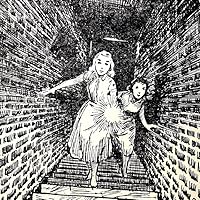
For the passengers aboard the Latakia, the transatlantic journey from New York to Cherbourg promises weeks of rest and relaxation, no matter what class of ticket they have. But after an Italian baroness is found strangled in her cabin, the situation on board becomes more tense. The main suspect soon goes overboard, creating more questions than answers: Did a guilty conscience spur a suicidal act, or was he a witness silenced by the true killer, still at large on the luxury liner.
Enter former intelligence officer Walter Ghost, tapped by the ship’s captain to play detective and solve the murder. He’s joined by his friend Dunsten Mollock, a novelist whose experience with mystery stories gives him helpful insights into the case. With clues including an amateur film, a doll, and a card from Memphis, Tennessee, it seems the duo have plenty to work with. But will they be able to solve the crime before word of the murder makes it into the steamship’s rumor mill, surely sending any guilty persons even deeper into hiding?
Originally published in 1929 and out of print for nearly a century, Murder on “B” Deck is a puzzling-yet-humorous whodunnit set in the Golden Age of transatlantic travel.
Includes discussion guide questions for use in book clubs.
Vincent Starrett was a book collector, author, bibliographer, and a Sherlock Holmes scholar. He has been referred to as part of Chicago's "literary renaissance” and has written or edited more than 50 books of essays, criticism, fiction, biography, poetry, and bibliography.
Only justifies three stars because of the cover and what that evokes.
Sadly, less than I was hoping for. Some of the elements were in place but the Art Deco ship on the cover turns out to be sluggish and characters are not the snappy Nick and Nora Charles of The Thin Man movies.
Its best elements were the trans-Atlantic cruise setting with people of the time (Almost entirely first class here. They don’t know it but the big stock market crash is just around the corner). The author has the typical amateur sleuth/passenger and his slightly dim sidekick as well as pretty women who add very little to the story.
The storyline is often preposterous, and for a short book it drags on too long. The first murder happens on day two from NYC to Cherbourg. A prominent “countess” from the Captain’s table is discovered dead by her maid. The sleuth is called into the case by the ship’s captain (another dullard) and we’re off. The missing countess is barely remarked upon by the other passengers. The captain isn’t too sure what to do with the body. He suggests that there is not a dedicated morgue on the ship and just leaves her in her room for the time being. What, for six more days??
This is only worth your time if you’re a dedicated fan of golden age detectives and “B” novels.
1920s murder mystery on a transatlantic liner with lots of promisingly weird aspects most of which devolved into unfunny jokes. Not sure why anyone bothered to republish this.
I very much enjoyed the beginning of this. The main character, a writer, overstayed his goodbye to his sister and her new husband as they set sail and wound up stuck on the ship himself. An old friend of his who is an amateur sleuth is already aboard, a Mr. Ghost (said to be apparently "appallingly ugly" though no description is ever given to explain what this means). Ghost has a more than winning personality and a very first-class mind so when a murder does happen on board, he's the perfect person to help solve it. I liked all of this, I even liked that the main character was writing a story and the actual murder is shockingly close to his plot. This was pretty much a solid three star read for me for most of the book.
It became a 2-star read when in the end, the main character and his paramour blame the first murder victim for her murder. Mind, they completely laid out that the man who killed her was wrong and very much hateful and likely to have killed her anyway, but still, they lay the blame at the victim's feet. It was so very close to "Well, she denied his attentions and laughed at him so of course....". I don't care that this is an older work, that doesn't work for me. Dated to the point of eye-rolling for this reader. Also, the murderer cops to the killings and just sort of slips away in death so quickly and easily that the interrogator didn't even realize he'd died for a minute. If this weren't on my Kindle, I'd have thrown the book down. Talk about an unsatisfying end after such an engaging start.
I'm a sucker for all things "transport" mystery, whether it be plane, train, or ship. So, this book was no exception. Our narrator, Dunstan Mollock, is nearly a stowaway on a transatlantic trip to Cherbourg, and of course the amateur sleuth and novelist gets right into the thick of things. I enjoyed the atmosphere and the novel within a novel storyline. A silent movie film reel is also an important clue, and its description proved to be surprisingly evocative. But despite the high points, I was disappointed with the ending, as I felt as though the suspect came out of left field.
Vincent Starrett, better known to me for his Holmesian work, gives readers a dose death on the high seas in his first murder mystery. Dunstan "Duns" Mollock, mystery writer and slightly Nigel Bruce-ish sidekick to Walter Ghost, is onboard the Latakia to see his sister and new hubby off on a voyage to England. The bon voyage party participants joke about what would happen if they didn't get off the boat in time and then Mollock manages to do just that. Fortunately, he runs into his old friend Walter Ghost, who seems to have influence over the captain, and, even more fortunately, he seems to run around with enough funds to cover a trip to England at the drop of a hat. He secures a first-class berth and is all set for a lovely voyage. He meets the delightful Miss Dhu Harrington and promptly sets about falling in love.
But the pleasant voyage is soon disrupted by the brutal murder of the Countess Fogartini. Ghost has a bit of a reputation as an amateur sleuth and the captain requests his help in unraveling the crime. There are few clues--in fact, at first it looks like the killer has gotten away without leaving a single trace. But then a rather ragged envelope with a lover's charm is found and speculation follows as to which passenger was the lover and whether he is also a killer. When Major Phillips (who had been quite attentive to the Countess) goes overboard, speculation goes further to say that he was the man. He must have killed the Countess in a jealous rage and then jumped overboard in a fit of remorse. But Ghost is not convinced. The major didn't seem to be that kind of man and he definitely is not the mystery man seen in a certain roll of film secured by the Countess. And when Ghost is attacked one night, it's obvious the culprit is still skulking among the passengers. He's only got five days to solve the crime before the ship docks in Cherbourg and passengers could leave the ship. Five days to track down a very careful killer.
As others on Goodreads have mentioned, I think the "B" in the title stands for "B" movie. I could definitely see this as an old black and white mystery/comedy. A younger, slightly less bumbling version of Nigel Bruce's Watson would be perfect as "Duns." The mystery itself is perfectly okay, though Much smarter heads than mine are needed to figure that out. Another point keeping this from a higher rating is the fact that while a big deal is made about Ghost needing to find out who the killer is before Cherbourg, there is no real sense of urgency or speed. Things move rather slowly in the middle and I just never felt the pressure of time as referred to (more than once).
This was a pleasant read and enjoyable enough. It just wasn't quite as exciting or interesting as I had hoped.
Reviewed on my blog My Reader's Block. Please request permission before reposting portions of review. Thanks.
Good detail and ambiance of a trans-Atlantic crossing. The vicious murder of a "countess" brings novelist Mollock and amateur sleuth Ghost together. I enjoyed the lighthearted treatment and delightful turn of phrase in this novel, with lots of time-period appropriate remarks and descriptions.
As a writer I notice the switching point of view which tends to take me out of the story. I'd have enjoyed it more if the author developed the main character Ghost a bit more: Michael Connelly says "the best crime novels are not about how a detective words on a case; they are about how a case works on a detective!"
The murderer is apprehended, but he shows up too late in the story, so the reader does not have any opportunity to guess at which of the set of suspects he might be. Still, a fun story in a bygone era. The class divisions of the time are well represented.
Minor gripe: my ebook version had a few typographical errors which closer proofreading might have avoided.
Novelist Duns comes to see sister Mavis off as she and new husband Todd sail to Europe on their honeymoon-business trip. He starts off with oh, what a drag it is to always be seeing people off and never going yourself. Todd asks Underwood to see the drunken Duns ashore. But 2 minutes later Duns is back on board as he forgot to give Mavis his newest book. Before he finds Mavis he runs into the ugly Walter Ghost, an old friend, gets stuck on board when the ship sails. He is offered a ride on the pilot boat but would require some awkward maneuvers that he is not sure he could handle, drunk or sober, so he sails to Europe with everybody else.
A Contessa winds up getting murdered and Walter, who knows a lot of people, is asked to investigate, apparently based on his wartime experience. This puts out one of the staff, who actually was a police/detective previously but he helps. Before he does much of anything, a Major Phillips is "man overboard". Did he jump, or was he pushed/thrown? This could be murder-suicide. But Walter doesn't think so.
And the amateur goes on to "investigate", Duns gets put out by Dhu, a girl he met on board, gets drunk and meets Underwood. He thinks he may be the killer - he is travelling incognito. Various other people are suspected, too.
But Walter must resolve it before Cherbourg, or can the captain force everyone to stay on to Southampton and be turned over to Scotland Yard? Walter isn't sure the captain has that kind of authority.
It is a nice romp.
This may have been Starrett's first book. It is the first book in the short Walter Ghost series - there are three.
An enjoyable murder mystery especially if you’re looking for a quick, evenly paced read. The mystery was intriguing enough and what made me like this was the fact that Walter Ghost was not a detective with an ego, unlike some. He is intelligent and methodical but also willing to listen to others and admit his mistakes or uncertainties. A very likeable detective. I also liked the supporting cast especially the ship officers and also Ghost’s good friend Mollocks.
The investigation was realistic enough and the conclusion satisfying.
Overall an enjoyable read and I’m looking forward to reading the other books in the series.
A fun mystery, that doesn't take itself too serious. It's the second book I've read of Starrett's that features a murder mystery writer. It reads like a black and white move caper mystery. One thing that is noticeable here is the writing is well done, and there are references made that tip you off that the author is knowledgeable about art, history and language.
Walter Ghost, who is roped in to help detect who the murderer is, makes good guesses, some mistakes, and knows how to roll with the flip of events. He and the mystery writer join forces to solve the crime.
One thing that I took notice of: there is a silent film shown in the story; and, it is one of the best descriptions of seeing a silent film I've read.
If you're looking for a fun mystery that moves along and you just want to escape. This is a good choice.
This 1929 detective novel doesn’t necessarily follow the fair play rules we’ve become accustomed to in more recent mysteries. It is understandable that Otto Penzler would include this as an American Mystery Classic due to it’s early detective and sidekick format. While this didn’t quite hit the mark for me, I would read his other entry in the series, The Grand Hotel Murder.
Setting a murder on board the transatlantic liner, Latakia, two days at sea, facilitates a good deal more tension in this mystery than if it had been set on land. The culprit's presence is acutely felt, the characters are captive and forced to mingle, suspensions run rampant. Meanwhile amateur sleuth, Walter Ghost, awaits the delivery of cablegrams and contemplates some obscure (to the reader) clues to the crime.
Murder on "B" Deck is perfect for mystery fans who enjoy fallible detectives (i.e., Walter Ghost) who don't make clever observations or brilliant deductions, and prefer crimes to be solved by accident. This is a very average mystery, solved by happenstance based on an implausible object and a telegram with the name of someone who just happens to be aboard ship. In fairness, after receiving the telegram Mr. Ghost does induce a Perry Masonesque confession. The story contains a slight, awkward romance that leads to subjecting the murdered woman to heavy and unfair victim blaming: "Oh, she was to blame, all right." (American women apparently are just too nice to live.) Why the amateur detective is given so much leeway to handle the case by the ship's captain is never quite made clear. Although the mystery is thin, Murder on "B" Deck still seems padded with many repetitions of the known facts, the narration of a chapter from a mystery story written by one of the characters (very meta), and the description of a short silent film (the implausible object). There might also have been a touch of Christie-like bigotry. While the story was mildly entertaining, most of the enjoyment came from a glimpse of life on a cruise in the Roaring Twenties. The mystery itself and the solving thereof were minor and nothing special. This was the first of three Walter Ghost mysteries and as I have the second I'll still read that. Vincent Starrett (1886-1974) was better known for his Holmes research and his well-received The Private Life of Sherlock Holmes (1933), which I'd like to read. Murder on "B" Deck had nothing of Holmes about it and can be left for readers who have nothing else to read or an insatiable curiosity about cruise life of a century ago. [3★]
Dunstable Mollock was not able to get off the ship before it departed on its voyage to London. Not to worry he finds an old friend Walter Ghost on board. Ghost is a bit of an eccentric genius which comes in handy when a fellow passenger is found dead This mystery written in 1929 is not comparable to modern mysteries. It doesn't lay out the clues for the reader to try to find the solution. What it does have is engaging dialogue that grabs the reader from the beginning. An adventure on the seas with a killing is how I would classify this book. I loved the characters and their interactions, Mollock was a favorite. The parts I disliked is the solution. It was not realistic. As stated earlier there was no clues to point the way. The best part of this book is the story that holds your attention from first to last. Considering when it was written I think it was well done.
Thriller writer Dunston Mollock has just gone on board the Latakia to wish bon voyage to his sister, when he finds himself stranded on board. Fortunately, his friend Walter Ghost is another passenger and smooths out the problems of Duns' irregular passage. When the stewardess finds the beautiful, mysterious Countess Forgartini strangled, the captain turns to Ghost for help, Mollock, who is mooning over an attractive girl on the passenger list, tries to help, partly to impress the lady and partly out of professional interest. One of the passengers who has paid some attention to the Countess drowns--accident, suicide, murder? A storm at sea means many of the passengers are confined to their cabins with seasickness, but red herrings abound nonetheless. As usual, Starrett seems to specialize in eccentric names.
I very much enjoyed this book. Good pace, interesting setting, a lively set of characters. I didn't find it much of a detective story, though, as the "detective", a likeable enough fellow, didn't really solve the murder mystery. In some ways that made it a more realistic story, but the Golden Age "fair play" rules weren't actually followed. This is not really important, as it didn't interfere with my enjoyment, but for those focused on the puzzle and working it out, this doesn't really play to those expectations.
OK mystery about a murder on an ocean liner. Characters weren't so well developed in my mind - I kept forgetting who was who. Some of the London cockney dialects were written out in conversation and made for painfully slow reading. And when the murder was revealed I was like Who? because they had barely been mentioned in passing. Disappointing, and if it wasn't so short I doubt I would've finished it.
There is a reason this book was out of print for so long - it's just not very good. I did enjoy the atmosphere of the ocean liner traveling from NYC to England. Boy travel sure has changed since 1929! The murder was not well thought out and the solution made no sense. The diary clue was especially unbelievable. The lead characters were ok but rather two dimensional.
This made me appreciate all the more the Agatha Christie mysteries I've been recently rereading.
I find Murder on “B” Deck to be such a fun ode to the genre because of its many nods and witty callbacks to classic detective fiction tropes. A playful self-awareness among the characters exists from the very beginning after mystery novelist Dunsten Mollock accidentally remains on board the Latakia as it departs from New York. He decides to take advantage of the mishap and begins writing a murder mystery set on a transatlantic ship much like the one he finds himself on. As Mollock reads the first chapter of this new story to friends and family on board, he is about to name a fictional baroness as his murder victim. He is interrupted, however, when the countess on board the Latakia – the woman he based his story on – is found dead in her stateroom. A chaotic investigation ensues as another guest goes overboard, a drunken fist fight occurs in the smoke room, and the leading amateur detective – Mollock’s friend Mr. Walter Ghost – is attacked himself.
I really enjoyed the opening chapters of the book. They set the nautical atmosphere and introduced our main characters beautifully. The banter and conversation between Mollock and Ghost were especially fun because as true friends, they did not fit the traditional extremes of detecting duos like Holmes and Watson, or Poirot and Hastings. Yes, Mollock is more passionate and Ghost more methodical, but they were both fallible characters thoroughly enjoying themselves in the thrill of chasing a murderer.
While I loved the mystery, I was a bit disappointed by its solution. The culprit, once revealed, was someone that was never really on the reader’s radar. I would have liked this person to be a bit more involved in the narrative, so that the surprise was more satisfying. I barely remembered the character at the reveal if I am being honest, and I don’t think a lack of attention on my part is to blame. The reasons for the murderer’s initial acts of violence also felt weak to me. With that said, it did seem to reflect what might happen in reality. And, as I adored most of the characters and the overall narrative, I will 100% be reading this author’s mysteries again in the future!
Inadvertently overstaying his pre-departure visit to the cruise liner "Latakia", crime novelist Dunstan Mollock gets to enjoy an unplanned trans-Atlantic crossing to Europe. His friend Walter Ghost, an amateur detective and an "appallingly ugly man" is also on the ship.
To make good use of his sudden spare time onboard the ship, Mollock decides to write a mystery story. Before long however he is involved in an murder mystery which mirrors his planned crime novel. Passenger Countess Fogartini is found dead in her cabin, a victim of strangling. Later the same night, Major Phillips, a fellow passenger goes overboard without a clue as to whether he jumped or was pushed.
The ship's captain asks Ghost to investigate the deaths and solve the mystery before the ship reaches Cherbourg in France. Ghost faces a complex puzzle and there's a cast of interesting characters to study. Mollock is both a help and a hindrance in the sleuthing. A lack of motive for the killing adds complications to Ghost's investigation.
It's an intricately plotted story, full of red herrings, dead ends and false starts to ramp up the tension and suspense. It's more character-driven then plot-driven. The ending is anti-climatic and may not satisfy all readers. The mystery story itself is the largest draw, rather than figuring out the answer to whodunnit.
The story was written in 1929 and reflects the then-current beliefs and conventions of those times. There's some writing that will offend modern readers, but it's not really in-your-face. This one of a series, but can be read as a standalone.
With its shifting points of view in the third person, Murder on "B" Deck may not generate much enthusiasm among contemporary readers of detective fiction. Fact is, Starrett employs a bit of modernist writing in his work. Not only with that shifting point of view but also with its self-reflexive elements (Duns Mollock being a writer of detective novels who begins one as the journey across the ocean begins). There is also the setting. Almost the entire novel takes place in the first class cabins of a transatlantic passenger liner, going from New York City to France and then Britain. That alone isn't new of course, but what is fascinating is how Starrett turns that limited locale, which should be claustrophobic (think classic isolated house in mysteries). Instead, it almost seems epic in scope, this being possible by the aforementioned point of view shifts, the pastiche supplied through allusions to foreign places as well as communications between ship and shore. The liner and the first class compartments seem much larger than they are, for almost all the action takes place in one or two cabins, a smoking room, the deck, or the dining hall.
Otherwise, I enjoy the steady, calm pace of the story. The murders take place outside the narrative, and the one act of violence comes as a cliffhanger at the end of the penultimate chapter. As has been my limited experience with other works by Starrett, this one also highlights his skill as a creator of atmosphere, be it sultry, wet, humid, chilly, dark, greyish, or gloomy. In fact, that atmosphere reflects the personalities of his characters and their actions. Well-written and with a surprise ending of sorts.
My American Mystery Classic edition is not the one shown above. The novel was originally published in 1929.
This is an OK murder mystery. A passenger on a cruise to Europe is killed in her cabin. Walter Ghost, an amateur detective who happens to be on board, is recruited by the captain to lead the investigation.
A ship is a good place to set a murder mystery. You know that your murderer is still around. Starrett unrolls a decent number of suspects and red herrings. Ghost has an informal sidekick, Dunstan Mollock, a mystery novelist. Mollock is the bumbling type assistant who falls in love with a suspect and gets drunk and blurts out things he should keep secret.
Walter Ghost is not much of a Sherlock Holmes. We are constantly told, rather than shown, how brilliant he is. We get many lines like this; "The possibilities of the situation flashed through Ghost's mind with startled rapidity." He does not have much of a personality and he does not really do many clever things in the story.
The plot is creaky. Subplots rise and fall. The solution comes out of left field. Some of the clues are silly and the ending is anticlimactic. The possibilities of a murder on a cruise ship don't really get developed.
Starrett is good at 1920s witty banter. He has some interesting minor characters.
Another classic mystery from the golden age of the 1920's, this story is set on a transatlantic voyage from New York to Cherbourg. Mystery writer Dunstan Mollock goes to see his sister and her new husband off on the Latakia and ends up getting stuck on board (quite a different process then cruise ships today!). Luckily his friend Walter Ghost is on board and smooths things out for him, and away we go on a five day adventure. Dunstan manages to fall for Dhu Harrington, who is travelling with her aunt, and starts to write a story for her based on the passengers on the ship. When the real-life contessa gets murdered (the inspiration for his murdered baroness) the novel gets put aside and Walter Ghost gets asked to solve the real crime. A second murder (accident? suicide?) soon follows, and the pressure is on - will they catch the murderer before the ship reaches Cherbourg?
Mr. Starrett sure has fun with this one - the banter between all of the characters is witty and rapid fire, the affection between Ghost and Mollock is genuine and a pleasure to read, the humor and sly winks to mystery stories makes one smile, the differences between classes on the ship gives a glimpse on what travel used to be like. Not a great ending, but everything else made this a worthwhile adventure.
A DRC was provided by Edelweiss in exchange for a sparking and soigne review.
What a black and white film this would make, with the women in bias cut evening gowns and the men sporting evening wear while they all dash about solving the mystery. Let's play thirties movie casting - perhaps a very young Myrna Loy as Dhu and Joan Crawford as the Countess, cheerfully American in her glamour. Robert Young would be perfect as Mollock but even more importantly, Fredric March or Paul Muni as Ghost, an ugly man whose intellect and charm takes the lead. What fun they would have!
The book is entertaining and ground-breaking for the time, with contemporary slang and a determination to be modern with lots of emphasis on sex and psychology. There's too much meta-awareness of the tropes of the existing mystery genre and a desire to change them through Ghost's determination to pursue his theories no matter the facts and a great deal of chat by the leading characters about the murders unfolding even as they dash about the ship trying to figure out whodunnit. But Ghost is a charismatic and interesting sleuth - I do wish MGM had picked up a series option from Starrett so we could have had more of him. Perhaps Ronald Colman? No, too horribly handsome, but when did Hollywood care about that? I shall now read the second Ghost book with that in mind.
Vincent Starrett was the second writer ever to be named a “Grand Master” by the Mystery Writers of America, after Agatha Christie. I’d never even heard of him until I decided to poke through that list. Such is fame. It’s pretty clear that Starrett was being honored more as a Sherlock Holmes scholar than a novelist, but let’s pick one and see how it holds up.
An American novel from 1929, this couldn’t be further from Dashiell Hammett, but unfortunately it doesn’t take much inspiration from Christie, either. A woman is murdered on a cruise ship, and ex-intelligence officer Walter Ghost must investigate. I love this stuff. Ships, trains, and planes, people being bumped off in contained vehicles with a small pool of suspects is a joy to me. Only ... when I say that Ghost "investigates," I'm being incredibly generous. They find a film in the victim's luggage and decide one of the actors in it is the murderer. They wire the victim's mother to ask what his name is. In the third to last chapter, she wires back and tells them. That's it, that's the investigation. The killer isn't even traveling under an alias. What an enormous waste of time. There are funny moments (the “Watson” is a mystery writer, and Starrett pokes fun at himself) but they can’t come close to justifying this.
Without meaning to, a well to-do guy joins his sister and her husband on their honeymoon to Europe. Europe! By ship! He is a crime author and plans to write his next novel on board. It doesn't take long for a real corpse to turn up.
This is a book re-issued, it's first publication was 1926, and it is exactly what you'd expect it to be. I can't really fault the book for the dnf, I have a class on Agatha Christie this semester and... it is not the right time to go for a novel from the same time. I mean, this is not a great as the works of the Queen of Crime, but come on, it was to be expected.
I found myself not caring for any of the characters. Since you read this kind of book for the characters, it just... I could have read on, but my opinion would not have changed in all likelyhood, so I'd rather spend my time elsewhere.
This was an unusual mystery for me, and I mean that in a good way; however, the characterizations simply weren't as unusual or interesting enough to bring my rating past three stars. This book was primarily unusual in that it seems to have been written with an artistically strong literary bent . . . which included the use of a surprisingly captivating narration of a silent movie. Of less interest--and slightly more confusion--was the narration of a separate story within the plot of this story. The author clearly had fun writing it, and although I did appreciate the aforementioned portion regarding the silent movie, the plot was merely good and the characters merely adequate. That said, I wouldn't be averse to giving the Walter Ghost series another try.
This book started off strong and the characters were colorful and engaging. I enjoyed the changing narrators and it had so much potential until the end, which was really rather annoying. The whole “fair play” rule was obviously not in effect for this golden age mystery. The killer was really only a vague part of the book until the very end so we, as the readers, would never have guessed it would be someone outside the main characters!! The plot they decided to follow that lead to the killer’s identity was tentative at best. There was no feeling of satisfaction upon the revelation of whodunnit. I was particularly bummed because I was throughly enjoying the story until the end. Gave it 3 stars only because I did enjoy the first 3/4 of the story.
This entire review has been hidden because of spoilers.
If you are a fun of whodunnits, DO NOT READ this book. Despite being advertised as a whodunnit, it is not. It is just a story which incudes a murder with no mystery at all. The solution is not, obviously, fair play. Fortunately, I will save some money since i decided not to purchased Dead Man Inside, the second Walter Ghost Story. I feel cheated by the back cover where it says "Golden Age whodunnit". Golden Age whodunnits are generally fair play and the murderer can be found among the main characters. In this case these ingredients are lacking.