Jump to ratings and reviews
Rate this book

The Lady in the Looking-Glass

Rate this book
People should not leave looking-glasses hanging in their rooms any more than they should leave open cheque books or letters confessing some hideous crime...

Sitting in the drawing room of a house in the country, an un-named narrator describes scenes outside the house that can be seen reflected in a mirror in the hall.

The Lady in the Looking-Glass was first published in the American monthly Harper’s Magazine in December 1929. The story was inspired by a visit Woolf made to Ethel Sands in Normandy. She noted in her diary for 20 September 1927:

How many little stories come into my head! For instance, Ethel Sands not looking at her letters. What this implies. One might write a book of short significant separate scenes. She did not open her letters.

10 pages, ebook

First published January 1, 1929

4 people are currently reading
291 people want to read

About the author

Virginia Woolf

1,841 books28.8k followers
(Adeline) Virginia Woolf was an English novelist and essayist regarded as one of the foremost modernist literary figures of the twentieth century.

During the interwar period, Woolf was a significant figure in London literary society and a member of the Bloomsbury Group. Her most famous works include the novels Mrs. Dalloway (1925), To the Lighthouse (1927), and Orlando (1928), and the book-length essay A Room of One's Own (1929) with its famous dictum, "a woman must have money and a room of her own if she is to write fiction."

Ratings & Reviews

What do you think?
Rate this book

Friends & Following

Create a free account to discover what your friends think of this book!

Community Reviews

5 stars
60 (31%)
4 stars
71 (37%)
3 stars
38 (20%)
2 stars
16 (8%)
1 star
3 (1%)
Displaying 1 - 28 of 28 reviews
Profile Image for Ilse.
552 reviews4,452 followers
September 24, 2025
Musings on mirrors

The room that afternoon was full of such shy creatures, lights and shadows, curtains blowing, petals falling - things that never happen, so it seems, if someone is looking. The quiet old country room with its rugs and stone chimney pieces, its sunken book-cases and red and gold lacquer cabinets, was full of such nocturnal creatures. They came pirouetting across the floor, stepping delicately with high-lifted feet and spread tails and pecking allusive beaks as if they had been cranes or flocks of elegant flamingoes whose pink was faded, or peacocks whose trains were veined with silver. And there were obscure flushes and darkenings too, as if a cuttlefish had suddenly suffused the air with purple; and the room had its passions and rages and envies and sorrows coming over it and touting it, like a human being. Nothing stayed the same for two seconds together.

Inspired by a visit to her friend Ethel Sands at the end of July 1927 and strongly affected by the atmosphere created by Ethel Sands and her companion Nan Hudson, Virginia Woolf noted in her diary 'How many little stories come into my head! For instance: Ethel Sands not looking at her letters. What this implies. One might write a book of short significant scenes. She did not open her letters.'

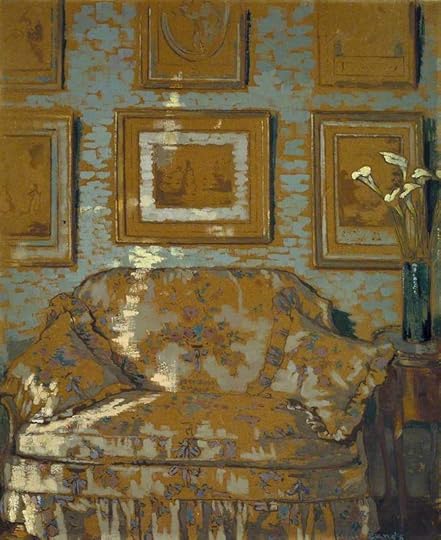
TATE-TATE-N03845-10-001
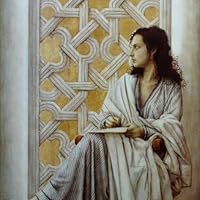
Ethel Sands, The Chintz Couch (1910)

‘The little letter story’ came to be The Lady in the Looking-glass: A Reflection, another exquisitely written, sensuous short story, a fugitive scene painting in the same spirit as In the Orchard and Kew Gardens in which a ‘momentary assembly of colour, sound and movement’ enchants the reader by dripping light and colour into the veins– at the same time conveying the finesse of Woolf’s artistry in a few pages and paying more respect to the classical form of the short story than the more experimental In the Orchard, culminating in an ending which after the initial administering of verbal and visual ambrosia leaves a more bitter and almost wry aftertaste.

Inspired by mirror effects – the narrator lets the reflection of the interior of a drawing-room in a looking-glass flow into observations reflecting on the mistress of the house, Isabella Tyson, herself, stunned by the realisation how very little, after all these years, one knew about her. All those furnishings, the minute painting of the lavish interior, those fine objects which seem collected so meticulously and with great effect disclose nothing of their mistress’s inner state of being:

It was her profounder state of being that one wanted to catch and turn to words, the state that is to the mind what breathing is to the body, what one calls happiness or unhappiness. At the mention of those words it became obvious, surely, that she must be happy. She was rich; she was distinguished; she had many friends; she travelled -- she bought rugs in Turkey and blue pots in Persia. Avenues of pleasure radiated this way and that from where she stood with her scissors raised to cut the trembling branches while the lacy clouds veiled her face.

Outwardly Isabella Tyson - or rather the narrator’s portrayal of her – reminisces Clarissa Dalloway (age, elegance) – an impression of continuity which is reinforced by the abound flower imagery and the motif of the almost obsessive preoccupancy with death – the end revealing however that both women are markedly distinct in character. Not every veil of mystery hides a treasure from view.

The story mostly draws on a use of contrasts, pivoting on the theme of the interior versus the exterior – the drawing-room versus the garden, the appearance and gestures of Isabella Tyson versus the inscrutability of her mind, change and evanescence versus stillness, the palpitations of breathing versus the transfixion of life in the trance of immortality by the looking-glass.

612ff2414b0ba159f3b359fd475afa13
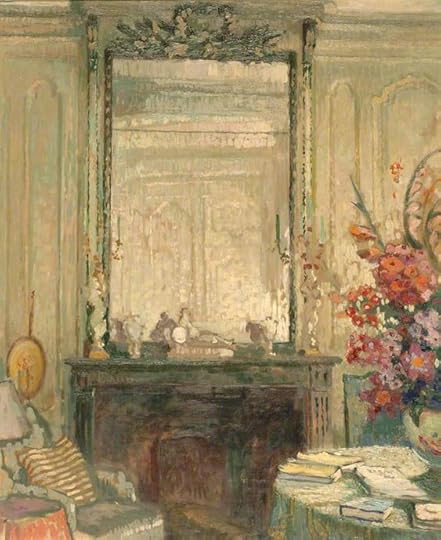
Ethel Sands, Interior with mirror and fireplace

So she stood thinking. Without making any thought precise—for she was one of those reticent people whose minds hold their thoughts enmeshed in clouds of silence—she was filled with thoughts. Her mind was like her room, in which lights advanced and retreated, came pirouetting and stepping delicately, spread their tails, pecked their way; and then her whole being was suffused, like the room again, with a cloud of some profound knowledge, some unspoken regret, and then she was full of locked drawers, stuffed with letters, like her cabinets.

If you would like to find out what is on Isabella Tyson’s mind while she is snipping the spray of traveller’s joy with her scissors or cutting an overgrown branch, you can read the story here
Profile Image for Jibran.
226 reviews768 followers
December 16, 2016
People should not leave looking-glass hanging in their rooms any more than they should leave open cheque books or letters confessing some hideous crime.

This opening line sets you for a deeply sensuous experience rich in imagistic detail from the life-sketch of Isabella Tyson, her story suffusing the mindscape like the ever-changing penumbra of light and shadow to converge like a fluid painting set within the gilt frame of the omniscient looking-glass that bares every truth about the inevitability of loss: her riches, her loves, her disappointments, her fading beauty, her womanhood - her whole humanity.

It's amazing how Virginia Woolf manages to convey a novel-length characterisation of her protagonist in a few pages only. That and her ingenious deployment of the looking-glass...erm...the mirror, as a reference point that sees all like the lens of a camera and like a deep, invisible, secret chest of truths which is privy to all that Isabella doesn't want us to know.

So beautifully written, there couldn't be a better example of Woolf's - indeed any writer's - stream of consciousness mode of storytelling.

April '16.
Profile Image for Vesna.
239 reviews169 followers
February 6, 2022
Can we ever know someone's inner self? In this Virginia Woolf's short story, or rather a lyrical sketch, the beauty of her prose is almost like a veil through which her penetrating thoughts about the possibility of truth slowly emerge. Like reflections in the looking-glass, the 'truth' elusively shifts between imagination and reality.

There is no need for me to write a review as it was already eloquently done by a GR friend Ilse here, which instantly inspired me to read the story. Instead, to give a sense of Woolf's lyrical writing and the elusive line between someone's imagined and real self, here are two quotes in which the narrator presents two very different ways in which we can see someone else. In this story, that person is Isabella Tyson, the eponymous 'lady' as reflected in her drawing-room 'looking-glass.'
Without making any thought precise—for she was one of those reticent people whose minds hold their thoughts enmeshed in clouds of silence—she was filled with thoughts. Her mind was like her room, in which lights advanced and retreated, came pirouetting and stepping delicately, spread their tails, pecked their way; and then her whole being was suffused, like the room again, with a cloud of some profound knowledge, some unspoken regret, and then she was full of locked drawers, stuffed with letters, like her cabinets. To talk of 'prizing her open' as if she were an oyster, to use any but the finest and subtlest and most pliable tools upon her was impious and absurd. One must imagine—here was she in the looking-glass.
Or is her 'real self' something else?
At once the looking-glass began to pour over her a light that seemed to fix her; that seemed like some acid to bite off the unessential and superficial and to leave only the truth. It was an enthralling spectacle. Everything dropped from her—clouds, dress, basket, diamond—all that one had called the creeper and convolvulus. Here was the hard wall beneath. Here was the woman herself. She stood naked in that pitiless light. And there was nothing. Isabella was perfectly empty. She had no thoughts. She had no friends. She cared for nobody. As for her letters, they were all bills.
Woolf starts and ends her story with the same advice:
People should not leave looking-glasses hanging in their rooms.
Is it because of beautiful delusions or disappointing reality, and which one is which? Both images are reflected in the same looking-glass, like in the mirror of our perceptions. Even in a short form, as in this miniature gem, Woolf is absolutely brilliant, a literary genius.
Profile Image for Mark André .
218 reviews342 followers
September 3, 2024
Interesting. Emotional. In a way, you knew the stark contrasting ending was coming. There was a sense with all the metaphors of being ‘set-up,’ but still well imagined, descriptive writing.
Profile Image for Bookish Bethany.
351 reviews34 followers
August 20, 2020
I love Virginia Woolf, so I am bias. I remember first encountering her at 16 on my grandma's bookshelf and falling in love - predominantly with her language. Her language leaves nothing out, it is evanescent, opalescent, deeply observant and philosophical.

This little story muses on a looking glass, the looking glass that holds the reflection of a woman like a beautiful ghost, or dream. It ebbs and flows with melancholy. It celebrates light, nature and life - but does not steer from more existential questions surrounding the futility of such pleasures, and the problem with watching your life through a looking glass and voyeurism.

We all read to be voyeurs, after all, books are looking glasses into others lives - and that is a sumptuous pleasure. But, relevant to our lives now, Woolf highlights the short falls of looking at others lives as reflections and comparing them to our own.

She also explores our collective fear of aging, especially as woman in a society that favours and lusts for younger flesh. These fears have not left us in the 21st century. The final image of the woman, now old, standing naked and empty in front of her lookinh glass is poignant and sad.
Profile Image for Ania.
252 reviews37 followers
November 1, 2012
What an interesting story. I don't mean the plot of course (there is none) but just how clearly and directly the author transports you to that one short brief moment in time. Suddenly I found myself out-of-body along Virginia, also out-of-body, standing in a bright and airy living room, looking at her flesh self via reflection in the mirror. Her spirit self, the looker, was keenly aware of the true state of things and was waiting for the lookee (her flesh self) to finally see past the illusions.

Her prose is quite wonderful and poetic: lyrical and flowing.

I must confess didn't like this short story at first. But the more I thought about it, the more I was impressed how clearly and easily she was able to transport me into that 1 moment with her dissociative perspective on herself and how clearly it all stood out in my mind.
Profile Image for Valeriia.
44 reviews
Read
January 28, 2024
Ок, мене переконали, я все ж таки почитаю місіс Делловей)
Profile Image for Nil Gurun Noyan.
119 reviews40 followers
October 3, 2024
Aynadaki Hanımefendi,beş öykülük bir derleme.Algıya karşı gerçeklik,materyalizm,benliğin istikrarsızlığı,yalnızlık ve kimlik gibi temalar ayna üzerinden sembolize ediliyor.Bu nedenle ayna,gerçekliği ortaya çıkarmak için güçlü bir motif olarak kullanılıyor.

‘İnsanlar açık çek defterlerini ya da işledikleri korkunç bir suçu itiraf ettikleri mektupları ortalıkta bırakmadıkları gibi odalarına da ayna asmamalılar.’
Profile Image for Reem.
70 reviews
Read
February 22, 2017
It's amazing how quickly and smoothly Woolf can take you deep down into her characters' minds. You are there in no time. You understand their feelings. You become them seeing through their eyes and struggling their struggles. This short story is a perfect example of Woolf's magical abilities. You will become the lady in the looking-glass while reading. You will see her hopes, dreams and be hit by her reality.

Thank you Virginia for not keeping your thoughts for yourself.
Profile Image for Karin.
217 reviews30 followers
August 8, 2016
It's all creatures, flowers, and light, and exquisite clothes, tales of travels, and letters, until it's not. It is not.
That ending. Well done.
Profile Image for Libros y apertivos.
67 reviews1 follower
February 24, 2024
Es la primera vez que leo a Virginia Woolf y me impresionó la caracterización de esta corta novela.

Esta historia te hace reflexionar sobre un espejo, un espejo que mantiene el reflejo de una mujer como un fantasma o un sueño que contiene mucha melancolía.

El espejo como alusión que ve todo, que es invisible y con misteriosos secretos de verdades, en la cual la protagonista Isabella no quiere que se sepa.

La autora nos hace reflexionar con esta historia destacando la vida de los demás como algo inconscientemente y para compararla con la de nosotros. También nos hace analizar el miedo que algunas personas tienen por envejecer.

Lo que más me impactó fue la imagen final de la mujer frente al espejo, es muy conmovedora y triste.

El relato me pareció muy confuso en toda la trama y solo me voy a quedar con la frase “todo lo que se refleja en el espejo no es lo que parece”.
Profile Image for awashi.
7 reviews
September 23, 2024
read this for class, virginia woolf’s writing is hauntingly beautiful
Profile Image for Italia8989.
271 reviews5 followers
December 23, 2016
There are plenty of people who cannot stand to look at themselves in the mirror. A mirror reveals the physical attributes we do not have to face 24/7. This truth juxtaposes what we feel inside, quite similarly hiding our true selves from the world. Woolf states this truth using prose.
1 review
July 9, 2019
This short story represents the modern man seclusion on one hand, and artificiality on another
It also resembles with the novel of Henry James " The portrait of a Lady " in which Isabella , the protagonist , rejects her two suitors for marriage and then did marriage with decitful man who deserted her life , same is the case with Isabel teyson , she is looking very rich , because of the luxury of her house , but in reality she is deserted ; secluded from society; having no suoter or friends and family.
Actually she has everything except happiness.
Profile Image for Jo.
141 reviews38 followers
June 27, 2021
To cut an overgrown branch saddened her because it had once lived,and life was dear to her.Yes,and at the same time the fall of the branch would suggest to her how she must die herself and all the futility and evanescence of things. And then again quickly catching this thought up,with her instant good sense, she thought life had treated her well; even if fall she must,it was to lie on the earth and moulder sweetly into the roots of violets.
Profile Image for eleni anayiotou.
15 reviews20 followers
December 31, 2023
Touched a very personal and intimate part of me. Woolf created the ephemeral, independent, elusive woman archetype centuries before we embodied it, only to crash it at the end in an expedient move of 3 mere lines. Acute criticism of Edwardian materialism, elegantly, but also sarcastically, illustrated.

Short in length, but nothing short of substance.
Profile Image for Jmmoml.
4 reviews
December 10, 2020
Virginia Woolf had the ability to make a simple thing like watching the reflection of a mirror into an amazing work with a beautiful use of words and mind-blowing sentences. I loved it.
Profile Image for gisela.
91 reviews4 followers
November 24, 2021
dearest, i feel certain i am being appreciative again. (for this short story)
Profile Image for Lena.
56 reviews
April 16, 2024
„Nie precyzowała żadnej z tych myśli - należała bowiem do tych powściągliwych osób, które własne myśli otulają chmurami ciszy - wypełniała się myślami”
Profile Image for Susan Molloy.
Author 149 books88 followers
December 27, 2023
Narrated by an unnamed speaker, this is a short story of an aged woman and the scenes observed through a hall mirror. This is merely a descriptive story – quite lovely descriptions at that – yet it’s anticlimactic. What is striking is the style in
Profile Image for pie.
8 reviews2 followers
May 17, 2016
Excellent short story!
Displaying 1 - 28 of 28 reviews

Can't find what you're looking for?

Get help and learn more about the design.