

What do you think?
The Princeton Economic History of the Western World #32
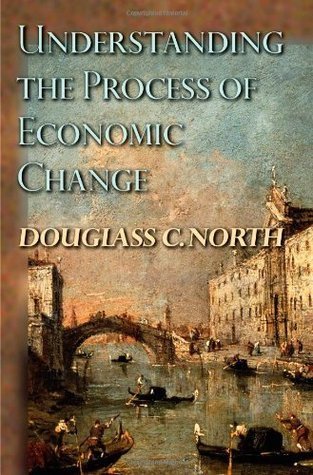
Understanding the Process of Economic Change
"In this landmark work, a Nobel Prize-winning economist develops a new way of understanding the process by which economies change. Douglass North inspired a revolution in economic history a generation ago by demonstrating that economic performance is determined largely by the kind and quality of institutions that support markets. As he showed in two now classic books that inspired the New Institutional Economics (today a subfield of economics), property rights and transaction costs are fundamental determinants. Here, North explains how different societies arrive at the institutional infrastructure that greatly determines their economic trajectories. North argues that economic change depends largely on ""adaptive efficiency,"" a society's effectiveness in creating institutions that are productive, stable, fair, and broadly accepted--and, importantly, flexible enough to be changed or replaced in response to political and economic feedback. While adhering to his earlier definition of institutions as the formal and informal rules that constrain human economic behavior, he extends his analysis to explore the deeper determinants of how these rules evolve and how economies change. Drawing on recent work by psychologists, he identifies intentionality as the crucial variable and proceeds to demonstrate how intentionality emerges as the product of social learning and how it then shapes the economy's institutional foundations and thus its capacity to adapt to changing circumstances. Understanding the Process of Economic Change accounts not only for past institutional change but also for the diverse performance of present-day economies. This major work is therefore also an essential guide to improving the performance of developing countries."
3339 pages, Kindle Edition
First published August 19, 1998
About the author
Douglass C. North
37 books108 followersDouglass Cecil North (November 5, 1920 – November 23, 2015) was an American economist known for his work in economic history. He was the co-recipient (with Robert William Fogel) of the 1993 Nobel Memorial Prize in Economic Sciences. In the words of the Nobel Committee, North and Fogel "renewed research in economic history by applying economic theory and quantitative methods in order to explain economic and institutional change."
Ratings & Reviews
Friends & Following
Create a free account to discover what your friends think of this book!
Community Reviews
Displaying 1 - 12 of 12 reviews

January 31, 2021
I considered giving this book an additional star because it was historically influential and contained some really interesting ideas. However, it was too badly written. There was not a clear argument. What was there was badly structured. The sentence structure was unnecessarily complex. The book was dense and used jargony terms without defining them. At the same time it was vague, making the same statement over and over again without fleshing out what was being claimed.
The ideas themselves, as far as I could extract them, were interesting. According to Wikipedia, the new institutional economics "is an economic perspective that attempts to extend economics by focusing on the institutions (that is to say the social and legal norms and rules) that underlie economic activity and with analysis beyond earlier institutional economics and neoclassical economics."
The key idea of this book is the world is more complex than individuals can handle. Therefore institutions (norms and rules, as opposed to organizations) evolve or are created to encapsulate human learning. However, they cannot be created arbitrarily. The bounded rationality of people plus the particular historical path that influenced a society's cultural learning means that the institutions of norms and rules are tightly tied to the society they came from. This makes it hard to translate ideas from one culture to another, as is illustrated by failed attempts to bring US-style constitutions to other countries without large investments to translate the necessary cultural norms. (Aside: We don't even know fully which norms are necessary!)
So there is something here. However, there are better ways to learn the same ideas. Complexity economics, as described in The Origin of Wealth covers many of the ideas about structural change and path dependency. Mark Granovetter's Society and Economy discusses the importance of norms and rules for how humans navigate through the world. And the field of behavioral economics, which was popularized in the twenty aughts, emphasizes that humans act under bounded rationality.
This book is commonly cited in works like those above, which is how I came to it. It was clearly an influential addition to the field at the time. However, I do not consider it a fundamental read at this point. Read the things that cite it, not the original.
I don't usually include my full detailed notes on Goodreads since I prefer people to read the original. In this case, I'll make an exception and include my detailed notes for the first 6 chapters.
The ideas themselves, as far as I could extract them, were interesting. According to Wikipedia, the new institutional economics "is an economic perspective that attempts to extend economics by focusing on the institutions (that is to say the social and legal norms and rules) that underlie economic activity and with analysis beyond earlier institutional economics and neoclassical economics."
The key idea of this book is the world is more complex than individuals can handle. Therefore institutions (norms and rules, as opposed to organizations) evolve or are created to encapsulate human learning. However, they cannot be created arbitrarily. The bounded rationality of people plus the particular historical path that influenced a society's cultural learning means that the institutions of norms and rules are tightly tied to the society they came from. This makes it hard to translate ideas from one culture to another, as is illustrated by failed attempts to bring US-style constitutions to other countries without large investments to translate the necessary cultural norms. (Aside: We don't even know fully which norms are necessary!)
So there is something here. However, there are better ways to learn the same ideas. Complexity economics, as described in The Origin of Wealth covers many of the ideas about structural change and path dependency. Mark Granovetter's Society and Economy discusses the importance of norms and rules for how humans navigate through the world. And the field of behavioral economics, which was popularized in the twenty aughts, emphasizes that humans act under bounded rationality.
This book is commonly cited in works like those above, which is how I came to it. It was clearly an influential addition to the field at the time. However, I do not consider it a fundamental read at this point. Read the things that cite it, not the original.
I don't usually include my full detailed notes on Goodreads since I prefer people to read the original. In this case, I'll make an exception and include my detailed notes for the first 6 chapters.

September 17, 2022
This seminal work on the role of institutions in economic development propelled Dr. North to the Nobel Prize. In simple terms, “Institutions” (differentiated from organizations) are the rules, both formal and informal, by which society plays.
Their quality (including, dependability) is positively correlated to economic and political stability / performance, and hence social welfare and human development. Their resilience to exogenous shocks and capacity to manage destabilizing endogenous dynamics contribute to long-term sustainability.
A must read for students of economic development.
Their quality (including, dependability) is positively correlated to economic and political stability / performance, and hence social welfare and human development. Their resilience to exogenous shocks and capacity to manage destabilizing endogenous dynamics contribute to long-term sustainability.
A must read for students of economic development.
December 9, 2022
An extraordinary attempt to explain the role of institutions in the proces of economic development. Unlike many textbook-baby-version treatments of institutions, North provides a deep analysis of the human situation in the world and explains the roots of our institutions, their role in shaping our choices and behavior, and the process of their change. He explains how institutions provide an order in response to a chaos that emerges from unknown and uncertain world we live in. In this respect, his analysis of the social institutions is very close to basic human situation recently popularized by J. Peterson in 12 Rules for Life: An Antidote to Chaos and Beyond Order: 12 More Rules For Life. Our beliefs about the world create rules, norms, and responses to everyday situations in which we find ourselves. As thay may or may not correspond to a reality, we adapt our rules and institutions and create ever more complex artifactual structures. Succesful societies adapt their institutions as problems evolve. But there exist a never ending struggle between rigid institutions with proper responses to our problems that provide stability and attemts to replace them with new rules to respond to new challenges but open up a window for a disorder and disorganisation of the society. Overall, this book goes far beyond the scope of economics that deals with the problem of resource allocations and heads towards a more fundamental problems of the humankind. The framework that goes from beliefs to institutions, organizatins, policies and outcomes is applied to explain our pre-historic origins, industrial era, political/economic tranformation in England, the rise and fall of Russia, and many other regions and epochs. Eventhough there has been inarguably big progress made in economics and other social sciences since North´s research (e.g. The Narrow Corridor: States, Societies, and the Fate of Liberty) treatment of the interplay between the power of the society and power of the state in shaping the societal development) the book is definitely worth reading as it provides many insights that are - to exacerbate a bit - at the margin or overlooked in our economics profession.

August 25, 2020
Fascinating overview of North’s focus on the process of economic change in society, with a focus on institutions and how institutions shape and are shaped by existing norms, highlighting difficulty of crafting economic institutions on societies without the requisite experience, highlighting difficulties of market reform in Latin and South America and the Soviet Union.
First few chapters feel only loosely related to the rest of the book and are a digression, in my view, on consciousness and intentionality. North ties this into his overall theory of why institutions are successful (adaptive efficiency), but ultimately feels out of place.
Good contribution to discussion of whether ‘markets’ arrive through a spontaneous order or conscious design. North views institutions as gradually developing to minimize transaction costs if allowed by political actors. For instance, protection of private property was a concession granted in interest of the sovereign collecting revenue that ultimately enhanced and extended impersonal exchange.
Bit of a mid way between Hayek’s (simplified version) of a spontaneous and the Rosseau/Heilbroner view that economic society is artificial and economic organization has no independent meaning.
First few chapters feel only loosely related to the rest of the book and are a digression, in my view, on consciousness and intentionality. North ties this into his overall theory of why institutions are successful (adaptive efficiency), but ultimately feels out of place.
Good contribution to discussion of whether ‘markets’ arrive through a spontaneous order or conscious design. North views institutions as gradually developing to minimize transaction costs if allowed by political actors. For instance, protection of private property was a concession granted in interest of the sovereign collecting revenue that ultimately enhanced and extended impersonal exchange.
Bit of a mid way between Hayek’s (simplified version) of a spontaneous and the Rosseau/Heilbroner view that economic society is artificial and economic organization has no independent meaning.

December 30, 2025
Explains economic change through chain of beliefs - institutions - organisations - policies where individuals' belief produce policies - this mediated through the environment that shapes beliefs and create a tendency towards lack of change. It is part of the cultural/postmodern turn in institutional economics seemingly that gives causal priority to culture in explaining economic differences. I did not find it convincing, nor well-argued.
A lot of fairly uninteresting usage of cognitive science, behavioural economics and psychology with not much up-take to simply argue rationality assumptions are not relevant. Yet I both disagree with this irrationalist assumption, and also found it much more interesting to understand the role of institutions with rational agents.
A lot of fairly uninteresting usage of cognitive science, behavioural economics and psychology with not much up-take to simply argue rationality assumptions are not relevant. Yet I both disagree with this irrationalist assumption, and also found it much more interesting to understand the role of institutions with rational agents.

April 1, 2023
For some moments, I forgot this book was initially written by an economist. For other moments, he attempted to write about economics from cognitive science, which I felt like he repeated himself many times without explicit conclusions. The role of institutions is discussed but I also feel like it is again just the same as Coase, quite theoretical.
Summing up, this book could have been more succinct.
Summing up, this book could have been more succinct.
September 17, 2018
Too vague, dispersed
I purchased this book with great hopes, but was sorely disappointed. It is not that I disagree with the author's ideas, but rather that the book seems to lack a central thesis. Reasonable and/or more or less obvious statements are endlessly lined up. At the end of the book one feels like asking "So what? "
I purchased this book with great hopes, but was sorely disappointed. It is not that I disagree with the author's ideas, but rather that the book seems to lack a central thesis. Reasonable and/or more or less obvious statements are endlessly lined up. At the end of the book one feels like asking "So what? "

October 5, 2018
Too much of a summary, glosses over too many important ideas.
May 3, 2021
dated

June 1, 2016
This book is a dense but important read. North is one of the foundational scholars of institutional economics, and this book is a good introduction to the concepts which underlie new institutional economics theory and a framework for understanding the system of thought. It also provides useful references for future reading, and stimulates plenty of new ideas of your own. Be aware there are sentences longer than some paragraphs in this book, and that it does require careful reading and analysis.

July 1, 2016
Challenging and even a little frustrating in its inconclusiveness, this is nevertheless a great synthesis of the New Institutionalism that tries to establish micro foundations for institutional change - sort of the holy grail for Institutionalism - by looking to neuroscience and psychology. Points in an interesting direction, but ultimately North admits that we don't really know for certain by certain institutions beneficial for growth take root in some places but not others.

November 5, 2016
Concise, but insightful book. Ideas from psychology, evolution and shared mental models. Humble about the state of our knowledge. Overall, a great book.
Displaying 1 - 12 of 12 reviews