When a small-town Scottish woman discovers a severed leg in the boot of one of the local hockey players’ uniforms, it’s a big scoop for the Highland Gazette. But reporter Joanne Ross wants a front-page story of her own, and she hopes to find it in Mae Bell, an American jazz singer whose husband disappeared in an aircraft accident five years ago and who is searching the Highlands for her husband’s colleagues.
Things take a very sinister turn when Nurse Urquhart, who dis-covered the limb, suffers a hideous and brutal attack. Even stranger, she was the recipient of letters warning her to keep her nose out of someone’s business — letters that Mae Bell and the staff of the Highland Gazette also received. What could it all mean?
Unfolding against a gorgeously rendered late 1950s Scottish countryside, North Sea Requiem captures the mores and issues of another era, especially in Joanne Ross — a woman wrestling with divorce, career, and a boss who wants to be more than just her superior. The result is a poignant, often haunting mix of violence, loss, and redemption in a narrative full of unnerving plot twists and unforgettable characters.
A. D. Scott was born in the Highlands of Scotland and educated at Inverness Royal Academy and the Royal Scottish Academy of Music and Drama. She has worked in theatre, in magazines, and as a knitwear designer and currently lives in Vietnam and north of Sydney, Australia.
“To a man with a hammer, everything looks like a nail.” – Mark Twain
With the publication of this review, Simon & Schuster and Atria executives will have bleeding ears and red faces and I’ll be placed in the crosshairs of a hit man named Jeb and I’ll be quietly removed from NetGalley and Amazon will put me in chains and lock me away and I’ll be alienated and isolated to the point that no one will talk to me but my wife and some little dog named Fluffy who will come and visit me when I’m put in an insane asylum and shoved in a straitjacket and thrust paper cups at random intervals filled with blue, white, and yellow pills.
If I could provide a one-sentence summary, it’d be as follows: Aspiring authors should read this novel for what not do as a writer. Forget Fifty Shades, this is your Bible. Study it, learn it, and then don’t ever fucking do it. Okay? Okay.
Here are a few of the highlights/lowlights: Passive voice? Check. Exclamation point minefields? Check. Repeated dialogue? Check. Circular communication? Check. Not getting to the point? Check. Am I making myself clear? No. Verbose to the point that I wanted to offer up editing services? Check. Overuse of accent and dialect? Check. Historical? Yes. Mystery? Possibly but it was a side car on this happy train. Plenty of clichés? Check. Used thought/saw and likeminded words to the point that it pulled me out of the story? Check. Overuse of telling instead of showing? Check. Stilted dialogue? Check. Stilted characters? Check. Plot twists? Possibly but I missed that particular train.
This novel made me so angry that I thought I had developed a complex. I wanted to tackle Santa Claus, throttle the Easter Bunny, and punch out the tooth fairy. And I had this absolute darkness lingering over me like a rain cloud. On the bright side, I came up with a character that will have a mother lode of shit dumped on his head, as I explore the depths of darkness ordinary individuals can sometimes face. If not for this particular book, this wouldn’t have been possible.
Oh, and Stephen King will be pleased that at least one element of his craft was followed--there wasn’t a plethora of adverbs.
I literally wanted to pound the shit out of NORTH SEA REQUIEM with a hacksaw, hammer, battering ram, and a flack vest. And then pick it back up and do it all over again.
Curtain calls and fancy halls and soccer balls and...you may finish this sentence however you like.
I have read other books in this series and liked them. First of all, I am a sucker for books set in Scotland and secondly find the time period of the late 1950's quite interesting. It's hard to remember back to a time when divorce was such a shame and Joann Ross is feeling the brunt of it. It does not matter that her husband has moved in with another woman who is pregnant, Joann is the bad person. Of course, she's practically living with her boss and the editor of the local newspaper where she's a reporter.
A local nurse is attacked with acid and dies. A mysterious American woman blows into town and hunts for information about her husband's death in an aircraft accident five years ago. Threatening anonymous letters turn up advising people to mind their own business. A severed leg is found in a boot. What is going on in this small Scottish Highland town?
Then the book just falls apart. Joann acts like a child worshipping the American, Mae Bell, and holding her boyfriend at arm's length. The plot is one of the most absurd I've ever read. It made no sense beginning to end. Even when the mystery is solved, you wonder to yourself, "did I just read that"? The most interesting mystery is put on the back burner and never really addressed and certainly never solved.
This is too bad because I've liked other books in the series but I think you would have to hold my feet to burning coal to read another.
This is the fourth book in the acclaimed mystery series evoking the mores, values and people of the Scottish Highlands of the 1950s.
Nurse Urquhart discovered a severed leg in the washing coming from the shinty team after their Saturday match against a rival town. Sundays was a forbidden day for washing and she was upset about this sunny day going to waste when time was limited. She pulled the muddied and bloodied shorts and shirts out of the container and let out a scream who had her husband, the trainer of the local shinty team, fainting.
The news splashed all over the front page of the newspaper, about the foot in the shinty boot, had the town talking the hind legs of the donkeys. For some inhabitants in the laid-back quiet town in the Scottish Highlands it was a sick prank, yet for others it would become the opening salvo for a chain of events that would divide the town, lead to murder, introspection, new discoveries, redemption and perhaps happiness.
The town was ruled by a bleak God, who was suppose to be the father of a loving Son, who resided in buildings with high walls, built with unforgiving stone, worshipped by unforgiving people and preaching the Gospel according to men.
Joanne Ross, a soon to be divorcee, wanted to prove that she can be a real news reporter, write more than just school events, church happenings and recipes for plum duff puddings. She wanted to liberate herself from a society who regarded women as mothers, not persons with dreams and thoughts of their own.
The appearance of Mae Bell, seeking more information about the death of her husband Robert, had Joanne brewing like a volcano seeking a place and time to explode. Her inner rebellion was fueled by the staunch believe of the male society that real women arranged everything, was always right, paid the bills, did the washing, the ironing, the shopping, the cooking, remembered everyone's birthdays, anniversaries, funerals, as a good wife should. In the men's eyes, that was how good women expressed love. Those who refused, or chose another way of expressing themselves were dealt with the right way, the justified way: physical abuse and/or rejection. Would she trust men again? Can she believe in love? Does it really exist?
Mae Belle represented everything Joanne wanted to be: confident, elegant, well-traveled, mysterious. But what was she hiding?
Only the police and the staff of the Highland Gazette were eager to get behind the sinister message and would lead to a lot of leg work to keep the investigators running for their money ...
I was in a little bit of a dwam myself after being drawn into the kurfuffle of solving the mystery. The story and characters were so real, so possible, so familiar, apart from the delightful introduction to Scottish words and customs. The narrative is a mystery, leading the reader through a maze of suspicions - exhilarating thoughts - of who's-dunnits' as well as added elements to throw us off the track. It was highly successful! And of course I was half-right half-wrong in the end, leaving me sneaking away tail between the legs! The conclusion was highly dramatic.
My thoughts on why it is a four-and-half and not a full five star read: The story is overall predictable in the sense that the recipe is the same for most of the books in this genre.Everything happens when it should, sort of. The scene where the guilty party was realized, had my legs pulled from under me though. It was too sudden, coming out of nowhere. I paged back to see where I missed the run-up paragraphs to it, but couldn't find anything in the previous few pages. I might be totally wrong and will accept it, but I had the impression that the story was shortened. The concluding events were too drawn out and lost the rhythm of the exploded drama.
However, the shocking surprise lies waiting, the final moment of sucking in your breath hard and fast. It is something so totally unexpected, it will make you laugh or cry. Who was the late Robert Bell really?
The events, characters, scenes, and everything else making this an excellent read, are all there in detail. There is so much depth to the story and people in it. It was definitely worth the time. Everything is concluded.
This book not only inspired me to read more books by A.D.Scott, but also to visit this amazing country and meet the inhabitants. I promise you, this severed leg is going to shake YOU right out of your socks!
Opening: Mrs Frank Urquhart was dead against the Sabbatarians.
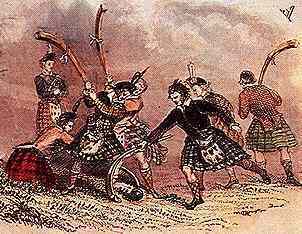
Shinty.
This is the fourth book featuring the staff of The Highland Gazette, circa mid 50s, and Joanne Ross in particular. The plight of highland women in that post-war decade or so, is brought to the readers' attention, yet everywhere is flabby cartoon interactions between two-dimensional characters.
A dreich story whichever way it is viewed, with underscored emphasis on dreary, wet, dull and miserable. Sorry Simon and Schuster, I think this will be one big flop.
Another enjoyable read from A.D. Scott in the Joanne Ross series. Scotland is one of my favorite settings for a book, and Scott presents a Scotland of the 1950s with its Scottish quirks and 50s morality. With Joanne being an almost divorced woman and a working woman, too, she is constantly swimming against the current of what most people in her small town consider a woman's role in life. Her job as a junior reporter at the Highland Gazette keeps her in the know of the news, both large and small items, and provides a vehicle for the author to keep readers informed, too. Joanne's evolving relationship with her boss, from boss to friend to love interest, has been interesting to follow and has developed slowly, as the times of the 1950s calls for.
In this fourth addition to the series, the action begins with the discovery of a severed leg in a boot by Nurse Urquhart, school nurse and wife to the local shinty team coach, in the shinty team's wash she is sorting. As people puzzle over this odd find, Joanne, in her usual search of minutiae in the paper, comes across an add for information about a deceased airman placed by his wife, Mae Bell, who is an American jazz singer from Paris. Although the severed leg and the ad for information appear to have nothing in common, their occurrences will prove to cross paths in a most bizarre and deadly manner. With the appearance of hateful letters of warning to these three women and a brutal attack on one, the need to unravel the mystery of it all becomes urgent. Lives are at stake unless the secrets of an apparently unbalanced mind can be discerned.
North Sea Requiem has a great story, which takes the reader on a twisty road to its conclusion, as mysteries should do. My only complaint is that there seems to be some jumping from one point to the next in Joanne's relationship with McAllister without explanation. It may not be important to the story at hand when the two begin sleeping together, but for the character development, it would seem a big enough event (especially in the 1950s setting) that it deserves more than a mere suggestion. I enjoy all the characters in this series, but I do think that Scott sometimes glosses over important moments in their lives. A less choppy approach would make the series a bit more complete.
There is much to like about the Highland Gazette Mystery series. One is the location of Scotland. The time period is the 1950's. Women during this period were to stay home with the children. It caused gossip when they worked. Divorce caused family shame. It appears the shame mainly fell on the woman even if the man asked for it. So it was not a good time for an ambitious and independent woman.
The occupation of the main characters was putting out a local newspaper. They are repeating characters from past books and they take their job very seriously. The reader went to work meetings with the characters. The characters are like old friends that it is good to be back with again to see what is going on with their lives. The characters really make the book along with the atmosphere. There is a new character who is a jazz singer from America. She turns everyone's head. Every time I read her name Mae Bell, I would read it as Ma Bell and have to correct myself. Maybe a younger American wouldn't make that error as Ma Bell is from the past.
There is intrigue-a leg found in a boot, a horrific attack and very threatening message to several people. There is more but I don't want to give anything away. It was a good read and I am looking forward to reading the next book in the series.
What happened? I have read 2 other books in this series and they were both good, 4 star rating. This one — the reporter characters behaved illogically, the story seemed very unlikely, it took far too long for reporters and police to solve. I still liked the setting but disappointed with the rest. It was okay, I finished it and maybe if the others in series had not been much better, I would have given this a 3. But that plot . . .
I've been a fan of A.D. Scott's series from the first book, A Small Death in the Great Glen. She very firmly places her readers in the middle of the Highlands of Scotland in the late 1950s, when there are more restrictions on behavior and what is "acceptable." Within that framework she places a cast of characters who do not fit in: a handsome young reporter who wants to go to the city to be a television star, a bachelor editor from Glasgow who loves a married woman, a female reporter who wants a divorce from her abusive husband so she can make a life for herself and her two daughters-- and an attractive, exotic American looking for men who knew her beloved husband.
The story slowly unfolds, and secrets are gradually uncovered amidst short, sharp bursts of violence that are all the more shocking for being in such a place and amongst characters as familiar to me as my own family. The books in this series can be read as standalones, but so much nuance will be lost that I don't recommend it. I often feel that Scott has a specific plan in mind for this series, and that the series in its entirety is really one complete work with each book a chapter within it. Bits and pieces are revealed about characters in one book and may not be picked up again until two more books have been published. Read with that in mind, I don't expect everything to be wrapped up in pretty little bows by each book's end. I am willing to let Scott work at her own pace.
The story in North Sea Requiem is a satisfying one, not only in terms of the mystery, but also in terms of the interaction between the characters. As I read the last few chapters, I knew that A.D. Scott's writing reminded me of another author. It wasn't until an hour or so after I'd finished (and was still savoring the story) that it dawned on me whom she reminded me of: Louise Penny. The similarities are not glaringly obvious, but they are there. A complex story being told in a series of books, characters who continuously evolve, and an underlying feeling of tenderness for a time, a place, and a people. Like Louise Penny, A.D. Scott simply cannot write fast enough for me.
NORTH SEA REQUIEM (The Highland Gazette: #4) Written by A.D. Scott 2013, Atria Books (336 Pages) genre: historical, fiction, mystery, Scotland
Rating: ★★★
Once I finished the fourth book in the Highland Gazette mysteries series I knew this was not a "must read as soon as published and will still read if there is a horribly boring/badly written" on my vast to be read list. If I noticed a book was coming out or was out I would definitely borrow from the library but it is not one I would buy or scour websites to find the release date. Unfortunately, if there was another book like book one I would probably give up on the series. While I am now invested in the characters there is no personal tie to them...hence my lower rating for the fourth novel. I cannot no matter how much I try...and I have tried for three books now...to like Joanne Ross. She is the main character and the books hinge on the readers feeling some kinship. Bad news first - I could not relate to her in anyway. Joanne comes off abrasive and selfish in the wrong ways. The Good news is that Don and MacAllister will have you routing for them and keep you reading. In this novel a few months have passed and Joanne is closer to becoming a divorcee but cannot decide if she is really in love with MacAllister. When a strange woman come to town looking for anyone who knew her deceased husband threatening anonymous letters start arriving at the Highland Gazette. Local woman Nurse Urquart finds a boot with a severed limb and is later attacked with acid. She too was sent threatening letters. What does an American Jazz singer and widow have in common with a local nurse? And who will be the next victim?
This is an extremely engaging series and I wondered if reading out of sequence would have an effect on the reading. It doesn't very much. I read the one after this and wondered what had happened to Joanne that her health was fragile; the answer is in this book but coming up to it you don't know what it is. There, that's all I can say without revealing stuff in both books. The reader does have to keep in mind that this series takes place in the 1960s and thinking was quite different then about a person's place in society, especially in more isolated areas of any country. There is still a very uptight morality obtaining in towns like (? Have you noticed that the town they're in is never named?) It's not Inverness and not Beauly. Is it west of the Black Isle? It doesn't matter because it all holds together from one book to the next and the characters are certainly trying hard to find satisfactory lives. When reading a book about another time you always have to wonder about illness and how it was and is now treated. Would the different time make a difference in the outcome? I did find it odd that an American would stay on in the RAF but apparently some did.
Wow. This is the fourth Scottish highlands mystery I’ve read. Fourth, and last. Scott cleverly creates atmospheric reading in these late 1940s Scottish mysteries, featuring a newly divorced Joanne and her beau who work for the local newspaper. This book just asked too much suspended disbelief from the reader. And the archaic presentation of mental illness was simply unforgivable. We had a good run, A. D. Scott, but we’re done.
I'm so grateful to have become acquainted with this series several months ago. I'm most grateful for the recommendation, and not once have I been disappointed by the plot or the writing style anywhere in this series.
Not only do you get a shot at some excellent armchair detection, oyu get a close look at Scotland as it was in the late '50s. You see how men and women interact, and you gain a deeper understanding of the various social expectations and constraints both sexes must endure. This book is particularly interesting in that it also deals with mental illness and disability and the extreme stigma attached to both in that society.
When a team nurse finds a detached leg encased in a boot as part of the team's laundry, her discovery sets off a murderous chain of events. Soon, the staff at the Highland Gazette are once again in the thick of things where the murders are concerned--either trying to adequately cover them for the paper or, in the case of Joann Ross, working at solving them.
As the plot continues, you meet American jazz singer Mae Bell, who enthrawls Joann and fascinates Joann's soon-to-be fiance, McAllister. Mae is mysterious and worldly, and she may know more about the murders than she realizes.
The plot in this fourth book is even stronger than in the previous ones, and the author's descriptions of how one family chose to deal with mental illness and disability in a child were memorable indeed.
My favorite of the series so far! Read the last third in one sitting. Scott makes the reader really care about the characters. Looking forward to the next to see what happens to Joanne, McAllister, and all the rest.
"When a small-town Scottish woman discovers a severed leg in the book of one of the local hockey players' uniforms, it's a big scoop for the Highland Gazette. But reporter Joanne Ross wants a front-page story of her own, and she hopes to find it in Mae Bell, an American jazz singer whose husband disappeared in an aircraft accident five year ago and who is searching the Highlands for her husband's colleagues.
"Things take a very sinister turn when Nurse Urqhart, who discovered the limb, suffers a hideous and brutal attack. Even stranger, she was the recipient of letters warning her to keep her nose out of someone's business -- letters that Mae Bell and the staff of the Highland Gazette also received. What could it all mean?
"Unfolding against a gorgeously rendered late 1950s Scottish countryside, North Sea Requiem captures the mores and issues of another ear, especially in Joanne Ross -- a woman wrestling with divorce, career, and a boss who wants to be more than just her superior. The result is a poignant, often haunting mix of violence, loss, and redemption in a narrative full of unnerving plot twists and unforgettable characters." ~~back cover
This book was a bit blacker than all the previous, since the guilty person was totally insane. Joanne and Mae Bell were captured and held in a dark, dank, small enclosure for days -- Joanne with a head injury. It got very nail biting towards the end ... would she survive? And if she did, would she have permanent brain damage? Would Mae Bell recover from the weeks of scarcely any food?
Actually, I'd give this a 4.5 rating. Truly absorbing, set in Scotland with characters who are believably of a different culture, using words (without a glossary!) like shinty: apparently a game combining the fierceness of soccer (football) with hockey (not ice). Straightaway, a man's lower leg is discovered in the team's uniform wash hamper, its sock the colors of the team. Good start.
The local weekly newspaper is the center of the story, which combines getting the paper out with some pretty brutal savagery and the startling visit of a gorgeous American woman looking for the details of her husband's death in the disappearance of a Royal Air Force plane in the North Sea some 6 years earlier. Long sentence to say--it's newspaper staff, not the police.
In terms of craft, Ms Scott lays a profoundly touching elegy to love and death and family that supports a riveting plot. That's HARD to manage without sentimentality or pedantry. I connected with even the most troubled characters, understanding, even as I became quite frantic wanting a Truly Happy Ending at ANY COST.
This is not the 1st book in the series, so you should maybe not start with it, like I did. However it can be read by itself. Some parts I liked, and this is why I started reading the whole series, others I disliked and this is I guess why I stopped abruptly at some point. On one hand: it is a very interesting setting, Scotland in the late fifties. Very parochial, closed and suspicious society (a woman in slacks will be frown upon etc). I think it is important to remember that things were not always as they are today. It is a cliche now but the past is indeed a foreign country. To me, this is compounded by the fact that Scotland is anyway a foreign country, one of many on the list of place where one assumes life is better than where one is. All-in-all, from an anthropological perspective it can be fascinating. On the other hand, the budding love story is extremely cheesy for my taste and I am not sure why it was necessary. Still, an unusual policier, worth reading.
The only problem with this series is that it is only 6 books long! Each book fascinates and thrills even more than the last and they just keep getting better. The incident of the severed leg sets off a chain of events that spiral almost out of control as the staff of the Highland Gazette dig or material for their newspaper. As in each novel, the characters reveal more and more of themselves, their backstories and we watch relationships grow and change. Mae Bell, jazz singer, exotic, exciting and looking for anything she can find on the reasons her husband's plane crashed six years before with no trace. Her questions seem to be rattling someone's cage and they don't like it one bit. Joanne can sense a great story in Mae Bell's journey to find answers and helps with an article. But threats begin to pile up along with the bodies. Joanne and Mae ultimately could pay with their lives!
Aside from the continuing saga of Joanne's romantic dithering, this was a great mystery set in the Scottish Highlands of the 1950's. Although the solution to the main mystery was fairly clear from quite early on, I still enjoyed the side stories and how they ended up tangled in with the main story. Not a fan of the romantic side of this...at this point, I'm quite honestly indifferent to whatever Joanne decides to do...hopefully that will fade into the background with the next book and the mystery will again come to the fore.
While I continue to love the setting (the Highlands of Scotland), the plot of this book was somewhat muddled. I was also disappointed in the character development of the main (female) character. At this point her self doubt and ambiguous feelings towards the man who apparently loves her is just annoying. That said, I will eagerly read the next book in the series, because I love being transported to the Highlands and I do care about the recurring characters.
I find the main series characters well developed and enjoy their interactions. That's what I look for in a mystery series like this. The 50s are not my favorite time period but the social setting and restrictions depicted in this series make quite a contrast to our current reality tv/ anything goes society. I wish we could find a healthier set point somewhere in the middle between stifling repression and over-sharing, tantrums and the hair-trigger violent explosions like road rage.
I’ll give it a 3.5. There’s a lot to like and lots of wonderful small town atmosphere, as stifling as it could be in 1950’s Scotland, but the mystery’s resolution seems to come out of nowhere. Joann Ross continues to be a somewhat less than fully developed character, while her and love interest seems more defined.
I’d love to love this series, and while I’ve read several now, I don’t know if I’ll continue.
Totally thrilling, with a suspense promise of more in volume 4, this novel begins with a stranger to the Highlands; a woman from America via Paris. Meanwhile, at the Gazette, hate letters mysteriously arrive and are focused upon Joanne Ross. The horrible events that ensue made for a sleepless night for this reader who must turn to the next book post haste!
Quaint little mystery taking place in a gossipy village in the Highlands, with great characters and intriguing females facing dilemmas and prejudices. Nice development of a child with a handicap; colorful personalities that seem like real people. Left me feeling like I lived there!
The characters and the locale are vivid and real and draw me in every time. I would suggest reading in chronological order. The evolution of the characters and their relationships is a story in itself.
Actually 3.5 stars. The mystery was quite clever. Having never read this author before, at first I thought that it was going to be a cozy mystery from the way it was starting. Then a murder happens, in a manner truly uncozy like! And the story become more intricate. It was an enjoyable read.
I read this because it involved a Shinty team, and I know a bit about Shinty. But, even with this hook, the mystery is heavy, unbelievable, and unwieldy. Pass.
This is a gentle series set in Scotland and involves a local newspaper and their stories. Murders happen and the people on staff try to find out what happened for the local news.
My first book by A.D. Scott. Purchased at an airport, I didn't realize it was part of a series. This precipitated a raid on my library for the remainder of the series!



 Shinty.