A Chaos Space Marine Sorcerer seeks the power of the gods
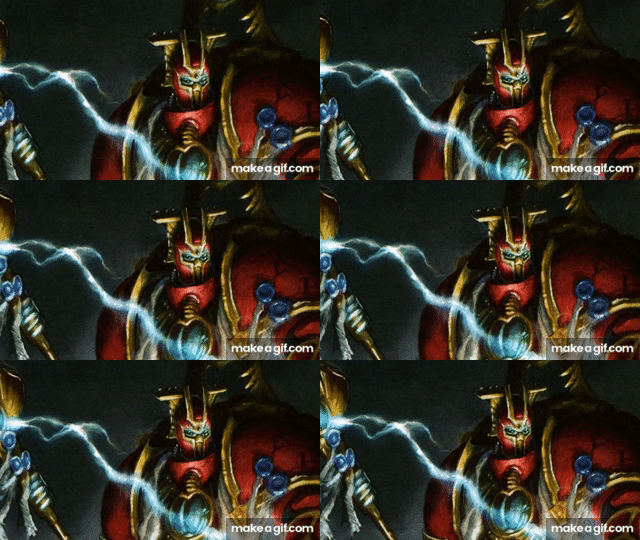
All is dust... Spurned by his former brothers and his father Magnus the Red, Ahriman is a wanderer, a sorcerer of Tzeentch whose actions condemned an entire Legion to an eternity of damnation. Once a vaunted servant of the Thousand Sons, he is now an outcast, a renegade who resides in the Eye of Terror. Ever scheming, he plots his return to power and the destruction of his enemies, an architect of fate and master of the warp.
John French is a writer and freelance game designer from Nottingham, England. His novels include the Ahriman series from Black Library, and The Lord of Nightmares trilogy for Fantasy Flight. The rest of his work can be seen scattered through a number of other books, including the New York Times bestselling anthology Age of Darkness. When he is not thinking of ways that dark and corrupting beings could destroy reality and space, John enjoys talking about why it would be a good idea... that and drinking good wine.
He looked up as Astraeos removed his helm and looked down at him. Ahriman looked to the daemon hovering above. It had grown long needle blades of bone from its fingers. Blood dripped from the talon's tips. The bound daemon was smiling its shark smile. 'What have you done?' breathed Ahriman. Astraeos sheathed his sword, a grim smile twisting his scarred face for an instant. 'Fulfilled my oaths', he said.
The Thousand Sons were a broken Legion after the razing of Prospero, mostly falling to the flesh change and warping into shambling abominations in the best case or dripping pools of flesh and blood in the worst one.
First Librarian Azhek Ahriman tried to save his brothers with a vast ritual called the Rubric, perhaps one of the greatest works of sorcery in history, but everything went disastrously wrong and most of former XV Legion turned from flesh into sealed suits of armors animated by the vestige spirits of those that wored them.
After his banishment from the Planet of Sorcerers as result, a broken and driven by guilt Ahriman, disguised and in exile, wanders aimless across the Eye of Terror, reduced to little more of a servant to The Harrowing, a Chaos Undivided warband of Traitor Space Marines. But Fate and Thousands Sons are still looking for Ahriman, and they will not give him up so easily...
Set several thousands of years after A Thousand Sons and the Horus Heresy, this novel was an hell of a read, a bleak and dark read, covering first steps of Ahriman rising from his knees after the aforementioned events, and his first steps and endeavours to redeem himself and save his Legion.
So we have a different Ahriman here, almost a broken and guilty anti-hero, so far dissimilar from the overpowered villain in so many W40k novels and rule-books like Rob Sanders' Atlas Infernal.
Just loved storyline and atmosphere, so bleak, brutal and grimdark, that in a few passages I could hear Summoning's Where Hope And Daylight Die song playing in my mind... play it here and see yourself: https://www.youtube.com/watch?v=368vR...
And the characters' cast of Ahriman's reluctant partners and opponents was just one of the best ever: deranged tech-priests going against Mechanicus' teachings and losing their minds, wandering renegade Space Marines survived to Exterminatus and purging of their never mentioned Chapter from Inquisition and Grey Knights, broken daemonologists and an old acquaintance straight out of the Horus Heresy.
Not best book to start if you are a newbie of Warhammer 40000 universe, but if you are a veteran reader of it, this is a real must read. A great and sometimes litterally visual insight inside the mind of one of the most iconic W40K characters ever, and an excellent sequel to Graham McNeill's A Thousand Sons and The Crimson King Horus Heresy novels.
Be sure to read John' French's All is Dust e-short just before starting this first chapter of the Ahriman's trilogy: it sets the mood for good and enriches a lot the whole experience.
And now I just can't wait to see what's going to happen in Ahriman: Sorcerer.
Following on several thousand years after the events of A Thousand Sons, this book details some of the events that led to Ahriman's exile from the infamous Planet of Sorcerers and his Legion. Once considered one of the most powerful living psykers in the known universe, his fall from grace and banishment led him to punish himself for thousands of years my dulling his mind to the powers of the warp and his own abilities, reducing him to little more than a servant and slave to war-bands and traitors. But that does not mean he is not hunted, by friend and foe alike. Only a chance encounter with a fellow group of renegade 'loyalist' Astarties on a seemingly abandoned space ship give him any chance of redemption when his old legion come looking for him, but to what end?
'Ahriman: Exile' answers some of questions relating to the 41st Millenniums most driven of characters, showing us a glimpse into his psyche (Literally wandering the corridors of his mind at times) and teases out some of the details that led to the shattering of the 'Thousands Sons' legion. Though there is mention of more ritual sorcery and mysticism used by the Legion, it is mercifully shorter on details and easier to read than A Thousand Sons largely because the legionary names are left out (Egyptian sounding names that all sound a little alike made it a strenuous book to read in places).
I enjoyed the book a great deal, its very visual in places and gave my imagination a real workout as I tried (in vain sometimes) to picture some of what was going on thought that didn't detract from the action one bit (psychic powers, what can you do). I would have preferred to have read more specific events of his years adrift but at over 400 pages long the book still had details and action aplenty to keep me entertained. If you are a Warhammer 40k fan and could get your head around A Thousand Sons then you will thoroughly enjoy Ahriman: Exile.
If you've never read a Warhammer 40k book, this may NOT be the best book to start with, and those not familiar with the Thousands Sons will have no clue as to what is going on so its best to start elsewhere. But add it to your 'want to read' list though when you are up to speed on the universe as I heartily recommend it.
Released back in 2012, Ahriman : Exile was John French’s first novel for Black Library, and you’re unlikely to find a more assured, complex, detailed debut novel than this. The first in a trilogy regarding one of the most famous villains in the Warhammer 40,000 universe, when we first meet him Ahriman is at his lowest ebb, years after the failure of his Rubric and his exile from the Legion he tried to save. Masquerading as a lowly sorcerer serving a motley warband of Traitor Marines, he’s a far cry from the former Chief Librarian of the Thousand Sons, resigned to his fate as an exile and hiding away from his past, his enemies and his own power.
I admit, I am a fan of Ahriman and the Thousand Sons, so when I found out French had written a novel about the character, I jumped at the chance to read it.
The first thing I really enjoyed about this book is where it falls with Graham McNeill's A Thousand Sons. French uses a lot from this Horus Heresy novel and it's nice to see the continuation of the themes McNeill started being used in the story of Ahriman after he is exiled. This helps to create a nice continuity in a fictional world where often Games Workshop/Black Library is all over the place with their timelines and continuity.
Another thing I enjoyed were some of the concepts that French brought forward. For example, the three traitor marines that end up joining his cause (if I remember correctly) never have their original chapter mentioned. This left me searching for clues as to which chapter they came from originally, adding to the mystery of their characters and who they are. The Titan Child was another really interesting element, as it goes against the standard Mechanicus teachings and thus is understandable as to why she's a traitor to the Imperium.
One thing that bugged me about the novel however was just how long Ahriman sat wallowing in his own self pity. For a character that has been portrayed as so intelligent and obsessed with problem solving (to the point of forming a secret cabal and casting a very powerful spell), it is weird to think that they would spend so long wallowing in self pity rather than trying to approach the problem and solve it. Instead, most of this novel is spent with him slowly getting back to where he should be and on the path he should be treading.
French does a nice job of showing how Ahriman manipulates those around him, and how he weaves the threads of plots that encircle him. Though this becomes even more apparently in the short stories that follow this novel, you can see the beginning of the threads here as well as why he would be a champion to Tzeentch. Thought the god is not mentioned, you can see his undercurrents throughout the story and French did a good job keeping the god just under the surface.
All in all, I really enjoyed this book. There was enough action to keep me interested, there were a lot of Thousand Son elements to satisfy any fan, and French's writing is fluid and strong. I recommend this to anyone with an interest in the Thousand Sons and Ahriman himself. You won't be disappointed... well, except for maybe the first half of the novel where he's wallowing, but it gets better. Way better.
This was a very entertaining read. Seeing Ahriman as a lowly punk renegade on the run was an interesting twist. Insight for his motivations for the Rubric (and his continuing quest) was cool, too. Finally, the time continuum differences between the Eye and 'real' space was fun, especially as an explanation for his power level and what was going on in the Imperium.
Pro: 1. A good insight on Ahriman psiche, a good idea to start with a renegade, low level Ahriman. Dulled by by his sins and following a low profile life as a simple thug marine.
2. The progressive corruption of loyalist marines.
Cons: 1. too long book for too short action. 2. I know that Ahriman is one of most powerfull psyker of galaxy, but for the sake of narration the author could give to him some problems to wins; it was never in danger, even in most dire situation. 3. Book closure: too hollywodian, a bit exaggerated.
No estuvo mal, sin embargo la descripción de las técnicas y el uso de la disformidad no me acaba de convencer.
La historia es convulsa, no llego a estar realmente conectado ni me identifico o puedo coger cariño a ningún personaje, quitando Astraeos, ya que Ahriman es muy escueto y no tiene más personalidad más que el tormento personal que lleva.
"Driven by guilt" or so says the cover. I was afraid of another of those self-loathing, spiteful and overly cynical protagonists that are hard to endure, blind to their potential and devoured by their guilt.
Not Ahriman. The description is strangely misleading, because I find him driven by responsibility and baited by hope. His mind is laced with doubt and he fights a constant battle against resignation, not always winning and sometimes caught and put back on his feet by other people when he's just given in to defeat. I find this sort of mind very easy to sympathize with.
He is a different kind of hero, and his is a different kind of adventure. Ahriman and his enemies are extremely powerful beings, so that evens things out - but we get more special effects during action scenes. Despite that, the story felt neither rushed nor depressed. The pacing was as even as the thought patterns of Ahriman are supposed to be during peak efficiency.
All in all a really good book, if you like sorcerers.
Egyptian space wizards will literally turn most of their legion to dust trying to save them from demon eczema, go on a thousands of years long exile murder hoboing shit with a bunch of sadistic death metal groupies with chainsaw swords, then decides after all that he needs to go back and try that first thing again because he'll get it right this time instead of just going to therapy.
This entire review has been hidden because of spoilers.
"Ahriman: Exile" begins with a pitiful Azhek Ahriman, who has rejected his name and goes by Horkos. He operates as a lowly sorcerers in the traitor marines' warband, named The Harrowing. All is gloom and doom, until a daemon begins to taunt Ahriman. Ahriman does not beleive in fate, but fate has come for him ,taunts the daemon in his dreams. And a sorcerer of the Thousand Sons, accompanied by two Rubricae (the fleshless marines) comes to collect Ahzek. The sorcerers of the Harrowing put up a fight, but the superiority of the son of Magnus decimates them and Ahriman fights him successfully, manages to kill him and with the help of three captive disgraced Imperial marines takes control of their captured ship. Ahriman learns that Amon, the wisest and most powerful cabalite collects exiled Thousand Sons for some mysterious reason and the daemon whispers of the possibility of fixing the Rubric. Ahriman knows that daemons speak falsehoods, but he cannot pass this opportunity and so begins his journey to find answers.
The story is interesting, propelled by Amon's unseen machinations of events, mostly linear. The locales visited, are well described - abandoned ships, ruined stations, etc. John French plays with the 40k canon in a very good way - he adds things that fit plausibly into the world. For example, he describes daemons that do not appear in the miniature wargame. It needs rules, regulations, classifications. In the book, some daemons reflect the unpredictability of Chaos, the variety, exemplified by the Changer of Ways. There is also an oracle of Tzeench, a former comrade of Ahriman - is he a mutant, a possessed marine or has he ascended to Daemon Prince - all of it makes sense, if you know the lore. Ahirman and his crew have to contend with Serpaphim, employed by Imperial inquisitors they meet along the way. The Seraphim are penitent heretics that have traded their minds and bodies to become cybernetic raging brutes - a process called arco-flagellation - such arco-flagellants are seen on the tabletop. The Seraphim are experimental - tougher, bigger, stronger they carry the Pariah gene - they are anti-psykers, bringing suffering to psykers around them. All of this is plausible.
French describes two daemon-possessed marines - one a screaming, laughing and mocking, the other - silent, watching, thirsting. In both cases the horror is palpable, the dread that the characters feel in their presence - too real.
French is a master of decribing psyker duels it must be said - he is very adept of visualizing mental warfare, which is unseen by default.
French makes good physical descriptions, but often in the middle of the action, which makes them annoying. Unfortunately, it happens too often.
What makes the book sublime however, are none of these. The compelling characters make the magic happen. One can say that the supporting two dimensional characters are too compelling, that they deserve more. And maybe this is so. It also keeps the readers' interest high.
The living heart of Ahriman's ship - the tech-priest Carmenta is always hidden by a mask, forced into exile for her technological heresy - fusing her mind with her ship, polluting the sacred machine-spirit. Carmenta trusts Ahriman immensely, she loves her ship even more - she will even betray Ahriman to save it. Her fusion with the ship is taxing - she feels its hunger for her mind, at times she feels a helpless prisoner of her own physical body, she lacks control, but she carries on, propelled by love, never fully realizing how her personality is slowly eroded.
There is one surviving sorcerer form the Harrowing - Maroth - broken by the Thousand Sons sorcerer's might. Maroth is a pathetic wretch, mutilated shadow of his former self. He is very similar to Gollum from The Lord of the Rings. However, Maroth is unable to inspire sympathy or affection - only vague pity and disgust - Maroth remains a monster, having mutilated, tortured and plotted a lot in his long and hateful life. The former sorcerer is still capable of great insight. Madness indeed hides a great wisdom in his case. Maroth plays a key role in a clever plot-twist at the very end of the novel. A twist that comes as a surprise, but still feels natural and plausible, all things considered.
There are three inquisitors who dispatch the aforementioned Seraphim. They are really one-note characters that French manages to make memorable. Malkira is irritable, straight-forward pragmatist that does not like surpirses. Erionas, the most senior of them (I think), is a stoic who sees opportunity in the unforseen. Sandwiched among them, learning and observing them, is Iobel, a psyker herself. She is moderate, for a fanatic. The Inquisiotrs exemplify the fanatacism of Imperial functionaries - the most important thing is the job done in the Emperor's name - nothing more, nothing less. When discussing their next course of action, while Malkira raises concerns about safety, Erionas reminds his comrades "Safety is not why we came here". And they know he is right. There is something admirable in this working-man fanatacism, most famously embodied in one saying of the Space Marines "Only in death does duty end."
Speaking of Space Marines, our three renegades are also interesting to read about. The last members of a chapter so disgraced, that they have beem declared renegades and heretics by the Imperium, they are actually loyalists (as were The Thousand Sons for a brief amount of time after the Burning of Prospero). Thidias is an old warrior, a stoical man of a few words, who accepts things as they are, but is not afraid to ask questions, when there is a glaring need for this. Kadin is everything what Thidias is not - young, brash, proud and rebelious. There is a difference he dislikes the traditionalist that is Thidias. Kadin sees the world black and white - for him the traitor is a traitor, a sorcerer is vile, no matter what his intentions and deeds show. Kadin gets posessed by a daemon and saved by Ahriman, who is skeptical of the outcome. The young marine wakes up with a new pair of snake eyes. His soul has suffered far worse fate - the young warrior has lost some of his memories, part of his virtues, some dear things for him are now alien. His outlook becomes bleaker. There is a growing emptiness inside his broken being. He is becoming similar to Maroth, which the insane, but occasionally wise wretch points out. Kadin and Maroth represent a lesser version of what the Rubricae, or Rubric Marines, are - beings, ruined by the powers of Chaos, broken and fractured souls. The last marines is the Librarian Astraeos, their leader. He tries to keep his men safe and desperately clings to his chapter's beliefs and customs in order to preserve its legacy. His chapter's code of conduct demands that they must follow and assist their saviour, Azhek Ahriman , a person whom Astraeos holds in contempt ( still, less than Kadin does). The librarian can understand Ahriman and why he did cast the Rubric - he may not pity him or excuese his actions, but at least seemingly understands his motives. Astraeos even becomes a pupil of the sorcerer and develops a slight fascination with the subject matter at hand (the period of apprenticeship happens off-page, which is a miss in my opinion). Astraeos is loyal to Ahriman, but he can be also stern and is not afraid to make remarks or to demand honesty from him.
A stark contrast to the rest of the cast is Silvanus. Silvanus is a navigator - a special breed of human muntant that makes warptravel possible. This mutant wants ot be loyal Imperial subject but above all else tries to stay alive in this world in which he enjoys rare luxury, thanks to his state. The man tries to survive among larger than life men and women (both litterally and figuratively).
At last there comes the figure of Amon - the mastermind behind all the events described in the book, who almost always is two steps ahead. Amon is a honourable man to a certain degree and also has compassion. He treats the fugitive he hunted, Ahriman, as a dear friend even in imprisonment. Amon is really a sad person. A witnes and victim of so much calamities, he sees the oblvion of the Thousand Sons as something inevitable and seeks to speed it up, to decrease the suffering and despair. He gathers the other cabalites and other traitorous marines, hungry for sorcerous power with one goal in mind - the burning of Sortiarius (the new home of the Thousand Sons legion), the annihilation of his legion and of his primarch. Amon has forsaken hope and has given himself to despair.
This is what disitnguishes him from our protagonist, Azhek Ahriman. Ahriman is a fascinating character, and no matter what are the others strong points of the book, he is the main star.
In the beginning, Ahriman has forsaken his name. The sorcerer has suppressed his true power that lead his legion to horror and near extinction, to the point he is not sure he can access its full potential again (misplaced doubt as it turns out later). Ahriman is annoyed at the members of the Harrowing, that he sees as destructive barbarians but constantly reminds himself that he is truly not better.
As mentioned above, Ahriman pursues the daemon's words of hope, ins spite of his better judgement. Because, despite all his intense self-hatred, Ahriman still hopes for deliverance. For hope is what defines Azhek Ahriman. Near the end, the techpriest Carmenta asks him why he let her live, why did he forgive her betrayal. His answer: "We must all hope that betrayal can be forgiven".
One would expect the Rubricae to feel betrayed by him, if they could feel anything. In the presence of Ahriman something unexpected happens - mayhap because it is none other than Ahriman, the Rubricae animate and one of them grabs Azhek by the throat. Affter a few moments the Rubric (Helio Isidorus from "All is Dust") releases him. The scene is touching. Ahriman swears to never utilzie the Rubrics as slaves (according to him such is the sentiment of the other Thousand Sons sorcerers).
Ahriman is compassionate to a degree, as Amon and as Amon he is polite in his demeanor. He is, above all else, determined to see the Rubric fixed. He is willing to exploit codes of honour and customs to his advantage, to withold the truth. He does share with his crew his shame when the shit hits the fan. Truth is something Azhek has troubles with - he has the habit not to tell everything that may be of interest to his companions, but manages to overcome this to a degree.
Ahriman is willing to go to extremes and the members of his crew realize this. Some of them think, independently of each other, that Ahriman will lead them to their deaths. Still, they follow - because he is charismatic and optimistic, he embodies hope for a better tomorrow in a bleak and cruel world (characterized by the words "Grim Darkness" and "Only war").
In the end, Ahriman accepts his power and true standing to accomplish his goals. It remains unknown in the end if he has overcome his previous arrogance.
Ahriman, in the beginning of the novel, does not believe in fate, but in the end he beleives. And his response to the revelation is to "wage war against fate". He hopes for victory, but the irony is that Tzeentch is not only the god of fate - he is also the god of hope.
The novel is the first part of the novel and this can be felt - by the twist and by the ending. If this a positive or a negative, everyone must decide for oneself.
The good is almost perfect to me. Unnecessary wordy descriptions and frustrating little emphasis on interesting characters make the "almost" part true. But, we must hope that the next two novels will remedy this.
I was really looking forward to this one as Thousand Sons are a legion I have always had an interest in. Ahriman is a character that has always intrigued me as well in the Warhammer 40k and Horus Heresy era. Sadly, for me, this just never really got off the ground.
John French has superb descriptive talent and paints very vivid imagery. That may sound like a plus but, when used to excess, as it was in this novel, it's somewhat of a negative. I often found myself getting a little lost as I was too busy paying attention to the descriptions only for the actual narrative to flow on past me. I felt this one was guilty of too much purple prose and it just turned me off from what was going on and, unfortunately, I never really switched back on.
Whether it was a product of the aforementioned abundance of purple prose, or just me not connecting with the story as a whole, but I found that I really didn't care about the characters in some cases and just flat out didn't know who they were in others. They were in the book for the long haul, but nothing about them seemed to stick and leave a lasting impression. Some of what was being told was interesting, but I was too switched off from the book to truly take it all in in any meaningful way.
As mentioned before, there were some positives that I took away from it regarding Ahriman and his past, but not enough to get this any higher than a 2 out of 5. Too much happened in the non-physical world for me to care. If it wasn't some lengthy inner-monologue or memory, it was Ahriman wandering the halls of his 'memory palace'. Far too little in this book of any actual substance to have me wanting to continue on with the series.
A really good read that definitely left me feeling satisfied. Ill start with the mc, Ahriman, the guy just does scream aura and he is by far the best thing about this book. His character development without giving spoilers was really consistent and well carried out with some aura filled moments sprinkled in there for good measure. I do think that at times he dissapears for too long to make way for characters I personally didn't have too much interest in seeing as much as I did about and that is a negative against the book in my eyes, paticularly for the way that it is carried out, you can't give me half a book of Ahriman being majorly a solo pov mc and then just throw in some other povs in the latter half to try and flesh out characters, at that point you've already sold me a dream that I was enjoying, why take it away? Moving on, the side characters are largely really strong here, the marines were super interesting and great additions that were written very well IMO. The tech witch? Eh....She had some really interesting moments and the ideas behind her character were good but for me she fell quite short, especially when she started getting more solo screen time 🙃. The antagonists were really good and the battles were largely well thought out. Overall this a book that is well written and supported largely by its incredibly strong central character But the prose can be a bit bumpy and there were stretches were I was close to being disinterested. Solid 4.
I've enjoyed short stories/novellas from French about Ahriman, so I figured I'd dig his longer-form stuff.
I did not.
I think I realized what bothers me about French, and it's something that more than one Warhammer author falls prey to, and that's like ... excessive adjective sickness. Sure, sometimes it's fun & warranted, I get it. Graham MacNeill is probably the best at finding a great balance between a ridiculous amount of adjectives and overwrought descriptions / plot. The problem with this novel is that I got like ... halfway through it then realized like ... TWO EVENTS had happened. Everything was just SO SLOW. It was mostly Ahriman just thinking about things, or other people declaring that things would happen! Ugh. A real grind. Pretty sure I got the others in a Humble Bundle or something so I'll probably give them a shot, but definitely bowing out early on this one.
What a disappointment. How you gonna take one of the more powerful, intelligent and interesting characters in 40k, make him the ‘protagonist’ of a book and rob him of depth, agency and insight??
Protagonist: boring, dull and too passive Antagonist: boring, dull and not enough of a challenge Secondary characters: boring, dull and 2D Plot: boring, dull and pointless Action: boring, dull and confusing Addition to the lore: was there any? Genuinely asking. Dialogue: boring, dull and not enough of it
Genuinely can’t think of a single positive about this. Reading this book was a bit like a dream and I can barely recall anything about the book. My least enjoyable BL experience
idk, on one hand books like these are easy to get through, they’re fun; on the other hand I have a fundamental problem with how modern Warhammer 40k is written, or exists for that matter—everything is an ad, everything clashes with the parody of old 40k (which is even acknowledged.) Either way, French is at least good at the action bits and his Ahriman is interesting.
I'm a fan of the thousand sons. Was interested in what happened to Ahriman from that novel. Left a lot to be said. I still might purchase the next in the series. Maybe I don't know.
There's a short story from the WD150-ish era about Thousand Son's Brother-Captain Karlsen's "memory palace" that's so much better than this entire book.
I despaired of finding a Warhammer novel that was anything other than just pure plot progression, and served only as a companion piece to the tabletop game. But in Ahriman: Exile I was thrilled to find a novel that didn't only exist to build out the lore of the 40k universe, but succeeded in its own right under its own strength. John French builds out a story on the character Ahriman, the disgraced sorcerer of the Thousand Sons legion, who begins the book on the run from his own former brotherhood as they relentlessly pursue him to seek vengeance for Ahriman's disastrous spell that brought his beloved legion to ruin. And on every step of his journey to change the fate of his doomed legion, and find redemption for himself, Ahriman encounters heroes and villains who are rich in character, complex yet understandable. Ahriman himself wrestles with deep-seated self-loathing, a longing for forgiveness, a craving for punishment, and an inescapable belief that through his power and will, he can bring the Thousand Sons back from teetering on the brink of oblivion. But as it was his hubris that led him to make a terrible mistake before, is he setting himself and his legion up for just more misfortune? Though the consequences of this story are far-reaching in the universe of 40k, French was wise enough to keep the narrative itself on a relatively small scale, with a smaller cast of characters, and invest the time and thought into developing them. This is a character study after all, and you learn the most about a character by how he interacts with those around him; how he tests their loyalties; how he responds to their betrayals. The world in which French sets this story is vividly detailed and feels lived in. It's grotesque, and grim, and inhumane, but is so well thought out that on every page I could imagine myself in the bowels of each derelict ship, on every inhospitable world, or in the presence of every force of sheer malice he encounters. I had a great time reading this book!
What’s most notable here is the semi-surreal nature of the work and the way in which French approaches the subject of Chaos. Taking a very different route from other authors, he presents it almost as a creeping horror much of the time. Even when it is displayed as a powerful force, it’s something more akin to John Carpenter horror films than the Evil Dead. This helps the book to stand out from the crowd and many of the best sequences are when he gives the story over to this, such as when the heroes are plunged into a world of unnatural darkness. At times it resembles the works of Moorcock himself and, while having a few definite weaknesses, the quiet nihilism found within the prose is reflected upon the characters especially well.
The individuals allied with Ahriman are figures relatively new to the Warp and barely beginning to step away from their loyalist roots. Chief among these are a very unusual breed of Tech-Priest and the remnants of a renegade space marine chapter, who serve to show the gradual slide to Chaos even better than Ahriman himself. Throughout the book they undergo a gradual shift away from their puritanical routes thanks to necessity, disaster or events beyond their control. In many respects they reflect the situation Ahriman himself is in, all are at their lowest point, slowly losing their former traditions and the values they once held so dear. By the end none escape unchanged and those who survive do so primarily thanks to their corruption or Ahriman’s teachings.
More interestingly still is what we see of the Thousand Sons legion through Ahriman’s eyes, as the book takes the time to examine the nature of sorcerers and the Rubric marines he created. Very early on, through Ahriman’s inner thoughts, the book gives a detailed insight into just what separated the sorcerers his legion from the clumsy shamanistic sorcerers of the Harrowing, the warband he is hiding among. It’s certainly an interesting angle to work with and helps show what made the legion so powerful in the first place. Atop of this, we finally have a novel which has the Imperium attempting to explore the time dilating effects of the Warp and doing more than merely guarding against it.
Unfortunately, while these ideas are extremely well presented, the book does have quite a few failings which can make it a slog to get through at times.
French’s ideas and his gradual development of the characters are all great, but his prose often feels extremely dry. Too often the environments of scenes feel nebulous or lacking in real description. His writing tends to work best when there is a single domineering theme in the environment or it can stop to focus entirely upon a single subject, but without that it can all to often seem featureless. This wouldn’t be so much of a problem were it not for the fact this was the Eye of Terror, and for the single most horrifying realm in the galaxy it all too often appears tame or unremarkable.
The dry nature of this writing also carries over to the characters themselves to a degree. While not as bad as some examples found in Black Library, all too often it seems that the ideas behind the characters are more interesting than their histories or personalities. Of the renegade space marines who join with Ahriman, we never learn their history in any significant detail nor even their chapter’s name. As a result, they feel too much like blank slates or walking examples of the book’s themes.
Both of these might have been fine were it not for two big problems.
Even ignoring the way the book occasionally plays fast and loose with the canon (such as fireball hurling sorcerers playing a major role in a Khornate warband of scavengers), many of the big events lack impact. The narrow focus of Ahriman: Exile and different style of Chaos means that there is a distinct lack of scale to many events or significant impact in certain battles. In the one time the book actually depicts the Rubric taking place, it is incredibly underwhelming and lacks emotive descriptions the sheer power, horror or details described in prior events. All too often it seems to be telling the reader this information rather than actually showing it.
The second major problem is that the book mishandles its main villain. While we are given an excellent introduction at the start, we see nothing of the one hunting Ahriman until the final few chapters and he makes very little impact. There’s no grand introduction or direct display of just how massive a threat he is via his mastery of the Warp, and instead it all too often seems as if it’s his minions who are the real threat. This could have served to build up mystery behind his identity and question just who could be so powerful, but the book lets this slip surprisingly early on. As a result, rather than appearing as an impressive foe he instead proves to be surprisingly forgettable, more a means to an end in Ahriman’s character arc than a real antagonist.
Despite these problems however, Ahriman: Exile is a solid tale which could please many Thousand Sons fans. If you are after great ideas, an interesting examination of corruption and the scars left on a veteran of the Horus Heresy, this is definitely one to pick up. Atop of the strengths outlined above, it sets some fantastic groundwork for a future series which will hopefully overcome the weaknesses of this tale. It’s definitely not for everyone however, and you should definitely take a look at a few extracts before choosing whether to buy this one or not.
Moves inexorably from scene to scene, but not through any apparent agency of the protagonist.
It's like the author was handed a script of places the characters had to appear and then told to write the scenes without regard to any overarching narrative.
Also, my understanding of Ahriman isn't that he's some guy who's just a little bit better than most of the people who oppose him. But that's how he often comes off here.
And as to the secondary characters falling to Chaos. That's really not how it goes; more like, they are Shanghaied into it. Chaos should be seductive; that's why it's such a huge problem in the 40k universe. Here, people only fall into it because Ahriman bosses them into it. And again, my impression of Ahriman is that he's such a capable, charismatic guy that people willingly follow him into whatever craziness he's up to. We get none of that here. Everyone who follows him does so only out of miserable obligation.
My favorite part of the book is when he's slumming it as some random Marine psyker with a bolter, but somehow it comes through in his movements that this is a guy who has been clearing rooms and hallways for centuries or millennia. Unfortunately that level of competence is never on display thereafter.
a fantastic read. ahriman is easily one of my favourite characters, along with the thousand sons being on of my favourite legions.
seeing the beginning of ahrimans redemption after the failed attempt of saving his legion was awesome. mr french added even more depth to this character and you can’t help but have admiration for ahriman. (on a side note. like magnus, ahriman did nothing wrong. fight me)
now the constant, “i have a plan” turning into “well the plan kind of failed and i almost died but that’s okay” throughout the novel did get a little tiresome by the end but it was a fantastic story nonetheless.
ps: also very important note. i’m reading the omnibus version. as john french states in the forward of the omnibus, i think this is the mandatory way to read this. french also added a few short stories into the omnibus to add more context & help the reader see beyond just ahrimans perspective. i’ll include these in the order i read them, with exile starting with “all is dust”. a very short, short story. but adds a lot of emotional weight to what has become of the thousand sons.
Ahriman is one of my favourite - if not my favourite - characters in the whole of 40k. So, going into this novel I was hesitant as most in my position would be, but I have been blown away by how excellent this novel is.
Ahriman is known to be one of the most powerful sorcerers in all of 40k, so naturally, I was curious how French would portray him. How would he convey psyker abilities, how would this look in my minds eye when reading? Well I can tell you, it comes off pretty well - some scenes, as you can imagine, people go pop!
Some reviews have said this novel is quite grim dark, I wouldn't say so, but it can be quite dark at times as we follow Ahriman on his journey - well, the beginning of it at least.
I found the other characters - even fringe characters - to be well flushed out and strongly written.
I honestly don't have anything bad to say regarding this book, I thoroughly enjoyed it.
I'll have a small break and then progress with the series - can't wait!!
"But it was you that set this in motion. It did not end with the Rubric. Your curse lives on, and yet you dare not face it. You run and let your Legion die because you were wrong once."
Ahriman is a Great Sorceror, and following the horrific Rubric that he set in motion, he must deal with his utter failure and his opposing will to survive. Which will win out?
Full disclosure, I love Black Library novels so there was very little chance that I wasn't going to like this book. I also love John French's writing style, he captures a crazy universe in the perfect way.
With that said, this book is wonderful. The way French captures milliseconds of action in great detail without losing the frenetic pace of a battle is delightful to read. Ahriman is a flawed character, and you never fully know his motives, but one which you find yourself rooting for in the end.
I highly recommend this book, and I can't wait to see what happens in Ahriman: Sorcerer...