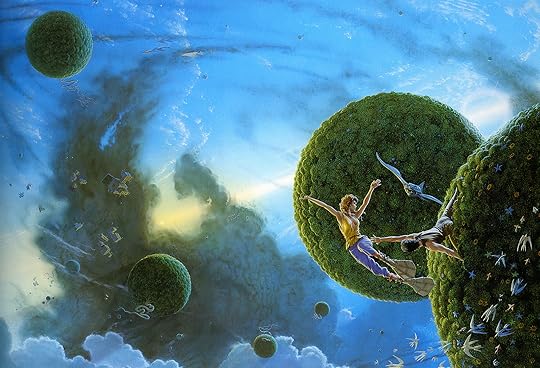
In this novel, Niven presents a fully-fleshed culture of evolved humans who live without gravity in the gas cloud surrounding a neutron star. In this Smoke Ring, free-floating life forms flourish, and all of them, from fish to fowl, can fly...
Laurence van Cott Niven's best known work is Ringworld(Ringworld, #1) (1970), which received the Hugo, Locus, Ditmar, and Nebula awards. His work is primarily hard science fiction, using big science concepts and theoretical physics. The creation of thoroughly worked-out alien species, which are very different from humans both physically and mentally, is recognized as one of Niven's main strengths.
Niven also often includes elements of detective fiction and adventure stories. His fantasy includes The Magic Goes Away series, which utilizes an exhaustible resource, called Mana, to make the magic a non-renewable resource.
Niven created an alien species, the Kzin, which were featured in a series of twelve collection books, the Man-Kzin Wars. He co-authored a number of novels with Jerry Pournelle. In fact, much of his writing since the 1970s has been in collaboration, particularly with Pournelle, Steven Barnes, Brenda Cooper, or Edward M. Lerner.
He briefly attended the California Institute of Technology and graduated with a Bachelor of Arts in mathematics (with a minor in psychology) from Washburn University, Topeka, Kansas, in 1962. He did a year of graduate work in mathematics at the University of California at Los Angeles. He has since lived in Los Angeles suburbs, including Chatsworth and Tarzana, as a full-time writer. He married Marilyn Joyce "Fuzzy Pink" Wisowaty, herself a well-known science fiction and Regency literature fan, on September 6, 1969.
Niven won the Hugo Award for Best Short Story for Neutron Star in 1967. In 1972, for Inconstant Moon, and in 1975 for The Hole Man. In 1976, he won the Hugo Award for Best Novelette for The Borderland of Sol.
Niven has written scripts for various science fiction television shows, including the original Land of the Lost series and Star Trek: The Animated Series, for which he adapted his early Kzin story The Soft Weapon. He adapted his story Inconstant Moon for an episode of the television series The Outer Limits in 1996.
He has also written for the DC Comics character Green Lantern including in his stories hard science fiction concepts such as universal entropy and the redshift effect, which are unusual in comic books.
Christmas 2010: I realised that I had got stuck in a rut. I was re-reading old favourites again and again, waiting for a few trusted authors to release new works. Something had to be done.
On the spur of the moment I set myself a challenge, to read every book to have won the Locus Sci-Fi award. That’s 35 books, 6 of which I’d previously read, leaving 29 titles by 14 authors who were new to me.
While working through this reading list I got married, went on my honeymoon, switched career and became a father. As such these stories became imprinted on my memory as the soundtrack to the happiest period in my life (so far).
Oh, what to say about The Integral Trees? The concept may have seemed strange and original back in ’85, but to the mind of this genre-burnt geek, familiar with the works it (presumably) helped inspire, it felt comfortable, cosy and tame.
There’s a gas ring around a neutron star full of free-fall life forms, with stranded humans living a floating Peter-Pan hunter-gatherer lifestyle amid the alien eco-system with their cultural memories of civilised planets little more than myths of legends...
It’s a story about gradually broadening horizons: our little tribe of survivors live in/on/around a zero-g space tree. Their tree is their world. Then – OMG! – they’re tossed off the tree and discover more humans living on other trees! Dare to dream; their might even be humans outside the gas ring – oh wait, there’s a spaceship! Whoa, what a mindfrack!
I’m not going to call this a great book. None of the characters are particularly vivid or memorable. The story isn’t revolutionary or daring. There’s nowt in the way of a thematic suckerpunch.
Applicable words to describe this book are: FUN, ESCAPISM, ROMP, PLAYFUL and SMART.
I recommend this to fans of Asimov and/or Varley – for me this fell halfway between the style of the latter Foundation books and Titan. I’ve heard that Pohl would make this ménage à trois a full on four-way, but I haven’t read any of his work yet to make that statement with much certainty.
The Hugo that year went to Neuromancer, and you have to say the better book won in that showdown! But I’m glad that Locus gave it to The Integral Trees, because otherwise this novel could easily have been forgotten over the years and it’s one that I recommended unreservedly as a thoroughly enjoyable little read. Great for a fling – but maybe not one to settle-down with, y’know?
I’m pretty sure I’ll cycle back around at some point to read A World Out of Time and Ringworld – I enjoyed touching base with his Nivenness and as soon as the opportunity arises I’d be happy to dig a little deeper into his catalogue.
Imagine living with air, water, plants and animals - but No land. Welcome to the Smoke Ring around a far star.
The thoughts of a man now inside a computer program in charge of the star-ship Discipline. . . It was taking too long, much longer than he had expected. Sharis Davis Kendy had not been an impatient man. After the change he had thought himself immune to impatience. But it was taking too long! What were they doing in there?
His senses were not limited. Sharis's telescopic array was powerful; he could sense the full electromagnetic spectrum, from microwave up to X-ray. But the Smoke Ring balked his view. It was a storm of wind, dust, clouds of water vapor, huge rippling drops of dirty water or thin mud, masses of free-floating rock; dots and motes and clumps of green, green surfaces on the drops and the rocks green tinges of algae in the clouds; trees shaped like integration signs, oriented radially to the neutron star and tufted with green at both ends; whale-sized creatures with vast mouths, to skim the green-tinged clouds .
Life was everywhere in the Smoke Ring. Claire Dalton had called it a Christmas wreath. Claire had been a very old woman before the State revived her as a corpsicle. The others had never seen a Christmas wreath; nor had Kendy. What they had seen, half a thousand years ago, was a perfect smoke ring several tens of thousands of kilometers across, with a tiny hot pinpoint in its center.
Their reports had been enthusiastic. Life was DNA-based, the air was not only breathable, but tasted fine
Discipline presently occupied the point of gravitational neutrality behind Goldblatt's World, the L2 point. This close, the sky split equally into star-sprinkled, black- and green-tinged cloudscape. Directly below, a vast distorted whirlpool of storm hid the residue of a gas giant planet, a rocky nugget two and a half times the mass of Earth.
Sharis would not enter that inner region. The maelstrom of forces could damage his ship. He couldn't guess how long the seeder r~mship must survive to accomplish his mission. He had waited more than half a thousand years already. The L2 point was still within the gas torus of which the Smoke Ring was only the densest part. Discipline was subject to slow erosive forces. He couldn't last forever in this place.
At least the crew were not extinct.
That would have hurt him terribly.
First catch your dinner . . . There was a hole in the tree. From the blackness inside Gavving saw a thickening of the live rope and a single eye lifting on a stalk to look at him. He jabbed at it. A lid flicked closed; the stalk dodged. Gavving tracked it. He felt the jar through his arm and shoulder as the harpoon punched through.
A huge mouth opened and screamed. The living rope thrashed and tried to fling Glory away. What saved Glory was Glory hersell~ she had plunged her own harpoon through the brown hawser and gripped the point where it emerged. She clung to the haft with both hands while the rope bent around to attack Gavving.
The mouth was lined with rows of triangular teeth. Gavving pulled his harpoon loose from the eye, with a twist, as if he had practiced all his life. He jabbed at the mouth, trying to reach the throat. The mouth snapped shut and he struck only teeth. He jabbed at the eye again.
Something convulsed in the dark of the hole. The mouth gaped improbably wide. Then a black mass surged from the hole. Gavving flung himself aside in time to escape being smashed loose. A hut-sized beast leapt into the sky on three short, thick legs armed with crescent claws. Short wings spread, a claw swiped at him and missed. Gavving saw with amazement that the rope was its nose.
He had thought it was trying to escape. Ten meters from its den it turned with astonishing speed. Gavving shrank back against the bark with his harpoon poised.
The beast's wings flapped madly, in reverse, pulling it back against its stretching nose . . . futilely. The foray team had arrived in force. Lines wrapped Glory and trapped the creature's rope of a nose. Lines spun out to bind its wings. Clave was screaming orders. He and Jinny and the Grad pulled strongly, turning the beast claws-outward from the tree In that position it was reeled in until harpoons could reach its head.
Gavving picked a spot and jabbed again and again, drilling through bone, then red-gray brain. He never noticed when the thing stopped moving. He only came to himself when dave shouted, "Gavving, Glory, dinner's on you. You killed it, you clean it."
Cargo And Repair Module. CARM. He stood stupidly. "Carm?"
She slapped its metal flank and pronounced the syllables as she had been taught. "Cargo And Repair Module. CARM. In!"
He got through both doors and a few paces beyond, and there he stopped, gaping, trying to see in every direction at once. For the moment she left him to it. She didn't blame him. Few copsiks ever saw the interior of the carm.
Ten chairs faced into a tremendous curved window of thick glass. Images were there that couldn't be outside the glass, nor could they be reflections. They must be in the glass itself: numbers and letters and line drawings in blue and yellow and green.
Behind the chairs was thirty or forty cubic meters of empty space.
There were bars set to swivel out of the walls and floor and ceiling, and numerous loops of metal: anchorage for stored goods against the jerky pull of the motors. Even so, the cabin was only a fifth the size of the carm. What was the rest?
When the carm moved, flame had spurted from nostrils at the rear. It seemed that something must burn to move the carm . . . a good deal of it, if it occupied most of the carm's bulk . . . and pumps to move the fuel, and mysteries whose names he'd glimpsed in the cassettes: attitude jet life support system, computer, mass sensor, echo laser.
The calm left by the needle had almost left his blood. He was starting to be afraid. Could he learn to read those numbers in the glass? Would he have the chance?
In Discipline the man/computer program Sharis Davis Kendy waits for the humans to take their next big step and leave the Smoke Ring
I’m surprised I’d never heard of this book. The world building is on par with ringworld. I love these kind of far out stories mostly about exploring a far out world dreamed up by an intelligent, imaginative mind. Typically, the characters are left underdeveloped and there’s a couple of cringy moments but overall pretty cool. I love it when they put so much thought into the world that they include maps, diagrams and glossaries. Fun stuff.
This was a more entertaining book than the first of the series A World Out of Time and lies somewhere between a 3 and 4-star. I felt generous so I bumped it up because of the idea of a biosphere in space over a gas giant which is an interesting idea (and inspiration for the end of biosphere and treeship at the end of The Rise of Endymion?) and the juvenile atmosphere that reigned here which was a pleasant change from some of the heavier sci-fi I read. Well, I say that, but the war between the two sides of the integral tree is not exactly a peaceful river trip, so I guess I am thinking more of the fact that the protagonists are all younger than in the other Niven novels I have read. I dunno, three or four stars?
As a math major, reading this book prior to class often came with the burden of disclaiming, "It's not about math." And that's a little disappointing, actually, because I don't read enough books about math, especially fiction books. And The Integral Trees would make a damn good title for a math novel.
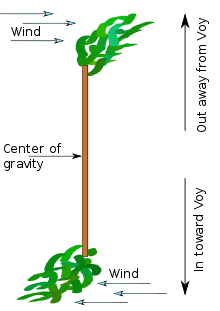
But no, Larry Niven had to go and steal the title for his own nefarious purposes. It actually took me longer than it should have taken to realize why the integral trees were named as such—I admit I did not scrutinize the diagrams very closely. They're shaped like integral signs. That's … not very impressive.
Fortunately, most of the book's worldbuilding is impressive and pretty much what I expect from the person who wrote Ringworld. I'd go so far as to declare the worldbuilding in The Integral Trees superior to Ringworld's. Although Niven's concept of a ringworld is better-known and more portable than the Gas Torus and Smoke Ring of this novel, the latter environment results in far weirder inhabitants and habitations. Getting used to how one moves around in an environment consisting of constant freefall is a bit of a challenge. But this gives Niven the opportunity to construct wonderful scenes that would usually be more at home in a fantasy story rather than a work of science fiction.
Now, I'm not one who visualizes events, even the most mundane ones, so scenes like the flight of the CARM don't fill my mind with cinematic wonder. Nevertheless, there's still plenty about the unique environment of the Smoke Ring that intrigues me, such as the changes in physiology undergone by the descendants of the original Discipline crew-members. These are people, humans with the same foibles as the rest of us, yet they are biologically somewhat different. Not only are their bodies longer, slimmer, their feet almost as skillful at manipulating objects as their hands, but their society, having developed in a ring of translucent gas, has radically different conceptions of "ground" and "sky." Science and their history prior to arriving at the Smoke Ring is more mythological than archaeological; some tribes are lucky enough to have a Scientist who has access to tapes and readers with the data of the Discipline expedition.
Although the inhabitants of the Smoke Ring have largely forgotten Discipline, Discipline has not forgotten them. The ship is controlled by the recorded personality of Sharls Davis Kendy. Niven steps away from a true "artificial intelligence" by using recorded personalities; these, along with the concepts of "storage space" and "tapes" and "readers" make for a very analog vision of the future. As a recorded personality, however, Kendy is a very interesting character. Unlike an AI, who would presumably be extremely clever and patient, Kendy is a fallible being who makes a lot of mistakes (including letting the Discipline anywhere near the Smoke Ring, though he claims he has erased that part of the mutiny from his memory). Kendy is also our only connection to Niven's distant State, a somewhat totalitarian, surveillance-based system of distributed governance. As such, the duty to recover crew for the Discipline and continue its mission is vital.
This sense of urgency and necessity runs through all the plots of The Integral Trees. This is a survival story, actually multiple survival stories, set in a fantastic environment. The protagonists are refugees who survived the destruction of their tuft more from luck than any skill on their parts; as the only remaining members of the tribe, they have to start anew somewhere. But subsequent events make this very difficult. At first the refugees have to struggle to survive in the open air of the Smoke Ring, living on little more than some bark that splintered from their fractured, forlorn tree. Soon they have to deal with other inhabitants of the Smoke Ring, another tribe that has no compunctions about capturing slaves.
Many of the main characters experience a test of loyalty as they weigh the options for survival. Minya, once a member of the Dalton-Quinn Tuft and now married to one of the Quinn refugees, enters the story as an antagonist. With the destruction of the tree, she is stranded far from her tuft with the rest of the refugees, and out of pure practicality she marries one of the two available males. After becoming a slave, Minya learns she's pregnant, though she's not sure who the father is. Nevertheless, she strives to escape and reunite with her husband, whom she has known for only a few weeks.
Grad Jeffer, apprentice to the Scientist of the Quinn Tribe, finds himself apprenticed to the Scientist of the tribe that captures and enslaves the refugees. He is in that delicate position of collaborator: still a slave, but trusted and accorded with privileges beyond an ordinary slave's position; liked, essentially, by no one. Jeffer, as a Scientist, has the corrupted remnants of the Discipline crew's knowledge, as well as the tapes and reader to go with it. But this doesn't preclude his own crises of conscience, first when he is plotting and initiating a rebellion that results in the murder of a Scientist, and then later when he is conversing with Kendy aboard the CARM. Jeffer may not be the leader of Quinn Tribe, but he is an authority figure, and for much of the book he functions as a leader while the tribe tries to escape from the slaver tree.
And finally, we come back to Kendy, for whom the question of survival is twofold. Firstly, on a personal level, he wants to continue his mission. Babysitting the Smoke Ring civilization until it reaches a level that he can jumpstart and control must be boring. And as we learn early in the book, his memory capacity is severely limited, so he is constantly editing old memories to make room for new ones. How long can this go on before he is no longer himself? Or has that already happened? Secondly, Kendy needs to fulfil one of his missions: ensure the survival of the State. Although the Discipline's primary mission was to seed planets with the materials that would form complex life, every such ship is also a little pocket of the State, completely able to refound the State should it cease to exist elsewhere. The fact that the crew has so thoroughly mutinied and abandoned the values of the State must be incredibly galling for Kendy.
Or at least, that's the sense I get from his chapters. Reading The Integral Trees takes effort, and not just because of the odd setting. Niven teases us by offering very little exposition; almost everything about the Smoke Ring society is explained through action and a little dialogue. Once in a while, particularly during Kendy's chapters, we'll get longer infodumps, but they never go into the detail I'd like. We don't learn that much about the State, just enough to suggest a totalitarian government. The result is a very tight book focused only on telling a story about these characters and not concerning itself with other, secondary characters. Indeed, I can count on one hand the characters who feel real or three-dimensional to me, and even that might be a stretch.
This is the same problem I experienced in reading Ringworld. Niven is a very clever, creative writer with a fertile imagination. His characters, however, are flat, almost set pieces at times. And sometimes the interactions between them just don't feel real at all. Minya and Gavving's marriage really irked me at first; they've known each other for a day, and she proposes to him. I suppose this is justifiable by pointing out that this society has evolved for five hundred years, and so customs are bound to be different from our own. But it's not just the stark pragmatism at work here—that's a quality I really do see as emerging from the evolution of a society in free-fall. It's a question of loyalties, of dependencies and relationships. Some of the other characters also have a quick change of heart, convenient for Niven and the plot but problematic from the reader's perspective. Consequences for being an antagonist are almost invariably a slap on the wrist and, if you're lucky, marriage! By the time the refugees escape, with some now-converted antagonists and some allies in tow, it seems like there are lots of loose ends that Niven simply decides to truncate rather than resolve. This mutability in the dynamics between characters makes it very difficult to become invested in one character or another's survival, and that sort of pathos is essential to a good survival story. And since The Integral Treesis a survival story….
There are some brilliant things about this book, not the least of which is its superiority to Ringworld when it comes to worldbuilding. I thought that part of the back cover summary was an editor's hyperbole; it's not. Alas, that's not enough, not even for Niven. The story is basic, well-structured, but short when it comes to an emotional connection. It's stunted. Ringworld suffers from similar shortcomings, but it's still superior in that respect. Fortunately, they are both on the shorter side for science fiction, so you can easily make that decision for yourself.
This summer I have chose to re-read books I read or tried to read back in high school. I'm positive that books I read when I was 15, or 16 years old will read differently now that I'm in my 40's. The Integral Trees and it's follow-up book, The Smoke Ring were such books.
I remember this book as a book about "space fairies." Humans live in this weird alien fairy type planet where they mutate into flying fairy-like creatures due to the low gravity environment.
Well......I guess this book was sort of like that, if you squint your eyes and cross them as you read it.
I'm not sure how I managed to forget how much real hard science is in this novel. I also shudder to realize that Larry Niven would probably die if he heard this novel described as "the space Fairy novels." The interesting question would be, would he die of horror or would he die of laughter?
In reality, this novel is an intricately built world with plausible mutations based on the science of low gravity living. I found the geopolitical struggles to be fascinating. My one negative would be that the characters might have been a little flat compared to the glorious and gorgeous world building. I must say I am looking forward to re-reading the third and last book in this series.
The setting for this story is a smoke ring around a binary star system, featuring massive, spinning "integral trees" with city-sized clumps of foliage at their ends, inhabited by free-fall life-forms, most of which were edible and all of which could fly. Humans are a more recent addition to this environment. The world-building and ecology is unique and fascinating, but the characterisation and plot are poor. This novel did not age well.
The Integral Treesis a precursor to Karl Schroeder's Virga series, and the spiritual and intellectual forefather of Niven's magnum opus, Ringworld. It shares that sense of a vast, fantastical yet possible, limitless world where anything can happen... and populated with people very strongly reminiscent of JM Barrie's Lost Boys, or Brian Aldiss' Starship crew. It's a story we've read a thousand times before in some form or another... the outcast finds adventure, glory, wealth, gets the girl, rescues the princess, destroys the evil empire... but what really stands out, what brings the magic, is the world it happens in. Its a world without gravity, and a story of what our fables would be... if we could fly.
In short, if you're considering reading Niven for the first time, pick this book first. It's not a very long book at all (I read it as a teenager) so if find you hate him, then you don't endure much. :) You get the interesting/strange world premise, lots of interesting inter-human development, plot twists, and a small/manageable but not overwhelming dose from the science aspect of sci-fi.
*** One of the first sci-fi books I read. I'm not really a sci-fi fan, but I picked this off my Dad's bookshelf because I liked the cover, and it was short, unlike most of his other scifi books. However, this had a good balance - enough to be interesting, not enough to lose my attention completely. Most of it was spread throughout the book, so I wasn't getting a huge dose, which helped. The first chapter has a little more, since it has to set up the premise, but it's not bad and if you get through it, it's worth it.
I love how posing the idea of a strangely-shaped world (such as Ringworld) can ripple down to affect how people think, evolve, and task manage. Sure, some call it rehash - pick a new shape, write a new book - but we see it in our world, after all. Think about how Islander communities differ from inland river-side communities, and those from mountain communities. In Niven's "world", Humans inhabit massive trees that radiate outword from the central star like spokes on a wheel, with "tufts" at each end that are the only habitable portions of this world. Yet we discover that there are indeed people surviving in rogue floating tufts of greenery without trees attached, which is unthinkable to tree-dwellers. (Think: pirates) I believe our cripple main-character gang eventually joins up with them for a while.
One of the most facinating parts to this book was how these isolated little tuft communities develop, both comparing them to the advanced group they initially came from (great plot twist there, btw), and to other tuft communities both more and less regressed. There's quite a bit of tribla warlike action going on in one of the trees, between the two end tufts. The tufts with access to information - teaching tapes, teachers, etc - are obviously more "civilized" than the ones without, such as the dying tuft which sends out our gang of cripples. But it's neat also to see that the "civilized" tufts are still devolving into sort of a caste or maybe master/apprentice system? Not sure how to characterize it. Character interactions are fascinating on the small scale, between our main group, and on a larger scale, between the other tufts they come across.
***
(I'm annoyed at the cover on the new editions. They damped down the bright green color of the old book - which was a small part of the premise, that in the trees and floating greenery even the air was almost tinged with green. Small, but I still remember it.)
This is an old favorite, mainly because the world Niven imagines is so unbelievably cool. Let me see if I can lay it out: a gas giant planet is orbiting a collapsed star a billion years after a supernova; the collapsed star is one of a binary with a normal star like the Sun. The gas giant's atmosphere has been slowly leaking away into orbit around the collapsed star, forming a ring of atmosphere through which the core of the planet orbits. This ring is dense enough to support life all the way around the collapsed star -- in zero gravity. So there's air, but no ground. And there are two suns -- the collapsed star, which is dim but close, and the other star, which provides light and heat. Life has evolved here, including giant trees that have something resembling tidal gravity at each end, and all sorts of bird-like creatures.
A human spaceship arrived 500 years ago to explore the system. There was some kind of mutiny, which led to the crew being stranded in the Smoke Ring. Since then, humanity has spread out into innumerable tribes all slowly losing their knowledge of science while they struggle to keep a few remnants of technology working. The plot does a nice job of revealing a lot of well-thought-out ramifications of this world -- various flora and fauna, various ways human tribes have adapted.
The writing is maybe a little better than what you'd expect from something like this written in 1980 or so. The characters are interesting and sometimes unexpected. There are strong female characters and even a few nicely feminist plot points, but there are several scenes (one in particular) that I think reveal the author's male gaze and pretty drastically undermine any positive gender politics.
But depth of character isn't the point with this one. Overall, the book more than delivers on the premise -- it's a mostly rollicking story in an absolutely amazing setting, and every chapter reveals some new and fascinating aspect of this world.
Larry Niven is one of those grand masters of science fiction. Literally. Named the 2015 Damon Knight Memorial Grand Master, he's been a finalist for the Hugo novel award eight times for different works. In my quick (though surely inaccurate) count of published novels and collections, I got to the number 95. This is only my seventh Niven book (thus I've not even read 8% of his works), but I haven't loved any of them. I haven't even really liked a one. The Integral Trees continues to confirm my estimation of Niven: talented with background ideas, awful with characters, poor with clarity, below average with plotting, and obsessed with sex.
At an almost subliminal or superficial level, this is my favorite science fiction world in all of science fiction. I first came across the idea elsewhere, but Niven presented it here, 14 years earlier. The author even has some diagrams (which can also be seen on his webpage) to make sense of his world: The Smoke Ring. The creation is awesome. The world and its physical properties, the hard science behind it, all were delightful to imagine. To find reason to believe in the existence of a place like this is one of the reasons I read science fiction. It is as creative as fantasy, but with the added tantalizing benefit of being possible, however improbable.
As much as I loved the setup, it was really that setup and not the execution that was so good. Niven is very poor with descriptions and depth of his world. He laid the physics groundwork but thereafter did the same thing he did in Ringworld. He made some sketches and stabs and exotic creatures, but aside from a few pointed physics tutorials, there wasn't a lot of effort or detail on how life in the Integral Trees would be experienced. His sociological worldbuilding is as awful as his hard science worldbuilding is good. The plotting too was what I've come to expect from Niven. He knows the general structure of adventure, thrill, and resolution but does not add anything original, deep, or creative to it. He added in a nonlinear timeline with shifting perspectives on this one as well, but I thought it detracted from the story and added to his already confusing writing.
I really loved the integral trees but not The Integral Trees.
Larry Niven is most well known for his Ringworld series. Therein, he established his hard sci-fi credentials with his elaborate world-building, an artificially constructed ring around a star providing enough livable surface area equivalent to thousands of Earths. And true to form, this book's strength is its world-building. It posits a star system composed of a G-class star in orbit around a neutron star. Closer in, the neutron star has a doughnut-shaped ring of gas fed by a gas giant, whose atmosphere is slowly being stripped by said neutron star. Life exists here in the form of kilometers-long trees, shaped like integrals (You know: the kind from Calculus), inhabited by alien birds and insects. Free floating ponds (giant spheres of water) occasionally crash into the trees, providing life sustaining water.
An exploration vessel from Earth happened upon this system. The entire crew of the ship disembarked, telling the ship's AI that they wanted a close-up look. But they never returned, choosing to settle there instead rather than live under the oppressive Terran government, simply referred to as "the State." The story picks up 500 years later. The AI is annoyed but still has some measure of patience.
The descendants of these mutineers have split into tribes and live on separate trees or opposite ends of the same tree. They've adapted to these new low gravity conditions while technology has almost all but reverted to primitive means. And so does the culture! Back to patriarchy! Oh yay!
Niven's early work is guilty—as many sci-fi authors of his generation are—of being stuck with outdated attitudes about women. This early 80s story shows a modicum of progress, but still clings to the past. In one tribe, there's a group of women warriors who patrol and hunt, but it's because the other option is to just cook and make babies. One character joins this group because she was tired of being groped all the time. She wants to find some kind of middle ground, but can't find it in her tribe. Others in this group are hinted at being lesbians, and there's one man who's been granted the "courtesy" of joining as he's gay. In other tribes, women have multiple roles, and in one, a woman is a scientist-apprentice. But lest you think this tribe is progressive, they take slaves from other tribes. The men are forced into labor while the women do the cooking and laundry while occasionally serving as "comfort women."
Niven flits about with which character runs the narrative, so we get multiple POVs within the same chapter. Just as we get to know a character, the POV switches and that's that. We start with the AI, then Gavving, the teenager coming into manhood, and then he-man Clave takes over with his twin girlfriends (eyeroll). The character of Merrill was born without legs, but we never get her POV of things.
It was an entertaining read for the first 70 pages, but after that, the writing felt amateurish. It was like Niven put most of his effort into the world-building and the start of the story, but didn't have anything left to continue. With his editor complaining about a deadline (I have no idea. I'm just making this part up.), he had an event hijack the story, forcing the characters into a slave rescue plot.
While this book is listed as being in the same series as A World Out of Time, there's no connection to it other than a reference to the nefarious State.
Fantastic worldbuilding clearly took all the time Niven was willing to put into this book- the characters are a clear afterthought.
The real problem, though is a nightmare of anti-feminist bullcrap. The female "lead" (I'm putting lead in quotes as all the women in this book are very clearly portrayed as pets whose only opinions are those of their men) joined a sort of nun warrior class at 14, because that was the only way to avoid being raped (a woman can either make babies or join this separate class- there are no other options). When we meet her she is regretting that decision. She meets our group, and it is made clear that she can either "marry" one of two available men, or else the group will kill her. She decides on our hero, a 15(ish) year old boy, and within the hour they're married. He is, to his credit, horrified that men had been bothering her when she was fourteen, and her response is to laugh and say something like "well, I AM very pretty, of course they wanted to rape me! giggle giggle."
Later the get captured and taken as slaves- the men are made to do hard labor, and the women are... otherwise used. That same character's response to being so used? "Well, at least I'll do a good job of it, if this is what I am to do".
Classic Niven. Interesting situations, cool science. The characters are interesting but not fantastic, certainly far less fantastic than the setting.
The Integral Trees takes place in gas torus around a neutron star. There's air and water and plants and animals, but no ground. Everything and everyone is continually in freefall. The human colonists--who have, by the way, lost much of their technology and are only vaguely familiar with their offworld origins--live on the giant integral trees (so named because they look like integration signs) where tidal effects give them some gravity.
So it's a weird setting. Everything is about orbits, and if you haven't played at least a little Kerbal Space Program (or worked at NASA) then a lot of the setting is going to be confusing for you. "West brings you out, out brings you east, east brings you in, in brings you west," the saying goes. If that doesn't mean anything to you, you might have a tough time.
But I loved it. It was right in my wheelhouse. The plot is kind of forgettable, except that it gives the characters plenty of opportunity to move around the world, seeing all the weird stuff in the environment. It's kind of like Ringworld in that way. The plot isn't what you show up for; it's the setting.
Such a novel idea, the Integral Trees by Larry Niven, so fantastic in its conception. With Ringword awarded all the high accolades, this storyline again revolves around another ring, a ring around a neutron star, as a gas torus . . . how oddly interesting.
I gave this novel 5 stars because of the super-charged, fascinating, mind-blowing storyline and characters. Definitely a great read!
Novela ganadora del Locus 1985. Larry Niven construye mundos muy interesantes, solo diré Mundo Anillo. Acá, toda una civilización construida en una burbuja de gas respirable en microgravedad, con “arboles” que permiten el desarrollo de tribus y conflictos. Todo desde un antiguo motín de una nave terrestre hace 500 años. Es una novela de aventuras, donde los héroes tratan de salvar su hogar explorando lo desconocido, buscando respuestas. Volando entre árboles (que tienen forma de integral, hay que decirlo). La historia es simple, algo predecible, pero entretiene. Los personajes y las situaciones hay que leerlas como hijos de su tiempo, sin cuestionar mucho. Sigue siendo una aventura destacable, con personajes algo flojos, pero suficientemente descritos como para entender. Los Locus tienen ese componente extraño de a veces ser novelas ganadoras entretenidas, pero no grandes obras. Acá, un buen libro y se lee fácil. Un universo Nivel muy bien armado, en todo caso. Con diagramas y todo 😊
In this novel, author Larry Niven constructs a believable world wholly unlike our own, without recourse to the supernatural or even the super-scientific, and populated by transplanted humans whose society has devolved into small, isolated, xenophobic, sometimes warring tribes. Although the Smoke Ring in which the story is set is alien in a great many respects, part of Niven's genius is his ability to paint a lucid picture of this setting with a minimum of words. This frees him to develop his characters and their relationships to excellent effect and to focus on the compelling, fast-paced plot. There is no filler here; every word counts.
I won't supply any spoilers other than to note that this novel sets up the sequel which followed without sacrificing a satisfying ending. The detail with which Niven constructs his alternate (but plausible) world is astonishing, whether describing its ecosystem, its cosmology, or the evolution of its various inhabitants. And because the characters are long ago descended from technologically advanced humans and, therefore, rely on a mixture of advanced and primitive technologies, fans of steampunk should find this an engrossing read.
I have trouble finding fault with this novel. The dialogue, the characterizations, the plot line, and the setting are all expertly wrought. And if the war-like tendency of the tribes which Niven creates seems pessimistic, this is more a criticism of human nature than Niven's depiction of it. One of the finest sci-fi novels I've read.
The story here concerns the descendents of Earth travelers who, five hundred years earlier, chose to settle in an array of massive, free-floating trees that orbit a neutron star. During a particularly lean time, a small group is sent out to search for additional resources, and then an environmental disaster strikes...
By this point in their history, the tree people have lost most of their technology, and scientific knowledge is limited, so (like Anne McCaffrey's Pern novels) this is a science fiction adventure that feels a lot like fantasy most of the time. Still, there is plenty of hard science used to describe their strange environment and how it works, so it may satisfy both camps.
Characterization is not the novel's strong point. All of the characters are stereotypes - the bossy alpha male, the science guy, the cranky old guy, the inexperienced guy, the young girls with nice breasts... - and never move beyond that. I didn't care too much about any one of them. This is a book you read for the bigger concepts. Those ideas are interesting enough that I may read the sequel at some point.
The Integral Trees is a basic party exploration adventure story, but with a really fascinating environment to explore. Instead of colonizing a planet, humans colonized a kind of space ‘trees’ living in a gas torus within a binary star system. I was really drawn in by the amount of thought and creativity behind the description of the physical setting and its extrapolation to how native life would develop and humans would adapt. The characters were a little simple in comparison, but they made for a fun group to follow as they traveled through such an impressive world.
A planet without ground, where the inhabitants are ruled by the whims of tide and wind. Not sure which is most fascinating: the unique setting, or the awkward delivery of the most mechanized sex scenes ever. Way to keep it systematic, Hard SF.
A story about a tribe of outcasts who live on a gigantic flying tree, sent on a quest to find out why their home is dying. That might sound like a fairy story written for small children, but in this case it's the premise for a hard science fiction novel which deals with a surprisingly wide range of adult issues. The Integral Trees won a Locus award in 1984 and was nominated for a Hugo and Nebulas in the same year.
The outcasts are the centuries-passed descendants of a space disaster, trapped beyond human contact with bodies highly adapted to their freefall environment. They sustain a fragile existence in a rigid tribal culture whose language and customs are based on fragmentary memories of their origin, all watched over by a slightly bonkers AI flying in orbit - if you're looking for a contemporary counterpoint, it's all slightly reminiscent of Adrian Tchaikovsky's Children of Time, which I wouldn't be surprised if it influenced.
Overall it works well, and I think it has stood the test of time. I find Liven to be very hit and miss. For every Dream Park or Ringworld, you get two stinkers. Like Adrian Tchaikovsky, Larry Niven was an absurdly prolific author, and a potential problem with such compulsives, is that sometimes they write novels when they haven't got anything in particular to say, or haven't given their ideas enough time to bed down. The Integral trees arguably does suffer from the latter, particularly in its underwhelming finale, which is a generic war/action scene, but before you get there, you are treated to a relentless and intriguing stream of ideas about how this alien environment would function, and thoughtful commentary on how cultures compete and advance, slavery, sexuality, and many other issues.
I was somewhat surprised to see accusations of sexism in other reviews. I can't deny that by current standards Liven often comes across as a little "male gaze", but there's a clear difference between being a misogynist, and presenting a deeply unpleasant societies that are misogynistic. In this case it's clearly explained why they have evolved that way - and we also get matriarchies, tribes in which the warriors are all women, we have transsexuality addressed directly and positively, less-able characters in starring roles, a clear message about traditional ideas of beauty being silly. For a novel written in 1985, this was decades ahead of its time in terms of inclusiveness.
Niven wrote a sequel - the Smoke Ring - and I will certainly give that a go at some point.
Read this one for Sci-Fi book group, would never have come across it on my own. A good read, if you are in the mood for a Big Adventure with lots of casualties along the way.
There's a science side to this book that I am not educated enough to fully appreciate, but it certainly makes for some very interesting world-building. What I enjoyed was the basic arc of the story (since it was published in 1984, I'm not worrying about spoilers, so please stop reading if that matters to you): Slaves rebel against their overlords, defeat them, and escape. The book doesn't use the word "slave," but that's clearly what their status amounts to. Actually, some of the original group that ends up involved in the revolt are not from the slave class, but they were cast out from their society, and are treated like slaves by the society that captures them in a slaving raid. To the extent that the story is about the outcasts surviving against all odds and finding a new home where they can start a new society where everyone is free and equal, it is both predictable adventure novel and satisfying conclusion. But since we only care about our little band, the fate of the folks left behind is unclear. We might infer that our heroes having taken the main pieces of technological advantage enjoyed by the slave-owners with them, the slaves will have made short work of their masters, but that's left to our imagination. There's a likable and heroic disabled character, and a trans character, too (alas, killed in combat before we get to know them). The sexual politics seem better than I would expect from a 1980s book by a male sci-fi writer, but I wouldn't call this feminist fiction. I may reevaluate this review after the group discusses it in early June.
Een avontuurlijk boek, boordevol aktie en spanning. Ik merkte wel dat het zeker nuttig is om het eerste boek van de reeks gelezen te hebben om alles goed te kunnen volgen. Larry Niven slaagt er erg goet in om de praktische moeilijkheden die gepaard gaan met het leven in de integraalbomen te schetsen en daarop aansluitend de (ingenieuze) oplossingen die de bewoners er op gevonden hebben te tonen. Mooi hoe hij een wereld zonder technologie (geen metaal) maar wel met een (vage) herinnering eraan beschrijft. Een kleine groep bannelingen waarvan er nog enkele afvallen en enkele personen die onderweg opgepikt worden spelen de hoofdrol wat het de lezer makkelijk maakt om een overzicht te houden. Jongere mensen zullen vooral geboeid worden door het avontuurlijke aspect maar als ouder persoon die het boek vroeger al eens gelezen had is me nu vooral opgevallen dat een handicap in 1 situatie juist een voordeel in een andere kan zijn.
So, this is the second book I have read from those labeled "The State", and I have to say, it is so far a rather curious set of books - neither one had much to do with The State! The first, A World Out of Time, began with The State - but largely removed from it - but the bulk was after its demise. This one was almost entirely devoted to the descendants of supposed "mutineers" from The State.
Well, in any case, this was an enjoyable read, as is usually the case with Niven. The scenario from anyone else I would think it to be an impossible situation; but with Larry Niven, I have no doubt he did a great deal of research to determine that, at most, it was very improbable. So I just accept it, and see where it goes.
So I would recommend this to anyone who isn't overly bothered by physical situations that make you say, "Wait a minute, what?"
I grabbed this audiobook because it is the prequel to a long-unread book on my shelf (stupid Science Fiction book club from the 1980s!). But I just couldn’t. Between the completely unclear and lengthy descriptions of “the smoke ring” by the author to one of the lamest narrators I’ve ever heard, this got 20 minutes of my time before being slammed onto the DNF pile. Guess I won’t be reading that sequel either. Oh well. Wasn’t Larry Niven supposed to be some sort of good author? If so, it sure wasn’t from this book!