

What do you think?

En la tradición de Marvel, esta novela gráfica en tapa dura presenta la eterna rivalidad entre el Poderoso Thor y su hermanastro Loki desde un punto de vista único. La insaciable sed de poder del Dios de las Mentiras, sus verdaderos sentimientos hacia Sif, las razones de su odio declarado hacia Thor… Todo ello de la mano de Robert Rodi, el último descubrimiento literario de la Casa de las Ideas, y con las fabulosas ilustraciones de Esad Ribic, un artista capaz de representar todo el esplendor de Asgard.
Contiene Loki 1 a 4 USA.
Guión: Robert Rodi
Dibujo: Esad Ribic
Contiene Loki 1 a 4 USA.
Guión: Robert Rodi
Dibujo: Esad Ribic
96 pages, Hardcover
First published January 1, 2004
About the author
Robert Rodi
209 books124 followersRobert was born in Chicago in the conformist 1950s, grew up in the insurrectionist 1960s, came of age in the hedonist 1970s, and went to work in the elitist 1980s. This roller-coaster ride has left him with a distinct aversion to isms of any kind; it also gave him an ear for hypocrisy, cant, and platitudes that allowed him, in the 1990s, to become a much-lauded social satirist.
After seven acclaimed novels set in the gay milieu, Robert grew restless for new challenges — which he found in activities as wide-ranging as publishing nonfiction, writing comic books, launching a literary-criticism blog, and taking to the stage (as a spoken-word performer, jazz singer, and rock-and-roll front man).
In 2011, excited by the rise of digital e-books, he returned to his first love, publishing new fiction inspired by the work of Alfred Hitchcock. He also organized the republishing of his seminal gay novels under the banner Robert Rodi Essentials.
Robert still resides in Chicago, in a century-old Queen Anne house with his partner Jeffrey Smith and a constantly shifting number of dogs.
.
German version: Robert Rodi wurde 1956 in einem Vorort von Chicago geboren. Im Alter von 22 schloss er sein Philosophie-Studium ab. Schon vorher beschäftigte er sich mit Comedy. Sein erster eigener Roman, "Fag Hag" aus dem Jahr 1991 war ein großer Erfolg. Es folgten mehrere andere komische Romane, zahlreiche Kurzgeschichten und Sketche. Robert lebt mit Partner und Hund in Chicago.
After seven acclaimed novels set in the gay milieu, Robert grew restless for new challenges — which he found in activities as wide-ranging as publishing nonfiction, writing comic books, launching a literary-criticism blog, and taking to the stage (as a spoken-word performer, jazz singer, and rock-and-roll front man).
In 2011, excited by the rise of digital e-books, he returned to his first love, publishing new fiction inspired by the work of Alfred Hitchcock. He also organized the republishing of his seminal gay novels under the banner Robert Rodi Essentials.
Robert still resides in Chicago, in a century-old Queen Anne house with his partner Jeffrey Smith and a constantly shifting number of dogs.
.
German version: Robert Rodi wurde 1956 in einem Vorort von Chicago geboren. Im Alter von 22 schloss er sein Philosophie-Studium ab. Schon vorher beschäftigte er sich mit Comedy. Sein erster eigener Roman, "Fag Hag" aus dem Jahr 1991 war ein großer Erfolg. Es folgten mehrere andere komische Romane, zahlreiche Kurzgeschichten und Sketche. Robert lebt mit Partner und Hund in Chicago.
Ratings & Reviews
Friends & Following
Create a free account to discover what your friends think of this book!
Community Reviews
Displaying 1 - 30 of 142 reviews

February 18, 2015
3.5 stars
Evil Buddy read with the Shallow Comic Readers.
Criteria? Anything with a Villain.
Yeesh.
Well, that was depressing.
I just finished it, so give me a minute here to digest it.

*clears throat*
Which makes no sense since I'm typing, but just go with it, ok?
Alright.
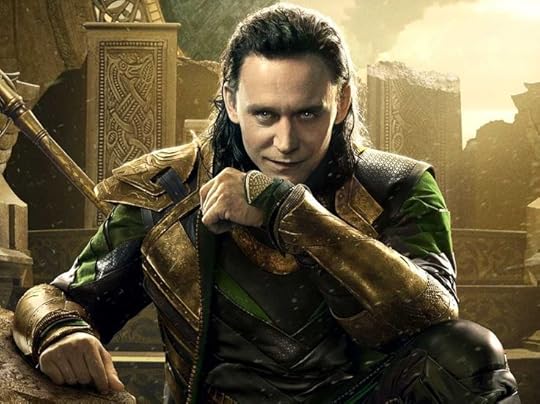
First, this ain't your sexy Hiddleston Loki.
Unless you think Grandpa Laufeyson looks hot.

So, in this one, Loki has finally beaten Thor, become ruler of Asgard, and...
Yeah, just kind of needs to decide what to do with the rest of his life.
Also, everyone (including Hel) goads him into sentencing Thor to death.
He's sort of sad, and he remembers how everyone in Asgard was mean to him, and the deck was stacked against him from the beginning, and blah, blah, blah.
And then his mom shows up and just embarrasses the hell out of him.
As we do.
So. After looking back on his life, he realizes that
I thought the art was interesting, and that the story was well-written.
But. I'd only recommend this to folks who like to read books that make them cry.
As in, Old Yeller, Where the Red Fern Grows, or anything by that Sparks dude.
Here's a little something to scrub the image of Geriatric Loki out of your mind:
Evil Buddy read with the Shallow Comic Readers.
Criteria? Anything with a Villain.
Yeesh.
Well, that was depressing.
I just finished it, so give me a minute here to digest it.
*clears throat*
Which makes no sense since I'm typing, but just go with it, ok?
Alright.
First, this ain't your sexy Hiddleston Loki.
Unless you think Grandpa Laufeyson looks hot.
So, in this one, Loki has finally beaten Thor, become ruler of Asgard, and...
Yeah, just kind of needs to decide what to do with the rest of his life.
Also, everyone (including Hel) goads him into sentencing Thor to death.
He's sort of sad, and he remembers how everyone in Asgard was mean to him, and the deck was stacked against him from the beginning, and blah, blah, blah.
And then his mom shows up and just embarrasses the hell out of him.
As we do.
So. After looking back on his life, he realizes that
I thought the art was interesting, and that the story was well-written.
But. I'd only recommend this to folks who like to read books that make them cry.
As in, Old Yeller, Where the Red Fern Grows, or anything by that Sparks dude.
Here's a little something to scrub the image of Geriatric Loki out of your mind:

January 21, 2016
Loki, god of mischief, is ever subject to fate. His fate seems to live and seethe in the shadow of Thor.
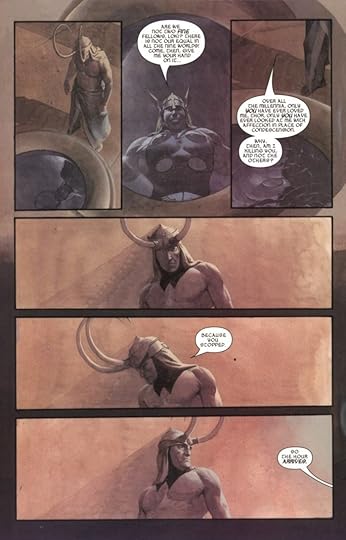
Loki provides insight into his mind. He's been mistreated and unloved by all, but Thor. Thor always loves Loki despite the fact Loki always betrays him.

Loki is a pawn of fate yet I can't feel too sorry for him. Everyone suffers misfortune, but it's the choices made in response to misfortune largely define us. Loki is undoubtedly mistreated, but he takes it out on his stepbrother who loves him along with those who mistreat him.
This story seemed to be written to make Loki sympathetic, but it instead made him seem somewhat pathetic.
Loki provides insight into his mind. He's been mistreated and unloved by all, but Thor. Thor always loves Loki despite the fact Loki always betrays him.
Loki is a pawn of fate yet I can't feel too sorry for him. Everyone suffers misfortune, but it's the choices made in response to misfortune largely define us. Loki is undoubtedly mistreated, but he takes it out on his stepbrother who loves him along with those who mistreat him.
This story seemed to be written to make Loki sympathetic, but it instead made him seem somewhat pathetic.

February 17, 2015
**Buddy Read with the Shallow Comic Readers -- This week's theme: Eeevillll!"

Thor has always been one of my favorite Marvel characters, because I always enjoy seeing the gods of old come to life. And what is Thor without Loki? The yin to his yang, the stop to his go, the black to his white, the Marvel to his DC...umm, I mean, the winter to his spring? Loki is the anti-Thor, and this book by Rodi and Ribic does its best to make those comparisons and provide the reader with a psychological profile of Loki.
Although the casual reader only knows that somehow Loki has usurped Odin and become Lord of Asgard, as Marvel sees fit not to let said casual reader know what has happened (exposition, folks!), it really doesn't hinder the tale at all. This is all about the eternal brotherly dynamic between Thor and Loki and how it has driven Loki to become the trickster god he is. He's hurt, dejected, rejected and just ugly, and that alone can bring a sociopath to commit villainy. I was reminded in a way of Gollum, from the Lord of the Rings, who tries to fight against the influence of the ring, and sometimes finds a way to be kind, but never is able to overcome it. Even when Loki decides to do the right thing, it's too late for good intentions.
The art by Esad Ribic is wonderful. He doesn't "prettify" the Asgardians, as they look like mean ol' Vikings who have been weathered and leathered by the cold Northern winds. It's realistic like covers to fantasy novels. One feels able to reach out and touch the sinewy muscles of Thor, or the shapely hips of Sif and Hela, and feel actual flesh, not paper (or in this case, electrostatic shock on a screen). Very well done job.
My only real complaint is the lettering, which is "runic" for want of a better word, and hard to read at times, particularly on a screen. I never know what is the reason for these word balloons in comics that are different from the standard balloons uttered by Spider-Man or Superman, for example. Are we to adopt a certain tone of voice, an other-worldly accent, or imagine Christian Bale as Batman (I'm Batman!)? It seems unnecessary.
4 stars out of 5. Half star docked for Marvel not giving us some back story, dammit!!
Thor has always been one of my favorite Marvel characters, because I always enjoy seeing the gods of old come to life. And what is Thor without Loki? The yin to his yang, the stop to his go, the black to his white, the Marvel to his DC...umm, I mean, the winter to his spring? Loki is the anti-Thor, and this book by Rodi and Ribic does its best to make those comparisons and provide the reader with a psychological profile of Loki.
Although the casual reader only knows that somehow Loki has usurped Odin and become Lord of Asgard, as Marvel sees fit not to let said casual reader know what has happened (exposition, folks!), it really doesn't hinder the tale at all. This is all about the eternal brotherly dynamic between Thor and Loki and how it has driven Loki to become the trickster god he is. He's hurt, dejected, rejected and just ugly, and that alone can bring a sociopath to commit villainy. I was reminded in a way of Gollum, from the Lord of the Rings, who tries to fight against the influence of the ring, and sometimes finds a way to be kind, but never is able to overcome it. Even when Loki decides to do the right thing, it's too late for good intentions.
The art by Esad Ribic is wonderful. He doesn't "prettify" the Asgardians, as they look like mean ol' Vikings who have been weathered and leathered by the cold Northern winds. It's realistic like covers to fantasy novels. One feels able to reach out and touch the sinewy muscles of Thor, or the shapely hips of Sif and Hela, and feel actual flesh, not paper (or in this case, electrostatic shock on a screen). Very well done job.
My only real complaint is the lettering, which is "runic" for want of a better word, and hard to read at times, particularly on a screen. I never know what is the reason for these word balloons in comics that are different from the standard balloons uttered by Spider-Man or Superman, for example. Are we to adopt a certain tone of voice, an other-worldly accent, or imagine Christian Bale as Batman (I'm Batman!)? It seems unnecessary.
4 stars out of 5. Half star docked for Marvel not giving us some back story, dammit!!

August 19, 2016
I really enjoyed this book. Esad Ribic's art was perfect... i really really loved the detailed realistic art of his. The Story was about the endless conflict between Thor and Loki...brothers, arch enemies. The Book started with Loki demending everyone at Asgard to kneel before him, that he won... and Thor was locked away... He was The king of Asgard, now. As the story went on Loki saw the conflict between him and Thor in endless Paralel Earths (This was the first time that i witnessed that Marvel had Multiversty just like DC Comics... i wonder which one stole it from the other... why do they have to be the same all the time ?...)Loki realised that him and Thor would end up fighting the last battle and he would lose... it was always this way, again and again and again... so Loki tried to tell this to angry vengeful Thor who just broke out of his prison so they could put a stop this vicious circle but Thor was too angry so he didn't listen and smacked Loki, really beated crap out of him... Loki just ended up beaten by Thor once again... there was no other way, no end. It would always be this way...

November 25, 2012
Ah yes, the age old rivalry pitting brother against brother, it'll never get old.
In this story, we get to see Loki's point of view for a change. After all, would a villain portray himself as such? Wouldn't the villain feel justified in his actions?
This is a story of Gods, you see, and mere mortals as ourselves cannot begin tho fathom the minds of such beings ;-)
Overall, it's a pretty good story with a beginning, a middle and an end (unlike most comic-book stories which are mostly soap operas ad infinitum).
But, what is really striking about this book is the art, indeed I doubt very much that the story would have been as apealing without such a beautiful artistic rendering.
In this story, we get to see Loki's point of view for a change. After all, would a villain portray himself as such? Wouldn't the villain feel justified in his actions?
This is a story of Gods, you see, and mere mortals as ourselves cannot begin tho fathom the minds of such beings ;-)
Overall, it's a pretty good story with a beginning, a middle and an end (unlike most comic-book stories which are mostly soap operas ad infinitum).
But, what is really striking about this book is the art, indeed I doubt very much that the story would have been as apealing without such a beautiful artistic rendering.

November 30, 2015
This series is my very favorite take on Loki ever. I think anyone will understand and enjoy Loki much more after reading Robert Rodi's take on him. Not exactly sympathetic, but you do get see his true motivations a lot more than is typical. And the art by Esad Ribic is amazing. Great effort by these two fine creators.

October 13, 2022
Telling a story from the villain's perspective is not a new literary device, but if done right, it can do wonders.
Loki tries to fully embrace this, showing us things from his point of view, succeeding at some places and failing at others.
The artwork by Esad Ribic is top notch, and really gives a Norse and Fantasy vibe to it.
Loki tries to fully embrace this, showing us things from his point of view, succeeding at some places and failing at others.
The artwork by Esad Ribic is top notch, and really gives a Norse and Fantasy vibe to it.
May 17, 2022
Svaka priča ima dvije strane. Uz fenomenalan crtež Ribića i ne tako dobar scenarij Rodija dobijemo upravo to.

August 16, 2020
well that’s just fucking depressing

February 18, 2024
To zakończenie 😭

June 14, 2013
I'm new to comics and graphic novels, so bear with me, but these were my thoughts:
On Robert Rodi and Esad Ribic:
Eh... Not really a fan. I thought the language felt forced and stilted. I had a hard time with how the Norse gods were portrayed, and I know that's partially because of how I play with myths, but I just wasn't a fan. And I felt like Ribic was overly pretty and I didn't like his palette choice. Obviously, other people do, so this is just me not really caring. Also, and this is a common problem I'm sure, there's this pose Hel is in and I tried replicating it. It's impossible and uncomfortable. I think more artists need to try actually holding themselves in a position before drawing it. And also: could some of the women, other than the old mothers, wear clothing? Please? But, that's the problem of going to a feminist school I guess.
On Stan Lee and Jack Kirby:
I usually don't like overly used exclamation points but Stan Lee rocks them and makes them work. Definitely want to read more of Stan Lee. Can't believe I missed out on him all this time. I liked the bright colors and the random additions of purples and greens to off-set the very blue-red-yellow color scheme.
On J. Michael Straczynski and Olivier Coipel:
I think this was my favorite. I connected with the writing style and art style the best. Hel felt more like Erishkigal, but from something I stumbled upon on the internet I think she's supposed to be a mixture of multiple hell goddesses (don't quote me on that), so I suppose it works.
~ ~ ~
I'm new to comics and graphic novels, and I'm really enjoying this genre of art. I'm excited to read more, particularly of the Marvel comics world.
On Robert Rodi and Esad Ribic:
Eh... Not really a fan. I thought the language felt forced and stilted. I had a hard time with how the Norse gods were portrayed, and I know that's partially because of how I play with myths, but I just wasn't a fan. And I felt like Ribic was overly pretty and I didn't like his palette choice. Obviously, other people do, so this is just me not really caring. Also, and this is a common problem I'm sure, there's this pose Hel is in and I tried replicating it. It's impossible and uncomfortable. I think more artists need to try actually holding themselves in a position before drawing it. And also: could some of the women, other than the old mothers, wear clothing? Please? But, that's the problem of going to a feminist school I guess.
On Stan Lee and Jack Kirby:
I usually don't like overly used exclamation points but Stan Lee rocks them and makes them work. Definitely want to read more of Stan Lee. Can't believe I missed out on him all this time. I liked the bright colors and the random additions of purples and greens to off-set the very blue-red-yellow color scheme.
On J. Michael Straczynski and Olivier Coipel:
I think this was my favorite. I connected with the writing style and art style the best. Hel felt more like Erishkigal, but from something I stumbled upon on the internet I think she's supposed to be a mixture of multiple hell goddesses (don't quote me on that), so I suppose it works.
~ ~ ~
I'm new to comics and graphic novels, and I'm really enjoying this genre of art. I'm excited to read more, particularly of the Marvel comics world.

September 8, 2008
Robert Rodi is more famous (at least to me) for writing entertaining queer novels such as Drag Queen and Fag Hag. So here he is, disguised as "Rob Rodi", writing a Mighty Thor comic, and yeah, it's pretty funny stuff. This series focuses on Thor's evil stepbrother Loki, melding his Marvel supervillain nature to the Norse trickster god(/goddess!) on which he's based.
So what you end up with is a clueless trickster god, bedecked with a cuckold-horn helmet, who has the Mighty Thor captured and chained up in the basement. The bulk of the comic features arrogant Loki lurching this way and that into staged encounters with parents and oracles. All the while, he's trying to figuring out how to maintain his "rule", behead Thor, and avoid his endlessly repeating failures.
I get the impression that Rodi phoned in the ending to this weird arc, and ... well, let's just say that a trickster god who is a blinkered Snively-Whiplash idiot doesn't make any mythic sense. Nor is it even a fun paradox.
Still, with Rodi typing out those affected pseudo-Norse cadences, and musclebound gods chained up in the dungeon: fun stuff.
So what you end up with is a clueless trickster god, bedecked with a cuckold-horn helmet, who has the Mighty Thor captured and chained up in the basement. The bulk of the comic features arrogant Loki lurching this way and that into staged encounters with parents and oracles. All the while, he's trying to figuring out how to maintain his "rule", behead Thor, and avoid his endlessly repeating failures.
I get the impression that Rodi phoned in the ending to this weird arc, and ... well, let's just say that a trickster god who is a blinkered Snively-Whiplash idiot doesn't make any mythic sense. Nor is it even a fun paradox.
Still, with Rodi typing out those affected pseudo-Norse cadences, and musclebound gods chained up in the dungeon: fun stuff.

February 8, 2024
O kurde, mocne to. A to zakończenie… Ujęło mnie, lubię jak zwraca się uwagę na ludzkie rozterki postaci, które w teorii takich wyrzutów sumienia czy właśnie rozterek nie mają.
Jest coś bolesnego w tym przedstawieniu postaci, która tak bardzo lubię…
Jest coś bolesnego w tym przedstawieniu postaci, która tak bardzo lubię…

January 19, 2018
I like this miniseries, but I think it could last longer. Loki finally is the main character, who develops throughout this short story.
April 24, 2024
(Zero spoiler review) 3.5/5
Save for Thor's inclusion in Millar's Ultimates run I've never really read any Thor stories, and I'm absolutely fine with that. He has never been a character that has appealed to me in any way. But like a homeless person on the street, I'm always open for change.
The fact that Rodi is clearly a competent author is a big plus. The man is clearly operating on a literary level above the usual post millenium super hero fare Marvel have deemed worthy of serving up. The problem is that for four issues, the story just doesn't quite progress as much as I would have liked. Again, I'm all for the slow burn, but when it was all said and done. 100 pages worth of story I didn't really feel as though I got. That and the ending left a lot to be desired. I don't think it was anywhere near as impactful as Rodi may have desired or intended. It just added further to my feelings of being short changed out of a complete tale.
I don't normally go for the more realistic art style, but Esad Ribic was really kicking goals here. For all of Rodi's literary talents, it is Ribic who has to be given the gold medal. Find me a modern book from either big two publisher that looks this good. I'll wait... Remember what art this good wasn't a rare exception, but was pretty much the rule more often than not. OmniBen remembers. 3.5/5
OmniBen.
Save for Thor's inclusion in Millar's Ultimates run I've never really read any Thor stories, and I'm absolutely fine with that. He has never been a character that has appealed to me in any way. But like a homeless person on the street, I'm always open for change.
The fact that Rodi is clearly a competent author is a big plus. The man is clearly operating on a literary level above the usual post millenium super hero fare Marvel have deemed worthy of serving up. The problem is that for four issues, the story just doesn't quite progress as much as I would have liked. Again, I'm all for the slow burn, but when it was all said and done. 100 pages worth of story I didn't really feel as though I got. That and the ending left a lot to be desired. I don't think it was anywhere near as impactful as Rodi may have desired or intended. It just added further to my feelings of being short changed out of a complete tale.
I don't normally go for the more realistic art style, but Esad Ribic was really kicking goals here. For all of Rodi's literary talents, it is Ribic who has to be given the gold medal. Find me a modern book from either big two publisher that looks this good. I'll wait... Remember what art this good wasn't a rare exception, but was pretty much the rule more often than not. OmniBen remembers. 3.5/5
OmniBen.

June 2, 2019
Finalmente ho trovato ciò che desideravo nel mondo fumettistico, ovvero disegni pittoreschi e una sceneggiatura paurosa. Il mix Loki (uno dei miei personaggi preferiti) e introspezione del personaggio grigio mi ha entusiasmata non poco, perché qui l'abilità narrativa permette di scavare nelle origini del cattivo della Marvel, indagando la sua psiche, ciò che l'ha portato a divenire signore di Asgard e il suo rapporto con il fratellastro. Un'opera davvero meritevole.

June 2, 2024
*sighs* *watches Thor the Dark World again*

September 15, 2013
What if Loki got what he desired: rule over Asgard and his adoptive family in chains? So begins a character study of a god pushed into self pity and malice from a lifetime of abuse, yet who also fears he is merely playing out the part of the villain fate has handed him. When you're dealing with high myth, are the gods ever able to change their roles?
Robert Rodi nails the mythic tone of the story without merely resorting to an abundance of "Ye"s and "thou"s. It is a conversation piece, largely between a man and himself. Most importantly, despite his self absorbed petulance you actually want him to win over the nauseating array of chiselled jawbones and flowing locks of his adoptive family. I'd reread this again in a heartbeat - the debates roiling in Loki's mind are superbly painted by Esad Ribic who lends a European earthiness to a style largely owned by Alex Ross. Superb stuff.
Robert Rodi nails the mythic tone of the story without merely resorting to an abundance of "Ye"s and "thou"s. It is a conversation piece, largely between a man and himself. Most importantly, despite his self absorbed petulance you actually want him to win over the nauseating array of chiselled jawbones and flowing locks of his adoptive family. I'd reread this again in a heartbeat - the debates roiling in Loki's mind are superbly painted by Esad Ribic who lends a European earthiness to a style largely owned by Alex Ross. Superb stuff.

July 12, 2012
If you have seen the movie Thor but are new to the comics, this is a good place to start, as it's sympathetic but never forgiving portrait of Loki is one shared by the Marvel Cinematic Universe. The story cleverly shows us Loki's point of view and brings understanding to how he is, while never condoning how far he has gone. There are no easy answers here, and it all leads to an emotionally devastating climax.
October 15, 2018
I was excited to read this comic mostly because I love Loki's character in the MCU. Not only because Tom Hiddleston does a terrific job bringing him to life but I adore the character himself, his ability to talk himself out of most situations, the was his trickster mind works, I think he is quite clever and yes, he is predictable sometimes, but in the end he always does something that surprises the hell out of everyone.
I pretty much knew that the comic version of Loki is quite different than what we see in the MCU. In the movies I love both Thor and Loki, however, in the comics I'm TEAM LOKI for he is so much more exciting.
Another thing that drew me to this comic is the idea about Loki finally winning and the consequences that come with him being on the throne of Asgard. In Thor: Ragnarök we got a glimpse of this and basically the same happens here, except Loki isn't enjoying it so much this time.
So Rodi's comic starts with the aftermath of the battle that eventually won Loki the throne. It's understandable, given the fact that it is a four-part mini series. His family and enemies are imprisoned and he is so ready to rule the Nine Realms. I totally understand that it is not the point of this story, but I would give my SOUL to see how did he took over Asgard exactly. Over the story he gets visited by his allies (hello, easter eggs), for example Hela, who all want to collect their "payment" for helping him in the battle.
So the point of this story is Loki's feelings, his character development. We see why he is the way he is (and lemme tell ya, I totally understand his hatred, I, too, hated everyone in this story), why he wants to rule Asgard, he reason behind his unrelenting desire to prove his worth, but not to Odin or Thor but to himself. His emotions are chaotic just like his entire character. Truth to be told, i had minor problems with this: typically, in comic books the characters - even if they're thousands years of old - get some childish characteristics and this book is no example. There are times when Loki talks and acts like my four years old niece when someone takes her toys away from her. So, at times I wanted to bitchslap the fudge out of Loki and other times, however, I did sympathize with him.
Nonetheless I honestly think that Rodi illustrates Loki's inner battles and finally we can see that from his point of view. Back in 2014, Matthew McConaughey said something in his Oscar acceptance speech that is pretty close to what Loki's story arc is about.
Matthew said:
"There are three things that I need each day. One, I need something to look up to, another to look forward to, and another is someone to chase.
(...)
When I was 15 years old I had a very important person in my life come and ask me 'Who's your hero?' I said, 'I thought about it and it's me in ten years.' So I turned 25 ten years later and that same person comes to me and goes, 'Are you a hero?' I said, 'Not even close!' She said why and I said, 'My hero is me at 35.' You see, every day, and every week, and every month, and every year of my life, my hero is always ten years away. I'm never going to be my hero. I'm not going to obtain that and that's fine with me because it keeps me with somebody to keep on chasing."
So, you see, Loki finally obtained what he chased for hundreds of years but he doesn't know what to do next. He figures out that he doesn't like to rule at all, doesn't really care about the endgame, he cares about something else. However, it seems he can't subdue his anger, his desire for revenge and his need to prove himself worthy and this two sides are locked in constant battle. The question is, which wolf is he going to feed...?
The book's structure follows the exact same formula, it doesn't have a tur beginning nor an ending and ends in a cliffhanger because just like with Loki's arc, the beginning or ending isn't what truly matters... the road is.
I want to highlight that Rodi very, very cleverly mixed the different myths and the alternative comics with his own take on Loki's story. These are brief scenes but give so much to the narrative.
As for the illustrations, I love that it's painted rather than drawn. It's pretty detailed or washed out where it needs to be providing the perfect mood. The colours aren't that vibrant, either like in classic comics, giving the story a more mystical and darker tone. I liked the wax styled characters however didn't particularly like the faces (okay, Thor was spot on).
There is a few bonus stuff at the end, such as early cover pencil drafts and character pages. They look fucking cool!
I pretty much knew that the comic version of Loki is quite different than what we see in the MCU. In the movies I love both Thor and Loki, however, in the comics I'm TEAM LOKI for he is so much more exciting.
Another thing that drew me to this comic is the idea about Loki finally winning and the consequences that come with him being on the throne of Asgard. In Thor: Ragnarök we got a glimpse of this and basically the same happens here, except Loki isn't enjoying it so much this time.
So Rodi's comic starts with the aftermath of the battle that eventually won Loki the throne. It's understandable, given the fact that it is a four-part mini series. His family and enemies are imprisoned and he is so ready to rule the Nine Realms. I totally understand that it is not the point of this story, but I would give my SOUL to see how did he took over Asgard exactly. Over the story he gets visited by his allies (hello, easter eggs), for example Hela, who all want to collect their "payment" for helping him in the battle.
So the point of this story is Loki's feelings, his character development. We see why he is the way he is (and lemme tell ya, I totally understand his hatred, I, too, hated everyone in this story), why he wants to rule Asgard, he reason behind his unrelenting desire to prove his worth, but not to Odin or Thor but to himself. His emotions are chaotic just like his entire character. Truth to be told, i had minor problems with this: typically, in comic books the characters - even if they're thousands years of old - get some childish characteristics and this book is no example. There are times when Loki talks and acts like my four years old niece when someone takes her toys away from her. So, at times I wanted to bitchslap the fudge out of Loki and other times, however, I did sympathize with him.
Nonetheless I honestly think that Rodi illustrates Loki's inner battles and finally we can see that from his point of view. Back in 2014, Matthew McConaughey said something in his Oscar acceptance speech that is pretty close to what Loki's story arc is about.
Matthew said:
"There are three things that I need each day. One, I need something to look up to, another to look forward to, and another is someone to chase.
(...)
When I was 15 years old I had a very important person in my life come and ask me 'Who's your hero?' I said, 'I thought about it and it's me in ten years.' So I turned 25 ten years later and that same person comes to me and goes, 'Are you a hero?' I said, 'Not even close!' She said why and I said, 'My hero is me at 35.' You see, every day, and every week, and every month, and every year of my life, my hero is always ten years away. I'm never going to be my hero. I'm not going to obtain that and that's fine with me because it keeps me with somebody to keep on chasing."
So, you see, Loki finally obtained what he chased for hundreds of years but he doesn't know what to do next. He figures out that he doesn't like to rule at all, doesn't really care about the endgame, he cares about something else. However, it seems he can't subdue his anger, his desire for revenge and his need to prove himself worthy and this two sides are locked in constant battle. The question is, which wolf is he going to feed...?
The book's structure follows the exact same formula, it doesn't have a tur beginning nor an ending and ends in a cliffhanger because just like with Loki's arc, the beginning or ending isn't what truly matters... the road is.
I want to highlight that Rodi very, very cleverly mixed the different myths and the alternative comics with his own take on Loki's story. These are brief scenes but give so much to the narrative.
As for the illustrations, I love that it's painted rather than drawn. It's pretty detailed or washed out where it needs to be providing the perfect mood. The colours aren't that vibrant, either like in classic comics, giving the story a more mystical and darker tone. I liked the wax styled characters however didn't particularly like the faces (okay, Thor was spot on).
There is a few bonus stuff at the end, such as early cover pencil drafts and character pages. They look fucking cool!

February 22, 2019
Maravilloso trabajo de Esad Ribic (cuya factura me trae a la cabeza al mejor Segrelles) que este tipo de edición muestra en su máximo esplendor. El guión, cuando un cómic cuenta con esta maravilla de aspecto gráfico, suele pasar a segundo plano, pero en este caso lo complementa a la perfección. Una buena historia que podría definirse como la otra versión, el punto de vista del villano (ecos de Alan Moore a lo lejos), en este caso un Loki más humano de lo que se suele presumir. Los dioses nórdicos marvelitas, con sus ragnaroks y su mitología cíclica, siempre se han presentado como marionetas del destino. Esta obra es un acercamiento a cómo esa circunstancia afecta a la interioridad de los individuos, a un reflexivo Loki en concreto. Fatalidad y belleza en un cómic cuyo aspecto reivindica su pertenencia al arte.

April 7, 2021
Estoy alucinando, me ha encantado.
La trama, el guión, los personajes, todo tan dramático, tan Shakespeariano...
El dibujo y el color se me hacían incómodos y grotescos (pero esto es por gusto mio, porque sé que están muy bien, los rasgos, como plasman las emociones, la intensidad del dramatismo en las sombras y las luces).
Es, sin duda, de lo mejor que he leído en comics desde hace tiempo (en Marvel me falta cultura para opinar, pero acepto sugerencias).
Un final que hace daño, como toda la profundidad de la obra. Totalmente perdida en la tragedia me hallo.
La trama, el guión, los personajes, todo tan dramático, tan Shakespeariano...
El dibujo y el color se me hacían incómodos y grotescos (pero esto es por gusto mio, porque sé que están muy bien, los rasgos, como plasman las emociones, la intensidad del dramatismo en las sombras y las luces).
Es, sin duda, de lo mejor que he leído en comics desde hace tiempo (en Marvel me falta cultura para opinar, pero acepto sugerencias).
Un final que hace daño, como toda la profundidad de la obra. Totalmente perdida en la tragedia me hallo.

June 28, 2021
While I can see how a lot of the Loki stuff Marvel has been doing in recent years really got started with this series, I just didn't find it all that compelling. The whole thing had a weirdly dated feel and nothing really happened except for Loki wandering around and monologuing at various other characters. An okay read if you're just trying to go through and read all the Loki-centric stuff but overall not as good as I would have expected it to be from the general concept.

July 14, 2021
Nice little story about Loki and his never-ending cycle of conflicts against his brother Thor. Classic storytelling and top-notch art.

February 27, 2017
É a terceira banda desenhada sobre Loki e Thor que leio. Está bastante interessante, com uma história cheia de ação e momentos de grande emoção, ou não fosse a personagem principal Loki.
Pois bem, as personagens estão muito interessantes, bem desenvolvidas e bem contextualizadas. Gostei da interação entre elas, bem como do enredo. Encontrei outras personagens do mundo de Asgardian que não costumam aparecer tanto, o que também é bom, porque dá a conhecer mais elementos deste mundo. Achei Loki bem engenhoso, se bem que aqui aparecem outras nuances dele. O lado mais humano, mais melancólico e amigável acaba por estar em conflito com o seu "eu" mais manhoso e intrujão.
Uma vez que esta ambiguidade é um dos fatores que mais interesse dá à personagem e que mais a demarca das outras, posso referir que esta dualidade está extremamente bem delineada neste volume, sendo a base para todo o enredo. A forma de lidar com o poder, de lidar com o irmão...bem como com todos os que o rodeiam está muito bem elaborada e vai ao encontro daquela chama de bondade que ele parece ter, mesmo que esteja bem lá no fundo.
A linguagem está bastante rica e fluída, com muito sarcasmo e ironia à mistura, o que é bastante agradável. Lê-se num instante.
Gostei bastante do enredo, achei-o relevante para o contexto asgardiano e para os seus mitos, bem como para os caminhos que a Marvel tende a dar a esta história. No entanto, não gostei muito da caracterização física (os desenhos em si) das personagens. As cores estão muito belas, bem como todos os pormenores, que dão toda a beleza visual que a história merece.
Em suma, uma banda desenhada interessante, que todos os fãs de Asgard gostarão. E, no fundo, para todos os fãs da Marvel.
April 11, 2013
What we have here is a series of dialogues, a far cry from the sorts of knockdown battles typical of Marvel's versions of the Asgardians. The writer attempts to give us a view of the events that have shaped Loki into the villain he is in the Marvel universe from the trickster's own point of view. These dialogues may not be quite as insightful as he intended, but we do get a glimpse of the other side of the arguments. Sif, Balder, and Odin are all scrutinized for the parts they played in Loki's life. It is a little telling that only Odin seems to show any realization about mistreating Loki (not with words but with facial expressions), though he stops short of any actual admission of guilt. The dialogue with Thor never happens as the thunder god remains silent as the trickster hurls words at him.
Esad Ribic's art deserves a lot praise here, with one caveat. Not only are his paintings beautiful, but the artist goes beyond simply conveying characters' emotions with facial expressions. Whole thoughts are implicit, or plainly obvious, on their faces. The reader can see what they're thinking (and sometimes denying) without a thought balloon in sight.
Balder's telling of other universes (kind of reconciling the differences between the Norse myths and Marvel's history) lead to two pages of stunning portrayals of multiple Thors and Lokis.
As for that caveat I mentioned: Loki's face is very haggish here, with hard lines, reddened nose, and missing teeth. I'm not sure why Ribic went in this direction for the character. Perhaps it was a way of visualizing the bitterness behind Loki's actions in the story. Instead of hiding behind a smug handsome grin, his darkness shows plainly on his face. I'm not sure if that's a good thing or not.
The ending of the books is abrupt and inconclusive.
The pitch included at the end of the book sheds a lot of light on what Robert Rodi set out to do with the book. It's hard to say just how much he succeeded in doing what he wanted. But, given how much attention Loki has gotten in recent years, and the changes he's gone through, perhaps he was successful in laying the groundwork for looking at this character differently.
Esad Ribic's art deserves a lot praise here, with one caveat. Not only are his paintings beautiful, but the artist goes beyond simply conveying characters' emotions with facial expressions. Whole thoughts are implicit, or plainly obvious, on their faces. The reader can see what they're thinking (and sometimes denying) without a thought balloon in sight.
Balder's telling of other universes (kind of reconciling the differences between the Norse myths and Marvel's history) lead to two pages of stunning portrayals of multiple Thors and Lokis.
As for that caveat I mentioned: Loki's face is very haggish here, with hard lines, reddened nose, and missing teeth. I'm not sure why Ribic went in this direction for the character. Perhaps it was a way of visualizing the bitterness behind Loki's actions in the story. Instead of hiding behind a smug handsome grin, his darkness shows plainly on his face. I'm not sure if that's a good thing or not.
The ending of the books is abrupt and inconclusive.
The pitch included at the end of the book sheds a lot of light on what Robert Rodi set out to do with the book. It's hard to say just how much he succeeded in doing what he wanted. But, given how much attention Loki has gotten in recent years, and the changes he's gone through, perhaps he was successful in laying the groundwork for looking at this character differently.
This entire review has been hidden because of spoilers.

November 6, 2013
I will admit, I am a Loki fangirl through and through thanks to the Marvel movies, but I hate being "one of those people" who have never read the comics of their favorite characters. I always find it difficult to decide where to start when picking up comics. Loki was a great place to start. It's a mini-series comprised of the 4 issues told from Loki's POV. We really get some insight into why he is the way he is. Loki has finally gotten what he wanted. He's over thrown Odin and humiliated Thor in front of all of Asgard. He is now in charge of Asgard, but he's still tormented by his past. Hela, the Goddess of Death, urges him to kill Thor, not just humiliate and imprison him. But is that what Loki truly wants?
Loki is such a heartbreaking character, with so many layers, which is why he's my favorite villain. He's not your typical plotting-to-end-the-world villain. He's mischievous, a trickster by nature, and also an outsider. This story speaks to that and explores how Loki would react once he wins because after all who Thor with Loki? Or Loki without Thor?
I can definitely see a lot of Tom Hiddleston's Loki in this story. I wouldn't be surprised if he pulled a lot of his character inspiration from this. That being said, don't go into it expecting a beautiful God of Mischief. Esad Ribis has created a Loki that's a bit stereotypical bad guy (missing teeth and all), but it worked for me. Loki's torment and festering hate of Thor, Odin, and the Asgardians who have mocked him his entire life are reflected in his appearance. It might be short, but it certainly packs a wallop of emotions. The ending especially.

Loki is such a heartbreaking character, with so many layers, which is why he's my favorite villain. He's not your typical plotting-to-end-the-world villain. He's mischievous, a trickster by nature, and also an outsider. This story speaks to that and explores how Loki would react once he wins because after all who Thor with Loki? Or Loki without Thor?
I can definitely see a lot of Tom Hiddleston's Loki in this story. I wouldn't be surprised if he pulled a lot of his character inspiration from this. That being said, don't go into it expecting a beautiful God of Mischief. Esad Ribis has created a Loki that's a bit stereotypical bad guy (missing teeth and all), but it worked for me. Loki's torment and festering hate of Thor, Odin, and the Asgardians who have mocked him his entire life are reflected in his appearance. It might be short, but it certainly packs a wallop of emotions. The ending especially.

May 11, 2015
(Perhaps may come back with a full review later?)
I definitely have an open mind when it comes to Loki and the rest of the Asgardians/Aesir, in pretty much whichever form/story they appear in. However, I did not care for this one much at all. The art style, I was not a fan of at all. (Also very irked by the fact that EVERY SINGLE FEMALE CHARACTER's clothes should have fallen off due to lack of competent functional fashion. Breast support is a thing that every woman needs, gentlemen. Falling off spandex does not cut it.) The plot felt wandering, and though there were some beautifully painful quotes, I felt the ending was FAR too abrupt. And not explained. Which may have been what the author was going for.... but it felt random, not impactful.
I definitely have an open mind when it comes to Loki and the rest of the Asgardians/Aesir, in pretty much whichever form/story they appear in. However, I did not care for this one much at all. The art style, I was not a fan of at all. (Also very irked by the fact that EVERY SINGLE FEMALE CHARACTER's clothes should have fallen off due to lack of competent functional fashion. Breast support is a thing that every woman needs, gentlemen. Falling off spandex does not cut it.) The plot felt wandering, and though there were some beautifully painful quotes, I felt the ending was FAR too abrupt. And not explained. Which may have been what the author was going for.... but it felt random, not impactful.

December 15, 2014
Si pasas por Panamericana y ves este libro, titulado como Thor & Loki:Blood Brotehers, no lo pienses mas, es una obra de arte en 33.000 pesitos ( ponle unos 13.14 dolares) y te estarás llevando una gran obra, en la cual vemos a Loki desde la primera pagina ser el señor de Asgard, con Thor arrodillado a sus pies, Odin atrapado, Sif encadenada y Balder esperando, además de Hela dando lata a el dios del engaño. La historia es buena, bien armada y disfrutable pero al estrella del libro es Esad Ribic , que en cada pagina se sale, con unas sombras que acechan, un Loki asqueroso, una Asgard fría...el artista se SALE, SE SALE...

March 3, 2021
Loki is a graphic novel that collects all four issues of the Loki miniseries of comic books by Robert Rodi (writer) and Esad Ribic (artist). As I was reading the story, I kept feeling a sense of déja vu, as if I had read the story before, even though I was fairly certain that I hadn't, and it eventually clicked as to why that was. It's because Rodi's story went on to inspire a 2011 motion comic (sort of like an animated movie) titled Thor & Loki: Blood Brothers, which I had seen. I remember not being a fan of the ending of that movie, and I am not a fan of the ending of this story either, which is why I award it only two stars out of five. So much is teased and built toward an ending that doesn't ever happen, and what does actually happen is so incredibly tragic and pointless. (I won't spoil what happens, but my guess is that Rodi was going for somewhat of a Greek or Shakespearean tragedy with Loki, especially given his beautiful use of some Old English, but it unfortunately, at least in my opinion, doesn't work.) As I was reading, I had fully intended to award this book the full five stars. The story is compelling, and it is, as I just said, beautifully written, but the ending, like I said, just totally ruined it for me. Moving on, however, I will discuss what I do like about Loki which is quite honestly just about everything else. Ribic's art is interesting because it seems almost like oil paintings, and the colors are very faded and pale. Loki also (unlike, say, Tom Hiddleston's cinematic Loki) appears to be kind of old and decrepit, and he is even kind of repulsive at times, but I don't necessarily dislike that about this story because it isn't isolated in that; he is sometimes depicted that way. Loki also features Hela as a side character, and I appreciate that because I find her fascinating and alluring. As I stated previously, the story (up until the horrible ending at least) is very compelling and well written. Rodi offers us a very clear picture of how and why Loki became evil. Thor was at times cruel to him and mocked him, and Frigga was also very unkind to him. There is a scene in the third chapter (my favorite chapter of the four), for example, in which Loki runs into her and addresses her as his mother, and she replies, "Address me, please, as Lady Frigga. I'll acknowledge no near relation to you, sir." Loki then retorts, "Of course not. It being amusing to claim maternity to Loki only when you might abuse the position by denying him all affection." It's clear that she is cruel, cold, and unloving toward him - certainly no mother, and he recognizes this. She also puts her hypocrisy on full display when she accuses him of being ungrateful toward Odin, to whom she refers as Loki's father, and Loki even recognizes and acknowledges this hypocrisy when he says, "Ah, but how can he be my father, if you are not my mother?" The writing is the main aspect of this book that I love; it's beautifully written, and Loki possesses senses of self awareness and self reflection like perhaps I had never seen in the character prior to reading this book. He acknowledges, for example, not just Frigga's hateful disposition and hypocrisy but also the fact that his path toward darkness and evil was not walked solely because of his own decisions but because of ways in which others created him, made him into a monster. "Of late I have been told that I am a prisoner of fortune... that the forces which created me are inviolate across many realms, and thus those whom it uses are exempt from blame for their role in the tragedy of my life... No matter the crimes committed against me [my emphasis], it is only I [my emphasis] who will be called criminal." He is absolutely correct. Thor, Frigga, Odin, Lady Sif, and countless others all had hands in crafting Loki into a monster with their cruelty, but no one has held them accountable for that. It is kind of meta in a sense because Rodi is raising awareness about perspective in storytelling, perspective that often fates certain characters to be villains and other characters to be heroes no matter what. (Always the villain, even when I'm not, Regina Mills laments on the television series Once Upon a Time, and there is absolutely a lot of truth in that.) Loki also explores themes such as duality and balance. "Trickster no longer... yet... what is Loki without Thor...?" Loki asks himself this rhetorical question after Hela demands that he execute Thor, and it is reminiscent of character dynamics such as that between Batman and The Joker. (You complete me, The Joker says to Batman in the 2008 film The Dark Knight.) Without a hero, there cannot be a villain because then the villain would be the hero, and without a villain, there would be no hero because there would be no need for one. Both must exist - light and darkness - or else a paradox takes hold. Loki is such an interesting and complex character whose essence Robert Rodi ensnares so beautifully on the pages of this book. I only wish that I were more satisfied with its ending. (Although not too terribly big of a deal, Rodi should also familiarize himself with what it actually means for someone to be a step relative, for Loki occasionally refers to characters such as Frigga as his stepmother and Thor as his stepbrother, and those labels are not accurate. You acquire a stepmother or stepbrother through one of your parents marrying anew, not by being fostered or adopted.)
Displaying 1 - 30 of 142 reviews