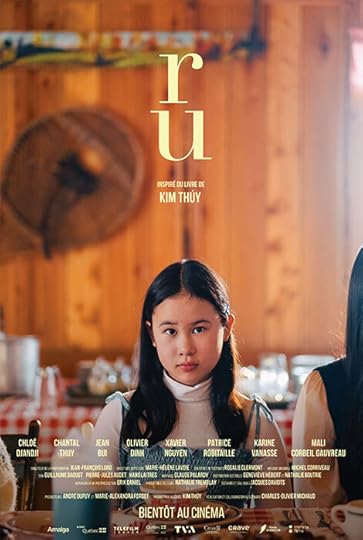
“In French, ru means a small stream, figuratively, a flow, a discharge—of tears, of blood, of money.
In Vietnamese, ru means a lullaby, to lull”
Written in vignettes: 113 chapters. 114 pages long.
Kim Thuy’s short snippets- stream of consciousness- type writing....
is beautifully written...almost poetic prose.
Her Vietnamese diaspora experiences — from childhood to motherhood.... (life altering, affecting memories),
had me thinking about the 545 children separated at the border that cannot be found.
With the election in America, only a week away - and all the horrors we keep learning in 2020...
The question that continued to sit with me while reading ‘Ru’...
was...
“What’s wrong with our world - why so much corruption? why so heartless? Why so evil?”
In “Ru” we first meet
Nguyen An Tinh when she was ten years of age.
Nguyen was born in Saigon. Being from a wealthy family with servants and cooks— their lifestyle changed dramatically when they were forced to flee their country during the communist takeover. Such a frightening transitional unsettling time for this family - and many families.
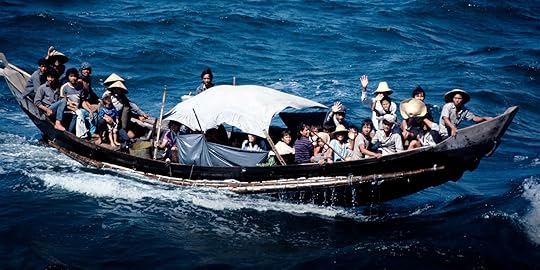
We learn about the horrors of traveling by boat - the horrors of mistreatment.
...Then more horrors as a refugee in Malaysia...
...Then ( yet again), more challenges to face after
arriving in Quebec in 1979.
Assimilate... assimilate...assimilate!
In no chronological order... we get glimpses from past and present days.....
from when the communists entered Saigon and the family had to hand over their property...
to daily experiences shared in a Quebec:
....going to the movies, ice skating, McDonald’s with a friend, furnishing their home in Quebec from flea market vendors.....
and many lessons learned - in the eyes of a child—from observations. ( from parents, teachers, relatives, friends, strangers, languages, and cultures).
“As a child, I thought that war and peace were the opposites. Yet I lived in peace when Vietnam was in flames and I didn’t experience war until Vietnam had laid down its weapons. I believe that war and peace are actually friends, who mock us”.
“For a long time, I thought my mother enjoyed constantly pushing me right to the edge. When I had my own children, I finally understood”.
“Finally understood”....
is such a powerful universal theme.
The reader can pause ....ask ourselves, “what do we understand ‘now’ that our parents taught us?”
“And what do our children ‘finally understand’? Anything? Ha... we can hope!
Back to this story (really wonderful)....
When in Saigon...
Nguyen’s mother was preparing her brothers to become musicians, scientists, politicians, athletes, artists and polyglots, all at the same time.
At the same time, every day, Nguyen’s mother made her children wash ‘four’ tiles on the floor and clean ‘twenty’ sprouted beans by removing their roots one by one. She was preparing her children for the collapse.
Their mother was right to do so, because very soon they no longer had a floor beneath their feet.
Families had to slept right on the dirt when in those refugee camps.
Horrible conditions!
As an adult, Nguyen had two children: Pascal and Henri.
Nguyen says:
“I didn’t cry out and I didn’t weep when I was told that my son Henri was a prisoner in his own world, when it was confirmed that he is one of those children who don’t hear us, even though they’re neither death nor mute. He is also one of those children we must love from a distance, neither touching, nor kissing, nor smiling at them because everyone of their senses would be assaulted by the odour of our skin, by the intensity of our voices, the texture of our hair, the throbbing of our hearts. probably he’ll never call me maman lovingly, even if he can pronounce the word poire with all the roundness and sensuality of the oi sound. He will never understand why I cried when he smiled for the first time. He won’t know that, thanks to him, every spark of joy has become a blessing and that I will keep waging war against autism, even if I know already that it’s invincible”.
“Already, I am defeated, stripped bare, beaten down”.
Nguyen’s family felt blessed to be among the two thousand refugees in a camp that was intended for two hundred.
She says.....
“throughout my early childhood, my cousin Sao Mai always spoke on my behalf because I was her shadow: the same age, the same class, the same sex, but her face was on the bright side and mine on the side of darkness, shadow, silence”.
Nguyen’s mother wanted her to learn French as fast as possible, English too.
When they were in Quebec, her mother sent her to a military garrison of anglophone cadets— because learning English was free ( but came with an emotional price).
The first conversation Ru had in English was with a boy at her school — it ended with Nguyen saying: “Bye, Asshole”.
The ‘sharing’ type writing in “Ru”...created an intimate-connection between the reader and the narrator.
I am left with a sweetness in my heart for the author —
and can’t imagine any reader that wouldn’t be.
THIS IS SUCH A LOVELY ENJOYABLE BOOK.
About the author:
Kim Thuy has worked as a seamstress, interpreter, lawyer and restaurant owner. “Ru”, her first book, has been published in 15 countries and received several awards, including the Governor General’s Literary Award. Kim Thuy currently lives in Montreal, where she devotes herself to writing.