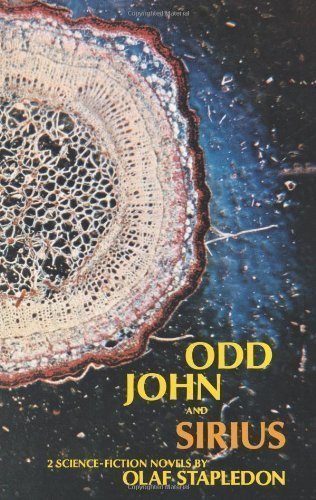
Two of the finest future histories ever written, each concerning a central question: If and when a superior being is introduced into a culture, how will either survive? Odd John is the definitive fictionalization of the mutated superman who has to decide what to do with his gifts, while Sirius concerns a dog with superhuman mentality.
Excerpted from wikipedia: William Olaf Stapledon was a British philosopher and author of several influential works of science fiction.
Stapledon's writings directly influenced Arthur C. Clarke, Brian Aldiss, Stanisław Lem, C. S. Lewis and John Maynard Smith and indirectly influenced many others, contributing many ideas to the world of science fiction.
Odd John brings up many issues worthy of discussion including how the human race treats its outliers and our morality with regards to other species. Also, were Odd John and the other supernormals truly morally superior?
Read - 26 March 1976. The book here is an omnibus edition of two Olaf Stapledon novels – Odd John (1935) and Sirius (1944).
Odd John; A Story Between Jest and Earnest - This was assigned reading in one of my undergraduate classes - English 230 "The Tradition of Science Fiction" at University of Wisconsin-Milwaukee.
Sirius; A Fantasy of Love and Discord - This was in the same book as Odd John, so I read it as well.
File under: historically important, possibly useful for a paper on early SF tropes and what they say about culture.
The interesting thing is that these two novels were written on either side of WWII. The first in the mid-thirties hilariously talks about how there may be war in a decade or so if things don't change. The second came out very near the end of the war and shows a world in which blackout curtains and getting bombed are just the normal every-day things you put up with.
So there's a thesis topic, the way the unthinkable becomes the mundane.
The other thesis topic would be the obsession of early SF authors with eugenics and "supermen" (how relevent to WWII!!) . and how, even a liberal author like this (Liberal by his time's standards... there are frequent "Communism yay!" and "Free love!" mentions) seems to accept the premise of eugenics as valid while perhaps disagreeing about the specifics.
He's not alone. Another golden age novel I read recently imagined a future with kids learning eugenics as a basic school subject.
Odd John twists the eugenics argument by having the 'super men' come from all the worldly races - and in fact wooly hair and broad noses / lips being among the identifying features. Though he falls back on the stereotype that the super-intelligent beings are of fragile health, have long, slender fingers, (one has six fingers on each hand) and large, bulbous heads. And of course there are frequent and disgusting racial stereotypes that the author probably didn't even realize where problematic... I say charitably.
Siris is by far the more readable of the two books, you can tell he's grown as a writer, and the eugenics malarky improves in that the subject is a dog bred by science to man-like intelligence. Though I'll say the book spends more time saying that he provides a view of humanity from the outside than actually showing it.
Sirius' super-intelligence comes from a syrum given to his mother while he was gestating and therefore the traits are not heritable by his children, of whom he has thousands because no one fixes this dog or gets him doggy-condoms.
Sirius also has a sexual relationship with a human woman. It's... I'd say it was delicately handled except it really wasn't. :P
Anyway, both Odd John and Sirius have the journey. They grow and learn and are geniuses, they seek out religion and spirituality as the ultimate thing they can achieve with their great intelligences, and then they are wrongly killed by the misunderstanding masses.
Here's another thesis: the science fiction writer, being almost by course bookish and convinced of his own intelligence, expresses his frustration dealing with people he sees as his intellectual inferiors while they are his power superiors.
In the world of Science Fiction alien creatures are common characters. Often these creatures have superior intelligence. The novel Sirius by Olaf Stapledon imagines what would happen if a scientist created a super-intelligent dog. Set in Wales and, briefly, Cambridge and London during the years before and during World War II this is a realistic portrayal of the creation of just such a dog. Thomas Trelone is the scientist who creates the super-intelligent dog, named Sirius. He is the only dog to have attained a human-like intelligence. Through a number of experiments Thomas has created better dogs who have an intermediate intelligence (they are above the dog's average intelligence, but they cannot master human language and complex analytic thinking as Sirius does). A sense of existential questioning suffuses the book, as the author delves into every aspect of Sirius's psyche. The novel deals with a large number of human issues through Sirius and his experiences, his unusual nature, his ideas and his relationships with humans.
Sirius is raised in North Wales, near Trawsfynydd. He is born at the same time as his creator's human daughter, Plaxy, and both of them are raised together as brother and sister. The characters go to great lengths to prevent Sirius from becoming a circus-type wonder-dog, and instead, they seek to develop Sirius's character much like a family would create and foster that of a human child. The intelligence of the dog is comparable to a normal human being, as he is able to communicate with English words, although it takes some time to understand his canine pronunciation.
The story is fascinating through honest portrayal of the disadvantages that Sirius faces in spite of his intelligence. The lack of hands reminds one of how much we take our own hands for granted, but there are other unique issues like Sirius's wolf-like nature which overwhelms him at times and leads to serious issues that Thomas did not foresee, but must nevertheless address. There is also the difficulty of Sirius's relationship with Plaxy which is close but strained as she grows older and leaves home. Interestingly she is not as interested in serious learning and contemplation as is Sirius creating another difficulty. In the end Sirius writes a book and starts another.
Stapledon writes with a lucid style and presents the world of Sirius with a realism that depicts his problems and accomplishments in a wholly believable way. Sirius's interest in the meaning of life and his spiritual nature were some of the most unexpected yet interesting aspects of this delightful work of speculative fiction.
A successful fictional critique of the following: human beings 1)in their response to developmental difference, 2) in their uses of industrialization, 3)their nationalistic tendencies, 4)tendencies toward anti-holism, i.e. extremism, and finally, and most importantly, a critique of human beings' attitudes generally toward the most gifted of their own kind. Olaf Stapledon elegantly--if not stylistically so :)-- describes how human beings react when faced with complex necessity: spiritual/human annihilation and utter alienation.
The book also functions as a device for explaining some more difficult idealistic philosophical-theological ideas and does so without revealing very much of their root sources, particularly if you're like this reader and have not read much philosophy. Stapledon was right to communicate his philosophical inquiries through mass-market fiction.
These are some of the obvious themes: the presence/non-presence of utopia, transcendence, capitalism and colonialism, eugenics, the ethics of violence, race (Stapledon/his narrator come off as slightly racist, but Stapledon redeems himself in the end, mostly [although he makes some nearly Conradian errors:]), and a narrative voice that is a cloying first-person and will inevitably turn some people away far before the book actually picks up momentum.
If you are reading this and find it boring at first, at least wait for the first few deaths before putting it down.
I look forward to reading Sirius as well as First Men and Starmaker.
This is actually two books in one and is apparently the only publication of the book still in print. The first, "Odd John," is a fictitious biography of the life and death of the first super being. The story is outlandish, but extremely believable, which makes it all the more relevant and disturbing. The second story, "sirius," runs in the same vein as "Odd John" except that it focuses on another kind of super being, a genetically modified dog with super human intelligence. Equally as clever as "Odd John," "Sirius" follows its canine protagonist on a road of self discovery that is both amusing and tragic, as he constantly struggles to find out which world he belongs to (Human or Canine) and mostly finds that he falls just outside the borders of both. Both works are brilliant but may turn many readers off due to the airy narrative and outdated style of writing, but anyone who can get past that (and the obnoxiously tiny print of Dover Trade Paper Backs) will definitely enjoy both stories thoroughly. They are both significant as the foundations of many sci-fi archetypes as well as brilliant and unique social criticisms.
Having had bad things to say about First and Last Men and Last Men in London, I must compliment Stapledon's Sirius. Differently ambitious, Sirius is about a dog more intelligent and sensitive than most humans and about his romantic relationship with a human woman. There are problems. You will sympathize with the dog and perhaps do some important thinking about the inner person as contrasted to outward appearances. Odd John was less impressive, but dealt with similar themes, here the contrast being between normal and extraordinary human beings.
A very cool story about the next stage of human evolution, the birth of a "superman" and his dysfunctional relationship with us mere mortals. Despite being almost 60 years old, I can't believe how modern it reads, unlike the dated sci-fi/horror stories by HP Lovecraft (one of the most over-rated writers ever) and Arthur Conan Doyle, although I still love H.G. Wells and Edgar Rice Burroughs (John Carter Warlord of Mars and Tarzan of the Apes will be required reading for my children). Recommended.
I'm not a big sci fi fan, actually not at all. But this book hooked me somewhat. I mean to make a story about a dog that is given human intelligence and his experiences in the world. And it works. It's engaging.
very interesting as an idea, but perhaps a bit too scholarly and old-fashioned to my taste, it didn't excite my imagination, but made me think about a number of things - one of those being the mild bitterness of the author (through John) about the hopelessness of the human race as species.
If you are a fan of thought experiments or if you have ever wondered what phrases like "the human condition" might mean, then both of these books are worth reading. I don't remember what scholar said this, but the remark went like this: With humans, evolution experimented with the large brain and I think that we have proven to be a dead end. Odd John imagines what would happen if the human brain was just a little bigger, not just in terms of size, but in its capacity for thought followed by action. I know that some critics see Nietzsche's Übermensch peeking out from behind the curtains, but Odd John isn't a book about a singular character who tries to win over adherents from among the populace. Instead, Odd John is only one of many such creatures who band together to create their own utopian society. It's not a fully fleshed out utopia because all these uber-humans care about is their spiritual worship project, which never is fully revealed to the reader; however, since the writer is a mere human, articulating this project is beyond his ken. I did appreciate the way that John explains his view of humans. That, to me, was the "odd" part of the book because it's a bit like looking into a funhouse mirror--you see humans not as distorted images though, but humans as distorted creatures. Sirius is a dog, but a very smart dog that has been genetically engineered to be as smart or smarted than humans. His only flaw? Well, being a dog for starters, but also the lack of hands with apposable thumbs--Sirius really gets upset at this flaw in his engineering! Unlike Odd John, Sirius is all alone in the world and so he alternates between Oxford Don and the Hound of the Baskervilles. Does he take up his higher calling or hearken to the call of the wild? I think that Stapledon is of course seeing humans as Sirius, and like Sirius we are animals at heart, but we are also animals with big brains. Ironically, the humans act more like animals in Stapledon's book, which leaves Sirius feeling more alone than he maybe should be--humans are not only tribal, they are also prideful and fearful and this makes them dangerous. At least Sirius makes the conscious decision to retreat into his animal nature; humans in Stapledon's book lack this feature. Both of these books are quite easy to read and are not only entertaining, but thought-provoking. Unlike, say, reading Vonnegut, whose books make you feel superior to the stupidity of the characters, Stapledon never lets you forget that when you smirk, you are smirking at yourself.
These are two good books to pair together, since, while they don't show author Olaf Stapledon at his pinnacle (according to most fans) the books are thematically close cousins. "Odd John" is about a superhuman who finds the normal specimens of his species to be by-turns fascinating, amusing, and repellent. "Sirius" is about a super-canine, who is a much more sympathetic character than John (not only because he walks among us in the form of man's best friend) and whose conflict between his primal nature and his super-intelligence afford him both indescribable ecstasies (a "Dog's Life" on steroids, if you will) and the torments of feeling that the confines of his body and his crude urges make his very existent feel like a cruel twist of fate, some cosmic trick played against him by his creator (which, doesn't make him all that different from most people, despite the amazing evolutionary mutation he presents to the world).
I've always had mixed-to-positive feelings about Olaf Stapledon, relishing his ideas, his charming descriptions of countrysides and idylls, as well as his ability to write with absolute conviction about stuff that, in other hands, would be laughable. Having said that, he has a tendency toward long-winded digression, which would be a problematic enough trait in a speaker at a symposium, but really grinds the proceedings to a halt in fiction.
This is a matter of taste, though, and maybe an unfair (sub)standard by which to judge a work from a time when people had different attentions spans (probably larger) and before the superhighway of information (mostly a deluge of crap) turned even the most inquisitive of us into drooling, texting, unfocused heaps of protoplasm; then again, there's lots of Golden Age and pre-Golden Age SF that has an adventurous and breezy style, so my problem with Stapledon's style might have more to do with him than with technology rerouting our collective dendrites.
He's worth a read, though, at any rate and this double-feature is as good an entry point into the man's body of work as any other piece, at least in my opinion (his magnum opus, based on who you talk to, is either "Star Maker" or "First and Last Men"). Recommended, in any case.
If you are looking for a fun adventure or hard Sci-Fi, this book is NOT for you. But, if you are looking for an amazing and honest description of mankind’s worst instincts and prejudices, this is a fantastic read.
Olaf Stapledon was a British philosopher; all of his books(at least all I’ve read) expounded upon human nature using the genre of science fiction as a vehicle.
In these particular books (this volume contains two separate stories), Stapledon looks at how outsiders see humanity and how humanity treats outsiders. In the first story, Odd John, Stapledon considers the life of a super-human.
The story’s titular character, John, is born with incredible features. He takes an unusually long time to develop, but when he begins to progress, he rapidly out paces his peers. The story follows growing pains and discoveries John makes. Stapledon uses John’s perspective to make a commentary on human politics, commerce, religion, and science. The book also has themes of humanities inability to accept and fear of someone new. In the end, humanity destroys what it can’t understand.
The second story is similar, but the perspective is different. This time, Stapledon’s looks at humanity through the eyes of a super-canine named Sirius. Through a series of experiments, Sirius is born with human-intelligence. Again, he develops much more slowly than his canine peers, but then develops into a dog with the mind of human.
Stapledon again looks at humanity’s religion and science. In addition, he focuses on human’s cruelty towards each other and towards “mere animals”. Again, in the end, humanity can not tolerate what is different and what it can’t understand.
Both of these stories should not be read as science -fiction, but rather an exposition of humanity.
Two novels. Both expertly written and supremely interesting. Olaf Stapleton did have a bit of an obsession with super human intelligence. Mysticism. Paranormal states. Much of this is apparent in these two novels. And what moral outlook would the superhuman have on the rest of us?
Odd John. ——- If you have any sympathy for this narcissistic murderous little psychopath and his small gang of would be mystic minded genius level world usurpers then the author has deftly sucked you in. The author uses the term ‘wide-awake’ many times. The ‘spiritually’ advanced are wide awake. The rest of us are asleep and don’t matter much. We can be casually murdered in order to make more space for them. Awake/asleep! A tired old metaphor and basically stupid and self serving, though of course much beloved by religious/mystic/cultist leaders everywhere. Justifies any evil. Morally abhorrent. Politically fascist and totalitarian. Whining on and on about their deeper spirituality and imminent transcendence. Nasty little ********* got the ending they deserved. Fascinating to track it all through.
Sirius —- About a super intelligent dog deliberately bred and raised to high level human intelligence. Yeah that was never going to end well. The book chronicles the dog’s efforts to find a purpose, a place in the world, to fit in with others. The reader is encouraged to be sympathetic. Mostly. Sirius does have his wild side. Obviously the author uses this theme to critique humans and human society and is occasionally heavy handed in this - a bit repetitious and boring. But in any case it is mostly about the life and tragedy of Sirius. In whom you may or may not see something of yourself.
Perhaps better than Odd John, Sirius also deals with the uses of super intelligence but has an ending of greater emotional impact. The writing is better, and the characters often seem well developed. The mutated dog, Sirius, becomes believably human and is far more interesting than the usual stereotypes used by authors attempting to allegorize the human condition. Probably, this comes from Stapledon's concern with the evolution of mankind to ethical and mental supermen or perhaps from his focus on an extremely short period. Always a writer of ideas, which are often central to his works, he is at his best when he deals with one-to-one relationships. Sirius and his human companions offer ideas but also the realization of the human ideal of love and friendship.
Not as well-known as his contemporary, H.G. Wells, Olaf Stapledon deserves recognition as a founder of modern speculative fiction. Odd John (1935) is a early tale of what a super-intelligent human would do in a world filled with us mundane types. Stapledon was a philosopher and the book wrestles with the idea that Odd John's morality would not be the same as our morality, that a refuge for those super-beings like Odd John would never truly be safe from the larger world.
This volume is two novellas. I have not yet read Sirius.
If you haven’t Star Maker- go, it is one of the greatest feats of imagination in science fiction, Hell all of fiction. That being said, it is a bit dry. Not so for these 2 stories. The protagonists while fantastic are both quite human, yes even Sirius. You feel for them and their plight. Neither of them asked for their gifts, but they do the best they can amongst humans who are at a total loss what to do with them and grow to despise them.
I had to read this book for my Senior Seminar in English (Theme: Superheroes) for my English degree. It was one of the only books I enjoyed all the way through. Odd John is definitely...."odd" to say the least. But, it has themes such as Übermensch (superman), conflict with human mentality, and the destruction of John Wainwright's 'utopia' with his other fellow superhumans. It was a pretty deep, thought-provoking read once invested. To any sci-fi lovers, it's a good read. From what I remember, I believe it was written in the '30s.
Two books in one, written just before and during WWII - some pretty early-day science fiction. Reads like a Sherlock Holmes story, complete with semi-anonymous gentleman narrator.
Both stories deal with nature vs nurture (and racial superiority/inferiority) in ways that are cringeworthy at times but would probably make rich fodder for a term paper.
I borrowed this one from Boston Library ebooks loan. As an early science fiction writer this author explores the boundaries of consciousness and alternative psychology. Another author who explored these fields was Robert Anton Wilson, who in his Cosmic Trigger novel references Olaf Stapledon as one of his influences.
Why you might like it: Cosmic-scale and evolutionary speculation bedrock. Rubric match: not yet scored. Uses your engineering/rigor/first-contact/world-building rubric. Tags: classic, cosmology, philosophy
Published in 1935 and 1944 these stories have some discriminatory language in them that although common in those times is no longer acceptable but the stories are very good and thought provoking.
What works well in these stories is the outsiders’ view of humanity and its irrational and often perverse individual and social behaviors. Odd John’s early life is especially appealing in a vicarious way, because, as the supremely precocious naïf, he is able to skewer the banality and the vacuity of established social norms and goals. What becomes difficult to perceive with the same pleasure are the loftier aims that Odd John and his cohorts adopt when they are on their island home. Even as the narrator—himself just an admiring Fido—is perplexed by the final suicidal actions of the supermen, so are this novel’s readers. While we might conceive all sorts of ways that the supermen could hide themselves away until they manage to extend themselves and their thoughts out into the universe, to make contact with higher intelligences, we have to assume—because, after all, they’re much brighter than we can even imagine—the supermen have chosen wisely, instead, to end their lives, and apparently their search for something of more value (spiritual?) than a continued mortal existence with humans. What could they have been thinking? Fido certainly didn’t know, and we readers can only speculate that they somehow knew best…
Sirius scales down the alienation, and makes the super intelligence of a dog equivalent to that of a human. From this perspective, we come to understand a good deal about the sensory limitations of humans, and about Sirius’ great envy and despair: man’s ability to manipulate things, literally, with his hands. This story is more poignant than Odd John simply because the aspirations of Sirius can be imagined, as well as his frustration and estrangement. What Stapledon does especially well in this novel is establish Sirius’ longing to understand his purpose, which as with Odd John is—within the scope of normal human enterprise—outside human experience. Sirius is a four-legged animal whose evolution has made him, first, a great predator and second, a willingly amiable companion to another species. Sirius feels himself wrenched out of his evolutionary track, caught between the two worlds—no longer a dog and not quite a man—and his instinct when frustrated in earning his place with humans is to revert to his canine impulses, whilst his human intelligence also suggests to him that there is a plane (definitely spiritual!) that exists for all sentient life. More poignancy and disgust erupts in the latter third of the novel when Sirius becomes the source of fearful curiosity and speculation that escalates into a malevolent fear of his difference.
In a stolid, sometimes stilted workmanlike prose, Stapledon tells two fascinating stories that enable a reader to take stock of humankind, to question what it is to possess intelligence and still live so much guided by irrationality. While each novel makes of mob mentality an especial nastiness, Stapledon does render some individuals with particularly sympathetic characteristics (Pax, Odd John’s mother; and Plaxy, Sirius’ human sister). I think it significant that Stapledon came to express these sentiments so vehemently at the dawn and in the midst of the Second World War—when the political landscape was rife with fear of socialism, communism, fascism, and totalitarianism—though probably Stapledon would deplore the seduction of the oxymoronic “mob mentality” in any era.
(A sidebar: I read just before these novels William Styron’s Confessions of Nat Turner, and it is eerie just how similar are the circumstances of Styron’s version of Nat Turner and the super dog Sirius.)
I chose to read this book because Oliver Sacks recommended it in a letter he wrote in response to an article about chimeras. I don't read a lot of science fiction, so I was happy for the variety this added to my usual reading list.
I read only Sirius , which is a story about a dog whose mother was given hormones during pregnancy that stimulated an unusual amount of brain growth in her unborn pup. Sirius is born and develops mentally much as a human child would. Part of the book deals with the relationship between Sirius and his human "sibling" Plaxy, who was born into the family around the same time as Sirius. Their love/rivalry is intensified by the differences between them, as they feel that they are united in spirit in ways that transcend their physical differences but are also jealous of the abilities and relationships that the other has.
Another aspect of the book, for me the most enjoyable, is the description of how a dog with human intelligence would see the world. Sirius laments constantly his lack of hands but excels over his human companions in his sensitivity to smell and his acute hearing. He creates music that bridges the human and canine worlds and becomes curious about religion. I enjoyed reading about these things from a dog's perspective.
Finally, the book deals with Sirius's uneasy relationship with humans. He is fiercely loyal to his family, especially Plaxy, and craves the intellectual stimulation that he can only find in conversation with other humans. But he finds that he is often uncontrollably angry with the human race, th "tyrants." In his human mode, he has a rare opportunity to apply human-like intelligence to the human race as seen from outside. But in his "wolf mode" he is angry and murderous, prone to long solitary hunts and reveling in his kills.
I liked this book because it was such a careful, intelligent, creative imagining of what a "dog-man" would be like. Parts were a bit odd and off-putting, particularly Sirius's relationship with Plaxy in the last part of the book, but overall, very well done!
Hmm. Well, these are certainly interesting books, but they come across more as philosophical disquisitions, with satirical edges, than as novels proper. They go well together as a thematically-similar pair--Odd John being the story of the eponymous character, one of the first of a new breed of super-humans, who sets out to create an ideal society, and Sirius being similarly the story of the titular character, this time a genetically-engineered dog with human (indeed, above-average) human intelligence. Lots of talk, lots of sententious commentary on the limits and venalities of humanity, which of course can be well-viewed from such outside perspectives, but not really an overabundance of action, and what action there is comes across quite flatly due to the choice of narrative voice. Both tales are told by a human friend of the characters (actually having the supernormal human or superintelligent dog tell his own story would tax even the most inventive and brilliant of writers to capture such unique perspectives), the effect of whihc is rather distancing. The narrator can only report indirectly on events, and each does so in suhc staid and plain terms that the books simply fail to excite--even when they (very daringly for the time, and even for today, really) hint at some pretty taboo behaviours on the parts of the characters (incest in the one case, bestiality in the other. These are important SF novels, ones that helped lay the gorundwork for these sorts of stories, but they're just not that engaging, I'm afraid. The tragedy of Sirius's situation--being literally alone in the world, as no other such dog exists or seems likely ever to exist--comes across rather better than John's situation, especially since one cannot really figure out whether one is supposed to admire or despise John, but really, that's just one of the main thematic strands of Frankenstein, handled well, yes, but not extenidng its implications very far. More showing, less telling, might have made these books more reader-friendly.