Jump to ratings and reviews
Rate this book

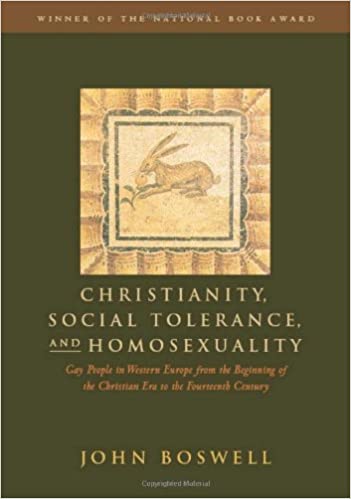
Christianity, Social Tolerance, and Homosexuality: Gay People in Western Europe from the Beginning of the Christian Era to the Fourteenth Century

Rate this book

John Boswell's highly acclaimed study of the history of attitudes toward homosexuality in the Christian West challenges received opinion and our own preconceptions about the Church's past relationship to its gay members, among whom were priests, bishops and even canonized saints. The historical breadth of Boswell's research (from the Greeks to Aquinas) and the variety of sources consulted (legal, literary, theological, artistic, and scientific) make this one of the most extensive treatments of any single aspect of Western social history. The product of ten years of research and analysis of records in a dozen languages, this book opens up a new area of historical inquiry and helps elucidate the origins and operations of intolerance as a social force.

424 pages, Paperback

First published January 1, 1980

130 people are currently reading
2967 people want to read

About the author

John Boswell

67 books58 followers
John Eastburn Boswell was a prominent historian and a professor at Yale University. Many of Boswell's studies focused on the issue of homosexuality and religion, specifically homosexuality and Christianity. Boswell graduated from the College of William & Mary and earned his phd at Harvard. He died in 1994, age 47.

Librarian note: There is more than one author by this name in the database. See authors with similar names.

Ratings & Reviews

What do you think?
Rate this book

Friends & Following

Create a free account to discover what your friends think of this book!

Community Reviews

5 stars
447 (47%)
4 stars
308 (32%)
3 stars
131 (13%)
2 stars
40 (4%)
1 star
19 (2%)
Displaying 1 - 30 of 81 reviews
Profile Image for Skylar Burris.
Author 20 books278 followers
March 2, 2010
The author of “Christianity, Homosexuality, and Social Tolerance” begins his book with the odd claim that he is not supporting any particular moral position with regard to homosexuality. I say it is odd because the massive volume is clearly aimed at convincing the reader that Christianity is, if you really dig into history and read the Scriptures just right, supportive of homosexual love and the sex that is an expression of that love.

Now, I have absolutely no problem with books with agendas. I very much enjoy reading persuasive writing. But I find the claim that one is merely being scientific (and if the science happens to agree with my personal agenda, what a coincidence!) to be disingenuous.

The book has a scholarly appearance and copious footnotes, but the author engages in a great deal of interpretative gymnastics with regard to Scripture, Christian tradition, and especially history. This is revisionism of the most agenda-driven variety. Boswell’s agenda is two-fold. First, he wishes to prove that homosexuality was generally accepted and approved of until about the 12th century and, secondly, he wishes to “rebut the common idea that religious belief -- Christian or other -- has been the *cause* of intolerance in regard to gay people."

Boswell is considerably more convincing when arguing for the second point than when arguing for the first. This is not to say that he convincingly argues that Christianity did not condemn homosexual sex, but rather that he convincingly argues that Christians who condemn (and have condemned) homosexuals are more often motivated by their prejudices than by their religious devotion. (That is, they would likely condemn homosexual sex in the absence of any Christian tradition, and they are not concerned with honoring the Christian tradition in other respects that are inconvenient to them personally.) However, Boswell does not merely argue that Christianity as a belief system can be interpreted in such a way as to not condemn homosexuality; he actually argues that Christianity as a historical institution did not condemn homosexuality until relatively recently – and that is such an absurd claim that the mental contortions involved in supporting it are at times amusing. Where he is most convincing, however, is in attacking the “natural law” argument against homosexuality – which is pure persuasive writing and not an attempt at reinterpreting Scripture or history as part of a claim of being scientific.

Despite its incredible revisionism, I do think the book worth more than one star, and if I could, I would even give it 2.5 stars. (When are we getting half stars on goodreads?!?!) Why? Because it did persuade me to rethink some of my ideas (always an interesting exercise) and because it gave me a fascinating perspective on the history of attitudes towards homosexuality.
Profile Image for Conrad.
200 reviews412 followers
May 30, 2007
I can't imagine anyone reading this book and not being moved and stunned by the rewriting of history that has accompanied the reign of the queerbashers. This book makes the case that buggery was a pretty well-known and accepted part of life for a very long time, that biblical injunctions against it condemn buttsex with the same vigor that they condemn eating lobster and as such were routinely ignored until lately, and that anyone who says otherwise has bought into a big old lie.

I've heard that people have nitpicked at some of Boswell's footnoting procedures. These people are scabies that feast on fleas on the ass of a smelly camel, as is the ex-girlfriend of mine who ran off with my copy. Boswell is angry, ambitious, fair-minded, and an engaging anecdotal historian, too - Eve Sedgwick and Judith Butler and most of their queer theorist pals could stand a Boswell writing seminar or ten...
732 reviews
December 1, 2012
Christianity, Social Tolerance, and Homosexuality is an extraordinary piece of scholarship that I wished I finished reading sooner. I was reading with good momentum before I unwisely decided to leave it home during a roadtrip, leaving the book to languish on my nightstand for many weeks. Professor John Boswell of Yale University spent ten years on this groundbreaking study of attitudes towards gay people in Western Europe. Starting with ancient Greece, he shows how feelings swayed between celebration, tolerance, indifference, and hostility up to the late Middle Ages. In scholarly, but engaging and civil prose, Boswell lets his interpretation do the arguing for him. Hostility to gay people is not inherent to Christianity, but due to conflation of homosexual acts with prostitution and rape, imprecise translation, and personal intolerant attitudes making its way into the public sphere and historical record. How revolutionary these arguments must have seemed in 1980—just before HIV/AIDS came to public attention—when this book came out! However, as a scholarly treatise with many long footnotes and foreign translations, it might not appeal to the average reader. Ultimately the lay reader has to trust the author on subtleties of context in classical languages to accept his thesis. I am pleased to know that this book won the 1981 National Book Award for history and would recommend it to any one interested in an intellectual account of history, religion, and homosexuality.
Profile Image for Mike.
183 reviews24 followers
October 20, 2008
This book more or less kicked off academic endeavors into this realm of research. For that fact alone it get more grace, than your typical book. Boswell's historical argument is way out of my league, but that isn't way I read the book. His argument as to the religious aspects of intolerance are over simplified and border on completely inaccurate, so much so that Crompton came along later and corrected Boswell's error in his book "Homosexuality and Civilization." The upside to this book was that personally it showed me that I was justifying my prejudice with the biblical text instead of drawing my convictions from the text itself. This might have been incidental to reading the book but every good trek into a bout of self understanding has to start somewhere.
Profile Image for Justin Lee.
664 reviews3 followers
November 6, 2014
There is something fantastic about this book. It's dense as hell, more text book than easy reading, and ridiculously well researched, but I loved it.

Back story: When I first came out, I was having a hard time dealing with the fact there isn't a lineage of gay history. We've been around forever but we're not a community with historical traditions and tales that have been told from generation to generation. This book comforted that part of me. Boswell gives proof that homosexual persons existed and that homosexual love did exist. I can't begin to describe the emotional effect this had when reading it. It's really an amazing feeling to read about gay people in the early Christian era. I'm still dubious of the idea of gay sub-cultures during this time, but this book goes a long way in showing what was.

I want to say that this book, written in 1980, was one of the first that explored gay and lesbian studies. Being an age where not all the information was readily available, I can only imagine how difficult this book was to produce. Boswell goes above and beyond what little expectations I had. That being said, I would love to have seen Mr. Boswell speak before his passing and hear his thoughts on how "Queer Studies" has evolved since his book was released.

I picked up the book because this wasn't an area where I had a lot of knowledge but that I was extremely interested in. How did gay people get by? Was Christianity always so intolerant? These questions were answered and pleasantly so. I feel much more informed than I once did. I feel closer to my community and a little closer to my religion. Understanding man's role in how religion changes and the philosophical changes is so interesting and Boswell gives wonderful information.

Because it was one of the first, I feel that there are many trails that he goes down where, at the time, might have been uncharted, but might be considered dead ends today after more research has been done. I can understand people's issue with his analytical takes on his research. Another issue is that as a modern reader, it's hard for me to apply modern terms and modern ideas to older/ancient societies. I'm not sure if I wholeheartedly support the idea that there was a gay subculture, but I also don't know if it's my personal definition I have a problem with.

This book is not for everyone. It is dense, challenging, and hard to read at times. For those with an interest in this area, the rewards are immense though.

Lastly, I must add that I am not a scholar in the academic sense, but rather a casual reader. My opinion is that of a casual reader.
Profile Image for Wayne.
70 reviews
April 3, 2008
An imperfect work, and one where I couldn't entirely follow the scholarship. But a cornerstone of interpreting scripture in a way that strips off centuries (millennia) of misinterpretation. Couple this with "The Invention of Sodomy in Christian Theology" by Mark. D. Jordon and "HOMOEROTICISM IN THE BIBLICAL WORLD" by MARTTI NISSINEN
Profile Image for Johnny D.
31 reviews4 followers
January 31, 2009
There is no way to overstate the cultural import of this book. It may seem that we are living in a dark age after the passage of prop 8 in California (and other anti-gay referendums across the country) but consider the existence of MCC churches, the controversial progressiveness of the Episcopalians, and the closing gap even among young Evangelicals when it comes to accepting and affirming gay relationships.

Boswell is responsible for much of this religious enlightenment. His landmark book, released in 1981, dared to challenge conventional wisdom regarding the history of the church and homosexuals. Boswell (Doctor of Medieval History at Yale, now deceased) reveals that the medieval church affirmed an early form of gay unions and that mistakes in translation inform much of the current "scriptural" bias against LGBT persons.

A dense read, but an important addition to the library of any gay person struggling with their religion or, indeed, any person interested in the history and future of true equality for all persons.
Profile Image for Kelly.
83 reviews
August 17, 2007
For my Intro to Christianity course back in college, I decided early on that I wanted my term paper to focus on gays in early Christianity. This was one of the books I chose as a reference, one the professor was actually surprised I used (in a good way). This is an excellent book, covering far more information than I could have ever dreamed finding. John Boswell lifts the rug to display the dirt and dust-motes that the church has been sweeping aside for centuries.
Profile Image for Alex Combs.
36 reviews3 followers
April 25, 2021
It seems to be taken for granted that the Christian teachings are traditionally against homosexuality and LGBT+ expressions of sexuality and gender.
However, John Boswell makes a good case for how this isn't as clear-cut as is commonly believed. Early Christians may have cared much less about gay stuff than we think!

Boswell discusses scriptures and theological teachings in detail, pointing out how they have been mistranslated, misconstrued, and taken out of context to serve the needs of modern homophobic attitudes. From an 11th century openly gay archbishop, to a 12th century clergy describing gay people being as numerous as grains of sand, it seems that Christian-based attitudes may not have always been on the side of homophobia.

Throughout the majority of medieval Europe it was only a few extreme Christian ascetics who believed gay love was something to freak out about. Even then, it was couched in the larger belief that 'every sperm is sacred'. Any sex acts without a reproductive goal were condemned, including masturbation! But in general the Christian church wasn't interested in adopting the strict attitude of these extremists.

It was not until the late Middle Ages that queer people became actively persecuted, when suddenly laws against ‘sodomy’ began popping up across Europe. This happened within the larger context of campaigns targeting Jews, Muslims, poor people, and women. This persecution of anyone ‘different’ had to do with the church and state trying to consolidate their power across Europe.

This book is packed with fantastic information, including primary source reprintings. Because of this it's better for research than casual reading!
Profile Image for Andre.
1,420 reviews104 followers
March 27, 2022
I couldn´t even finish half of this book. Early on I had a bad feeling about this book. Not only is there his insistence of something else except religion as a cause of intolerance without naming an alternative, the gaps in his reasonings and his apparently lack of the concept of bisexuality. His claiming that Socrates had a relationship with someone called Alcibiades (never heard of him) doesn't bode well either. Socrates was his teacher and at least 19 years older. I do agree with him that one has to be cautious in regard to the past, but I think he throws caution out of the window the moment he reads "Male lovers"; e.g. it is stated here that Hercules had 14 male lovers, but I would ask: How old were they and what did they look like? When he mentions the phrase "passion of the cut sleeve"; I knew he made amistake as that story is definitely not positive.
After the introduction, the first chapter was about nothing but definitions and it got on my nerves. This author is writing confusingly enough as it is. He can claim that it was only few Latin writers who stigmatized homosexuality and the few who criminalized it, only did that metaphorically, it is nonethless evidence for its acceptance being not as widespread as he claimed, in fact, his adherence to the "no law against it" reasoning seems suspicious. He mentions roman boy prostitutes and gay marriages, but based in his earlier chapters, I doubt that these are truly marriages, it could have been a mocking comment, considered how he never points out how few interests there were in adult men. Over and over he talked of boys (which I doubt means youthful men as he claimed earlier), and finally, the talk about bottoms in Rome. Even he has to admit the scorn that sexually passive men received, which makes me wonder why that is so. Whatever he considers positive applies to boys and slaves, not free roman citizens. And he doesn't really adress that. He mentions prostitutes time and again, and I think they are a good example how something can exist widely and yet be derived. Because, due to the aversion to seeing free men becoming prostitutes, it is clear that there must be something shameful attached to being a prostitute, so I suspected that slaves can be prostitutes because they are already so low, nothing is lost. And maybe I would give a shit about his claims of sexual passitivity being somewhat accepted because some emperors admitted to being sexually passive, if the two examples he gave in the footnote weren't Nero and Calligula. And speaking of the notes, they often show a different picture than his words, don't back him up or show things (like Budica's claims) that seem really disturbing.
I looked up these Hadrian and Antonius that he mentions as such a positive example, and as I suspected, there is not simply a huge difference in age as Hadrian was already 35 when Antonius was born, but the latter died at age 19. And I also have read the lesbian tale from Ovid's metamorphoses and what he doesn't mention at first is how much the woman in it agonizes about her sexual attraction to women. Later it is shown that he does know that tale in Metamorphoses where that woman is anguished about being a lesbian and that she is transformed into a man. And that still doesn't count as evidence for him?
What was really ridiculous was his statements about the Bible, so the word "homosexual" doesn't appear in the Bible... what difference does tha make? The word "heterosexual" doesn't appear in it either. So I don't get his reasoning here. While I do agree with him as to why the Sodom and Gomorrha story probably came to be misinterpeted sexually, I think his rebuttal regarding the infamous Levitical passage as well as to the stance on early Christians in regard to judaic law is at best semantic word play. If the passage basically refers to idolatry, why single out gay sex and not refer to temple prostitutes in general?
His reasoning as to why the mentioned texts in the New Testament that so many argue condemn homosexuality are not meaning that is really just wordplay here. Not only does his "there was no word for homosexuality in Greek and Hebrew" doesn't hold because the word "Heterosexuality" didn't exist either, but his reasoning for Paul claims that Paul meant heterosexual people who did gay sex. But what reasoning is that?
That he considers the rising intolerance towards homosexuality in the roman empire to be connected to an influx of rural born leaders and rising state control is an interesting theory, but his earlier dismissal of homophobia among early christians due to lack of statements by jesus and Paul, doesn't hold up. They were rural as well and by his "they didn't talk about it logic"... well...
There is so much that bugs me with his argumentations, his constant excuse of the Bible, the fact that the "gays" here constantly mention youths and boys but rarely actual men, at best they say youths, but I don't think they mean anyone over 20. And of course his footnotes several times say that the referenced sources may not be reliable. This makes me seriously consider to put this book down.
Sure, these poems could be read as a romantic same sex relationship, however, it might as well not. He seems to acknowledge this, however there really needs to be more than this to give credit to his claims, but he doesn't give anything.
Selling kids into slavery was common in the ancient world among the romans and a large percentage of those were used for prostitution. He writes himself that this was from adolescence until being old enough to be laborers, however, that couldn't have been many years so these prostitutes, especially the male ones, would have been really young. And it is still so annoying when he argues "...not mentioned..."
Plus, if all the stuff he mentions didn't lead to widespread homophobia, then what did´? So far her never gave a clear answer, which is why this reads rather like an apologist tract to me than an actual history book.
Does it really not bother him how all these texts constantly talk of youths and boys and only rarely men? What age range does he think "youths" refers to? I skipped the rest of that chapter. It was too much of a constant apology tour in my eyes to be of any use.
Then he wrote that the Visigoths were a barbarian minority of Arian heretics who had conquered and ruled a Hispano-Roman majority... THE VISIGOTHSWERE NOT ARYANS!!!! This book is from the 1980s, and since he talks so much about language he should know that germanic languages do not belong to the arian language family and the Aryan race was long descredited in his time! That was it. I quit!!!!
4 reviews1 follower
February 2, 2025
Really interesting history of not only social mores but also Catholicism.
10.6k reviews35 followers
July 3, 2024
THE PATHBREAKING HISTORY STUDY OF CHRISTIAN ATTITUDES

John Eastburn Boswell (1947-1994; he died from AIDS-related complications) was a historian and professor at Yale University.

He wrote in the Preface of this 1980 book, “If religious texts are widely supposed to have been the origin of a medieval prejudice, their role in determining the attitude in question must be carefully examined; if it is assumed that scholastic opinions on a subject were an inevitable response to the force of the preceding Christian tradition, a historian who wishes to present an alternative explanation must examine the force of the previous tradition in minute detail. Only if he can demonstrate that it is insufficient explanation for the opinions in question can he expect his alternative explanation to carry much weight.” (Pg. xv)

He continues, “This book is not intended as support of criticism of any particular contemporary points of view---scientific or moral---regarding homosexuality. Where extended discussion of arguments against homosexual behavior has been presented, the aim has been twofold: to demonstrate that what may seem to have been the origin of popular antipathy in the past often was not, and to clarify crucial differences between ostensibly analogous ancient and modern objections to homosexuality… What will strike some readers as a partisan point of view is chiefly the absence of the negative attitudes on this subject ubiquitous in the modern West; after a long loud noise, a sudden silence may seem deafening.” (Pg. xv-xvi)

He notes, “two major assumptions may be mentioned as underlying the belief that homosexuality is ‘unnatural’… The most recent of these, the idea that behavior which is inherently nonreproductive is ‘unnatural’ in an evolutionary sense, is probably applied to gay people inaccurately. Nonreproductivity can … hardly be imagined to have induced intolerance of gay people in ancient societies which idolized celibacy or in modern ones which consider masturbation perfectly ‘natural’… This objection is clearly a justification rather than a cause of prejudice. The second assumption is that homosexuality does not occur among animals other than humans. In the first place, this is demonstrably false… In the second place, it is predicate on [the] assumption---that uniquely human behavior is not ‘natural’---which is fundamentally unsupportable in almost any context.” (Pg. 12)

He rejects “the idea that tolerance of or indifference toward homosexual practices was associated with the decline of Rome… The only historical basis for these notions is the relatively greater occurrence of reference to homosexual behavior in imperial than in republican literature. Information about every single aspect of Roman life survives in greater abundance from the Empire than from the Republic.” (Pg. 71)

He points out, “The Bible was not the only or even the principal source of early Christian ethics, and the biblical passages purportedly relating to homosexuality had little to do with early Christian misgivings on the subject. Very few influential theologians based objections to homosexual practice on the New Testament passages now claimed to derogate such behavior, and those who did invoked them only as support for arguments based primarily on other authorities. It is, moreover, quite clear that nothing in the Bible would have categorically precluded homosexual relations among early Christians.” (Pg. 92)

Of Sodom, he comments, “the thesis of this trend in [modern] scholarship is that Lot was violating the custom of Sodom… by entertaining unknown guests within the city walls at night without obtaining the permission of the elders of the city… the city was consequently destroyed not for sexual immorality but for the sin of inhospitality to strangers.” (Pg. 93-94) He adds, “Some modern readers may have difficulty imagining that a breach of hospitality could be so serious an offense as to warrant the destruction of a city. According to Genesis, of course, the Lord was already inclined to punish the Sodomites before the angels arrived there.” (Pg. 96)

He quotes Lev 18:22 and 20:13, then comments, “The Hebrew word ‘toevah’, here translated ‘abomination,’ does not usually signify something intrinsically evil, like rape or theft… but something which is ritually unclean for Jews, like eating pork or engaging in intercourse during menstruation, both of which are prohibited in these same chapters. It is used throughout the Old Testament to designate those Jewish sins which involve ethnic contamination or idolatry…” (Pg. 100)

He notes, “Almost no early Christian writers appealed to Leviticus as authority against homosexual acts… If the Old Testament has no specific positive role in creating early Christian attitudes toward homosexual acts, may it not have had a negative role? Would not the complete silence on the subject of gay sexuality and the … heterosexual model have predisposed Christians to reject homosexuality[?]… [This] would have constituted an extremely weak argument … In fact intense love relations between persons of the same gender figure prominently in the Old Testament---e.g., Saul and David, David and Jonathan, Ruth and Naomi---and were celebrated throughout the Middle Ages in both ecclesiastical and popular literature as examples of extraordinary devotion, sometimes with distinctly erotic overtones.” (Pg. 105)

He says of Romans 1-2, “the persons Paul condemns are manifestly not homosexual: what he derogates are homosexual acts committed by apparently heterosexual persons. The whole point of Romans 1, in fact, is to stigmatize persons who have rejected their calling, gotten off the true path they were once on… Paul did not discuss gay PERSONS but only homosexual ACTS committed by heterosexual persons.” (Pg. 109) Later, he adds, “There was no implication in the passage that homosexual acts, much less homosexual persons, were NECESSARILY sinful.” (Pg. 114)

He acknowledges, “it may well be argued that the complete silence of Christian writers on the subject and the exclusively heterosexual focus of New Testament comments on sexuality reflect general disapproval of homosexuality on the part of Jesus or the early church… [But] It is hardly surprising that Jesus and Paul, in responding to questions put to them regarding marriage, the family, and divorce, would frame their answers in terms of heterosexual relationships. Their intent was manifestly not to explain or legislate on the whole range of human affections, and they made no pretense of providing moral guidance on all forms of love. They simply answered troublesome questions about heterosexual marriage submitted to them by persons attempting to establish a new sexual morality in societies where there were… no effective means of birth control except abstinence, abortion, or abandonment of unwanted children. Gay relationships… left no one defenseless or unprovided for… That early Christian writers did not feel called upon to comment explicitly on such relationships is no more surprising than their failure to mention household pets…” (Pg. 116)

He summarizes, “The New Testament takes no demonstrable position on homosexuality. To suggest that Paul’s references to excesses of sexual indulgence involving homosexual behavior are indicative of a general position in opposition to same-sex eroticism is as unfounded as arguing that his condemnation of drunkenness implies opposition to the drinking of wine. At the very most, the effect of Christian Scripture on attitudes toward homosexuality could be described as moot. The most judicious historical perspective might be that it had no effect at all. The source of antigay feelings among Christians must be sought elsewhere.” (Pg. 117)

He notes, “[Augustine] rejected as an adult the possibility of licit homosexual relationships. IN the thirteenth century his opinion was to gain ascendancy in Christian circles, but only after vigorous opposition at many points in Christian history. Not only does there appear to have been no general prejudice against gay people among early Christians; there does not seem to have been any reason for Christianity to adopt a hostile attitude toward homosexual behavior.” (Pg. 135)

But later, “By 1300… a single homosexual act was enough to prevent absolutely ordination to any clerical rank, or---in many places---to merit the death penalty.” (Pg. 295) Then “[Thomas Aquinas] struggled… to construct a philosophical justification for classifying homosexual acts … to a position of unique enormity unparalleled since the time of Chrysostom.” (Pg. 321) Later, he adds, “it was particularly significant for gay people that Thomas’s ideas about homosexuality triumphed just at the moment when the church began to enforce orthodoxy more rigorously than ever before and to insist that everyone accept in every detail not just the infallible pronouncements of popes and councils but every statement of orthodox theologians.” (Pg. 330)

He summarizes, “Religious sanctions and intellectual support created by later medieval theology crystallized public and official expression of such attitudes in the thirteenth century and prolonged their effects for centuries thereafter; such expression both inspired and drew life from the vehement antipathy of the masses. Only when and where the latter abated did such groups experience a general amelioration of their fortunes. In the case of gay people, such changes were relatively rare and lie far beyond the scope of this study.” (Pg. 332)

With Boswell’s book, the defense of same-sex relations for Christians took a huge leap forward, in terms of historical depth and even literary quality; it is not surprising that this book won the 1981 American Book Award for History. Needless to say, it is “must reading” for anyone even remotely interested in such subjects.
Profile Image for Lizabeth Tucker.
941 reviews13 followers
December 17, 2019
Subtitled " Gay People in Western Europe from the Beginning of the Christian Era to the Fourteenth Century".

This is an extremely dry and slow look at how the prejudices against gays embedded in the modern religions developed over the centuries and were not part of the original liturgy. Many works of the time were and continue to be edited in regards to gender where romantic, sexual, emotional relationships.

I have a few problems with this work. First, the footnotes may or may not be translated, putting at a disadvantage a reader who doesn't have the knowledge of the language involved, whether it is Latin (which I do know), Greek, Italian, Persian, etc. Secondly, I found the amount of time spent discussing terminology to be excessive even for a technical paper.

Would I recommend it? Possibly for those looking for additional research material and a discussion of how literature, poetry and historical documents have been censored and edited. But for the casual reader simply looking for information on gays in history, no.
Profile Image for Reading Through the Lists.
552 reviews13 followers
November 21, 2019
“[The author’s] comfort must subsist in the belief that he has at least posted landmarks where there were none before and opened the trails on which others will reach destinations far beyond his own furthest advance.”

A trailblazing work, and, as such, subject to many of the flaws and mistakes that come with pioneering a new field. Many scholars have since responded to Boswell, correcting his approaches, re-defining his categories, and challenging his conclusions. Boswell is certainly at his most convincing when he quietly and skillfully interrogates his sources (such as Thomas Aquinas), and at his least convincing when he forces those sources to fit his pre-determined meaning (The Bible, monastic poetry). But no one can deny his importance in what was, in the 1980s, the nascent field of LGBT+ studies.

Read for a graduate course on homosexuality in the Middle Ages.
Profile Image for Beth Windle.
175 reviews16 followers
November 8, 2009
A Catholic apologist attempts to recuperate Catholicism (and Christianity in general) in terms of its treatment of gay people until approximately 1500. This book is important, but it's also important to note that Boswell, a gay man, was also a Christian. Apparently, much of his scholarly work is an attempt to reconcile his gay identity with his Christian identity. He cautions against a reductive reading that blames all anti-gay intolerance on Christianity, but I think he misses (and perhaps even consciously ignores) the fact that Christianity has always been and will always be anti-gay.

I'm glad I was assigned to read this book because I would never have read it on my own. It's interesting, well written, and a formative text in the history of sexuality.
Profile Image for Albert.
19 reviews11 followers
December 21, 2009
I'm reading this again-- I just can't imagine a more healing gesture than clarifying the rift between Christianity and gays, maybe the last remaining non-religious minority it thoroughly marginalizes-- and one of the most important, powerful, and inspiring groups in society ever. Pre-medeival Christianity, in many ways, seems to take all that talk about love a lot more seriously, along with interpreting Scripture in a much more context-specific, or at least more subtle, or at least far less unanimously hateful way. It becomes possible o understand the New Testament as fairly anti-imperialist (in spite of Karl Barth, whom I love)-- kind of a first-century Wretched of the Earth.
Profile Image for Beth.
1,081 reviews14 followers
February 25, 2009
This crossover (written for both educated laypeople and for academics) is highly informative (especially if your read the zillion footnotes), bursts a lot of preconceptions about European society of the times, and is an appealing read, also.

It's going to take me months to get through because it's rich in info and is not a fast read even by nonfiction standards.

Update in February '09: Whew! Finally finished! Very good resource for adult religious/social education, discussion (and debate!)
Profile Image for Aaron Thomas.
Author 6 books55 followers
January 7, 2019
This is fascinating for most of its length. As Boswell charts the history of the Church's approach to homosexuality, the book is fascinating. As he moves into arguing specifically with Thomas Aquinas's arguments about homosexuality, Boswell lost me.

There is a startling limit to his approach, though. Because Boswell is looking for prohibitions or even general discussions of homosexuality in general and as such, he omits opprobrium aimed at homosexual activity in specific, such as male/male rape, pederasty, etc.
Profile Image for Kersplebedeb.
147 reviews114 followers
January 30, 2008
Brilliant medieval Church history; the author's controversial thesis is not only that elements in the Church were pro-queer, but also that the Roman Catholic hierarhcy in some circumstances acted as a protector against popular homophobia.
Profile Image for Ray Lang.
32 reviews
May 18, 2010
Very scrupulously documented and copiously footnoted history of attitudes surrounding homosexuality in the Christian tradition, from very early times to the present. It was surprising to me how recently the current very hard line on homosexuality emerged.
Profile Image for Jerry.
676 reviews
January 1, 2011
Great book. Meticulously researched, although it reads like a textbook. My partner and I actually met Mr. Boswell several times. He also researched and wrote a book on gay marriage from ancient to modern times.
Profile Image for Ted.
30 reviews36 followers
December 4, 2008
An amazing academic study, incredibly well-researched, about how Christianity changed for all time Greco-Roman paragigms of homosexuality.
Profile Image for Fred.
69 reviews9 followers
July 26, 2008
My brain really, really hurts now, but I think I am a better person for reading this. It is not a beach read-Boswell invented O.C.D.
14 reviews1 follower
April 3, 2009
Extremely dense but incredibly insightful again, to the views of a literal interpretation versus an analytical interpretation of the bible. Brilliant.
Profile Image for srevans.
31 reviews1 follower
Want to read
October 1, 2009
(added to amazon.com "Curious About These" list, c. March 2007.)
Profile Image for Ethan.
235 reviews1 follower
May 26, 2017
Doesn't promise to answer many questions and doesn't. It DOES however provide the in depth context required to make educated guesses. The major thrust of the book seems to be an attempt to prove that the early Christian Church didn't consider homosexuality as terrible as they seem to presently. If this was the author's goal he fell short. Although, this is primarily an academic work with no room for editorializing. Let me do that: even if the early Church wasn't as hostile to gay people as they are today - they did go out of their way to reinforce political and popular prejudice as the arm of the Inquisition reached out to rot the whole world. Rather than coming away with a more appreciative opinion of the efforts of the faithful I was left with an even more bitter taste. It would seem by evidence both past and present that Christianity poisons morality and will continue to do so until finally toppled. That day (and I say that as a person of faith) cannot come soon enough. Traditional religious structures are dangerous, cruel and amoral. Faith in an of itself is beautiful and beneficial to society but the institutions established in the name of god are corrupt and constantly seeking destruction.
Profile Image for madelgard.
9 reviews
January 27, 2025
Extraordinarily comprehensive, and very useful for primary sources. Dense but readable prose. Tons of fun anecdotes as well; special shout-out to Pope Gregory the Great for finding English boys so attractive he wants to convert the entire nation:

Pope Gregory the Great [encountered] beautiful English boys for sale in the public market of Rome itself in the sixth century. [...] Gregory found the English boys so beautiful that he called their appearance "angelic" (a pun on the Latin "anglicus") and opined that such loveliness deserved the reward of heaven.

On a serious note: the exploration of the emotional tenderness early Christian monks felt towards each other was astonishingly tender. Aelred and his love for a younger monk, which "grew slowly and cautiously", was especially moving. The great strength of this book is marrying exhaustive historical research with the very human experience of tracking the way love between men was not just viewed, but lived. Highly recommended.
Profile Image for Bree.
272 reviews12 followers
November 7, 2017
Exhausting to read, but in the best possible way. I grew up in an anti-gay Christian environment and thus have carried a lot of shame and anxiety about my queer identity. Reading this book helped me to let go of it thanks to Boswell's excellent analyses of primary religious texts and his understanding of them within their specific literary and historical texts.

From a scholarly point, I see why this was so foundational in studies of pre-modern sexuality: Boswell took on a massive task in writing this book, but managed to see it through admirably. He uses a huge range of sources and analyzes them exceptionally well, contextualizing everything very clearly. The conclusion does fall a little bit flat, but overall, this is an amazing work that anyone interested in pre-modern sexuality and/or anyone studying Christianity needs to read.
Displaying 1 - 30 of 81 reviews

Can't find what you're looking for?

Get help and learn more about the design.