Jump to ratings and reviews
Rate this book

Världen om aftonen

Rate this book
Against the backdrop of World War II, The World in the Evening charts the emotional development of Stephen Monk, an aimless Englishman living in California. After his second marriage suddenly ends, Stephen finds himself living with a relative in a small Pennsylvania Quaker town, haunted by memories of his prewar affair with a younger man during a visit to the Canary Islands. The world traveler comes to a gradual understanding of himself and of his newly adopted homeland.

292 pages, Hardcover

First published January 1, 1954

26 people are currently reading
1675 people want to read

About the author

Christopher Isherwood

164 books1,518 followers
English-born American writer Christopher William Bradshaw Isherwood portrayed Berlin in the early 1930s in his best known works, such as Goodbye to Berlin (1939), the basis for the musical Cabaret (1966). Isherwood was a novelist, playwright, screenwriter, autobiographer, and diarist.

With W.H. Auden he wrote three plays— The Dog Beneath the Skin (1932), The Ascent of F6 (1936), and On the Frontier (1938). Isherwood tells the story in his first autobiography, Lions and Shadows .

After Isherwood wrote joke answers on his second-year exams, Cambridge University in 1925 asked him to leave. He briefly attended medical school and progressed with his first two novels, All the Conspirators (1928) and The Memorial (1932). In 1930, he moved to Berlin, where he taught English, dabbled in Communism, and enthusiastically explored his homosexuality. His experiences provided the material for Mister Norris Changes Trains (1935) and Goodbye to Berlin (1938), still his most famous book.

In Berlin in 1932, he also began an important relationship with Heinz Neddermeyer, a young German with whom he fled the Nazis in 1933. England refused entry to Neddermeyer on his second visit in 1934, and the pair moved restlessly about Europe until the Gestapo arrested Neddermeyer in May 1937 and then finally separated them.

In 1938, Isherwood sailed with Auden to China to write Journey to a War (1939), about the Sino-Japanese conflict. They returned to England and Isherwood went on to Hollywood to look for movie-writing work. He also became a disciple of the Ramakrishna monk, Swami Prabhavananda, head of the Vedanta Society of Southern California. He decided not to take monastic vows, but he remained a Hindu for the rest of his life, serving, praying, and lecturing in the temple every week and writing a biography, Ramakrishna and His Disciples (1965).

In 1945, Isherwood published Prater Violet, fictionalizing his first movie writing job in London in 1933-1934. In Hollywood, he spent the start of the 1950s fighting his way free of a destructive five-year affair with an attractive and undisciplined American photographer, William Caskey. Caskey took the photographs for Isherwood’s travel book about South America, The Condor and The Cows (1947). Isherwood’s sixth novel, The World in the Evening (1954), written mostly during this period, was less successful than earlier ones.

In 1953, he fell in love with Don Bachardy, an eighteen-year-old college student born and raised in Los Angeles. They were to remain together until Isherwood’s death. In 1961, Isherwood and completed the final revisions to his new novel Down There on a Visit (1962). Their relationship nearly ended in 1963, and Isherwood moved out of their Santa Monica house. This dark period underpins Isherwood’s masterpiece A Single Man (1964).

Isherwood wrote another novel, A Meeting by the River (1967), about two brothers, but he gave up writing fiction and turned entirely to autobiography. In Kathleen and Frank (1971), he drew on the letters and diaries of his parents. In Christopher and His Kind (1976), he returned to the 1930s to tell, as a publicly avowed homosexual, the real story of his life in Berlin and his wanderings with Heinz Neddermeyer. The book made him a hero of gay liberation and a national celebrity all over again but now in his true, political and personal identity.

Ratings & Reviews

What do you think?
Rate this book

Friends & Following

Create a free account to discover what your friends think of this book!

Community Reviews

5 stars
219 (29%)
4 stars
310 (41%)
3 stars
182 (24%)
2 stars
32 (4%)
1 star
4 (<1%)
Displaying 1 - 30 of 88 reviews
Profile Image for Orsodimondo.
2,458 reviews2,430 followers
September 1, 2025
ESPRIMERE CIÒ CHE È SERIO IN TERMINI DI UMORISMO, ARTIFICIO, ELEGANZA.

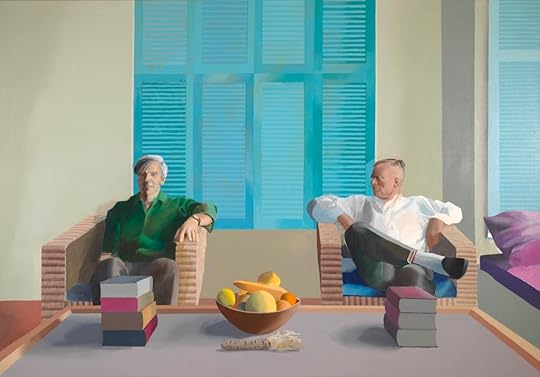
David Hockney: Christopher Isherwood e Don Bachardy, 1968. Collezione privata.

Isherwood lo considerava il peggiore dei suoi romanzi (uscito nel 1953 o ‘54, in Italia nel ‘58).
È probabilmente più famoso per quel paio di pagine dedicate al termine “Camp” che per la trama o la sua qualità letteraria.
Io ho cominciato a scoprire Isherwood proprio da qui. E non l’ho trovato affatto così scarso come riteneva invece il suo autore.
E adesso avrei perfino voglia di rileggerlo.
Se non altro perché mi sono reso conto che per quanto modesta, sono in possesso di edizione rara, l’unica che sia mai stata pubblicata in Italia di questo titolo. Fuori catalogo da oltre sessant’anni.


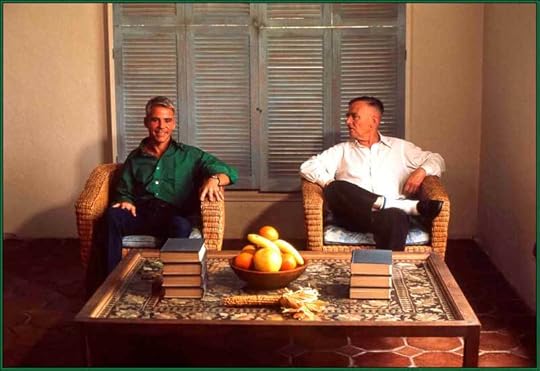
Christopher Isherwood e Don Bachardy nella loro casa di Malibu fotografati da Chris O’Dell.

Stephen (che nell’edizione italiana diventa Stefano, sigh) Monk non ha bisogno di lavorare per vivere, ha abbastanza soldi di famiglia da permettersi una vita lussuosa a Los Angeles, o dove altro preferisce: per esempio sulla Riviera francese dove a causa di una malattia ha perso la prima amata moglie, Elizabeth Rydall, autrice di un acclamato romanzo intitolato The World in the Evening (sì, esattamente lo stesso titolo).
A Hollywood (perché cos’altro è Los Angeles se non quello che cresce intorno a Hollywood? No, no, io non la penso così: ma la gente di cinema sì, almeno quella che s’incontra nelle pagine di questa storia), Stephen è percepito come uno straniero.
La sua intraprendente seconda moglie Jane sembra brillare di luce propria: e forse è solo grazie a lei che anche Stephen finisce citato o fotografato negli articoli di gossip dei quotidiani.


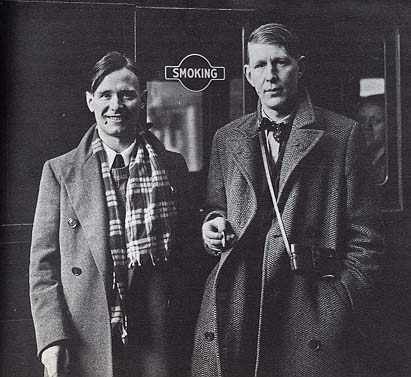
Isherwood e W.H.Auden.

Il romanzo inizia con un party tipico di quelle parti e di quell’epoca. Tasso alcolico elevato: un bicchiere vuoto è un bicchiere che aspetta di essere riempito.
Stephen per l’appunto ne tiene in mano uno e il riflesso dell’acqua della piscina lo colora di verde: automaticamente mi torna in mente la luce verde del Gatsby e quel suo braccio teso – anche perché la gente di questo romanzo, lo stesso protagonista, sua moglie, la Riviera francese sono eco dei capolavori di FSF.

Stephen sorprende sua moglie tra le braccia di un altro, l’amante che lui immaginava: prima volta che li becca in flagrante - ma aveva già dentro la convinzione che la storia andasse avanti da tempo. La sua reazione è: voltare le spalle e andarsene.
Torna a casa, fa la valigia, la riempie anche con le lettere di Elizabeth, la prima moglie, prende il primo volo e parte per Philadelphia, per andare a stare da sua zia Sara, qualche giorno o forse qualche settimana, o forse anche di più.


Don Bachardy: ritratto di Isherwood.

La seconda guerra mondiale è in corso, gli US stanno per entrare in guerra a loro volta: Stephen incontra divise all’aeroporto, alla stazione, per strada.
Zia Sara è inglese come Stephen, è ‘casa’, è quell’approdo sicuro di cui Stephen ha bisogno in questo suo (lungo) momento di crisi, di esistenza senza apparente direzione.
Le lettere di Elizabeth che si è portato dietro per difenderle dalla vendetta di Jane sono lo strumento perfetto per avviare il percorso della memoria, della riflessione, e, sì, anche di bilanci e propositi.


Don Bachardy dipinge un ritratto di Isherwood.

E così Stephen man mano ripensa (e rivive) gli anni con Elizabeth, e anche quella storia con un uomo più giovane alle isole Canarie che lo aveva sedotto per bene. Elizabeth lo venne a sapere e perdonò.
Riuscirà Stephen a perdonare il tradimento di Jane? Ma soprattutto, riuscirà a perdonare se stesso?


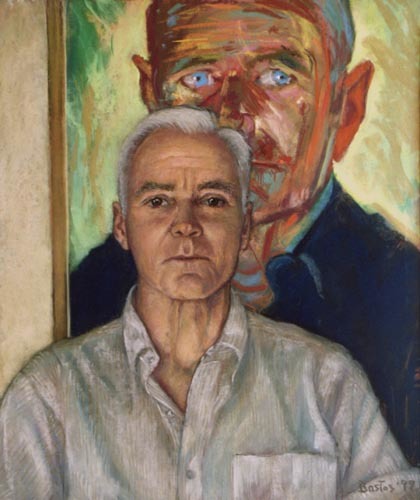
Don Bachardy: autoritratto davanti al ritratto di Isherwood.
Profile Image for Mimi.
745 reviews226 followers
November 9, 2024
There's an unsettling quietness in Isherwood's writing and narration that continues to fascinate me. He shares Shirley Jackson's gift for turning mundane every day life events into life-defining moments, minus the chilling effect that settles in afterward.

This story here, like all Isherwood stories, is much more than the sum of its parts, and is particularly difficult to describe without going off on all sorts of tangents. Mostly because it's one of those great-impact novels that touch on so many aspects of life and identity. There's lots of nostalgia and introspection mixed into the writing to give it that unsettling quietness that I can't get over.

The story takes place in Hollywood at a glamorous party in which Stephen Monk attends only to see his wife there with another man. Finally realizing there's nothing left to salvage of his marriage, he descends into a depressive state and takes refuge at a relative's home in the county to get away from it all. While there, he has an accident and injuries himself seriously enough to need bed rest, which gives him what he's afraid of most: time to think and reminisce. It takes him back to his days spent on the Canary Islands shortly before WWII and the affair he had with a younger man. The rest of the story is him reminiscing about this time period. In the end, he comes to an understanding, of himself, of life in America, of his failed marriage. Things don't tie up neatly like that, but Monk seems to have a grasp on his life again.

Isherwood's writing, though not read much outside of literary circles when he had been alive, helped define a new consciousness in an era when people didn't talk about certain things and instead would much rather ignore anything they thought threatened the mainstream consciousness, like homosexuality. Isherwood's voice was one of the first to speak of queerness openly--we don't see such writing until much later, the late 80s at least. He had a way of showing same-sex relationships as being just another way of living; another facet of life, although a very quiet, hidden life. The subtlety in his prose makes his stories stand out and stand the test of time, I think.


I got this book through a GR giveaway (yes, another one!), and I'd like to thank the people at Farrar, Straus and Giroux for the book and the little attachment. Seriously, that was really sweet.


Cross-posted at http://covers2covers.wordpress.com/20...
Profile Image for Chris.
409 reviews191 followers
January 28, 2018
This is an amazingly mutilayered phsychological journey of how the main character, Stephen Monk, grows up out of his youthful shell into an adult. Isherwood covers a lot of ground here in 301 pages: jealousy, the appropriateness of marriage, Quakerism, Nazi Germany and World War II (it wouldn't be Isherwood without this), Hollywood, New York, Paris, age differences in relationships, gay-straight friendships, homosexual militancy, the value and meaning of literature, mysticism...and there is even more! This sounds like a jumble, but one of Isherwood's major talents was to make sense of complexity, manage to find a unifying thread, and deliver his message.

And the message is simply each of us has to find his own way in life without reference to other people, institutions, or norms. In Stephen's case, he is an extremely attractive young man drawn to both sexes, young and old, but he is unaware of his effect on others. Moving through an ill-advised marriage, infidelities with other women (and men), he flounders through relationships. In particular, and at the core of the book, is his wrenching affair with Michael Drummond, a beautiful young gay man completely taken by Stephen. Ultimately Stephen rejects him from a sense of overwhelming shame and this is when Stephen finally realizes, too late, what he can offer others, and what they can offer him.

The only criticism I have is the portrayal of Sarah, Stephen's "adopted" Quaker aunt, who emerges from these pages as a not quite believable paragon of virtue with no apparant faults whatsoever. A tireless humanitarian with boudless energy for doing good, I just couldn't quite believe in her. Isherwood was certainly evoking in her his actual spiritual advisor who played a large part in the author's later life.

Two other characters deserve special mention: the first, Elizabeth, Stephen's first wife, is an admirable author with lofty goals but not quite enough talent to accomplish them: this I liked, aren't we all similar? She is obviously Isherwood's own modest impression of himself. The second, Bob Wood, is a rebellious gay youth who is the first appearance in Isherwood's fiction of the new generation of Americans who finally rebelled against heterosexual society and were comfortable with their sexuality. Prior to him, Isherwood's more "English" type was reserved and survived by remaining hidden. The author himself, later in life, went through this same transformation and became widely know for his - at least literary - militancy.

I am simply awed at what Isherwood has done in this book. As another reviewer has said, it is inconceivable any author today would have the patience and intellectual breadth and worldly experience to create something like this.
Profile Image for Stuart.
168 reviews30 followers
November 26, 2021
...As I emptied my glass, “ I really do forgive myself, from the bottom of my heart?”

Hmmm...
I can’t say I enjoyed this. I wanted to. I expected to. My first Isherwood and perhaps I should’ve started with The Berlin Stories. I’m trying to forgive myself, from the bottom of my heart.

As I hydroplaned over the surface I kept thinking, the next page I’ll start to dive and submerge, stop thinking about why I’m not enjoying it. But after the halfway point I decided, it’s not me, it’s you book. I don’t plan on shunning Christopher, but our first outing was rough.

Why you never asked?

The problem of the three saintly ladies...

There are three saints in this book. Sarah is the I’ll-help-anyone-in-a-jam-heart-of-gold-Quaker Saint. Gerda is an earthier version being the refugee-thick-ankled-I’ll-help-anyone-too Saint. And then there’s Elizabeth the humanist-lettered-city-mouse Saint. (No spoilers but Elizabeth could be canonized.) They are all incredibly forgiving of our main character Stephen. Poor Steve is always forgiven. Most of the time they end up blaming themselves for his misdeeds. In many ways, they are fully fleshed, but this idealization of their pure hearts made them all seem like different reflections of the same character. Part of never diving deep was that I could never really buy these characters flaccid motivations. Sarah yes, but when the other two were added, they lessened Sarah’s impact on the story.


Bob and Charles wander in...

Why are Bob and Charles in the story? As a gay man, I was intrigued to read about a gay couple living, somewhat openly together in the late ’30s, but as an eager reader, I kept wondering, why are you here? They served no purpose to the plot (other than to give a great definition of ‘camp’ that is illuminating and hilarious.) I read that this was the first? time that a gay couple was depicted in this way, so it’s innovative. But innovation has a fleeting shelf life. Once the rules of what one can write about are broken, all we are left with is how do these two affect the story. I had a hard time figuring out, as delightful as they would be to have over for brunch, why they sashayed their way in the middle of the novel.


Stephen’s charmed life...

Were there any consequences for Stephen? As mentioned before, the women in Steve’s life forgive him everything. He never has to face reality because the women end up blaming themselves for the most part. Everything can be solved over a cocktail. He is like a spoilt child but not in an illuminating ironic way, just in a boring way. Money to burn, aimless, interested in nothing. Really, what does this guy want? What is his motivation? What are his dreams? Can your main character not have an ‘I want’ moment? If this was a musical his opening number might go something like:


Look at this life, it’s rather neat?
Wouldn't you think my collection's complete?
Wouldn't you think I'm the guy,
The heir who has everything?

Look at this trove, treasures untold.
How many wonders can one townhouse hold?
Looking around here you'd think,
Sure, he's got everything.
(Takes a drink.)

I've got gadgets and girlfriends a plenty.
My bungalow’s next to Zsa Zsa Gabor.
(You want Charles and Bobs? He’s not yet twenty! Shh.)
But who cares? No big deal.

I want,
...Meh.

(Song clangs to a halt.)

Here, have some money...

Which brings me to: Everyone has money. No problem. Novelists many times focus on the wealthy right? Austen, Eliot, Fitzgerald. They treat it as a central part of the plot, philosophy, and symbolism of the book. But here, Isherwood never deals with the effect of money on his characters. Money doesn't really play into the plot except to let them have no constraints. It never becomes a real symbol that makes a philosophical point. It’s taken for granted and joked about, as when Elizabeth and Steve laugh that they are like the poor rich because they aren’t interested in yachts and excess. Ok, I get it, you’re the relatable rich, so we’re done talking about money. Money talk is so boring. Another martini darling?


The Forster problem...

Just finished a biography of Forster and I read that Forster was a mentor to the cute, fresh-faced Isherwood. Maybe this is where I got off-track. Expectations are the enemy of direct experience. I wasn’t expecting Isherwood to be like Forster exactly, but the beautiful hangover I had from reading Forster made me judgmental, so TWITE suffered in comparison. In a Forster novel, each character is essential to the plot, like a bumper, slingshot, or kicker in a pinball machine making the steel ball of plot bounce in unexpected but “of course!” directions, based on what that character symbolizes. I felt like so many of Isherwood’s characters were dispensable; they weren’t integral to driving the journey of the book. Even the setting of pre-WW II had no real consequence to the story except as a backdrop/setting. Stevie's bumpers lamely respond, letting him drop through - game over. Was this the point? If so, then for me, it wasn’t done in a great thematic way to explore this ennui. It just made me not care about him or his journey.


Oh Michael...

Who had consequences? Who was interesting? Who had drama and a journey? Michael! Oh, Michael. What a fantastic character. That’s the novel I would like to read. Michael’s story. “A Matterhorn for Michael.” "Michael: Matter-horny." From boy figuring out his sexuality, to love and heartbreak, to war correspondent. A gay Hemingway!


My first review and I’m such a bitch! (One of Isherwood’s favorite words in TWITE.) But I’ll forgive myself because Stephen does. The question mark at the end of that quote is ironic? Yes? If so, the last punctuation mark in the book is a little too late for irony. Let’s have a drink, shall we?
Profile Image for J..
462 reviews235 followers
July 9, 2014

... I woke up next morning in the police station without a centime. I had a splitting headache and I must have been dumped in some gutter, for my clothes were filthy. This adventure made me unreasonably indignant. Paris had betrayed me, I felt. It had treated me like a common tourist. The city wasn't friendly, as I'd imagined. It was a nest of cheap, cold-blooded crooks. I suddenly hated it. Two days later, I'd left for Germany. Berlin was a complete contrast. Outwardly, it was graver, stiffer and more formal; inwardly, it was far more lurid and depraved. For a runaway puritan, it was a more congenial refuge than Paris, because it recognized vice, and cultivated it in all its forms with humorless Prussian thoroughness.

But that persona, of course, is the very-young Isherwood, a last sip of vintage youthful decadence, the Isherwood whose exploits in the field of human relations we are familiar with. The change in The World In The Evening is that this is the man who has come on in life since the infamous Berlin stories, not such an avid student anymore. But not very much wiser, either.

It's a stretch to call this a novel, since it seems almost entirely a remixed memoir. By various contrivances and devices, reminiscence, flashback, letters and postcards, this book proceeds thru the travels of the European expat wandering the world after the continent becomes unsafe. We are confronted at all turns with personal drama, love affairs with both sexes, love gone wrong and the larger scheme of the world going wrong, on the eve of the war.

The conflict for this reader is that this is generally not my cup of tea; try as they may, English reserve and tidy prose still don't make up for purple-ish situations; soap opera is soap opera. A novel doesn't have to wrack its brains to present real life, although this one does; a novel can stand alone as its own separate reality. This one chooses not to.

But Isherwood is still able to stand outside the gush, as he has proven in his earlier work. There is something beyond just the standoffish with this author, that takes the reader along any path he chooses, knowing it is only for the moment, and there will be deeper currents as time goes on. This is at its most difficult here, where the protagonist is adrift in the whirl of an age that hasn't made any sense of anything except antagonism.

For the record, this may be the actual origin of the spiritualist in Isherwood, and there are just the beginnings of that in this book. We will see more of it in future books, but he's trying, without being so awfully Somerset-Maughamish, to grapple with it here.

Lovely moments, appalling emotional outbursts, a wandering scheme. Overall a three-star novel, but in the context, and because he convinces rather than caters to the crowd or plays at magic tricks, another free star.
Profile Image for Steve.
16 reviews9 followers
April 17, 2012
Isherwood's novels can, at times, give the impression of having been written by the love child of E.M. Forster and Noel Coward. They are full of deep introspection, lively wit, and an attention to style that is captivating in its own right. 'The World in the Evening' displays this quality perfectly. At times, the dialogue verges on the precious, but it never breaks the engaging pace of the story.

I was reminded in many ways of two related novels of Edith Wharton ('The Gods Arrive' and 'Hudson River Bracketed') in which the author divides herself into a pair of lovers struggling with their art and their love for each other. Isherwood has done much the same here, although the writer judges his art more harshly in this novel than Wharton did in her own.

Isherwood's treatment of the bisexuality of the main character is refreshing in that it is not a metaphor for gay life. Other characters in the book are recognizably gay and very comfortable with themselves.

Discovering that the world is a bigger place than one had imagined is not always something that we can do for ourselves. The novel illustrates the importance of paying attention to the lives around us, how they intersect with our own and change us whether we are ready for it or not.


Profile Image for Sara.
655 reviews66 followers
May 7, 2016
Slightly tedious at times, but mostly like one of those fabulously glamorous movies where Kristin Scott-Thomas and Matthew Goode lounge around with cocktails, ogling both sexes and griping about that beastly war. I enjoyed Isherwood's matter-of-fact treatment of homosexuality; however, I didn't find his narrator to be nearly as interesting as his tragic wife. The women bring this book to life, and as one of the first mentions of camp in 20th century literature, that's how it should be.
Profile Image for Dan.
Author 21 books547 followers
April 14, 2016
Let me start by saying I'm partial to Isherwood. His Prater Violet is perhaps my favorite novel of all time. The World in the Evening, however, may be a close runner-up. Isherwood oscillates between epistolary and straight-forward narrative, for a rather haunting, heart-felt experience that eschews sentimentality. It's the story of Stephen Monk, a wealthy young man who meanders throughout the world in the company of his wife, Elizabeth Rydal - a celebrated British author - in the early '30s. As is common with Isherwood, the specter of Hitler's Germany is always operating on the fringes to ground the narrative with a kind of melancholy realism. What's particularly interesting about Stephen is that, unlike most of Isherwood's narrators, he's more than just a thinly veiled version of the author. They share essential characteristics - a kind of wanderlust and a simmering political consciousness carefully kept in check - but they are fundamentally different people - the character and the author - a distance that is brought off to great effect. Ultimately, what The World delivers is a clear meditation on coming-of-age in a chaotic world, with plenty of the bohemian verve and Weimar insightfulness we've come to expect from Isherwood. Highly recommended.

If you liked this, make sure to follow me on Goodreads for more reviews!
Profile Image for Joyce.
122 reviews17 followers
April 23, 2022
Considering the range of topics that Mr Isherwood covers (Quakerism, WWII, Nazism, the wide spectrum of human relationships to name a few) in The World in the Evening, I'm surprised the book is not longer. But then again, Isherwood has demonstrated to me before (in A Single Man) that every sentence and line in his works has purpose, and contributes in weaving a final complex yet fully satisfying and very thoughtful piece of literature.

The blurb for this book should be sufficient starting ground for a reader to understand the foundation concept of this novel. Part of the beauty of reading this work is taking the entire novel in, in its complete form and not from short cuts of reading reviewers' summaries, I believe. By the end of this novel I felt rather cathartic, and a little more learned on how I could perhaps sincerely reflect on my own misgivings, wrong doings, but also on my most happiest memories as well.

If there is one author I have read that I feel truly understands the human condition and is thoughtful and lucid enough to write and perhaps teach others about it, it's Christopher Isherwood. I do not believe you can write about such a complex topic without possessing some incredible clarity. In this world where many people prefer to take things at face value because it means much less effort and brain power on their part, Isherwood's works are a guiding light for those who wish to care and learn much more.
Profile Image for Brenden O'Donnell.
114 reviews2 followers
April 7, 2023
Gay Quaker forced convalescence. Lots of pages. Weirdly, my vibe. Understandable if it’s not yours.
Profile Image for Bree (AnotherLookBook).
299 reviews67 followers
June 9, 2014
A novel about a man in pre-WWII Europe and America who, while bedridden at his Quaker aunt’s house, reflects on his first marriage and the dissolution of his second. 1954.

Full review (and other recommendations!) at Another look book

I received my copy via Goodreads' First Reads program, which is awesome, because this is the first book I've won! The World in the Evening isn't the kind of book I'm usually draw to. It's navel-gazely--fine by me--but it's a man's navel, and I tend to sympathize better with women navel-gazers. All the same, it's a book that grabs you immediately, right from the opening scene, and continues to consume you long after you turn the last page. As a quality piece of literature, I thoroughly recommend it. Especially if, like me, it doesn't sound like your usual fare.

I'm delighted that, with this 2013 edition, The World in the Evening might make it onto a few more bookshelves. I'm also delighted by the cover art, which is tactful and relevant. The typeface, too, strikes me as slightly vintage. This vintage aficionado is pleased.

I'm less pleased, however, that on randomly flipping through this edition I found a typo on page 134. "Quaker," folks, not "Quarker."
Profile Image for Marti.
443 reviews19 followers
February 7, 2020
Although not my favorite Isherwood novel, it was good enough that I had to give it more stars than other things to which I have given only three stars.

I guess the thing that bothered me the most was that he was writing as a straight man. Ordinarily, I would have thought the character was deluding himself by remaining in a closet; except that in his earlier novels (this one was written in 1950), Isherwood never tried to hide the fact that his characters were gay. And on top of being straight, the protagonist is also a Quaker from the Philadelphia mainline (who conveniently spent most of his formative years in boarding school in Britain....otherwise, that really would have been a bridge too far).

However, if you can overlook that, it is pretty interesting snapshot of the 1930s -- a time when Hitler was gaining power and everyone had presentiment of doom -- something which I found resonated now. Though set in 1941 the story is told through flashbacks and features the usual wealthy types who drift between Paris and the Riviera. This is the type of book that is low on plot and long on esoteric, meandering, dialogue that strays off topic; but I guess I will take that over a comic book any day.
Profile Image for Alice C.
65 reviews
June 24, 2025
i always love an isherwood and this was no exception. genuinely wasn’t expecting the story with steve and Elizabeth’s friend, i forget his name, but that was amazing. and i enjoyed how casual and implicit steve and elizabeth were about his infidelity…
Profile Image for Richard Jespers.
Author 2 books21 followers
August 8, 2017
Evening, set in the late 1930s and early 1940s, seems to be hung on a simple frame. Part One is entitled “An End.” In it the protagonist, Stephen Monk, catches his second wife, Jane, in a compromising position with another man and leaves her immediately—almost too easily, it seems. Isherwood introduces a number of principle characters, including Stephen’s “Aunt” Sarah, as well as his nurse, Gerda. Part Two is called “Letters and Life.” In this section Stephen recovers from a horrendous accident which occurs at the end of Part One, in which he is hit by a truck (described rather ethereally with little blood or pain). In this new milieu of body casts and long, empty days of convalescence, Monk untangles his life for the reader (often by way of letters he has saved): he flashes back to the life with his first wife, Elizabeth, a famous author, older than Stephen by twelve years, and how she dies. All of this section takes place in his family home in Pennsylvania which his aunt manages. He also describes an early episode in his married life with Elizabeth in which a younger man inveigles him into having a brief and unsatisfactory affair. In Part Three, “A Beginning,” the reader is brought back to the beginning time period where Stephen’s body is healed, and he ties up all the loose ends of the story. Stephen and his ex-wife Jane have lunch, and the reader finally learns what really happens in the beginning with her and the man she’s with in bed (actually, it’s a large children’s playhouse in the back yard where a party is being given). For some readers (even to Isherwood as a younger man), the novel might conclude a bit sappily, a bit too neatly. The ending is perhaps saved by the witty repartee the couple exchange. For twenty-first century readers, it may be a bit too sweet.

A few nuggets from the novel:

In this passage we read a portion of a letter written by Elizabeth, with regard to Hitler’s rise to power, while she lives in Europe: “Oughtn’t I to be doing something to try to stop the spread of this hate-disease? Oughtn’t I to be attacking it directly? But, of course, this very feeling of guilt and inadequacy is really a symptom of the disease itself. The disease is trying to paralyze you into complete inaction, so it makes you drop your own work and attempt to fight it in some apparently practical way, which is unpractical for you because you aren’t equipped for it—and so you end frustrated and doing nothing” (171). It may remind some of us of how we and the media are paralyzed by a particular presidential candidate at the moment.

“Suddenly, I didn’t care any more. The problem had dissolved itself in the beer; and now there wasn’t any problem at all, no drama, no tenseness. This was all clean fun, I told myself; and it didn’t have to be anything more than that.
In the darkness I remembered the adolescent, half-angry pleasure of wrestling with boys at school. And then, later, there was a going even further back, into the nursery sleep of childhood with it teddy bear, or of puppies or kittens in a basket, wanting only the warmness of anybody” (194).
Here, Stephen describes (barely referring to it) his sexual experience with a young man. It helps him, a heterosexual man, to rationalize his one-night stand, a move rather dated by standards of contemporary gay or straight fiction.

“This was the next day, in New York. Jane and I had met—for the first time since our divorce—to have cocktails and lunch at a hotel on Central Park; and I had finished telling her about the civilian ambulance unit in which I’d enlisted as a driver, to go to North Africa” (293-4). This passage makes me wonder why Isherwood chooses this kind of job for Stephen Monk, when Hemingway has selected it over twenty years earlier for his noted character, Frederic Henry, in A Farewell to Arms. Perhaps it is a common way for a civilian to become involved in a war effort.

“‘Well, thanks,” I grinned. ‘You aren’t looking any too repulsive yourself, right now’” (294). Isherwood does this occasionally, uses a speech attribution which is not really a synonym for the word “say”—a practice that may be acceptable in British publishing but one which current practitioners of fiction abhor. Also, the remark itself seems rather a backhanded compliment given to a woman who has once been your wife.

More so than any book of Isherwood’s that I have read so far, this reading seems to be an academic exercise, not as enjoyable as the previous twelve.
Profile Image for Bob Schnell.
651 reviews14 followers
March 29, 2018
I've always preferred Christopher Isherwood's non-fiction (memoirs especially) to his fiction. "The World in the Evening" is a good example why. The main character is obviously Isherwood in the guise of a mostly heterosexual man of means who seems incapable of living on his own. It is always women who support him emotionally, sexually and as nurse/mother. Yet his eyes occasionally stray to a good looking man...

Though it reads well, the book is too introspective and sentimental. The main character seems incapable of thinking past his own wants and needs though he does have glimpses of what it must be like to be selfless. The story is told through a sequence of conversations, letters and memories. It reminds me of the movie "Two for the Road"with Audrey Hepburn and Albert Finney recalling the stages of their characters' romance, marriage and divorce. It looks good and is entertaining enough, but in the end it doesn't have much to say. For Isherwood completists.
Profile Image for Alvin.
Author 8 books140 followers
October 25, 2016
Isherwood's talent for explicating emotional intelligence is on full display here, and most of the main characters are devastatingly real. Larger moral and political questions dealing with pacifism, social responsibility, and the relation of camp to religiosity, are seamlessly incorporated into the story as well. The only reason this doesn't get a full five stars is that the book drags towards the end, giving far too much space to a couple of love triangles about which I wasn't especially interested. Overall, though, a thoroughly worthwhile read.
Profile Image for Al  Zaquan.
129 reviews11 followers
May 31, 2018
A chore to finish. There are gems in the dialogue and letters, but the background-building and often long detours made by lost characters were very slow and excruciating.
Profile Image for Hana.
61 reviews
October 7, 2018
I've spent the past day trying to formulate into words exactly what I enjoyed so much about The World in the Evening, but it feels like my enjoyment defies explanation or logical analysis, so let me put it this way: I did not enjoy reading A Single Man because it was supposed to be 100 pages of this guy's supposedly profound daily life, but instead felt like 500 pages of George taking a shit or talking to random dudes at the gym*. The World in the Evening, on the other hand, was 300 pages of kind-of Isherwood/ Stephen reminiscing on his mundane life as a husband while lying in bed wearing a rotting cast that felt like a warm, whimsical, winding bedtime story that my mom was telling me from memory. I was so absorbed by everything. In A Single man, George ran around the ocean naked with one of his students and I was like Please Chris, just kill someone off already so I can be entertained (obviously Isherwood somehow heard me and made my prayer come true, and obviously I complained about it anyway). In The World in the Evening, Stephen described that time his wife got pregnant but had a miscarriage and my reaction was OH my GOD Steve PLEASE tell me MORE I HAVE to KNOW what HAPPENS NEXT.

The fact that this book took place in an alternate reality paradise where queerness was accepted with ease by friends and family definitely made it all the more enjoyable. I highly doubt people had such positive reactions toward homosexuality during the 30's, but I also don't care. Everyone seemed pretty unoffended by Bob and Charles "living together", and Elizabeth, being the absolute angel that she is, seems unaffected by the revelation that her husband is not only attracted to men but also having sex with one on the side. (I can't tell if Elizabeth's indifference toward Stephen's affairs is wonderfully progressive or just a case of a woman setting the bar incredibly low for her husband and finding that the bar needs to be set even lower. As someone who has some problems with society's approach toward monogamy, I'm going to reluctantly go with the former.)

Also, part of the reason I picked this book up even after my disappointing experience with A Single Man was because Susan Sontag cited it in her essay, Notes on Camp. The few pages that were devoted to explaining the aesthetics of camp were short but wonderful, and they absolutely delivered. I think it should be read by anyone interested in the aesthetics of irony (which is basically every disillusioned young person on the internet nowadays, isn't it).

In conclusion, and on a more serious note, The World in the Evening was an absolute pleasure to read and has really restored my interest in Isherwood. His ability to inject humanity and warmth into even the most ordinary situations, and to make average, everyday people complicated and absorbing was what really set this novel apart from the other fiction I've read recently. I'll be picking up more of his books in the near future- hopefully they won't be like A Single Man.

*I haven't read A Single Man in a year, and I don't plan to read it or even skim it to check the basic plot points for the sake of this review. Did George really spend 60 pages on the toilet? Probably, but I'm not going to get out of bed and find my copy just to confirm what I already knew.
Profile Image for Stuart.
483 reviews19 followers
November 28, 2020
A subtle novel about forgiving the people you loved and failed (and forgiving yourself in the bargain), this lovely book retraces ground from earlier, better Isherwood (especially Berlin Stories) but with a maturity reflecting the author's increased understanding and compassion for the follies of humans locked into their lives. Reluctant leading man Stephen is that rarity in fiction, a bisexual man who moves back and forth between male and female partners, whose promiscuity is neither romanticized nor condemned, his search for meaning in the realtionships that criss-cross his life neither belittled nor given a weight beyond the narrow sphere of his existence. Set against the beginning of the US involvement with WWII but with the bulk of the action placed in the past, there is a sly irony in this young man's self-obsession that allows his rise to consciousness of the lives of others (and ultimately the larger world) to ring authentic without straying into didactic and at no point does it seem like Isherwood is preaching to Stephen, let alone the reader, so much as letting both discover all there is beyond the immediate concerns of a broken heart. The other characters in the book, major and minor, are finely wrought, with unexpected twists and complexity that emerges only as Stephen becomes aware of it (or allows for it to exist), with perhaps the finest of them all being the dead writer at the center of Stephen's life and whose quest to articulate the progress of the soul before she dies is the driving force of the novel, even providing the title. A gentle but intriguing book, this is a coming of age story about someone who was technically already a grown up, and a reminder that we all come to maturity at our own pace.
18 reviews
Read
July 26, 2024
An Isherwood about heterosexuals in America that I oddly related to more than the Berlin novels. I loved the male protagonist being a dick -- very empathetic in a surprising way. Couldn't quite put my finger on why the awful man in this novel - selfish, self-aggrandising, rarely self-aware - didn't irritate me. I feel quite similar to him, especially when he tries and fails to sound clever.

I would love to be an old woman who smokes perfumed Turkish cigarettes in a long jade holder.

Also made me think of that ever-lasting bug-bear: people who write who have neither seen nor read nor felt enough. I really believe Isherwood went out of his way to experience as much as he possibly could, then to transfer this into book material that reflects their real experiences. I feel like I don't really want to go and live 80 lives and suspect I shall never be a successful author (as a result?).

"But consciousness wasn't ashamed because consciousness wasn't I."

This made me want to be more self-aware - and aware that no matter how self-aware I become, there will be flaws in myself I will miss. We will always have reasons to hate ourselves if we look for them, so there isn't really any point in hating yourself now, when you hardly know all of the reasons you should.
Profile Image for Rhiannon Grant.
Author 11 books48 followers
March 9, 2018
I bought a copy of this book because someone tipped me off that it has Quakers in it. And indeed it does: a somewhat idealised portrait, perhaps, but the character of Sarah, who is a Quaker and a significant influence on both the plot and Stephen, the lead character, is an interesting one. It also deals with other themes: sexuality, pacifism, responses to the war (it's set mainly in Europe and America in the ten years or so up to 1941), and some meta issues about what a novel can deal with. In some ways, this is the sort of novel I don't usually like very much - at one level, it's just about a self-centred man who spends the whole time naval-gazing. It's a testament to Isherwood's skill that he is able to use this structure to reveal a whole lot more, about complex sexuality, about relationships (including some realistic and sympathetic women), and about political issues. In the latter particularly, the Quakers serve as a foil: very few characters become pacifists, but the presence of a few pacifists opens up a discursive space in which the novelist can explore why so few of his characters take that path.
Profile Image for Wherefore Art Thou.
248 reviews13 followers
March 28, 2025
This is a beautiful and thorough explanation of the self, the murkiness of sexuality and love, and what people can mean to each other.

The first third is a much faster, exciting pace than the rest, which is bogged down a little bit by long letters, the text of which could have been truncated or eliminated entirely in my opinion. Vastly overwritten, perhaps, but I was very much ok with wading through, even drowning in all the “dearests” if I were to here and there stumble on some insights about people, if not myself.

The extra layers of primary story, recalled memory, texts printed in the letters and then the occasional bounce between them create a collage of a story rather than a singular one. It throws off the pacing and the storytelling for the sake of thematic episodes and it mostly works out. A little patience goes a long way.

I am very glad I read this book, even if it was a little drawn long and thin. There’s lots of little complexities here to think about and reconcile with in one’s own life. It does help to be rich, it seems, to afford to explore oneself more completely.
Profile Image for Graham McKay.
146 reviews
July 30, 2025
Isherwood is able to take you back to the 1930s and 40s so easily. Granted he was writing his books not long afterwards but it still feels so seamless and his descriptions are never overdone. His writing is soothing and to me what sets him apart is his dialogue. Dialogue can be a showstopper for me if it's not believable or if its too mechanical or plot driven. The World in the Evening dives heavily into the psychology of relationships, jealousy, and purpose along with the superficiality of American culture. We follow Stephen, a quintessential handsome trust fund baby as he navigates then reflects on his life's significant relationships. Between the main characters the entire spectrum of selfishness to selflessness is on display, at odds with each other in some seriously heartbreaking scenes. They don't turn books like this into movies because "nothing happens". Everything happening is internal, the main character looks in the mirror where he reconciles the biggest mistakes of his past. He was so refreshingly honest, coming to a place where he forgives himself and you can't help feeling a second-hand therapeutic wave wash over you.
Profile Image for Aaron Ambrose.
428 reviews8 followers
January 26, 2025
This is really, really good. I hovered over that 5th star for quite a while, and the only thing stopping me is a few aspects of the book that haven't aged so well. It's my first time reading Isherwood, and I was happy to have my preconceptions smashed pretty quickly. Isherwood is smart and frank, and it's even more remarkable considering he was publishing during the Eisenhower years. There's a polite delicacy here about sex, but all the mental complications surrounding it get articulated with highly adult clarity and poignancy. My favorite aspect of the book is that it understands and captures the inconsistency of people, as hard as we may try to be "ourselves." There's a nice passage toward the end that questions whether fiction damages us readers because it encourages us to see real (mutable, odd) people as characters in novels (fixed, "well-rounded"). This book did what I always crave from a novel: it made me rethink the way I see the world.
Profile Image for Nathan.
46 reviews1 follower
September 16, 2023
This was going to be a solid 3 stars, at least, until the last 70 pages or so, but the final stretch not only upped the melodrama and sentimentality, but revealed what a very poor patchwork the novel is. There's lots of interesting threads here, some of which might have made for wonderful novellas in their own right, but they don't go together. The Jane stuff is especially tiresome, while Michael Drummond, in the fifty or so pages he occupies, threatens to swallow the book whole. The emotional violence of his second—and most substantial—appearance isn't the mode in which I most enjoy Isherwood, but there's no question in my mind that he is the character I will continue to remember as others fate away.

Isherwood is still a great prose stylist, and I continue to hope I'll find something else of his I like half as much as A Single Man. This wasn't it.
Profile Image for Bill.
456 reviews
September 17, 2021
Stephen is a well to do young man who spends the late 1930s-early 1940s jet setting around the world scarcely aware of anything outside his own sphere. An accident leaves him in the care of an old aunt in small town Pennsylvania, which with the help of various caregivers gives him time to reflect on his life.

I don't know if Stephen was meant to be Isherwood himself, but I do know I found all the characters to be well-developed, the plot believable, and I even was reminded a bit of Orson Welles. I still need to read Isherwood's "Berlin Stories" and especially his memoir "Christopher and His Kind".

Profile Image for Nicholas George.
Author 2 books69 followers
September 27, 2023
One really has to take into account the time period in which this was written to really assess it. You have to wonder how much Stephen Monk is based on Isherwood himself--a conflicted gay man living in an era when that had to be kept in the closet. Although Monk appears to be mostly heterosexual (his relationships with his two wives are genuinely passionate), the gay character Michael certainly tempts him, and the inclusion of a happily partnered gay male couple (Bob and Charles) shows Stephen an appealing alternative. Isherwood would later write more openly about gay relationships, but this early work--superbly written--only hints at a world that would later be explored in richer depth.
3 reviews
May 14, 2020
I found this at times, to be a difficult read. Some chapters were longer than I thought necessary but, other's were exceptionally well written and had a really nice flow. Overall, this wasn't my favourite book that I've read by Isherwood, I found the plot unnecessarily complex and detailed at times. However, if I was to say one good thing about this novel, it's that I forgot that it was fiction. The characters were so believable, and so relatable that I forgot at times, especially towards the end, that they weren't real.
Profile Image for Fran Bergen.
2 reviews
April 7, 2023
"Hay personas que son como países. Cuando estás con ellas ése es tu país y hablas su idioma y no importa dónde estés: estás con ellas."

"Matar a un millón de personas... Comprendes el significado de esa frase? Yo no, y Elizabeth tampoco. Lo admitía abiertamente y por eso se limitaba a los efectos sutiles, como en miniatura, que sabía que podía manejar. Estoy seguro de que tenía razón, porque así funcionaba su talento de escritora."
This entire review has been hidden because of spoilers.
Displaying 1 - 30 of 88 reviews

Can't find what you're looking for?

Get help and learn more about the design.