

What do you think?
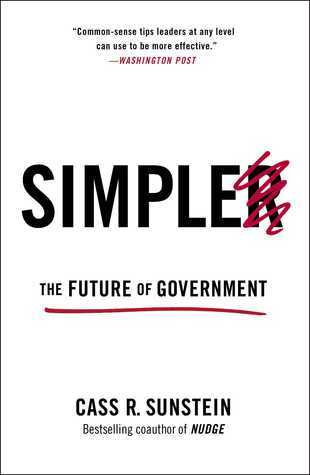
Simpler: The Future of Government
For nearly four years, Cass R. Sunstein, bestselling author and President Obama’s “Regulatory Czar,” helped to oversee a revolution in better government. He explains how and why—and what comes next.The future of government arrived four years ago. Government became simpler, it became smarter, and Cass Sunstein was at the center of it all. Drawing on state-of-the-art work in behavioral psychology and economics, Sunstein, as administrator of the powerful White House Office of Information and Regulatory Affairs (OIRA), quietly helped save the nation billions of dollars while preventing thousands of deaths and countless illnesses and accidents. All this was accomplished in part through the extraordinary power of nudges—low-cost, seemingly modest policies that preserve freedom of choice. In combination with smart, disciplined cost-benefit analysis, nudges are simplifying government and making it far more effective.
Twenty-first century insights now inform simplified mortgage and student loan applications, the labeling of food and energy-efficient cars, financial reform, and health care reform. New principles—democratizing data, presenting individuals and businesses with the most salient information, ensuring that the better outcome is the automatic outcome—are transforming government. Countless regulations are being streamlined or eliminated. Transparent review of which rules are working, and which aren’t, is becoming the norm. Citing numerous examples from his years in the first term of the Obama Administration, and projecting forward into a data-driven future, Simpler provides a new understanding of how government can work.
Twenty-first century insights now inform simplified mortgage and student loan applications, the labeling of food and energy-efficient cars, financial reform, and health care reform. New principles—democratizing data, presenting individuals and businesses with the most salient information, ensuring that the better outcome is the automatic outcome—are transforming government. Countless regulations are being streamlined or eliminated. Transparent review of which rules are working, and which aren’t, is becoming the norm. Citing numerous examples from his years in the first term of the Obama Administration, and projecting forward into a data-driven future, Simpler provides a new understanding of how government can work.
272 pages, Kindle Edition
First published April 1, 2013
About the author
Cass R. Sunstein
179 books761 followersCass R. Sunstein is an American legal scholar, particularly in the fields of constitutional law, administrative law, environmental law, and law and behavioral economics, who currently is the Administrator of the White House Office of Information and Regulatory Affairs in the Obama administration. For 27 years, Sunstein taught at the University of Chicago Law School, where he continues to teach as the Harry Kalven Visiting Professor. Sunstein is currently Professor of Law at Harvard Law School, where he is on leave while working in the Obama administration.
Ratings & Reviews
Friends & Following
Create a free account to discover what your friends think of this book!
Community Reviews
Displaying 1 - 30 of 62 reviews

April 13, 2013
A slim volume that is equal parts memoir of Sunstein's time at OIRA and encomiums to certain regulations promulgated during President Obama's first term in office. Sunstein basically takes the insights of Thinking, Fast and Slow and applies them to certain, high profile regulations. Other times, he explains how he applied his philosophy articulated in Nudge: Improving Decisions About Health, Wealth, and Happiness when discharging his role at OIRA.
As a result of this approach, if you have read Nudge, Thinking, Fast and Slow, and have knowledge of major regulations of the past four years this book will bore you silly (as it did me, alas). If, however, the application of insights from behavioral economics to regulations and the intellectual and political struggles over cost-benefit analysis are new to you, and you wish to have Gladwellian anecdotes about them from one of the field's premiere intellectuals, this book will be quite interesting and very illuminating.
(I offer one warning: If you have trepidation about regulations promulgated under the current President, this book may be hard to take as it is an unabashed love letter to the regulatory state and its decisions of the past four years.)
As a result of this approach, if you have read Nudge, Thinking, Fast and Slow, and have knowledge of major regulations of the past four years this book will bore you silly (as it did me, alas). If, however, the application of insights from behavioral economics to regulations and the intellectual and political struggles over cost-benefit analysis are new to you, and you wish to have Gladwellian anecdotes about them from one of the field's premiere intellectuals, this book will be quite interesting and very illuminating.
(I offer one warning: If you have trepidation about regulations promulgated under the current President, this book may be hard to take as it is an unabashed love letter to the regulatory state and its decisions of the past four years.)

July 26, 2016
Good read for those entering government, to aid their decision making process and focus on what is really important when making policy decisions. About 30% longer than necessary though, judging by my highlights. Perhaps a re-read a year from now would turn up different things.
Quotable quotes:
"I have no complaints that you want to hear about."
____________
The Obama administration strove for flexible performance standards, rather than rigid design standards.
In government, you are accountable to your boss, the president of the United States. An idea that is lousy or not really feasible is not welcome, even if it is thought-provoking. You cannot speak publicly without authorisation, and whatever you initiate or proceed with has to be consistent with the judgement and goals of the team. Official documents have to go through a clearance process, which can be long and frustrating, but which is a crucial means of ensuring the team is committed to it.
Trusting your gut works best when you are familiar with the subject at hand, and it is non-complex.
Shortsighted decision-making occurs in part because people fail to consider their future interests as belonging to the self." Some of us envision our future selves in the same way that we envision other people
People respond to information about benefits or risks of engaging in certain actions if they are simultaneously presented with clear, explicit information about how to do so.
No society with democratic elections and a free press has ever experienced a famine (Amartya Sen's research)
The crippled epistemology of extremism: extreme views arising as a consequence of the narrow set of people from whom they learn.
Quotable quotes:
"I have no complaints that you want to hear about."
____________
The Obama administration strove for flexible performance standards, rather than rigid design standards.
In government, you are accountable to your boss, the president of the United States. An idea that is lousy or not really feasible is not welcome, even if it is thought-provoking. You cannot speak publicly without authorisation, and whatever you initiate or proceed with has to be consistent with the judgement and goals of the team. Official documents have to go through a clearance process, which can be long and frustrating, but which is a crucial means of ensuring the team is committed to it.
Trusting your gut works best when you are familiar with the subject at hand, and it is non-complex.
Shortsighted decision-making occurs in part because people fail to consider their future interests as belonging to the self." Some of us envision our future selves in the same way that we envision other people
People respond to information about benefits or risks of engaging in certain actions if they are simultaneously presented with clear, explicit information about how to do so.
No society with democratic elections and a free press has ever experienced a famine (Amartya Sen's research)
The crippled epistemology of extremism: extreme views arising as a consequence of the narrow set of people from whom they learn.

February 22, 2022
Reading about how those in government try to improve the government, change policies and incrementally increase the benefit to the citizens they represent. From the official Nudge unit of the government (which is an awesome title if you can get it), I think if you are in the position to change the government or a company culture by asking the best why questions from within, you can make sustainable changes to an organization.
Who would have through before reading this that the food pyramid was so complex to change with so many approvals and buy ins needed to even change a small piece of it. This does cover behavioral economics and it also covers incentives. You must understand your represented citizens and weigh their wants about what is right sometimes. Is this paternalism, yes ish as it's a grey line, but it at least should allow us and others to bring up questions in an effort to make things better.
Who would have through before reading this that the food pyramid was so complex to change with so many approvals and buy ins needed to even change a small piece of it. This does cover behavioral economics and it also covers incentives. You must understand your represented citizens and weigh their wants about what is right sometimes. Is this paternalism, yes ish as it's a grey line, but it at least should allow us and others to bring up questions in an effort to make things better.
January 4, 2026
Simpler — Cass Sunstein
Author was head of OIRA — chief regulatory authority of USA — during the Obama administration. In this book, he not only explains the science of “nudging” and common-sense rule-making, he does so while citing number of anecdotes and real life examples from his own experience
Except anecdotes, book doesn’t provide any new information to readers who had read Thinking Fast and Slow of Daniel Kanheman or Nudge coauthored by Richard Thaler with Cass Sunstein.
However, to any administrator and public official, it is simple yet enriching read since it connects theory with practice in government affairs.
Author was head of OIRA — chief regulatory authority of USA — during the Obama administration. In this book, he not only explains the science of “nudging” and common-sense rule-making, he does so while citing number of anecdotes and real life examples from his own experience
Except anecdotes, book doesn’t provide any new information to readers who had read Thinking Fast and Slow of Daniel Kanheman or Nudge coauthored by Richard Thaler with Cass Sunstein.
However, to any administrator and public official, it is simple yet enriching read since it connects theory with practice in government affairs.

February 27, 2022
Cass is a great storyteller and my type of technocrat. The book was easy to follow and the takeaways were clear. But I found it to be a bit redundant. Although this book focuses a lot more on the type of interventions that he designed during his time in the Obama admin, it duplicates a lot of the knowledge from Nudge. It also reminded me a lot of his class at H and how married he is to the idea of conducting CBA. If I ever teach CBA, I might even use a passage or two.
It is a good book overall, but I think I would have been ok without reading it.
It is a good book overall, but I think I would have been ok without reading it.

April 13, 2013
Buy this book, then read the beginning of Chapter 4 which provides a hilarious send-up of how ineffective the government's food pyramid was (it is funnier when you can actually see the figure): "Now ask yourself what you should be eating if you care about nutrition. Maybe the shoeless person climbing (away from the food? toward the top?) holds a clue. But wait. What is so good about the top? What is that white apex supposed to represent? Is it heaven? Is it thinness? At the bottom, why are so many foods crowded into each other? Are you supposed to eat all of those things? At once? What’s that large stripe between “fruits” and “meat and beans”? And what is that brown thing at the lower right? Is it a shoe? Did it belong to that climbing person? Are you supposed to eat it?"
Then go back to the beginning of the book from beginning to end. And then start thinking about how you can apply the many lessons that Cass Sunstein imparts with brilliance, wit, insight, compassion, and endless energy and initiative--tying together a large amount of material into a coherent, consistent intellectual framework that is focused but also flexible.
Then go back to the beginning of the book from beginning to end. And then start thinking about how you can apply the many lessons that Cass Sunstein imparts with brilliance, wit, insight, compassion, and endless energy and initiative--tying together a large amount of material into a coherent, consistent intellectual framework that is focused but also flexible.

February 27, 2013
I read this book with a giant smile on my face the entire time. I cannot stress how important this book/thesis/material is and how much I hope the concepts and ideas spread to other countries. THANK YOU CASS!
If you couldn't tell from the first sentence, im a big fan of Sunstein's regulatory philosophy. I've read almost all of his books and this one was probably written the best. There wasn't really any new information in this book, but a good compilation of some important texts. This book was written as Nudge part 2 but I hope the audience is much broader than that.
I wish Simpler had more anecdotes and stories from the inside, but other than that, a very satisfying read.
If you couldn't tell from the first sentence, im a big fan of Sunstein's regulatory philosophy. I've read almost all of his books and this one was probably written the best. There wasn't really any new information in this book, but a good compilation of some important texts. This book was written as Nudge part 2 but I hope the audience is much broader than that.
I wish Simpler had more anecdotes and stories from the inside, but other than that, a very satisfying read.
April 17, 2013
This is a short and easy to read book that describe Cass Sunstein's experience in applying behavioral economics to the world of regulation at the federal level. The book has several very interesting examples of the applications. I'm a little bit disappointed that the book is mostly a rehash of nudge as well as a few older materials from other books. But for the first time reader of behavioral economics - an excellent read.

October 30, 2016
This was surprisingly enjoyable. Sure, I never would've touched this had it not been required for my Poli Sci class, but if we had to read anything, I'd choose this in a heartbeat. I appreciated how Sunstein eloquently broke things down, making the concepts easy to understand while treating the reader like a competent human being. This book is exactly what it set out be: simple.

June 29, 2013
If you've read Nudge, then you've read this book.

August 18, 2013
Terribly written. Painful to read. The entire book is propaganda explaining how the government manipulates us. Don't bother wasting your time with this one.

April 10, 2025
Simple: the Future of Government
21/2025.
A perfect read for Tax Season. How can government be made simpler and more user friendly? This is a practical book in the discourse on what government should be and be (something both parties in the US seem to struggle to provide a clear vision on, and a valid debate globally).
Sunstein relies on his time as a regulatory chief in the Obama administration to show how simplification of choices and presentation of rules makes life easier for people; always a good goal.
One aspect of regulatory work is that immature firms and trade associations tend to seek a lowest common denominator of “avoid regulation at all costs”, while more mature shops can embrace regulation that gives them certainty and flexibility. This book is more for the latter camp. This is important when considering regulation for difficult situations where individual actors’ self interest may be harmful to the use of public or common goods.
Sunstein’s basic method is to apply behavioral economics to facilitate healthy choices while not impinging on individual liberties. That is: make doing the right thing a bit easier and people will tend to do it. Think of things like: listing calorie counts and mpg on consumer labels, etc. These things can have small accumulative impacts that result in major changes. Changing from “opt in” to “opt out” has had major impacts from privacy protection to health savings plan enrollment to organ donation. Sunstein goes out of his way to discuss measures to avoid an overly paternalistic regulatory regime, as well.
Of course, helping people make better decisions is aided by access to good information in clear presentation. Compelled disclosure (as in nutritional facts) is often resisted by industry, but incentivizes better behavior by industry while helping people make better decisions. It’s a double benefit.
A great example of this is my local electric utility, which sends me a monthly report comparing my electric use to my neighborhood, and to “efficient homes”. It allows me to try to out compete the “efficient” homes and bring my use to a minimum; good for my wallet, good for the environment, and good for the utility, which saves on infrastructure overuse during peak periods.
21/2025.
A perfect read for Tax Season. How can government be made simpler and more user friendly? This is a practical book in the discourse on what government should be and be (something both parties in the US seem to struggle to provide a clear vision on, and a valid debate globally).
Sunstein relies on his time as a regulatory chief in the Obama administration to show how simplification of choices and presentation of rules makes life easier for people; always a good goal.
One aspect of regulatory work is that immature firms and trade associations tend to seek a lowest common denominator of “avoid regulation at all costs”, while more mature shops can embrace regulation that gives them certainty and flexibility. This book is more for the latter camp. This is important when considering regulation for difficult situations where individual actors’ self interest may be harmful to the use of public or common goods.
Sunstein’s basic method is to apply behavioral economics to facilitate healthy choices while not impinging on individual liberties. That is: make doing the right thing a bit easier and people will tend to do it. Think of things like: listing calorie counts and mpg on consumer labels, etc. These things can have small accumulative impacts that result in major changes. Changing from “opt in” to “opt out” has had major impacts from privacy protection to health savings plan enrollment to organ donation. Sunstein goes out of his way to discuss measures to avoid an overly paternalistic regulatory regime, as well.
Of course, helping people make better decisions is aided by access to good information in clear presentation. Compelled disclosure (as in nutritional facts) is often resisted by industry, but incentivizes better behavior by industry while helping people make better decisions. It’s a double benefit.
A great example of this is my local electric utility, which sends me a monthly report comparing my electric use to my neighborhood, and to “efficient homes”. It allows me to try to out compete the “efficient” homes and bring my use to a minimum; good for my wallet, good for the environment, and good for the utility, which saves on infrastructure overuse during peak periods.

September 1, 2023
Rounded up from 3.5 stars because Sunstein puts a lot of effort into trying to tell people what the internal workings of government are like. Too many comfortable cynics believe that civil servants are lazy and/or dumb and/or ideologically biased. Most civil servants are actually smart and hardworking. Anyone who doesn't believe that will have trouble accepting this book. Sunstein has a lot of perceptive and useful things to say about government regulation. On the other hand, as many other reviewers have noted, much of his discussion amounts to applying behavioral economics to the business of government. Anyone who has read Nudge or Thinking, Fast and Slow will not find much new in here.
Reading the book 10 years after its publication allows some perspectives. Sunstein saw political polarization already making regulatory affairs in the U.S. difficult; they seem to be even more difficult now, to a degree that he may have found unexpected a decade ago. He concedes the ironic point that trying to make government simpler is often not a simple task. One example: he sets a lot of store in cost-benefit analysis but admits that getting the numbers right is not easy, that some aspects of decisions cannot be quantified, and that people for and against a proposed regulation often assume that the government's cost-benefit analysis is biased in one direction or another. There's also the overhanging question of how much the project of regulation is a Sisyphus-like affair: Sunstein lists regulations that have saved hundreds of millions of dollars and thousands of lives, but more problems seem constantly to arise to take the place of the old ones.
The main drawback for many readers may be that large parts of the book can feel repetitive, despite much of the detail being called for to support the arguments. I still found it a useful read and full of ideas that one hopes governments can apply.
Reading the book 10 years after its publication allows some perspectives. Sunstein saw political polarization already making regulatory affairs in the U.S. difficult; they seem to be even more difficult now, to a degree that he may have found unexpected a decade ago. He concedes the ironic point that trying to make government simpler is often not a simple task. One example: he sets a lot of store in cost-benefit analysis but admits that getting the numbers right is not easy, that some aspects of decisions cannot be quantified, and that people for and against a proposed regulation often assume that the government's cost-benefit analysis is biased in one direction or another. There's also the overhanging question of how much the project of regulation is a Sisyphus-like affair: Sunstein lists regulations that have saved hundreds of millions of dollars and thousands of lives, but more problems seem constantly to arise to take the place of the old ones.
The main drawback for many readers may be that large parts of the book can feel repetitive, despite much of the detail being called for to support the arguments. I still found it a useful read and full of ideas that one hopes governments can apply.
December 19, 2024
In SIMPLER: THE FUTURE OF GOVERNMENT, Cass Sunstein writes about his time as "regulatory czar" under the Obama administration. He combines fascinating anecdotes of the realities and absurdities of modern politics with examples of how tools like behavioral economics and cost-benefit analysis can save Americans time, money, and harm by informing data-driven regulatory decisions.
From the book jacket: "Drawing on state-of-the-art work in behavioral psychology and economics, Sunstein, as administrator of the powerful White House Office of Information and Regulatory Affairs (OIRA), quietly helped save the nation billions of dollars while preventing thousands of deaths and countless illnesses and accidents. All this was accomplished in part through the extraordinary power of nudges—low-cost, seemingly modest policies that preserve freedom of choice. In combination with smart, disciplined cost-benefit analysis, nudges are simplifying government and making it far more effective." It's a fascinating and very readable book.
From the book jacket: "Drawing on state-of-the-art work in behavioral psychology and economics, Sunstein, as administrator of the powerful White House Office of Information and Regulatory Affairs (OIRA), quietly helped save the nation billions of dollars while preventing thousands of deaths and countless illnesses and accidents. All this was accomplished in part through the extraordinary power of nudges—low-cost, seemingly modest policies that preserve freedom of choice. In combination with smart, disciplined cost-benefit analysis, nudges are simplifying government and making it far more effective." It's a fascinating and very readable book.

December 31, 2020
Cass Sunstein served in OIRA, the White House Office of Information and Regulatory Affairs, during the Obama administration. He highlights many nudges the government used in public policy to make processes simpler and policies easier to adopt. Key concepts include:
- Nudges: "approaches that influence decisions while preserving freedom of choice"
- System 1 (reactive, immediate) vs. System 2's (thoughtful, long-term) effects on public policy making
- Amended the food pyramid as a food plate to demonstrate healthy portions vs. servings in a day
- Cost / benefit (incl. equity + distributive) analysis should be used more as a tool to inform public policy
- Proposed concept of regulatory moneyball ~ use more facts to decide on policy vs. predispositions / emotions / intuitions
This books offers a different perspective to governing and creating change.
- Nudges: "approaches that influence decisions while preserving freedom of choice"
- System 1 (reactive, immediate) vs. System 2's (thoughtful, long-term) effects on public policy making
- Amended the food pyramid as a food plate to demonstrate healthy portions vs. servings in a day
- Cost / benefit (incl. equity + distributive) analysis should be used more as a tool to inform public policy
- Proposed concept of regulatory moneyball ~ use more facts to decide on policy vs. predispositions / emotions / intuitions
This books offers a different perspective to governing and creating change.

August 6, 2022
A pleasant retrospection on the authors lesson post a government job to reduce unnecessary bureaucracy. He came with an accumulated 25+ years of academic experience and approached the role with decision architectures, retrospectives, public engagement and dialog, system 1 thinking, and nudges.
He highlights the details of getting through the political hurdles for the appointment, false narratives and rumors, challenges of enabling better choices, and the efficiencies and benefits gained through enabled changes. A heathy retrospective we should all noodle post a 25+ year career in thought and service.
He highlights the details of getting through the political hurdles for the appointment, false narratives and rumors, challenges of enabling better choices, and the efficiencies and benefits gained through enabled changes. A heathy retrospective we should all noodle post a 25+ year career in thought and service.
February 9, 2020
Essentially a follow-up to 'Nudge' showing how the author put his recommendations into practice in OIRA. Readable, insightful, and full of great examples of the important work done by the government out of the headlines.
You can only read it with a sinking feeling thinking about those running the USG today but, gives you some hope another administration could turn things around. Recommend pairing this book with 'The Fifth Risk' by Michael Lewis.
You can only read it with a sinking feeling thinking about those running the USG today but, gives you some hope another administration could turn things around. Recommend pairing this book with 'The Fifth Risk' by Michael Lewis.

October 14, 2017
2.5/5 Stars
I had to read this for my Business and Politics class, as I had to read Nudge for my policy analysis course. It becomes repetitive quickly and is very dry. I think the points are (somewhat) valid, but it basically reads as an older establishment man humble-bragging about his time at the OIRA.
I had to read this for my Business and Politics class, as I had to read Nudge for my policy analysis course. It becomes repetitive quickly and is very dry. I think the points are (somewhat) valid, but it basically reads as an older establishment man humble-bragging about his time at the OIRA.

November 30, 2019
I loved how much Sunstein geeked out over nudges and government simplification throughout this entire book, and some of the examples were very interesting. Nonetheless, this is basically a manifesto about bringing design thinking and A/B testing into government, so I don’t think it will be as thought provoking for those who come from the tech industry.

April 23, 2020
At times, Sunstein comes across as sexist, but the book is otherwise solid and an important topic. I give it four stars instead of three because the book is pretty readable, Sunstein addresses counterpoints with some thoroughness, and it is a short read. I wonder how things have changed since 2012/2013

December 19, 2020
While Sunstein makes some valuable points, they’re buried in a hubristic retelling of his work in the Obama administration. That’s great, but write it in a separate book. Most public servants don’t have the time to mine for what matters here. Could have presented the important info in a book 1/5th the size.

May 28, 2022
3.5 stars. This definitely had interesting concepts and was written in an approachable (albeit occasionally dry) way, so I would recommend to a degree. Admittedly though it's hard to process how this even compares to how dysfunctional government feels right now and this was written 10 years ago so... yeah.

March 8, 2018
**+/5

June 12, 2018
Solid follow-up to Nudge if you're working in, or are interested in, public policy.

October 2, 2018
Dissappointing considering Cass wrote it
October 31, 2019
Great read
The ideas approached by the author are quite well developed and specific examples are provided to illustrate the main points.
The ideas approached by the author are quite well developed and specific examples are provided to illustrate the main points.

January 28, 2021
How to “nudge” in the governments

August 4, 2021
Practical uses of sunstein and thaler’s previous books especially nudge. Hammers home the need of cost-benefit analysis to make governance decisions

May 27, 2013
An interesting look at the author's attempts to make the US government serve its people better. Sunstein preaches the benefits of cost-benefit analysis to provide a check on dogmatic values and opinions. It's valuable as a window into what the first Obama administration was doing in terms of government regulations, and the different ways regulations can be structured. He also argues strongly for "nudges", which are regulations that make it easier to choose a certain way although they still allow people to choose diferently. Although I agree strongly with many of Sunstein's points (cost-benefit analysis and the value of preserving people's ability to choose), there are a few things that really could have been fleshed out more:
- He relies on Esther Duflo's work that for the poor, doing nothing is often harmful, while for those who are well off, doing nothing is often helpful. I really don't see either side of that and maybe there's a context that is missing here (such as what kind of choices fit this situation).
- Cost-benefit analysis has certain weaknesses when it comes to predicting benefits derived from human behavior. I wish Sunstein had shown awareness of second-order effects. For example, I believe neither the seatbelt law nor the airbag requirements ended up providing the benefits they were predicted to, in large part because making driving safer for people tends to make them drive less safely and "compensates" for the increased safety (this is discussed in Traffic: Why We Drive the Way We Do among other places). Sunstein does talk about reviewing rules that already exist to see if they are providing the predicted benefits at the predicted costs, which is helpful to identify situations where second-order effects occurred, although it would have been nice to see more significant examples.
- Sunstein talks about how blind and randomized studies are the gold standard for investigating the effects of regulations and that it's hard for government to do that with regulations. He doesn't mention part of that is because it's the government's job to treat people fairly, so you can't force some people to follow a new regulation and not others, but maybe that's assumed. He also doesn't mention that nudges can make a key difference here in terms of providing a way to see if people are choosing in favor of the nudge or not and figuring out why to resolve whether a "nudgy" regulation is a good idea. I would think that is a major strength of the nudge approach.
- He relies on Esther Duflo's work that for the poor, doing nothing is often harmful, while for those who are well off, doing nothing is often helpful. I really don't see either side of that and maybe there's a context that is missing here (such as what kind of choices fit this situation).
- Cost-benefit analysis has certain weaknesses when it comes to predicting benefits derived from human behavior. I wish Sunstein had shown awareness of second-order effects. For example, I believe neither the seatbelt law nor the airbag requirements ended up providing the benefits they were predicted to, in large part because making driving safer for people tends to make them drive less safely and "compensates" for the increased safety (this is discussed in Traffic: Why We Drive the Way We Do among other places). Sunstein does talk about reviewing rules that already exist to see if they are providing the predicted benefits at the predicted costs, which is helpful to identify situations where second-order effects occurred, although it would have been nice to see more significant examples.
- Sunstein talks about how blind and randomized studies are the gold standard for investigating the effects of regulations and that it's hard for government to do that with regulations. He doesn't mention part of that is because it's the government's job to treat people fairly, so you can't force some people to follow a new regulation and not others, but maybe that's assumed. He also doesn't mention that nudges can make a key difference here in terms of providing a way to see if people are choosing in favor of the nudge or not and figuring out why to resolve whether a "nudgy" regulation is a good idea. I would think that is a major strength of the nudge approach.

January 7, 2022
Simpler: The Future of Government is a well-written and fairly interesting read that explores the ways in which governments can become more efficient and effective in serving the needs of their citizens. Author Cass Sunstein argues that by streamlining regulations, cutting unnecessary bureaucracy, and using behavioral economics (implementing "nudges" - the seminal work of Sustein and Thaler) among other tools, governments can create a more simplified and user-friendly system that better meets the needs of their citizens.
The author recounts his experience working in OIRA for Barack Obama and how he led his organization to simplify and scale back on regulations through effective use of "nudges". He provides a truly unique perspective given his role within the government and there is much to be learned from how he dealt with the incessant pushback from special interest groups. To make objective and rational decisions, he would only come to conclusions after hearing various feedback from a wide, often conflicting, span of experts.
One note definitely worth mentioning is that A LOT of what is discussed (this book was written in 2013) is extremely pertinent to the current state of the union in 2021/2022 with regard to current administration's the handling (or lack thereof) of the COVID-19 pandemic. I intentionally did not research anything about the author or where he stands politically on any current issues because I wanted to read with an objective unbiased mindset, so I am curious now if he still stands by his beliefs today as strongly as he did back then. Arguably the most central message from the book is that nudges should be used over mandates because nudges respect autonomy whereas mandates typically result in negative economic consequences in one form or another.
It did seem as though a lot of his work merely drew on Thinking Fast and Slow by Daniel Kahneman (arguably my favorite book of all time) which was then applied to government problems. While I think this was a very interesting application, there wasn't particularly much novelty in my opinion. I admit I may be biased because I've read quite a bunch of these behavioral economics books lately. Personally, I found the book to be somewhat dry, and struggled to fully engage with the ideas presented. In general, the book seemed to drag on, and truth be told I was happy to be done with this one.
The author recounts his experience working in OIRA for Barack Obama and how he led his organization to simplify and scale back on regulations through effective use of "nudges". He provides a truly unique perspective given his role within the government and there is much to be learned from how he dealt with the incessant pushback from special interest groups. To make objective and rational decisions, he would only come to conclusions after hearing various feedback from a wide, often conflicting, span of experts.
One note definitely worth mentioning is that A LOT of what is discussed (this book was written in 2013) is extremely pertinent to the current state of the union in 2021/2022 with regard to current administration's the handling (or lack thereof) of the COVID-19 pandemic. I intentionally did not research anything about the author or where he stands politically on any current issues because I wanted to read with an objective unbiased mindset, so I am curious now if he still stands by his beliefs today as strongly as he did back then. Arguably the most central message from the book is that nudges should be used over mandates because nudges respect autonomy whereas mandates typically result in negative economic consequences in one form or another.
It did seem as though a lot of his work merely drew on Thinking Fast and Slow by Daniel Kahneman (arguably my favorite book of all time) which was then applied to government problems. While I think this was a very interesting application, there wasn't particularly much novelty in my opinion. I admit I may be biased because I've read quite a bunch of these behavioral economics books lately. Personally, I found the book to be somewhat dry, and struggled to fully engage with the ideas presented. In general, the book seemed to drag on, and truth be told I was happy to be done with this one.
Displaying 1 - 30 of 62 reviews