

What do you think?

I maestri oscuri
Inghilterra, 1321. Il gufo è stato gettato sulla soglia di casa sua, morto; gli occhi sbarrati sembrano accusarlo. Giles conosce il significato di quel macabro dono, sa che è ben più di un avvertimento: i Maestri Oscuri stanno per venire a prenderlo, per assalirlo nella foresta o nel suo letto. Lo puniranno per i suoi peccati. Dopo qualche settimana di terrore, infatti, un gruppo di uomini con i mantelli scuri lo accerchia, i visi nascosti da maschere da gufo. Lo agguantano, lo feriscono e lo portano via, per sempre. Giles viene sacrificato agli dei, il giorno della fiera del primo maggio, perché non è stato in grado di resistere alle tentazioni. Nessuno nel villaggio ha mai osato opporsi agli atroci soprusi perpetrati dall’antica setta. Da qualche anno, però, è giunto dal nord della Francia un gruppo di donne, le seguaci di Marta, con l’intento di stabilirsi a Ulewic e di portarvi un messaggio di pace. Sono loro le prime a sollevarsi in difesa dei deboli. Quando i Maestri si accorgono dell’influenza che le straniere cominciano ad avere sulla gente, capiscono che quelle che erano sembrate delle innocue religiose potrebbero trasformarsi in una minaccia al loro potere. C’è un unico modo per eliminarle: farle diventare agli occhi del popolo l’incarnazione di ciò che più teme. Saranno accusate di essere delle streghe, di aver ucciso gli animali e distrutto i raccolti, uniche ricchezze dei contadini, di aver portato il più terribile dei mali: la peste. E forse neppure la sacra reliquia che nascondono sarà in grado di proteggerle dall’ira funesta degli Oscuri.
466 pages, Hardcover
First published March 26, 2009
About the author
Karen Maitland
21 books1,253 followersKaren Maitland, who also writes as KJ Maitland, has a doctorate in psycholinguists and lives in the beautiful county of Devon, close to Dartmoor where Agatha Christie had her writing retreat and Sir Arthur Colon Doyle wrote 'The Hound of the Baskervilles', one of Karen’s favourite childhood books.
Writing as KJ Maitland, 'A Plague of Serpents,' the final historical thriller in her Jacobean quartet, is now out in pb. Set in the aftermath of the infamous Gunpowder Plot of 1605, Daniel Pursglove is ordered to infiltrate the 'Serpents', a desperate band of Catholics plotting the death of the King, or face his own execution. The 1st book in the series -'The Drowned City', the 2nd - 'Traitor in the Ice', and the 3rd - 'Rivers of Treason', are all published by Headline.
Her first stand alone medieval thriller was 'Company of Liars', was set at the time of the Black Death in 1348. This was followed by The Owl Killers', 'The Gallows Curse', 'Falcons of Fire and Ice', 'The Vanishing Witch', 'The Raven's Head,' 'The Plague Charmer' and 'A Gathering of Ghosts', Her medieval novels are written under the name of Karen Maitland and are published by Penguin and Headline.
Karen is also one of six historical crime writers known as the Medieval Murderers – Philip Gooden, Susannah Gregory, Michael Jecks, Bernard Knight and Ian Morson – who together write joint murder-mystery novel, including 'The Sacred Stone', 'Hill of Bones' and 'The First Murder', 'The False Virgin' and 'The Deadliest Sin' published by Simon & Schuster.
Writing as KJ Maitland, 'A Plague of Serpents,' the final historical thriller in her Jacobean quartet, is now out in pb. Set in the aftermath of the infamous Gunpowder Plot of 1605, Daniel Pursglove is ordered to infiltrate the 'Serpents', a desperate band of Catholics plotting the death of the King, or face his own execution. The 1st book in the series -'The Drowned City', the 2nd - 'Traitor in the Ice', and the 3rd - 'Rivers of Treason', are all published by Headline.
Her first stand alone medieval thriller was 'Company of Liars', was set at the time of the Black Death in 1348. This was followed by The Owl Killers', 'The Gallows Curse', 'Falcons of Fire and Ice', 'The Vanishing Witch', 'The Raven's Head,' 'The Plague Charmer' and 'A Gathering of Ghosts', Her medieval novels are written under the name of Karen Maitland and are published by Penguin and Headline.
Karen is also one of six historical crime writers known as the Medieval Murderers – Philip Gooden, Susannah Gregory, Michael Jecks, Bernard Knight and Ian Morson – who together write joint murder-mystery novel, including 'The Sacred Stone', 'Hill of Bones' and 'The First Murder', 'The False Virgin' and 'The Deadliest Sin' published by Simon & Schuster.
Ratings & Reviews
Friends & Following
Create a free account to discover what your friends think of this book!
Community Reviews
Displaying 1 - 30 of 514 reviews

August 25, 2012
"Beguines are pernicious tares sown by the Devil to destroy the order of man and God. It was women that destroyed the order in the Garden of Eden, Lilith refusing to lie beneath Adam, and Eve seducing him into forbidden knowledge. Now they are hell-bent on destroying the very priesthood itself, and with it the Holy Church and all Christendom. They will drag you to hell with them if they can. I caution you not to suffer them to take root here, lest all you hold dear is destroyed and thrown in chaos."
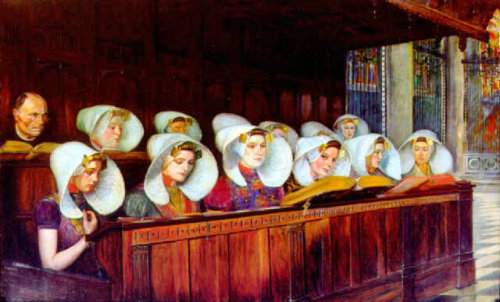
Beguines, now aren't they so dang cute?
During the crusades, as we all know, a bunch of European men decided to leave home and go throw a big party in the Middle East. Saracen swords removed many heads and limbs and those the sword didn't kill dysentery and other diseases waded through their ranks bringing weakness and death. Now back home there were not only a shortage of males, due to this misguided road trip to Jerusalem, but also a large number of women and children without means of support. The Middle Ages was a male based society and women were expected to live under the guardianship of a man. So a recently widowed woman had a choice to join a nunnery, which if you have kids that is out, or find some man who finds you useful for his bed or at least as slave labor in his fields or kitchen. In the later part of the 12th century, but with gaining momentum in the 13th and 14th century these women banded together and formed beguinages.
Need breeds necessity, but still I can't express how impressed I am with the ingenuity of these women to do something so daring that truly embraces the concept of Carpe Diem.
They made their living weaving and tilling the soil. They lived a pious life without vows. They could leave at any time. In this book they have a leadership paradigm in place, but as I found after some research many of the beguinages existed as a much looser confederation of like minded individuals. I'm of the opinion, after working with unions and other organizations, that eventually it is the natural order that leadership will emerge in nearly every situation simply because someone must organize the best use of labor. Servant Martha has lead a group of adventurous souls from a beguinage located in Bruges to start a new sanctuary in England. Every woman that enters the beguinage is given a new name of a saint. If they move up to the leadership counsel they will be given yet another name designating their responsibility with the name Martha, for instance Gate Martha, Merchant Martha, Healing Martha etc.
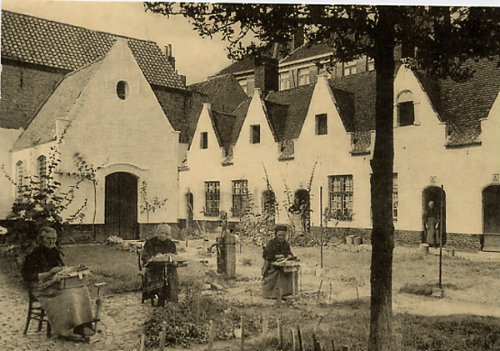
Bruges Beguinage that still exists in Belgium although at some point it was taken over by Benedictine Nuns.
Servant Martha is really the glue that holds everything together. She is taller and more vigorous than the average woman and is strong willed with defined opinions all traits that make her a natural leader. As one of her followers describes her: "If Servant Martha had lived in the time of Noah and God had told her that HE was going to send a flood to destroy the world, she would have simply said, 'Nonsense.' And he wouldn't have dared to do it.
Things are going well for the beguines. They are prospering. The crops have done well and the goods they sell at market have found ready buyers. They have more than enough to sustain themselves. Times have not gone so well for the villagers. An anthrax based virus has infected their hogs and to keep the contagion from spreading the King's men have killed all the hogs. The crops have been flooded. The Lord of that region and the church and the local Owl cult each have demanded their share of tithing from the village leaving them on the verge of starvation. The beguines begin to share their food and provide healing for the poor at no charge. Whoa, whoa wait a minute at no charge?!
Father Ulfrid thought he had problems before the beguines showed up. He has been booted to this hamlet over a bit of scandal involving a pretty young lad and the bishop has him on a short leash. He has bumped heads with the Owl Cult and found that forming an alliance with them will maybe insure his ability to keep breathing will continue. Besides the problem isn't with the over burden of tithes or natural disasters, but with those damn beguine witches. Why have they prospered while everyone else has suffered? Why are they taking care of the poor and disaffected taking money away from his church coffers?
Fear is instilled and the superstitious nature of the village starts to erode the relationship between the beguines and the people they only wish to help. "Now, you listen to me, my lad, your father would flay the hide off you if he knew you were messing with those hags. You don't know what goes on behind those walls of their; if they got hold of a lad like you, like as not you'd never be seen again. All those women together like that can do things you wouldn't dream of, lad. They can make your nose rot off your face and your cock shrivel up like a worm. So mind you stay well out of their way." That shriveling cock threat gets a guy every time.
Servant Martha is under attack from the church with threats of excommunication and the Owl Cult continues to step up their harassment as well. Servant Martha finds herself in a desperate struggle with the supernatural...or is it? "It was huge, bigger than a bull. It had the head of a bird of prey, with a black hooked beak, as long as a man's hand. Huge round eyes blazed unblinking out of the feathered face, the deep black pupils ringed with read flame. The creature was staring straight at me. But it wasn't a bird. It couldn't be a bird...between its great wings, the broad chest was not covered with feathers, but bare wet skin that glistened bone-white.
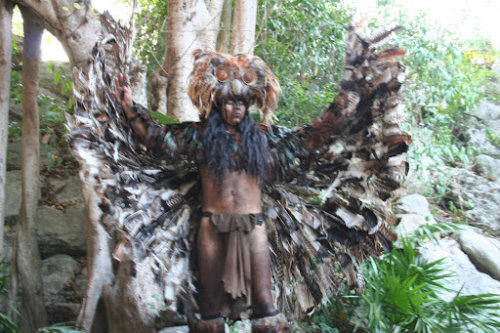
Owl Man...not a superhero
There are many more elements to the story than what I have chosen to reveal today. The story is told through the eyes of the participants. Karen Maitland also included these wonderful tidbits about saints between the chapters. Here is an example:
I enjoyed Karen Maitland's first book Company Of Liars more than I did this one. It has a Chaucerian feel to it coupled with a twisty plot that kept me guessing the whole time. This books main value to me was introducing me to the beguines. What a wonderful concept that provided security to women that were otherwise at the mercy of the Church or the local Lord or a drunken lout. If a woman didn't have something those entities wanted than she had no bargaining power and; therefore, little worth. The concept of giving freely to those in need and challenging the concepts of the church landed many beguines in trouble. They were burned as heretics, ordered to disband, and considered a threat to the natural order of things. Woman are just so dangerous when they have choices. I will leave you with one last thought from Servant Martha. "How easily we forget that we have chosen what we are and can choose what we will become."
If you wish to see more of my most recent book and movie reviews, visit http://www.jeffreykeeten.com
I also have a Facebook blogger page at:https://www.facebook.com/JeffreyKeeten
Beguines, now aren't they so dang cute?
During the crusades, as we all know, a bunch of European men decided to leave home and go throw a big party in the Middle East. Saracen swords removed many heads and limbs and those the sword didn't kill dysentery and other diseases waded through their ranks bringing weakness and death. Now back home there were not only a shortage of males, due to this misguided road trip to Jerusalem, but also a large number of women and children without means of support. The Middle Ages was a male based society and women were expected to live under the guardianship of a man. So a recently widowed woman had a choice to join a nunnery, which if you have kids that is out, or find some man who finds you useful for his bed or at least as slave labor in his fields or kitchen. In the later part of the 12th century, but with gaining momentum in the 13th and 14th century these women banded together and formed beguinages.
Need breeds necessity, but still I can't express how impressed I am with the ingenuity of these women to do something so daring that truly embraces the concept of Carpe Diem.
They made their living weaving and tilling the soil. They lived a pious life without vows. They could leave at any time. In this book they have a leadership paradigm in place, but as I found after some research many of the beguinages existed as a much looser confederation of like minded individuals. I'm of the opinion, after working with unions and other organizations, that eventually it is the natural order that leadership will emerge in nearly every situation simply because someone must organize the best use of labor. Servant Martha has lead a group of adventurous souls from a beguinage located in Bruges to start a new sanctuary in England. Every woman that enters the beguinage is given a new name of a saint. If they move up to the leadership counsel they will be given yet another name designating their responsibility with the name Martha, for instance Gate Martha, Merchant Martha, Healing Martha etc.
Bruges Beguinage that still exists in Belgium although at some point it was taken over by Benedictine Nuns.
Servant Martha is really the glue that holds everything together. She is taller and more vigorous than the average woman and is strong willed with defined opinions all traits that make her a natural leader. As one of her followers describes her: "If Servant Martha had lived in the time of Noah and God had told her that HE was going to send a flood to destroy the world, she would have simply said, 'Nonsense.' And he wouldn't have dared to do it.
Things are going well for the beguines. They are prospering. The crops have done well and the goods they sell at market have found ready buyers. They have more than enough to sustain themselves. Times have not gone so well for the villagers. An anthrax based virus has infected their hogs and to keep the contagion from spreading the King's men have killed all the hogs. The crops have been flooded. The Lord of that region and the church and the local Owl cult each have demanded their share of tithing from the village leaving them on the verge of starvation. The beguines begin to share their food and provide healing for the poor at no charge. Whoa, whoa wait a minute at no charge?!
Father Ulfrid thought he had problems before the beguines showed up. He has been booted to this hamlet over a bit of scandal involving a pretty young lad and the bishop has him on a short leash. He has bumped heads with the Owl Cult and found that forming an alliance with them will maybe insure his ability to keep breathing will continue. Besides the problem isn't with the over burden of tithes or natural disasters, but with those damn beguine witches. Why have they prospered while everyone else has suffered? Why are they taking care of the poor and disaffected taking money away from his church coffers?
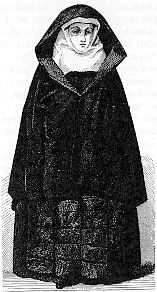
Fear is instilled and the superstitious nature of the village starts to erode the relationship between the beguines and the people they only wish to help. "Now, you listen to me, my lad, your father would flay the hide off you if he knew you were messing with those hags. You don't know what goes on behind those walls of their; if they got hold of a lad like you, like as not you'd never be seen again. All those women together like that can do things you wouldn't dream of, lad. They can make your nose rot off your face and your cock shrivel up like a worm. So mind you stay well out of their way." That shriveling cock threat gets a guy every time.
Servant Martha is under attack from the church with threats of excommunication and the Owl Cult continues to step up their harassment as well. Servant Martha finds herself in a desperate struggle with the supernatural...or is it? "It was huge, bigger than a bull. It had the head of a bird of prey, with a black hooked beak, as long as a man's hand. Huge round eyes blazed unblinking out of the feathered face, the deep black pupils ringed with read flame. The creature was staring straight at me. But it wasn't a bird. It couldn't be a bird...between its great wings, the broad chest was not covered with feathers, but bare wet skin that glistened bone-white.
Owl Man...not a superhero
There are many more elements to the story than what I have chosen to reveal today. The story is told through the eyes of the participants. Karen Maitland also included these wonderful tidbits about saints between the chapters. Here is an example:
St. Diuma's Day: Seventh-century Irish Bishop who was famed for converting the pagan Mercians in England to Christianity, but after the Bishop's death it was widely claimed that the pious Diuma or Diona was in fact a woman.
I enjoyed Karen Maitland's first book Company Of Liars more than I did this one. It has a Chaucerian feel to it coupled with a twisty plot that kept me guessing the whole time. This books main value to me was introducing me to the beguines. What a wonderful concept that provided security to women that were otherwise at the mercy of the Church or the local Lord or a drunken lout. If a woman didn't have something those entities wanted than she had no bargaining power and; therefore, little worth. The concept of giving freely to those in need and challenging the concepts of the church landed many beguines in trouble. They were burned as heretics, ordered to disband, and considered a threat to the natural order of things. Woman are just so dangerous when they have choices. I will leave you with one last thought from Servant Martha. "How easily we forget that we have chosen what we are and can choose what we will become."
If you wish to see more of my most recent book and movie reviews, visit http://www.jeffreykeeten.com
I also have a Facebook blogger page at:https://www.facebook.com/JeffreyKeeten

February 12, 2018
Encumbered
Karen Maitland's ability to vividly create the 14th century English village is fantastic with the ever-present tug-of-war between religion and superstition. The atmosphere is full of distrust, and a group of Beguine women who establish a community on bought land, come into this delicate balance. The Beguine residents work hard and utilise many farming and commercial skills to grow and sell their goods at the markets. The Beguines' successful independence and generosity to the local community threaten the dominance and control of the Church and the Lord of the region, who derive their income from the villagers while giving very little back.
The capable, Servant Martha, leads the Beguine community and does so through hard work, commitment, fairness and generosity. When the food crops fail for the villagers and hardship falls on the local community, the Beguines provide food and shelter for the starving at no cost. Consequently, the Lord and Church are feeling it in their pockets, and with a secret Owl Cult prepared to cause damage and harassment, the Owl Killers focus on making life difficult if not impossible for the Beguines.
The narrative is delivered from 5 characters, including 2 Beguine women, a young village girl, the priest, and the Lord's daughter. Each character is fabulously drawn, and the story illustrates their perspective on life, preconceptions of others, motivations and beliefs. Life is harsh for ordinary folk, and starvation and homelessness became prevalent in times of plague and disaster. The jealousies from the Church branded the Beguines witches. While more Godly and Christain than the Church, they faced ex-communication and became targets from the pagan Owl Cult. The Owl Cult is secret, but they have powerful support and protection.
The plot is excellent, the pace is perfect, the historical scene-setting, and the captivating dialogue underpins a sense of anxiety and apprehension. Karen Maitland does exceptionally well in drawing the atmosphere of menace and foreboding as it hangs on every page. I would highly recommend this book as it is a joy to read.
Karen Maitland's ability to vividly create the 14th century English village is fantastic with the ever-present tug-of-war between religion and superstition. The atmosphere is full of distrust, and a group of Beguine women who establish a community on bought land, come into this delicate balance. The Beguine residents work hard and utilise many farming and commercial skills to grow and sell their goods at the markets. The Beguines' successful independence and generosity to the local community threaten the dominance and control of the Church and the Lord of the region, who derive their income from the villagers while giving very little back.
The capable, Servant Martha, leads the Beguine community and does so through hard work, commitment, fairness and generosity. When the food crops fail for the villagers and hardship falls on the local community, the Beguines provide food and shelter for the starving at no cost. Consequently, the Lord and Church are feeling it in their pockets, and with a secret Owl Cult prepared to cause damage and harassment, the Owl Killers focus on making life difficult if not impossible for the Beguines.
The narrative is delivered from 5 characters, including 2 Beguine women, a young village girl, the priest, and the Lord's daughter. Each character is fabulously drawn, and the story illustrates their perspective on life, preconceptions of others, motivations and beliefs. Life is harsh for ordinary folk, and starvation and homelessness became prevalent in times of plague and disaster. The jealousies from the Church branded the Beguines witches. While more Godly and Christain than the Church, they faced ex-communication and became targets from the pagan Owl Cult. The Owl Cult is secret, but they have powerful support and protection.
The plot is excellent, the pace is perfect, the historical scene-setting, and the captivating dialogue underpins a sense of anxiety and apprehension. Karen Maitland does exceptionally well in drawing the atmosphere of menace and foreboding as it hangs on every page. I would highly recommend this book as it is a joy to read.

July 22, 2014
We do not know how strong we are until we are attacked by the evil of this world. - Mechthild of Magdeburg, beguine from 1230 to 1270.
A great story, sort of a mix between history, religion and fantasy.
The writing of this author and the storytelling makes you feel and taste the Dark Ages....
My second Maitland, last year I read Company of Liars, both great reads. Thanks Caro for the tip!
This is the story: 1321. In the heart of the countryside in England lies an isolated village, where pagan Owl Masters rule through fear, superstition and murder. When a group of religious women, 'Beguines' called Marthas, ill-advisedly but determined, settles outside the village, they awaken dangerous jealousies, amongst others of the corrupt parish priest, Father Ulfrid. Why do their crops succeed? How do their cattle survive the plague and sickness? And why should they own the holy relic that protects them from harm? As torment and hellfire rain down, the women must take a stand to stop this darkness from spreading its evil across the land...
A great story, sort of a mix between history, religion and fantasy.
The writing of this author and the storytelling makes you feel and taste the Dark Ages....
My second Maitland, last year I read Company of Liars, both great reads. Thanks Caro for the tip!
This is the story: 1321. In the heart of the countryside in England lies an isolated village, where pagan Owl Masters rule through fear, superstition and murder. When a group of religious women, 'Beguines' called Marthas, ill-advisedly but determined, settles outside the village, they awaken dangerous jealousies, amongst others of the corrupt parish priest, Father Ulfrid. Why do their crops succeed? How do their cattle survive the plague and sickness? And why should they own the holy relic that protects them from harm? As torment and hellfire rain down, the women must take a stand to stop this darkness from spreading its evil across the land...

August 19, 2010
This is one of those rare books that truly stand out from the crowd. Having originally majored in medieval history, I have always been extremely impressed by those rare books set in the dark ages, or shortly thereafter, simply because of the reams of research that have to be done to make a book of this sort even halfway believable. Not a lot of people realize just how VERY different life was at that time.
This book is set in 1321 in England. At that time, in Flanders, France and parts of Belgium, there existed a lay order of women called the beguines. They took no vows, other than celibacy, and dedicated themselves to charity and good works. None of the women were bound to stay there, should they wish to return to their father's houses, or their husbands. But very, very few did. In a way, these beguinages were the predecessors of battered womens' shelters. They fed and nursed any of the sick or hungry, including lepers that had been declared dead to the world. The last beguinage continued to operate until 1927.
"The Owl Killers" is about a small village in England, where a beguinage has been bequeathed some property. There is really only small evidence of a beguinage ever being in England - primarily there were chased out as witches, any other false charge the Church or the ruling aristocracy could trump up to get rid of them. They were dedicated to the Church, but the priests saw them only as their competition.
Remember, this was a time when demons were thought to roam the land, and children were beaten almost to death if their parents could not come up with their tithes, either to the Church or to their "landlord." After all, if the parents were beaten, they couldn't work to come up with the money, so they beat the children. The Church also taught that any sins of the parents were passed directly to their children, so if a child was born mute, or crippled, they were usually abandoned to die. The beguinages took in these poor souls. In their way, they followed Christ's word far more than did any of the Priests or Churches.
The action in this book truly begins when the third daughter of the ruling Lord D'Acaster is driven to the beguinage. She made the mistake of being out in the forest after hours, and witnessed a pagan ritual. She was raped, and when she showed up in the morning, her father disinherited her, so she was taken in by the beguines. But this girl reads, unlike any of the village occupants, and she does begin to question the need for priests or sacraments as the only way to reach God, much as Martin Luther did the next century. The beguines allow the doubt of priests -- they doubt them as well -- but to doubt the sacraments is true heresy.
This is a truly remarkable book, very solid in its history -- when one reads of children collecting dog dung for the local tanner, a modern person doubts that that might actually have occurred. Not only did it occur, but these people quite literally lived in filth, at the complete mercy of the elements and their Church, who would as soon bleed them dead and dry for their tithes.
I would recommend this book completely to anyone interested in the history of women, in particular. A wonderful, engrossing read.
This book is set in 1321 in England. At that time, in Flanders, France and parts of Belgium, there existed a lay order of women called the beguines. They took no vows, other than celibacy, and dedicated themselves to charity and good works. None of the women were bound to stay there, should they wish to return to their father's houses, or their husbands. But very, very few did. In a way, these beguinages were the predecessors of battered womens' shelters. They fed and nursed any of the sick or hungry, including lepers that had been declared dead to the world. The last beguinage continued to operate until 1927.
"The Owl Killers" is about a small village in England, where a beguinage has been bequeathed some property. There is really only small evidence of a beguinage ever being in England - primarily there were chased out as witches, any other false charge the Church or the ruling aristocracy could trump up to get rid of them. They were dedicated to the Church, but the priests saw them only as their competition.
Remember, this was a time when demons were thought to roam the land, and children were beaten almost to death if their parents could not come up with their tithes, either to the Church or to their "landlord." After all, if the parents were beaten, they couldn't work to come up with the money, so they beat the children. The Church also taught that any sins of the parents were passed directly to their children, so if a child was born mute, or crippled, they were usually abandoned to die. The beguinages took in these poor souls. In their way, they followed Christ's word far more than did any of the Priests or Churches.
The action in this book truly begins when the third daughter of the ruling Lord D'Acaster is driven to the beguinage. She made the mistake of being out in the forest after hours, and witnessed a pagan ritual. She was raped, and when she showed up in the morning, her father disinherited her, so she was taken in by the beguines. But this girl reads, unlike any of the village occupants, and she does begin to question the need for priests or sacraments as the only way to reach God, much as Martin Luther did the next century. The beguines allow the doubt of priests -- they doubt them as well -- but to doubt the sacraments is true heresy.
This is a truly remarkable book, very solid in its history -- when one reads of children collecting dog dung for the local tanner, a modern person doubts that that might actually have occurred. Not only did it occur, but these people quite literally lived in filth, at the complete mercy of the elements and their Church, who would as soon bleed them dead and dry for their tithes.
I would recommend this book completely to anyone interested in the history of women, in particular. A wonderful, engrossing read.

July 14, 2014
In 1321, there were a multitude of problems. Superstition ruled the day. Disease lurked around every corner and famine was an ever-present specter. And no matter how bad that year's harvest turned out to be, the church demanded to receive its tithe. Seems like that's enough suffering for one lifetime, yet the precarious lives lived by the characters in Maitland's excellent novel are made even crappier by the existence of the Owl Killers, a protection racket putting the squeeze on the village denizens to pay up...or ELSE!
Now, it's up to an elite fighting force of women to put a stop to these dastardly brutes.
Well, sort of...
Cloistered away in an enclave, these women keep to themselves and conduct their own society. They are feared and scorned by the villagers, unless, of course, the villagers need food, shelter or medical care. Then, when the owl pellets hit the fan, guess who they expect to clean up the mess?
These gals will battle demons, money-grubbing land barons, corrupt clergymen and the dreaded Owl Masters to restore peace and prosperity to the village.
Girl Power! Woo-hoo!
This is only the second book I've read by Maitland, but she is fast becoming a favorite. She provides a good mix of suspense, drama, history and oomph, and I'm looking forward to reading the rest of her work.
But don't just take my word for it...see the excellent and informative reviews by:
Jeffrey - https://www.goodreads.com/review/show...
Bettie - http://bettie.booklikes.com/post/6128...
and
Bondama - https://www.goodreads.com/review/show...
Now, it's up to an elite fighting force of women to put a stop to these dastardly brutes.
Well, sort of...
Cloistered away in an enclave, these women keep to themselves and conduct their own society. They are feared and scorned by the villagers, unless, of course, the villagers need food, shelter or medical care. Then, when the owl pellets hit the fan, guess who they expect to clean up the mess?
These gals will battle demons, money-grubbing land barons, corrupt clergymen and the dreaded Owl Masters to restore peace and prosperity to the village.
Girl Power! Woo-hoo!
This is only the second book I've read by Maitland, but she is fast becoming a favorite. She provides a good mix of suspense, drama, history and oomph, and I'm looking forward to reading the rest of her work.
But don't just take my word for it...see the excellent and informative reviews by:
Jeffrey - https://www.goodreads.com/review/show...
Bettie - http://bettie.booklikes.com/post/6128...
and
Bondama - https://www.goodreads.com/review/show...

July 21, 2014
Owls are among my favourite birds, mainly because they were important to my maternal grandmother Matilda and they will always be associated with her in my mind. Anyone who kills an owl is immediately persona non grata to me. My one disappointment with this book was that the followers of the pagan religion in this book turned out to be bad guys, killing owls to warn people that they were next if they didn’t conform and murdering people just as readily. However, in this novel, there is plenty of bad behaviour to go around, no matter which religion a villager adheres to. Religion, whether nature-based or not, is used in this medieval society as a means of social control (as it still is in our century, let’s be honest).
I had no idea there were Beguinages in the Middle Ages—communities built for and by women, to escape the male-dominated church and male-dominated society. In the beguinage, women could still engage with the world, unlike nuns, who were expected to withdraw from worldly pursuits (this is shown starkly by the comparison between Servant Martha and the Anchorite known as Andrew). Women in a beguinage could pursue their own economic interests and intellectual interests with fewer barriers and more personal independence.
The book is full of strong women—from the many Marthas who run the beguinage, to the old witch woman who is feared by all, to the village women who work like horses while raising children, to even the girl-children who are beaten and worked hard, even while half-starved. As Eleanor Roosevelt said, “A woman is like a tea bag; you never know how strong it is until it’s in hot water.” I know that I derive encouragement from the stories of women in my family tree—the circumstances that they endured, the events that they participated in, and the toughness that they exhibited. Although we are gradually emerging from the societal mindset that says that history is made by men, it is important to acknowledge that the men were able to do the historical things only because they had a female support system at home. As a single (straight) working woman, I have often proclaimed that I do not need a husband, but I could sure as heck use a wife! However, my woman’s wages would not support more than one person, so I am stuck doing all the support work as well as the wage-earning—but after reading this book, I shall not be whining too often about this situation.
I also appreciated that medieval life is portrayed as I think it really was: medicine is next to nonexistent, crops fail, natural disasters happen, superstition is rampant, education is only for the rich, and life is difficult for everyone, but especially the average villager. If you escape plague or starvation, you still have to manoeuver through village and church politics. I know that as a teen, I had idealized visions of how people in earlier eras lived and a book like this would have opened my eyes. (There was a time that I believed that I had been born too late—I think I had read too many romantic frontier novels by the likes of Zane Grey—and have since learned more about the experiences of my home-steading grandmothers. I now know very definitely that I am a 21st century woman, through and through).
I had no idea there were Beguinages in the Middle Ages—communities built for and by women, to escape the male-dominated church and male-dominated society. In the beguinage, women could still engage with the world, unlike nuns, who were expected to withdraw from worldly pursuits (this is shown starkly by the comparison between Servant Martha and the Anchorite known as Andrew). Women in a beguinage could pursue their own economic interests and intellectual interests with fewer barriers and more personal independence.
The book is full of strong women—from the many Marthas who run the beguinage, to the old witch woman who is feared by all, to the village women who work like horses while raising children, to even the girl-children who are beaten and worked hard, even while half-starved. As Eleanor Roosevelt said, “A woman is like a tea bag; you never know how strong it is until it’s in hot water.” I know that I derive encouragement from the stories of women in my family tree—the circumstances that they endured, the events that they participated in, and the toughness that they exhibited. Although we are gradually emerging from the societal mindset that says that history is made by men, it is important to acknowledge that the men were able to do the historical things only because they had a female support system at home. As a single (straight) working woman, I have often proclaimed that I do not need a husband, but I could sure as heck use a wife! However, my woman’s wages would not support more than one person, so I am stuck doing all the support work as well as the wage-earning—but after reading this book, I shall not be whining too often about this situation.
I also appreciated that medieval life is portrayed as I think it really was: medicine is next to nonexistent, crops fail, natural disasters happen, superstition is rampant, education is only for the rich, and life is difficult for everyone, but especially the average villager. If you escape plague or starvation, you still have to manoeuver through village and church politics. I know that as a teen, I had idealized visions of how people in earlier eras lived and a book like this would have opened my eyes. (There was a time that I believed that I had been born too late—I think I had read too many romantic frontier novels by the likes of Zane Grey—and have since learned more about the experiences of my home-steading grandmothers. I now know very definitely that I am a 21st century woman, through and through).

February 25, 2021
Labai patiko, buvo sunku atsitraukti. Puikiai perteikta viduramziu atmosfera, idomus personazai (bent jau dauguma), intriga islaikoma iki paskutinio puslapio. Idomu buvo skaityti apie Beguinage ir jo gyventojas. Panasu, kad jos buvo savotiskos feminizmo pradininkes, kovojusios uz moteru pasirinkimo laisve.
Labai rekomenduoju ir dar karta aciu Caro. Kazi kada as buciau atradusi sia autore jei ne tu :)
Labai rekomenduoju ir dar karta aciu Caro. Kazi kada as buciau atradusi sia autore jei ne tu :)

August 23, 2012
Having loved Company of Liars, I was excited to read Karen Maitland’s next novel, The Owl Killers, set in Ulewic, a 14th century village near Norfolk.
For centuries, Ulewic has been ruled by both the lord of the manor and by the Owl Masters - a predatory, pagan group empowered by fear, blackmail and superstition to dispense a harsh form of law and order.
A group of religious women settles in a beguinage outside the village and when their crops succeed and their animals survive diseases, jealousy and conflict are brought to a head in Ulewic.
The author uses a multiple narrative voice flawlessly, each voice distinct and compelling. I engaged with every one of the characters, whose lives are drawn out smoothly and interwoven into the main story in an unobtrusive and enjoyable way.
Pagan and Christian ways intermingle and clash, the story steeped in witchcraft, heresy, mystery, suspense and tragedy. At times very dark and bleak, it also evokes human nature at its best, and explores the power of faith.
The author has vividly brought to life a medieval community where the mind was ruled by religion and superstition. Through simple, lyrical prose, she builds the plot to a conclusion that provides both resolution and the expectation of what might have happened next.
Karen Maitland truly knows how to write about what interests her, and I would highly recommend The Owl Killers to fans of historical fiction and the supernatural.
For centuries, Ulewic has been ruled by both the lord of the manor and by the Owl Masters - a predatory, pagan group empowered by fear, blackmail and superstition to dispense a harsh form of law and order.
A group of religious women settles in a beguinage outside the village and when their crops succeed and their animals survive diseases, jealousy and conflict are brought to a head in Ulewic.
The author uses a multiple narrative voice flawlessly, each voice distinct and compelling. I engaged with every one of the characters, whose lives are drawn out smoothly and interwoven into the main story in an unobtrusive and enjoyable way.
Pagan and Christian ways intermingle and clash, the story steeped in witchcraft, heresy, mystery, suspense and tragedy. At times very dark and bleak, it also evokes human nature at its best, and explores the power of faith.
The author has vividly brought to life a medieval community where the mind was ruled by religion and superstition. Through simple, lyrical prose, she builds the plot to a conclusion that provides both resolution and the expectation of what might have happened next.
Karen Maitland truly knows how to write about what interests her, and I would highly recommend The Owl Killers to fans of historical fiction and the supernatural.

February 28, 2011
(From my Letter to the author)
My complaint is that Owl Killers kept me up until 3 am this morning.
At nearly 69, I am not accustomed to keeping such late hours, but I simply could not put it down!
I feel quite fortunate to have come to Owl Killers (albeit by accident) with 30+ years' work as an academic librarian, a life time of voracious reading centered on historical fiction and autobiography, a quality education, and a friend who is a medievalist. I suppose, I was just waiting for your books to find their way to me.
After I read the front flap of Owl Killers I laughed and thought of my friend in San Francisco who is a béguine! [Lillian Kaiser '53, BMC folks]
I appreciate the historical accuracy, the attention to detail (character and location), the pre-chapter snippets referring to the customs and celebrations of the period,the vivid ethnographic quality of the mass of Owl Killers that is not story line. I was truly engrossed: skimming was not possible. The way you have written it, with numerous narrators, keeps the reader engaged and attentive to detail
(e. g., " 'sauvegarde', a place of refuge" in the first 75 pages, and Healing Martha's "gar... gar"[don;t want to give anything away here] much later on).
My complaint is that Owl Killers kept me up until 3 am this morning.
At nearly 69, I am not accustomed to keeping such late hours, but I simply could not put it down!
I feel quite fortunate to have come to Owl Killers (albeit by accident) with 30+ years' work as an academic librarian, a life time of voracious reading centered on historical fiction and autobiography, a quality education, and a friend who is a medievalist. I suppose, I was just waiting for your books to find their way to me.
After I read the front flap of Owl Killers I laughed and thought of my friend in San Francisco who is a béguine! [Lillian Kaiser '53, BMC folks]
I appreciate the historical accuracy, the attention to detail (character and location), the pre-chapter snippets referring to the customs and celebrations of the period,the vivid ethnographic quality of the mass of Owl Killers that is not story line. I was truly engrossed: skimming was not possible. The way you have written it, with numerous narrators, keeps the reader engaged and attentive to detail
(e. g., " 'sauvegarde', a place of refuge" in the first 75 pages, and Healing Martha's "gar... gar"[don;t want to give anything away here] much later on).

June 12, 2012
I think this might be my favourite of Karen Maitland's books so far -- I definitely liked it more than The Gallows Curse, although it didn't grip me as tightly as Company of Liars. I have nothing really to nitpick about here, though: the five POVs were well done and cast interesting lights on each other, and I love the research Maitland clearly put into it. The very concept of a beguinage is pretty fascinating, so that helps, but the way Maitland brought this one to life -- and tried to explain a real historical event through it -- is even more so. I've always loved historical novels that take something we know (a wingless Roman Eagle was found buried in Silchester, and Rosemary Sutcliff wrote The Eagle of the Ninth to explain it, for example) and try to puzzle out why. Karen Maitland explores why the beguinages failed to take root in Britain, despite some evidence of them existing here, and despite their longevity and appeal on the continent.
As with her other books, she evokes the Middle Ages well -- the smells, the sounds, the sights. Perhaps a little predictably, I suppose: she gives us the vision of the Middle Ages we expect, dirt and plagues and superstition, but still. She does her work well.
I suppose I do have one nitpick, and that's the POV of Pisspuddle, which doesn't add much. It does add a villagers-eye view, so there's that, but mostly she's just a small child who doesn't matter that much to the events happening around her.
The characters are all intriguing: I really felt for Osmanna, and for Servant Martha, particularly. I felt very sorry for Beatrice, even though I knew she was seeing things from a very biased point of view. And Healer Martha deserved better.
Oh yes, and trigger warning: rape, abusive parents, sickness. More or less what you might expect, but just in case.
As with her other books, she evokes the Middle Ages well -- the smells, the sounds, the sights. Perhaps a little predictably, I suppose: she gives us the vision of the Middle Ages we expect, dirt and plagues and superstition, but still. She does her work well.
I suppose I do have one nitpick, and that's the POV of Pisspuddle, which doesn't add much. It does add a villagers-eye view, so there's that, but mostly she's just a small child who doesn't matter that much to the events happening around her.
The characters are all intriguing: I really felt for Osmanna, and for Servant Martha, particularly. I felt very sorry for Beatrice, even though I knew she was seeing things from a very biased point of view. And Healer Martha deserved better.
Oh yes, and trigger warning: rape, abusive parents, sickness. More or less what you might expect, but just in case.

May 21, 2010
At first, I wasn't certain I would enjoy this book - I often read historical fiction, but usually gravitate towards stories set in the 18th and 19th centuries, while this is set much further back, in 1321. However, once I'd got a handle on the complex plot, I found myself absolutely loving it. The characterisation and lively dialogue really bring the story to life, and the plot tackles so many issues that are incredibly relevant to modern life, while the narrative still felt authentically historical throughout - no mean feat. The use of five - very different and equally unreliable - narrators is a masterstroke, allowing the reader to see how the same events are (mis)interpreted and understood by different individuals. My only criticism is that the plot gets a bit muddled towards the end and the conclusion isn't particularly satisfying after the atmosphere of suspense and fear created so effectively in the earlier part of the book.

November 17, 2011
Loved her first book and this one was also very good. Dark and atmospheric, Paganism vs. Christianity in the Dark ages. Compelling characters, quite a bit of terror and I am just so glad we are not living during that time period.

Read
December 17, 2016DNF at 55%. This book was just not for me. Nothing happend and pages were filled with people threatening and arguing about God. Really not my thing...
June 26, 2018
I think I should just get it over with and add all Karen Maitland books to my favourites shelf before I've read them
Yet again, another stand out novel that blossomed with every page and made me question my own perspectives of history. I learn a hella lot with Maitland by caring so much for these characters - I remember a quote of hers about telling history through the medium of fiction just makes it more interesting as well as apparent and I completely agree. She explores many current focus points of today's society in these books such as gender, feminism, privilege, sexuality, fear of the unknown (or what we don't understand) and identity. MORE PEOPLE NEED TO READ MAITLAND. All of her books I have read so far are insanely challenging and perfect to analyse and discuss.
I couldn't put down The Owl Killers. It was so dark - it was witchy, magical, infuriating and just p e r f e c t .
This is a fictional story based on a real Christian faction of women called beguines. It really catches in my throat how, and Maitland touches on this herself, this movement has been lost to common knowledge. The beguines were Catholic women who did not want to marry or join a nunnery. Instead, they created their own communities where they did everything by themselves, including: cooking, farming, trading, just anything they needed to get by and live. They had to remain celibate during their time at the beguinage but they were free to leave whenever they wanted with all of their possessions. This was clearly contradictory of the Catholic church's values and operations, so they were usually excommunicated or even executed as heretics.
These women decided to choose a different, radical path so they could flourish and experience independence and success without guardianship within these guilds. It just breaks my heart how the Catholic Church has fought to eradicate them from memory. These communities of 'wayward' women lived in their communal beguinages just outside of villages and townships through out Europe in the middle ages. They were persecuted, ridiculed and assaulted for not abiding to the patriarchy. For not living a protected lifestyle as a pretty, quiet, baby-making fuck machine. These woman wanted education and enlightenment as well as to be charitable to others as was their way of expressing their love to God (Catholics of the time would denounce lepers and banish them from the parish to wander alone until they died or join a colony whereas beguines took lepers in, nursed them back to health and let them be part of the community).
Now, everyone KNOWS this quote;
I am so sick of the hatred that is being poured into what we do not understand. Sure, the Catholics stopped burning women whose only crime was intelligence and Huntington's sufferers but homosexuals kissing in public STILL get met with outcry. A Muslim family of refugees from Sudan fear leaving the house for all the shaming. AUTHORS LIKE J.K. ROWLING AND MARGARET LINDHOLM AKA ROBIN HOBB STILL HAVE TO CHANGE THEIR PRINTED NAMES SO PEOPLE WILL ASSUME THEY'RE MEN AND TAKE THEIR WORK SERIOUSLYYYYYYY. This is why these kind of books are important - CAN PEOPLE PLEEEEASE JUST EDUCATE THEMSELVES, LEARN FROM THESE DARK TIMES AND JUST LOVE EACHOTHER?!!
i am out
Yet again, another stand out novel that blossomed with every page and made me question my own perspectives of history. I learn a hella lot with Maitland by caring so much for these characters - I remember a quote of hers about telling history through the medium of fiction just makes it more interesting as well as apparent and I completely agree. She explores many current focus points of today's society in these books such as gender, feminism, privilege, sexuality, fear of the unknown (or what we don't understand) and identity. MORE PEOPLE NEED TO READ MAITLAND. All of her books I have read so far are insanely challenging and perfect to analyse and discuss.
I couldn't put down The Owl Killers. It was so dark - it was witchy, magical, infuriating and just p e r f e c t .
This is a fictional story based on a real Christian faction of women called beguines. It really catches in my throat how, and Maitland touches on this herself, this movement has been lost to common knowledge. The beguines were Catholic women who did not want to marry or join a nunnery. Instead, they created their own communities where they did everything by themselves, including: cooking, farming, trading, just anything they needed to get by and live. They had to remain celibate during their time at the beguinage but they were free to leave whenever they wanted with all of their possessions. This was clearly contradictory of the Catholic church's values and operations, so they were usually excommunicated or even executed as heretics.
These women decided to choose a different, radical path so they could flourish and experience independence and success without guardianship within these guilds. It just breaks my heart how the Catholic Church has fought to eradicate them from memory. These communities of 'wayward' women lived in their communal beguinages just outside of villages and townships through out Europe in the middle ages. They were persecuted, ridiculed and assaulted for not abiding to the patriarchy. For not living a protected lifestyle as a pretty, quiet, baby-making fuck machine. These woman wanted education and enlightenment as well as to be charitable to others as was their way of expressing their love to God (Catholics of the time would denounce lepers and banish them from the parish to wander alone until they died or join a colony whereas beguines took lepers in, nursed them back to health and let them be part of the community).
Now, everyone KNOWS this quote;
“Those who cannot remember the past are condemned to repeat it." - George Santayana
I am so sick of the hatred that is being poured into what we do not understand. Sure, the Catholics stopped burning women whose only crime was intelligence and Huntington's sufferers but homosexuals kissing in public STILL get met with outcry. A Muslim family of refugees from Sudan fear leaving the house for all the shaming. AUTHORS LIKE J.K. ROWLING AND MARGARET LINDHOLM AKA ROBIN HOBB STILL HAVE TO CHANGE THEIR PRINTED NAMES SO PEOPLE WILL ASSUME THEY'RE MEN AND TAKE THEIR WORK SERIOUSLYYYYYYY. This is why these kind of books are important - CAN PEOPLE PLEEEEASE JUST EDUCATE THEMSELVES, LEARN FROM THESE DARK TIMES AND JUST LOVE EACHOTHER?!!
i am out
“You have already excommunicated half the village because they will not pay their tithes. So why wouldn't they come to us? Can you excommunicate them twice over? As for the sick, most are here because the Mother Church in her great charity has already damned them and driven them out. The churches are emptier than a pauper's purse and little wonder, for men get more solace from the alewives than from their priests. More stand now outside your church than within it. What difference does it make if you forbid them burial in your churchyard, since they cannot afford the soul-scot you charge them to be buried there? Those who still look to God make their prayers far away from the church, where the air is sweeter and their voices are not smothered beneath your hypocrisy and greed.”

December 3, 2009
‘... a legend can only die if no one speaks its name’
The setting for this novel is a fictional English village named Ulewic. During 1321-22, the village is struggling with a number of natural and supernatural forces. The villagers’ lives are shadowed by the Owl Masters and haunted by the Owlman who leaves death and destruction in his wake. The novel centres on a beguinage, a religious community of women, originally from Bruges and newly established outside the village. The tensions between the beguinage, the village priest and the townspeople themselves build through ignorance, fear, envy and are fuelled by illness, natural disaster and manipulation.
The narrators include a number of different characters, alternating throughout the story and each with their own perspective of events.
For this novel, this works particularly well because of the combination of pagan and Christian beliefs, of belief in the supernatural and superstition. The narrators include: the Servant Martha (the leader of the beguins), the teenaged Agatha/Osmanna (the cast out daughter of Ulewic’s most powerful man who is accepted into the beguinage); Father Ulfrid (the village priest) and a village child.
I enjoyed this novel. I liked some characters, detested others and was fascinated by the concept of beguinage. This novel is of the Dark Ages in both time and setting, but some aspects transcend the passage of time.
Jennifer Cameron-Smith
The setting for this novel is a fictional English village named Ulewic. During 1321-22, the village is struggling with a number of natural and supernatural forces. The villagers’ lives are shadowed by the Owl Masters and haunted by the Owlman who leaves death and destruction in his wake. The novel centres on a beguinage, a religious community of women, originally from Bruges and newly established outside the village. The tensions between the beguinage, the village priest and the townspeople themselves build through ignorance, fear, envy and are fuelled by illness, natural disaster and manipulation.
The narrators include a number of different characters, alternating throughout the story and each with their own perspective of events.
For this novel, this works particularly well because of the combination of pagan and Christian beliefs, of belief in the supernatural and superstition. The narrators include: the Servant Martha (the leader of the beguins), the teenaged Agatha/Osmanna (the cast out daughter of Ulewic’s most powerful man who is accepted into the beguinage); Father Ulfrid (the village priest) and a village child.
I enjoyed this novel. I liked some characters, detested others and was fascinated by the concept of beguinage. This novel is of the Dark Ages in both time and setting, but some aspects transcend the passage of time.
Jennifer Cameron-Smith

October 28, 2012
God, religion and a firm foundation of faith has been matters of great befuddlement for me for a while now. We who have feared and revered everything beyond the immediate vicinity of the fire in the cave have come a long way into the multi million dollar world of organized religion. Fear has always been the riding whip for religion and power its allure. Men and women who hold sway over the multitudes with a firm grasp on the pulse of belief will commmand far more murderous mobs than a dictator can ever imagine in today's world. Of late, my reading into the investigations of such conflicts in the name of belief has served to strengthen this prejudice of mine. This novel explores such a delicate situation while being set in a fictional town of Ulewic in England in the 1320's.
Ulewic is a hovel of a town in the middle of nowhere. A Catholic Church stuggling to find a foothold in a town still rooted deep in pagan beliefs with the captain being a weakling of a priest makes an interesting character study. Father Ulfried of the Church is the owner of a personality which I can aptly call despicable. Starting off from a neutral and futile existence in the beginning, this character acquires a negative tone as the story reaches its finale and is my most favorite character of them all in the story. Pitted against him are the Owl Masters who through superstition, violence and fear rule the village and its denizens. Then there is the beguinage and its women right in the middle of these two titans. A beguinage was a community of women who sustained themselves and the society among them through their own hard work. Unlike a nunnery, there weren't any bonds that held these women back for they were given the choice to come and go as they liked to. Naturally such a community of self sustaining women in a pre-dominantly male oriented society gave rise to conflicts and that is what the novel explores in depth and detail. It is as the Joker says : An irresistable force meeting an immovable object.
The structure of the book works out brilliantly to its advantage. The story is told from multiple POV's and the narrative effortlessly shifts gears between one persona and the next. While the scope is limited to the small town, the scale of exploration on topics of Christianity, Paganism, liberal thought, sexuality are rather massive in the book. This was the one reason why I wasn't totally bugged when melodrama started seeping it by droplets along the narrative for the scope of the tale warrants it. The pace is rather well maintained and on some days kept me reading late into the night. For all this brilliance on the part of the author, I felt let down by the ending. It felt all rushed through and did not sit with me well when most of the loose ends were tied. Well, you can't have them all !
All in all, a most excellent story.
Ulewic is a hovel of a town in the middle of nowhere. A Catholic Church stuggling to find a foothold in a town still rooted deep in pagan beliefs with the captain being a weakling of a priest makes an interesting character study. Father Ulfried of the Church is the owner of a personality which I can aptly call despicable. Starting off from a neutral and futile existence in the beginning, this character acquires a negative tone as the story reaches its finale and is my most favorite character of them all in the story. Pitted against him are the Owl Masters who through superstition, violence and fear rule the village and its denizens. Then there is the beguinage and its women right in the middle of these two titans. A beguinage was a community of women who sustained themselves and the society among them through their own hard work. Unlike a nunnery, there weren't any bonds that held these women back for they were given the choice to come and go as they liked to. Naturally such a community of self sustaining women in a pre-dominantly male oriented society gave rise to conflicts and that is what the novel explores in depth and detail. It is as the Joker says : An irresistable force meeting an immovable object.
The structure of the book works out brilliantly to its advantage. The story is told from multiple POV's and the narrative effortlessly shifts gears between one persona and the next. While the scope is limited to the small town, the scale of exploration on topics of Christianity, Paganism, liberal thought, sexuality are rather massive in the book. This was the one reason why I wasn't totally bugged when melodrama started seeping it by droplets along the narrative for the scope of the tale warrants it. The pace is rather well maintained and on some days kept me reading late into the night. For all this brilliance on the part of the author, I felt let down by the ending. It felt all rushed through and did not sit with me well when most of the loose ends were tied. Well, you can't have them all !
All in all, a most excellent story.

July 31, 2013
(another stay up to midnight to finish book!). There was a sense of dread threaded throughout this story. I was worried this novel would be just one long, hopeless tragedy. I'm very happy that was not to be the case.
It's hard to tell which I like better, The Company of Liars or this (I'm leaning towards this one). They are both five starers, but each brings something different to the table.
I think this is more of an atmospheric novel, and it certainly delivers on that account. I felt completely immersed into the fourteenth-century East-Anglian fenlands. The action doesn't really get going until you're about 60% into the book. That's something I don't mind - when it's well written - and that's certainly the case here. But I know some people may be put off by that. Even though things didn't get hopping until later, the story still held me in a strong grip of suspense. I just knew something horrible and sinister was brewing up.
This book also has a few more elements of fantasy/mysticism. While I usually don't like that in my historical fiction, the way it's written here, it just works. I think it really complements and ads something to the whole story, rather than being a distraction or seeming to be tacked on as an afterthought. Of course a big party of this novel is about examining the conflict between Christianity and the early pagan beliefs of the people. So it makes sense that we are experiencing what the people themselves see and experience.
This book addresses a fascinating moment in the history of the middle ages. Not that the town, people and events described actually happened, but the environmental and resulting social upheaval going on at that time was certainly real enough. And it was fascinating to learn of the lady-religious, female-collective movement of the Beguinage Communities during these times.
I'm starting to think the most moving historical fiction novels are those about fictional people living thru real times/events, rather than those about real people.
(p.s. - quite an excellent chapter of historical notes, and glossary!)
It's hard to tell which I like better, The Company of Liars or this (I'm leaning towards this one). They are both five starers, but each brings something different to the table.
I think this is more of an atmospheric novel, and it certainly delivers on that account. I felt completely immersed into the fourteenth-century East-Anglian fenlands. The action doesn't really get going until you're about 60% into the book. That's something I don't mind - when it's well written - and that's certainly the case here. But I know some people may be put off by that. Even though things didn't get hopping until later, the story still held me in a strong grip of suspense. I just knew something horrible and sinister was brewing up.
This book also has a few more elements of fantasy/mysticism. While I usually don't like that in my historical fiction, the way it's written here, it just works. I think it really complements and ads something to the whole story, rather than being a distraction or seeming to be tacked on as an afterthought. Of course a big party of this novel is about examining the conflict between Christianity and the early pagan beliefs of the people. So it makes sense that we are experiencing what the people themselves see and experience.
This book addresses a fascinating moment in the history of the middle ages. Not that the town, people and events described actually happened, but the environmental and resulting social upheaval going on at that time was certainly real enough. And it was fascinating to learn of the lady-religious, female-collective movement of the Beguinage Communities during these times.
I'm starting to think the most moving historical fiction novels are those about fictional people living thru real times/events, rather than those about real people.
(p.s. - quite an excellent chapter of historical notes, and glossary!)

March 8, 2013
Was it over a year ago that I read this? It must be - I remember where I was. I was working at a temporary job that involved predominantly photocopying, possibly the most dismal office I have ever encountered and, crucially, a half-hour commute that took my bus straight past Edinburgh Castle. I remember reading this book with a growing feeling of dread, looking out of the window and wondering how I could feel so grateful to be here and so dispirited about my day at the same time.
Since then, this has become one of my secret recommendation weapons - I've recommended it to a good three or four people, and they all seem to have enjoyed it as much as I have. I was recommended it myself, actually, by one of those readers who seems to be able to do no wrong and always points me at things I end up adoring. And I did adore this. It was great. Karen Maitland writes fantastic characters, fascinating situations, and almost suffocating levels of darkness and trepidation. She can write atmosphere like no other writer I know. It was exactly what was great about The Company of Liars, only where that didn't pay off, this delivered in spadefuls right to the very end.
I wonder, if I read it again, whether I would give it five stars this time around. I certainly remember it favourably, and at the time I was reading it, I was feeling suffocated enough. This was hardly a light in the darkness. But I tell you what, it was bloody good.
Since then, this has become one of my secret recommendation weapons - I've recommended it to a good three or four people, and they all seem to have enjoyed it as much as I have. I was recommended it myself, actually, by one of those readers who seems to be able to do no wrong and always points me at things I end up adoring. And I did adore this. It was great. Karen Maitland writes fantastic characters, fascinating situations, and almost suffocating levels of darkness and trepidation. She can write atmosphere like no other writer I know. It was exactly what was great about The Company of Liars, only where that didn't pay off, this delivered in spadefuls right to the very end.
I wonder, if I read it again, whether I would give it five stars this time around. I certainly remember it favourably, and at the time I was reading it, I was feeling suffocated enough. This was hardly a light in the darkness. But I tell you what, it was bloody good.
March 6, 2025
The number of povs had me worried initially but they're masterfully interwoven, and each and every character gets to shine. It's such good character work. I can't stress this enough: the character work is phenomenal.
It can be hard to read at times. The lack of empathy, patience, understanding, and acceptance in these people really hurts. But it's so human as well because they have all suffered, are all leading such hard lives, and while this doesn't by any means excuse causing harm to others, you feel for them (even if most of what I felt was pity...)
The ending felt lackluster at first, and is the least memorable part imo but then again, we're just seeing a snippet of the lives of these people, so it seems fitting.
It can be hard to read at times. The lack of empathy, patience, understanding, and acceptance in these people really hurts. But it's so human as well because they have all suffered, are all leading such hard lives, and while this doesn't by any means excuse causing harm to others, you feel for them (even if most of what I felt was pity...)
The ending felt lackluster at first, and is the least memorable part imo but then again, we're just seeing a snippet of the lives of these people, so it seems fitting.

Read
June 9, 2018She can truly write a story. Her tales are deep and filled with streams of consciousness to how people of an age or of this era think. Their "eyes" and worldview- just excellent in how she can portray with just a few words or derisive actions their myriads of tangential context. And she is terrific at the realities of the early middle ages. I loved her "Company of Liars" and this is much in the same excellence of writing.
But this book was not for me. I got to about the end of the first 1/3rd of this very long book and just didn't want to read about this cultural mindset any longer. I'm sure it was very real and probably exactly factual to have occurred. But to me its nugget of content was putrid. And not to my taste.
And I also felt it contained a strong to overwhelming (and nearly continual to various characters too)bias for the "eyes" belief that holds vast negativity of religion as a whole. Others would disagree, I'm sure. But to me it was like swallowing an entire shot glass of castor oil in one gulp. Not that I couldn't. But I just don't want to.
No rating. DNF Not for me.
But this book was not for me. I got to about the end of the first 1/3rd of this very long book and just didn't want to read about this cultural mindset any longer. I'm sure it was very real and probably exactly factual to have occurred. But to me its nugget of content was putrid. And not to my taste.
And I also felt it contained a strong to overwhelming (and nearly continual to various characters too)bias for the "eyes" belief that holds vast negativity of religion as a whole. Others would disagree, I'm sure. But to me it was like swallowing an entire shot glass of castor oil in one gulp. Not that I couldn't. But I just don't want to.
No rating. DNF Not for me.

September 28, 2019
Another historical religious mystery which enthralled me from the beginning .
Never had heard about beguines, though I was familiar with nunneries.
This is set in 1321 in a small seaside village in England where mysterious occurrences occur and the village folklore seems to be actually happening .
There is a beguinage with mostly good women , a manor housing cruel lords , the owl masters who try to cause havoc in the village , many deaths and killings happen , and accusations of witchery and heresy gain momentum.
Was an interesting read. Loved it , though it had something lacking which prevented me from giving it 5 stars
Never had heard about beguines, though I was familiar with nunneries.
This is set in 1321 in a small seaside village in England where mysterious occurrences occur and the village folklore seems to be actually happening .
There is a beguinage with mostly good women , a manor housing cruel lords , the owl masters who try to cause havoc in the village , many deaths and killings happen , and accusations of witchery and heresy gain momentum.
Was an interesting read. Loved it , though it had something lacking which prevented me from giving it 5 stars
March 12, 2011
I was beginning to wonder what I had picked up when I started to read this book because of the lack of clear structure owing to multiple characters telling their tales back and forth between each other. As I read on however it really began to work and I become more and more intrigued by the plot line and found it difficult to put the book down.
I loved the manner in which the plot had many twists and turns and really challenges your thoughts and assumptions/ stereotypes particularly when you meet the Character Hillary for the second time (those who have read it already will know what I mean). Although I really should have seen it coming.
The book also has a few surprises and ties the story lines together quite well. Characters do things in the book that you may or may not expect them to do which only adds to the riveting read that this book truly is. If you have an avid interest in historical, religious and human conflict stories then you will love this book just like I did.
I loved the manner in which the plot had many twists and turns and really challenges your thoughts and assumptions/ stereotypes particularly when you meet the Character Hillary for the second time (those who have read it already will know what I mean). Although I really should have seen it coming.
The book also has a few surprises and ties the story lines together quite well. Characters do things in the book that you may or may not expect them to do which only adds to the riveting read that this book truly is. If you have an avid interest in historical, religious and human conflict stories then you will love this book just like I did.

July 17, 2018
Set in 1321, this book really exemplifies the old adage about life being "nasty, brutish and short" (I just looked it up and it was coined by Thomas Hobbes in 1651 who apparently wrote how, without central government, there would be no culture or society and people would be at war with each other). The village of Ulewic on the east coast of England is beset by crop failures compounded by serious flooding, cattle disease, pig disease, sicknesses affecting the human population, inbreeding - anyone who really "belongs" has webbed fingers - child abuse, the impossibility of paying the tithe (a tenth of a household's supposed wealth in either coin or goods) to the Church and also the burden of having to pay the tyrannical local lord. On top of all that, there is a nasty protection racket run by men who call themselves the Owl Masters. Their identities are unknown as they dress up in owl masks, but they are able to publicly murder anyone who steps out of line - even for having sex outside marriage, for example - and get away with it. Meanwhile the local priest is too scared to do anything and more worried about his feud with the bishop, which stems from his being caught having illicit sex when he was stationed in Norwich: he has been sent to this benighted coastal village as a punishment.
Into this environment has come a group of women who draw the ire and jealousy of the whole community. The women are beguines, a Medieval lay order which was extensive on the continent but never found a footing in what later became the United Kingdom. The women live a life of useful labour, and use their self-generated wealth to nurse the sick and feed the local poor. Unfortunately, this breeds resentment rather than gratitude, and unfounded accusations that they are whores or witches; ironic in view of the beguines' oath of chastity and their Christian beliefs. Their being 'foreigners' into the bargain makes matters even worse. But at that time women who were living a self supporting communal life without having to depend on men were the target of suspicion and even violence. And so it proves here, especially when the leader of the community, Servant Martha, feels compelled to intercede for a couple of unfortunate local girls.
This was an interesting although very dark read with an extremely brutal peasant lifestyle being vividly invoked. I did know about the beguines, though had not heard before that there was slight evidence that they might have tried to found a community in England. The vicious retalliation unleashed against them is all too convincing. I did wonder though if people at that time really did not know that a stroke was a natural ailment and not something inflicted by devils. It was also a bit sad that what seemed to be survivals of pagan beliefs had been retained only in the negative view of the Church - so that the mother goddess had been translated into Black Anu, a witch figure that lived in water and dragged men down to their deaths, for example. The original pagan beliefs would not have had such a negative view of women or treated them so badly as this distorted medieval notion, so ironically the pagan men in this novel seem to treat women even worse than the Church.
The story switches viewpoint between a number of characters. One in particular changes from initially sympathetic to out and out deranged. I did find the ending rather abrupt and disconnected as if a section might have been missing, though I more or less gathered what had occurred off stage. I did wonder why, given the tolerance of the beguines, the leper character had been abandoned. The twist about the identity of the person who attacked the young girl in the woods and what he had done to her previously The story is also rather ambiguous, given that several characters seem to see apparently supernatural entities, as to who really did attack her. Partly for these reasons and partly because the unrelenting descriptions of diarrhoea, rot and filth were pretty wearing at times, I would rate this at 3 stars.
Into this environment has come a group of women who draw the ire and jealousy of the whole community. The women are beguines, a Medieval lay order which was extensive on the continent but never found a footing in what later became the United Kingdom. The women live a life of useful labour, and use their self-generated wealth to nurse the sick and feed the local poor. Unfortunately, this breeds resentment rather than gratitude, and unfounded accusations that they are whores or witches; ironic in view of the beguines' oath of chastity and their Christian beliefs. Their being 'foreigners' into the bargain makes matters even worse. But at that time women who were living a self supporting communal life without having to depend on men were the target of suspicion and even violence. And so it proves here, especially when the leader of the community, Servant Martha, feels compelled to intercede for a couple of unfortunate local girls.
This was an interesting although very dark read with an extremely brutal peasant lifestyle being vividly invoked. I did know about the beguines, though had not heard before that there was slight evidence that they might have tried to found a community in England. The vicious retalliation unleashed against them is all too convincing. I did wonder though if people at that time really did not know that a stroke was a natural ailment and not something inflicted by devils. It was also a bit sad that what seemed to be survivals of pagan beliefs had been retained only in the negative view of the Church - so that the mother goddess had been translated into Black Anu, a witch figure that lived in water and dragged men down to their deaths, for example. The original pagan beliefs would not have had such a negative view of women or treated them so badly as this distorted medieval notion, so ironically the pagan men in this novel seem to treat women even worse than the Church.
The story switches viewpoint between a number of characters. One in particular changes from initially sympathetic to out and out deranged. I did find the ending rather abrupt and disconnected as if a section might have been missing, though I more or less gathered what had occurred off stage. I did wonder why, given the tolerance of the beguines, the leper character had been abandoned. The twist about the identity of the person who attacked the young girl in the woods and what he had done to her previously The story is also rather ambiguous, given that several characters seem to see apparently supernatural entities, as to who really did attack her. Partly for these reasons and partly because the unrelenting descriptions of diarrhoea, rot and filth were pretty wearing at times, I would rate this at 3 stars.

December 5, 2009
Karen Maitland's THE OWL KILLERS is a compelling and creepy exploration of the clash between the pagan undercurrents in medieval England and the growing strength of the Christian faith. Set in a backwater town plagued by a despotic overlord and group of masked men who call themselves the Owl Masters —dedicated to preserving their power at any costs by exacting tribute from the downtrodden villagers and enacting terrifying nightly rites— the novel follows a number of characters from their points of view, each of whom has her or her reasons for liking or resenting a group of foreign women who have come to settle outside in the village. Part of a medieval phenomenon called a beguinage, these woman hail from different sections of society, united in their commitment to an ascetic lifestyle that includes caring for the less fortunate. However, not all is as it seems under the hard-working, disciplined exterior of the beguinage and it is precisely here where Ms Maitland deftly weaves the strands of discord, suspicion, resentment, and eventual fear that thrust the women into the heart of a horrific plot hatched by the Owl Masters.
The characters are finely wrought and include a vengeful priest with a secret; an ancient cunning woman who lives like a wild thing on the hill; her feral granddaughter; and various women of the beguinage, including the stalwart leader, Servant Martha, and an unbalanced acolyte, Beatrice. The arrival of the manor lord’s disgraced daughter, who has witnessed a terrifying rite in the forest where a demon allegedly was unleashed, sets off a chain of events that will ensnare each of these characters in a deadly struggle to preserve his or her way of life— a struggle that foreshadows the crumbling of the foundations of a much older, matriarchal system of belief under the onslaught of a virile and aggressive Church. While the changing viewpoints within Ms Maitland’s narrative may prove confounding to some readers, those who persist will find unexpected moments of transcendent beauty, as Ms Maitland excels in depicting not only the people of her savage, rarely explored world but also the shifting landscape which they inhabit.
From a catastrophic flood to the beatific sufferings of a starving anchorite to a heart-stopping chase through the forest as a winged beast flies overhead, THE OWL KILLERS is not for the faint of heart, evoking a medieval vision that offers stark contrast to our often overly-romantic imaginings.
The characters are finely wrought and include a vengeful priest with a secret; an ancient cunning woman who lives like a wild thing on the hill; her feral granddaughter; and various women of the beguinage, including the stalwart leader, Servant Martha, and an unbalanced acolyte, Beatrice. The arrival of the manor lord’s disgraced daughter, who has witnessed a terrifying rite in the forest where a demon allegedly was unleashed, sets off a chain of events that will ensnare each of these characters in a deadly struggle to preserve his or her way of life— a struggle that foreshadows the crumbling of the foundations of a much older, matriarchal system of belief under the onslaught of a virile and aggressive Church. While the changing viewpoints within Ms Maitland’s narrative may prove confounding to some readers, those who persist will find unexpected moments of transcendent beauty, as Ms Maitland excels in depicting not only the people of her savage, rarely explored world but also the shifting landscape which they inhabit.
From a catastrophic flood to the beatific sufferings of a starving anchorite to a heart-stopping chase through the forest as a winged beast flies overhead, THE OWL KILLERS is not for the faint of heart, evoking a medieval vision that offers stark contrast to our often overly-romantic imaginings.

December 4, 2021
Read this in 2012, and its a standalone book about the fear of the unexplained and supernatural.
This book is set in the year AD 1321, and its main centre is a small village where the Owl Masters are ruling that village by using blackmail and terror to keep this village under their control.
When a house of religious women is established in this village, this dark status quo is broken, and a new situation will occur with hostile and dark feelings.
So when crops succeed to grow within this religious community while in the rest of the village it fails to grow, jealousy will settle in this village, and especially when this hous eof worship give shelter to a young martyr.
This young female martyr dies a gruesome death, and soon accusations of witchcraft and heresy will come into play, and all this brought forward by the dark pagan leader of these Owl Masters, and that will turn this village in fear and death.
Highly recommended, for this is a wonderful tale about conflicting faiths, beliefs, jealousies, hatred and power, and that will lead to this superb tale where these differences about thoughts of life are fought out between various parties right to the death, and that's why I like to call this marvellous book:"A Terrific Gripping Owl Killers"!
This book is set in the year AD 1321, and its main centre is a small village where the Owl Masters are ruling that village by using blackmail and terror to keep this village under their control.
When a house of religious women is established in this village, this dark status quo is broken, and a new situation will occur with hostile and dark feelings.
So when crops succeed to grow within this religious community while in the rest of the village it fails to grow, jealousy will settle in this village, and especially when this hous eof worship give shelter to a young martyr.
This young female martyr dies a gruesome death, and soon accusations of witchcraft and heresy will come into play, and all this brought forward by the dark pagan leader of these Owl Masters, and that will turn this village in fear and death.
Highly recommended, for this is a wonderful tale about conflicting faiths, beliefs, jealousies, hatred and power, and that will lead to this superb tale where these differences about thoughts of life are fought out between various parties right to the death, and that's why I like to call this marvellous book:"A Terrific Gripping Owl Killers"!

April 9, 2019
I really enjoy Karen Maitland's novels. While they seem to be quite harsh on the church and humanity as a whole I enjoy the blend of the historical and supernatural settings.
They are often difficult to read as it was quite honestly a brutal time, where the fear of the devil overrode all reason, but for some reason I enjoy the darkness in her novels, as towards the end there is usually some light after a number of twists and turns I don't see coming but thoroughly love.
This one is one of her weaker books. It didn't keep me as hooked as usual, and had a rather unsatisfying conclusion. I do highly recommend some of her other stuff though.
They are often difficult to read as it was quite honestly a brutal time, where the fear of the devil overrode all reason, but for some reason I enjoy the darkness in her novels, as towards the end there is usually some light after a number of twists and turns I don't see coming but thoroughly love.
This one is one of her weaker books. It didn't keep me as hooked as usual, and had a rather unsatisfying conclusion. I do highly recommend some of her other stuff though.

June 25, 2018
Firstly let me reassure that even at 600 pages, this is a fairly quick, manageable read. It is not overly complicated, and there are not too many complexities with the number of characters or details that need to be kept track of by the reader - it is all pretty straightforward, and it is spelled out.
It is entertaining historical fiction with some interesting gruesomeness, some atmospheric settings and some legitimate-sounding history. There is even a section at the end of the book explaining the history and the background to the story (which I take from ruthlessly for the below).
There are loads of reviews which describe the plot, and while I am not going to be drawn to explain it all... but...
Set in 1321, a particularly interesting period of time in England and Europe. Climatic change is causing widespread droughts, flooding and crop failure. Livestock were subject to new diseases spreading throughout the countryside (thought to be anthrax), and fear and suspicion were rampant. The pope ordered special prayers to be said in church five times a day, and likely tithes were increased at a time where they were least affordable.
People began revolting against the church, and in some cases throwing priests out of their churches and engaged in bizarre cults, and reverting to pagan beliefs.
Against this background a remarkable movement emerged in Europe, which came to be known as the Beguinage communities. Thousands of women who did not wish to marry or take the veil as nuns began to set themselves up in female collectives. The women farmed, engaged in crafts such as weaving, established hospitals, and educated girls. They preached in the streets and translated the bible into the local vernacular, therefore challenging the role of the church. They also challenged the male guilds (often undercutting their prices).
This story revolves around a group of such women who had come across from Flanders to England and established a Beguinage community in a Norfolk village. Here they are resisted by not only the church, but the wealthy landowner and the Owl Masters - anonymous pagan cult leaders who also challenge the church for control over the villagers.
The copy I have is an uncorrected proof, so the infrequent typos are forgiven, but as I said above, the writing style and the way the story plays out is simple - there are no leaps to make, no ambiguous occurrences to keep us guessing, just a linear timeline. I had hoped for a more engaging approach - although the straight forward made for easy, quick reading.
The other minor negative was the voice - each chapter is written in first person narrative. Unfortunately, across all of the characters, there is no variance - they all present in the same way, and there was nothing unique to each character.
Notwithstanding the criticisms above, this is still a good read. It is an engaging story, based in viable history, with interesting characters.
3.5 stars, rounded down.
It is entertaining historical fiction with some interesting gruesomeness, some atmospheric settings and some legitimate-sounding history. There is even a section at the end of the book explaining the history and the background to the story (which I take from ruthlessly for the below).
There are loads of reviews which describe the plot, and while I am not going to be drawn to explain it all... but...
Set in 1321, a particularly interesting period of time in England and Europe. Climatic change is causing widespread droughts, flooding and crop failure. Livestock were subject to new diseases spreading throughout the countryside (thought to be anthrax), and fear and suspicion were rampant. The pope ordered special prayers to be said in church five times a day, and likely tithes were increased at a time where they were least affordable.
People began revolting against the church, and in some cases throwing priests out of their churches and engaged in bizarre cults, and reverting to pagan beliefs.
Against this background a remarkable movement emerged in Europe, which came to be known as the Beguinage communities. Thousands of women who did not wish to marry or take the veil as nuns began to set themselves up in female collectives. The women farmed, engaged in crafts such as weaving, established hospitals, and educated girls. They preached in the streets and translated the bible into the local vernacular, therefore challenging the role of the church. They also challenged the male guilds (often undercutting their prices).
This story revolves around a group of such women who had come across from Flanders to England and established a Beguinage community in a Norfolk village. Here they are resisted by not only the church, but the wealthy landowner and the Owl Masters - anonymous pagan cult leaders who also challenge the church for control over the villagers.
The copy I have is an uncorrected proof, so the infrequent typos are forgiven, but as I said above, the writing style and the way the story plays out is simple - there are no leaps to make, no ambiguous occurrences to keep us guessing, just a linear timeline. I had hoped for a more engaging approach - although the straight forward made for easy, quick reading.
The other minor negative was the voice - each chapter is written in first person narrative. Unfortunately, across all of the characters, there is no variance - they all present in the same way, and there was nothing unique to each character.
Notwithstanding the criticisms above, this is still a good read. It is an engaging story, based in viable history, with interesting characters.
3.5 stars, rounded down.

August 26, 2015
1321 turned out to be a pretty cruddy year for the village of Ulewic.
Times are tough – crops are failing and the meagre harvests are blighted with mould, while the livestock is falling foul of disease, and what passes for the local power is too busy preying on the populace to be of much help.
Ruled over by a lord obsessed with chastity whose nephew is obsessed with relieving people of theirs – consensually or not - their priest is also too busy fornicating, and then worrying about getting caught, to attract any to his flock. Instead, the villagers turn to the beguinage on its doorstep for help and charity, or to the older gods and the Owl Masters that apparently serve them for justice and revenge.
It’s with the women of the beguinage – a community of religious women of the kind that apparently flourished across Europe at the time – that this story is chiefly concerned. Already suspicious due to being foreigners, and attracting the ire of what passes for the church due to being women and for not doing exactly as the priest says, when the daughter of the local lord becomes one of their number events are set in motion to sorely test their faith.
Breathing life into an age that was dogged by superstition, bullied by the church, where the less fortunate were the playthings of the powerful and where being a woman is one of the biggest sins anyone could commit, The Owl Killers told its tale slowly and effectively, with multiple narrators showing us multiple viewpoints and letting us question what we’d seen or been told (although not all of the narrators were as effective as others and the slowness sometimes felt a little too slow) but the end result was largely an atmospheric and intelligent take on the lives of women in medieval England.
Read it when the nights are drawing in, the wind is blowing and the rain is dripping from the trees and you'll soon be nervously eyeing every bird (and man, especially religious ones) that crosses your path.
**Also posted at Randomly Reading and Ranting**
Times are tough – crops are failing and the meagre harvests are blighted with mould, while the livestock is falling foul of disease, and what passes for the local power is too busy preying on the populace to be of much help.
Ruled over by a lord obsessed with chastity whose nephew is obsessed with relieving people of theirs – consensually or not - their priest is also too busy fornicating, and then worrying about getting caught, to attract any to his flock. Instead, the villagers turn to the beguinage on its doorstep for help and charity, or to the older gods and the Owl Masters that apparently serve them for justice and revenge.
It’s with the women of the beguinage – a community of religious women of the kind that apparently flourished across Europe at the time – that this story is chiefly concerned. Already suspicious due to being foreigners, and attracting the ire of what passes for the church due to being women and for not doing exactly as the priest says, when the daughter of the local lord becomes one of their number events are set in motion to sorely test their faith.
Breathing life into an age that was dogged by superstition, bullied by the church, where the less fortunate were the playthings of the powerful and where being a woman is one of the biggest sins anyone could commit, The Owl Killers told its tale slowly and effectively, with multiple narrators showing us multiple viewpoints and letting us question what we’d seen or been told (although not all of the narrators were as effective as others and the slowness sometimes felt a little too slow) but the end result was largely an atmospheric and intelligent take on the lives of women in medieval England.
Read it when the nights are drawing in, the wind is blowing and the rain is dripping from the trees and you'll soon be nervously eyeing every bird (and man, especially religious ones) that crosses your path.
**Also posted at Randomly Reading and Ranting**

March 22, 2010
The Owl Killers is a story set in 1300’s England where both Christianity and paganism are fighting for a foothold in the tiny village of Ulwich. The village is torn between the Church’s demanding of their share of their meager earnings, the payments to the lord of the manor and the Owl Masters who use terror and superstition to try bring the people back to ancient pagan ways. Into this mix comes a group of Christian women who live in their own beguinage, a community where they live without men as celibates but without taking the veil. When the village is struck by disaster after disaster both the Church and The Owl Masters seek to blame the women for all the bad luck coming their way, this despite the fact that this self sufficient group has shared their food, cared for the ill and sheltered those in need. The tension slowly ratchets up until the dramatic conclusion.
Maitland is quite adept at rich details that make you see and feel the desperation of this small village and the conflict between different factions that takes no heed of those in desperate need. The story is told in alternating voices, those of the women of the beguinage; Father Ulfrid- the inept village priest; the young daughter of the manor; one of the poor children of the village; an embittered member of the beguinage; each provides a distinct point of view of the village and the events occurring around them.
My one complaint is that the story sometimes weaves between brutal reality and witchcraft blended with the supernatural; I would have liked a clearer point of view. What I really appreciated where both the glossary of medieval terminology and the author’s notes that provided a wonderful explanation of the climate changes that occurred at that time as well as the background into the formation of the beguinage- which existed in many parts of Europe right through 1927. Well researched, well written and very atmospheric. Definitely worth the read if you enjoy medieval historical fiction.
Maitland is quite adept at rich details that make you see and feel the desperation of this small village and the conflict between different factions that takes no heed of those in desperate need. The story is told in alternating voices, those of the women of the beguinage; Father Ulfrid- the inept village priest; the young daughter of the manor; one of the poor children of the village; an embittered member of the beguinage; each provides a distinct point of view of the village and the events occurring around them.
My one complaint is that the story sometimes weaves between brutal reality and witchcraft blended with the supernatural; I would have liked a clearer point of view. What I really appreciated where both the glossary of medieval terminology and the author’s notes that provided a wonderful explanation of the climate changes that occurred at that time as well as the background into the formation of the beguinage- which existed in many parts of Europe right through 1927. Well researched, well written and very atmospheric. Definitely worth the read if you enjoy medieval historical fiction.

January 6, 2010
I am smitten with Karen Maitland's writting if The Owl Killers is indicitive of her talent I will be spending many hours with her. Maitland evokes vividly the texture and realities of life in Medieval England with this novel.
She also introduced me to the Beguines, a medievel society of religious lay women who shunned marriage and the nun's veil to live in collectives. These women may very well be the first feminists who stood against the power of church and state to live lives of service. Unlike nuns and anchorites who shielded themselves from the world, the Beguines engaged it.
They were physicans and teachers as well. They wrote books, preached and even translated the bible in the venacular long befor the church allowed it to be done. When they were finally excomunicated they took on the role of the priests and said mass and consecrated and administered the sacraments. These women are my new found heros.
The Owl Killers tells the story of an attempt to found a beguinage in a small shit hole of an English town. It relates the struggle between the church, manor and the secritive Owl Masters, who try to revive the old ways. The story is ultimately a struggle against the oppressive power of insitutions and an individuals right to seek the truth for themselves and in their own way.
The chapters are named after a paticular saints feast day as was common at the time the Julian calendar was still in use. The story is told through the first person accounts of several of the characters involved.
Maitland brings each character to life and gives them both roses and warts. The Beguine Beatrice was hateful and petty in so many ways yet she lived under the burden of unrelieved grief which drove her mad in the end. It was hard not to feel empathy for her.
I find myself needing to remember this was a work of fiction as Maitland made the world of the Owl Killers come alive to me.
She also introduced me to the Beguines, a medievel society of religious lay women who shunned marriage and the nun's veil to live in collectives. These women may very well be the first feminists who stood against the power of church and state to live lives of service. Unlike nuns and anchorites who shielded themselves from the world, the Beguines engaged it.
They were physicans and teachers as well. They wrote books, preached and even translated the bible in the venacular long befor the church allowed it to be done. When they were finally excomunicated they took on the role of the priests and said mass and consecrated and administered the sacraments. These women are my new found heros.
The Owl Killers tells the story of an attempt to found a beguinage in a small shit hole of an English town. It relates the struggle between the church, manor and the secritive Owl Masters, who try to revive the old ways. The story is ultimately a struggle against the oppressive power of insitutions and an individuals right to seek the truth for themselves and in their own way.
The chapters are named after a paticular saints feast day as was common at the time the Julian calendar was still in use. The story is told through the first person accounts of several of the characters involved.
Maitland brings each character to life and gives them both roses and warts. The Beguine Beatrice was hateful and petty in so many ways yet she lived under the burden of unrelieved grief which drove her mad in the end. It was hard not to feel empathy for her.
I find myself needing to remember this was a work of fiction as Maitland made the world of the Owl Killers come alive to me.
Displaying 1 - 30 of 514 reviews