صدرت هذه الرواية التي وضعها أحد أبرز الروائيين الكوبيين في الأصل بعنوان "ذكريات لا تقبل العزاء"، وقد حولت إلى فيلم حاز نجاحاً واسعاً. وهي تقوم على ذكريات رجل أعمال مثقف في هافانا أثناء الأزمة الكوبية.
رجل هجرته زوجته وعائلته ولكنه رفض أن يترك أرض الوطن، يأسف لرحيل أصدقائه، لكنه يحتقر سطحيتهم البرجوازية، يعترف بضرورة الإصلاح الاجتماعي، لكنه غير قادر على رفض وجوده السابق كلياً كواحد من الطبقة المتوسطة. وفوق كل ذلك، فهو أبعد ما يكون عن النضج اللازم حتى ينسجم مع نفسه ومع الأحداث السياسية الجارية.
وحيد، تنخره الذكريات ويكبر عليه الشعور بالعزلة الداخلية، والاضطراب الذهني: "سأموت، هذا كل ما في الأمر، حسناً، إنني أقبل هذا، لن أحاول أن أتسلسل بعيداً من خلال الشقوق كصرصار. لم تعد هناك أية شقوق. لقد نفذت الشقوق والحفر والملاجئ.
أريد أن أحتفظ بالرؤية الصافية والفارغة لأيام الأزمة. الأشياء من حولي والخوف والرغبات تخنقني. هذا مستحيل. ليس عندي ما أضيفه أبعد من ذلك. انتهى، الإنسان (أنا) حزين، لكن يريد أن يعيش.. أن يتجاوز الكلمات".
"Δεν θέλω να ξεφύγω από την τρύπα που κουβαλάω μέσα μου. Θέλω να μείνω μόνος και να δω ως που μπορώ να φτάσω, να δω αν θα καταφέρω να αγγίξω τον πυθμένα του κενού μου. Μερικές φορές δεν αντέχω άλλο και τότε είναι σαν να καταρρεω εσωτερικά. Ήδη ζουληξα το τσιγάρο μου στο μπρούτζινο τασάκι."
Είχα δει την ταινία του Alea χρόνια πριν και με είχε μαγέψει. Έψαξα τότε το βιβλίο αλλά για κάποιο διάστημα ήταν εξαντλημένο. Ακόμα δεν θυμάμαι πως και που βρήκα αυτό το αντίτυπο, ούτε και ξέρω για ποιο λόγο άφησα τόσο καιρό να περάσει για να το διαβάσω. Οι σελίδες του έχουν κιτρινήσει και μυρίζει καπνό, αλλά η πραγματική γοητεία του είναι οι λέξεις του Δεσνόα. Με πρωτοπρόσωπη αφήγηση περιγράφει την ιστορία ενός μεσήλικου αστού τα πρώτα χρόνια της Κουβανικής Επανάστασης. Η ζωή του έχει αλλάξει άρδην, φίλοι και οικογένεια έχουν φύγει από το νησί και εκείνος ακροβατεί ανάμεσα στις αναμνήσεις του παρελθόντος και την παρούσα ανυπαρξία του. Τίποτα δεν τον συγκινεί. Τσουλάει πάνω στον άθραυστο πάγο της πραγματικότητας χωρίς κανένα ενδιαφέρον, με μόνο λίγα ψήγματα οργής να τον ξυπνούν που και που από τον υπαρξιακό του λήθαργο. Ένα γεγονός θα τον ταρακουνήσει, η Κρίση των Πυραύλων και η υπαρκτή πια πιθανότητα ο πόλεμος να του αποδείξει την θνητότητα του.
Οι Μνήμες Υπανάπτυξης δεν είναι σίγουρα το αριστουργηματικό βιβλίο που θα σου αλλάξει την ζωή. Όχι, αλλά είναι τόσο καλογραμμένο και πετυχημένα τοποθετημένο σε μια κρίσιμη για την τότε εποχή στιγμή που δεν μπορείς πάρα να το παραδεχτείς και ίσως κάπου και να συμπαθήσεις, μην πω συμπονέσεις, τον κάπως αχώνευτο πρωταγωνιστή.
Extra αγάπη στον Δεσνόες για τα πολύ ενδιαφέροντα σχόλια σχετικά με το Χιροσίμα, Αγάπη μου και την πετυχημένη αυτοαναφορικότητα.
The contemporary Cuban novel don't get no respect in Yankeelandia, which is a shame, particularly in this case. Edmundo Desnoes, once dubbed the "enfant terrible" of the post-Castro literary scene, decided to recount the early days of the Cuban Revolution through the eyes of a disaffected young but rich drifter whose parents and best friend all depart for the United States. Left alone in his Havana apartment he ponders, but never participates in, the changes brought by the Revolution. The scene where American books, such as LOLITA, are replaced in the bookstores by turgid Soviet tomes on Marxism is alone the price of your reading time. P.S.: Desnoes could not keep up his "I'm for the Revolution except in those cases in which I'm against it" stance and fled to the USA in 1979. Still, treasure this gem.
Blas: “La Habana, 1960. La Revolución cubana acaba de triunfar, la clase acomodada huye de la isla espantada por la deriva comunista de Castro. Pero el protagonista de este relato, miembro de la burguesía cubana culta y viajada, no se va: quiere quedarse a ver cómo su país cambia con el nuevo régimen. Esta novela corta y semiautobiográfica, un clásico de las letras cubanas, es un fresco cínico y desesperanzado de los primeros años del castrismo.
El libro después se adaptó a una película, incluso más célebre, en 1968. Acaba de ser reeditado en España por Cátedra en una versión comentada que incluye información bibliográfica sobre Desnoes, quien acabó exiliándose en Estados Unidos, y el contexto político de la obra».
This is a sort of diary, describing conditions in Cuba immediately after the communist revolution. It is the author’s diary. Shockingly, this author decided to remain in Cuba after the communist revolution, even though his wife, family, and friends all left.
Before the revolution, the author was a fairly well-to-do, furniture store owner. After the revolution, the author is awarded an income from the new government, as compensation for his nationalized family property. I never realized that when communist governments nationalized property they actually paid the former owners for it. I always envisioned it was simply seized.
With a source of income, the author attempts to become a writer; which I guess he accomplished, as I’m reading his published work. Nevertheless, I must say that I find the writing something of a hodge-podge of fleeting thoughts, loosely connected, if connected at all.
The author’s newfound freedom appears to lead to depression and misery for him, as he moves from one troubled romantic relationship to another. He lives generally in constant melancholy. His depression is spurred by: (1) fear the island will suffer nuclear attack from the United States, (2) lamentation for the loss of the materialistic middle class, and (3) the diminished supply of foreign made commodities, such as soft drinks. In fact, the author confesses that he actually prefers “things to people”, a testament to how misplaced he is, as a formerly affluent character, in a world where affluence is being banished.
Yet, amazingly, even in the midst of his lamentations over lost materialism, he begins to poke fun of society people, expressing thankfulness that the revolution has dislodged them; and referring to them as: "narrow-minded people, who would never bother to even read a book". Even though the author was obviously a part of the former Cuban bourgeoisie, he labels the bourgeoisie as imbeciles, because they would do nothing to alleviate the grass huts and poverty that had loomed about them. He laughs openly at the impotence and pettiness of their professed morality. Ultimately, he confesses that he takes morbid pleasure in knowing that people like himself are predominantly extinguished in Cuba.
But he has plenty of hate reserved for the lower classes as well. He openly detests the common people: as drivel, poverty-stricken, poorly dressed, incoherent, lazy, defenseless, and uneducated. He refers to them as “mediocre, hairless animals” or “hapless human litter”. He insists they are animals because they are governed by things outside themselves, responding only to stimulus, void of premeditation, and having no “self” with which to confront the world. He insists the commoners live only a reactionary existence. He cannot see or find anything to love permanently in the character of other people, so instead he insists on dehumanizing people into abstractions, such as that of proletariat or bourgeoisie.
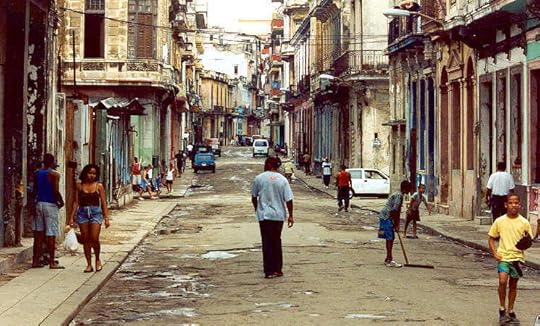
The Streets of Havana
He equates the Americans and the Russians; as people from great world powers, with a persistent colonial attitude, manifesting arrogance at visiting a backward country like Cuba. He thinks foreigners see Cuba as good only for indulging their instincts: fishing, killing wild animals, sunning, gambling, or frequenting prostitutes. He describes the occupying Russians as: “all tanned and bronzed, looking for a beautiful Cuban señorita”. He describes the Russians as exactly like the Americans: “as a people squandering wastefully and spending lavishly because they have things in abundance”.
The author sees himself, in the midst of a socialist society, as a: “dead man among the living”. The Christian reader can understand the truth in his statement, as he has clearly never awakened to a true love for other people, or of God. He sees the world only as something to complain about. He is overcome by fear. Fear of nuclear catastrophe, fear about his present life, fear of other people, and fear of death. He confesses: “If I could overcome my fear of people and death, I would be another man.”
But he can never become the “New Man”, not the man the Revolution envisions. Theirs is a vision of a man without his sinfulness. Communism promulgates the pipe dream that man’s sinfulness can somehow be defeated by government; when in fact it can only be defeated by God, and even then the tendency of man is degenerative. Theirs is a vision of a “kingdom-to-come”, but they fail to grasp that it must be instituted by Christ, not Fidel Castro. Nor do they grasp that it is a Kingdom that must be instituted supernaturally, not by the minuscule efforts of socialists. The author is, indeed, melancholy because he knows that he cannot be that “New Man”; and he is instead inclined to see himself, and all of mankind for that matter, as a pollution upon the earth. For the author, the world is senseless, as it must be to all atheists.
I don’t think the average American has any perception of the fear under which smaller nations live, due to their perception they may be invaded by America. The author writes: “I won’t worry about the future. We could all be blown to pieces before that. The mushroom cloud is smiling at me”. The reality is that the U.S. has troops in 130 different countries and spends more on its military budget than the next ten countries combined, including China, Russia, Britain, Japan, France, and others.
The author recounts hearing rainstorm thunder and thinking it to be the thundering of war, of a coming invasion. The author laments his helplessness to do anything about it. For the author, every sound anticipates the end of the world: an auto passing, a coughing motor, a door slamming, etc.
Ultimately, his fear gets the best of him, and the author flees to the United States.
An enjoyable yet bummer read. This book captures the contradictions of living in Cuba following the Cuban revolution, from the perspective of a very sad, hard to like writer, who is upset about all the bourgeois luxuries and privileges he has lost in the Cuban people’s pursuit of a communist society.
BUT, I also think that the shithead sad-boy protagonist reflects many of the same feelings that many people I know in real life would have, if they had to sacrifice their luxuries so that everyone could live a dignified life. People would rather maintain the existing system of exploitation and domination if it means they have access to certain privileges, rather than fight for a world without domination and where our basic needs are provided for.
Hace una representación muy crítica del proceso revolucionario, con una estructura irónica y ambigua, que le permite leerse como un juicio crítico contra la burguesía vacilante y decadente, así como contra la revolución autoritaria y opresiva, proponiéndose una reflexión sobre la cultura del subdesarrollo, con un narrador que se caracteriza por una sucesión de “alegrías y sufrimientos primitivos y directos que no han sido tra-bajados y enredados por la cultura” y era un “arcaico emocional”, incapaz de sostener emociones y sentimientos, sin poder llevar a cabo el ejercicio de la memoria, pues para el sujeto subdesarrollado ligar el pasado con el presente y el futuro era imposible, así como articular un proyecto de país coherente y a largo plazo.
Great to see there is an English version, although glad I was introduced to the original text back in 1997 through a professor who had a copy. An extremely interesting inside view of the transition and polarization of life in Cuba, politically, socially and the personal assimilation of the author. Works coming out of Cuba after the fall of Batista (and the degrading influence the affluent N. Americans and politicians had on Cuba pre-Castro) are fascinating and insightful. Desnoes offers a unique view of a Cuban who had every reason to join the mass exodus of the aristocracy to the U.S., but postpones his stay in Cuba (won't spoil his final decision).
Terrific. There is a film version of the same title that is equally insightful and well realized.
Basis for the film "Memories of Underdevelopment" (1968) by, Tomas Gutierrez Alea. Amazing film, and an amazing novel. My favorite part in the novel is when the protagonist attends a roundtable discussion concerning "Literature and Underdevelopment" with panel participant, Edmund Desnoes. Fantastic.
Sometimes the narrator was way too unyielding to his belief that all the people around him are victims of underdevelopment. He seems quite a stubborn hero to me. I recommend it to people, like me, who can better understand a historical period or certain crucial situations through literature.
I liked this book for many reasons, but without sympathizing with the main character Sergio. I didn't want to like the book or the movie because of the 'unconventional protagonist', but I wanted to write a few thoughts on it.
First, we should acknowledge an enjoyment from those either for the revolution who want to talk about its shortcomings and where it needs improvements ('you can't find certain commodities and goods like before', 'everything is about the revolution', etc.) that the main character Sergio highlights, or those against the revolution, who see this as a justification from a Cuban for their anti-revolutionary or pro-imperialist views. There's a secondary enjoyment from both sides when he praises the revolution for inconveniencing his bourgeois friends who he despises - a kind of self sabotaging enjoyment.
Second, after acknowledging his critiques, we must recognize where they are coming from: a character who we find to be disgraceful. These critiques coming from such a problematic source are then exposed as problematic; our views we hold in common are not validated through a 'subject presumed to know', but instead challenged through an out of touch narcissist. He is no Trotsky, but a Dr. Zhivago. He does not critique for or against any cause, it's only done as a complaint; being inconvenienced while galloping around and destroying women's lives (Dr. Zhivago isn't as harsh maybe, but same framework with Pasternak being more of a bourgeois writer writing about a well off doctor in the revolution etc.).
When the book is seen in its totality, it should not be read as an anti-revolutionary work about a bourgeois writer who the reader is supposed to like. It's in many ways the opposite. It's first of all a complex novel about an experience of a certain time from the perspective of a pseudo-existentialist detached from the working class, and can be read as such, but, instead of a condemnation or endorsement of the revolution, it is the story of how a problematic individual is the one making these critiques of the revolution. The critique is a kind of outdated rambling of an out of touch old guy, like your racist uncle saying saying anything. The book I think is not an endorsement of these views, but an opposition. Through such a problematic character whose only plea is the first person narration that attempts to humanize him - which is why I think the movie is even harder to sympathize with - I read this much more as a Crime and Punishment (Dostoevsky) than a Nausea (Sartre). But while I'm comparing it to other books, I think it could most accurately be called a Cuban The Stranger (Camus).
Πριν δυο μέρες διάβασα το "33 στροφές" του Κανέκ Σάντσες Γκεβάρα και τώρα ξαναπιάνω βιβλίο σχετικά με την Κούβα, αν και αυτό γράφτηκε τη δεκαετία του '60 και έχει να κάνει με τα πρώτα χρόνια της Επανάστασης, με τον μεσήλικα αστό αφηγητή της ιστορίας να μην είναι και στα καλύτερά του, βλέποντας όλες αυτές τις τρομακτικές αλλαγές γύρω του, έχοντας αντικρουόμενα αισθήματα για την Επανάσταση και βλέποντας την οικογένειά του και τους περισσότερους φίλους του να έχουν φύγει από την Κούβα και αυτός να έχει περιπέσει σε μια αδιαφορία, σε έναν υπαρξιακό λήθαργο, με τη λίγη οργή που νιώθει να τον ξυπνάει πού και πού, μέχρι που έρχεται και η Κρίση των Πυραύλων και αρχίζει να νιώθει τον κίνδυνο για την ίδια του την ύπαρξη και να καταλαβαίνει τη θνητότητά του. Ωραίο βιβλιαράκι, εξαιρετικά καλογραμμένο και σε μεγάλο βαθμό ενδιαφέρον, θίγει διάφορα ζητήματα, προσωπικά δεν με συντάραξε κιόλας, πάντως σίγουρα μου άφησε καλές εντυπώσεις. Υ.Γ. Το βιβλίο αυτό αποτελεί τη βάση για μια κατά τα φαινόμενα αριστουργηματική ταινία με τον ίδιο τίτλο, την οποία έχω σκοπό να δω κάποια στιγμή στο κοντινό μέλλον.
Tan personal, tan intimista, tan egoísta, tan desesperado por los cambios que vive su país, la ausencia de sus seres queridos, tanta soledad en su enorme casa y en las calles, la incertidumbre, las críticas a ambos sectores políticos, la sozobra y los detalles que ahora cobran trascendencia. Habla de política con un cinismo exacerbado. Argumento: un pro-revolucionario cubano se queda solo en su país criticándolo todo hasta que conoce a Elena, por culpa de quien termina en la cárcel. Estructura: 1a persona en pasado, lineal con constantes referencias al pasado. El tiempo ahora es un capricho (16). Laura era la suma de todas esas cosas. Con todo lo que me dejó puedo hasta hacer el amor con ella de nuevo (19). El cubano no aguanta una revolución sin autos americanos (35). Es de un rollo egocéntrico fatal, pero por el contexto político cubano que le toca vivir es rescatable en sus monólogos.
Memorias del subdesarrollo es una novela escrita en forma de diario (sin fechas) en la cuál se narra la Cuba en la ebullición de la revolución. Sergio, el protagonista va narrando como todos los que quiere se exilian mientras él decide quedarse en Cuba, más por curiosidad que por temas políticos. No puede decirse que está a favor ni en contra del régimen. Él como parte de la burguesía del momento solo va tomando nota de los cambios que se dan en el entorno de su país, en qué le afectan estos cambios y se ve como poco a poco, el protagonista (también escritor), se sumerge en un mundo vacuo. Hay ironía y humor peculiar en la narración y una divertida escena en la casa de Hemingway.
Set against the lead up to the Cuban Missile Crisis, Desnoes's MC is a petite bourgeois whose furniture shop was nationalised during the revolution, who lives off his compensatory income, and who by turns supports and hates the social changes with a mix of disdain, arrogance, timidity and self-loathing. He's also misogynistic, sexually objectifies women and is completely self-centred. Desnoes is certainly making a socio-political comment, though the best I could make of it was, "everything is shit".
3.5⭐ if you don't mind deeply flawed and rather unpleasant protagonists, whose existential suffering is, nonetheless, human and pitiful.
"Comprendí que Cuba estaba al revés. O al derecho; es posible. Todo había cambiado. Antes yo hubiera sido el tipo respetable y ellos los desgraciados culpables. Ahora yo resultaba el miserable. Ellos, con su pobreza, su incoherencia y los prejuicios que arrastraban de la burguesía, eran todos unos señores respetables. Yo era culpable de mi educación."
El siglo xx latinoamericano está plagado de derivados del Dostoievski de "Memorias del subsuelo" (que hoy, más que resistirse a hacerse tratar el hígado, seguro sería un escéptico de las vacunas). En esa inagotable lista de desacierto, pesadumbre y risa autocompasiva, este librito de Desnoes brilla aún.
This gives a good variety of different character perspectives regarding the revolution. The writer’s style is very accessible and at times the clear simplicity reminds me of Bukowski without the delightful grim of addiction. The ending section that talks about the Cuban missile crisis is especially poignant.
El libro es bueno, el problema son las expectativas que había creado. Después de haber visto la película y de haber buscado el libro por varios años, tenía unas expectativas demasiado altas. Estaba esperando algo superior a lo que había experimentado con la película, pero no fue así.
Además, la edición —muy bonita por fuera— tiene varios errores que me molestan enormemente. Es una pena que solo hayan pasado el texto original por un programa de reconocimiento de caracteres y no lo hayan revisado después. Muy mal mono azul, muy mal.
Cuban novel from the sixties that gets a little existential at the end. Decent writing, the main character is kind of repugnant (maybe a reflection of the authors own attitudes?).
Está escrito como diario, y refleja lo que se vivió en Cuba durante la "transformación". No sé mucho del tema, ésta novela me ayudó a entenderlo un poco más.