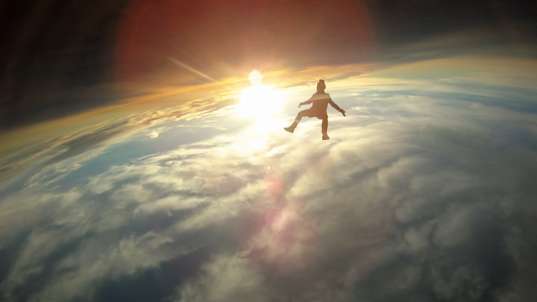
După ce armele nucleare au devastat Pământul, doar Ostrovul Ceresc, aerostatul propulsat cu energie solară care plutește deasupra Europei, mai deține înalta tehnologie. Autoritatea sa începe să pălească odată cu lovitura de stat pusă la cale de o facțiune religioasă.
Un tânăr nobil scapă de pe Ostrov și ajunge pe sol, unde se alătură unui grup din Uniunea de Nord-Vest preocupat să reinstaureze puterea atomului în scopuri pașnice. Tehnologia, scoasă în afara legii de secole, ar urma să permită recâștigarea moștenirii pierdute a călătoriei spațiale.
Încercărilor Uniunii de Nord-Vest li se opune Imperiul Maurai, care proslăvește atotputernicia naturii. Romanul urmărește personajele care încearcă să aplaneze conflictele dintre națiuni.
Pseudonym A. A. Craig, Michael Karageorge, Winston P. Sanders, P. A. Kingsley.
Poul William Anderson was an American science fiction author who began his career during one of the Golden Ages of the genre and continued to write and remain popular into the 21st century. Anderson also authored several works of fantasy, historical novels, and a prodigious number of short stories. He received numerous awards for his writing, including seven Hugo Awards and three Nebula Awards.
Anderson received a degree in physics from the University of Minnesota in 1948. He married Karen Kruse in 1953. They had one daughter, Astrid, who is married to science fiction author Greg Bear. Anderson was the sixth President of Science Fiction and Fantasy Writers of America, taking office in 1972. He was a member of the Swordsmen and Sorcerers' Guild of America, a loose-knit group of Heroic Fantasy authors founded in the 1960s, some of whose works were anthologized in Lin Carter's Flashing Swords! anthologies. He was a founding member of the Society for Creative Anachronism. Robert A. Heinlein dedicated his 1985 novel The Cat Who Walks Through Walls to Anderson and eight of the other members of the Citizens' Advisory Council on National Space Policy.[2][3]
Poul Anderson died of cancer on July 31, 2001, after a month in the hospital. Several of his novels were published posthumously.
Maybe Poul Anderson’s greatest attribute is to make the epic personal, to bring within arm’s reach the limitless expanses of time and space.
Reminiscent of Anderson’s Vault of the Ages and The Winter of the World the author returns to his Maurai world creation to a far future post-apocalyptic tale, really more abut the centuries old rebuilding of civilization, with our self destroyed culture a distant memory.
The idea behind the Maurai is that a nuclear war has decimated most of society, as we know it, with vast stretches of North America and Eastern Europe no longer populated. (Anderson first developed the Maurai in the 1950s when the cold war between the US and the USSR raged frigidly). The Maurai, made up largely of Australia, New Zealand and the Pacific islands, was spared much of the destruction and so had a head start on rebuilding a world culture. More interested in green technology and biology, the Maurai are zealous to avoid the nuclear devastation of the old world and to guard against backslides toward technology that is not earth friendly. This concept makes this series of stories especially relevant for today’s readers.
Published in 1983, Anderson was able to take the time to more fully develop this story than he had been in his earlier days. Reading this excellent book, I got the idea that the old master was trying to create a masterpiece out of this unique world building experiment.
Orion Shall Rise also includes a floating city / air station called Skyholm, a pre-war aerostat that is developing into a myth by the populace of a future France that has seen generations come and go with the reassuring satellite always hovering overhead.
Tying together themes of social and cultural evolution and Anderson’s unique ability to connect probable trends in future societies, Orion Shall Rise is one of his best.
On a lighter note:
Back in the olden days of the eighties, the comedy show SCTV (starring John Candy, Eugene Levy, Rick Moranis, Catherine O’Hara and host of other funny people) made a spoof of the television series Amerika (1987) called Kanada, where the great white north (Kooo-loo-koo-koo-koo-ka-koo!) was invaded by and occupied by the Polynesians. This skit is so obscure that I could not even find it on YouTube. (Can I get a “like” from anyone else who remembers SCTV?) In Anderson’s Orion Shall Rise, the Maurai invades and occupies the Northwest Union, a loosely organized confederacy made up of the Pacific Northwest and Canada. Were the producers of SCTV inspired by Anderson’s work? We may never know, but I could not help laughing to myself as I read.
Poul Anderson was an exciting and prolific writer of both science fiction and fantasy. I've never read one of his authored or co-authored books that I did not enjoy. This story was no exception. Sure, it had its dull moments and got a little complicated at times, but the plot was well drawn as were the characters.
The story takes place centuries after a nuclear holocaust wiped out most of earth's population and left much of the land devastated. Three major civilizations have emerged: The Domain which covers most of what is now Northern Europe, the Murai, a queen led nation of South Pacific seafarers and the Northwest Confederation based in the Northwest corner of North America. There are other smaller groups such as the Mong and the Yuan, Asian survivors of the disaster as well as the Espanyans in Southeastern Europe.
The Domain is protected by an immense dirigible called Skyholm which can deliver lasers anywhere in the Domain. The Murai are militarily, the strongest and see themselves as the keepers of the peace. They constantly look for any fissionable material in order to confiscate it. The Northwesterners or Norries as they call themselves are divided into lodges, the strongest of which are the Wolves. The Murai defeated the Norries in the Power War when they tried to build nuclear power plants.
The plot is built around the efforts of the Norries to build a nuclear-powered space ship without anyone discovering what they are doing. The major sub-plot involves the protagonist Iern of the Domain being usurped as leader in a coup just as he is about to be elected by Jovain, a jealous, vindictive rival. Iern escapes to the Northwest and enlists in the space ship effort after falling in love with Ronica Birken a Norrie who helps him escape the clutches of Jovain.
This book won a number of awards including a Hugo and a Nebula. It contains most of the themes that Anderson used in many of his writings: liberty, adventure, individualism, tragic conflicts, human foibles and others. I'm not sure this was Anderson's Magnus Opus, but it's not only long at close to 500 pages but has been reprinted numerous times in the 35 years since its first appearance.
There are times the plot drags but the time is put to good use exploring the characters' motivations and plans. The ending is action-filled and very exciting. The conclusion ties up a number of loose ends and leaves the reader with hope for the human race.
I highly recommend it to not only sci-fi fans but anyone who enjoys an exciting yarn taking place in an imaginative universe with lots of parallels to our own.
I was about to put this book aside at about one quarter in. Some positive reviews here convinced me to carry on, and in the end I'm glad I did. However, I still think for the first 60-70% is concerned too much with world building and too little with telling a story and developing the characters.
It is funny - I have wavered back and forth for quite while on whether or not to read this after I first saw it at my friend's aunt's used book store waaaay back when. I found this copy for a good price (cheap, cheap, cheap!) during a sale at another used bookstore this past year. I finally decided to take a chance and read it (after numerous times of picking it up and putting it back down). Anyway. Enough about me.
I enjoyed this book far more than I thought I would. It does take a bit of time before it starts moving; most of the beginning of the book is setting the stage "for what comes later." Once it gets moving, it focuses on six main characters with a multitudinous cast of supporting characters. The author does a nice job of world-building and does a nice job of creating characters I rooted for and characters I did not care about in the least bit, they were so despicable to me. There was a lot of 'the ends justifies the means' going on throughout the book, as well as a lot of 'blatant hypocrisy' amongst the characters who could not see it because of their own blinders. I did start to second-guess the author on how it was going to end, and I was happy to be proven wrong. The ending was not necessarily 'as satisfying' or 'as neat' as I would normally prefer, but that is okay. it was a very involved story, and it has a lot of backstory history in it to help guide the reader along.
It is funny, but I realized as I read this book that "info-dumps" have occurred with great regularity in most genres over the years; the "info-dump" is not "new" to the 1990s or 2000s. I think the difference is how well the author does in dumping the information onto the unsuspecting reader. In this book, I think the author does a decent job with how he shovels information at the reader. I did not find it overwhelming in the least bit.
One "thing" that I especially enjoyed was when Ronica said to her "crew", "Let's go, boys! . . . On the bounce!" (165). I found myself wondering if it was an homage to Heinlein's Starship Troopers, as that was a phrase used quite often throughout the book. It was an interesting turn of the tongue, as it does not really fit in with the general tone of the book or the moment when she says it. Perhaps she had grown up reading and being educated on "the classics"? hahahah
There is a lot going on in this book.
There was a lot of intrigue in the book, a lot of double-crosses and betrayals. it seemed many of the men had no issues with cheating on their wives and sleeping around as long as they were away on a "mission of national importance." Yet, they always seemed surprised to learn that their wives were not happy with the lecherous adultery of the husbands. Go figure!
Some other "things" that caught my attention: On page 359, the comment is made that Jovain suddenly realizes he has not been paying enough attention to the engineers, the technicians, of Skyholm. He further realizes that this lack of attention has been to his detriment. Yuh think?!? It really struck me as funny when I read that.
pp. 366-367
I think the most horrific part of the book for me occurred on page 408.
The book had an interesting mix of "old religions" and "new religions", some of which intermixed various beliefs in the creating of new religions. It seemed the three "primary" "old religions" which had survived were Hinduism, Christianity, and Judaism. The new religions focused mainly on "preserving and protecting the Earth" and being virulently "anti-technology" (to varying levels).
it was funny - having finished Confessions of an Economic Hitman recently, the constant talk about how important energy is to an economy in order to improve the economy and to speed up modernization really reminded me of that book. People are constantly talking about how important the economy is to industry and how equally important energy is to industry (increasing it and improving it). Not everybody in the book held to this view, but it was still amusing to me to read about this mindset in this book.
It was an interesting book; it was a fun book; it was a crazy book. It had some events in it that I did not expect to happen, but which did make sense in retrospect. The author did a good job putting together this dystopian world of the future and then expanding upon it in terms of how things might have changed due to specific events being put into motion. I did enjoy reading it, and I wish I had taken a chance upon reading it sooner. As I said early, it does take some time for it to build up speed (steam?), but when it does, it keeps the reader hopping. I am glad that I took the time to read it.
I usually like post-apocalyptic novels. But this one by Poul Anderson, I’m not too sure about.
There seems like quite a bit of earth left after the “Big War”, whereas I’m pretty sure if several hundred megaton nukes detonated all over our green earth, there would be very little left afterwards. Maybe some cockroaches, ashes, glass bowls and hot rocks.
However, in Poul’s ‘Orion Shall Rise’ we see some pretty well off and advanced civilizations from all over the globe doing pretty well. There is an orbiting platform, fighter planes and aircraft carriers to name a few of the technologies left intact. Um, yeah okay.
Anyhow, overlooking this, we have three or four distinct cultures vying for dominance. One in particular has spent decades on a dream, the dream that Orion shall rise. They have done an incredible job of hiding this project from the other cultures, but in the end the secret is exposed and that’s when all hell breaks loose.
I can’t tell you what Orion is, or that would spoil the book, but its rising will surely disrupt and completely change the current way of things.
The first two thirds of the book deals with the different cultures and how they operate and differ. I was reminded of “Downbelow Station”, and almost bored to tears as much, but not quite. I’m much more into action, adventure and mystery and the first two thirds of this book had very little of it.
So, not wanting to give up on it, Poul’s writing is good, I slugged along and was duly rewarded for my perseverance. You see, the last hundred or so pages really heat up and turn into the kind of post-apocalyptic novel I enjoy complete with action, adventure and some mystery.
Overall I would say this is a good book, but not great. The ending pages almost make up for the slow beginning and middle. Almost, but not quite.
For exceptional post-apocalypse novels I would suggest “Liege-Killer”, or “The Postman”, or Wayland Drew’s Earthring Cycle series or Paul O Williams’ Pelbar cycle novels.
I’m not saying to give this one a pass, just that there are much better post-apocalypse novels out there.
Orion rose, but is sure took a long time to do so.
Probably I will put 5 stars on most books I read, because I find reading very relaxing. But this book really got me hooked. The idea that our society, as we know it, just ended and we went back to medieval organisation, but still have a space station to protect us is something that I do see happening. It's a tale about power. The classic story about the struggle between that is good and bad in every society. There is no civilization and going forward without some bad things happening and we will always look up to the stars for salvation. Some people just have what they need to save the world and become heroes, as Iern and Ronica and there are always some people like Jovain, that just think they are good human being, but their core is corrupted by their own desire for personal gain and glory. Love is never a good reason for war and treason.
This is a book that most fantasy readers will like, but there are some good aspects for the SF genre readers also.
This was a an unexpected gem. Orion Shall Rise is set 800 years after a nuclear war has erased our civilisation. New civilisations have rebuilt and the world is dominated by the Maurai, a seafaring empire which polices the world to prevent the rebuilding of nuclear technologies. The Northwest Confederation occupies the northwest region of North America and seeks to recapture the old industry of the twentieth century. Between the two sits the Domain, a federation occupying the ancient lands of France and overseen by a massive floating citadel called Skyholm, which is used to defend the land against the lesser civilisations of Espayn, Italya and the Rhineland and to break up massive storms which sweep in from the Atlantic. As agents from the Northwest Confederation (Norries) scour the world for fissionable materials left over from the pre-holocaust days., a coup in Skyholm sends a young nobleman, Iern, deposed from his rightful place as heir to the Captain, on an epic journey across the world where he becomes involved in an illicit project to build a spacecraft using rediscovered nuclear warheads for propulsion. Once the project is discovered a terrible conflict begins, leading the world to the edge of a second holocaust. It took me a while to get into this book, but once I had cleared the first 100 pages or so I was gripped by this marvellous, imaginative tale. At times the plot dragged a little, but the dragging passages served the purpose of fleshing out all of the key characters and some minor ones besides. The picture of the new post-apocalypse world was well-drawn and fascinating. Aspects of the world come across almost as medieval with old-fashioned titles and manners, yet threaded through that world are jet aircraft, laser weapons and battleships. I was especially interested in the fact that although Anderson wrote this in 1983, it has a very strong eco theme in which the world is swept by a religion focused on the concept of Gaea and all civilisations apart from the Norries seek to utilise technologies that preserve the land. This novel has war, technology, romance, philosophy, religion and visions of future technology and hasn't suffered from being nearly 40 years old.
A fost odată un om pe nume Mael cel Roşu, care sălăşluia în Ar‑Mor. Ţinutul acesta se afla la capătul apusean al Brezh‑ului, care, la rândul său, era situat la marginea dinspre apus a Domeniului. Din acele locuri, Ostrovul Ceresc strălucea către răsărit, aproape de linia orizontului, şi, nu rareori, vreo culme ori coroana unui copac îl ascundeau vederii. Nu părea a fi mai mare decât o jumătate de lună plină. Cu toate acestea, locuitorii ţinutului îl priveau cu un respect evlavios ce lipsea uneori acelora care îl vedeau mai de‑aproape, semeţ şi impunător. La urma urmei, aceia trăiau de multă vreme sub stăpânirea lui. Oamenii clanurilor erau printre ei în fiecare zi. Peninsula Breizheg se alipise Domeniului cu mai puţin de un secol înainte de naşterea lui Mael, şi nu ca urmare a unei cuceriri sângeroase, ci prin semnarea unor tratate. În afara oraşelor peninsulei, bărbaţii din neamul aerogenilor erau arareori întâlniţi, iar de femeile lor nici nu se pomenise. În vorbirea de fiecare zi, localnicii îi numeau pe acei bărbaţi sfinţi, iar tradiţia spunea câ ar avea puterea de a face minuni. Casa lui Mael se înălţa pe o culme plină de flori purpurii şi aurii, în anotimpurile prielnice. La poalele colinei se afla o pădure, iar mai jos, în vale, se zăreau ogoare şi livezi, şi o mulţime de colibe. Cât vedea cu ochii, de‑acolo, de sus, îi aparţinea lui Mael; el împreună cu fiii săi, cu supuşii săi şi cu odraslele acestora gospodăreau totul: caii, turmele, recolta şi cheresteaua pădurii, vânatul şi peştele din ape. Mael era adesea plecat de‑acasă, căci rangul său îi impunea anumite îndatoriri. Mestromorul, care domnea peste Ar‑Mor, îi acordase încrederea sa, spre a veghea pacea şi a judeca neînţelegerile din ţinut. În decursul vizitelor sale în cetatea Kemper, Mael ajunsese să îl cunoască pe coordonator, Talence Donal Ferlay, cel trimis de către Ostrovul Ceresc spre a‑i sfătui pe cârmuitori şi a se asigura că sfaturile date erau urmate.
I loved this book. I had to go back and forth between 4 and 5 stars because I didn't love the very end of it, but overall I'd say it's closer to 4.75 than 4 so I put it at 5 stars. The world he created was interesting to me, with seemingly plausible civilization. The characters were enjoyable in their variety, even the "villains" were interesting and human. The concepts explored were also fascinating, the morality of nuclear technology, energy technology, bioethics, conservation, human progress, religion, and others. Even though the dialogue wasn't always realistic in terms of modern conversation, in the context of the novel with bastardized languages it worked. Overall, this may be one of my favorite books that I've read this year. I'd like to thank my brother, Ian, for recommending it.
One of the best post-apocalyptic worldbuilding exercises in all of science fiction, alongside Walter Miller's in A Canticle for Liebowitz. The Maurai hegemony, the Northwest Federation, Skyholm and the Mong are all rich in imaginative detail.
DNF : I don't know what it is about this book but i got to 60% and finally gave up There's a lot going on and at the same time there's absolutely nothing going on. I've left it bookmarked and will likely finish it at some point. Until then..........
Poul Anderson in several of his novels exploresthe phenomen of a future society turning away from high technology, and this is one of the best. The earth has slowly come back from a nuclear war and the dominant Polynesian state closely monitors the rest of the world for signs of a return to the nuclear technology that nearly destroyed humanity centuries earlier. In some ways this makes the Polynesians, here called "Maurai," similar to the American government in its current efforts to limit the nuclear ambitions of Iran and North Korea. There are five or six major characters, each from one of the successor human civilizations and each are interestingly drawn, particularly a France under the rule of an elite caste based in an aerostat, or dirigible, stationed in the stratosphere.
Deeply imaginative, beautiful world with an enourmous scale. But the writing is flawed, the main character is romantically interested and seduces most of the named female characters, with the exception of his mother.
This entire review has been hidden because of spoilers.
din păcate, SF-ul e doar o spoială vagă de post-apocaliptism, dar și aceea slab realizată și prezentată; restul e un pseudo-Dumas cvasi-medieval cu aristocrați, lipsit de zvâc și povești interesante, împachetat într-o scriitură cam anchilozată și dialoguri țepene. Plictisitor.
I'd probably give this 3.5. I found the first many chapters of Anderson's tale very intriguing as I tried to figure out the society he was painting, while I was waiting to find a character I could root for. Sadly, I never did.
If there are other books in this series I may give them a try.
Enjoyable, with some science that may be interesting in light of current events. The science is largely real; check out Freeman Dyson and the real Project Orion for background.
Interesting tale. A planet different yet the same. Seems a reboot isn't an answer either. Actually it's humanity that requires a reboot or a new program.
It was a good book, but I had a real hard time both getting into it, and reading for extended amounts of time. Not quite sure why. Good storyline, I just didn't click with it.
Can't say it's completely compelling the whole way through, but it's extremely fun and gets to a couple of things that post-apocalpytic worlds go past or miss.
Why you might like it: Institutional rebirth with engineering. Rubric match: not yet scored. Uses your engineering/rigor/first-contact/world-building rubric. Tags: post-collapse, politics
Very disjointed no real ending, then a short story at the end in the same world, but it read like a chapter of a different book in the same universe. I am not sure why I finished it.
This is a relatively old book from 1983. I did not particularly enjoy reading it but there is no single reason for this. It's not a bad or offensive book but at the end you feel you wasted your time. I always feel bad when writing negative reviews for books that are innocuous- it's like a person with no skills themselves passing judgement on an artist's painting. However, my opinion as a consumer is that this book is weak, and I want to give warning. My thoughts: - Did not find it engaging. It took me over a month to read. I read Cormac McCarthy's The Passenger and Stella Maris in three days - those books were vastly more enjoyable and engaging. - Story is not particularly new or unique. Many variations of the post-apocalyptic genre exist that are done far better. Worldbuilding is done, but the world is not particularly interesting. - Writing is OK but blah. Sometime Poul Anderson has a nice turn of phrase but in general he is more workmanlike. His attempts at more poetic writing come off as unnatural and forced and slow the story down. Sometimes the prose is a little cringe worthy. - Mr. Anderson wants to say something important, but I don't think he knows what- other than humans will blunder their way up to the stars. - The character's I never felt were particularly interesting and sometimes are downright annoying. - Boring. Because the ideas are not particularly new or interesting, the characters bland, and the writing uninspired, the story is boring. I never picked up the book saying I wonder what will happen next. I found I did not care. Read this book if you have nothing else to read and are bored.
Orion Shall Rise is very tedious in its pace. The characters and the plot, centred around a post-nuclear-holocaust Earth, take a long time to weave their way together, which I suppose it should, as the setting is all the world. The strategy Anderson takes in fabricating the evolution of language seems at times to be poor choice and occasionally corny.
It seems to be a simple science fiction novel, with an incredibly dense storyline and convoluted plot. Perhaps the best part of it is not knowing the outcome by simply analysing the plot and characters. No nation is 'good', no nation is 'evil' as far as Anderson describes them, but their characteristics and inhabitants are fully rounded, both good and bad.
It feels like a long, dull read, but I thoroughly enjoyed it. I cannot point to anything that would make it an outstanding piece of literature, it doesn't seem striking for anything but its immersiveness. Yet somehow I love this book more than perhaps any other.