Lin Carter was an American author, editor, and critic best known for his influential role in fantasy literature during the mid-20th century. Born in St. Petersburg, Florida, he developed an early passion for myth, adventure stories, and imaginative fiction, drawing inspiration from authors such as Edgar Rice Burroughs, Robert E. Howard, H. P. Lovecraft, and J. R. R. Tolkien. After serving in the U.S. Army, Carter attended Columbia University, where he honed his literary skills and deepened his knowledge of classical and medieval literature, myth, and folklore — elements that would become central to his work. Carter authored numerous novels, short stories, and critical studies, often working within the sword-and-sorcery and high fantasy traditions. His own creations, such as the “Thongor of Lemuria” series, paid homage to pulp-era adventure fiction while adding his distinctive voice and world-building style. His nonfiction book Tolkien: A Look Behind The Lord of the Rings was one of the first major studies of Tolkien’s work and its mythological roots, and it helped establish Carter as a knowledgeable commentator on fantasy literature. Beyond his own writing, Carter was a central figure in bringing classic and forgotten works of fantasy back into print. As editor of the Ballantine Adult Fantasy series from 1969 to 1974, he curated and introduced dozens of volumes, reintroducing readers to authors such as William Morris, Lord Dunsany, E. R. Eddison, and James Branch Cabell. His introductions not only contextualized these works historically and literarily but also encouraged a new generation to explore the breadth of the fantasy tradition. Carter was also active in the shared literary universe of the “Cthulhu Mythos,” expanding upon the creations of H. P. Lovecraft and other members of the “Lovecraft Circle.” His collaborations and solo contributions in this genre further cemented his reputation as both a creative writer and a literary preservationist. In addition to fiction and criticism, Carter was an active member of several science fiction and fantasy organizations, including the Science Fiction Writers of America. He frequently appeared at conventions, where he was known for his enthusiasm, deep knowledge of the genre, and willingness to mentor aspiring writers. Though sometimes critiqued for the derivative nature of some of his work, Carter’s influence on the fantasy revival of the late 20th century remains significant. His combination of creative output, editorial vision, and scholarly enthusiasm helped bridge the gap between the pulp traditions of the early 1900s and the expansive fantasy publishing boom that followed. Lin Carter’s legacy endures through his own imaginative tales, his critical studies, and the many classic works he rescued from obscurity, ensuring their place in the canon of fantasy literature for generations to come.
011 - Introduction - "Of Warriors and Wizards" - Lin Carter 017 - "The Bagful of Dreams" - Cudgel the Clever by Jack Vance 059 - "The Tupilak" - The Merfolk by Poul Anderson 101 - " Storm in a Bottle" - Brak the Barbarian by John Jakes 161 - "Swords Against the Marluk" - Deryni by Katherine Kurtz 203 - "The Lands Beyond the World" - Elric of Melnibone by Michael Moorcock.
For a good time and some light reading, Lin Carter edits a collection of fun 'Sword and Sorcery' stories. All the novelettes here were also published as portions of larger works by their respective authors. I first encountered these stories in a paperback printed by Dell Books in November 1977, although the Science Fiction Book Club did a previous version of the book, which I never purchased.
The stories here may have appeared in a slightly revised form. My favorite here was Jack Vance's "The Bagful of Dreams" which became part of his Dying Earth novel "Cugel's Saga" (1983).also up there among my favorites was Mike Moorcock's "The Lands Beyond the World" that had already appeared as a section of his Elric novel "The Sailor on the Seas of Fate" (1976), though its appearance in this anthology marked its first American publication.
Poul Anderson's "The Tupilak" was incorporated into his novel "The Merman's Children" (1979).
John Jakes's "Storm in a Bottle" was included in his Brak the Barbarian collection "The Fortunes of Brak"(1980).
Katherine Kurtz's "Swords Against the Marluk" eventually became the basis of part of her Deryni novel "The King's Deryni" (2014).
I had the opportunity to meet and speak with Mr. Carter at one time at a World Science Fiction convention and he certainly was a character.
Every time through a collection curated by Lin Carter, I have to wonder what the other authors thought of his excessively chummy, sometimes cringingly inappropriate filler material. What did they think of this whole SAGA organization that Carter mumbles on about, other than being a mildly amusing diversion and income source via the Flashing Swords! collections?
Again, this is a set of stories drawn from established series and characters, though Anderson's _The Merman's Children_ fix-up collection is still in the future. But it shows considerable range.
You can never tell if Cugel the Clever, in Vance's "The Bagful of Dreams", is ever really in control of the situation. He is paired against a rival, Iolo, who is as conniving and amoral as he is, and both are striving for a complex goal in a contest with unusual rules. And, of course, nothing goes right. It is remarkable how the situation can be filled with so much conflict that never boils over into violence.
Anderson manages to wring a new shape of tragedy and loss in "The Tupilak", which is again crisp in writing while retaining the feel of pre-Christian mythology.
Brak the Barbarian kills off another pony in "Storm in a Bottle", but it is not his fault this time. Jakes establishes an intriguing setting, of a city driven mad by drought and on the verge of spiraling out of control. But this is seen from too great a remove as we follow Brak through an investigation that leads him exactly where the reader expects.
"Swords Against the Marluk" speaks to the conflicts besetting Gwynedd and the suspicions held against the Deryni, both of which are noteworthy and powerful, but the story's events are split between an indeterminably long mystic ritual and then a bloody and not terribly remarkable battle.
"The Lands Beyond the World" is an Elric piece inserted between two established stories, and so has a bunch of connective tissue on either end. This makes it feel ripped untidily from something larger. Still excellent, if you ignore the stray viscera.
This fourth volume of Carter's original anthology series of sword & sorcery stories contains five stories from some of the best known names in fantasy of the time. I thought some of the stories leaned much to the heroic/high side than to the swords & sorcery genre that he initially proclaimed to promote, but that's okay... Included are an excellent Jack Vance story featuring his character Cugel the Clever, a pretty standard Brak the Barbarian adventure by John Jakes, a Poul Anderson Merfolk story that I didn't care for, and a good Katherine Kurtz Deryni story. The book concludes with my favorite, one of Michael Moorcok's Elric stories, The Lands Beyond the World.
I picked this up inexpensively from a Half-Price Books a while back . . . a very cool collection, with some great swords-and-sorcery authors returning to their favored characters and settings - a Cugel story from Jack Vance, a Viking story from Poul Anderson, a Brak the Barbarian story from John Jakes, a Deryni story from Katherine Kurtz (the first one I've ever read, though I've been meaning to check out the Deryni books since the late 1980s - this may inspire me to finally do so!), and an Elric story from Michael Moorcock. What more could any swords-and-sorcery fan ask?
Volume 4 of Lin Carter's fantasy anthology was pretty good. Of the 5 authors and stories in the book I had only read one. For the fun of it I ranked each story in terms of my enjoyment of it 1- 5 with 1 being my personal favorite and so on.
1st would have to be the Moorcock Elric story though I have read The Sailor on the Seas of Fate many times it was different to just read Elric's leaving of the mystical ship, his friendship with Smiorgan, and his dealings with the nefarious Saxif D'Aan as a single story. Still, Elric is among my favorite of fantasy heroes so it was a nice pleasant wrap-up to this book to finish with this story.
2nd I would place The Bagful of Dreams by Jack Vance featuring the rogue Cugel the Clever. The story literally made me laugh out loud in parts. Just crazy predicaments and mischief and almost fairy tale like in the way Vance moves Cugel around from situation to situation.
3rd would be John Jakes with Storm in a Bottle featuring his blond barbarian Brak who starts and ends the book enslaved. A neat whodunnit yarn.
4th would be Katherine Kurtz with Swords against the Marluk featuring her Deryni characters. Some neat magical effects are sprinkled in with a nice battle scene.
And last and 5th on my list would be The Tupilak by Poul Anderson featuring a brother and sister merfolk duo which to me was hard to envision and get behind with a lot of various characters and factions and history that I found less than underwhelming. I did like the monster in the story which came in the form of the frame of a walrus hide, stuffed with hay, sewn up and given claws and fangs with wizardry most likely imbuing it with life and a major hate.
Though in 1977 we were starting to hit end of the sword and sorcery boom, this anthology packs a punch. Bookended by stories by Jack Vance and Michael Moorcock, the tales between hold their own.
This is an outstanding collection of some of the best in classic sword and sorcery writing! I had heard of all of these fine fantasy writers, but had never yet read one of them. This is an exdellent sampler of some excellent writing, and it gives you a feel of why they are so popular and respected in the field. Lin Carter's observations on the Sword and Sorcery genre, and the writers who write it, is also a fascinating read. I am thinking it's time we created another such guild.
This is only the second book that I've read in the “Flashing Swords” anthology series, edited by the infamous Lin Carter. The first one was basically an even split between the good and bad for me, making two of the four stories worthwhile. “Flashing Swords #4” stacks up a little better, since it has five stories, and three of those landed well.
The collection actually does something pretty smart in that it finishes on a Michael Moorcock “Elric” story, “Lands Beyond the World”, which I read years ago since it's also the middle segment of “Sailor on the Seas of Fate” (my favorite of the original 6 Elric books). In general I get pretty critical and impatient with Moorcock, since he tends to speed through the interesting stuff and he can be a trifle too talky. This is still a pretty solid entry into the fantasy genre, it has the albino swordsman being dropped off from a mysterious otherworldly ship, fighting pirates on an island, trying to rescue a woman in peril, and squaring off against an immortal sorcerer out of time who is being pursued by an immortal white horse. Elric is, as always, our depressive anti-Conan, and his adventures are suited to that idea.
John Jakes is in this one with his “Brak” character, who is very much an intentional Conan-clone... or “Clonan” if you will. He ends up in a kingdom ruled by an aged warlord who has a creepy eunuch wizard, and Brak is, of course, in chains. In “Storm in a Bottle”, Brak must learn in just two days why rain no longer falls in the kingdom, or be executed. As you were all looking to see, there is sorcery and a monster. Jakes is good at making the original “sword and sorcery” format feel relevant and fresh by really pummeling the hero with violence. Brak never gets out of an adventure without shedding some blood, making this quite the reverse of something that Lin Carter would write. A couple of elements might not sit well, being that the wizard, called “the sexless one”, keeps boys as servants and their effeminacy is posed as horrifying.
Returning in this volume is Jack Vance with “The Bagful of Dreams” which has a scoundrel hero obtaining a portal to another world to win a contest of wonders. Now, this is only the third thing I've read from Vance, but the guy always delivers! The unscrupulous players are all entertaining, and Cugel makes a fine heel of a hero. The portal first just has a spooky tentacle poking out, but then we are favored to go in there and see what's attached. “The Bagful of Dreams” opens the book, which, again, is a wise move.
That was the good, we're through the good.
...that and the simple fact that there's no Lin Carter story in this one.
Some might argue that the bad here isn't all that bad but... meh, this here's my review!
Katherine Kurtz apparently had a whole series of books dedicated to a mythical Wales with these humanoid magic guys called “Deryni”, and this story, “Swords Against the Marluk”, is from that, I guess. Am I likely to go and read those books? Nope. Anyhow, there's some king named Brion hanging out with his squire boy, Alaric. Alaric is one of these Deryni guys, and it doesn't seem like they're really different from people, and I guess you might be one and not know it? Anyhow, Brion's good brother shows up to let him know that Brion's bad brother wants to take over the kingdom and they need to do battle in some field. Brion's bad brother is a Deryni too, so I am guessing being one of those is just the luck of the draw. The whole battle and such was foreseen by the late father of the king, and the dead king went and just sort of hypnotized a set of instructions into both the king and the squire (who was 4 at the time, we get a flashback). This is largely to do with magic, enchanting a rock, making a circle of fire, etc etc. I guess we're supposed to thrill in wonder and mystery, but to me this was a deflation of suspense and a bit of a cheat having the heroes essentially being puppets and having that be a good thing. Perhaps it wasn't the worst written of all of these, but I'm still not into it.
Finally I'll talk about tale #2 here, being Poul Anderson and his merfolk (they were in Flashing Swords #1 as well), and an “adventure” involving some Inuits and vikings clashing on Greenland. The story also contains an artificially made sea-monster, which I think is also the title, “The Tupilak”. I think I was only able to get through this one because I was on an airplane and there wasn't much else to do. The merfolk are carefully fitted into a real historical period and there's always some Norse stuff, but Anderson is not content merely to craft a historic fantasy, it has got to be right on time for his 1970s readers. These 70s cats are jaded, see? They ain't gonna blush at declarations of love, or the word “passion”... they need to get expressly told that these characters are down to screw. I don't think I'm really a prude or anything, but I think sex in fiction is more effective as an undercurrent. Overtly blurting out reminders about intercourse and incest makes this feel like something written by an overeager teenage virgin, rather than adult who supposedly is actually experienced in that department. I mean, what is this, John Norman? It's not like it's on every line or every page, but I was just annoyed that Anderson felt the need to include it.
So we get: Vance, Anderson, Jakes, Kurtz, Moorcock, or, in my opinion: Good, Bad, Good, Bad, Good. So, all it 3 out of 5.
This book was dedicated to the late Norvell W. Page, aka Grant Stockbridge, who also wrote a Conan knockoff. Nice.
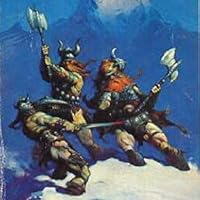
The fourth book in the Flashing Swords (1977)series, edited by Lin Carter, contains five tales of warriors and swordsmen battling black magic, plus an introduction from Carter along with his description of each author, their influence and style. Each story has an illustration by Rick Bryant. Some make like his style, but I find it a bit lackluster and more of what one might have seen on the pages of middle-tier comic books from the early 70's.
The first tale, "The Bagful of Dreams," by Jack Vance, is a story of Cugel the Clever. It's an otherworldy tale of Cugel, who is part con artist and part fighter. He saves the life of another man, but then is captured by a creature from another dimension. The man is off to a contest and is sure he will win for his wondrous creation to impress the ruler, but Cugel tricks him, gets free, then enters the contest himself. The other dimension seems to be influenced a bit by Lovecraft. The story is only so-so.
The next story is "The Tupilak" by Poul Anderson. It's a merfolk tale, based around the mythology and history of the Norse in Greenland. A hybrid of merfolk and human, the brother-sister team are exploring from Scandinavia to Greenland, trying to find their people. The Norse trust neither the merfolk or the Inuit. The leader of the humans they come across, hiding behind a cross, as most of the Norse people had recently converted to Christianity, tricks the duo and forces them to battle a legendary monster named the Tupilak, which they believe the Inuit created to kill them off. It's an entertaining story and, though I have never read the novel, it seems to be the spark that became Anderson's novel The Merman's Children (2014), which means I will now have to purchase that book because I enjoyed the story well enough.
Third in the collection is a John Jakes Brak the barbarian story entitled "Storm in the Bottle." Jakes purposely created a Conan-like character with blonde hair (He-Man, anybody?) that doesn't wear the fur diaper. That's all fine and dandy. Unfortunately, he tries to make the character smarter and tougher than Robert E. Howard's Conan and fails. Brak is taken prisoner for no more reason than he was in the wrong place at the wrong time. He has to help the kingdom solve the problem of why they are not getting rain and are dying from the drought. The fight scenes and Brak's actions show that Brak wouldn't survive a fight against Conan for more than a minute. The story is also pretty thin and the antagonist is easily guessed halfway through.
Katherine Kurtz provides a Deryni story that takes place from an important event that happened in her first Deryni novel, Deryni Rising and is alluded to in the other Deryni books, but is never described. It involves Alaric assisting King Brion against Marluk. The story stands alone and is well worth the read, even if you've never read a Deryni novel. After reading "Swords Against the Marluk," readers will probably seek out more Deryni stories.
The same goes for anyone who has never read an Elric story by Michael Moorcock. In "The Lands Beyond the World," Moorcock has Elric caught in another dimension that has no regard for time, as he battles warriors from a variety of eras upon a ship that precedes his own time. He finds a damsel in distress trying to escape someone of his own ancient bloodline who has a cruel history. Elric's magic doesn't work as well in this world, but his ancestor's magic is quite potent. With his soul-sucking sword, his little bit of magic and his wits, Elric must overcome his foe. Definitely a great adventure and a well-crafted story.
This volume of the Flashing Swords! series, while still entertaining for the most part, did not quite hold up to the previous entry of the series that I have read (Volume 2).
Collected in this volume are five sword and sorcery short stories by known authors of the genre: Jack Vance, Poul Anderson, John Jakes, Katherine Kurtz, and Michael Moorcock; as is the case with the previous entries in the series, this volume of Flashing Swords! was edited by Lin Carter.
While I do not individually rate short stories in a collection, I will provide an overview of my thoughts. Unsurprisingly, Michael Moorcock tells the best tale in the collection with another story of Elric of Melnibone, and one with a peculiar setting at that. In terms of quality, Katherine Kurtz and Jack Vance are the next runners-up; Kurtz spins a yarn set in her Deryni series (my introduction to the series) that shows off her skills in worldbuilding and historical fiction, while Vance sets his tale in the Dying Earth series (again, my introduction to this series as well) by following the exploits of his character Cugel. The next rung down on the ladder of quality would be John Jakes' tale of Brak the Barbarian; while I was anticipating to enjoy this story, Jakes delivers a very predictable and overall unenjoyable plot, despite there being some interesting worldbuilding and monster-creation. Finally, the worst story in the collection would have to be Poul Anderson's tale of the Mermen siblings, which featured an wholly uninteresting plot, subpar worldbuilding, and uninteresting side characters as well as criminally dull protagonists; this story, especially compared to the others in the collections, was a slog to get through.
While I thought this collection of stories was overall average, I would certainly still recommend it to fans of the Sword and Sorcery genre. Despite the fact that I did not enjoy Poul Andersons entry in this collection, it was interesting to see him work in a genre that was not science fiction (the same could also be said of Jack Vance in this collection). This collection, as can be said of the Flashing Swords! series in general, also serves to introduce readers to different existing fantasy series, so that is another positive; however, for readers who want to be introduced to the Sword and Sorcery genre in general, I would direct those readers to Flashing Swords! #2 instead of starting with this volume.
Flashing Swords! #4, edited by Lin Carter, is the last of the flashing sword compilations. Published in 1977, is promised lots of sword and sorcery action, but the results were more middling. It's a perfectly fine casual read, but don't bust down the gates to grab a copy.
"The Bagful of Dreams" by Jack Vance, features a tricky wanderer trying to win a magical contest by hook or by crook, and he's up against an equally guileful crook. This story led the volume and deserved to lead.
"The Tupilak" by Poul Anderson follows his mer-people story line. The whole thing read artfully enough that it almost didn't belong.
"Storm in a Bottle" by John Jakes entertained me as well as any of his other stories in this series. A barbarian who is ironically more civilized than the civilized people, find himself chained and beaten, with only one risky way to win his freedom: do the impossible in two days by making it rain.
"Swords Against the Marluk" by Katherine Kurtz demonstrated that M. Kurtz had no true understanding of this sub-genre. I like her work just fine, but it didn't fit very well. There was a seediness lacking in its story, that of a young king fighting a rival in a small battle.
"The Lands Beyond the World" by Michael Moorcock was an Elric story, as seedy and ambivalent and you could normally get, but also with an unusually happy ending. Elric seeks to reach home, so leaves the Seas of Fate, striking out on his own, only to get tied up against more sorcery.
Commuter train read: Enjoyed this intelligent, diverting, collection of Sword & Sorcery stories by Jack Vance (Cugel the Clever), John Jakes (Brak the Barbarian), Poul Anderson (Merfolk), Katherine Kurtz (Deryni), and Michael Moorcock (Elric). I was a big Elric fan as a teen, but this is one of my least favourite episodes. I love Moorcock's multiverse*, love Moorcock as an editor, and love the generally weird vibe of his fantasy, but Elric is hit and miss and in this story he's more of a spectator than a protagonist.
Five stories by members of the Swordsmen and Sorcerers’ Guild. Some good, some fair. No doubt first drafts for future novels. I know for sure I read the Michael Moorcock story, (the best one), in a full length novel.
Note to self: From the Birds and Books giant giveaway.
Amazingly, I read volumes one, two and four of this five volume series of sword and sorcery collections--and I profess not to like the genre! Presumably this was because these were relatively cheap selections from The Science Fiction Book Club which I belonged to at the time.