

What do you think?

99 Ways to Tell a Story: Exercises in Style
99 Ways to Tell a Story is a series of engrossing one-page comics that tell the same story ninety-nine different ways. Inspired by Raymond Queneau’s 1947 Exercises in Style , a mainstay of creative writing courses, Madden’s project demonstrates the expansive range of possibilities available to all storytellers. Readers are taken on an enlightening tour—sometimes amusing, always surprising—through the world of the story. Writers and artists in every media will find Madden’s collection especially useful, even revelatory. Here is a chance to see the full scope of opportunities available to the storyteller, each applied to a single scenario: varying points of view, visual and verbal parodies, formal reimaginings, and radical shuffling of the basic components of the story. Madden’s amazing series of approaches will inspire storytellers to think through and around obstacles that might otherwise prevent them from getting good ideas onto the page. 99 Ways to Tell a Story provides a model that will spark productive conversations among all types of creative people: novelists, screenwriters, graphic designers, and cartoonists.
207 pages, Paperback
First published October 25, 2005
About the author
Matt Madden
42 books26 followersMatt Madden is an American cartoonist as well as comics teacher, editor and translator. He is best known for the book 99 Ways to Tell a Story: Exercises in Style (2005), an experimental comic based on the idea of Raymond Queneau's Exercises in Style.
Madden was born in New York City in 1968 and has lived in Michigan, Texas, Pennsylvania, and abroad in Mexico and France. From 2012 to 2016 he had an extended residency at La Maison des Auteurs in Angoulême, France. He has also received the title of knight in the Order of Arts and Letters of the French Republic. Since 2016 Madden lives in Philadelphia with his wife, fellow cartoonist Jessica Abel, and children.
As a translator, Madden has translated graphic novels from Spanish and French for American publishers First Second and New York Comics Review. He also teaches comics at the School of Visual Arts in NYC and at Yale University.
Madden was born in New York City in 1968 and has lived in Michigan, Texas, Pennsylvania, and abroad in Mexico and France. From 2012 to 2016 he had an extended residency at La Maison des Auteurs in Angoulême, France. He has also received the title of knight in the Order of Arts and Letters of the French Republic. Since 2016 Madden lives in Philadelphia with his wife, fellow cartoonist Jessica Abel, and children.
As a translator, Madden has translated graphic novels from Spanish and French for American publishers First Second and New York Comics Review. He also teaches comics at the School of Visual Arts in NYC and at Yale University.
Ratings & Reviews
Friends & Following
Create a free account to discover what your friends think of this book!
Community Reviews
Displaying 1 - 30 of 162 reviews

May 2, 2015
Let me start by quoting from the blurb:
Inspired by Raymond Queneau's 1947 work of the same title, which told a simple story in ninety-nine different styles and genres ... Madden does the same but in different styles of comics - Marvel superhero, R. Crumb, Herge, even as a map or the Bayeux Tapestry.
Well, Matt's work may not have been quite as original as this statement suggests. In 1963, Gallimard published an illustrated edition of Exercises de Style, which contained drawings by Jacques Carelman, a painter and illustrator in the general group of experimental artists who collectively formed the "Ou-x-po". In this book, we find an illustration of Queneau's story, presented in the form of the Bayeux Tapestry(*). Of course, Matt shows his own version of the tapestry, tailor-made to represent his story, but the idea itself appears derivative.
(*) I have not actually seen the original edition, but there is a picture of Carelman's illustration in "Mathews, Harry & Alastair Brotchie, Oulipo Compendium, London 2011, p 148."
Still, this was the only major disappointment I had when I looked through Matt's book. Overall, I thought it was a good effort, but also no more than that. Still, some of his strips are real gems, and show the wit and visual impact that I was hoping to find in more of the book.
But I think I need to take a step back and chat a bit about the tradition in which I believe Matt's work needs to be placed. In 1960, French writer Raymond Queneau and his mathematician friend Francois Le Lionnais founded an experimental literary group in Paris. The members of the group liked to muck around with literary and linguistic conventions and typically worked by setting themselves constraints which they themselves invented. They would then write a piece of literature that satisfied the constraint and see whether the result was interesting (for example, writing an entire novel without using the letter "e"). They called this "workshop for potential literature", in French "Ouvroir de Litterature Potentielle" or OuLiPo for short.
It should not take long for the concept to spill out into other forms of cultural activity, and soon there were two other main groupings, "Oulipopo" and "Oupeinpo". The former would muck around with conventions of crime novels (ouvroir de litterature policiere potentielle), the latter with those of paintings, in obvious notation, so to speak.
But of course, lots more structured cultural activities exist, and the concept spawned several other groups, who variously mucked around with conventions found in cooking, music, photography, and... you guessed it, comics. Those in the know like to refer to these "off-mainstream" ouvroirs generically as "Ou-x-Po", and the one we are interested in calls itself "Oubapo", for "ouvroir bd potentielle", and everybody French of course knows that "BD" stands for "bandes dessinees", a form of literature the English-speaking world would call "comic strip". [For background on this movement, see Oulipo Compendium, as quoted above under (*), introductory essays]
Phew. Finally I got to the point. Are you still with me? This is possibly one of the more abstruse subjects in literature to talk about, but I am chatting about Matt's book in this review, and as it stands in the direct tradition of Oubapo, it is useful to know this stuff. In fact, Matt took a sabbatical from his teaching job at Yale to live in France, and he made contributions to at least one Oupus, the name given to the Collective Publications of the Oubapo. [For background on Matt, check out his blog here]
So, to be fair to Matt in my critique, I think I need to acknowledge that he actually set himself quite a complicated brief: He started out with the intention of showing 99 different ways in which the language of comics can be used to achieve different effects. But he chooses to do this in a style analogous to Queneau's model, and this is where things get difficult. Queneau himself did not really show 99 different existing styles, and demonstrate their relative merits, he played around with literary conventions in an anticipation what 13 years later was to become Oulipo. So Matt tries to achieve both, show the impact of different existing comic book styles, and at the same time play around with them, and destroy their conventional building blocks.
I think he is at his best when he tries to do the former. I liked his investigation into perspective, as in "A Refrigerator with a View" and "Fixed Point in Space" ("scenic restriction" in Oubapo lingo). The investigations into other artist's styles are interesting (eg Herge's Ligne Claire or DC comics). Variations on style components are evocative (No Line, Silhouette). Different cinematographic effects come over well (Extreme Close-Ups, Long Shots, Extreme Zoom, Isometric Projection), and "Vertical" and "Horizontal" probably demonstrate best what I had expected from the book - a demonstration how structural components unique to comics change the impact of the story on the reader.
Matt is often (but not always) at his weakest when he tries to implement iconoclastic interpretations in the syle of the Oubapiens. He includes some of the stock techniques in the inventory of that school, but does not quite pull it off, I find. "Two-in-One" is a form of "hybridisation", but the speaker saying the lines of Matt's original story changes identity - in panel 5, it is Queneau, in panel 9, it is Matt. In "Palindrome", named after another much-used "Oubapienist" technique, he almost pulls it off, and up to panel 12 (panel 4 of the reverse leg) the story works brilliantly. But panel 13 (5) would not be possible, I am afraid, and does not make sense. But "Inking Outside the Box" is brilliant! It is actually one of the best examples of what the Oubapiens call "reframing" that I've seen.
Most impressive, however, are the three strips that conclude the book. They do not really investigate style, or stand in the tradition of Oubapo. They would not make sense without the odd familiarity that, after 96 strips, we have come to feel for Matt, Jessica, and the fixtures of his flat. In "No Refrigerator", I was actually sad to see it gone. In "No Jessica", I mourned the void that had entered Matt's life. And in "No Matt", the concluding strip, I felt a haunting sense of absence as the camera panned through the empty rooms, echoing with the faint voice of Jessica's unanswered call, amplifying the oppressive silence that remained.
My ribboned hat is off to Matt. The journey had its ups and downs, but the finish was masterful.

This work is licensed under a Creative Commons Attribution-NonCommercial 3.0 Unported License
Inspired by Raymond Queneau's 1947 work of the same title, which told a simple story in ninety-nine different styles and genres ... Madden does the same but in different styles of comics - Marvel superhero, R. Crumb, Herge, even as a map or the Bayeux Tapestry.
Well, Matt's work may not have been quite as original as this statement suggests. In 1963, Gallimard published an illustrated edition of Exercises de Style, which contained drawings by Jacques Carelman, a painter and illustrator in the general group of experimental artists who collectively formed the "Ou-x-po". In this book, we find an illustration of Queneau's story, presented in the form of the Bayeux Tapestry(*). Of course, Matt shows his own version of the tapestry, tailor-made to represent his story, but the idea itself appears derivative.
(*) I have not actually seen the original edition, but there is a picture of Carelman's illustration in "Mathews, Harry & Alastair Brotchie, Oulipo Compendium, London 2011, p 148."
Still, this was the only major disappointment I had when I looked through Matt's book. Overall, I thought it was a good effort, but also no more than that. Still, some of his strips are real gems, and show the wit and visual impact that I was hoping to find in more of the book.
But I think I need to take a step back and chat a bit about the tradition in which I believe Matt's work needs to be placed. In 1960, French writer Raymond Queneau and his mathematician friend Francois Le Lionnais founded an experimental literary group in Paris. The members of the group liked to muck around with literary and linguistic conventions and typically worked by setting themselves constraints which they themselves invented. They would then write a piece of literature that satisfied the constraint and see whether the result was interesting (for example, writing an entire novel without using the letter "e"). They called this "workshop for potential literature", in French "Ouvroir de Litterature Potentielle" or OuLiPo for short.
It should not take long for the concept to spill out into other forms of cultural activity, and soon there were two other main groupings, "Oulipopo" and "Oupeinpo". The former would muck around with conventions of crime novels (ouvroir de litterature policiere potentielle), the latter with those of paintings, in obvious notation, so to speak.
But of course, lots more structured cultural activities exist, and the concept spawned several other groups, who variously mucked around with conventions found in cooking, music, photography, and... you guessed it, comics. Those in the know like to refer to these "off-mainstream" ouvroirs generically as "Ou-x-Po", and the one we are interested in calls itself "Oubapo", for "ouvroir bd potentielle", and everybody French of course knows that "BD" stands for "bandes dessinees", a form of literature the English-speaking world would call "comic strip". [For background on this movement, see Oulipo Compendium, as quoted above under (*), introductory essays]
Phew. Finally I got to the point. Are you still with me? This is possibly one of the more abstruse subjects in literature to talk about, but I am chatting about Matt's book in this review, and as it stands in the direct tradition of Oubapo, it is useful to know this stuff. In fact, Matt took a sabbatical from his teaching job at Yale to live in France, and he made contributions to at least one Oupus, the name given to the Collective Publications of the Oubapo. [For background on Matt, check out his blog here]
So, to be fair to Matt in my critique, I think I need to acknowledge that he actually set himself quite a complicated brief: He started out with the intention of showing 99 different ways in which the language of comics can be used to achieve different effects. But he chooses to do this in a style analogous to Queneau's model, and this is where things get difficult. Queneau himself did not really show 99 different existing styles, and demonstrate their relative merits, he played around with literary conventions in an anticipation what 13 years later was to become Oulipo. So Matt tries to achieve both, show the impact of different existing comic book styles, and at the same time play around with them, and destroy their conventional building blocks.
I think he is at his best when he tries to do the former. I liked his investigation into perspective, as in "A Refrigerator with a View" and "Fixed Point in Space" ("scenic restriction" in Oubapo lingo). The investigations into other artist's styles are interesting (eg Herge's Ligne Claire or DC comics). Variations on style components are evocative (No Line, Silhouette). Different cinematographic effects come over well (Extreme Close-Ups, Long Shots, Extreme Zoom, Isometric Projection), and "Vertical" and "Horizontal" probably demonstrate best what I had expected from the book - a demonstration how structural components unique to comics change the impact of the story on the reader.
Matt is often (but not always) at his weakest when he tries to implement iconoclastic interpretations in the syle of the Oubapiens. He includes some of the stock techniques in the inventory of that school, but does not quite pull it off, I find. "Two-in-One" is a form of "hybridisation", but the speaker saying the lines of Matt's original story changes identity - in panel 5, it is Queneau, in panel 9, it is Matt. In "Palindrome", named after another much-used "Oubapienist" technique, he almost pulls it off, and up to panel 12 (panel 4 of the reverse leg) the story works brilliantly. But panel 13 (5) would not be possible, I am afraid, and does not make sense. But "Inking Outside the Box" is brilliant! It is actually one of the best examples of what the Oubapiens call "reframing" that I've seen.
Most impressive, however, are the three strips that conclude the book. They do not really investigate style, or stand in the tradition of Oubapo. They would not make sense without the odd familiarity that, after 96 strips, we have come to feel for Matt, Jessica, and the fixtures of his flat. In "No Refrigerator", I was actually sad to see it gone. In "No Jessica", I mourned the void that had entered Matt's life. And in "No Matt", the concluding strip, I felt a haunting sense of absence as the camera panned through the empty rooms, echoing with the faint voice of Jessica's unanswered call, amplifying the oppressive silence that remained.
My ribboned hat is off to Matt. The journey had its ups and downs, but the finish was masterful.
This work is licensed under a Creative Commons Attribution-NonCommercial 3.0 Unported License

March 24, 2010
This is Raymond Queneau's "Exercises in Style" reimagined as 99 variants of the same visual narrative. It's the kind of project that (I suspect) will leave most people scratching their head and asking WTF, but that will prove irresistible to a certain very specialized subset of readers. You know who you are. I'm not saying it's a given that you attend Comicon, have an unsettling mastery of Star Wars arcana, or work in Information Technology. On the other hand, the reader most likely to enjoy Madden's book is someone who was already a fan of Queneau and has at least some familiarity with the conventions of the comic/graphic novel genre.
You gotta admire Matt Madden for being crazy enough to dream this up and actually bring it to fruition. That said, not all of his 99 variations are successful. A few are just baffling, some are likely to resonate only with true comic book aficionados, others are dull, but there are compensating moments of sheer inspiration.
I particularly enjoyed the "Public Service Announcement" and "Paranoid Religious Tract" variations, though the unquestioned winner has to be the "Newly discovered fragment of the Bayeux tapestry". On the other hand, variations titled "manga" and "digital" are as predictably dull as you might imagine.
Two stars for amusement value, with an extra star granted for sheer chutzpah.
You gotta admire Matt Madden for being crazy enough to dream this up and actually bring it to fruition. That said, not all of his 99 variations are successful. A few are just baffling, some are likely to resonate only with true comic book aficionados, others are dull, but there are compensating moments of sheer inspiration.
I particularly enjoyed the "Public Service Announcement" and "Paranoid Religious Tract" variations, though the unquestioned winner has to be the "Newly discovered fragment of the Bayeux tapestry". On the other hand, variations titled "manga" and "digital" are as predictably dull as you might imagine.
Two stars for amusement value, with an extra star granted for sheer chutzpah.

March 24, 2010
Queneau-lite, for people who can't be bothered to read the French original; Madden draws 99 one-page cartoons, all presenting variants on this basic story:
[image error]
Some of the ideas are very funny! I particularly liked Manga, Superhero, Bayeux Tapestry, Map, Political Cartoon, How-To (he explains the process of drawing a comic strip) and most of the parody/homage pieces in honour of famous graphic artists. The Crumb parody is spot-on:

A few entries do give the impression of being there to make up the numbers, but at least half of them hit their targets. Recommended if you want an amusing quick read!
[image error]
Some of the ideas are very funny! I particularly liked Manga, Superhero, Bayeux Tapestry, Map, Political Cartoon, How-To (he explains the process of drawing a comic strip) and most of the parody/homage pieces in honour of famous graphic artists. The Crumb parody is spot-on:
A few entries do give the impression of being there to make up the numbers, but at least half of them hit their targets. Recommended if you want an amusing quick read!
August 6, 2021
An extremely charming experiment in form with respect shown to a wide variety of historical and contemporary comics and film. Always a joy to crack this open again and share it with a friend. A cabinet of possibilities.

February 14, 2020
Finally got around to reading this comic version inspired by Queneau's classic! Loved it! Longer review soon!
October 28, 2024
“Matt Madden’s Exercise in Style is a series of engrossing one-page comics that tell the same story in a variety of ways. Inspired by Raymond Queneau’s 1947 work of the same title . . . Madden’s project demonstrates the expansive range of possibilities available to all storytellers.”
If you read through the review on goodreads, you’ll see a lot of negative reviews because it seems that Madden’s book follows Queneau’s book a bit too closely.
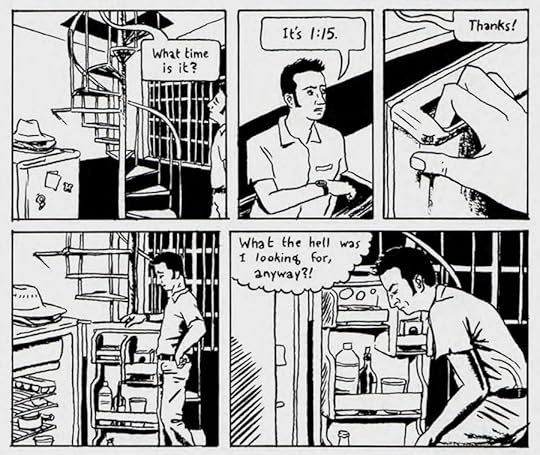
I haven’t read Queneau’s book, so I found Madden’s book a charming little exercise. First, he takes a simple narrative: a man closes his laptop, walks down stairs, is asked what time it is, he answers, he opens the refrigerator, and forgets what he was looking for. Then, he writes the simple narrative in 99 visual styles. Some of these are particularly amusing and creative. Some standout ones for me: political cartoon, underground comix, manga, Bayeux Tapestry, map, and paranoid religious tract.
If you read through the review on goodreads, you’ll see a lot of negative reviews because it seems that Madden’s book follows Queneau’s book a bit too closely.
I haven’t read Queneau’s book, so I found Madden’s book a charming little exercise. First, he takes a simple narrative: a man closes his laptop, walks down stairs, is asked what time it is, he answers, he opens the refrigerator, and forgets what he was looking for. Then, he writes the simple narrative in 99 visual styles. Some of these are particularly amusing and creative. Some standout ones for me: political cartoon, underground comix, manga, Bayeux Tapestry, map, and paranoid religious tract.

January 17, 2026
Lo amé, muy bueno y cretivo, realmente se extiende y explora los recovecos del potencial que tiene una historia muy simple.

September 25, 2018
This was a required reading for my digital storytelling course. I think I can see why it’s listed as mandatory, primarily to provide an overview of the various artistic styles of comic strip drawing, but beyond that it doesn’t hold much importance to most students in this class, since most assignments do not require the submission of comics. If that was the case, my limited skills would have me fail the course miserably.
The book was informative and explained many various styles of drawing comics/frames, which can be beneficial for the improved enjoyment of reading comics in my spare time.
ElliotScribbles
The book was informative and explained many various styles of drawing comics/frames, which can be beneficial for the improved enjoyment of reading comics in my spare time.
ElliotScribbles

October 23, 2017
This is an absolute gem of a book that I stumbled across in my university library. I thought it looked whimsical and unique and so I just had to pick it up - and I was not disappointed at all. This was charming, funny, hysterical and definitely made me laugh out loud on numerous occasions. Matt takes one scenario and twists it to fit different prompts and buzz words, which gives the story hilarious and refreshing twists. Some of them are so absurd that they don't quite make sense, but that makes it even funnier. It offers a way of looking at things from a different perspective and teaches you that you can always take one thing and make it into so many different things. It teaches the idea that your ideas are not linear - you can take your initial idea, present it in one way and then continue adapting it. It shows the flexibility of ideas and creativity and truly offers a different method of thinking and looking at things. Whilst teaching this useful lesson, it offers something very amusing, quirky and delightfully interesting. I thoroughly loved every page of this. I would recommend it if you are a designer, illustrator, writer, etc. If you feel it is useful to you, or if you feel you would get some good amusement from it, then definitely pick it up. I can't recommend it enough!

November 30, 2017
Very interesting, very funny and just inspiring. Matt Madden has written the most boring one page comic story - he gets up to go to the fridge, his wife calls out to ask him the time, and when he gets to the fridge he can't remember what he wanted. Sorry, I've given the plot away. Having shown you the story, he then goes on to show you it another 98 ways, using different comic genres, different artistic styles, different styles of particular comic book artists, different view points... reading it you just think how this could be applied to so many things, and how much fun you could have experimenting. And just how with a little imagination, you can get so much out of that one boring story. I love it and I'm sure I'll be looking through this book on many more occasions.
December 8, 2009
Serendipitous find as I searched Amazon for books related to one of my favorites: Exercises de Style de Raymond Queneau. The premise, take the same 2 events, and retell them in 95 different ways, varying the style each time. This version is all about graphically, visually, retelling the same story. In my quest to get more visually intelligent about graphic novels, this was definitely a step in the right direction.

April 11, 2021
Really broadens your scope on ways to present a story. 😃

January 9, 2026
This was a fun read, the creator takes a one page comic, where a man gets up from his desk, closes the laptop, then walks out of the room, to get something from the fridge, but gets interrupted by someone in a room above asking what the time is, which causes the man to forget what he wanted from the fridge. The one page comic is then re-drawn in 99 different artistic styles, including text only.
Most of them were good but there were three that really stood out. Page 43, is drawn as a manga, it even includes an angle that shows up a female characters skirt, I've not read much manga, though I understand this is a common trope of the genre.
Page 89 is drawn as a newspaper advert, showing a slender comic artist at the beach, getting sand kicked on his comics before learning to draw more muscular characters, which in turn make the artist more muscular, who then confronts the sand kicking bully.
Page 123 where each scene is drawn as an advert for products which relate to something in the scene, from a laptop computer, to a regression hypnotherapy service, to hopefully help the man remember what he went to the fridge for.
I picked this up from a recommendation, based on books I'd read and I'm glad I did, really worth a read.
Most of them were good but there were three that really stood out. Page 43, is drawn as a manga, it even includes an angle that shows up a female characters skirt, I've not read much manga, though I understand this is a common trope of the genre.
Page 89 is drawn as a newspaper advert, showing a slender comic artist at the beach, getting sand kicked on his comics before learning to draw more muscular characters, which in turn make the artist more muscular, who then confronts the sand kicking bully.
Page 123 where each scene is drawn as an advert for products which relate to something in the scene, from a laptop computer, to a regression hypnotherapy service, to hopefully help the man remember what he went to the fridge for.
I picked this up from a recommendation, based on books I'd read and I'm glad I did, really worth a read.

February 20, 2021
Це — перша книжка про комікс, яку я прочитала.
Необхідність почитати щось про комікс я усвідомила десь так: читаючи комікси помітила, що мені подобається не все, що найбільше вражають певні сюжетні ходи, а інші — взагалі ні, що якісь способи нарації в коміксі працюють цікавіше, ніж у "голому тексті", а якісь — значно гірше. Тому, коли в автора одного з оголошень на OLX виявилася, крім коміксів, ще й книжка про комікси, я її просто придбала.
Що сподобалося: спосіб побудови розповіді. На одній із перших сторінок читач дізнається, яку історію буде читати протягом решти книги. Фабула її дуже проста: чоловік встає, йде у вітальню, з другого поверху хтось запитує, котра година, чоловік відповідає, що чверть на другу, з другого поверху дякують, та коли чоловік підходить до холодильника, то не може згадати, по що прийшов.
І прочитавши першу історію, я подумала, що це — одна з тих книг, які ніколи не дочитаю (маю таких штук 10 на столі і ще кілька десятків на полицях). Але виявилося, що ця вправа виглядає дуже цікаво саме в графіці (не лише Рей Кено робив подібне з текстом, під час навчання на літературній творчості ми постійно виконували подібні вправи і результат... був дуже різним). Найбільше я була вражена неочікуваним способом нарації: коміксом-мапою. Але загалом відзначила для себе багато цікавих речей. Думаю, художникам, які створюють комікси, книжка має сподобатися.
У примітках до книги перекладач наводить приклади фігурних віршів з російської літератури. І я подумала, що це — ідеальний спосіб подати дуже широкому колу читачів, яке щороку зростає, матеріал із теорії [давньої] літератури. Сподіваюся, що ця книга вийде також в українському перекладі, але вже з примітками про раки літеральні та інші прекрасні фігурні вірші з української літератури.
Необхідність почитати щось про комікс я усвідомила десь так: читаючи комікси помітила, що мені подобається не все, що найбільше вражають певні сюжетні ходи, а інші — взагалі ні, що якісь способи нарації в коміксі працюють цікавіше, ніж у "голому тексті", а якісь — значно гірше. Тому, коли в автора одного з оголошень на OLX виявилася, крім коміксів, ще й книжка про комікси, я її просто придбала.
Що сподобалося: спосіб побудови розповіді. На одній із перших сторінок читач дізнається, яку історію буде читати протягом решти книги. Фабула її дуже проста: чоловік встає, йде у вітальню, з другого поверху хтось запитує, котра година, чоловік відповідає, що чверть на другу, з другого поверху дякують, та коли чоловік підходить до холодильника, то не може згадати, по що прийшов.
І прочитавши першу історію, я подумала, що це — одна з тих книг, які ніколи не дочитаю (маю таких штук 10 на столі і ще кілька десятків на полицях). Але виявилося, що ця вправа виглядає дуже цікаво саме в графіці (не лише Рей Кено робив подібне з текстом, під час навчання на літературній творчості ми постійно виконували подібні вправи і результат... був дуже різним). Найбільше я була вражена неочікуваним способом нарації: коміксом-мапою. Але загалом відзначила для себе багато цікавих речей. Думаю, художникам, які створюють комікси, книжка має сподобатися.
У примітках до книги перекладач наводить приклади фігурних віршів з російської літератури. І я подумала, що це — ідеальний спосіб подати дуже широкому колу читачів, яке щороку зростає, матеріал із теорії [давньої] літератури. Сподіваюся, що ця книга вийде також в українському перекладі, але вже з примітками про раки літеральні та інші прекрасні фігурні вірші з української літератури.
August 23, 2026
Divertidíssimo experimento de Matt Madden que procura contar um mesmo enredo de 99 maneiras diferentes. Ao fazer esse exercício, ele mostra que forma e conteúdo são indissociáveis. Além disso, acaba desenhando um grande passeio pela história dos quadrinhos.
É uma delícia mergulhar nos diversos estilos e observar a enorme capacidade criativa humana.
E por mais abrangente e dinâmico que seja o livro, o curioso é que chegamos ao fim imaginando pelo menos outras 99 maneiras de se contar a mesma história.
Uma empolgante declaração de amor aos quadrinhos - tanto como técnica como arte.
É uma delícia mergulhar nos diversos estilos e observar a enorme capacidade criativa humana.
E por mais abrangente e dinâmico que seja o livro, o curioso é que chegamos ao fim imaginando pelo menos outras 99 maneiras de se contar a mesma história.
Uma empolgante declaração de amor aos quadrinhos - tanto como técnica como arte.

February 3, 2019
Madden starts with a simple, almost banal, comics page that portrays him getting up from his desk, telling his wife what time it is, walking to the fridge, and then forgetting what he wanted. And then, he repeats that page 99 times in different styles. Sometimes he uses a different genre (superhero, manga, ...), sometimes he does a pastiche (Krazy Kat or Little Nemo in Slumberland), but often the changes are more formal (changes in perspective, panel type, or art style). My favorite page is called "Inventory" and just displays, in each panel, the most relevant features of the original page (e.g., a picture of a desk). There is no narrative - even the letters used in the original page are presented in alphabetic order here - but you still get some gist of the original scenario.
It's a quick read with testament after testament to Madden's skills in presenting comics history. It's also quite funny, not so much because of obvious laugh lines, but because you are constantly and often joyfully surprised by the changes. Aside from one small quibble (why did we need an upskirt image on the manga page?), I liked this a lot.
It's a quick read with testament after testament to Madden's skills in presenting comics history. It's also quite funny, not so much because of obvious laugh lines, but because you are constantly and often joyfully surprised by the changes. Aside from one small quibble (why did we need an upskirt image on the manga page?), I liked this a lot.

December 9, 2020
Me ha gustado mucho, es tan original! como el título sugiere, el autor elige 99 estilos para contar la misma historia, haciendo ya de paso un viaje por la historia gráfica y su evolución. Fantástico y divertido

December 27, 2021
крутое упражнение длиной в книгу; понимаешь, что в играх со стилем и формой можно найти смысл, который не найдешь намеренно.
October 9, 2022
Genius!

June 18, 2024
un ejercicio súper interesante y creativo, puede haber gente que lo considere sencillo pero me parece realmente complejo representar de tantas maneras una misma idea.

September 7, 2024
3 stars
If I never look at the words, "What the hell was I looking for?" I will live a happy existence.
If I never look at the words, "What the hell was I looking for?" I will live a happy existence.

November 9, 2025
La misma escena. 99 veces. Y no se me ha hecho repetitiva. Quería seguir, dar la vuelta a la página y que me sorprendiera con un nuevo enfoque. Ha habido muy pocos que me han dejado fría. Muchos me han hecho reflexionar sobre la forma de contar historias, con otros he aprendido cosas nuevas de la historia del cómic.
En fin, recomendadísimo para cualquier cuentista como yo.
En fin, recomendadísimo para cualquier cuentista como yo.
October 16, 2025
Goh, dit vond ik echt zó tof.

May 27, 2018
Constraining yourself in the most ridiculous of ways can yield creativity in weird ways. I would recommend reading it in hardback - the fun arises in observing how every interpretation of the comic is different from the original template (and yet the same).

June 9, 2021
عبارة عن مشهد مصور بطريقة الكوميكس، يعاد تكراره مع تغييرات طفيفة وأحيانا كاملة، مع الاحتفاظ بنفس الكلمات أو نفس المضمون. ويغلب اللون الأبيض والأسود مع وجود مشاهد بالألوان.
الفكرة رائعة لكن التطبيق جيد. فيه بعض الفائدة للمهتمين بصناعة الأفلام أو الكوميكس. أنهيته في جلستين.
الفكرة رائعة لكن التطبيق جيد. فيه بعض الفائدة للمهتمين بصناعة الأفلام أو الكوميكس. أنهيته في جلستين.

May 6, 2023
I've read a few graphic adaptations of novels or memoirs and others that exist only as drawings-and-text. I'm often confused and underwhelmed by these stories' visual imagery. I have trouble "getting" the story and wonder what I'm misinterpreting or failing to notice. I hope that having read this book I'll be more observant and discerning.
To other readers: After the 99 comic strips, Madden includes a section with brief notes about some of the strips. Some of the notes greatly increased my understanding and enjoyment of the strips. It would have been easy to overlook this section.
To other readers: After the 99 comic strips, Madden includes a section with brief notes about some of the strips. Some of the notes greatly increased my understanding and enjoyment of the strips. It would have been easy to overlook this section.

September 6, 2018
An exploration in pictorial and narrative expressions, after Exercises in Style. Other comic artists, such as Bill Watterson, have done some experiments like this, but this author took it seriously and made a book. Wonderful.
The first story Template has eight panels, and there are three direct quotes and one indirect quote that shows the protagonist's thought. Then the author shows his variations.
My favorites are:
* Subjective: how the 1st POV is like in comics
* Voyeur: reminiscent of Hitchcock's Rear Window
* Manga: in the style of shonen (boys') manga, reading from right to left, and complete with pointless exhibitionism
* Plus One: I love this kind of absurdity
* Inking Outside the Box: yeah, we don't know what's just outside. I find it rather philosophical.
* The Critic: we all know critics who over-analyzes, right?
* Different Images: in which the seemingly nonchalant four quotes--especially the last line "What the hell was I looking for, anyway?"--take new meanings
Let's see, can I think of other variations?
* The Template doesn't show the person the protagonist is talking with. There are only quotes. A voice. So maybe it's not his girlfriend but an alien interloper mimicking her voice.
* How about starting the story at the end (panel 8), go back to the beginning, and finish in the middle. This is how some stories are narrated these days.
* What if we blow up one of the panel while making others smaller? Or add a black panel to show the protagonist's confusion? (A tech often used in Japanese manga.) How about adding more panels to make it look like slow motion?
* Can we make it beautiful and lyrical? Can a snapshot of everyday life be lyrical? Absolutely, I'd say. Cool breeze from the window, outside there are stars and city lights, a little place where you do the work you love, from which you are taking a little break ...
* There is one Flashback in the book, but there can be other versions. What if his girlfriend left him shortly after this incident--isn't it small things you remember about your past love? What if she died in an accident?
* In terms of pictorial styles: how about cubism? Pointillism? Oriental brush painting?
* If the last indirect quote is changed to another language, it's make the protagonist bilingual (Bilinguals often speak in one language, then think in another language, switching back and forth and mixing them together sometimes)
Fun reading that stimulates your creativity.
The first story Template has eight panels, and there are three direct quotes and one indirect quote that shows the protagonist's thought. Then the author shows his variations.
My favorites are:
* Subjective: how the 1st POV is like in comics
* Voyeur: reminiscent of Hitchcock's Rear Window
* Manga: in the style of shonen (boys') manga, reading from right to left, and complete with pointless exhibitionism
* Plus One: I love this kind of absurdity
* Inking Outside the Box: yeah, we don't know what's just outside. I find it rather philosophical.
* The Critic: we all know critics who over-analyzes, right?
* Different Images: in which the seemingly nonchalant four quotes--especially the last line "What the hell was I looking for, anyway?"--take new meanings
Let's see, can I think of other variations?
* The Template doesn't show the person the protagonist is talking with. There are only quotes. A voice. So maybe it's not his girlfriend but an alien interloper mimicking her voice.
* How about starting the story at the end (panel 8), go back to the beginning, and finish in the middle. This is how some stories are narrated these days.
* What if we blow up one of the panel while making others smaller? Or add a black panel to show the protagonist's confusion? (A tech often used in Japanese manga.) How about adding more panels to make it look like slow motion?
* Can we make it beautiful and lyrical? Can a snapshot of everyday life be lyrical? Absolutely, I'd say. Cool breeze from the window, outside there are stars and city lights, a little place where you do the work you love, from which you are taking a little break ...
* There is one Flashback in the book, but there can be other versions. What if his girlfriend left him shortly after this incident--isn't it small things you remember about your past love? What if she died in an accident?
* In terms of pictorial styles: how about cubism? Pointillism? Oriental brush painting?
* If the last indirect quote is changed to another language, it's make the protagonist bilingual (Bilinguals often speak in one language, then think in another language, switching back and forth and mixing them together sometimes)
Fun reading that stimulates your creativity.

February 11, 2012
This book is an imitation and homage to Raymond Queneau’s legendary Exercises in Style. Both works in turn reflect the tradition of books of etudes that teach and explore composition and keyboard techniques running from Bach at least to Shostakovich. Like Exercise in Style, 99 Ways To Tell a Story takes a very small incident: a man in what is evidently a two-story apartment leaves his workspace to go to the kitchen. He is interrupted by someone upstairs asking him what time it is. He then reaches a refrigerator and can't remember what he was looking for. This incident is depicted in 99 graphic styles ranging from highly realistic through minimalist to sumptuously drawn superheroes. I am no expert on comics, though I read some regularly, nor on graphic arts in general, but it seems to me this book would be a learning experience to anyone who considers different manners of storytelling in any medium besides being great fun.

July 4, 2015
eine wunderbare variation auf die 'stilübungen' von raymond queneau in comicform.
matt maden geht mit bestechend spielerischem ernst an die sache heran und zeigt - nicht weniger überzeugend wie sein inspirator - wie viele optionen es im comic gibt.
der einzige schwachpunkt besteht meiner ansicht nach in den hommagen, die sich in dem werk finden. diese sind zwar sehr gut umgesetzt, verlassen aber den klar umrissenen rahmen des werks, weil sie das fass zu weit auskippen... andererseits aber, es gäbe auch innerhalb des rahmens noch mindestens weitere 99 optionen, die geschichte zu erzählen, daher wiegt dieser einzige trübe punkt nicht genug, um einen stern abzuziehen: klare 5 sterne!
...aber was zur hölle wollte ich eigentlich sagen?
;)
matt maden geht mit bestechend spielerischem ernst an die sache heran und zeigt - nicht weniger überzeugend wie sein inspirator - wie viele optionen es im comic gibt.
der einzige schwachpunkt besteht meiner ansicht nach in den hommagen, die sich in dem werk finden. diese sind zwar sehr gut umgesetzt, verlassen aber den klar umrissenen rahmen des werks, weil sie das fass zu weit auskippen... andererseits aber, es gäbe auch innerhalb des rahmens noch mindestens weitere 99 optionen, die geschichte zu erzählen, daher wiegt dieser einzige trübe punkt nicht genug, um einen stern abzuziehen: klare 5 sterne!
...aber was zur hölle wollte ich eigentlich sagen?
;)
September 29, 2020
Quite an ingenious experiment. I wanted to read Raymond Queneau's Exercises in Style but when I searched for it, this came along as a suggestion. It was a fairly quick read but oh my, a simple story can be interpreted in so many different ways just by changing story elements. I thought to myself that this presents creative ways to rewrite a scene from a short story to practice pastiche and hone writing skills. Waiting to try that out.
Displaying 1 - 30 of 162 reviews