

What do you think?

Essex County
Essex County, Vol. 2: Historias de Fantasmas
Historias de fantasmas, segunda entrega de la trilogía Essex County, ambientada en una versión ficticia del pueblo natal del autor canadiense Jeff Lemire, se centra en las vidas de los hermanos Lou y Vince Lebeuf a través de casi siete décadas. El hermano mayor, Lou, convertido en un viejo sordo y solitario, vive sus últimos días en la granja asolado por la culpabilidad y lamentado las decisiones que tomó y que rompieron su familia. Desde su infancia en la granja, hasta el Toronto de los años 50 (donde ambos hermanos fueron jugadores de hockey profesional), Lou revisita su vida, convertido en observador silencioso de sus propios fantasmas.
La trilogía Essex County ha ganado los premios Shuster, el Alex, que concede la American Library Association, y ha sido nominada a dos Eisner y un Harvey.
La trilogía Essex County ha ganado los premios Shuster, el Alex, que concede la American Library Association, y ha sido nominada a dos Eisner y un Harvey.
224 pages, Paperback
First published September 29, 2007
About the author
Jeff Lemire
1,503 books3,972 followersLibrarian note:
There is more than one author in the GoodReads database with this name
Jeff Lemire is a New York Times bestselling and award winning author, and creator of the acclaimed graphic novels Sweet Tooth, Essex County, The Underwater Welder, Trillium, Plutona, Black Hammer, Descender, Royal City, and Gideon Falls. His upcoming projects include a host of series and original graphic novels, including the fantasy series Ascender with Dustin Nguyen.
There is more than one author in the GoodReads database with this name
Jeff Lemire is a New York Times bestselling and award winning author, and creator of the acclaimed graphic novels Sweet Tooth, Essex County, The Underwater Welder, Trillium, Plutona, Black Hammer, Descender, Royal City, and Gideon Falls. His upcoming projects include a host of series and original graphic novels, including the fantasy series Ascender with Dustin Nguyen.
Ratings & Reviews
Friends & Following
Create a free account to discover what your friends think of this book!
Community Reviews
Displaying 1 - 30 of 157 reviews

July 24, 2020
"Bu dünyada yapayalnız olmanın iki yolu var. Kalabalıklar içinde kaybolmak ya da tamamen tecrit edilmiş olmak".
Birinci kitapla bağlantısı var mıdır derken öyle güzel bağladı ki gözlerin dolmasına engel olmak mümkün değil. Yaşlılığın, ya da yaşlanmadan Lou gibi olmanın etkilerini o kadar yakından biliyorum ki insanın içini acıtıyor. Bir anlık heyecan, gizem, bilinmezlik, yıllar süren huzursuzluk, kardeş küslüğü, ve küçücük bir kasabada birbirinin içine geçmiş hayatlar.
Gazete küpürleri ve mektupları çok beğendim. Harflemeyi ise çok çok beğendim. Marmara Çizgi gerçekten güzel bir iş çıkarmış. Bununla birlikte enteresan bir şekilde sayfa numaraları yok. Her ne kadar ilginç gelse de bence yerinde bir uygulama.
Çok beğendim ve duygulandım.
Herkese keyifli okumalar!
Birinci kitapla bağlantısı var mıdır derken öyle güzel bağladı ki gözlerin dolmasına engel olmak mümkün değil. Yaşlılığın, ya da yaşlanmadan Lou gibi olmanın etkilerini o kadar yakından biliyorum ki insanın içini acıtıyor. Bir anlık heyecan, gizem, bilinmezlik, yıllar süren huzursuzluk, kardeş küslüğü, ve küçücük bir kasabada birbirinin içine geçmiş hayatlar.
Gazete küpürleri ve mektupları çok beğendim. Harflemeyi ise çok çok beğendim. Marmara Çizgi gerçekten güzel bir iş çıkarmış. Bununla birlikte enteresan bir şekilde sayfa numaraları yok. Her ne kadar ilginç gelse de bence yerinde bir uygulama.
Çok beğendim ve duygulandım.
Herkese keyifli okumalar!

July 24, 2011
The story is about two brothers, Lou and Vince LeBeuf, who aspire to play pro hockey. Vince is the talented one but leaves the sport in his prime to marry his girlfriend Beth, start a family, and work on a farm. Lou tries to make it in hockey, breaks his knee, and becomes a tram driver. The two brothers, once inseparable, are torn apart by their shared love of Beth and don't speak for 25 years. The story is told from the perspective of Lou, now deaf and aged in his eighties, looking back on his life story like a ghost, hovering in the background.
I'll be honest, this book is devastating. Few comic books leave me feel like I've been punched in the gut but this one destroyed me. The brothers' life story and how the years treat them is so moving and well told, it's like seeing poetry. Lemire's artwork is amazing throughout, I can't fault it at all, it's perfectly done with panels seguing effortlessly into other panels, a blink of an eye and decades melt away, it's astonishing to see. Images like a snowy night when Lou and Beth are standing atop a rooftop looking over a nighttime Toronto with Lou in his old age looking down as the moon are hauntingly beautiful. The finale when the brothers are together for the last time choked me up and I cried, the picture (double paged) is perfect in tone and appearance.
I've read all of Jeff Lemire's work and it's sad to see "Ghost Stories" out of print but a collected book of the series "The Complete Essex County" has brought the book back into print. I highly recommend seeking out that book, it's comic books as highest art, and Lemire's finest achievement (so far). "Ghost Stories" is Lemire's deepest, most profound book, I can't recommend it more.
I'll be honest, this book is devastating. Few comic books leave me feel like I've been punched in the gut but this one destroyed me. The brothers' life story and how the years treat them is so moving and well told, it's like seeing poetry. Lemire's artwork is amazing throughout, I can't fault it at all, it's perfectly done with panels seguing effortlessly into other panels, a blink of an eye and decades melt away, it's astonishing to see. Images like a snowy night when Lou and Beth are standing atop a rooftop looking over a nighttime Toronto with Lou in his old age looking down as the moon are hauntingly beautiful. The finale when the brothers are together for the last time choked me up and I cried, the picture (double paged) is perfect in tone and appearance.
I've read all of Jeff Lemire's work and it's sad to see "Ghost Stories" out of print but a collected book of the series "The Complete Essex County" has brought the book back into print. I highly recommend seeking out that book, it's comic books as highest art, and Lemire's finest achievement (so far). "Ghost Stories" is Lemire's deepest, most profound book, I can't recommend it more.

July 1, 2017
Brilliant storytelling. Longest entry in the series (I think...)
This time, a tale of two brothers.
Loved the crossover with characters from volume 1.
This time, a tale of two brothers.
Loved the crossover with characters from volume 1.

August 25, 2023
Took a while to get into this, mostly because I was trying to connect the storylines to the first volume, Essex County, Vol. 1: Tales from the Farm. What happened to Lester, the first volume’s main character? Note: it does eventually tie together, but one has to be patient.
The scope is different here too, covering decades instead of focusing on a lonely orphan.
However, it is well done, and could be a stand alone, really.
The scope is different here too, covering decades instead of focusing on a lonely orphan.
However, it is well done, and could be a stand alone, really.

July 13, 2019
Kardeş sevgisi, aile kurma, aldatma, yıllar süren pişmanlık, izolasyon, hastalıklar(geriatri), taşraya dönüş, şehre uyum sağlayamama, yaşlılık sorunlarını işlemiş, serinin fazlasıyla üzücü ikinci cildi. Bir öyküde, romanda olsa sayfalar sürecek temaları 1 saatte okuyorsunuz, daha ne istenir.

December 8, 2018
The last collection was a quick enough read so I decided to keep reading. Why the hell not?
Favoring a vaster array of verbiage and a higher ratio of words to images to match, Lemire has managed to craft a tale that is superior to its predecessor. Where the last was unapologetic in its desolation, Ghost Stories manages to take that same sadness and build it into something far more complex and human. Fiercely inverting the nostalgia for the days of yore, the present plays host to a series of torturous memories that haunt our protagonist for over a hundred pages.
Melting the present into the past and the past into the present makes for a memorable technique that is effective as it is inducing an emotional connection between the reader and the text. With a cornucopia of fictional newspaper clippings and photographs, this decidedly unreal story can feel phenomenally real to the touch. Your heart could very well burst in regards to the sheer humanity within.
Yet as much growth and aged experience applied within, various flaws break down a particularly stellar first half. Most likely do to decisions made by the publisher ($!) the length of Ghost Stories well exceeds it’s sweet spot. Passing it’s own marker of maximum effectiveness, there is an uneven slope toward diminishing returns that is flummoxed by focusing on an erstwhile ancillary in its second half. Becoming too complex, it can become more confusing to keep various details coherent and understandable.
Overplaying its hand, the good becomes overloaded with a disappointing level of overreach that exceeds its own vision. Not quite a case of too many cooks spoiling broth but the converse holds true here. With the broth oversaturated, the series’ ostensible lo-fi/minimalist becomes abrogated at best and debased at worst.
Enjoy the first half for what it is.
Favoring a vaster array of verbiage and a higher ratio of words to images to match, Lemire has managed to craft a tale that is superior to its predecessor. Where the last was unapologetic in its desolation, Ghost Stories manages to take that same sadness and build it into something far more complex and human. Fiercely inverting the nostalgia for the days of yore, the present plays host to a series of torturous memories that haunt our protagonist for over a hundred pages.
Melting the present into the past and the past into the present makes for a memorable technique that is effective as it is inducing an emotional connection between the reader and the text. With a cornucopia of fictional newspaper clippings and photographs, this decidedly unreal story can feel phenomenally real to the touch. Your heart could very well burst in regards to the sheer humanity within.
Yet as much growth and aged experience applied within, various flaws break down a particularly stellar first half. Most likely do to decisions made by the publisher ($!) the length of Ghost Stories well exceeds it’s sweet spot. Passing it’s own marker of maximum effectiveness, there is an uneven slope toward diminishing returns that is flummoxed by focusing on an erstwhile ancillary in its second half. Becoming too complex, it can become more confusing to keep various details coherent and understandable.
Overplaying its hand, the good becomes overloaded with a disappointing level of overreach that exceeds its own vision. Not quite a case of too many cooks spoiling broth but the converse holds true here. With the broth oversaturated, the series’ ostensible lo-fi/minimalist becomes abrogated at best and debased at worst.
Enjoy the first half for what it is.

July 22, 2017
Hokeycilerimizin hikayesini biraz daha netleştiriyor ikinci cilt. Bazı şeyleri daha iyi anlıyor, büyük babaların hayatlarını görüyoruz. Yapılan bir anlık hata ya da bir anlık gafletin sonunda yıllarca süren bir nefreti görüyoruz. Bir anda alevlenen tutku, her zaman güzel şeylerin başlangıcı olmuyor. Enfes serinin ikinci cildini de tavsiye ediyorum.

August 22, 2017
Holy crap that was powerful and emotional. This is the essence of a graphic novel. The simple and bold imagery matched with a extremely moving and relatable story. Lou and Vince are two brothers raised in hockey and you get to see their lives through the perspective of Lou. It's about family, loneliness, and lose, it is a heartbreaking story but it is so damn touching and human. It left me with chills at the end and that almost never happens. Damn fine writing from Lemire and the art ( not my favorite) matches the storytelling for this book really really well.

September 25, 2020
Tear my heart out, won't ya?

February 2, 2021
Feel like crying? Read this

November 5, 2015
I'm going to review this series as a whole and not separately, because you cannot take one book away from the trilogy. I have never been a huge fan of graphic novels, or sports related stories in general. This trilogy is both, a graphic novel that centers around hockey, specifically the Toronto Maple Leafs, so I didn't know how engrossing it would be or if I made the right choice buying it. It was lying around my house for a while before I finally picked it up and started reading...when suddenly I was on to the second volume, then the third, then I was online looking up more of Jeff Lemire's work...
Wow. What a fantastic series this turned out to be. I was fully immersed in the lives of those characters that I was surprised to get to the last page. The illustrations and artwork were so profoundly beautiful, I could feel my heart clench at a simple expression drawn on a character's face, a simple sigh, a simple bow of the head.
The first book portrays the lives of Lester, a young boy who has just lost his mother to cancer, and his Uncle Ken. Lester moved in with his uncle after his mother's death, but can't seem to get along or find any common ground between them, leaving their relationship awfully strained and awkward. All of which is beautifully portrayed through the illustrations, making you breath the awkwardness and tension between them. Lester then befriends Jimmy, an older, childlike man, who runs the local gas station after suffering an injury, which ended his professional hockey career. Lester and Jimmy love to play pretend, in which Lester is a superhero out to save the world from aliens. Lester finds he can be himself around Jimmy, even sharing with him the comics he's drawn.
The second book talks about two brothers Lou and Vince, primarily through a series of flashbacks that Lou is having, in which so much regret is depicted. This, for me, was the all time favourite of all three volumes. The artwork was so powerful and expressive that it almost brought me to tears. So many emotions, so many provocative moments. Jeff Lemire has outdone himself with this one. The artwork is very simple, black and white drawings, with very little dialogue. You could go pages without a single word written or spoken by any of the characters, but the illustrations alone would tell the story. The one page that really stuck in my mind is a series of panels, in which Lou and Vince and his son Jimmy are watching hockey on TV and you can tell the years passing, by the way they were aging from one panel to another and the way Jimmy was getting bigger and bigger, until you reach the last panel where it's just Lou and Vince watching Jimmy playing on TV. Absolutely brilliant portrayal of time passing, without having to spell it out to the reader that the years are, in fact, going by.
Another example of the brilliance of Lemire's artwork was in the beautiful depiction of Lou meeting Vince's girlfriend for the first time. You immediately know what will happen just from their facial expressions upon meeting. You can tell. You can see it from the very beginning just by that one moment they share. And yet, when it happens, it doesn't make it any less disappointing and does not take away the shame and regret that accompanies that incident.
Then there's the third volume that illustrates the life of nurse Annie Quenneville, who is going around working her shifts. The one shift the comic focuses on is Lou's, where we find out that the nurse looks after Lou, who has gone deaf, has a drinking problem and barely speaks. She also looks after her own grandmother, who has a story of her own that we end up reading about through flashbacks and memories.
Beautiful novels, all connected and interconnected in the most incredibly subtle ways making it look effortless. All the stories come together, until it climaxes right where we started - with Lester and uncle Ken.
Wonderful, wonderful series. I am so glad I bought it, and I feel privileged to have experienced this sort of brilliant work.
Wow. What a fantastic series this turned out to be. I was fully immersed in the lives of those characters that I was surprised to get to the last page. The illustrations and artwork were so profoundly beautiful, I could feel my heart clench at a simple expression drawn on a character's face, a simple sigh, a simple bow of the head.
The first book portrays the lives of Lester, a young boy who has just lost his mother to cancer, and his Uncle Ken. Lester moved in with his uncle after his mother's death, but can't seem to get along or find any common ground between them, leaving their relationship awfully strained and awkward. All of which is beautifully portrayed through the illustrations, making you breath the awkwardness and tension between them. Lester then befriends Jimmy, an older, childlike man, who runs the local gas station after suffering an injury, which ended his professional hockey career. Lester and Jimmy love to play pretend, in which Lester is a superhero out to save the world from aliens. Lester finds he can be himself around Jimmy, even sharing with him the comics he's drawn.
The second book talks about two brothers Lou and Vince, primarily through a series of flashbacks that Lou is having, in which so much regret is depicted. This, for me, was the all time favourite of all three volumes. The artwork was so powerful and expressive that it almost brought me to tears. So many emotions, so many provocative moments. Jeff Lemire has outdone himself with this one. The artwork is very simple, black and white drawings, with very little dialogue. You could go pages without a single word written or spoken by any of the characters, but the illustrations alone would tell the story. The one page that really stuck in my mind is a series of panels, in which Lou and Vince and his son Jimmy are watching hockey on TV and you can tell the years passing, by the way they were aging from one panel to another and the way Jimmy was getting bigger and bigger, until you reach the last panel where it's just Lou and Vince watching Jimmy playing on TV. Absolutely brilliant portrayal of time passing, without having to spell it out to the reader that the years are, in fact, going by.
Another example of the brilliance of Lemire's artwork was in the beautiful depiction of Lou meeting Vince's girlfriend for the first time. You immediately know what will happen just from their facial expressions upon meeting. You can tell. You can see it from the very beginning just by that one moment they share. And yet, when it happens, it doesn't make it any less disappointing and does not take away the shame and regret that accompanies that incident.
Then there's the third volume that illustrates the life of nurse Annie Quenneville, who is going around working her shifts. The one shift the comic focuses on is Lou's, where we find out that the nurse looks after Lou, who has gone deaf, has a drinking problem and barely speaks. She also looks after her own grandmother, who has a story of her own that we end up reading about through flashbacks and memories.
Beautiful novels, all connected and interconnected in the most incredibly subtle ways making it look effortless. All the stories come together, until it climaxes right where we started - with Lester and uncle Ken.
Wonderful, wonderful series. I am so glad I bought it, and I feel privileged to have experienced this sort of brilliant work.

November 2, 2015
Oh god. This almost made me cry.

January 27, 2019
There are only two ways to be completely alone in the world...lost in a crowd...or in total isolation. And here I am. This is a story of two brothers and their shared love for hockey and a girl. Deep, poetic, visceral and devastating at times..this is definitely one of Lemire's best work. The story is told by the elder brother who is lonely in an old age. He blames himself for all the mistakes and ruminates about the past and wishes how only if he could go back and change that one night!

December 2, 2021
Farm life is not for me, and large open spaces, like, say the great plains, give me full-on heebie-jeebies. So, yeah, bleak, full of grief, women are more like plot than people.
But hockey! And Toronto! And the way Lou flows back and forth in time. There's beauty in Lemire's Canadian Gothic isolation.
Library copy
But hockey! And Toronto! And the way Lou flows back and forth in time. There's beauty in Lemire's Canadian Gothic isolation.
Library copy

December 31, 2020
Wow man. Just wow. No other author I’ve ever read can do what lemire does. He’s a national treasure. For the canucks. Poor guy. For all of his talent, he’ll always be a Canadian. Nobody is perfect. Freakin amazing author. 5 stars.

October 6, 2026
hikâyesi çok hüzünlü.. belki her şey çok farklı olabilirdi, diyor insan okurken ama tek bir yaşamı seçmek ve bunda ısrar etmek de her zaman doğru olan değil demek ki. çizimlerini ve sahnelenme biçimlerini çok sevdim. sanki film izliyormuşum gibi hissettirdi.

August 26, 2017
A fast read, but it was just OK for me.

November 19, 2020
"Neden gündzüleri açık tutamadığım gözlerimi geceleri kapayamıyorum?"

September 2, 2022
Beautiful heartbreaking story set around Hockey, I really loved the ending and the drifts from memory to reality.

November 9, 2020
Heartbreaking

October 23, 2021
Bir grafik romanın beni bu kadar içine çekeceğini, etkileyeceğini tahmin edemezdim. İlk kitapta tutabildiğim gözyaşlarını bu sefer tutamadım.

November 21, 2020
Required reading for my Literature Now class. Saving all of my thoughts for the schoolwork.

February 5, 2022
Trying to broaden my genres. Graphic novels.

November 8, 2010
I don't know what it is about Jeff Lemire's art. The individual drawings are often scratchy, ugly, and hard to look at. But the tales he weaves, his skill at telling a story with the panels and the composition, it's breathtaking. And Ghost Stories is a simple but universal story of family, love, and hockey. (Okay, maybe the hockey part isn't universal, but I love it.) And the ending, it gave me chills. Just a beautiful book, definitely worth holding on to and reading again many times in the years to come.

October 29, 2017
basit çizgiler, derin bir hikaye anlatış tarzı. Çizgi romanların bize vermeye devam ettiği eşsiz anlar. İki kardeşin hikayesini okurken kahvenizi hazırlayın ya da soğuğundan bir bira açın. Öyle cümleler ve düş gücüyle karşılaşacaksınız ki onun sadeliği hikâyenin hiç bitmemesini istemenize yol açacak. Yalnızlığın farklı çağrışımları bu yüzden güçlenen çizgiler. Hayata karşı kaç sayı önde olursak olalım, özlemeye devam edeceğimiz görkemli anlar hep olacak.

September 3, 2011
Once again, despite the crude art--though it's still quite good in its own right--Lemire has crafted a very emotionally engaging story.
I got the first book on a whim, and am very glad that I did so.
Can't wait to read volume three.
I got the first book on a whim, and am very glad that I did so.
Can't wait to read volume three.

February 18, 2016
Couldn't care about the troubles of these characters. That's why their pain and loneliness and grief only annoyed me instead of stirring me. I appreciated the effort going into the multilayered story and the visual tricks used to signal the transitions from the various pasts into the present.

January 10, 2017
Other Useful Reviews: Jake's review and Sridhar Reddy's review
Book Info: This collection contains Essex County issue #2.
ABSOLUTE RATING: {3+/5 stars}
STANDARDIZED RATING: <3/5 stars>
"It was kind of neat sitting behind the glass, watching the city go by. And I liked having the same route each day... no surprises. Only one path I could take. Routine helps to hide the loneliness I guess. I'll admit, as much as I tried not to, I thought about Vince a lot... I wondered if he was as lonely as I was. You know, there are only two ways to be completely alone in this world... lost in a crowd... or in total isolation. And, even though I wondered if he was lonely too... Deep down I knew he wasn't."
– Lou Lebeuf

In this second installment of Essex County, we're introduced to Lou and Vince Lebeuf – two semiprofessional hokey jocks playing for the Toronto Grizzlies. Anyone who recalls Jimmy's character in Tales from the Farm might already be familiar with the name "Lebeuf," and you can expect to see some further exploration into that character's history. But really, the central character here is Lou, and though more than half the story is set in the past (somewhere between 1951 to the early oughts), he seems to be narrating it as an elderly dementia sufferer roughly a decade into the 21st century. So when we're not watching Lou confusedly stumble through his days at a nursing home or under supervised care, we're seeing the nostalgic flashbacks to his past, which are memories tinged both with triumph and tragedy.
After finishing Tales from the Farm, I've been on the fence about whether I should revisit the Essex County trilogy. Now, three months later, I think I can say I'm about halfway glad that I did. So although Ghost Stories wasn't quite good enough to get me on the Lemire bandwagon, it showed another part of the writer I hadn't seen showcased in the previous installment. But the fact that this second volume of EC is so different from the last one in many respects proved to be both beneficial and harmful.
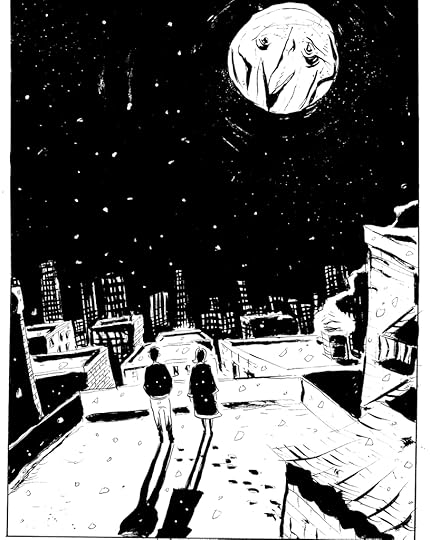
On the positive side, Lemire's creative artwork was by far the most substantial asset of this story. Beyond the fact that I found it slightly more emotive this time around (especially in old man Lou's case), Lemire's surrealistic imagery managed to invoke a much more dramatic feel this time around, and was utilized a lot more dynamically. I wouldn't have said so for volume one, but this approach made for some fairly memorable scenes throughout the book, and his mid-story covers separating the chapters were all remarkably well-done. And even more than the romantic, moonlit rooftop scene or the one where the Grizzlies tap their hockey sticks in solemn reverence, perhaps my favorite moment in the book was when Lou breaks down after recalling some bad news he received over the telephone. I don't want to spoil it by getting into a whole lot of detail here, but I will say that the execution is sharp in its poignancy, and is also one of the many instances of near-flawless narrative transitions between Lou's flashbacks and the present time.
Another great thing about this volume is that, with Lou, it allowed Lemire to introduce the strongest character featured in the title thus far. For most, I imagine it'd be pretty easy to get behind the longing, helplessness, and loss of independence that has characterized much of Lou's present existence, and one can't help but feel sorry for him. But while it's sad to see just how incapable of self-care his condition has made him, it also allows Lemire to write and draw the character as very endearing (in an adorable kind of way). I especially liked the scenes of him interacting with the nurse, and it was somehow both amusing and tragic to witness his futile objections and perpetual confusion. And the themes of loneliness, acceptance, guilt, and forbidden love from Lou's past managed to carry the narrative along in an intermittently compelling fashion.
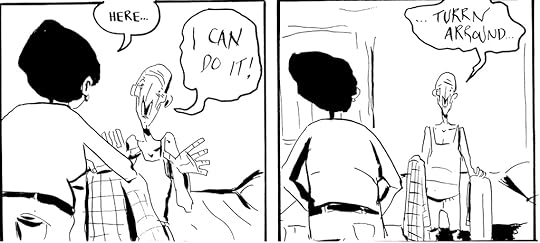
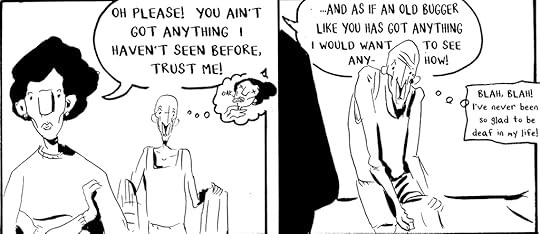
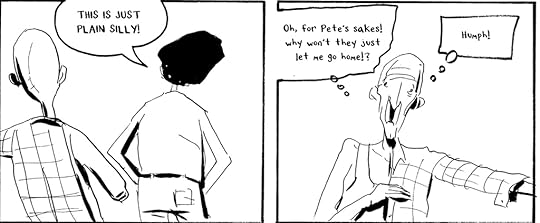
But I really didn't get the need for stretching the story out so long. Even though Lemire had a comparably simple story to tell with Ghost Stories, this book turned out to be twice as long as volume one! I really feel like without that extra padding, it could've pulled off a half-star advantage over the previous one. Aside from the unexceptional hockey segments – which I struggle to see how they'd be particularly engaging unless you're a hockey fan – there were quite a few scenes and conversational exchanges which fell kinda flat. And if Lemire truly is, as Darwyn Cooke has claimed, a "haunted man," his plain writing certainly doesn't do all that much to reflect the boundless emotional depth he's supposedly gained over the course of his life. Now I don't mean to imply that the quality was poor, but that kind of basic and unadorned writing style seemed much better suited for the one-on-one dialogues than it did for the group conversations included here. Partly because of this, characterization for rest of the cast was quite thin, and even Vince lacked a bit of substance.
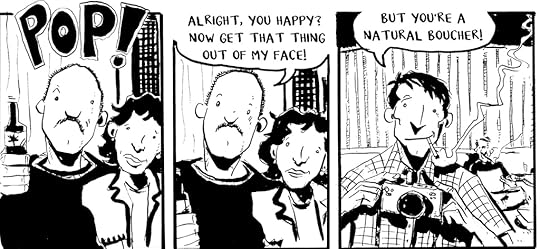
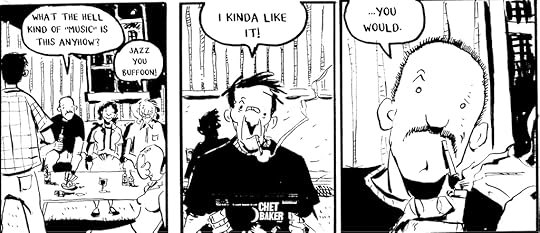
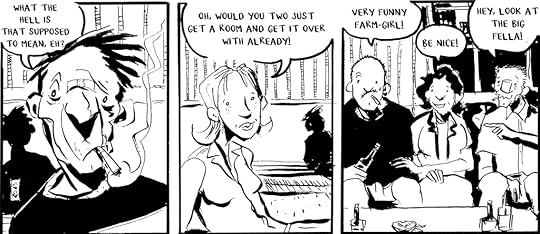
[None of the scenes featuring characters other than Lou and Vince got much more interesting than this. And while the group conversations were the weakest, many of the two-person exchanges were pretty lukewarm as well. Again, this isn't bad writing, but it surely doesn't do a whole lot to impress or amuse.]
And getting back to the point I started to make before, this book was only occasionally moving. While I'm honestly convinced the writer had a worthwhile story to tell here, the emotional impact was diluted when he decided to stretch its finite potency over half a lifetime. This meant that, situated between significant plot points, we get a rather mundane series of scenes which tended to be one (or more) of the following: Lou performing daily tasks, expository segments filled with thought bubbles or narrative boxes, or Lou engaged in brief and humdrum dialogue with somebody else. To Cooke, these "innocuous and seemingly unconnected" moments "gather and gain weight when viewed in a cumulative light." But to me, this was true only up to a point, and just a handful of these moments were independently interesting. Generally, it takes a talented author with a great mastery over written language to be able to consistently forge beauty out of the ordinary, and sadly, it's very clear to me that Lemire simply isn't there yet.
But looking back on it, I'm sure a lot of the time I saw as wasted was actually necessary to give readers a more gradual perception of time; given the story's setup/premise, we needed the opportunity to fully inhabit each of the major eras in Lou's life before ultimately arriving to his present circumstance. And admittedly, one of the benefits of spending so much time alternating between time periods was probably to avoid beating us down with the gloom and dreariness of dementia, so I can definitely appreciate the sentiment. However, I would've actually *preferred* a more intense focus on how exactly Lou's condition affected his life, and I very much enjoyed watching him inhabit that ambiguous space of being both child-like and adult. These present time segments were also much simpler and more intimate, so they played better to Lemire's artistic talents than did the past time segments, which often were quite hectic and impersonal by comparison.
So overall, Ghost Stories was a more uneven production than I was expecting, but it also proved that Lemire has a bit more creative range than I thought he did. And I figure since I've already read two-thirds of the Essex County series, I might as well check out the final book to see if he could surprise me again. Besides, neither of these first two volumes were a chore to read, and I suppose they're a pleasant enough way to kill some time at least.
Postscript:
Just as with Tales from the Farm, I think I'll just devote this section to another thematic analysis of the book.
If you really look closely, there's a whole lot of implicit meaning you can derive from the story. And like I said in my previous review – and as Jake and Sridhar state in their current ones – EC really seems to be a series that relies on the readers' personal experiences and compassion to carry out much of the heavy lifting, and Lemire doesn't do quite as much as other writers to uniquely personalize his characters. So for me, rather than put me in awe, reflection on these stories only serve to make me mourn how great this book *could* have been if the writer had only pulled his weight. But whatever. Let's get on with the analysis, shall we?
As much as I love this interpretation, it's one that I really had to work for, and I'm not convinced I should have had to do quite so much reading into it. So I'm not sure, but I've got a sneaking suspicion that Lemire himself may not have planned anything quite that sophisticated. All I know is, there's no way I can give him too much credit for it.
Book Info: This collection contains Essex County issue #2.
ABSOLUTE RATING: {3+/5 stars}
STANDARDIZED RATING: <3/5 stars>
"It was kind of neat sitting behind the glass, watching the city go by. And I liked having the same route each day... no surprises. Only one path I could take. Routine helps to hide the loneliness I guess. I'll admit, as much as I tried not to, I thought about Vince a lot... I wondered if he was as lonely as I was. You know, there are only two ways to be completely alone in this world... lost in a crowd... or in total isolation. And, even though I wondered if he was lonely too... Deep down I knew he wasn't."
– Lou Lebeuf
In this second installment of Essex County, we're introduced to Lou and Vince Lebeuf – two semiprofessional hokey jocks playing for the Toronto Grizzlies. Anyone who recalls Jimmy's character in Tales from the Farm might already be familiar with the name "Lebeuf," and you can expect to see some further exploration into that character's history. But really, the central character here is Lou, and though more than half the story is set in the past (somewhere between 1951 to the early oughts), he seems to be narrating it as an elderly dementia sufferer roughly a decade into the 21st century. So when we're not watching Lou confusedly stumble through his days at a nursing home or under supervised care, we're seeing the nostalgic flashbacks to his past, which are memories tinged both with triumph and tragedy.
After finishing Tales from the Farm, I've been on the fence about whether I should revisit the Essex County trilogy. Now, three months later, I think I can say I'm about halfway glad that I did. So although Ghost Stories wasn't quite good enough to get me on the Lemire bandwagon, it showed another part of the writer I hadn't seen showcased in the previous installment. But the fact that this second volume of EC is so different from the last one in many respects proved to be both beneficial and harmful.
On the positive side, Lemire's creative artwork was by far the most substantial asset of this story. Beyond the fact that I found it slightly more emotive this time around (especially in old man Lou's case), Lemire's surrealistic imagery managed to invoke a much more dramatic feel this time around, and was utilized a lot more dynamically. I wouldn't have said so for volume one, but this approach made for some fairly memorable scenes throughout the book, and his mid-story covers separating the chapters were all remarkably well-done. And even more than the romantic, moonlit rooftop scene or the one where the Grizzlies tap their hockey sticks in solemn reverence, perhaps my favorite moment in the book was when Lou breaks down after recalling some bad news he received over the telephone. I don't want to spoil it by getting into a whole lot of detail here, but I will say that the execution is sharp in its poignancy, and is also one of the many instances of near-flawless narrative transitions between Lou's flashbacks and the present time.
Another great thing about this volume is that, with Lou, it allowed Lemire to introduce the strongest character featured in the title thus far. For most, I imagine it'd be pretty easy to get behind the longing, helplessness, and loss of independence that has characterized much of Lou's present existence, and one can't help but feel sorry for him. But while it's sad to see just how incapable of self-care his condition has made him, it also allows Lemire to write and draw the character as very endearing (in an adorable kind of way). I especially liked the scenes of him interacting with the nurse, and it was somehow both amusing and tragic to witness his futile objections and perpetual confusion. And the themes of loneliness, acceptance, guilt, and forbidden love from Lou's past managed to carry the narrative along in an intermittently compelling fashion.
But I really didn't get the need for stretching the story out so long. Even though Lemire had a comparably simple story to tell with Ghost Stories, this book turned out to be twice as long as volume one! I really feel like without that extra padding, it could've pulled off a half-star advantage over the previous one. Aside from the unexceptional hockey segments – which I struggle to see how they'd be particularly engaging unless you're a hockey fan – there were quite a few scenes and conversational exchanges which fell kinda flat. And if Lemire truly is, as Darwyn Cooke has claimed, a "haunted man," his plain writing certainly doesn't do all that much to reflect the boundless emotional depth he's supposedly gained over the course of his life. Now I don't mean to imply that the quality was poor, but that kind of basic and unadorned writing style seemed much better suited for the one-on-one dialogues than it did for the group conversations included here. Partly because of this, characterization for rest of the cast was quite thin, and even Vince lacked a bit of substance.
[None of the scenes featuring characters other than Lou and Vince got much more interesting than this. And while the group conversations were the weakest, many of the two-person exchanges were pretty lukewarm as well. Again, this isn't bad writing, but it surely doesn't do a whole lot to impress or amuse.]
And getting back to the point I started to make before, this book was only occasionally moving. While I'm honestly convinced the writer had a worthwhile story to tell here, the emotional impact was diluted when he decided to stretch its finite potency over half a lifetime. This meant that, situated between significant plot points, we get a rather mundane series of scenes which tended to be one (or more) of the following: Lou performing daily tasks, expository segments filled with thought bubbles or narrative boxes, or Lou engaged in brief and humdrum dialogue with somebody else. To Cooke, these "innocuous and seemingly unconnected" moments "gather and gain weight when viewed in a cumulative light." But to me, this was true only up to a point, and just a handful of these moments were independently interesting. Generally, it takes a talented author with a great mastery over written language to be able to consistently forge beauty out of the ordinary, and sadly, it's very clear to me that Lemire simply isn't there yet.
But looking back on it, I'm sure a lot of the time I saw as wasted was actually necessary to give readers a more gradual perception of time; given the story's setup/premise, we needed the opportunity to fully inhabit each of the major eras in Lou's life before ultimately arriving to his present circumstance. And admittedly, one of the benefits of spending so much time alternating between time periods was probably to avoid beating us down with the gloom and dreariness of dementia, so I can definitely appreciate the sentiment. However, I would've actually *preferred* a more intense focus on how exactly Lou's condition affected his life, and I very much enjoyed watching him inhabit that ambiguous space of being both child-like and adult. These present time segments were also much simpler and more intimate, so they played better to Lemire's artistic talents than did the past time segments, which often were quite hectic and impersonal by comparison.
So overall, Ghost Stories was a more uneven production than I was expecting, but it also proved that Lemire has a bit more creative range than I thought he did. And I figure since I've already read two-thirds of the Essex County series, I might as well check out the final book to see if he could surprise me again. Besides, neither of these first two volumes were a chore to read, and I suppose they're a pleasant enough way to kill some time at least.
Postscript:
Just as with Tales from the Farm, I think I'll just devote this section to another thematic analysis of the book.
If you really look closely, there's a whole lot of implicit meaning you can derive from the story. And like I said in my previous review – and as Jake and Sridhar state in their current ones – EC really seems to be a series that relies on the readers' personal experiences and compassion to carry out much of the heavy lifting, and Lemire doesn't do quite as much as other writers to uniquely personalize his characters. So for me, rather than put me in awe, reflection on these stories only serve to make me mourn how great this book *could* have been if the writer had only pulled his weight. But whatever. Let's get on with the analysis, shall we?
As much as I love this interpretation, it's one that I really had to work for, and I'm not convinced I should have had to do quite so much reading into it. So I'm not sure, but I've got a sneaking suspicion that Lemire himself may not have planned anything quite that sophisticated. All I know is, there's no way I can give him too much credit for it.

May 29, 2017
I was hesitant to complete Ghost Stories after finding that it was going to focus on sports, specifically hockey. But, the complexity of the narrative structure, the poignancy of the story and connection to the first Essex County graphic novel were compelling enough to make me forget my ambivalence regarding athletics. I finished this volume over my oatmeal and had to fight back tears as the novel came to a close. Two brothers who bonded over hockey are bitterly separated for twenty-five years after a wintry tryst on a rooftop in Toronto involving Lou and Beth, Vince's wife. Lou, mostly deaf and hiding alcohol in peanut butter jars, drifts through memories of his lonely life once a knee injury prevents him from achieving his dreams of playing for the NHL. His nurse Annie inevitably finds him unable to care for himself and puts him in an elder care community home, but he escapes into his solitude where the only company are his vivid memories of the past and the omnipresent black birds of Essex County.
This entire review has been hidden because of spoilers.

October 31, 2017
Upon exiting the Media Center, I spied a graphic novel and being the eve of Halloween, thought, perfect for Halloween!
Jeff LeMire's Ghost Stories caught me off guard, because, yes. ghosts exist, but in this case, with a mix of Canadian hockey, family, and farming! Farming? This is the second in a series of three by the same author, and I jumped right in the middle of this story.
Yes, the two do not sound as if the go together, but, once you find out how life, choices, hockey, and living out the remainder of your life based on those choices fitting together. Not necessarily always positive, the choices and how life can play out sets a tone both optimistic and pessimistic which is easy to follow through some very detailed illustrations and graphics. I fell into the plot easily and found it difficult to find the positive way out, which is true sometimes in life. There are certainly ghosts these characters carry with them and that come out from the pages.
Jeff LeMire's Ghost Stories caught me off guard, because, yes. ghosts exist, but in this case, with a mix of Canadian hockey, family, and farming! Farming? This is the second in a series of three by the same author, and I jumped right in the middle of this story.
Yes, the two do not sound as if the go together, but, once you find out how life, choices, hockey, and living out the remainder of your life based on those choices fitting together. Not necessarily always positive, the choices and how life can play out sets a tone both optimistic and pessimistic which is easy to follow through some very detailed illustrations and graphics. I fell into the plot easily and found it difficult to find the positive way out, which is true sometimes in life. There are certainly ghosts these characters carry with them and that come out from the pages.
Displaying 1 - 30 of 157 reviews