From the revolutionary camaraderie of the Colonial taverns to the saloons of the turn of the century; from a Prohibition period rife with class politics, social reform, and opportunism to a trail of nightclub neon so vast, it was called the Conga Belt, Drinking Boston is a tribute to the fascinating role alcohol has played throughout the city's history. Teasing out this curious relationship in particular, the clash between a constrained Puritanism (lingering like a hangover today) and a raucous revolutionary spirit, Drinking Boston introduces the cast of characters who championed or vilified drinking and the places where they imbibed legally and otherwise. Visiting some of Boston's most storied neighborhood bars, this pub crawl ends with Boston's distinct recipe for the current cocktail renaissance sweeping the nation. Stephanie Schorow serves up a remarkable cocktail representative of Boston's intoxicating story: its spirit of invention, its hardscrabble politics, its mythology, and the city's never-ending battle between personal freedom and civic reform.
Stephanie Schorow is a Boston-area reporter and writer. For 12 years she toiled as a features editor and ink-stained scribe for the Boston Herald until she struck out on her own as a freelance writer in 2005. Her articles now regularly appear in the Boston Globe and other publications.
Since Boston has the dubious honor of coming in first place on the Daily Beast's 25 Drunken Cities list for two years in a row and I regularly enjoy the pleasure of working, eating, and drinking there, I knew this book would be right up my alley.
This is a very well laid out chronology of Boston’s drinking history starting with the city’s revolutionary past and Prohibition and continuing with a detailed exploration of the city’s changing landscape, the public’s drinking tastes and habits, and an interest in classic drinks while inventing new creations using a variety of ingredients not available in years past. It covers saloons, taverns, nightclubs, jazz bars, gay bars, dive bars, and today’s neighborhood eateries that serve craft cocktails.
The mention of Cocoanut Grove’s tragic fire in 1942 that killed 492 people makes me want to visit its former location and explore the subject further, since it is a part of the city’s history I wasn’t aware of.
One of Boston’s oldest surviving bars is Jacob Wirth’s. I enjoyed reading about how it survived Prohibition by serving “near beer” that had less than .5% alcohol and loved how customers celebrated Repeal at Jacob Wirth’s even though the establishment had not yet obtained a liquor license.
Getting smashed at Jacob Wirth's (est. 1868)
It was also interesting reading about McGreevy’s (formerly called the Third Base Saloon), a long-standing sports bar and baseball museum that is now owned by the Dropkick Murphys. Even though I’m not into sports bars, I’m tempted to visit just for its history.
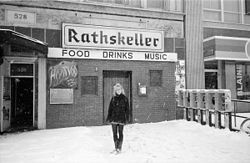
Reading about some of the bars that have come and gone made me a little nostalgic for the Rathskeller (known as The Rat), a punk club in Kenmore Square known for its music scene, sticky floors, and fights. I remember seeing The Neighborhoods there in the early 80’s.
Along with the history, there are lots of interesting black & white photos and illustrations. Each chapter concludes with a drink recipe.
This is a thoroughly enjoyable and comprehensive history that I was glad to find at the library.
Drinking Boston is a jaunty trip through the city's history from inside its bars, taverns, breweries and even prisons. Carefully researched and can be used as a reference and even a cocktail recipe book.
I picked this up at an author signing that I really only went to because I liked the restaurant that was hosting the signing and wanted to get free drinks and appetizers. The signing was an overcrowded disappointment, but the book actually turned out to be pretty good.
I expected it to be little more than a collection of anecdotes about Boston bars, padded with recipes, but Schorow actually provides an excellent history of Boston's taverns, bars, and breweries. Of course she talks about speakeasies, Prohibition, and the current craft cocktail renaissance, but I found the sections about Revolutionary-era Boston to be the real eye-openers.
As with any book of this type, I sort of got the impression that the author's own interests end up dominating her account (beer seems to get short shrift), but I don't feel she ignored all that much. Probably not of much interest to non-Bostonians, though.
Informative and cool but it was just too boring for me. And the chapters were long. I don't mind long chapters, but if they're long boring chapters... ARG!
An interesting history of alcohol usage and sales in Boston up to the present day. A lot of compelling info about the Boston party scene throughout the last century.