It is the dawn of World War I, and Sherlock Holmes has been dead for 20 years. Professor James Moriarty is a lost man, but he's called back into the fray when MI5 blackmails him into finding Holmes' long-lost brother, Mycroft. What at first appears to be a routine case leads to a web of intrigue that involves a psychic box and its creator, a woman from Moriarty's past, and a new villain that threatens to be greater than Moriarty ever was! This deluxe, hardcover edition collects Moriarty #1-9, the first and second story arcs of the acclaimed series ("The Dark Chamber" and "The Lazarus Tree").
20 years after the death of Sherlock Holmes (hope that’s not a spoiler), James Moriarty has sunken into a melancholy existence on the shadowy streets of the city of London. Withdrawn, he has little interest in the world around him as it teeters on the brink of the largest war in history, content to mind the small portion that remains of the vast criminal underworld he once controlled. That is, until ghosts from his past return to drag him from the obscurity in which he has settled and back into the city’s contemporary nether world.
Sounds pretty fuckin’ good to me. Probably why I’m not 100% sure I didn’t fall in love with it. It started strong. Some familiar characters from Holmes’ prior stories and world history made appearances and that was pretty cool. I genuinely liked Moriarty as the protagonist here. But Daniel Corey’s book fell off its pace at about the midway point and never seemed to get back on track after that. The 2nd half had more of a bizarre paranormal vibe that I never bought into and didn’t enjoy it as much as the beginning of the book. Not bad, but not to my taste. I think I would’ve preferred it stayed more of a mystery rather than goin’ all X-Files.
Artistically, Anthony Diecidue was my favorite of the 3 illustrators that contributed (the others being Mike Vosburg and Perry Freeze). Diecidue’s sketchy style was the real reason I picked this one up. It simply appealed to me. Vosburg and Freeze’s styles were close enough to Anthony’s to keep it from being jarring during the changes, but I still noticed the differences immediately and neither charmed me the way Anthony’s did.
Overall, I got this book dirt-cheap and it was worth the cash. Probably would’ve been more disappointed had I paid full price. I'd recommend this one to fans of Arthur Conan Doyle’s original detective. I think they'd appreciate what Corey did with Doyle's characters here more than most.
(nb: I received an advance review copy from the publisher via NetGalley)
Sherlock Holmes has been dead for twenty years, and there's nobody to rein in Professor James Moriarty. Can the world still be standing?
The answer is yes. There was something life-affirming for Moriarty in having an opponent as worthy of Holmes. With his arch nemesis gone, life just isn't as much fun; the challenge is gone. In fact, we find ourselves wondering if Moriarty was necessarily “evil” at all—he was just playing black to Holmes’s white in an ongoing game of chess. This deluxe edition of “Moriarty” features both of the “Moriarty” stories, presented beautifully.
When we meet Moriarty here, he’s given up his old life. Without Holmes as his opposite, he’s grown bored. He leaves Professor James Moriarty behind, and works under the name “Trumbold,” doing small investigations for mainly criminal elements. It’s intellectual scut-work at best, and it pays far less than masterminding all of Europe’s criminal underworlds. He’s slumming it, and he knows it.
One day, he stumbles onto a real mystery with worthy adversaries. He’s forced to rekindle some of his underworld acquaintances, and he finds himself stimulated for a change. Another genius scientist—one of Moriarty’s former colleagues at Durham University—has developed a device that can show people the darkest secrets of their pasts, as well as horrors from their futures. Twists and turns abound, as Moriarty wracks his brain to find this device before it can be used to destroy London.
In the second story, we’re off to Burma, where Moriarty is looking for a missing colleague. He stumbles into chaos, with opium trafficking, Colonial oppression, mysterious shootings, and a tree that just might have unimaginable mystical properties. Moriarty has to rely on his guts and considerable intellect to survive.
Professor James Moriarty has always been one of the most underappreciated characters in literature. For many, he was simply Sherlock Holmes’s intellectual punching bag, but there was more to him than that. The guy wasn’t Snidely Whiplash, for crying out loud. He created plots and schemes that were so deeply intricate that only Sherlock Holmes could solve them. It’s easy to imagine how frustrating it must have been to be the most-intelligent man alive, EXCEPT for Sherlock Holmes.
From these two excellent stories, we see the same Moriarty—the lover of puzzles and mysteries—just working from the other side.
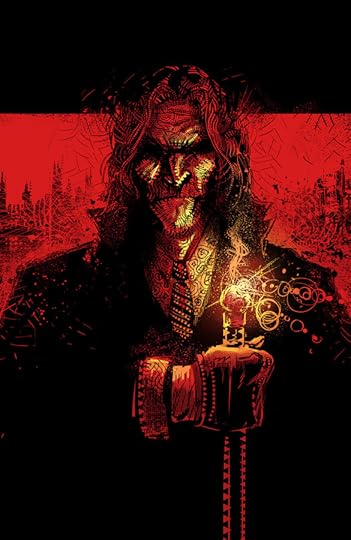
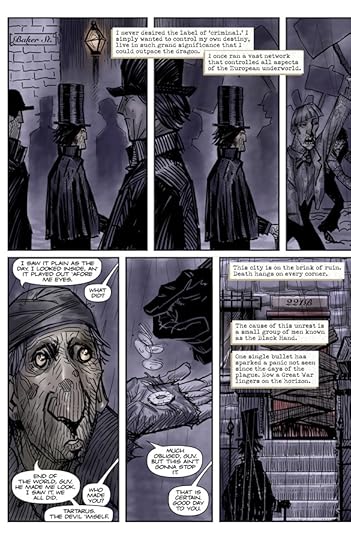
The two story arcs in “Moriarty” are creative and interesting, and I like what author Daniel Corey does in this counterintuitive take on Professor James Moriarty. The artwork, led by Anthony Diecedue (with Mike Vosburg, Perry Freeze, and lettering by Dave Lanphear), gives the feeling of old London. The images suggest dim lighting and fog. The faces are almost gaunt, all sharp edges and planes, full of menace.
The combination of story and illustration mesh perfectly, making “Moriarty” a dark joy of a graphic novel, with an unusually literate flavor.
Moriarty Deluxe edition combines comics 1-9 (giving a LOT of great reading) into one deluxe edition.
Although Moriarty features only a little in Doyle's Sherlock Holmes, he is given a full treatment here. The mastermind who would rule the world is instead left a broken man after the incident at Reichenbach Falls - where Moriarty and Holmes both believe the other is dead and both disappear from society. The story picks up decades later, at the cusp of World War I, and features two stories. One story involves an arcane society in London with a machine that can photograph the future, the search for Holmes' brother, and a plot to murder the Archduke Ferdinand (beginning World War I). The second story continues to Burma and Kingston, Jamaica, and once again concerns missing men. Both stories are linked quite effectively and Moriarty's continual denouement into madness after the loss of his arch nemesis (who he dreams is not truly dead) take hold.
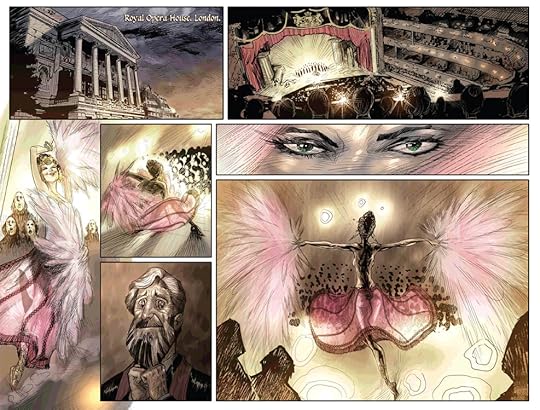
The illustration style is dark and murky - a cross between finished line drawing and original sketches. Although in color, the colors are very muted and panels have a monochromatic feeling. As well, the illustrators greatly makes use of shadows and indistinct features to further the story. This creates a great gothic moodiness that suits the storyline and echoes Moriarity's own conflicted psyche. If I have one complaint, it's that the illustrator didn't do his homework and shows women wearing 1880s clothing in the 1910s. It was a bit too anachronistic and felt sloppy.
The writing is intelligent, layered, and nuanced. Moriarty is intelligent, plans effectively, but not omniscient. Nor omnipotent - he uses lackeys well as a means to his ends. Although the artwork did take a bit to acclimate (especially if one is used to clean and bright modern comics with finished lines), once reading, this is a meaty book that rewards upon rereads. It's not a quick 30 minute glance through and then toss it on the shelf kind of book. It really is a unique and fascinating character study with involved mysteries and even action as Moriarty often has to use his sword-cane to extricate himself from situations. And some historical names will crop up like Mara Hari, adding to the authenticity of the storytelling.
I found this to be quite inventive and very engaging. The writing was solid and worthy of a full novel treatment. Both stories were distinct but also furthered the character development and plot points, despite each having their own arc.
In all, highly recommended. Provided by the publisher as an ARC
Moriarty is a collection of the graphic novel series written by Daniel Corey about the Sherlock Holmes' archnemesis set in the backdrop around the WW1 era and two decades after the 'Reichenback Falls'. After Holmes' death, Moriarty have been living under unassuming name, living as an investigator and involved in trade businesses and neglected his broken crime empire since he had lost his motivation or called his 'dragon' which drove him on as the notorious Professor Moriarty. However, while war is looming ahead, he was approached to find the missing Mycroft Holmes and found himself facing another 'dragon' hell-bent on destroying the world.
I noticed there was two element at work here, Corey's compelling prose and artworks by Anthony Diecidue, Mike Vosburg & Perry Freeze which translates into a very dark gothic horror atmosphere of the novel and a story about a broken man finding his purpose to be alive again. "Moriarty" is about the an anti-hero side of the renown criminal genius and his story where we were able to glimpse into his dark mind and the dangerous world he's living in which is a shade of grey where even the good guys doesn't seem to be good either. Despite being older and haggard than the person he once was, he was no less dangerous opponent in this re-imagined universe. Admittedly, the story were more similar to Guy Ritchie's Sherlock Holmes movies. The artwork in the novel were adult, heavily noir, action packed and carry some Asian exoticsm in the mix like the second episode of BBC's Sherlock Holmes. Its definitely not a lighthearted novel, and despite being coloured, the stroke made the graphic novel accessible in grayscale and quite similar in style to Neil Gaiman's Sandman series. There were some moment where it does get predictable, deary and convoluted with action and violent scenes but the dense written part kept me going to the end. The graphic novel seemed to skewed more towards the novel part than the graphics which at some time seems to be more of a sketch to be consistent through the novel.
However, I really like the idea of Moriarty's side of the story and I think the graphic novel would be even more successful if being adapted in the big screen. Preferably by Doug Jones, obviously.
The ARC is provided by the publisher via Netgalley in exchange for an honest review
I am not a Sherlock Holmes aficionado, but I do enjoy Holmes and gang, I love the deduction and being involved in figuring out the puzzles. This book isn’t about Holmes, not directly, this graphic novel follows Moriarty 20 years past the death of his arch nemesis, Sherlock Holmes. At first I didn’t really enjoy it, the art was odd to me, and getting inside of Moriarty’s head is equally strange, especially seeing as he really isn’t how I expect him to be. Honestly the afterward of this book says exactly how I feel about Moriarty. This book shows a post-Holmes Moriarty, not as a bad guy, though he’s not a good guy either, but he seems to almost take up Holmes’ mantle, follow in the footsteps of deductive reasoning and mystery solving. Though in a twisted and dark way. The art, like I said, hated it at first, it felt rough, it felt rushed, but as I read on it grew on me and now I find it lush and beautiful. The art should be rough, it’s a rough story Moriarty is a rough character who’s been through a lot and has so much going on that the art fit him perfectly. I love the idea, now, of getting to see a new version, a new perspective on the characters of Conan Doyle. I think this is a must for fans of this genre, it’s beautiful art and interesting story lines (2 different arcs) draw the reader in and captivates them. Loved it.
I did receive this book for free for an honest review!
I loved this book. The story was creative and the artwork is gorgeous. It was nice to see a character who is so flat in the canon become a dynamic antihero. Any Sherlockian would enjoy this read.
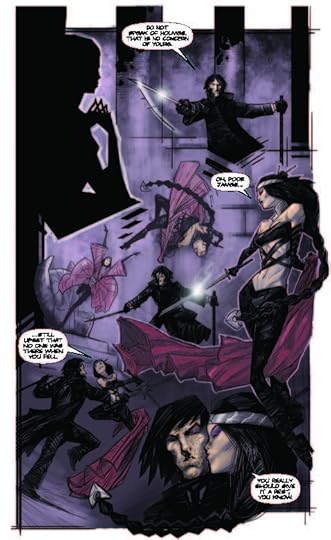
Two quibbles. The first is that the character the Jade Serpent is dressed like a dominatrix. Which would be fine were she a dominatrix. But she's supposed to be a badass swordfighter. I think the outfit she has on wouldn't even allow her to tie her shoes much less kick ass with a sword. This is the standard complaint I always have about comics, though. Women in ridiculous revealing "I'm nothing but eye candy" clothes. Lady needs more practical clothes. These are the early 1900s, after all. She should be dressed more like Moriarty.
The second is that when the Jade Serpent first speaks to Watson, she comments that he is not nearly as fat as the Strand illustrations lead us to believe him to be. Watson is trim in the Strand illustrations; fat Watson doesn't come into play until Nigel Bruce's portrayal in the 1940s films. I have to mention this because I am a Watson fangirl and a HUGE NERD.
Otherwise, A plus plus. I certainly hope the series continues.
I bought this at a sale mostly based on the fact that I like Professor Moriarty and I'm always intrigued by adaptations that put him into the role of protagonist. The book starts off fairly strong, and I think Corey writes the character well, with a complex inner monologue and interesting motivations (I quite enjoyed the emphasis on Holmes and Moriarty as mirrors of each other, and Moriarty feeling adrift in a world without him.) What I don't like is the entire rest of the story. There are main characters apart from Moriarty: people do move in and out of his story, but they're never well developed and usually irrelevant. Watson turns out of nowhere at really random moments and never does anything. The only exception is a ninja lady who accompanies Moriarty in the first volume, and she irritated me to no end. Basically she existed to walk around half-naked and kill people for him, then she vanished without any explanation between the two volumes. That's it's for characters. The plot itself leans heavily on obscure mysteries and the boundaries between science and magic. There's a box to see the future and a tree to resurrect dead people. Neither plot point is executed very well. Things are not explained, or they're boring. Moriarty's journey is often not well motivated. The action scenes bored me because I didn't enjoy the style they were drawn in. I think I would recommend this for people who like the art style (I didn't), and are interested in the themes, and for literally no one else.
This entire review has been hidden because of spoilers.
“Then one day the dragon had a face. I looked deeply into that face…and I killed it. For a moment, it seemed I had escaped death, and was born again. But then I realized…it is the fear of death that really makes you alive…” Moriarty in Moriarty written by Daniel Corey
The first story arc, The Dark Chamber, starts right after the murder of the Archduke Franz Ferdinand, on the precipice before World War I. It has been 20 years since Sherlock Holmes died at Reichenbach Falls (and he hasn’t been resurrected 3 years later in this version), and Professor James Moriarty hasn’t been the same since. Now going by a number of aliases, Moriarty has given up his criminal empire and operates a much smaller dock-side operation that functions more like a private investigator. Just as Moriarty starts to poke into the cause of the Archduke’s assassination, MI5 (a secretive spy network run by the government) blackmails Moriarty into looking for Mycroft Holmes, Sherlock’s brother, who has disappeared. Moriarty must call upon people from his old life, and reawaken his old skills as he falls down into a strange world where science is mixed with Greek mythological code names. Can he stop the mysterious man behind it all, and can he find a way to truly live again?
The second story arc, The Lazarus Tree, picks up right where the previous one ended. Now Moriarty must deal with the mysteries that arose from his previous case. He must deal with the images from his past and the premonition about his death. Out in the tumultuous land of Burma, can Moriarty continue to find the control he always needed in his life, and what does the ghost from his past mean?
Besides my subscription to the Batwoman comics, I am not usually one for American styled comic books; instead, I tend to prefer the Japanese (manga) comics. However, when I saw that there was a comic called Moriarty on Netgalley, I downloaded it immediately. Sherlock Holmes is one of my favorite characters, and his nemesis Professor Moriarty is one that has intrigued me in so many versions. I was able to read through the two-story arc comic in one day, and honestly, I could not put it down once I had started reading.
I will be the first to admit that I love an anti-hero or a more neutral villain (sometimes even a real villain), so this book was perfect for me. I loved the character of Moriarty, mostly for all the same reasons I have always loved Sherlock Holmes. We are able to see how brilliant Moriarty is, and in The Lazarus Tree, we can see just how vast his network had been before the Reichenbach Falls. Around Moriarty, Holmes’s ghost is palpable. Without the consulting detective around there is no one that can challenge Moriarty, and he cannot function without that perfect nemesis. It was strange to see the story from the other side, since there are so many versions from Holmes’ point of view. In a way, Moriarty appears broken, and a man looking for some sort of redemption. It would be a mistake to think that Moriarty is a hero, but he will save some people, and he will stop plots to destroy the world. There is a moral ambiguity to him that is interesting, as you are never sure that he won’t just kill someone nor do the ‘evil’ thing. This is a wonderful freedom that you get when a character is not actually a hero!
As far as the mystery goes, I will admit, I am still not sure I followed everything. Usually this would bother me, I usually like to be able to figure everything out at the end, but with this story, I was okay with it. Most of this is because the author and artists blended Arthur Conan Doyle’s world with science and Greek mythology. There are supernatural elements, and these leave you wondering what really happened, and if the magic is really there or not.
I found the first story arc easier to follow. However, I think I liked some of the revelations from the second story arc better. The trouble with the second arc was that at times it was hard to tell what was a dream and what was reality. While I think this is purposefully done to reflect what is happening to Moriarty, it still is a bit jarring. There are also times when it is hard to tell whether Moriarty is talking or someone else. I am still not sure, looking back, what the actual reality is, but I think if the series continues it will become clear.
The artwork is very different from the Japanese styles that I tend to prefer, but the grittier artwork was perfect for the story. Moriarty is a hardened man, and there is a roughness about his face, yet he can still walk in the refined society. His appearance reminds me a bit of Wolverine from the X-Men, with his hair and stubble. For the most part, Moriarty is in a three piece suit, but in fights, he will take off the jacket and sometimes the waistcoat. His weapon of choice is a sword, not a rapier but more of a Japanese katana (a samurai sword), which is unusual but a perfect fit for his character.
There were parts that I wasn’t as fond of in the story. The first is that the timing seemed a bit off. I know that for it to be set on the eve of World War I, twenty years need to have passed, however things don’t feel like that. Instead, Moriarty still seems at the top of his game. Even if he was in his 20s when he fought Sherlock, this would make him at least 40, and realistically he is probably closer to 60 at this point. So to see him racing around, fighting, and surviving explosions was a bit unrealistic to me. There is also a lady that he supposedly knew in his former life, and she did not look even close to 40, yet should have been. However, none of this ever really detracted from the story.
I did love the emergence of characters and plot pieces that I recognized from the original Sherlock Holmes stories. There are at least 4 characters that I recognized from the cannon stories, and at least one great mention of starting a Red-Headed League! Overall, I want to buy this book, and re-read it many times! I will be on the lookout for the continuation of this series, as I think there is so much potential still.
Final Verdict: A great reimagining of a classic character with a complicated plot and intriguing art. Not for everyone, but a delight for those who love anti-heroes.
What if Holmes died at Riechenbach Falls and Moriarty didn’t? And Moriarty decided to be a Holmes for the underworld, solving little mysteries for criminals and finding keys to small treasures. That’s what Moriarty was doing for 20 years, but puzzlingly we start after that when Moriarty gets dragged into some extremely complicated quasi-supernatural plots involving world domination. Personally I would much rather have read the ‘Moriarty as the underworlds Holmes’ stories. Artwork was well done, a bit on the crazed scribbling side at times, but it suited the story.
Unfortunately this book was merely ok to me .Mostly the art style was the deterrent for me , it did help to engage in the story. It was nice to have familiar characters to help the story develop .Maybe I was expecting to much for such a mastermind genius character.
Confusing, hard to follow, action- and fight-oriented when it's not being pretentiously mystical. If you're writing a story about a twenty-years-older Moriarty trying to find his place in the pre-World War I era, given his age, then you shouldn't have him jumping around like an action hero.
Moriarty is a deluxe hardbound graphic novel that contains the first two story arcs from the Image comic book (The Dark Chamber and The Lazarus Tree). Sherlock Holmes inspired stories aren't exactly a rarity and this particular series claim to uniqueness is the focus not on Holmes, but rather on Professor Moriarty.
The story starts some 20 years after Moriarty has faced and killed Holmes at the Reichenbach Falls. After this encounter it seems that Moriarty has essentially lost his purpose in life and falls into a sort of shabby imitation of Holmes own _consulting detective_ function only for the less legitimate side of society. But now there seems to be a new master criminal on the scene and the British Government pull Moriarty back into action.
Writer Daniel Corey treads a fine line here, acknowledging that Moriarty has very little in the way of morals while still presenting things in a way which make us want him to succeed. Yes he's a bad guy, but maybe Watson and Holmes weren't quite as squeaky clean as we were lead to believe by those stories in the Strand?
He also really emphasizes how similar the characters of Moriarty and Holmes are with the intellect, the arrogance and the deductive powers. At times Moriarty almost feels like a stand in.
However, unlike the official Holmes stories, this is much more of an action adventure with Moriarty regularly wielding a sword and occasionally a gun. The material also delves much more into the occult without providing a scientific explanation. While this isn't very Holmes like it does fit with the creator Arthur Conan Doyle who was very interested in spiritualism.
Artwise the style that Anthony Diecidue uses is dark, distorted and almost ugly with lots of lines. Which admittedly doesn't sound very nice but does fit the tone of the book rather well. Although there are a few panels which are less than easy to follow.
As a deluxe edition there are a few extras on offer including the script of one of the issues and some artwork by other artists.
All round it makes a nice package and a good read.
Moriarty Deluxe Edition collects a series of comics about Holmes villain Moriarty and paints him as an interesting anti-hero in a world after Sherlock Holmes is gone. There are any number of projects that pay homage to Moriarty and Holmes, so it's always worth asking if we need another one. In this case, the answer is a definite yes.
20 years after Reichenbach Falls, Moriarty still founders without his greatest rival Holmes. In the first story arc, he gets word that the start of the Great War might have been caused by a group known as the Black Hand, he goes in search of them. Along the way, he looks into the disappearance of Mycroft Holmes and the mysterious and deadly Tartarus. He travels about in a series of costumes and aliases.
The second story continues from the first, but has Moriarty travelling to Burma to look into the disappearance of one of his men. There is also a mysterious tree that keeps showing up in his dreams.
There is plenty of action, and while Moriarty is never a truly good guy, he seems to be a better man than those he is pursuing. It's a huge graphic novel and a pretty engrossing story. The art is roughed out, but feels like pulp illustration, so it serves the story well, with lots of dark shadows in the panels and lines all over Moriarty's face.
I will say that I didn't love the art in this graphic novel but that's all I didn't like. I loved this twist on the Sherlock Holmes tales. I love the stories told from alternative viewpoints and this one was awesome. Of course, this story is after the end of the Sherlock Holmes stories where Moriarty has killed Holmes. In this tale, Moriarty has become a sort of anti-Holmes. He has the same powers of observation and deduction but he's morose. Well maybe not that far off of Holmes now that I think about it. He's supposed to be a super-villain but his work is not the sort that a villain would be doing. He spends this book searching for missing persons and trying to stop a war (or two). In this upside down world, the good guys are working for the wrong side and the bad guys are the heroes. It's great fun, full of wit and nerdy facts. I can't wait to get my hands on the next installment.
I probably didn't appreciate this book to its fullest effect, having lacking a comprehensive knowledge of his role in the Holmes stories, other than being the detective's match... there's also a lot that I might have missed due to my extreme sleep deprivation at the time, and if I didn't get that wrong, a lot of read between the lines moments.
This book does an excellent job of managing to make Moriarty out as a good guy while he's the same bad old man as ever. Corey, along with his fantastic drawing and coloring team brings a depraved era to life with aplomb. There's a Lovecraftian element, and Mycroft Holmes, supposedly a dullard, is more than meets the eye.
I believe if you needed a lesson in world domination a hundred years ago, this book would be a good place to start.
With such an amazingly rich well of inspiration for this book, collecting two volumes, Moriarty is dreadfully lacking cognizant storytelling. At times the book is overwhelmed with narration and others are devoid of supposition. Daniel Corey has some interesting nuggets in here but there is so much missing its hard to get into the story. It bounces many places without rhyme or reason at times and even the main plot seems to be suspect. The art is sketchy and seems right for certain scenes but others it needed to be tightened up so the reader could understand what was happening as the writing didn't do that. Overall, just a big disappointment.
I had the privilege of meeting Daniel Corey at 221b con this past April. After his panel(which I attended very hung over and in pjs) I simply had to buy this comic. And wow, am I glad I did.
Moriarty is such a beautifully versatile character, and this version of him is probably my favorite now.
The art is dark and gorgeous. The story is compelling. If I went into everything that I liked about it I'd just end up ruining it.
Basically, if you like all things Sherlock and haven't read this, you should really reconsider. :D
I love sherlock Holmes! And here he is again, or is he. The story begins after holmes and Moriarty tumble over the Reichenback Falls. Evil is afoot and a Pinkerton Agent, Chase, teams up with a Scotland Yard detective, Jones to find Devereaux a associate of Moriarty. Jones has an obsession with Holmes and uses his methods. Devereaux is an agoriphobic. Together the intrique carries on the holmes mystique.
I loved it! I want to read more. The adaptation on Moriarty's point of view was well written. I have to admit that I wasn't expecting what I got from this read and would highly recommend to fellow Sherlockians. :)
Enjoyable, at least at first, but the second half drifted into weird supernatural tales, and to my mind, wasn't as interesting. However, it's still well worth reading, just for the unusual take on the topic.
Gorgeously illustrated, but the story I found a bit muddy and confused - if we're going to revisit Moriarty in graphic novel form, I prefer The League of Extraordinary Gentlemen's take. I did appreciate the hat-tip to George Orwell's Burmese Days, though.