

What do you think?
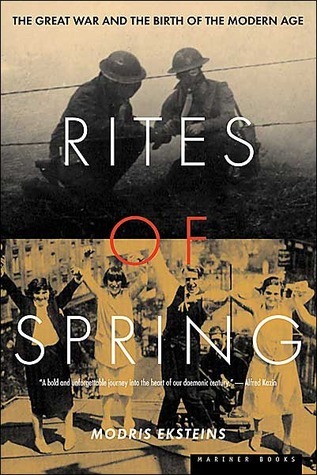
Rites of Spring: The Great War and the Birth of the Modern Age
A rare and remarkable cultural history of World War I that unearths the roots of modernism
Dazzling in its originality, Rites of Spring probes the origins, impact, and aftermath of World War I, from the premiere of Stravinsky's ballet The Rite of Spring in 1913, to the death of Hitler in 1945. Recognizing that The Great War was the psychological turning point . . . for modernism as a whole, author Modris Eksteins examines the lives of ordinary people, works of modern literature, and pivotal historical events to redefine the way we look at our past and toward our future.
396 pages, Paperback
First published April 1, 1989
About the author
Modris Eksteins
17 books46 followersA specialist in German history and modern culture, Modris Eksteins attended Upper Canada College on scholarship and then the University of Toronto (Trinity College) from which he graduated with a BA in 1965 while concurrently attaining a Diploma from Heidelberg University in 1963. He then studied at Oxford University (St. Antony's College) as a Rhodes Scholar, earning his BPhil in 1967, and DPhil in 1970. He joined the Division of Humanities at University of Toronto Scarborough in 1970, retiring as professor emeritus of history in 2010.
Ratings & Reviews
Friends & Following
Create a free account to discover what your friends think of this book!
Community Reviews
Displaying 1 - 30 of 223 reviews

June 29, 2012
I was spurred to read this book by a discussion in the History of Sexuality class I am teaching this summer. I had assigned some readings exploring how the modern West has responded to political, economic, and social changes through conflicts over sexuality and gender roles. We spent some time discussing how important World War I was as an accelerant to tensions over increased sexual freedom, the roles of the New Woman and the New Man in Western society, etc. It seemed like a good time to delve deeper in these questions, so I picked up Eksteins.
Rites of Spring is an ambitious and creative work of cultural history. In it, Eksteins creates an intricate web, combining examinations of art and literature, major episodes in European cultural history, important literary, political, and cultural figures, along with considerations of culture writ large - the public reaction to the first public performance of Stravinsky's Rites of Spring in Paris, general responses of the home front to the horrors of WWI, the sweeping public support for the Great War in Germany, the European hero worship and public hysteria over Charles Lindbergh's flight across the Atlantic. I was particularly impressed by his ability to tie literary and artistic developments with both deep-seated morals and cultural values, and political and military events. He avoids the pitfalls of some works of cultural history, which end up reading more as an annotated who's who list than a coherent discussion of the complexities of culture across a population.
Eksteins' main thesis is that the modern artistic spirit is characterized in the period leading up to WWI by a transition from art as expression of moral commitment to the past, to art as "provocation and event." (23) He depicts German society as exemplifying the modern, progressive spirit -- oriented to the future, valuing the individual's mystic connection to progress over the conservative orientation to history exemplified by France and, especially, England. Eksteins argues that WWI acted as an accelerant on modernization for France and England - although there was still a general commitment to the conservative ideals of duty, honor, and conserving traditions, by the conclusion of the War, the horrors of trench warfare and total war had called into question the relevance of the past for the present experienced by English and French veterans and their families. Eksteins continues to trace this post-war development, using it to explain the rise of a spiritual crisis in the West, marked both by repression and by resistance to repression, as shown by pitched debates over increased sexual freedom, changes in gender roles, and an overall resistance to moral constraints in the 1920s. Eksteins describes the post-WWI modern culture as follows: "There is no collective reality, only individual response, only dreams and myths, which have lost their nexus with social convention." (308) He concludes with a discussion of how Hitler and Nazi Germany rose up out of this modern sensibility.
There are some uneven sections in the book. I felt that Eksteins backed into his discussion of pre-War England, and did not develop as comprehensive a description of English culture as he provided for Germany and France. The chapter on Hitler also seemed rather rushed to me, and the one place where Ekstein fell short in his ability to make certain that the general public got equal consideration with major historical figures. As a whole, though, Rites of Spring is a deeply researched, creative, and provocative approach to cultural history. Highly recommended.
Rites of Spring is an ambitious and creative work of cultural history. In it, Eksteins creates an intricate web, combining examinations of art and literature, major episodes in European cultural history, important literary, political, and cultural figures, along with considerations of culture writ large - the public reaction to the first public performance of Stravinsky's Rites of Spring in Paris, general responses of the home front to the horrors of WWI, the sweeping public support for the Great War in Germany, the European hero worship and public hysteria over Charles Lindbergh's flight across the Atlantic. I was particularly impressed by his ability to tie literary and artistic developments with both deep-seated morals and cultural values, and political and military events. He avoids the pitfalls of some works of cultural history, which end up reading more as an annotated who's who list than a coherent discussion of the complexities of culture across a population.
Eksteins' main thesis is that the modern artistic spirit is characterized in the period leading up to WWI by a transition from art as expression of moral commitment to the past, to art as "provocation and event." (23) He depicts German society as exemplifying the modern, progressive spirit -- oriented to the future, valuing the individual's mystic connection to progress over the conservative orientation to history exemplified by France and, especially, England. Eksteins argues that WWI acted as an accelerant on modernization for France and England - although there was still a general commitment to the conservative ideals of duty, honor, and conserving traditions, by the conclusion of the War, the horrors of trench warfare and total war had called into question the relevance of the past for the present experienced by English and French veterans and their families. Eksteins continues to trace this post-war development, using it to explain the rise of a spiritual crisis in the West, marked both by repression and by resistance to repression, as shown by pitched debates over increased sexual freedom, changes in gender roles, and an overall resistance to moral constraints in the 1920s. Eksteins describes the post-WWI modern culture as follows: "There is no collective reality, only individual response, only dreams and myths, which have lost their nexus with social convention." (308) He concludes with a discussion of how Hitler and Nazi Germany rose up out of this modern sensibility.
There are some uneven sections in the book. I felt that Eksteins backed into his discussion of pre-War England, and did not develop as comprehensive a description of English culture as he provided for Germany and France. The chapter on Hitler also seemed rather rushed to me, and the one place where Ekstein fell short in his ability to make certain that the general public got equal consideration with major historical figures. As a whole, though, Rites of Spring is a deeply researched, creative, and provocative approach to cultural history. Highly recommended.

December 11, 2008
Act I – Eksteins draws an extended parallel between the ballet Rites of Spring and the outbreak of the First World War. He also rejects the commonplace view of the Germans as backwards, barbaric Huns intent on extinguishing the cultural lights of Europe, and instead presents a more pan-European view of a society both decadent and innocent. The possibility of civil war was present in many nations before the war.
Act II – An analysis of a fundamental shift in the perception of the Great War by the soldiers, and eventually by the civilian segments of the belligerent nations. Eksteins argues that this change in attitude toward the war carried over into the postwar era and the working out of the memory of the battles. This change was accompanied by various changes in European culture(s).
Act III – Eksteins describes the inability of Europe to reflect in a rational way on the war experience. The war experience was a crucial factor in understanding the new culture of the 1920s and 30s, but it was first met with silence, then with emotional rather than intellectual accounts. In combination with the inability of the left and right to conduct a reasoned political dialogue, this produced an atmosphere or irrationality with made the rise of the National Socialist party possible.
Related reading: Stephen Kern, Ernst Jünger, Paul Fussell, Stefan Zweig
Act II – An analysis of a fundamental shift in the perception of the Great War by the soldiers, and eventually by the civilian segments of the belligerent nations. Eksteins argues that this change in attitude toward the war carried over into the postwar era and the working out of the memory of the battles. This change was accompanied by various changes in European culture(s).
Act III – Eksteins describes the inability of Europe to reflect in a rational way on the war experience. The war experience was a crucial factor in understanding the new culture of the 1920s and 30s, but it was first met with silence, then with emotional rather than intellectual accounts. In combination with the inability of the left and right to conduct a reasoned political dialogue, this produced an atmosphere or irrationality with made the rise of the National Socialist party possible.
Related reading: Stephen Kern, Ernst Jünger, Paul Fussell, Stefan Zweig

January 27, 2011
Modris Eksteins' fantastic autopsy of the European mindset before, during, and after the Great War—the half-decade of unmitigated slaughter that brought a thunderous mailed fist down upon all that a near century of European peace had accomplished—opens with an electrifying setpiece, one which brought to my mind Thomas Mann's The Magic Mountain. The frenzied response to Diaghilev's The Rite of Spring at its opening in Paris anticipates the currents that would flood though the sluice when the Guns of August roared: provocatively scored by Stravinsky and danced by Nijinsky, its themes of an erotic primitivism, of a mythical nature resplendent with the heroic virtues, was served up as a lush and stimulating primal challenge to the enlightenment rationality that was already proving a chafing bond to a restless civilization. This was a Europe whose narrowed gaze was increasingly turning inwards to ponder the thresholds of death and the artistic and existence, the lure of rebellion and the impetus to tear down the staid old structures and erect a modernized newness, one more in tune to the swelling desires for a glorious change that would finally allow man to advance beyond the barriers that were holding him back by using the mythical greatness of the past as a propellent into the future.
This surging energy literally drove the crowds to demand the war that their monarchs and prime ministers were hesitantly offering. Caught up in a collective madness, the highly civilized nations of the West boldly marched into an apocalypse, with only a few making the despairing observation that the lights in Europe were about to go out. What emerged from the smoking ruin was a subdued and dazed continent, its firebrand patriotism and enthusiasms tempered by disillusionment and bitterness—and set against one's indentity as part of an ethnic state was a new focus upon the individual and his own egoistic needs and manifestations. Thus, whilst the European powers were repairing and rebuilding, a Nietzschean-seasoned idealism, native to the German nation now brought low, spread its tendrils deep into the cultural and societal fields of the alleged victors. Eksteins produces the trans-Atlantic flight of Charles Lindbergh as a triumph of the heroic amongst the Europeans who had long been absent of such a victorious feeling against the grinning spectre from the trenches; and follows it with the publication of All Quiet on the Western Front, the best-selling war memoir of Remarque which seemingly exemplified a frustrated romanticism that burned within the Germans, who felt they had given their all for the glorious Krieg which had not only failed them, but betrayed them in the end. It was within these complex amalgamations of a fiery prewar modernist and avant-garde uprising against the previous centuries' stolid virtues, and an existential angst and smoldering resentment at all that was lost—most especially, personally lost—that, wedded with the spreading idealistic themes of spirit and myth and a primal, romantic Samsonian strength that was treacherously sheared by the Delilah of the enlightenment bourgeoisie, set the stage for the virulent outbreak of Nazi fervor and a crippling and nihilistic self-doubt amongst the Western states. Eksteins takes wide-brush strokes at times, but his design is convincing and the final portrait indelibly cast, the Great War situated as the pivotal turning point of the Victorian and Edwardian eras into the (post)modern age. This is a powerful piece of cultural history set down by a skillful pen.
This surging energy literally drove the crowds to demand the war that their monarchs and prime ministers were hesitantly offering. Caught up in a collective madness, the highly civilized nations of the West boldly marched into an apocalypse, with only a few making the despairing observation that the lights in Europe were about to go out. What emerged from the smoking ruin was a subdued and dazed continent, its firebrand patriotism and enthusiasms tempered by disillusionment and bitterness—and set against one's indentity as part of an ethnic state was a new focus upon the individual and his own egoistic needs and manifestations. Thus, whilst the European powers were repairing and rebuilding, a Nietzschean-seasoned idealism, native to the German nation now brought low, spread its tendrils deep into the cultural and societal fields of the alleged victors. Eksteins produces the trans-Atlantic flight of Charles Lindbergh as a triumph of the heroic amongst the Europeans who had long been absent of such a victorious feeling against the grinning spectre from the trenches; and follows it with the publication of All Quiet on the Western Front, the best-selling war memoir of Remarque which seemingly exemplified a frustrated romanticism that burned within the Germans, who felt they had given their all for the glorious Krieg which had not only failed them, but betrayed them in the end. It was within these complex amalgamations of a fiery prewar modernist and avant-garde uprising against the previous centuries' stolid virtues, and an existential angst and smoldering resentment at all that was lost—most especially, personally lost—that, wedded with the spreading idealistic themes of spirit and myth and a primal, romantic Samsonian strength that was treacherously sheared by the Delilah of the enlightenment bourgeoisie, set the stage for the virulent outbreak of Nazi fervor and a crippling and nihilistic self-doubt amongst the Western states. Eksteins takes wide-brush strokes at times, but his design is convincing and the final portrait indelibly cast, the Great War situated as the pivotal turning point of the Victorian and Edwardian eras into the (post)modern age. This is a powerful piece of cultural history set down by a skillful pen.

May 14, 2008
Simply stunning - beautifully structured and written arguments and an immensely informative text on not just World War One but a wide variety of cultural issues from the 1850s to 1945. Ekstein has attempted the most difficult of tasks facing the historian, i.e. to describe the cultural and social nuances of an age and explain how and why they change; and he succeeded brilliantly here. A single poignant event, such as a performance of the Ballet Russe in 1913 or the Unofficial Christmas Truce of 1914, becomes the point of departure for Ekstein's far-reaching discussions, as he attempts to explain how such an event was possible within the context of the time.
Just what kept men in the horrible conditions of the trench system of the Western Front for years? What sustained them on the edge of no-mans-land? What propelled them over the top? And just what sustained them, or broke them, after it was all over? These are only a few of the central questions that occupy Ekstein. His answers, executed in brilliantly descriptive and readable prose, embrace a contextual totality rarely achieved in a manageable monograph.
It helps to have at least a basic understanding of World War One before reading Ekstein's text, but it is not absolutely necessary in order to appreciate the arguments he makes.
Just what kept men in the horrible conditions of the trench system of the Western Front for years? What sustained them on the edge of no-mans-land? What propelled them over the top? And just what sustained them, or broke them, after it was all over? These are only a few of the central questions that occupy Ekstein. His answers, executed in brilliantly descriptive and readable prose, embrace a contextual totality rarely achieved in a manageable monograph.
It helps to have at least a basic understanding of World War One before reading Ekstein's text, but it is not absolutely necessary in order to appreciate the arguments he makes.

August 1, 2010
I didn't get around to reviewing this in June, though since then I have often thought of Eksteins’ description of a dazed and traumatized post-WW1 Europe flirting with Fascism, and the politics of mystic restoration:
And I thought of it a lot while reading John Ellis’ The Social History of the Machine Gun this weekend. Ellis describes the disorientation and despair of indigenous peoples before the seeming invincibility of European firepower, especially machine guns, mere handfuls of which, in battle after battle, mowed down thousands of spear- and club-armed native warriors. Desperate for a way out of this nightmare, many tribes embraced mystic cults which promised adherents invulnerability to white weapons. For instance, during the Maji-Maji revolt against German rule, in current-day Tanzania in 1905, 8,000 warriors from three different tribes, convinced that under a spell the machine gun bullets would turn to water, repeatedly charged a German fort and were slaughtered. This occurred in the United States as well, in the shape of the Ghost Dances that originated with the Paiute and then spread to other tribes, most famously the starving and reservation-confined Lakota Sioux. The Lakota ghost dancers donned what they believed were bulletproof shirts, for frenzied dances intended to bring about an apocalypse in which the ancestors would revive, the buffalo return and the whites vanish; the US Army eventually resolved this problematic religious revival with a machine gun-aided massacre at Wounded Knee in 1890.
So, Fascist chimeras like Hitler’s “Thousand Year Reich” and Mussolini’s promise to restore the Roman Empire might be the Ghost Dances of a shattered postwar Europe; though, it seems the Europeans were Ghost Dancing long before they turned their machine guns on each other; they were trying to dance away the machine gun as soon as it was invented. A major theme of Ellis’ book is the refusal of European military elites – especially the British – to consider what a machine-gun dominated battlefield might be like. In the decades preceding the First World War, even as they were using the guns to mow down Africans, the British higher ups insisted the guns would have no place on the conventional European battlefield, and that war among civilized nations was a matter of battalions of stout-hearted heroes charging home, not mere machine operation. The newfangled contraptions might repel a skirt-wearing native with a bone in his nose; but Englishmen were made of stronger stuff. In their Ghost Dance, the British brass hats believed machine guns would make no difference. Field Marshall Haig could order his men to walk up to German machine guns because, as he declared a year before the Somme, “the machine gun is a much over-rated weapon.” Ellis concludes:
…the devastation was so wide and the task of reconstruction so staggering that notions of how this was to be accomplished dissolved often into daydream and wishful thinking.
And I thought of it a lot while reading John Ellis’ The Social History of the Machine Gun this weekend. Ellis describes the disorientation and despair of indigenous peoples before the seeming invincibility of European firepower, especially machine guns, mere handfuls of which, in battle after battle, mowed down thousands of spear- and club-armed native warriors. Desperate for a way out of this nightmare, many tribes embraced mystic cults which promised adherents invulnerability to white weapons. For instance, during the Maji-Maji revolt against German rule, in current-day Tanzania in 1905, 8,000 warriors from three different tribes, convinced that under a spell the machine gun bullets would turn to water, repeatedly charged a German fort and were slaughtered. This occurred in the United States as well, in the shape of the Ghost Dances that originated with the Paiute and then spread to other tribes, most famously the starving and reservation-confined Lakota Sioux. The Lakota ghost dancers donned what they believed were bulletproof shirts, for frenzied dances intended to bring about an apocalypse in which the ancestors would revive, the buffalo return and the whites vanish; the US Army eventually resolved this problematic religious revival with a machine gun-aided massacre at Wounded Knee in 1890.
So, Fascist chimeras like Hitler’s “Thousand Year Reich” and Mussolini’s promise to restore the Roman Empire might be the Ghost Dances of a shattered postwar Europe; though, it seems the Europeans were Ghost Dancing long before they turned their machine guns on each other; they were trying to dance away the machine gun as soon as it was invented. A major theme of Ellis’ book is the refusal of European military elites – especially the British – to consider what a machine-gun dominated battlefield might be like. In the decades preceding the First World War, even as they were using the guns to mow down Africans, the British higher ups insisted the guns would have no place on the conventional European battlefield, and that war among civilized nations was a matter of battalions of stout-hearted heroes charging home, not mere machine operation. The newfangled contraptions might repel a skirt-wearing native with a bone in his nose; but Englishmen were made of stronger stuff. In their Ghost Dance, the British brass hats believed machine guns would make no difference. Field Marshall Haig could order his men to walk up to German machine guns because, as he declared a year before the Somme, “the machine gun is a much over-rated weapon.” Ellis concludes:
Of all the chickens that came home to roost and cackle over the dead on the battlefields of the First World War, none was more raucous than the racialism that had somehow assumed that the white man would be invulnerable to those same weapons that had slaughtered natives in their thousands.

May 27, 2014
Modris Eksteins theory is that the rise of Modern Art and the emergence of a Nazi state in Germany were part of a single phenomenon. The belief in enlightened progress which had dominated the 100 years preceding the outbreak of World War I was replaced by a desire amongst artists and the common people for a single giant conflagration that would either destroy the world or create a better new one.
This a wild, nonsensical theory made credible and charming by Ekstein's elegant style and enormous erudition. In particular, Ekstein's knowledge of German literature adds a new perspective for a reader like myself familiar only with French and English culture. One has to applaud Ekstein for drawing the public's attention to the work of Erich Maria Remarque who is slowly slipping out the public's conscience.
Above all this book is fun to any seasoned reader and culture buff. It enables one to compare his or her own life time of experience reading books or attending the opera with the perceptions of Eksteins.
The first question one has to ask is whether culture is the reflection or the cause of historical change. Generally one would say the material changes in history come first. You need metal tools in other words to make marble statues. The printing press was necessary for the novel to emerge as a major form of artistic expression. However, the French and Bolshevik revolutions grew out of ideas not any change in our physical circumstances.
Perhaps, the madman is right and that Nazism was just a bad artistic movement that got out of hand. Don't try selling this idea on any undergraduate history term paper however. Who ever is marking it will think you are crazy.
This a wild, nonsensical theory made credible and charming by Ekstein's elegant style and enormous erudition. In particular, Ekstein's knowledge of German literature adds a new perspective for a reader like myself familiar only with French and English culture. One has to applaud Ekstein for drawing the public's attention to the work of Erich Maria Remarque who is slowly slipping out the public's conscience.
Above all this book is fun to any seasoned reader and culture buff. It enables one to compare his or her own life time of experience reading books or attending the opera with the perceptions of Eksteins.
The first question one has to ask is whether culture is the reflection or the cause of historical change. Generally one would say the material changes in history come first. You need metal tools in other words to make marble statues. The printing press was necessary for the novel to emerge as a major form of artistic expression. However, the French and Bolshevik revolutions grew out of ideas not any change in our physical circumstances.
Perhaps, the madman is right and that Nazism was just a bad artistic movement that got out of hand. Don't try selling this idea on any undergraduate history term paper however. Who ever is marking it will think you are crazy.

October 29, 2012
This well-researched and well-written history spans about 35 years, from the Parisian performance of Stravinsky's "Rite of Spring" to brief mentions of the end of WWII. Different sections focus in on different elements of the arts and political upheaval, including chapters highlighting specific cultural works, cities, or moments in time. I am still pondering the ongoing connection between societal change that could simultaneously create the environment where such important musical and artistic developments could happen, while also being the same breeding ground for devastating war. This makes me uncomfortable, somehow, as if in appreciating the art I have also condoned the violence.
The trio of Stravinsky the composer, Diaghilev the founder of the Ballets Russes, and Nijinksy the choreographer were instrumental in the infamous production of The Rite of Spring in 1913. Intentionally manufactured for a reaction, the author argues that the audience is integral to the experience of the work.
Eksteins comes back to this argument about every seminal work he mentions, that it isn't just the work itself, but the reaction to it.
When he discusses the end of "The Great War" in the context of books like All Quiet on the Western Front, Eksteins says, "Art had become more important than history." Events fueled the art, and art played a key role in determining events. This is an interesting parallel to follow throughout the book. There are a lot of other bits I am tempted to quote, but they are bits from other sources that Eksteins used in his well-documented research. (I may need to go back and read more of Ludwig Feuerbach and Rainer Maria Rilke.)
Over all, this is a great read. I did get bogged down a bit in the middle when the emphasis was on life in the trenches, but the constant connection to the arts and philosophy saved it from only being about sand bags filled with rotting corpses.
The trio of Stravinsky the composer, Diaghilev the founder of the Ballets Russes, and Nijinksy the choreographer were instrumental in the infamous production of The Rite of Spring in 1913. Intentionally manufactured for a reaction, the author argues that the audience is integral to the experience of the work.
"Surprise is freedom. The audience, in Diaghilev's view, could be as important to the experience of art as the performers. The art would not teach - that would make it subservient; it would excite, provoke, inspire. It would unlock experience."
Eksteins comes back to this argument about every seminal work he mentions, that it isn't just the work itself, but the reaction to it.
When he discusses the end of "The Great War" in the context of books like All Quiet on the Western Front, Eksteins says, "Art had become more important than history." Events fueled the art, and art played a key role in determining events. This is an interesting parallel to follow throughout the book. There are a lot of other bits I am tempted to quote, but they are bits from other sources that Eksteins used in his well-documented research. (I may need to go back and read more of Ludwig Feuerbach and Rainer Maria Rilke.)
Over all, this is a great read. I did get bogged down a bit in the middle when the emphasis was on life in the trenches, but the constant connection to the arts and philosophy saved it from only being about sand bags filled with rotting corpses.

March 17, 2015
Flashes of brilliance but tedious and repetitive for large stretches, sort of an exceptionally cultured pub bore. The final chapter on Nazism was superficial and trite and presumably tacked on at the publishers' behest.

February 4, 2016
It leans too much on it's opening act ( la sacrifice de printemps ) and cannot hope to accomodate both pre-war and post-war modernism in full, but it does link the two in an ecclectic but erudite manner. Also holds the disctinction of being a new angle on the war, back in the day.

March 19, 2012
Much ink has been spilled in trying to locate the fons et origo of modernism, and Modris Eksteins is not the first historian to suggest that it occurred on or about the evening of May 29, 1913 at the Paris premiere of Stravinsky’s “Le Sacre du Printemps.” Eksteins’ social history, however, is as thoroughly compelling as any, re-introducing you to characters in both the balletic production, but also the broader cultural mise-en-scène: the eccentric Diaghilev and Nijinsky, the founding of the Ballets Ruses. The totally arrhythmic music, the spasmodic modes of dance, the wildness of that May night was far too much for the audience. “The ballet contains and illustrates many of the essential features of modern revolt: the overt hostility to inherited form; the fascination with primitivism and indeed with anything that contradicts the notion of civilization; the emphasis on vitalism as opposed to rationalism; the perception of existence as a continuous flux and a series of relations, not as constants and absolutes; the psychological introspection accompanying the rebellion against social convention” (p. 52). Had this primitivism been wholly confined to the stage, it may not have caused the outright riot that it did that night. But in many ways, the performance was symbolic of a number of other paradigm shifts in culture and politics which can be seen as leading up to the Great War.
While it begins with no political concerns, “Rites of Spring” does move on to all the territory you would expect of a book with the subtitle “The Great War and the Birth of the Modern Age.” The unification, industrialization, and modernization of Germany is synthesized nicely with the more explicitly cultural effects this wrought – the rise of a certain vitalistic German idealism, especially seen in the eminent German social critics of the time, an increasing prevalent Kulturkampf, and the eschewal of what was perceived as the weak, bourgeois liberalism of the French and English. Not only did many Germans seek out a kind of Nietzschean transvalutation of values, but they saw this as inseparable from their innovative modes of warfare, especially toxic gas and submarine technology, which they saw as attempts to assert the superiority of the German Geist. (For a fuller treatment of these particular themes, see Fritz Stern’s excellent “Politics of Cultural Despair: A Study in the Rise of Germanic Ideology.”)
The sections “Reason in Madness” and “Sacred Dance” discuss the extreme effects that trench warfare wrought on soldiers, painting a stark picture of the origin of the term “shell shock.” Feelings, sympathy, and memories couldn’t survive on the battlefield; failure to expurgate them would lead to insanity. Just as he tried to delouse himself as regularly as possible,” wrote Jacques Riviere, “so the combatant took care to kill in himself, one by one, as soon as they appeared, before he was bitten, every one of his feelings. Now he clearly saw that feelings were vermin, and that there was nothing to do but to treat them as such.”
Eksteins also talks about disillusionment, which he claims, believably, never took hold in Germany during the War as it did in England and France. Where it did exist, it was much more common among the civilians than the fighting soldiers, though “the language and literature of disillusionment would on the whole be a postwar phenomenon – everywhere.” Literature describing the permanent psychological effects on soldiers is much older than the Great War, but it is rarely given the important consideration that Eksteins gives it.
One of the most compelling vignettes here is Eksteins’ extended re-telling of Lindbergh’s transatlantic flight in May, 1927. Contemporaries saw his feat as a point of historical torsion, enabling both a revival of the imagination, a rebirth of individualism, and Dionysian will. But it was also a sign for all that was gone and would never be regained. “Freedom was no longer a matter of being at liberty to do what is morally right and ethically responsible. Freedom had become a personal matter, a responsibility above all to oneself. The modern impulse before the war had possessed a strong measure of optimism, springing from a bourgeois religion of meliorism. That optimism had not disappeared entirely by the twenties, but it was now more wish than confident prediction. Its landscape was one of destruction and desolation, not simply the barrenness that the avant-garde had so despised before the war” (p. 267).
While it begins with no political concerns, “Rites of Spring” does move on to all the territory you would expect of a book with the subtitle “The Great War and the Birth of the Modern Age.” The unification, industrialization, and modernization of Germany is synthesized nicely with the more explicitly cultural effects this wrought – the rise of a certain vitalistic German idealism, especially seen in the eminent German social critics of the time, an increasing prevalent Kulturkampf, and the eschewal of what was perceived as the weak, bourgeois liberalism of the French and English. Not only did many Germans seek out a kind of Nietzschean transvalutation of values, but they saw this as inseparable from their innovative modes of warfare, especially toxic gas and submarine technology, which they saw as attempts to assert the superiority of the German Geist. (For a fuller treatment of these particular themes, see Fritz Stern’s excellent “Politics of Cultural Despair: A Study in the Rise of Germanic Ideology.”)
The sections “Reason in Madness” and “Sacred Dance” discuss the extreme effects that trench warfare wrought on soldiers, painting a stark picture of the origin of the term “shell shock.” Feelings, sympathy, and memories couldn’t survive on the battlefield; failure to expurgate them would lead to insanity. Just as he tried to delouse himself as regularly as possible,” wrote Jacques Riviere, “so the combatant took care to kill in himself, one by one, as soon as they appeared, before he was bitten, every one of his feelings. Now he clearly saw that feelings were vermin, and that there was nothing to do but to treat them as such.”
Eksteins also talks about disillusionment, which he claims, believably, never took hold in Germany during the War as it did in England and France. Where it did exist, it was much more common among the civilians than the fighting soldiers, though “the language and literature of disillusionment would on the whole be a postwar phenomenon – everywhere.” Literature describing the permanent psychological effects on soldiers is much older than the Great War, but it is rarely given the important consideration that Eksteins gives it.
One of the most compelling vignettes here is Eksteins’ extended re-telling of Lindbergh’s transatlantic flight in May, 1927. Contemporaries saw his feat as a point of historical torsion, enabling both a revival of the imagination, a rebirth of individualism, and Dionysian will. But it was also a sign for all that was gone and would never be regained. “Freedom was no longer a matter of being at liberty to do what is morally right and ethically responsible. Freedom had become a personal matter, a responsibility above all to oneself. The modern impulse before the war had possessed a strong measure of optimism, springing from a bourgeois religion of meliorism. That optimism had not disappeared entirely by the twenties, but it was now more wish than confident prediction. Its landscape was one of destruction and desolation, not simply the barrenness that the avant-garde had so despised before the war” (p. 267).

October 9, 2010
Having read and enjoyed Paul Fussel's The Great War and Modern Memory I came to Modris Eksteins’ The Rites Of Spring and discovered another great work of cultural history that both augmented and complemented Fussel's book. The author transports the reader by demonstrating the advent of the modern through a mood laced with death, movement, irony, rebellion and inwardness. The book unveils a pre-war world of German industrialization and avant-garde art, discusses the disillusionment of an unending first world war, and climaxes with the resultant rise of Nazi regime. Eksteins’ cultural history is readable as he delves into the beginning of the 20th century, limning the convoluted social, political and military realities through the lens of individual lives of thinkers, artists and politicians. His aesthetic style, fleeting comparisons and iconoclastic conclusions not only mimics the modes of his subjects, but engages the interest of the reader in a manner paralleled only by authors of fiction. Taking a new approach to cultural history, The Rites of Spring challenges traditional historiography that sheds new light on the spirit of the modern age. For those interested in the nexus of traditional history and culture this is an essential book.

May 13, 2022
Took the angle on history that fascinates me: what ideas were in the air? What ideas did those confront? How did a melding of the two occur? What made the assumptions of the old status quo Vulnerable?i

April 4, 2013
Eksteins presents the reader with an argument for an interesting link between modernism in art and the modernism leading to and resulting from the destruction of much of traditional European culture in WWI. More importantly, he presents the reader with a wealth of details about WWI and the growth of fascism.
His argument, to me, is neither terribly convincing nor interesting. To summarize my discontent let me just say that The Rites of Spring and The Second Battle of Ypres are not even in the same solar system. There are some kernels of insight in what he argues, but it is far too overdrawn. Flanders was Flanders; Diaghilev was Diaghilev.
Nonetheless, the author's discussions of the turmoil in high culture at the turn of the century is interesting and insightful. His discussions of WWI experiences are also informative--patrols walking past each other and exercising an unwritten compact to ignore the other. How the different cultural and national groups fought in different ways is fascinating. He describes trench warfare in all its enormous horror with both appropriately shocking detail and sincere indignation. His discussion of public support for the war and changes over time in that support are very insightful.
His description of the idea of German Kultur and its modernist implications vs. British traditionalism is one of his interesting kernels of cultural history worthy of consideration.
In conclusion. Read this book for its details, for its descriptions, and for its insight into the growth of some dimensions of what the author calls modernism. It tells us about modernism in art; it tells us about modernism and Germany; it tell us about modernism and war. But, don't expect a finely honed argument that weaves together Nijinsky, the Maxim gun, and Hitler.
I have to admit that I am not a fan of striking, but unsuccessful, attempts to tie too tightly together things that really have only some surface similarities. That attitude makes me care little for the book. I am a fan of very good prose, thick description, and serious research in primary sources. That attitude makes me like this book a great deal.
His argument, to me, is neither terribly convincing nor interesting. To summarize my discontent let me just say that The Rites of Spring and The Second Battle of Ypres are not even in the same solar system. There are some kernels of insight in what he argues, but it is far too overdrawn. Flanders was Flanders; Diaghilev was Diaghilev.
Nonetheless, the author's discussions of the turmoil in high culture at the turn of the century is interesting and insightful. His discussions of WWI experiences are also informative--patrols walking past each other and exercising an unwritten compact to ignore the other. How the different cultural and national groups fought in different ways is fascinating. He describes trench warfare in all its enormous horror with both appropriately shocking detail and sincere indignation. His discussion of public support for the war and changes over time in that support are very insightful.
His description of the idea of German Kultur and its modernist implications vs. British traditionalism is one of his interesting kernels of cultural history worthy of consideration.
In conclusion. Read this book for its details, for its descriptions, and for its insight into the growth of some dimensions of what the author calls modernism. It tells us about modernism in art; it tells us about modernism and Germany; it tell us about modernism and war. But, don't expect a finely honed argument that weaves together Nijinsky, the Maxim gun, and Hitler.
I have to admit that I am not a fan of striking, but unsuccessful, attempts to tie too tightly together things that really have only some surface similarities. That attitude makes me care little for the book. I am a fan of very good prose, thick description, and serious research in primary sources. That attitude makes me like this book a great deal.

January 3, 2008
I hold this book in very high esteem, not only because it is very well-written, but because it forced me to completely revise my understanding of twentieth century nation-states.
In Rites of Spring, Ecksteins argues that fascism represented the ultimate manifestation of the "modern" nation-state. That is, Nazis (and many of their admirers such as American aviation hero Charles Lindbergh) saw themselves as cutting-edge modernists, and were merely applying technology worship, industrialism, Darwinian theory, socialism, state-sponsored capitalism, extreme nationalism, and a host of other faddish notions (many of which are still around today) to the problem of governance. That their political program resulted in the horrors of the Holocaust and the subjugation of Europe should not, Ecksteins argues, be viewed as an aberration. Such was (and in my opinion still is) the nature of modern nation states.
Perhaps the most important book I have ever read as it regards shaking up my understanding of the world.
In Rites of Spring, Ecksteins argues that fascism represented the ultimate manifestation of the "modern" nation-state. That is, Nazis (and many of their admirers such as American aviation hero Charles Lindbergh) saw themselves as cutting-edge modernists, and were merely applying technology worship, industrialism, Darwinian theory, socialism, state-sponsored capitalism, extreme nationalism, and a host of other faddish notions (many of which are still around today) to the problem of governance. That their political program resulted in the horrors of the Holocaust and the subjugation of Europe should not, Ecksteins argues, be viewed as an aberration. Such was (and in my opinion still is) the nature of modern nation states.
Perhaps the most important book I have ever read as it regards shaking up my understanding of the world.
March 7, 2008
Along with Paul Fussell's "The Great War and Modern Memory," this is the best cultural/literary history I've ever read about The Great War.
I became, for a time, obsessed with WWI, partly because I felt that I hadn't learned enough about it in the course of my traditional schooling (as was the case with so many historical subjects, alas), and partly because I began to understand that it was *this* war, and not WW2, which is in some respects the defining event of the twentieth century.
Paul Fussell's brilliant book is a kind of literary history of the Great War, and one of its theses is that the cataclysm of that war gave birth to literary and cultural modernism. In "Rites of Spring," Modris Ecksteins argues that it's actually the other way around. It was modernism, he claims, which spawned the Great War; it was "The Wasteland" -- or its intellectual forbears -- which gave rise to No Man's Land. I guess it's somewhat "revisionist," but Ecksteins makes a compelling case.
I became, for a time, obsessed with WWI, partly because I felt that I hadn't learned enough about it in the course of my traditional schooling (as was the case with so many historical subjects, alas), and partly because I began to understand that it was *this* war, and not WW2, which is in some respects the defining event of the twentieth century.
Paul Fussell's brilliant book is a kind of literary history of the Great War, and one of its theses is that the cataclysm of that war gave birth to literary and cultural modernism. In "Rites of Spring," Modris Ecksteins argues that it's actually the other way around. It was modernism, he claims, which spawned the Great War; it was "The Wasteland" -- or its intellectual forbears -- which gave rise to No Man's Land. I guess it's somewhat "revisionist," but Ecksteins makes a compelling case.

November 9, 2009
Probably my favorite history book I've ever read. Eksteins calls himself a post-modern narrativist, and he gives the reader a lot of responsibility. Presenting events, roughly in chronological order, he tells a cultural history from the days leading up to World War One to the beginnings of World War Two. He uses events like the opening night of the Rites of Spring ballet, or the 1914 Christmas Truce, or the flight of Charles Lindbergh to reveal the hearts and minds of Europeans. Eksteins often writes about how art and life began to merge during WWI, and I see that even within his writing. Rites of Spring is a work of art.

May 28, 2009
If you've read Paul Fussell's The Great War and Modern Memory, then you must read this one as as well. This is one the most important books I've ever read. If you decide to read this book, seek out an edition (paperback or the original hardback) that has Nijinsky dancing on the cover. A later paperback edition does not include the photographs that Eksteins selected to underscore powerful points made in the text. The exlcusion of the photographs was an incredibly stupid thing to do in order save money. Your library may have this book.

November 25, 2014
Sorry this review got so long...I got carried away...
Rites of Spring is a fascinating look into the cultural tensions emerging in Europe in the years leading up to the outbreak of the First World War. I read this book for my World War One history class in college. I normally develop an irritation with books that I'm forced to read (and write papers about), but this book I found fascinating and engaging. I loved the use of music and art as a gateway into interpreting not only social history but military history, as well. Its not often that you find a book which incorporates ballet and music as integral to understanding WWI history.
(I'm going to get really sentimental now) It was also a book were passages struck such a cord with me that I recall them years later. I'm not exaggerating when I say that this book brought tears to my eyes. I'm not going to lie, I cried while I read this book. I don't normally do that when reading a history text. The chapter describing the Christmas truce is so powerful and beautifully written that I will never forget the scenes described. (SPOILER, even though its been a century) ... Eksteins' description of a lone violin on the German lines beginning to play 'Stille Nacht' (Silent Night) and a German soldiers beginning to sing. The British and French soldiers listening from their trenches across the wasteland of No Man's Land (hearing music, a song sacred to both sides, coming from the men they were trying to kill hours earlier) and eventually beginning to sing along. The soldiers tentatively poking their heads above the trench and finally walking out to greet each other across the field where men were normally killed in droves, even exchanging gifts in honor of Christmas. It was such a beautifully written passage. The way Eksteins writes, I could hear that violin in my head; I could almost hear the soldiers exchanging hesitant greetings. I felt like I was physically witnessing what I was reading. Eksteins brought the history to a visceral level which I have rarely experienced before or since. Honestly, I would recommend this book based on that 'scene' alone.
However, Eksteins makes it clear that this display of (dare I say) comradery and Christmas spirit is the outlier of WWI. The Christmas Truce never happened again. In fact, Eksteins describes in equally vivid detail how the war devolved into a dehumanizing brutality. If you are uncomfortable reading descriptive accounts of the gore and raw violence of war, I would read with caution. (The gore does not approach the level of Fussel's 'Great War and Modern Memory')
In conclusion, (oh my gawd, it's like I'm writing a paper...) the book really forced me to think the deep questions: about humanity and the cultural and societal influences on warfare. It is a gripping, though heavy, read.
Side-note: I would recommend listening to at least the beginning of Stravinsky's score for the Rite of Spring ballet before reading (its on YouTube). Hearing the dissonant and jarring nature of the score will really assist in understanding the author's approach and argument.
Rites of Spring is a fascinating look into the cultural tensions emerging in Europe in the years leading up to the outbreak of the First World War. I read this book for my World War One history class in college. I normally develop an irritation with books that I'm forced to read (and write papers about), but this book I found fascinating and engaging. I loved the use of music and art as a gateway into interpreting not only social history but military history, as well. Its not often that you find a book which incorporates ballet and music as integral to understanding WWI history.
(I'm going to get really sentimental now) It was also a book were passages struck such a cord with me that I recall them years later. I'm not exaggerating when I say that this book brought tears to my eyes. I'm not going to lie, I cried while I read this book. I don't normally do that when reading a history text. The chapter describing the Christmas truce is so powerful and beautifully written that I will never forget the scenes described. (SPOILER, even though its been a century) ... Eksteins' description of a lone violin on the German lines beginning to play 'Stille Nacht' (Silent Night) and a German soldiers beginning to sing. The British and French soldiers listening from their trenches across the wasteland of No Man's Land (hearing music, a song sacred to both sides, coming from the men they were trying to kill hours earlier) and eventually beginning to sing along. The soldiers tentatively poking their heads above the trench and finally walking out to greet each other across the field where men were normally killed in droves, even exchanging gifts in honor of Christmas. It was such a beautifully written passage. The way Eksteins writes, I could hear that violin in my head; I could almost hear the soldiers exchanging hesitant greetings. I felt like I was physically witnessing what I was reading. Eksteins brought the history to a visceral level which I have rarely experienced before or since. Honestly, I would recommend this book based on that 'scene' alone.
However, Eksteins makes it clear that this display of (dare I say) comradery and Christmas spirit is the outlier of WWI. The Christmas Truce never happened again. In fact, Eksteins describes in equally vivid detail how the war devolved into a dehumanizing brutality. If you are uncomfortable reading descriptive accounts of the gore and raw violence of war, I would read with caution. (The gore does not approach the level of Fussel's 'Great War and Modern Memory')
In conclusion, (oh my gawd, it's like I'm writing a paper...) the book really forced me to think the deep questions: about humanity and the cultural and societal influences on warfare. It is a gripping, though heavy, read.
Side-note: I would recommend listening to at least the beginning of Stravinsky's score for the Rite of Spring ballet before reading (its on YouTube). Hearing the dissonant and jarring nature of the score will really assist in understanding the author's approach and argument.

August 19, 2024
This work deserves a slow read and ready commonplace book and multiple revisits — and a sharper mind than my own. I am utterly compelled by Ecksteins’ through-line between the aestheticization of the self and the eventual making of the great wars — and the subsequent birth of weltering modernity. As he provocatively claims, “Nazi kitsch may bear a blood relationship to the highbrow religion of art proclaimed by many moderns.” This is a strong word, yet for those of us who are living here in the age of TikTok and “influencers” and the rabid legalism of political uniformity, Ecksteins reminds us that there is, yet again, nothing new under the sun.

November 17, 2024
okay bestie ate with this one, enough that i finished a required reading!!!! i love art and modernism. if i could upload pictures on good reads and i would post a picture of my illegible notes while reading this and one line is just “lowkey a freak for Germany” i should not be in grad school. anyways

October 26, 2008
Second read — to prepare for a class lecture
Phenomenal book -- compulsively readable
Phenomenal book -- compulsively readable
June 29, 2022
This book explained the Western world to me. I am won over to the field of history, and must now make up for all the classes I didn’t take in college.
July 25, 2023
Wojna była kwestią jednostkowego doświadczenia, a nie zbiorowej interpretacji, stała się materią sztuki, a nie historii
- wydaje mi się, że ten cytat idealnie podkreśla całe przesłanie tej książki. To nie jest utwór dla pasjonatów militariów, mundurów czy broni; to utwór dla artystów, pisarzy i osób, które chcą zagłębić się w 1 wojnę światową na innym spektrum. Ta książka pozwala czytelnikowi poznać sposób w jaki wyglądało natarcie na okopy nieprzyjaciela, poznać życie na froncie dzięki wielu zacytowanym wspomnieniom, ukazuje kilka ważniejszych wydarzeń historycznych tj. lot Lindbergha z Ameryki do Europy, jednak jej sedno to rozwodzenie się autora na temat wojny jako witalnej siły, modernistycznej apoteozy życia, śmierci i rozkładu, awangardy i militarnej abstrakcji. Stąd także tytuł utworu: "Święto Wiosny" - balet Strawińskiego otwiera tą książkę i wprowadza odbiorcę w to jakie podejście do życia i śmierci posiadali wtedy artyści oraz intelektualiści (o których często mowa, bo okazuje się, że na front szło wielu studentów). Bardzo podobały mi się liczne nawiązania do sztuki i literatury w tym utworze. Moje ulubione to: 'kubistyczna wojna' (maski żołnierzy były trójkątne, geometryczne) i 'danse macabre" (bitwa pod Verdun i użycie gazu przez Niemców skojarzyło się pewnemu Francuzowi z "tańcem śmierci"). Autor cytował też wiele wierszy, książek i wspominał o malarzach, poetach i pisarzach, którzy szukali ukojenia w sztuce po wojnie. Fragment o różnicach społecznych i kulturowych pomiędzy Francuzami oraz Brytyjczykami, a Niemcami podczas tego światowego konfliktu jest wykonany perfekcyjnie. Autor dzięki temu opisowi pokazuje odbiorcy, że podczas wojny wytworzyły się dwa obozy: ten, który chce tradycyjnych zasad, gentlemanskiego podejścia i powrotu starego porządku (Francja i Wielka Brytania) oraz ten drugi, ta skupiony na buncie, awangardzie, zmianie świata, odczuciach metafizycznych i postrzeganiu wojny jako rodzenia się nowej przyszłości (Niemcy). Przed lekturą tego utworu postrzegałam Wielką Wojnę jako polityczny konflikt, którego wybuch zależał od władz. Po zamknięciu tej książki już wiem, jak wiele czynników poza polityką wpłynęło na to, że masa młodych chłopców chwyciła za broń i zadecydowała się tańczyć i tańczyć, aby następnie stać się śmiertelną ofiarą wiru życia. Była to dla mnie niesamowita lektura, która dała mi wiele informacji nie tylko o wojnie, ale również o sztuce, filozofii, balecie, a przede wszystkim o ludziach i ich uczuciach...

June 1, 2019
Em um tempo nebuloso como o atual, rever aquilo que nos trouxe até aqui torna-se fundamental para entendermos nosso futuro. “A Sagração da Primavera”, de Modris Eksteins, é muito mais que um livro sobre a Primeira Guerra Mundial: trata das tensões políticas, sociais e culturais originadas pelo conflito. A Grande Guerra foi muito mais que um duelo por territórios ou pelo poder, foi um choque entre visões de mundo distintas, o embate entre o liberalismo britânico e a erudição francesa contra um recém-nascido Império Alemão. O livro de Eksteins analisa todo o percurso da guerra, que começa com pouco sentido para os soldados, como nos indica a famosa Trégua de Natal, e se encerra com grandes traumas não apenas para os exércitos, mas para todas as nações envolvidas no conflito. O resultado de tudo isso é uma grande depressão generalizada, dando início a novas problemáticas socioculturais que impactariam diretamente no restante do Século XX; milhões de soldados são reintroduzidos às sociedades em ruínas, e nada mais parece como antes, a ilusão de paz e prosperidade da Belle Époque foi rompida para nunca mais retornar. O sentimento de angústia, vazio e revanchismo é o que, décadas depois, motivaria a ascensão dos governos totalitários nazifascistas, com um amplo apoio popular, tornando uma nova Grande Guerra um destino inevitável para as nações europeias. Eksteins, com um brilhantismo inigualável, apresenta todas as motivações e consequências culturais para os principais acontecimentos do século passado, mas é impossível não encontrar semelhanças entre o ontem e o hoje; embora mais de cem anos nos separem dos relatos de “A Sagração da Primavera”, é fácil questionar se realmente progredimos, ou se nos encontramos no mesmo ciclo vicioso de conflitos políticos e culturais. Como isso nos ajuda a desvendar o futuro? Cabe ao leitor concluir, mas o livro de Modris Eksteins possui muitas evidências que podem nos ajudar a compreender, ao menos de forma geral, como a cultura precede os conflitos.

December 20, 2013
If you're looking for a pretentious bit of philosophizing around one of the most interesting and least easily understood dramas of the 20th century, this is the right book. It makes grandiose claims that it only backs by - oh wait, by nothing at all. It discovers the link between Stravinski's Rites of Spring and World War I in just the same way that some of us discover the meaning of life in a dream, then fail to remember it in the morning. Only this particular guy fails to say "oh shoot, I just dreamed this, so it's probably worth nothing in the real world." Such fragile comparisons were worth little in high school composition classes, and to see them underlie a serious book is troubling.
This is basically a nonsensical book written by a very cultivated person who puts bits and pieces together, then tries to convince you that they make sense. Culture is an important element of the amalgam that led to WWI, but not in the way that the British were noble and the French were refined and they took these traits with them to the battlefield. The fact that some French general or something considered the way his soldiers saluted was very important is representative of - umm, of absolutely nothing. And this author's flipping back and forth is confusing and pointless, and his insights into the background of WWI are annoyingly shallow. I stopped halfway through. Maybe it was all going to become wonderfully substantial and important, but I just can't take the groundless statements and interlaced cultural trivia anymore. I like my history a bit more grounded.
I can't be bothered to remember this guy's name, that's how bad it is. To my mind he is a bit of a fraud, and I find his sweeping statements and revelations questionable, superficial, redundant, far-fetched or fraudulent.
This is basically a nonsensical book written by a very cultivated person who puts bits and pieces together, then tries to convince you that they make sense. Culture is an important element of the amalgam that led to WWI, but not in the way that the British were noble and the French were refined and they took these traits with them to the battlefield. The fact that some French general or something considered the way his soldiers saluted was very important is representative of - umm, of absolutely nothing. And this author's flipping back and forth is confusing and pointless, and his insights into the background of WWI are annoyingly shallow. I stopped halfway through. Maybe it was all going to become wonderfully substantial and important, but I just can't take the groundless statements and interlaced cultural trivia anymore. I like my history a bit more grounded.
I can't be bothered to remember this guy's name, that's how bad it is. To my mind he is a bit of a fraud, and I find his sweeping statements and revelations questionable, superficial, redundant, far-fetched or fraudulent.

Read
June 21, 2025I first read this five years ago, in the summer of 2020, and I found it this time as interesting and insightful as I did then. This is partly because of how penetratingly it connects various cultural and political strands (Modernism, the two World Wars, Nazism, vitalism, interbellum malaise, idealization of new technology, and more), illuminating the period it describes in unusual and innovative ways; and partly for how presciently — and ominously— relevant to the present day much of it is. (If you think the main problems or concerns of the day stem mainly from Those Other People, the ones who don't vote or think the way you do: think again. There is a species of malady, a twistedness, a corrupt and gnawing zeal for novelty and revolt, that cuts right across conventional cultural/political categories and designations. It infects all kinds of people.)

September 14, 2018
Really liked this; Eskteins does a great job of weaving his argument throughout, and his narrative voice and his argumentative voice flow really smoothly together. Obviously good for undergrads--super accessible, while still nuanced enough to be useful. It's also a really interesting read, coming from someone who isn't super interested in World War I.
August 30, 2017
Paris
p. 30 “[Diaghalev] conceived of art as a means of deliverance and regeneration...art...is a life force; it has the invigorating power of religion; it acts through the individual but in the end is greater than that individual; it is in fact a surrogate religion.”
p. 34 “ In the art of Klimt, in the early operas of Straus...in the personal antics of Verlaine, Tchaikovsky and Wilde, and even in the relaxed morality of the German youth movement, a motif of eroticism dominated the search for newness and change.”
p. 41 Nijinsky to Stravinsky: “Now I know what Le Sacre will be when everything is as we both want it: new, beautiful, and utterly different - but for the ordinary viewer a jolting and emotional experience.”
Parallel to the new technology and totalness of Great War (beautiful, new and different) - jolting & emotional to those who experienced it
In Flanders’ field
p. 118 “Liberty was hard work. Liberty was not the right to do as you pleased; liberty was the opportunity to do as you should.”
Soldiers driven to serve not by sense of purpose in war, but out of devoir and kinship/loyalty to other soldiers
Journey to the Interior
War experience spurred increasingly experimental modes of composition and artistic innovation
Avant-garde of the 1920s
p. 219 “Traditional language and vocabulary were grossly inadequate, it seemed, to describe the trench experience.”
Courage, glory, heroism - all too classical/romantic to have a place in describing life in the trenches
Erich Maria Remarque
p. 280, “The idea that the war was the source of all ills struck him suddenly…”
“His main purpose was simply to describe the terrible effects of the war on the generation that grew up during it.”
‘All of us were, and still are, restless, aimless, sometimes excited, sometimes indifferent, and essentially unhappy.’
p. 282 [on Paul’s death in AQWF]: “The external world consists only of brutality, hypocrisy, illusion...Main remains alone, without a foothold in the real world.”
“Brief scenes and short, crisp sentences, in the first person and in the present tense, create an inescapable and gripping immediacy. There is no delicacy.”
“The war, Remarque was asserting in 1928, had shattered the possibility of pursuing what society would consider a normal existence.”
A comment on the postwar mind, on the postwar view of the war, than an attempt to reconstruct the reality of the trench experience.
p. 286 “Herbert Read, veteran, poet, and art historian, heralded Remarque’s [All Quiet on the Western Front] as ‘the Bible of the common soldier.”
p. 287 “The war, as we shall see, gave meaning to fascism. Thus, any suggestion that the war had been purposeless was a slur against the very existence of this form of extremism.”
p. 291 “It is noteworthy that among the mountains of writing built up on the subject of the Great War, a good many of the more satisfying attempts to deal with its meaning have come from the pens of poets, novelists and even literary critics…”
p. 296 “Remarque’s novel did a great deal to undermine the view that Germans were ‘peculiar’ and not to be trusted. Furthermore, All Quiet promoted at a popular level what historical revisionism was achieving at an academic and political level: the erosion of the idea of a collective German war guilt.”
p. 299: Gestapo ordered 3411 copies of AQWF to be burned/destroyed.
Spring Without End
p. 302 “After Auschwitz, for Theodor Adorno, poetry was no longer possible. Words, the main vehicles hitherto of western sensibility and rationalism, were no longer adequate or appropriate...silence seemed the only proper response.”
Nazism was a cultural eruption; not imposed by a few but developed by many.
The intention was to create a new type of human being from whom would spring a new morality, social system and new international order.
p. 306 “The war was to be, in [Hitler’s] own words, ‘the greatest and most unforgettable time of my earthly experience.’”
Lived on the front line from basically beginning to end
p. 308 Hitler’s use of gas against the Jews/other enemies of the Reich informed by his experience in a gas attack on the front lines
“Hitler constantly referred to the Jews as ‘vermin.’ And he remembered that the most effective instrument during the war against vermin - rats and other pests - had been gas.”
p. 312 “[Nazism was] an assault on the senses, primarily visual and aural. The spoken word took precedence over the written. Drama, music, dance and later radio and film were accorded more importance than literature. Nazism was a grand spectacle, from beginning to end.”
Vehicle for propaganda?
Choice of Opera House as legislative meeting venue after Reichstag fire was not a coincidence - “politics was now to become ‘genuine’ theatre.”
Hitler ordered reconstruction of theatres/music venues before anything else after being bombarded
p. 316 “Terror, like everything else, was turned into an art form.”
“War is beautiful because it combines the gunfire, the cannonades, the pauses, the scents and the stench of putrefaction into a symphony.”
p. 325 “Just as the overriding theme of Die Meistersinger - according to Hanfstaengl, Hitler’s favorite opera - is the awakening of life and art that comes with spring, so too was that of Nazism.”
p. 30 “[Diaghalev] conceived of art as a means of deliverance and regeneration...art...is a life force; it has the invigorating power of religion; it acts through the individual but in the end is greater than that individual; it is in fact a surrogate religion.”
p. 34 “ In the art of Klimt, in the early operas of Straus...in the personal antics of Verlaine, Tchaikovsky and Wilde, and even in the relaxed morality of the German youth movement, a motif of eroticism dominated the search for newness and change.”
p. 41 Nijinsky to Stravinsky: “Now I know what Le Sacre will be when everything is as we both want it: new, beautiful, and utterly different - but for the ordinary viewer a jolting and emotional experience.”
Parallel to the new technology and totalness of Great War (beautiful, new and different) - jolting & emotional to those who experienced it
In Flanders’ field
p. 118 “Liberty was hard work. Liberty was not the right to do as you pleased; liberty was the opportunity to do as you should.”
Soldiers driven to serve not by sense of purpose in war, but out of devoir and kinship/loyalty to other soldiers
Journey to the Interior
War experience spurred increasingly experimental modes of composition and artistic innovation
Avant-garde of the 1920s
p. 219 “Traditional language and vocabulary were grossly inadequate, it seemed, to describe the trench experience.”
Courage, glory, heroism - all too classical/romantic to have a place in describing life in the trenches
Erich Maria Remarque
p. 280, “The idea that the war was the source of all ills struck him suddenly…”
“His main purpose was simply to describe the terrible effects of the war on the generation that grew up during it.”
‘All of us were, and still are, restless, aimless, sometimes excited, sometimes indifferent, and essentially unhappy.’
p. 282 [on Paul’s death in AQWF]: “The external world consists only of brutality, hypocrisy, illusion...Main remains alone, without a foothold in the real world.”
“Brief scenes and short, crisp sentences, in the first person and in the present tense, create an inescapable and gripping immediacy. There is no delicacy.”
“The war, Remarque was asserting in 1928, had shattered the possibility of pursuing what society would consider a normal existence.”
A comment on the postwar mind, on the postwar view of the war, than an attempt to reconstruct the reality of the trench experience.
p. 286 “Herbert Read, veteran, poet, and art historian, heralded Remarque’s [All Quiet on the Western Front] as ‘the Bible of the common soldier.”
p. 287 “The war, as we shall see, gave meaning to fascism. Thus, any suggestion that the war had been purposeless was a slur against the very existence of this form of extremism.”
p. 291 “It is noteworthy that among the mountains of writing built up on the subject of the Great War, a good many of the more satisfying attempts to deal with its meaning have come from the pens of poets, novelists and even literary critics…”
p. 296 “Remarque’s novel did a great deal to undermine the view that Germans were ‘peculiar’ and not to be trusted. Furthermore, All Quiet promoted at a popular level what historical revisionism was achieving at an academic and political level: the erosion of the idea of a collective German war guilt.”
p. 299: Gestapo ordered 3411 copies of AQWF to be burned/destroyed.
Spring Without End
p. 302 “After Auschwitz, for Theodor Adorno, poetry was no longer possible. Words, the main vehicles hitherto of western sensibility and rationalism, were no longer adequate or appropriate...silence seemed the only proper response.”
Nazism was a cultural eruption; not imposed by a few but developed by many.
The intention was to create a new type of human being from whom would spring a new morality, social system and new international order.
p. 306 “The war was to be, in [Hitler’s] own words, ‘the greatest and most unforgettable time of my earthly experience.’”
Lived on the front line from basically beginning to end
p. 308 Hitler’s use of gas against the Jews/other enemies of the Reich informed by his experience in a gas attack on the front lines
“Hitler constantly referred to the Jews as ‘vermin.’ And he remembered that the most effective instrument during the war against vermin - rats and other pests - had been gas.”
p. 312 “[Nazism was] an assault on the senses, primarily visual and aural. The spoken word took precedence over the written. Drama, music, dance and later radio and film were accorded more importance than literature. Nazism was a grand spectacle, from beginning to end.”
Vehicle for propaganda?
Choice of Opera House as legislative meeting venue after Reichstag fire was not a coincidence - “politics was now to become ‘genuine’ theatre.”
Hitler ordered reconstruction of theatres/music venues before anything else after being bombarded
p. 316 “Terror, like everything else, was turned into an art form.”
“War is beautiful because it combines the gunfire, the cannonades, the pauses, the scents and the stench of putrefaction into a symphony.”
p. 325 “Just as the overriding theme of Die Meistersinger - according to Hanfstaengl, Hitler’s favorite opera - is the awakening of life and art that comes with spring, so too was that of Nazism.”
This entire review has been hidden because of spoilers.

September 1, 2026
Modris Eksteins is a professor of history, so his knowledge of the subject is beyond any comparison.
Professor Eksteins aptly compares the causes and effects of World War One and World War Two. His argument is, and I tend to believe him, that World War One caused World War Two.
Professor Eksteins aptly compares the causes and effects of World War One and World War Two. His argument is, and I tend to believe him, that World War One caused World War Two.

October 8, 2012
This is a fantastic read; at once both profound and pretentious, tying disparate threads into a very plausible tapestry. I was fascinated by it from the beginning where Stravinsky's ballet 'Le Sacre du Printemps' (The Rites of Spring) and it's infamous premiere are offered as a precursor and motif of the world transformation wrought by the coming storm of World War I. The author draws on just about every cultural source and reference that the he could lay his hands on, from the breadth of cultural trends, metaphysics, and the arts to individual human experiences, drives and responses.
There is much more to this book than I can summarise here but my thoughts at the moment are this; -
The significance of war to the C20th was arguably less about military history and political intrigues than the change it wrought on society and especially human consciousness as a whole; i.e. culture, art, spirituality, peoples sense of identity and their relationship to the world. It gave a reason d'etere to existential anxiety and doubt in terms of intellectual culture and cost people their lives, relationships, way of life, health and sanity on an individual level. Essentially every niche and aspect of society was affected somehow. Human barbarity and disposition towards evil became undeniable. Wars affected people and people collectively are society, 'it' being shaped and driven by what people are, what they think, what they believe, dream and aspire to. Questions were asked, and most-times never really answered, leaving a chasm between the ideal and the attainable.
This book examines social and cultural history of C19th Europe and C20th war and the inherent link between the two, their reciprocation and co creation aiming to thereby discern the roots of modernism and it's demise into the disillusionment of post-modernism.
If I understand Mr Eksteins correctly then, Europe was driven by it's own aspirations towards war; essentially a civil war that sucked the world into it. This, in part, echoes Gunther Grass' 'Danzig trilogy', and 'The Dog Years' in particular, arriving at the same conclusion from a different route: War was the inevitable consequence, the culmination even, of C19th European (read German)culture, metaphysics and philosophy. With the failure of facsist or socialist idealism, all that remained afterwards was image without substance, loss of meaning and disillusionment; Scarecrows in Grass' fiction. It was left to the artists, poets and playwrights to best expressed this as meaning became increasingly abstract, personal, subjective. An indictment? Certainly, but then think about the colonial histories of England, Spain or France by comparison. There is a difference only in time.
To quote from the concluding chapters
It is noteworthy that among the mountains of writing built up on the subject of the Great War, a good many of the more satisfying attempts to deal with it's meaning have come from the pens of poets, novelists, and even literary critics, and that professional historians have produced, by and large, specialized and limited accounts, most of which pale in evocative and explanatory power before those of the litterateurs. Historians have failed to find explanations to the war that correspond to the horrendous realities, to the actual experience of the war. The spate of official and unofficial histories that issued forth in the twenties was largely ignored by the public. By contrast, Remarque's All Quiet became, virtually overnight, the best seller of all previous time. Imaginative, not historical, literature it was that sparked the intense reconsideration of the meaning of the war at the end of the twenties.
If validity and meaning to such an historical event as WWI could only be found in individual experiences, it follows then that post war culture would eventually shift its' emphasis towards the individual rather than the collective, society or the nation as a whole. Add to this disillusionment with previous ways of understanding and a rapidly changing world and the roots of Post-modernism seem obvious. From here it also seems to me, that the logical, even inevitable, consequence of the Nazi's attempted ressurection of prewar values, i.e. National pride, God, King (Kaiser/Fuhrer)and country, was inevitably narcissism and nihilism.
A book to be read and reread.
Displaying 1 - 30 of 223 reviews