Jump to ratings and reviews
Rate this book

Rewire: Digital Cosmopolitans in the Age of Connection

Rate this book
A rousing call to action for those who would be citizens of the world—online and off.

We live in an age of connection, one that is accelerated by the Internet. This increasingly ubiquitous, immensely powerful technology often leads us to assume that as the number of people online grows, it inevitably leads to a smaller, more cosmopolitan world. We’ll understand more, we think. We’ll know more. We’ll engage more and share more with people from other cultures. In reality, it is easier to ship bottles of water from Fiji to Atlanta than it is to get news from Tokyo to New York.

In Rewire, media scholar and activist Ethan Zuckerman explains why the technological ability to communicate with someone does not inevitably lead to increased human connection. At the most basic level, our human tendency to “flock together” means that most of our interactions, online or off, are with a small set of people with whom we have much in common. In examining this fundamental tendency, Zuckerman draws on his own work as well as the latest research in psychology and sociology to consider technology’s role in disconnecting ourselves from the rest of the world.

For those who seek a wider picture—a picture now critical for survival in an age of global economic crises and pandemics—Zuckerman highlights the challenges, and the headway already made, in truly connecting people across cultures. From voracious xenophiles eager to explore other countries to bridge figures who are able to connect one culture to another, people are at the center of his vision for a true kind of cosmopolitanism. And it is people who will shape a new approach to existing technologies, and perhaps invent some new ones, that embrace translation, cross-cultural inspiration, and the search for new, serendipitous experiences.

Rich with Zuckerman’s personal experience and wisdom, Rewire offers a map of the social, technical, and policy innovations needed to more tightly connect the world.

288 pages, Hardcover

First published June 17, 2013

58 people are currently reading
1456 people want to read

About the author

Ethan Zuckerman

12 books21 followers
Ethan Zuckerman is the director of the MIT Center for Civic Media. A media scholar, Internet activist, and blogger, he lives in Lanesboro, Massachusetts.

Ratings & Reviews

What do you think?
Rate this book

Friends & Following

Create a free account to discover what your friends think of this book!

Community Reviews

5 stars
115 (28%)
4 stars
168 (41%)
3 stars
90 (22%)
2 stars
26 (6%)
1 star
4 (<1%)
Displaying 1 - 30 of 47 reviews
Profile Image for Tim.
Author 71 books2,685 followers
July 2, 2013
There are far too many books about technology and society that start with a premise and then beat it to death. We've recently been treated to a large number of ideological diatribes explaining how the internet is transforming everything, either for the better or the worse. The irony is that most of those decrying the impact of the internet demonstrate the very weaknesses of internet argument they claim to excoriate: they argue from authority, they attack those who disagree with them, and they use overblown statements (link bait, in Internet parlance) to attract attention.

Rewire, on the other hand, is a thoughtful exploration, based on decades of real-world experience, of what the internet changes, and what it doesn't, about human society. This is the best book on the Internet that I've read in a long time.

It should be widely read and discussed.
Profile Image for Jon Lebkowsky.
11 reviews20 followers
July 12, 2013
Just concluded a conversation about Rewire with Ethan on the WELL: http://bit.ly/ethanz-rewire

Ethan has studied the global impact of Internet technology for many years, and was cofounder with Rebecca MacKinnon of Global Voices, a global blog aggregator and great source of global perspective. In Rewire, he puts his experience to work, reviewing the problems and promise of global connectedness. The Internet for many of us appeared as a platform to further democratic intent, if not make democracy more workable. That promise is still in the air, but we also see that the Internet can facilitate echo chambers and contribute to polarization, propaganda, xenophobia, fragmentation, distraction, etc. Ethan discusses how bridge figures can work across cultures and how we can create contexts for constructive argument and possible synthesis. An important book that will hopefully inspire constructive thinking about cross-cultural communication.
Profile Image for Maggie.
36 reviews11 followers
October 26, 2015
I thought the content of this book was interesting. However, I really couldn't get over the fact that the author just assumes that the reader wants (or should want) to be a digital cosmopolitan. I'm not saying I don't think being one would be great, but he directly alludes to the "caring problem" that needs to be overcome and provides no suggestions to get there.

I'm not one to consider myself to be all that cosmopolitan - at least not in the sense that the author describes one as (i.e. an emphasis on global/cultural awareness). I think a lot about the fact that I should read the news more but I have a hard time motivating myself to. This book provided no such motivation. I spent the entire book being mad and indignant at the authors assumptions that being a cosmopolitan in the way he describes is a superior way to live and something we should aspire to. I do honestly think there are merits and benefits to exposing oneself to diversity, but the author really doesn't spell these out at all and I don't think it should be left up to me to guess why I should suddenly care about things I don't currently care about. The author brings up the fact that it's hard to care about topics that are unfamiliar to us but then provides no suggestions as to why we SHOULD care and if we should, how to get ourselves to do so.
Profile Image for Christina.
104 reviews3 followers
February 13, 2018
Poorly executed attempt at calling into action a more global, and networked society. I read with great precision the first half of the book, but then the second half was skimmed, especially since the conclusion had all the main points one needed to get from the book. Things I did not find amusing about this author :
1) he just assumes that being more aware of international affairs is a positive thing and should be some thing we all default to, but as a social scientist I am forced to ask WHY????? you can't just say it is important and necessary without giving the reader any reasoning
2) it was a plain bullet point list of "oh I did this", "look at my work in Cambridge", "guess what I talked to this scholar on Skype and this is what he said", "at MIT my fellow scholars are researching this stuff" ..... there was no concise argument and he kept jumping around from one fact to the next
3) repeating arguments of confirmation bias and the fact that we all create self-tailored social media and news outlet habits is REDUNDANT... I think by now we all know that we do this online and avoid seeing individuals opinions and experiences that differ from ourselves. Please be more creative and either explain the significance of this or move on
4) promoting your own website *clap clap clap* are you proud of yourself?
48 reviews3 followers
July 13, 2014
I read this book hoping to find an interesting text for my undergrad students on media and politics in the digital age. Zuckerman does a decent job of presenting a few important social science ideas and theories in an accessible way for a lay audience. But there are some things he oversimplifies enough that his descriptions become truly misleading. The worst part of book, however, is the never-ending series of vignettes. Used carefully, and thoughtfully tied to the larger ideas that are then fully explicated outside of the anecdote, vignettes can be powerful. But used in this quantity, they're just a lazy narrative device that quickly becomes tiresome. Though slightly more sophisticated that Thomas Friedman's patented "here's what my cab driver's story tells us about the whole world" shtick, the never-ending parade of "enlightening" stories left me perpetually rolling my eyes.
Profile Image for David Sasaki.
244 reviews401 followers
May 20, 2013
Ethan has crafted a beautiful, engaging book for all who seek to transcend the cultural, political, and linguistic barriers that history has placed between us. Unfortunately, I fear that those of us who aspire to global citizenship are a small and diminishing minority. In a world where information is everywhere, time is compressed, and attention is fragmented, I sense an emerging impulse to cultivate local community around common shards of our fragmented culture.

Rewire begins with several anecdotes that demonstrate how seemingly globalized our physical world has become, while the globalization of culture and communication lag behind. Residents of Boston, for example, drink bottled water from Fiji without a second thought, but few are aware that Fiji experienced a military takeover in 2006. Far fewer have heard the music of Voqa Mosimosi or seen The Land Has Eyes , the first and only Fijian feature film. Noting that it costs only 18 cents to ship a liter of water from Fiji to the US, Ethan observes that it has proven more complicated to move the weightless bits of Fijian culture across the Internet than to move atoms of Fiji's water from a distant island to your neighborhood grocer.

Fiji water plant

However, in the very next chapter, "Imaginary Cosmopolitanism," we are cautioned to not take Fiji as a representative sample of globalization's forward march. Citing figures from Pankaj Ghemawat's challenge to Thomas Friedman's assertion that "the world is flat," Ethan observes that venture capitalists still invest 80% of their capital domestically, only 20% of stock market shares are owned by foreign investors, and only 7% of the world's rice is sold across international borders.

The flat-world view looks at infrastructures of connectivity and conflates what could be with what will be. It blurs three separate phenomena — the globalization of atoms, people, and bits — into a single trend. The infrastructure that it celebrates — container shipping, air travel, and the Internet — quite obviously have the potential to shrink distance and integrate economies and cultures. But they're held in check by social, legal, economic, and cultural forces that make the blurring of international borders a slow, gradual, and uneven process.


In all three cases — atoms, people, and bits — Ethan finds that we tend to overestimate the pace of globalization. Products made in China represent only 2.7% of US consumer spending and only 17% of the food that Americans consume comes from abroad. (Ethan cites the figure 7% from a 2008 article, but as of 2009 the USDA claims 17%. Notably, the importation of plant products increased from 16.8% in 1990 to 25.6% in 2009.)

Similarly, in the case of the globalization of people, Ethan notes that "global migration is significantly lower than it was 100 years ago." If you follow the debate around immigration reform in the United States you might be led to believe that millions of Mexicans are waiting at the US border to cross as soon as any change is made to immigration policy. In fact, only 11% of Mexicans say they would like live in another country. And in 2010 net migration from Mexico to the US was zero — maybe even less. (That is, more Mexicans migrated from the US to Mexico than vise-versa.)

Even the most cosmopolitan of regions — North America and Western Europe — are surprisingly domestic. Only 9.4% of those living in European countries were born in another country. Only 14% of those living in the US were born elsewhere, compared to 21.3% of those living in Canada. Migration is more easily explained in leaps and bounds that are shaped by economic development, war, and natural disaster than as part of a linear narrative of steady globalization.

Our overestimation of the globalization of atoms and people pales in comparison to to our assumptions about the globalization of culture and communication. Assuming that we are interested in becoming so, there is no reason we shouldn't all be cosmopolitans now. In 1970, your average international phone call cost $2.43 a minute. It was nearly impossible to gain access to foreign newspapers, and video-conferencing was a thing of science fiction. A decade ago you might have had access to CNN and the BBC in your hotel room in Johannesburg, but you couldn't have dreamed of constant, streaming access to live news — in English! — from local sources in Japan, France, China, Russia, and Qatar. You didn't have access to Google News' incredible archive. Nor could you saunter down the streets of all seven continents using Street View.

And yet, the Project on Excellence in Journalism found a drop in front-page coverage of foreign affairs from 27% to 14% among sixteen major US newspapers between 1979 and 2009. Similar studies have found even greater drops in international coverage on television and radio news broadcasts. The same holds true for consumers of online news. According to data from Google's Ad Planner, Ethan informs us, 94% of page views by US internet users are for domestic websites. (99.9% of page views by Chinese internet users are for domestic websites.) Netflix, Spotify, and Amazon may give us more access than ever before to movies, albums and books produced in other countries, but it seems that the increase in supply has occurred along with a decrease in demand for content from other countries. Or, alternatively, perhaps the demand for information about other cultures never existed in the first place. Rather, we were force-fed information about other cultures by elitist editors who felt it their duty to inform readers about current affairs around the world. Now that those editors and curators have less influence, we dedicate more of our attention to what we care the most about: ourselves, our family, and our friends.

Building on the work of Robert Putnam, Ethan uses the analogy of cities to explain how access to more diverse content online may actually cause us to "hunker down" and stick with content and relationships that we are already familiar with. Extensive research by Putnam and his colleagues found a strong correlation between ethnic diversity and the decline in civic participation. Unfortunately, it seems that an increase in diversity is accompanied by a decrease in public trust and cooperation. To put it another way, it's much easier to stick to groups of individuals just like us (think of the groups of friends in popular TV shows like Girls, Friends, Arrested Development and Mad Men) than to expose ourselves to the awkwardness and anxiety of socializing with those who may have different beliefs, values and customs.

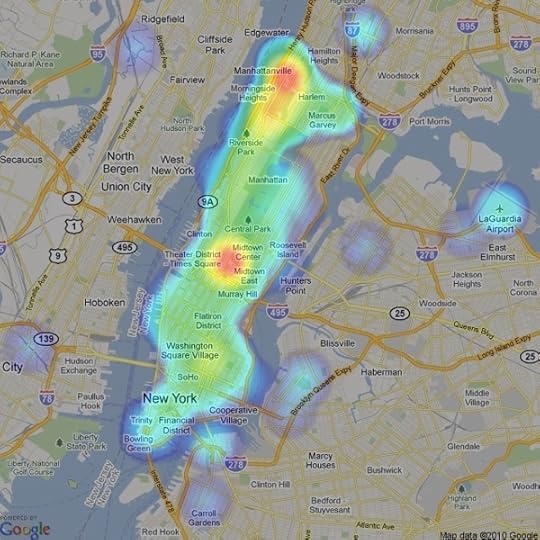
In fact, our provincial online behavior matches the lives we lead offline. A heatmap made by Wall Street Journal editor Zach Seward reminds us of a truth we'd rather ignore: our lives are pathetically limited to the same few locations over and over again despite an infinity of potential experiences.

5280603173 f7299de4d4 z

Engineering Cosmopolitanism

Having made a convincing case that we continue to lack cosmopolitan practices despite having all the tools at our disposal, Ethan dedicates the second half of the book to exploring what can be done to rewire "the Internet" so that users are more exposed to content from other cultures. He approaches the challenge with the perspective of an engineer, but his recommendations are far from the "solutionist" widgets and algorithms that one may expect. In fact, his vision for a rewired, cosmopolitan Internet depends on people — certain types of individuals equipped with increasingly important skills.

... the remainder of the review is here:

http://davidsasaki.name/2013/05/revie...
Profile Image for Christo de Klerk.
32 reviews2 followers
November 1, 2013
But rewiring is also about the wires, no? A discussion about net culture, it's parochial tendencies, and ways to support network diversity and foster serendipitous discovery are all reasons why I like this book. This work is a conscious apologetic for cyber utopianism. The author argues that idealism for the web is not an empty hope.

What feels cloyingly missing is the economic and material side of this net culture. The closest that we get to a discussion of this is in the analysis of a pre-internet example of a cross cultural collaboration. Paul Simon and Ladysmith Black Mambazo's story, argues Zuckerman, is not one of cultural appropriation, because Paul Simon had an earnest xenophilia and because of the good financial arrangement he made with LBM.

Okay, so why not then talk about digital labour in cross cultural/global collaborations? At first I think it might just be an oversight, but then in the final chapters the discussion turns to corporations. Companies need xenophiles, argues Zuckerman. A simple point, but for what purpose? To put a good face on the imperialism of a multinational? Sure, the Dutch East India Company may have lacked these, but English imperial forces, merchants, and missionaries had plenty.

Xenophilia, a subject's love for whatever they perceive to be culturally other, is not enough. Often during the book, I would try swap or complement solidarity for xenophilia. During the Apartheid regime it was not enough for Paul Simon to love black South African culture - there were greater expectations. Did the collaboration violate the cultural boycott imposed by much of the world? Did it join in a demonstration of solidarity against the regime?

Maybe solidarity isn't the right word, but like xenophilia it is present in weak and strong social connections; and is the difference between wiring for more intense exchange and wiring for transformation.
Profile Image for Ilya Inozemtsev.
113 reviews39 followers
August 22, 2022
Нон-фикшен в вакууме: несколько сплетающихся между собой кейсов о серендипности, важности сообществ и других вещей в меняющемся мире. Обязательно для прочтения тем, кто меняет профессию или место обитания.
Profile Image for Filip Struhárik.
81 reviews312 followers
June 2, 2016
"The Internet will not magically turn us into digital cosmopolitans." Very good book, very good thoughts. I made a lot of notes.
Profile Image for Craig.
59 reviews24 followers
June 27, 2013
Realizing we're parochial and understanding what we're ignoring is different than being parochial while suspecting we're fairly cosmopolitan. Ethan Zuckerman makes a convincing case that our media exposure is far less diverse than we would think—and that the Internet might even be fortifying our parochial tendencies.

While it seems there’s nothing left on store shelves that isn’t made in China, Zuckerman points out that fewer than three percent of US consumer spending goes to Chinese goods. We’re in the midst of a global immigration crisis, yet immigration rates peaked before WWII. Exports account for just twenty percent of global production, and only three percent of books in the US come from international authors (J.K. Rowling factors into this figure). Despite what Thomas Friedman says, the world is not yet flat. Now that we’re globalized…We permit him too much even in his premise.

Ethan Zuckerman is curious about why our media attention ends up where it does. He points out that the proportion of news dedicated to international stories these days is less than it was decades ago. So while we’re no longer at the complete mercy of the news outlets and freer to track news down for ourselves online, somehow less of it crosses our borders. Interestingly this is a global phenomenon and not just an American one (so it seems like only an incremental improvement towards cosmopolitanism is necessary to make USA number one!).

I was fairly surprised that our exposure to international coverage has so drastically diminished. Part of the problem Zuckerman attributes to the major news outlets no longer being able to afford their foreign bureaus, but otherwise he doesn’t wander too far into speculation about why this may be—throughout Rewire awareness of insufficiency is most often the primary goal. But maybe he could have included some figures on political activeness on the local level—like beyond simply voting. You can only increase your media consumption so much, so at some point international and more local media are rivalrous goods. For example, if people were getting more politically active at the local level a shift in coverage from the international to the national and local levels would make sense given the coverage’s rivalrous relationship. Even if this were the case Zuckerman’s objective would still remain unchanged: in consuming media from one region/perspective, we should be aware of where our attention is not going. He also points to the good bit of research showing the benefit of diversity within organizations (doing a good job at pointing out how diversity is not something to be revered without understanding its complexities), so even those more active on the local level would benefit from a more global view and international camaraderies.

(A second, hopefully not too cynical, speculation: With NPR-style international news coverage we no longer hear coverage of events but instead get stories of the individuals impacted by them. This personal angle is meant to bolster the event’s empathic weight, but often the result is that we’re more apt to dismiss the event. Like Oh thank goodness, nothing’s really going on, it’s just some guy’s story. Or else it feels like the news outlet is just topping off some self-imposed diversity quota; Nothing is really going on in other countries. See, after fishing around for some big news all they came up with were some interviews with a few locals.)

But there’s also a lack of border-penetrating content because there aren’t enough human translators—or more precisely, there aren’t enough humans interested in translating. Computer translation is improving but not yet adequate to the task either. Translation of a single article—even about a consequential event—is not enough. We need enough translated material to allow a contextual base for interest to develop around in that region of the world. Even when the translated material is there and we have a sort of superficial contextual base, we still run into what Zuckerman calls a “caring problem”—knowing nothing about and no one from the affected country. He highlights bridge figures—those who have feet in two cultural worlds, i.e. context providers—and xenophiles—people who can’t stop themselves from crossing these bridges. It’s a good bit of analysis and Zuckerman’s Global Voices project is an attempt to increase visibility of bridge figures and translators by collecting them in one place.

Ethan is uncomfortable dictating what percentage of media consumption should be allotted to any given country. Again, his goal is consumption awareness, and he is busy now at the MIT Center for Civic Media making quantified self kind of tools to track and make us aware of our personal habits along these lines. He encourages others to take up these kind of projects too, which seems like a good initiative as long as it doesn’t become “gamified” and no longer about comprehension or compassion, but badges. Using such tools to consciously remake our “media diets” also risks developing all the neurosis that accompany nutritional dieting regimens. Ethan wants to go beyond awareness to “designed serendipity”—remaking the Web so that our strolls around it are potentially more cosmopolitan. He’s been talking about serendipity for years. I’m skeptical to what degree it can be designed. It seems more likely that serendipity is a set figure. You could bias the infrastructure and dictate where it is diverted, say, global at the expense of local, but at this point again you have to be transparent about your intentions and keep the user aware of what they are forgoing. Like would someone who is extremely politically active at a local level want their search engine result more globally skewed? They might if they can find solidarity with other communities in similar plights, but then they might miss out on some pertinent development on the local level. In the same transmission what is signal to the novice might be noise to the expert and vice versa. The same would be true of the globally and locally oriented activist. I bring this up not to draw support from Ethan’s effort to raise awareness of our media consumption, but to maybe highlight pitfalls of “designing” serendipity. It’s not a huge fault either. With the figures he provided on average we can use more global exposure, and it’s certainly not localism Zuckerman is against but parochialism.

I often found myself thinking of Peter Singer’s expanding circle where definition of in-group expands from small band to village to city to country then to all humanity and on then to animals. It’s necessarily an expanding circle of diversity. Then there’s Steven Pinker’s recent work showing that pretty much any way you can think to measure it, violence has been on a continual decline since the dawn of recorded history. Kevin Kelly points to evidence that technological progression mirrors the trajectory of evolution—trending towards complexity among other things. I wonder how fixed these trends are; it seems doubtful that they can be goosed beyond their natural(?) pace. Diversity via serendipity can only be planned if that objective and its mechanism are invisible to the subject; otherwise, again, it feels like a diversity quota. On the other hand, successful invisibility requires some sort of master planner—puppet master if you want to be a little more conspiratorial—to which not only beneficent motives but competency must be entrusted—of course search results, for example, are never strictly “objective.” The mechanism behind an expansion of diversity might be something like Schumpeter’s creative destruction under which innovation is continuously destroying the current paradigm. Although we might collectively benefit from innovation, it’s not an unbridled process because we can expect those with vested interests to resist. And we can expect parochial interests to resist in the same way against expansion into the global and the diverse.

In this respect it is Rewire as an argument and not precisely its suggested actions that functions as the mechanism for expansion. Awareness of a world beyond is necessary before venturing into it. It’s a question of whether we’re rewiring for attention or intention.

Zuckerman points to a history of the Internet being compared to a city before taking on the metaphor himself. It’s a useful comparison, but he maybe underestimates the degree that cyberspace coincides with physical space. A contextual foothold is critical in understanding news reports about other cultures, but there is another barrier which is not as well addressed. Perceived relevance is necessary to want to gain that foothold. Don’t we care about the news of our nation much more than international stories not simply because of lack of context outside our borders but lack of perceived impact within them? Citizens are accountable to their own governments after all, not the laws of other countries, and while arguing that policy of one government affects others is logical, it’s a strain to envision the impact; we quickly end up with what seems like a lot of butterflies in Brazil. Again, how much can these processes be hastened? Can you goose perceived relevance when even the ethereal Internet lies over top a country? After all it’s much easier to become Foursquare mayor of the local dive than the Foursquare mayor of some place in Burundi. The map may not be the territory, but neither is it so distinct as to precede the territory—not yet, at least.

I do worry a little that this review might make the book out to be less nuanced a read than it is, and despite my own commentary here, I'll point out that Ethan is not a heavy user of the words “should” and “shouldn't”—one of his many likable traits. Blind spots are not the places where we've concluded that’s just not that interesting, after all—they’re actually blind. “While countless American commentators, most notably Secretary of State Hillary Clinton have criticized China’s firewall and decried Chinese censorship, far fewer have pointed out that there’s potentially important uncensored Chinese news that never reaches an English-speaking audience.” Rewire is most powerfully a tool of introspection, and while the mechanism for progress towards a more cosmopolitan world is too complex to be anything but correlative, Ethan Zuckerman is no doubt playing some part. And if we do get frustrated with the pace of progress, more and more, at least, the Internet seems to be a facilitator of sudden critical masses.

(An interesting complementary read might be Cyrus Farivar's The Internet of Elsewhere .)
Profile Image for Kate.
6 reviews10 followers
September 13, 2016
Although I'd give the content 5 stars
Profile Image for Galatea.
300 reviews2 followers
September 17, 2024
A report on the potential, peril, and predicament that online globalization brings, and why it matters.

Let me start with the bad. This book's pretty clunky, and could've used with a good copy edit revision to clean up the typos and the structure of the text, which at times became frequent enough to be intrusive, but at least didn't garble the message.

That aside, this book is a fantastic exploration of the way online tech, from chat rooms to online newspapers to web browsing both create the opportunity to widen one's perspective, while also giving users incentives to streamline their virtual spaces and trap themselves in echo chambers.

A constant theme throughout is the need for a mild, but constant urge to seek perspectives and information outside of one's comfort zone; things that might confuse, bore, or even conflict with a person's tastes and preconceived notions.

Reading this in 2024, more than a decade after it was published (in 2013), the book is still as important and as prophetic as ever, with its warnings for information and data curation ringing especially prescient in the wake of scandals like Cambridge Analytica, internet censorship (and state-sanctioned trolling) in Russia and China, and the dismal state of misinformation and polarization online.

It also deals with real life examples concerning international trade and business, showing the benefits and the potential pitfalls of cognitive diversity and multiculturalism there as well.

I would gladly read an updated version of this book, hands down.
Profile Image for Elvis.
118 reviews1 follower
November 14, 2023
The first 100 pages were informative and interesting, but the more book goes on the more you notice the faults of author's thinking and his newspaperish style of writing.

Ethan Zuckerman states that he reads newspaper a lot and you can see that in his writing. He writes a lot of stories and facts without stopping and looking at them more deeply, just the same way the newspaper operates. Newspaper will never give its readers something to think about deeply, rather it gives you fancy facts that you will forget after one hour and obviously the person who reads newspaper a lot will produce the same kind of content.

Another thing that I did not like is that he author assumes right of the bat that a more cosmopolitan perspective on things or a more cosmopolitan news environment is something inherently good. He does not really argue about it or talks about it in a great length, why it is good or why it is beneficial for us to know that happens in another country or in another part of the word, he just believes that.
Profile Image for Ronald.
30 reviews2 followers
March 6, 2019
Zuckerman writes with a lot of examples and anecdotes about ‘digital cosmopolitans’. By explaining lot of (important) topics regarding cosmopolitans and technology, I had to think again about my own view on myself as a digital cosmopolitans. Can is consider myself a (digital) cosmopolitan or am I living in my own bubble?

The book also explains why it is important to have connections across the globe and how nations, companies and people themselves can become a better ‘digital cosmopolitan’.

This book had a lot of information in it. There are a lot example stories, which sometimes leaded me to think off topic. The examples where sometimes richer then the point zuckerman tried to make. Therefore 4 stars.
Profile Image for Sergey Minkin.
3 reviews1 follower
October 20, 2021
Интересные мысли о современном, казалось бы, уже очень доступном и открытом мире. Мире, где нам из кармана доступны знания и новости любой точки мира. И тем не менее мира, где на самом деле все это не так. Как понятие космополитизма живет и развивается сейчас и что нам с ним делать. При этом, в книге много истории самого автора, которой можно было бы вполне пренебречь, не потеряв основной мысли.
Profile Image for Alina Seniuta.
56 reviews
July 12, 2017
Felt more like an extended article rather than a book for me. The author did share a different perspective on what we usually make no question of , provided a whole bookmarks bar of further readings (at least for me), but kind of rolled it up in a clumsy trying-to-be-persuasive way.
Profile Image for Francesca Woodhouse.
2 reviews
August 19, 2017
The first half of the book was stronger than the second, but I would recommend it as a good
call to action for the positives of a more connected world - discussions around bridging, friends across borders, openness to other news.
Profile Image for SHUGI.
25 reviews
June 19, 2024
Tech needs to be dissected. I'm reading this book at the age of Neuralink and boy does it scare me to think about how life is going to change. This is a great book in regards of taking a look at how the internet is impacting society. Great book.
Profile Image for Winston Hearn.
7 reviews2 followers
September 13, 2017
There's a lot of race, class, and inequality analysis that should be present in this book but isn't.
239 reviews3 followers
September 8, 2019
This book argues that we'll be smarter, more successful people if we embrace an international cosmopolitan perspective. The author isn't wrong; I just found the book a bit repetitive.
Profile Image for Anton Shanaurin.
302 reviews12 followers
January 13, 2023
Господин Цукерман отправляется к либертарианским патерналистам.
Profile Image for Joel Gn.
128 reviews
October 10, 2019
Key takeaway: the online space can potentially lead to greater cultural diversity and exchange, but users must consciously put aside tribal and ideological proclivities to realise them.
Profile Image for Gjacobsen.
79 reviews5 followers
December 16, 2013
I had the pleasure of hearing Zuckerman present at a conference earlier this year to an audience that didn't work in his particular field (Zuckerman is the Director of Civic Media at the MIT Media Lab and focuses on the distribution of attention in mainstream and new/social media). While not his typical constituency, Zuckerman expertly drew the connections from his research and knowledge of global trends around media and individual engagement that clearly resonated with our broad-based group. I found myself wanting to learn more about his work and came to "Rewire."

"Rewire" is a fascinating read that coalesces Zuckerman's passions, including Africa and the developing world, the attention paid to and consumption of media focused on global issues, the expansion of individual voice through social media, among others. His purpose in writing the book is to elevate the importance of living dual lives, as citizens of nations and citizens of the world. His belief is that those with a practical, literate understanding of global issues and cultures ("cosmopolitans") will yield, to keep it simple, a better world. In a tightly organized but highly readable fashion, he advocates for an alternative mindset around media consumption and engagement to solve a core problem of our "connected age", a paradox: that while it is easier than ever to share information from across the world, the manifold lenses through we which we access and view the world - Twitter, newspapers, television, people - have become narrower. Similarly, we are less open to "serendipitous" encounters that may foster new learnings and cross-cultural understanding. It's terribly interesting.

While Zuckerman's argument is interspersed with stories of other's research, case studies, and examples, at times they seem self-aggrandizing. In many cases, he knows the individuals involved and worked with them at some point in his life (the introduction of the book invites the reader to join he and his friends in realizing a "rewired" world). He clearly values their insights, but on occasion the names become muddled. On the whole, they support his argument if they have not outright informed his argument.

As a newcomer to books such as these, I'm sure there are more thoughtful counter-arguments to what Zuckerman proposes. For myself, the core question I have is whether or not he overstates the importance of the examples he presents. He argues that people have a tendency to care more about what's immediate to them and around them. Additionally, what's already like them (homophily). I spend quite a bit of my time working in a severely disinvested city where many of its residents are experiencing extreme poverty and isolation, lack of safety, and other social pathologies. I can't help but think that the issues experienced individually in neighborhoods like what I've described have more pressing matters to attend to, if they have adequate resources and access to the "connectors", those who can provide guidance and curation to other cultures and information. At what level is participation possible as opposed to trickle-down beneficiary of a more caring world? Of course, the book arcs at a high-level, so more practical-oriented questions aren't addressed.

Overall, as a call to engage, the book is inspiring and enjoyable. Sure, there are holes to poke but at its core the book is fundamentally about one thing: the possibility of a better connected world and better outcomes for people across the globe. If that also interests you, you will enjoy Zuckerman's idealism.
222 reviews8 followers
July 7, 2015
Overall, totally dig it. He's pushing cosmopolitanism, the idea that we can be "citizens of the world", taking into account our responsibility and connectedness to each other.

He started this "Global Voices" site a few years ago, trying to offer views from bloggers worldwide. It's pretty cool, but as he notes, not enough. It's hard for me to care about what happens in Gabon. But in an age of SARS and Arab Spring, we kind of need to. At least, someone needs to.

Some useful concepts or other notes:

Hallin's spheres: the center is consensus, that's easy, we all agree. Next is the sphere of legitimate debate. Outside that is the sphere of deviance: ideas so ridiculous that no one seriously thinks them. This is the goal of revolutionaries and rabble rousers: to move ideas from the sphere of deviance into the sphere of legitimate debate. This is of course a double edged sword: it's good that, say, gay marriage and marijuana legalization made that leap; it's, you know, existentially dangerous that global warming has.

(Also, choice quote from cartoonist Ted Rall: "'no one seriously thinks' is brutarian to the point of Orwellian.") P86

How news works now: Galtung and Runge's "news values": short time frames, moral unambiguousness, unexpectedness, and reflection of preconceptions.

Apparently, of all newspapers in the US, only the NY Times, LA times, Washington Post, and WSJ still have substantial foreign bureaus?!

Goals of Global Voices: filtering, translating, contextualizing. Making good-enough translation transparent, enabling bridge figures, and engineering serendipity.

Human Libraries. Rent a person and talk for a while to learn things from their perspective. Awesome. P196

Community by arbitrary structure. Birth days of the week in Ghana. Livejournal birth month groups.

Discovery by breadth first search. Ish. "Impressionism? Might as well start with Monet. If not, Renoir. Now you have at least a sense of whether you like impressionism. Want to try Haitian food? Go to these top 3 popular Haitian places." The Dave Arnold algorithm (named after his friend). Where are the top 3 places for people who live in Greenfield? There's a lot of connection to cities here: people experience more serendipity in cities. How can we make online services more conducive to this? P228
Profile Image for Dani Arribas-bel.
32 reviews20 followers
December 8, 2013
The book considers the effect that the internet and the new wave of news distribution associated with it in the last few years (social networks, etc.) can have in our perception of the world and in how connected we will actually stay to more initially distant realities. Surprisingly (or maybe not so much), the main thesis of Zuckerman is that true cosmopolitanism won't come by itself as an extra feature of technology, we have to bring it and built it in ourselves if we really value it. The book is very well written; the ideas are powerful and deep but I think they are laid out in a way that's easy to understand and digest. It also contains several historical background, anecdotes and examples that are fascinating in themselves, but that illustrate his point very well. On the minus side, if I have to mention one, I would say he tries to scratch the surface of many topics without going into too much detail so, if you are looking for an academic treaty on any of these, this is not your book. As a window into new areas you might not know you like, it's a fantastic one though.

I've really enjoyed the book in many respects. Although the thesis is clear from the beginning, it's not one of those books that only has one idea and stretches it for 400 pages. The author delves into several aspects of what being cosmopolitan today means, why it is something we should embrace it in one way or another and, how we can get there. It challenges the conventional wisdom and tries to get the reader out of his/her comfort zone. Reading it has made me realize how much of this aim to connect with a global community was in my teenage, when I started delving into the internet and looking for the most disparate things from each corner of the globe. But, if you buy the book's premise, that's really why I liked it and, in fact, why I read it in first place. Homophily.
Author 1 book7 followers
April 12, 2015
This book takes a pragmatic, clear approach to a challenging issue - how to maintain openness to the new and valuable in a world where it is easy to fall into a rut of the familiar and comfortable. Zuckerman's background in the MIT Media Labs and the Global Voices project suits him well in this undertaking.

While the hopes of technology pioneers are often that tech will create a single, connected humanity, it also tends to at least initially harden hierarchies. The initial democracy of radio was largely usurped by large media companies, and the openness of the Internet is not often experienced by those who largely spend their time in the walled gardens of Facebook.

The antidote Zuckerman recommends is genuine connection with others outside our normal "circle of concern". As we get to know people in other countries, cultures, and circumstances, we seek to learn more, start to care more, and ultimately do more for others. Actions as simple as making a friend from another country can lead to whole new worlds of interest and opportunity.

The book avoids lazy thinking around these issues and is also well-written. Highly recommended.
Profile Image for Laurel.
752 reviews15 followers
May 19, 2014
I think that for someone that is not intimately familiar with the many ways that life online has transformed our global world, much insight would be gained from this book. The information presented by the author, mid-read, that recounts some basic theories of mass communication, gate-keeping and the press bored me, because of my professional familiarity with the literature. There were some new ideas and ways of looking at networking online that I found interesting and well presented. For some reason though, I found the ideas dis-jointed and was unable to find a coherent thesis that linked the chapters in this book. I would recommend this book to someone who wanted to know more about the impact of the internet on our world, but note that this book is a beginning, and not the last word on "the Age of Connection". The title is mis-leading in that the focus is not on "Digital Cosmopolitans" which I assumed referenced users, rather this is a disjointed look at some very interesting current theories with related real-world outcomes.
Profile Image for Jennie .
251 reviews20 followers
July 27, 2013
I found the structure of this book kind of frustrating. When I think about it, a lot of that reaction boiled down to the fact that the author seemed to be assuming cosmopolitanism as a generic good in this book, so he didn't bother even trying to make a convincing case for its benefits until the end. I mean, certainly I think it's a positive trait, but I know from my social circles in North America that it's not something most people I know particularly strive for. So there's that. On the other hand, the stories Zuckerman chose to illustrate the points he was trying to make about bridging figures and the ways in which we're parochial when we think we're cosmopolitan were all really interesting, and that kept me reading. I guess I just wish the chapters had been in a different order, or maybe that there had been a clearer argument about the benefits of the behaviours Zuckerman was promoting at the very beginning.
Profile Image for bibliotekker Holman.
355 reviews
November 20, 2013

"A central paradox of this connected age is that while it’s easier than ever to share information and perspectives from different parts of the world, we may be encountering a narrower picture of the world than we did in less connected days." In this thought provoking book, Zuckerman adds detail to this idea by introducing the reader to insightful sociological research into this fascinating yet worrisome phenomenon. A very good read.
The author offers a number of stories and vignettes that give hope. So called "bridge figures" and xenophiles are creating connections that alleviate the inherent homophily and insularity that can be a human tendency. His book is a call for all of us to become more aware of the box we live in and to try to climb out of it and view the world of boxes around us.
Displaying 1 - 30 of 47 reviews

Can't find what you're looking for?

Get help and learn more about the design.