Jump to ratings and reviews
Rate this book

The Archives of Varok

The Webs of Varok

Rate this book

Silver medalist, YA fiction — Nautilus Book Awards
Finalist, science fiction— ForeWord’s Book of the Year Awards

In an alternate 21st century Solar System: Tandra Grey has left Earth for the ancient sustainable culture of Varok, with its promise of stability for her young daughter. But a genius with a hidden talent sets her eye on Varok's wealth—and Tandra's soul mates. Tandra, the elll Conn, and the varok Orram must untangle a web of deceit to restore balance for Varok and their fragile new family.

“. . . engaging, multi-layered, provocative, and above all relevant to the times. . .” —Frank Kaminski, book reviewer for Energy Bulletin and Resilience.org

“. . . a page-turning struggle between the eternal themes of personal accumulation vs. the common good.” —Kathy Campbell, past president, League of Women Voters New Mexico

“. . . so many alien-imaginative twists, intrigues, and betrayals that the spellbound reader won't even realize s/he's being educated!” —Professor William Rees, originator of the Ecological Footprint concept

The second novel in Cary Neeper's Archives of Varok series, The Webs of Varok follows the new, offworld adventures of the characters from Neeper's 1975 novel A Place Beyond Man, re-released in 2011. With three more titles coming in 2013-14, the five-volume Archives of Varok travels with Tandra's family on quests from Earth to the Oort Cloud with several stops in-between.

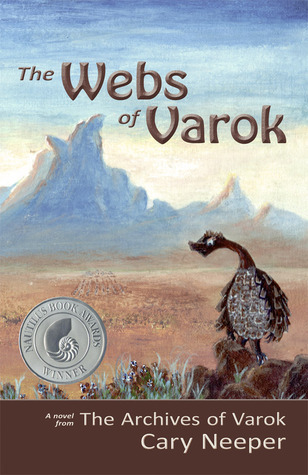
Cary Neeper lives in the US Southwest with her husband and a friendly menagerie of dogs, fish and fowl. An avid proponent of sustainability and steady-state economics since the 1970s, she studied zoology, chemistry and religion at Pomona College and medical microbiology at the University of Wisconsin–Madison. Cary paints landscapes in acrylics, including the cover art for The Webs of Varok.

ebook

First published December 4, 2012

2 people are currently reading
357 people want to read

About the author

Cary Neeper

9 books32 followers
Current Blogs
---Book reviews of critical nonfiction appear on my Goodreads blog--re many issues now critical to today's threats and choices.
--Following new information re astrobiology:
https://astronaut.com/whos-star-chips...
--Exploring work on animal sentience in our animal friends' stories and current books--How The Hen House Turns at the Los Alamos Daily Post (http://ladailypost.com) monthly.

As the author of the Archives of Varok series--set in an alternate 21st century solar system, populated with three or more intelligent (see log lines below)--my challenge has been to stay as realistic as possible in order to portray the frustrations, challenges and solutions of our current dilemmas here on Earth.

Meanwhile, the Kepler discoveries have told us that we are very likely not alone in this universe, so it’s even more important to ask who we are as human beings, a major theme in the books.

In spite of the aliens, I’m realistic about facts like the enormity of space between stars and the energy and time required to travel anywhere else. We are actually isolated out here, so we had better take care of planet Earth, as portrayed in the Archivees.

It could be that one thing I have wrong is the Archives’ time setting of 20-70 C.E. We may not have so many decades left to pull back and get it right. At the same time, the complexity of our lives is real, so that anything we do has the potential to trigger significant effects in the long run, (the theme of The Alien Effect).
See:
https://eauthorresource.wordpress.com/

Here are the brief synopses of The Archives of Varok:
The View Beyond Earth
In a 21st C. Oz (our solar system plus close neighbors) a young woman finds herself in trusting her child's instincts.
The Webs of Varok -(Nautilus Silver Medal 2013 YA Division and ForeWord Finalist for adult scifi 2012)

The Alien Effect
As the mixed family continues to untangle their story toward a secure future, it illustrates how complexity works--i.e." nothing we do is inconsequential." Who we are and what we do matter.
An Alien's QuestOur young woman raised by the mixed family reviews religious philosophy and finds Meaning close at hand.

Besides The Archives of Varok, I have written book reviews for the Christian Science Monitor, technical papers, newspaper articles, and essays; produced two musicals based on a sci-fi spoof; conducted workshops; and taught courses in sustainability and complexity at the University of New Mexico-Los Alamos. My blogs include How the Hen House Turns for the Los Alamos Daily Post (stories from 40 years with domestic birds and dogs) and Who's Out There for astronaut.com

Ratings & Reviews

What do you think?
Rate this book

Friends & Following

Create a free account to discover what your friends think of this book!

Community Reviews

5 stars
4 (28%)
4 stars
6 (42%)
3 stars
3 (21%)
2 stars
1 (7%)
1 star
0 (0%)
Displaying 1 - 5 of 5 reviews
Profile Image for Denzil Pugh.
47 reviews5 followers
January 22, 2013
The best science-fiction/fantasy novels are ones that lie outside the stereotypes of either genre. I abhor reading fantasy just for fantasies' sake. Why escape to another world when you return to the same world as the same person? I like to have meaning in my books, something with meat on it, that I can rip away and take with me. Certainly, there will be a few times when Anne McCaffrey's books will call to me, something light, but usually, I want something more along the lines of Orson Scott Card, where larger moral issues are addressed. In fact, when I read and review books, especially of the sci-fi variety, my question always is, "How would OSC write this?" If I find the answer is, "Just like this," then I know I've found a good book. And such is The Webs of Varok by Cary Neeper.

What surprised me was that this wasn't the first book in this series, but the second. Neeper wrote a book about Alien first contact in 1975, called A Place Beyond Man (which was redone in 2011 as The View Beyond Earth). However, it's not completely necessary to read the other book to understand what's going on. The prologue does an ample job of getting everything set. Further, the forward tells us that what Neeper is trying to do is to create a society with a self-sustaining environment, incorporating population control, a regulatory business trade, and a Utopian system of government based on the idea that citizens are content to live their lives within the confines of regulations in order to prevent the previous cataclysms where ecological and economical systems spiraled out of control. In fact, the book is more about this idea than anything else, leading one to believe that the plot means nothing and that it's going to be the author preaching at us the whole time. This is very far from being true.

The characters, Tandra, the human, Conn, the Elll, and Orram, the Varok, are all very well constructed, done with dialogue, much as OSC would do. In fact, Neeper does an amazing job creating all of the sentient beings on Jupiter's hidden moon. Ellls are aquatic beings who survive on land using clothing that remains wet. They are sensuous beings, outgoing and social. The Varoks, for whom the moon is named, were the main sentient beings until whatever cataclysm befell upon them (a biological war, as it turns out), ripping apart their sense of touch. They have relied upon their development of mental communication, reading each other's minds. In fact, this is the main crux of the novel, that Varoks cannot lie to each other. This keeps the world in check, for no one is able to do anything illegal without being caught. This is the same outcome of Clarke & Baxter's technology of wormhole usage in The Light of Other Days. Thus the world can operate completely differently than Earth. The downside of this is that Neeper (as the characters in the book) would recommend using the same regulations of Varok here on Earth, in present day society. This, of course, is impossible, because human nature will not acquiesce to total regulation by a government. It was tried before, called Communism, and it didn't work, for precisely that reason.

I remember walking through the park here in Conyers, and trying to come up with a society that could live in harmony with the beauty that I was seeing around me. And having read Ayn Rand and being against governmental control of the individual, I tried to overcome the weaknesses of Rand's world and our own. The only way I could do it was with population control and economic controls that would forbid companies from making forced obsolescence a part of the economic system (see my blog on the forever light bulb coming from Clifford D. Simak's book Ring Around the Sun. In fact, when I stopped thinking about it that day, I had come up with a society very similar to Neeper's Varok, but with the large problem of making people honest with themselves and others. Only a biological or technological breakthrough would accomplish this.

I give The Webs of Varok 4/5 stars on the systems of Goodreads and others because of a couple of plot issues that happen late in the book that threw me off. It might be that something distracted me at the sentence where Orram's disappearance happened, or something. It's not always the book's fault, but I can't reconcile it. I do recommend the book, even to conservatives who would find reading a book written with liberal ideas repulsive. You'll like it. You'll even agree with most of the ideas in the book. They are ideals that conservatives and liberals must strive for (and the goals are usually the same, just arrived at in two totally different ways). I have the first book (75) version, and will get the '11 version, too, and see what differences there are. It looks like the '75 book deals with the differences between the three species, especially those of social and sensual nature. I hope that these books are done as well as this book. I look forward to reading them.
Profile Image for Carolina.
256 reviews13 followers
February 14, 2013
Originally posted at: A Girl That Likes Books

I got this book through the Early Reviewers program of LybraryThing, and here is my review.

What's the book about?

This is the second installment of the Archives of Varok, by the same author. It's settled in a alternate 21st century where the Earth has gone in override with environmental and economical excess and we have found that one of Jupiter's moons, Varok, is inhabited by species physically different from us but with a lot to teach us on how we should take care of our planet and each Other. Tandra Grey a human, has decided to leave Earth with her new family, composed by a Varok named Orram and and Elll named Conn as well as an adopted daughter. When arriving to Varok, their new home, they realize that something is off with the planet and will have to figure out what it is in order not only to save it but also to save their new family.

What was different of this book?

I've never read a book with such a strong and blunt environmental message. That said...I have a problem with a book that keeps using "germs" as a term to refer to any type of pathogen. Is it the scientist in me? Maybe. But "germs" to me is the same as say "a thingy" instead of calling something by its proper name. Just saying.

What about the main character?

To be completely honest, I'm not 100% sure who was the main character, both Tandra and Conn have big parts, but so does Orram and Mahntik. I think they were all very complex characters, well constructed. However, none of them gave me any feeling of empathy or connection. Tandra is the first-person narrator of portions of The Webs of Varok, like her voyage to Varok with her other family members. Other parts, like when we read about Mahntik conspiring with Gitahl, are in the third-person, and that for me made it even harder to "adopt" a character.

The 10% moment

It took me an awful lot of time to read this book and that also applies to getting to the 10%. I wasn't caught in the story I'm afraid. I don't know if it was due to me not reading the first book, but every review I saw said that it was ok if you didn't. There was something missing for me to fall for the characters.

Final thoughts

The message is very nice, very well delivered. An interesting dissertation if you may on how bad monopolies can be, how abusing the environment can have catastrophic consequences for everyone. The book is beautifully written with enough details for you to picture the varokian environment. The intrigue...well, it was sort off there but there was no climax for me, and the conclusion was weak, in my opinion. I was expecting more development on Mahntik's abilities as well as the struggle of Tara to adapting to a new home. I can see the potential in this book, but it was just not for me.

I am hesitant as to consider this book as Science Fiction since I didn't really see any science part developed. Sure there is the threat of the (ugh) new strains of germs being released as a bioweapon...but I wished there was more about this strains, what do they do, how were they developed. Not a comprehensive text book description, but something more. I almost feel tempted to put it under Fantasy more than SciFi if one might need to choose a genre.

Because of all these reasons I gave this a 2/5, it was a good book, but not a good book for me.
Profile Image for C.M. Truxler.
Author 1 book11 followers
January 1, 2013
The Webs of Varok Keeps Readers Tied to Pages

This, the second installment of The Archives of Varok, Cary Neeper’s new book, The Webs of Varok, is a Science Fiction jaunt into intricately detailed worlds and beings, which includes a sampling of Varokian linguistics supplied by the author. The novel, subsequently written to entertain young adults with the Sci-Fi genre, manages to cross over age categories easily and entertain a varied mass of readers. Journeys through embellished discussions have never been so appealing.

The focuses of this first-person work is not singular, or even a couple; the focus of the novel is a family unlike any other, yet will be distinctly familiar to some. Tandra, Orram, Conn, and Shawne make up the unique family, though Tandra seems to be the main narrator. They are a family not of blood, but bonds just as deep and meaningful, perhaps more so in many ways. Each character stands clear and vibrant within the readers mind. Each are live breathing creations of the Neeper’s imagination.

The plot is well thought out and expansive, yet no detail is missed. Readers are treated to sketches, at the beginning of the work, of both Varok and Leahnyahorkah (The Haven of All That Fly). The sketches add a fitting touch to the validity of Neeper’s creations and implant the surrounding landscape deeper within the reader’s mind. If the work has a weak point at all, it is the aching feeling of coming into the tale too far in and missing something. The feeling is highly prevalent at the beginning of the work, but eases more the further into the story a reader travels. Nagging feeling or not, the journey Neeper has created is one any Sci-Fi enthusiast should not miss.
Profile Image for Sam.
456 reviews10 followers
January 6, 2013
This is the second book in "The Archives of Varok" and I'm not sure if it would have helped reading the first book before embarking on the second one. That being being said, although I got confused a time or two it did hold my interest and if this is your genre then I recommend you give this a read. I won this from LibraryThing Early Reviewers.
Profile Image for Kathy.
336 reviews9 followers
March 2, 2020
Neeper's work shows an astounding level of imagination. This book gives you detailed world building, unique cultural systems and a believable yet alien characters. A fascinating read.

Displaying 1 - 5 of 5 reviews

Can't find what you're looking for?

Get help and learn more about the design.