

What do you think?
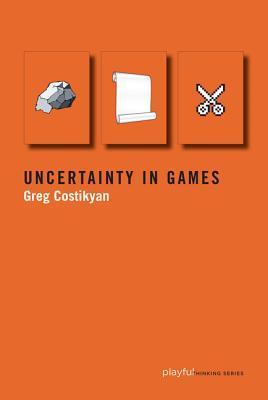
Uncertainty in Games
In life, uncertainty surrounds us. Things that we thought were good for us turn out to be bad for us (and vice versa); people we thought we knew well behave in mysterious ways; the stock market takes a nosedive. Thanks to an inexplicable optimism, most of the time we are fairly cheerful about it all. But we do devote much effort to managing and ameliorating uncertainty. Is it any wonder, then, asks Greg Costikyan, that we have taken this aspect of our lives and transformed it culturally, making a series of elaborate constructs that subject us to uncertainty but in a fictive and nonthreatening way? That we create games. In this concise and entertaining book, Costikyan, an award-winning game designer, argues that games require uncertainty to hold our interest, and that the struggle to master uncertainty is central to their appeal. Game designers, he suggests, can harness the idea of uncertainty to guide their work. Costikyan explores the many sources of uncertainty in many sorts of games -- from Super Mario Bros. to Rock/Paper/Scissors , from Monopoly to CityVille , from FPS Deathmatch play to Chess . He describes types of uncertainty, including performative uncertainty, analytic complexity, and narrative anticipation. And he suggest ways that game designers who want to craft novel game experiences can use an understanding of game uncertainty in its many forms to improve their designs.
141 pages, Hardcover
First published January 1, 2013
Ratings & Reviews
Friends & Following
Create a free account to discover what your friends think of this book!
Community Reviews
Displaying 1 - 30 of 56 reviews

January 15, 2023
with a grain of salt, because i am stupid:
gives a nice basic explanation as to how uncertainty can affect play/how to manipulate using uncertainty, but is pretty repetitive of the same basic concepts and doesn't go much deeper than slightly subsurface level material. i would have preferred something that was sourced more in behavioral psychology, but this will suffice.
tbqh, the book could have done without that entire middle section of case studies, and instead sprinkled them throughout explanations of key concepts like costikyan does at the end. one of the big qualms i have about books like this is that they will go very in-depth with the case study examples, but the takeaways are few and brief and the meat of the text is spent describing the game. understandable, bc people who study games usually... love games, but it makes the text somehow indigestible for me. the information is less applicable in those case studies as well. but again, this might just be bc i am STUPID!
gives a nice basic explanation as to how uncertainty can affect play/how to manipulate using uncertainty, but is pretty repetitive of the same basic concepts and doesn't go much deeper than slightly subsurface level material. i would have preferred something that was sourced more in behavioral psychology, but this will suffice.
tbqh, the book could have done without that entire middle section of case studies, and instead sprinkled them throughout explanations of key concepts like costikyan does at the end. one of the big qualms i have about books like this is that they will go very in-depth with the case study examples, but the takeaways are few and brief and the meat of the text is spent describing the game. understandable, bc people who study games usually... love games, but it makes the text somehow indigestible for me. the information is less applicable in those case studies as well. but again, this might just be bc i am STUPID!

June 21, 2018
I had high hopes for this, but a better title might have been Old Games I Like, And Some Common Sense Regarding Uncertainty.
It was written in a formal style, but occasionally would use phrases like "you're screwed" or "l33t" or the favorite, "analysis paralysis” just to keep the reader guessing. I don't prefer wading through academic style to get at good information, but I will if I have to. Unfortunately, this lacked the academic content, leaving me wading through the muck for no good reason.
I hoped that it would've been better, but not even its brevity could help it.
It was written in a formal style, but occasionally would use phrases like "you're screwed" or "l33t" or the favorite, "analysis paralysis” just to keep the reader guessing. I don't prefer wading through academic style to get at good information, but I will if I have to. Unfortunately, this lacked the academic content, leaving me wading through the muck for no good reason.
I hoped that it would've been better, but not even its brevity could help it.

Read
September 28, 2024An interesting analysis and reflection on how uncertainty affects our interest in games and video games. The author offers numerous examples, very diverse in genre and style, that reflect the importance of the uncertainty factor in the game design process. Some of these examples are very revealing about how the degree of uncertainty affects the engagement and difficulty of the experience. In addition to this, I believe that these ideas can be perfectly applied to the storytelling and scriptwriting processes.

June 17, 2018
What is it: an analysis of several kinds of uncertainty that designers can and do leverage in several kinds of games.
Why do I like it: on my initial read of this book five years ago, I found it extremely helpful for providing a vocabulary for an aspect of game design that I hadn't seen addressed clearly/explicitly in other books on game design. It provided me a language for understanding some of my own experiences of gameplay and for better understanding a specific facet of how game experiences are designed.
Re-reading it now, in the context of a research project which I'll admit may be biasing my perspective unfairly, I still think Costikyan's vocabulary is very useful but I am less impressed by his analysis wielding that vocabulary and modeling how to understand uncertainty in games. Two facets stand out: 1. almost no analysis whatsoever about how game designers constrain or mitigate uncertainty to fine-tune and balance it, 2. an authorial posture of assumption stated as assertion, rather than an openness to the possibilities especially of player and designer psychology that might extend beyond Costikyan's own experience and perspective.
I don't think those are damning flaws, though. This still seems to me to be an essential book for understanding its core topic, and it does provide significant value in the framework and vocabulary Costikyan provides.
You might also like: The Art of Failure: An Essay on the Pain of Playing Video Games or maybe Values at Play in Digital Games
Why do I like it: on my initial read of this book five years ago, I found it extremely helpful for providing a vocabulary for an aspect of game design that I hadn't seen addressed clearly/explicitly in other books on game design. It provided me a language for understanding some of my own experiences of gameplay and for better understanding a specific facet of how game experiences are designed.
Re-reading it now, in the context of a research project which I'll admit may be biasing my perspective unfairly, I still think Costikyan's vocabulary is very useful but I am less impressed by his analysis wielding that vocabulary and modeling how to understand uncertainty in games. Two facets stand out: 1. almost no analysis whatsoever about how game designers constrain or mitigate uncertainty to fine-tune and balance it, 2. an authorial posture of assumption stated as assertion, rather than an openness to the possibilities especially of player and designer psychology that might extend beyond Costikyan's own experience and perspective.
I don't think those are damning flaws, though. This still seems to me to be an essential book for understanding its core topic, and it does provide significant value in the framework and vocabulary Costikyan provides.
You might also like: The Art of Failure: An Essay on the Pain of Playing Video Games or maybe Values at Play in Digital Games

June 28, 2020
In this thin volume, noted game designer Greg Costikyan focuses on just one aspect of game design - uncertainty - both its impact on existing games and how it can be used as a design tool to improve future game designs.
After a brief introduction, the author goes through several types of games, both computer and board, pointing out various forms of uncertainty contained in them. He then moves to a chapter covering each in detail, from the perspective of a game designer. In the final section he suggests that while designers make obvious choices to adjust difficulty, refactor strategies, and the like, they may be better off adjusting the levels of uncertainty instead.
This is the first or second book in the Playful Thinking series, "engaging and visually compelling volumes on game-related topics, authored by both scholars and industry luminaries, that are easily accessible to academics, professionals, and laymen from a broad range of backgrounds and levels of experience." I found it interesting, expanding the language of games and game design. I'd like to read one of the other books in the series (11 so far) soon.
After a brief introduction, the author goes through several types of games, both computer and board, pointing out various forms of uncertainty contained in them. He then moves to a chapter covering each in detail, from the perspective of a game designer. In the final section he suggests that while designers make obvious choices to adjust difficulty, refactor strategies, and the like, they may be better off adjusting the levels of uncertainty instead.
This is the first or second book in the Playful Thinking series, "engaging and visually compelling volumes on game-related topics, authored by both scholars and industry luminaries, that are easily accessible to academics, professionals, and laymen from a broad range of backgrounds and levels of experience." I found it interesting, expanding the language of games and game design. I'd like to read one of the other books in the series (11 so far) soon.

April 13, 2024
Costikyan organizes his writing intuitively, and his prose is clear and thoughtful. I was most impressed, though, with how plainly he presents his ideas, avoiding jargon. Another must-read for designers.

June 7, 2017
A more depth in look into why some games keep us more interested than others.
Uncertainty is not a word we use in our vocabulary often. We would never wake up in the morning and hope a never ending unfortunate events that break our routine flow, nor if they occur we would react in an optimistic way of overcoming such challenge. In contrast, most of our days, we anticipate and prepare for the worst to happen. We mitigate and manage the risk, especially if failing so affects our own survival. We make our life plain and dull, for although it would be exciting to explore new challenges to face, the risk of failing is more costly than the rewards it entails.
In other words, although there is no danger in performative actions like flying from one country to another with an airplane (the probability of an airplane accident is very low), the current culture of how most societies respond to the failure of others' is negative. For these reasons, if we ever wanted to practice our skills or explore new territories, we do it in such fashion through artificial safe environments: schools, our close relationships, and meet-ups. Business organizations even created a word just for that to promote in their workplace environment: "psychological safety".
It is sad to this day that our culture overgeneralizes the mistakes of others either implicitly or explicitly leaving us only the opportunity to test these things out through safe environments. But what hugely amazes me the most is how to this day business organizations run effectively and efficiently while ordinary individuals are not able to manage their financial and health challenges, the lowest ladder of Maslow's Pyramid. That gives enough talk why we only trust organizations and why personal individual choices are mostly not to be trusted for they have not self-actualized themselves in the first place. There is definitely some cognitive dissonance of all the uncertainty we give to ourselves on still living in a clutter, yet adding more expectations that we can barely handle. We create so much complexity to our life that we drop a few bags along the road, yet out of all this we are masters on covering it up like we have it all under control. We are great actors like Mr. Bean, just instead of being awkward and funny, we try to act our cover up in the most professional manner of all.
For the reasons above, being aware of uncertainty and keeping the right balance of handling it is an element that at an individual level, we are not there yet, at the corporation level, we see the epitome of it, and at the game level, it exemplifies the basic foundations that we can deconstruct and analyze the nature of uncertainty that we are most fond with. Besides describing the content of the topic of this book, I also want to persuade you that the topic itself is interesting on its own as well. I am pretty sure most of us hate uncertainty, but it is our purpose on serving this uncertainty in order to become better human actors. As paradoxical as it seems, uncertainty helps us figure out what we have in control and what we do not have in control and in what ways we can have more control of something we did not have proper control previously. The book devotes in its first chapters on the topic of how uncertainty was fiddled into games and became sophisticated due to our human nature (compare that to animals where their only game is by fighting with close relatives in a non-threatening way).
The book does an analysis of several (and I mean several!) type of games that contain uncertainty: From retro games like Super Mario Brothers, simulation games like Civilization and Roller Coaster Tycoon, board games like chess and Dungeon & Dragons, as well card games like Magic and poker. Did I mention about minesweeper? Discussing them all in here will instead spoil you all the fun for reading the book in the first place. What is interesting about the author is that he describes these topics in a very simple manner, that for as long you are familiar with the games discussed, there is no much academic rigor that you have to get accustomed to.
It does though have a lot of terminology on describing different states when engaging a game (breaking the flow, grognard capture, fiero) to the different types of uncertainty that exist in a game (performative, randomness, analytic complexity, player unpredictability). However, once you get used to the terminology, you will find it later useful when analyzing a game. Let us say you and your friend start a discussion about the game "Faster than Light". The terminology that you learn in here will help you to express your ideas better.
Another great thing about the book is that the author is as much objectively as possible on the topic of uncertainty in games. It will not discuss for instance on how bad social games have become by leaving l33t gamers to pay in-app purchases out of a casual game where you have to ask your "friends" for help. It will instead tell you why social games were successful to a specific demographic, leaving other factors to be another topic for another book.
The book can bring you some nostalgia and new insights. When I was a teenager, I really did not have a definition of what a game represented, but one of my close classmates already knew the importance of uncertainty in games. When I played a role playing game with a walkthrough, my close classmate would be upset for ruining the experience of figuring the analytic complexity and hidden information by myself. The same upset feelings were exposed when I showed to him the game Xenosaga to him: A game composed of 30 minutes of cut-scenes for every 5 minutes of gameplay. After all, what I show to him was not a game, but a Trojan horse impersonating as a video game on the game cover. Once you pop the disc in, you will see its true form was no less than watching a CGI movie. To call a game, a game, it requires the individual to have some interactivity to its world, and this one had practically little to none. I was still baffled to this day why I have not realized it yet. Also, another insight I came up after reading this book is whether a person who plays a game is actually a player or designer. For instance, my wife has low tolerance or patience on accomplishing challenges on Roller Coaster Tycoon. She cannot wait all the time it takes to build and unlock assets. For that reason, she plays it in sandbox mode. She plays the game for the satisfaction of creating the nicest theme park. In circumstances where a person has no uncertainties when facing a challenge, it is more best to say that my wife designs something over a game instead of playing something over a game. In summary, just because the title says its a game from the box does not mean it is a game or would be played as a game.
In the last chapters, the author concludes that as long we provide the right balance and mix of uncertainty, we can turn a boring game interesting. But beyond renovating a game in order to be successful, we should wonder if games bring any practical benefit to our life other than the release of stress. There are great questions that can be derived from this book, such as:
1. What skills and information should we gain from games through uncertainty (performative, analytic complexity, unknown information) that compliments our future career, as well be resourceful and better human actors through society?
2. We always model our life with purpose. Ergo, we have "game theory" that describes the game of life. Should uncertainty be perceived as a positive component instead of a negative component to our life? Just think about it: If everything was settled to us from the start, our software, our culture would have stayed intact and we would still be cavemen eating maple leafs while watching grass grow. Which society would you prefer to live: Cavemen? Your present culture? The future? If uncertainty did not exist in the first place, we would not have been driven both at an individual and collective level to improve ourselves and understand our world. Should we change our mindset on how we handle uncertainty?
3. Exposing uncertainty on our background activities can break the flow of such activities and make them more interesting, such as in our relationships and workplace environment. With the right mix and balance, can uncertainty expand to our personal life as well?
If you want to improve your game for keeping players engaged, "Uncertainty In Games" by Greg Costikyan will give you the basics to get you started. It is also an excellent read if you are a gamer and want to know why you love playing games in the first place, as well figuring how games can compliment, incorporate and extend on our personal life.
Uncertainty is not a word we use in our vocabulary often. We would never wake up in the morning and hope a never ending unfortunate events that break our routine flow, nor if they occur we would react in an optimistic way of overcoming such challenge. In contrast, most of our days, we anticipate and prepare for the worst to happen. We mitigate and manage the risk, especially if failing so affects our own survival. We make our life plain and dull, for although it would be exciting to explore new challenges to face, the risk of failing is more costly than the rewards it entails.
In other words, although there is no danger in performative actions like flying from one country to another with an airplane (the probability of an airplane accident is very low), the current culture of how most societies respond to the failure of others' is negative. For these reasons, if we ever wanted to practice our skills or explore new territories, we do it in such fashion through artificial safe environments: schools, our close relationships, and meet-ups. Business organizations even created a word just for that to promote in their workplace environment: "psychological safety".
It is sad to this day that our culture overgeneralizes the mistakes of others either implicitly or explicitly leaving us only the opportunity to test these things out through safe environments. But what hugely amazes me the most is how to this day business organizations run effectively and efficiently while ordinary individuals are not able to manage their financial and health challenges, the lowest ladder of Maslow's Pyramid. That gives enough talk why we only trust organizations and why personal individual choices are mostly not to be trusted for they have not self-actualized themselves in the first place. There is definitely some cognitive dissonance of all the uncertainty we give to ourselves on still living in a clutter, yet adding more expectations that we can barely handle. We create so much complexity to our life that we drop a few bags along the road, yet out of all this we are masters on covering it up like we have it all under control. We are great actors like Mr. Bean, just instead of being awkward and funny, we try to act our cover up in the most professional manner of all.
For the reasons above, being aware of uncertainty and keeping the right balance of handling it is an element that at an individual level, we are not there yet, at the corporation level, we see the epitome of it, and at the game level, it exemplifies the basic foundations that we can deconstruct and analyze the nature of uncertainty that we are most fond with. Besides describing the content of the topic of this book, I also want to persuade you that the topic itself is interesting on its own as well. I am pretty sure most of us hate uncertainty, but it is our purpose on serving this uncertainty in order to become better human actors. As paradoxical as it seems, uncertainty helps us figure out what we have in control and what we do not have in control and in what ways we can have more control of something we did not have proper control previously. The book devotes in its first chapters on the topic of how uncertainty was fiddled into games and became sophisticated due to our human nature (compare that to animals where their only game is by fighting with close relatives in a non-threatening way).
The book does an analysis of several (and I mean several!) type of games that contain uncertainty: From retro games like Super Mario Brothers, simulation games like Civilization and Roller Coaster Tycoon, board games like chess and Dungeon & Dragons, as well card games like Magic and poker. Did I mention about minesweeper? Discussing them all in here will instead spoil you all the fun for reading the book in the first place. What is interesting about the author is that he describes these topics in a very simple manner, that for as long you are familiar with the games discussed, there is no much academic rigor that you have to get accustomed to.
It does though have a lot of terminology on describing different states when engaging a game (breaking the flow, grognard capture, fiero) to the different types of uncertainty that exist in a game (performative, randomness, analytic complexity, player unpredictability). However, once you get used to the terminology, you will find it later useful when analyzing a game. Let us say you and your friend start a discussion about the game "Faster than Light". The terminology that you learn in here will help you to express your ideas better.
Another great thing about the book is that the author is as much objectively as possible on the topic of uncertainty in games. It will not discuss for instance on how bad social games have become by leaving l33t gamers to pay in-app purchases out of a casual game where you have to ask your "friends" for help. It will instead tell you why social games were successful to a specific demographic, leaving other factors to be another topic for another book.
The book can bring you some nostalgia and new insights. When I was a teenager, I really did not have a definition of what a game represented, but one of my close classmates already knew the importance of uncertainty in games. When I played a role playing game with a walkthrough, my close classmate would be upset for ruining the experience of figuring the analytic complexity and hidden information by myself. The same upset feelings were exposed when I showed to him the game Xenosaga to him: A game composed of 30 minutes of cut-scenes for every 5 minutes of gameplay. After all, what I show to him was not a game, but a Trojan horse impersonating as a video game on the game cover. Once you pop the disc in, you will see its true form was no less than watching a CGI movie. To call a game, a game, it requires the individual to have some interactivity to its world, and this one had practically little to none. I was still baffled to this day why I have not realized it yet. Also, another insight I came up after reading this book is whether a person who plays a game is actually a player or designer. For instance, my wife has low tolerance or patience on accomplishing challenges on Roller Coaster Tycoon. She cannot wait all the time it takes to build and unlock assets. For that reason, she plays it in sandbox mode. She plays the game for the satisfaction of creating the nicest theme park. In circumstances where a person has no uncertainties when facing a challenge, it is more best to say that my wife designs something over a game instead of playing something over a game. In summary, just because the title says its a game from the box does not mean it is a game or would be played as a game.
In the last chapters, the author concludes that as long we provide the right balance and mix of uncertainty, we can turn a boring game interesting. But beyond renovating a game in order to be successful, we should wonder if games bring any practical benefit to our life other than the release of stress. There are great questions that can be derived from this book, such as:
1. What skills and information should we gain from games through uncertainty (performative, analytic complexity, unknown information) that compliments our future career, as well be resourceful and better human actors through society?
2. We always model our life with purpose. Ergo, we have "game theory" that describes the game of life. Should uncertainty be perceived as a positive component instead of a negative component to our life? Just think about it: If everything was settled to us from the start, our software, our culture would have stayed intact and we would still be cavemen eating maple leafs while watching grass grow. Which society would you prefer to live: Cavemen? Your present culture? The future? If uncertainty did not exist in the first place, we would not have been driven both at an individual and collective level to improve ourselves and understand our world. Should we change our mindset on how we handle uncertainty?
3. Exposing uncertainty on our background activities can break the flow of such activities and make them more interesting, such as in our relationships and workplace environment. With the right mix and balance, can uncertainty expand to our personal life as well?
If you want to improve your game for keeping players engaged, "Uncertainty In Games" by Greg Costikyan will give you the basics to get you started. It is also an excellent read if you are a gamer and want to know why you love playing games in the first place, as well figuring how games can compliment, incorporate and extend on our personal life.

August 29, 2015
Just because any old game has a quantifiable amount of uncertainty in it is no gauge of the game's fun, and this becomes more clear as the author provides a scattershot analysis of various chestnuts like Chess, Rock/Paper/Scissors, CityVille and Super Mario Bros. Predictability, randomness, player control and retention are some of the key factors for a game designer on the studio floor (or hunched over a desktop anywhere else). Surprised to find barely a nod, just over a sentence each for game-changing games like Minecraft or the Legend of Zelda while other familiar games (like the missing men, Pac- and Hang-) are not mentioned at all. Attempts to keep things brief could have at least indicated more resources than the eleven listed here.

September 17, 2014
Wonderful book and a deep but quick read. Really a must read for anyone with an interest in games and game design.

June 7, 2021
A great systematic approach to the topic, very dry though. Great as a reference for academics! Not so much as a casual reader

March 30, 2021
This is an enjoyable study of the types of uncertainty found in all kinds of games, from video games, to board games, to online games, to roleplaying games. Uncertainty in Games is the second in the Playful Thinking Series, which is intended to present “short, readable, and argumentative books that share some playfulness and excitement with the games that they are about” (vii). The argument of this book is “that games require uncertainty to hold our interest, and that the struggle to master uncertainty is central to the appeal of games” (2). I have a hard time imagining anyone arguing the opposing position, but even if the initial posturing is a little strained, the content of the book is solid.
Costikyan first looks at what he means by uncertainty in games, positing that games are about the way we harness and tame the uncertainty of life in games, to make them the subject of play in order to prepare us for the very real uncertainty of living, in the same way pups play fight to hone the survival skills they need. He further defines what he means by uncertainty in play, noting that it goes way beyond concern about the outcome of play, about who wins or loses.
Then Costikyan goes through a number of games and pinpoints where their uncertainty lies. This section is a large part of the book, and is interesting whether you know the games being dissected or not. He provides a quick summary of play for each game and then breaks down the sources of uncertainty and broadly categorizes them. Then, after leading you through all these disparate analyses, he brings all the categories together in a single chapter and attempts to consolidate the specific elements into 11 basic sources of uncertainty.
Finally, we are given a short chapter on the applicability of Costikyan’s observations to the art of game design, using uncertainty as a way to analyze why a game in development might feel flat and uninteresting. This section is good but brief. I know it is the publisher’s goal to keep these books thin, but an extra 15-20 pages of useful and inspiring analysis and examples would be a much stronger ending to the book. Perhaps conversations with another designer, or even stories from his own games, about times when finding the right source or combination of sources of uncertainty turned a design around. Without such a study, the book becomes a mere reference book.
As a physical object, the book has a good feel and presentation. Costikyan’s writing is strong and he states his keen observations well. I like the idea of the series, which now has 9 books in it, and I’m tempted to seek out another book from it to see if it proves to be more argumentative and theoretical than this one.
Costikyan first looks at what he means by uncertainty in games, positing that games are about the way we harness and tame the uncertainty of life in games, to make them the subject of play in order to prepare us for the very real uncertainty of living, in the same way pups play fight to hone the survival skills they need. He further defines what he means by uncertainty in play, noting that it goes way beyond concern about the outcome of play, about who wins or loses.
Then Costikyan goes through a number of games and pinpoints where their uncertainty lies. This section is a large part of the book, and is interesting whether you know the games being dissected or not. He provides a quick summary of play for each game and then breaks down the sources of uncertainty and broadly categorizes them. Then, after leading you through all these disparate analyses, he brings all the categories together in a single chapter and attempts to consolidate the specific elements into 11 basic sources of uncertainty.
Finally, we are given a short chapter on the applicability of Costikyan’s observations to the art of game design, using uncertainty as a way to analyze why a game in development might feel flat and uninteresting. This section is good but brief. I know it is the publisher’s goal to keep these books thin, but an extra 15-20 pages of useful and inspiring analysis and examples would be a much stronger ending to the book. Perhaps conversations with another designer, or even stories from his own games, about times when finding the right source or combination of sources of uncertainty turned a design around. Without such a study, the book becomes a mere reference book.
As a physical object, the book has a good feel and presentation. Costikyan’s writing is strong and he states his keen observations well. I like the idea of the series, which now has 9 books in it, and I’m tempted to seek out another book from it to see if it proves to be more argumentative and theoretical than this one.

August 18, 2024
This book offers a fresh perspective on how to analyze and understand games, making it an easy recommendation for anyone interested in game design or simply wanting to gain a deeper understanding of games. Despite its short length, it’s one of those humble books that demands a lot of attention and active reading. I often found myself pausing after just a few sentences, reflecting on what I had just read, and trying to fully grasp the concepts by comparing them to others and placing them in different contexts.
That said, as a professional game designer, I’d argue that this book only scratches the surface of the topic. There's so much more to explore and a deep rabbit hole to dive into when it comes to fully understanding the various facets of uncertainty in games. This book serves as an excellent primer though, for what is an interesting and expansive subject worth further investigation.
That said, as a professional game designer, I’d argue that this book only scratches the surface of the topic. There's so much more to explore and a deep rabbit hole to dive into when it comes to fully understanding the various facets of uncertainty in games. This book serves as an excellent primer though, for what is an interesting and expansive subject worth further investigation.
October 9, 2022
Greg Costikyan outlines his theory for the value of uncertainty in game design, and looks into several types of uncertainty in games, following with an analysis of several games with multiple forms. I like this book; it's a little more blunt and wandering than a lot of academic game studies works, but it's also a lot more accessible, reading-wise. I'm not sure I'd assign a chapter to a class--it's a little long for that--but the concepts included in it are worth considering. It matches well with the idea that games contain a certain sense of mystery, as Johan Huizinga's definition outlines (though the exact form of mystery is closer to how Caillois conceptualizes it). It's maybe a bit light, and a bit out of date now. There's not a lot of consideration of how these elements function on an industry or social level. But it's still a book I refer back to, and one that I find interesting.
September 25, 2024
To be plain, this book wasn’t very good. As a game designer myself, there was very little new or interesting insights to be garnered here.
I’m not even sure what the purpose of the book is, besides to say- there’s lot of types of uncertainty in games?
But the author peanut butters everything possible as uncertainty, to the point it feels overly stretched, at times you’re left wondering if he was just coming up with more ideas and calling them uncertainty to fill up more space.
His word choice or tone is also sometimes…pompous. I don’t love his writer’s voice.
I would recommend skipping. Giving 2 stars because it’s still about games, and I enjoy reading about games, even if the execution and content is not great.
I’m not even sure what the purpose of the book is, besides to say- there’s lot of types of uncertainty in games?
But the author peanut butters everything possible as uncertainty, to the point it feels overly stretched, at times you’re left wondering if he was just coming up with more ideas and calling them uncertainty to fill up more space.
His word choice or tone is also sometimes…pompous. I don’t love his writer’s voice.
I would recommend skipping. Giving 2 stars because it’s still about games, and I enjoy reading about games, even if the execution and content is not great.

July 4, 2017
This felt really padded, which is not a good thing for such a short book. I think there was a good idea at its core, but none of the analysis felt insightful. The definition of uncertainty could have benefitted from a more rigorous use of a definition of randomness that incorporates knowledge. Meanwhile, there was some handwavey invocation of the CLT and stats in general that seemed inaccurate.
I have usually had good luck with academic books on games, and this one was recommended to me, but I was unable to find much redeeming in it. I also felt like the author's focus was more on board games than videogames. Would have been better as a blog post.
I have usually had good luck with academic books on games, and this one was recommended to me, but I was unable to find much redeeming in it. I also felt like the author's focus was more on board games than videogames. Would have been better as a blog post.
November 7, 2018
Greg Costikyan käy läpi erilaisia tapoja joilla pelit hyödyntävät epävarmuutta (uncertainty). Selkein esimerkki ovat erilaiset satunnaissysteemit korttipeleistä ja noppapeleistä todennäköisyyksiin, mutta on mukana myös vähän epämääräisempiä epävarmuuksia, kuten muita pelaajia ja tiedon puutetta. Malli on aika puhutteleva, ja analyysi on parhaimmillaan todella tarkkanäköistä. Costikyan kirjoittaa tarkasti ja mielenkiintoisesti, ja tekstiä on ilo lukea. Kokonaisargumentti on vähän epämääräinen kun epävarmuudeksi voidaan ymmärtää lopulta kaikenlaista, mutta kyllä kirja on silti lukemisen arvoinen.
August 30, 2020
I quite enjoyed this. It's probably a better read if you're older, and have played a lot of games from the 70's-80's-90's so you can follow his examples better. It's short, and there's a fair amount of common sense here, but Costikyan does a great job of pulling it all together.
The overall point is that uncertainty is what makes games interesting. Obviously. If you know going in who is going to win, and how things will unfold, there's not much sense in playing. What then, are the ways in which games are uncertain?
I especially like how he separates uncertainty from chance, or randomness. Chess has no randomness, but it's still a highly uncertain game.
The overall point is that uncertainty is what makes games interesting. Obviously. If you know going in who is going to win, and how things will unfold, there's not much sense in playing. What then, are the ways in which games are uncertain?
I especially like how he separates uncertainty from chance, or randomness. Chess has no randomness, but it's still a highly uncertain game.

July 16, 2018
I have a bit of a problem with the author's assertion that puzzles aren't games, especially as he later expands his definition to include puzzles, while explicitly excluding them.
I don't believe this really detracts from the essay; Costikyan's perspective alone makes it a really worthwhile read, and the way in which he breaks down a variety of games, genres and systems provides a very different insight into game design.
Most of all, I spent most of this read wanting to fiddle around designing a game, so, job done?
I don't believe this really detracts from the essay; Costikyan's perspective alone makes it a really worthwhile read, and the way in which he breaks down a variety of games, genres and systems provides a very different insight into game design.
Most of all, I spent most of this read wanting to fiddle around designing a game, so, job done?

March 21, 2019
The concepts in this book were really interesting and I can see some practical applications. However, the examples given often rely on the reader knowing more about a particular game he's talking about. Explaining a bunch of rules and context in just a couple sentences isn't very effective, and a lot of impact is lost not understanding the full story behind something.
Reading at least the introduction, overview, and the brief breakdown of each of the types of uncertainty is at least recommended for designers of games or UIs of any type, though not sure I can recommend the full read.
Reading at least the introduction, overview, and the brief breakdown of each of the types of uncertainty is at least recommended for designers of games or UIs of any type, though not sure I can recommend the full read.

September 20, 2025
The insight that performative uncertainty can be analyzed separately from perceptive uncertainty is interesting and I’m not sure I agree but I appreciate the intervention. The conceit of “schedule uncertainty” coming from social games was something I wish was treated more at length, especially given the author’s expertise in social games (a field I’m less familiar with), as opposed to the truly asinine rambling about forced uncertainty. A staggeringly vapid slog for a book that’s not even 150 pages.

July 7, 2018
I work for a game developer and our office purchased this book for our library. I was very pleased they did, this is an excellent analysis as to why a little bit of uncertainty, randomness and unexpected results can be positive influences on nearly all popular games. I liked the specific examples Costikyan gave for Chess, Poker, Ticket to Ride, Risk, Super Mario Bros and dozens of other games across a myriad of influences, history and genres. Clearly well researched and well written.
October 3, 2022
Un saggio sui vari tipi di incertezza nei giochi (che non si limita ad un banale tiro di dado), sia da tavolo, che videogames, sia giocatore singolo che multigiocatore. Il significato dell'incerto, come è stato gestito in giochi più o meno famosi facendone da esempio.
Un saggio carino per chi è interessato a fare da game designer, dal canto mio speravo fosse meno "scolastico" e l'ho apprezzato solo in minima parte.
Un saggio carino per chi è interessato a fare da game designer, dal canto mio speravo fosse meno "scolastico" e l'ho apprezzato solo in minima parte.

October 19, 2023
ok this is a pretty decent book and a nice write up on the topic of uncertainty. So why only three stars? 1. the book is considerably longer than it needs to be, it could have almost been an extended essay, all the examples are not necessary for understanding the points 2. The information in the book could have been organized a lot better

March 31, 2024
Interesting text that aims high but then lands on a stamp collecting actoss existing games of different mechanics.
I was so hopeful that there would be synthsis and work to
map out the types of uncertainty in games but expectations are not met.
The thesis that uncertainty in games is core is extremely convincing, however.
I was so hopeful that there would be synthsis and work to
map out the types of uncertainty in games but expectations are not met.
The thesis that uncertainty in games is core is extremely convincing, however.

August 21, 2018
An interesting dive into the role of uncertainty in games, both new and ancient. Littered with examples of how the various forms of uncertainty show up in games, many of which a gamer will have played or at least heard of. Something for both designers and players alike to mull over.

May 17, 2026
I enjoyed the author's categorisation of uncertainty. Anything that adds more precise language to game design isn't a bad thing. Unfortunately, every game example is also paired with his opinion on said game. Which, frankly, I'm not interested in.

February 16, 2018
Workmanlike breakdown of different kinds of uncertainty in different kinds of games. Pretty high-level in its view and general approach. Costikyan comes across as a bit pompous in this.

April 13, 2018
Excellent introductory educational tool for game design.

April 23, 2018
Nice little book. Not without problems and not too deep, moreso a simple "fun fact" "introductory" read into the topic.

May 1, 2018
Short, easy to read exploration of the role of uncertainty in digital and analog games. Gives plenty of examples and discusses the relevance for game design.
Displaying 1 - 30 of 56 reviews