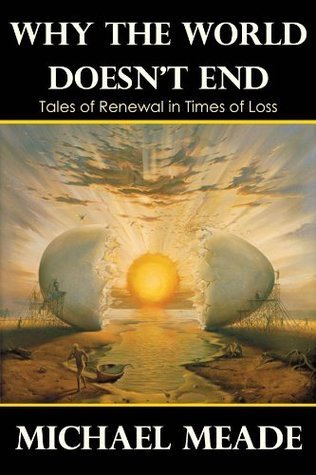
Starting with the sense that the contemporary world is uncertain and fragmented, troubled with tragedy and fraught with inauthenticity, mythologist Meade seeks for hints of renewal amidst the rattling and the rubble. At a time when people expect the world to come to an end because of global warming or nuclear nightmares, at the hand of wrathful deities or the prediction of ancient calendars, Meade offers surprising tales of renewal as well as an in-depth treatise on the psychology and mythology of the end of an era. In place of simple apocalyptic scenarios, the author follows a knowing thread back to ancient notions of apocalypsis as a liminal period marking the passage between one era and the next. Apocalypsis involves eruptions in nature and disruptions of culture, but also makes possible revelations of a unifying principle and guiding force in each life. Apocalypsis uncovers the hidden unity that connects all of life; but only after the surface of life cracks and the expected patterns fail. He describes a time of indeterminate length when people face the choice of assisting with the renewal of the world or falling under the spell of collective anxieties and doomsday predictions.
Endings and beginnings are eternally intertwined; “most end-of-the-world visions and end-time myths involve images of a regenerated world.” Life is cyclical, and despite the feelings we get when we find ourselves hurtling towards what feels like an end, it is important to remember that after that end comes a beginning. We are simply in the middle of another one of life’s many cycles. Cultures from across the world and throughout history all have myths associated with the cycle of life, death, and rebirth, and in his book Meade tells a number of these tales.
One of the myths our author shares is about a Native American woman who lives in a cave and alternates between weaving a cloth and stirring a pot of broth. There is a black dog that lives in the cave and every time she puts down her cloth in order to stir the broth, the dog approaches it and unravels it with his teeth. Then, when she puts down her spoon and leaves the pot unattended, its contents begin to settle on the bottom and burn. So, she is caught in a perpetual balance of tending to one and then the other, with each becoming undone when she turns her attention away. It’s a simple story that is packed with metaphor.
The woman represents Mother Earth and the cave is her earthly home; the weaving of the cloth represents the slow and patient construction of life and the interconnectedness of all things while the pot of broth symbolizes sustenance. Together, they mirror life, as the cloth creates meaning and the broth sustains life. The black dog represents entropy, the unknown, and death, and it doesn’t destroy the cloth out of malice, but unravels it as a necessary function of the cycle of creation and destruction.
The story itself is a metaphor for creation: it is never finished, but is in a constant state of becoming and unbecoming. Life’s creation and destruction are found in balance with one another, synonymous with order and chaos, yin and yang. “The most animated, surprising, and soulful places are those spaces found betwixt and between one thing and another” Meade writes, “between sleeping and waking, between culture and nature, where the inner and outer and the above and below entwine.” The story teaches us that true balance requires opposition—if the woman ever managed to complete her cloth, it would represent perfect harmony, a state of affairs we can never truly achieve. This tale of Mother Earth helps us understand that time is circular and has no end—it is an eternal loop of activity.
This is one of many mythological stories shared by Meade and extrapolated upon in the pages of his book in addition to many anecdotes on change. He writes about how when cultures fall apart it “happens in two places at once: where its youth are rejected and not fully invited into life and where its elders are forgotten and forget what is important about life.” This idea struck me as appropriate for our current day: young people are struggling to get their first foothold in society and older people have forgotten what is truly important in life as they have pulled the ladder to success up after themselves.
Intertwined throughout the myths of renewal and anecdotes of change, Meade writes about the journey we all take towards greater realization of our own role in the grand stories of life. “Every pilgrimage is secretly a journey to the center of oneself,” he says, “when we risk seeking what we most long for, we also begin the path of self-discovery.” This journey is an important spiritual one to take, for it is how we understand how creation and destruction take place in our own personal lives. The cycle of change happens on the individual level and also the societal level, and the myths we tell about one are appropriate for the other.
My overall take-away from reading this book is that regardless of where we are in our lives, either individually or collectively, we are in the middle of a cycle. If the end feels near, there is a beginning waiting in the wings, and vice versa. Despite the cloudiness of the future, we can all count on one thing: life will go on.
This book was perfect to read at the end of 2020 and beginning of 2021. It manages to cover concepts of the apocalypse and the most difficult things humans can face while being incredibly hopeful and inspiring. I want everyone I know to read this book now.
An excellent examination of the human journey we take part in, and how it is described in myth and story. To give you a sense of the book, here's a short quote from Chapter 6 - the Gift of Life, page 122: "Having a genuine vision of one's life requires and open heart as well as an open mind. Some might argue that the heart and eye are completely separate organs and shouldn't be confused. One receives impressions of light and movement; the other, deeply encased in the body is there to pump blood. Yet there are organs within organs. The mind can operate anywhere in the body and a blind person can often see many things clearly. There is a heart within the heart that holds a deeper capacity for vision. There is an eye in the heart that sees beauty and envisions things that cannot be proven by logic or be simply explained or easily understood. The eye within has its own sense of purpose and direction, just as the heart has its own thoughts that began long before the mud body formed and all the kicking and crying started. The heart is a subtle organ that mythically remains connected to the Heart of Heaven as well as to the Heart of the Earth. The eye of the heart is shaped for seeing the mysteries of life and love and for sighting new ways for making both. " Michael Meade is one of my favorite story/myth-tellers and I was hoping for more tales (hence the 4 star), but still a wonderful read.