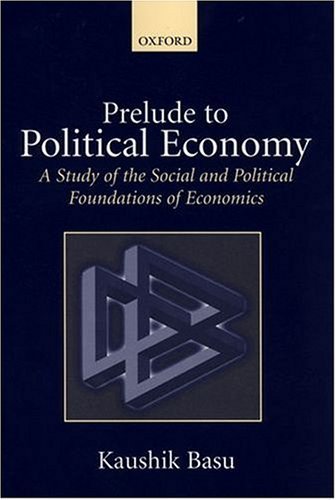
This book seeks to provide a better understanding of the state, the law, social norms, and the role of policy advise. It subscribes to the discipline of positive political economy, but also looks at the social situations that lie beyond economics and politics. It is divided into the five parts. Part I presents a primer on game theory. Part II raises the argument than an economy or market is embedded in a social setting, with all its attendant norms, institutions, and beliefs. Part III explores the idea of “the state” and laws. Part IV discusses selected topics on welfare economics. Part V argues that human beings do not use their rationality calculus over all available actions but only over a subset of them.
Kaushik Basu (born 9 January 1952) is an Indian economist who is currently the Chief Economic Adviser to the Government of India and is also the C. Marks Professor of International Studies and Professor of Economics and, till recently, he was Chairman of the Department of Economics and Director, Center for Analytic Economics at Cornell University.
He is Editor of Social Choice and Welfare, Associate Editor of Japanese Economic Review and is on the Board of Editors of the World Bank Economic Review. In 2008, the Government of India awarded him the Padma Bhushan, one of the country's highest civil honors.
Basu is strongest when he explains ideas conceptually, rather than through abstract game theory models—which he himself suggests may not even capture economics well. But that’s also his advantage: he uses the same tools of mainstream economics to quietly push back against its assumptions. This makes him credible to orthodox economists, while at the same time laying the groundwork for a more inclusive economics—one that treats politics and society as part of the discipline instead of forcing them through the narrow lens of “rational actors.”
I appreciated this textbook, even if I felt myself drifting at points. I’ll probably get more out of it later, once my math and game theory are more solid. Still, Basu’s method feels like a natural step forward for the field, and it’s sharp enough to turn against those “objective” professionals who think economics is beyond critique.