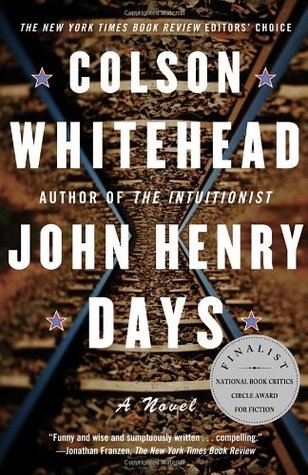
This is my first Colson Whitehead book and I liked it quite a bit. It is a patchwork novel, narrating characters and events from a range of times and places in American history: late 19th century as well as early, mid, and late 20th century - not in that order! These narratives loop backward and forward round one another, but not to the point of incoherence. Several of the set pieces are just exquisite, some of the best stuff I've ever read. By far the most gripping for me was a (fictional) eyewitness account of the 1969 Rolling Stones/Hell's Angels debacle in the desert. It is horrifically fascinating (and told in the dazzlingly authentic voice of an old white rock journalist).
If it surprises you that such an account would find itself in the midst of a novel ostensibly about the legend of John Henry and the history of the railroads of America, then it gives you an indication of the unexpected turns this novel takes. You will indeed encounter very richly rendered passages on John Henry himself working away at his legendary steel-driving as a member of the work crews making railroad tunnels through America's mountains. You will also see 'temp' workers in an office helping create search engine content for the very latest (1996) in internet technology. You'll be a hack journalist in a convenience store queue in the middle of the night with junkies in modern (1990s) Brooklyn one chapter, a 1950s blues singer on the make in Chicago in another, a middle class ten-year-old black girl in late 1940s Harlem in yet another, and have a modern press pass to a phantasmagoric-dystopic book launch in still another.
There are one or two moments of suspense or violence, a few moments of eeriness or horror, lots of chuckles and some outright laughs. There are tons of wry observations and insights about the contemporary grotesque-yet-bland circus of pop culture and media and technology. (Wonderful refrains are scattered throughout about the 'plodding obeisance of pop', 'He had been devoured by pop', 'deep into cold pop', 'life under pop', etc.) There is poignancy and there is dystopia. It is about ecology as much as culture. Indeed, you could perhaps call it the story of 'Pop vs. The Mountain'.
(I know you will be few, but if any of you are R. A. Lafferty fans like I am, you'll perhaps be as surprised and delighted as I was to find some very interesting resonances between the two otherwise disparate authors.)
The book suffers from its form. It is hard to be impelled by any one narrative thread. There is a (shiftless but very likeable) main character and his is the main story of the novel, but he can be off stage for long swathes of narration. At times the pages fly by but at others they grind to a halt. There is always some reward in moving forward, some new set piece you wouldn't have guessed and for which you are very glad you kept going. But it is a long, sprawling, high-minded 'great American novel' (if bitingly ironic in its high-mindedness).
The latent (and sometimes blatant) prejudice toward many white and 'country' people from an NYC perspective was off-putting at times, if understandable. But there was, at least, an honesty to the narrative that often admitted it was big city paranoia toward the rest of the country. (A neglected theme that could use its own novel-length treatments.)
It is also a very philosophically bleak novel. There are certain versions of this kind of bleakness that for some reason I can totally take to (e.g. Cormac McCarthy), but in this novel I found it bordering on depressing for me personally. It is mostly quite deeply cynical. (Not in the sense of having no sympathy for characters, but rather in the sense of seeming to 'see through' just about *everything*, bordering on nihilism. Some, I know, find such a worldview bracing. I find it untrue.) Still, I can relate to the novel's world-weary vision. Considering its pessimism, it is actually remarkable that it stays true to the instinctual yearning to find a scrap of meaning or value or goodness, mostly failing but maybe showing a glimmer of hope in the end. It is a search for authenticity in a world of slick, sick fakery and I salute the author for turning away in disgust from so much of contemporary American culture.
I am definitely very excited to go on to read the rest of Colson Whitehead's novels.