Jump to ratings and reviews
Rate this book

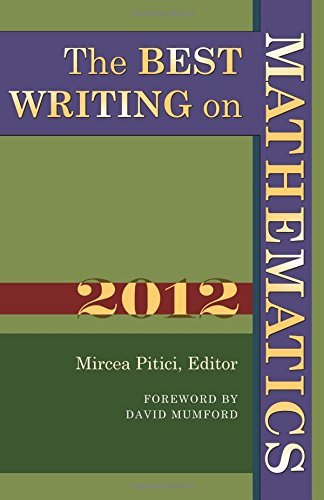
The Best Writing on Mathematics 2012

Rate this book
This annual anthology brings together the year's finest mathematics writing from around the world. Featuring promising new voices alongside some of the foremost names in the field, "The Best Writing on Mathematics 2012" makes available to a wide audience many articles not easily found anywhere else--and you don't need to be a mathematician to enjoy them. These writings offer surprising insights into the nature, meaning, and practice of mathematics today. They delve into the history, philosophy, teaching, and everyday occurrences of math, and take readers behind the scenes of today's hottest mathematical debates. Here Robert Lang explains mathematical aspects of origami foldings; Terence Tao discusses the frequency and distribution of the prime numbers; Timothy Gowers and Mario Livio ponder whether mathematics is invented or discovered; Brian Hayes describes what is special about a ball in five dimensions; Mark Colyvan glosses on the mathematics of dating; and much, much more.In addition to presenting the year's most memorable writings on mathematics, this must-have anthology includes a foreword by esteemed mathematician David Mumford and an introduction by the editor Mircea Pitici. This book belongs on the shelf of anyone interested in where math has taken us--and where it is headed.

Paperback Bunko

First published November 11, 2012

6 people are currently reading
62 people want to read

About the author

Mircea Pitici

16 books14 followers

Ratings & Reviews

What do you think?
Rate this book

Friends & Following

Create a free account to discover what your friends think of this book!

Community Reviews

5 stars
10 (25%)
4 stars
16 (41%)
3 stars
11 (28%)
2 stars
2 (5%)
1 star
0 (0%)
Displaying 1 - 7 of 7 reviews
Profile Image for Ted.
515 reviews737 followers
June 5, 2018
See last part of review for a very interesting, feel-good report!


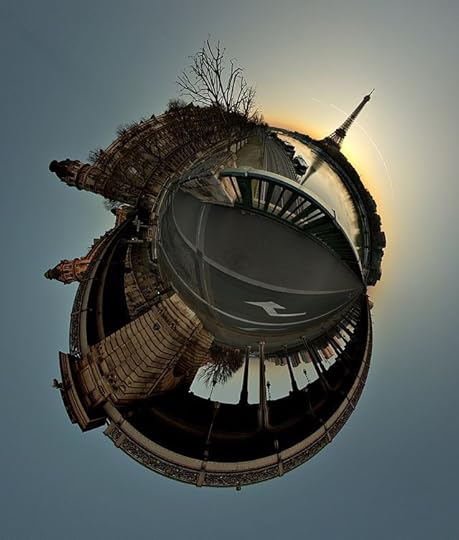
Stereographic projection of Paris, as discussed in the article (#7) on the viewable sphere.

The book is a compilation of articles written in 2012 which the editor believes to be of interest, and accessible, to the general reader with even a little interest in math. I found a very few articles where I was a little over-powered by the math (maybe two or three); the rest barely required even being comfortable with equations. It’s true that most mention mathematical terms and topics, but most readers should be able to slide by anything they’re totally unfamiliar with just by the context. The articles are from such sources as The British Society for the History of Mathematics, Scientific American, Nature and The College Mathematics Journal.

The editor, Mircea Pitici, began editing this series in 2010, having considered it for about five years and finally finding a publisher (Princeton U. Press) that was interested in the idea. In his Introduction, Pitici has this to say about his goal in presenting the books.
By editing this series, I stand for the wide dissemination of insightful writings that touch on any aspect related to mathematics. I aim to diminish the gap between mathematics professionals and the general public and to give exposure to a substantial literature that is not currently used systematically in scholarly settings. Along the way, I hope to weaken or even to undermine some of the barriers that stand between mathematics and its pedagogy, history, and philosophy, thus alleviating the strains of hyperspecialization and offering opportunities for connection and collaboration among people involved with different aspects of mathematics.


The book is not divided into topical sections, but most of the articles are grouped near others that are related in some way. Here’s my attempt at summarizing the groups of topics.

Basic questions about math – 1-3 (the numbers refer to the article list below)
Specific math topics – 4-6, 20, 23
Math in social life and society – 7-10, 24
Math education – 11-16
Math, science, history & philosophy – 17-23

Most readers would probably find something that would interest them. Check out this list of articles, (with a few words on most of them). A lot of them can be found on line by Googling the title.

1 - Why Math Works MARIO LIVIO. blog: https://blogs.stsci.edu/livio/
2 - Is Mathematics Discovered or Invented? TIMOTHY GOWERS. good
3 - The Unplanned Impact of Mathematics PETER ROWLETT. delightful
4 - An Adventure in the Nth Dimension BRIAN HAYES. fascinating, pdf: http://www.americanscientist.org/libr...
5 - Structure and Randomness in the Prime Numbers TERENCE TAO. interesting but quite advanced
6 - The Strangest Numbers in String Theory JOHN C. BAEZ AND JOHN HUERTA. check-marked
7 - Mathematics Meets Photography: The Viewable Sphere DAVID SWART AND BRUCE TORRENCE. Great!
8 - Dancing Mathematics and the Mathematics of Dance SARAH-MARIE BELCASTRO AND KARL SCHAFFER. interesting but a bit dry to me
9 – Can One Hear the Sound of a Theorem? ROB SCHNEIDERMAN. very interesting
10 - Flat-Unfoldability and Woven Origami Tessellations ROBERT J. LANG. gave up on this one
11 - A Continuous Path from High School Calculus to University Analysis TIMOTHY GOWERS
12 - Mathematics Teachers’ Subtle, Complex Disciplinary Knowledge BRENT DAVIS
13 - How to Be a Good Teacher Is an Undecidable Problem ERICA FLAPAN. check-marked, fun to read
14 - How Your Philosophy of Mathematics Impacts Your Teaching BONNIE GOLD. interesting
15 - Variables in Mathematics Education SUSANNA S. EPP. could be useful to teachers
16 - Bottom Line on Mathematics Education DAVIS MUMFORD AND SOL GARFUNKEL. very interesting, Google it
17 - History of Mathematics and History of Science Reunited? JEREMY GRAY. OUTSTANDING
18 - Augustus De Morgan behind the Scenes CHARLOTTE SIMMONS. most enjoyable, filled with history and anecdotes
19 - Routing Problems: A Historical Perspective GIUSEPPE BRUNO, ANDREA GENOVESE AND GENNARO IMPROTA. reasonably interesting
20 - The Cycloid and Jean Bernoulli GERALD l. ALEXANDERSON. worthwhile
21 - Was Cantor Surprised? FERNANDO Q. GOUVEA. interesting, but I found it tough going
22 - Why Is There Philosophy of Mathematics at All? IAN HACKING. good; many good books mentioned at end
23 - Ultimate Logic: To Infinity and Beyond RICHARD ELWES. Very interesting
24 - Mating, Dating, and Mathematics: It’s All in the Game MARK COLYVAN. love is strange https://www.youtube.com/watch?v=pCvcZ...

The last fifteen pages include short bios of all the contributors, a lengthy list of additional articles that were considered for inclusion (I underlined about twenty of these for future investigation), and information on where each of the included articles first appeared.

I was reading the book for a long while, but that’s mostly because I was reading 8-10 other books at the same time. When I finally decided to finish it recently, I found it easy and entertaining to read the last 8 or so articles in fairly short order.

UPDATE

The New Yorker, in its 2/2/15 issue, has a PROFILE article that fits in nicely with this book – though it is more of a “people” article than a “numbers” article. But surely most of us are more interested in people than in numbers, right?

There are three main sections to this review update: (1) a link to the article; (2) a brief synopsis of the human interest (“profile”) aspect of the article; and (3) an alternate explanation of the math part of the article which might be a bit more detailed than the article itself.

(1) The article http://www.newyorker.com/magazine/201... , by Alec Wilkinson, is a great read, and if you have time, do read it. Afterwards you can skip section 2. If you’re interested in the math, but a bit confused by what the article said, read section 3.


(2) Yitang Zhang profile


Yitang Zhang is a quiet, unassuming man, “deeply reticent, with a manner formal and elaborately polite”, in Wilkinson’s words. Zhang was born in Shanghai in 1955, he’s now in his sixtieth year. He received his PhD in algebraic geometry from Purdue in 1991, but parted unhappily from his thesis advisor, leaving the university without his support. Having published nothing, he was unable to find an academic job. He worked at short term jobs in New York and Lexington KY, one of which was keeping the books at a friend’s Subway franchise in Lexington. Wilkinson quotes Zhang
“Sometimes, if it was busy at the store, I helped with the cash register. Even I knew how to make the sandwiches, but I didn’t do it so much.” When Zhang wasn't working, he would go to the library at the University of Kentucky and read journals in algebraic geometry and number theory “For years, I didn’t really keep up my dream in mathematics”, he said.
[Wilkinson:] “You must have been unhappy.”
He shrugged. “My life is not always easy,” he said.

Zhang finally obtained a position at the University of New Hampshire with a friend’s help in 1999. The position was that of a part-time, untenured instructor of calculus. This rather suited Zhang, since he had time to contemplate the mathematical problems that interested him.

Zhang began thinking about a famous conjecture in prime number theory, the “bound gap” problem, in 2010, but made little progress for a couple years. “We couldn’t see any hope,” he said. [Zhang often refers to himself as “we”, but this “from diffidence”, and is definitely not the “royal we”.] Then, on July 3, 2012, in the middle of the afternoon, “within five or ten minutes, the way is open.”

He finished his paper, “Bounded Gaps Between Primes”, in late 2012, and sent it to Annals of Mathematics in April 2013 (without telling anyone). In that year Annals received 915 papers and published 37 of them. When the paper was received an initial reader commented that, if correct, it was a blockbuster – but it would have to be examined very closely, and with skepticism because of Zhang’s lack of credentials; he had authored only one previously published paper, in 2001, which went mostly unnoticed.

The paper was then assigned to two other readers, “referees”, whose job is to read the paper carefully to decide if its proofs and claims are valid. One of these referees, Henryk Iwaniec, was the writer of a 2005 paper which Zhang’s work was partially based on. As the two referees read the paper at a conference they were both attending, they read with increased attention. Iwaniec relates in the article that “There had been nothing written on the subject since 2005. The problem was too difficult to solve. As we read more and more, the chance that the work was correct was becoming really great. Maybe two days later, we started looking for completeness, for connections … we’re checking line by line.”
After a few weeks [the readers wrote] “We have completed our study of the paper ‘Bounded Gaps Between Primes’ by Yitang Zhang … The main results are of the first rank. The author has succeeded to prove a landmark theorem in the distribution of prime numbers … Although we studied the arguments very thoroughly, we found it very difficult to spot even the smallest slip … We are very happy to strongly recommend the acceptance of the paper for publication …”


Since the paper’s publication, Zhang has been awarded the 2013 Morningside Special Achievement Award in Mathematics, the 2013 Ostrowski Prize, the 2014 Frank Nelson Cole Prize in Number Theory, and the 2014 Rolf Schock Prize in Mathematics. He is a 2014 recipient of a MacArthur Award "for solving a problem that had been open for more than a hundred and fifty years". Zhang also received an appointment from the University as a full professor.

Wilkinson notes that the British mathematician G.H. Hardy once wrote that mathematics "is a young man's game", and continued, "I do not know of a single instance of a major mathematical advance initiated by a man past fifty." I guess times change.


(3) The math

Here’s my best shot at explaining the problem that Zhang addressed.

(1.) We’re talking about the positive integers , from 1 to (infinity).

(2.) These can be divided up into two sets: prime numbers (their only divisors are themselves and 1), and composite numbers (the rest). Example: the first few primes are 1,2,3,5,7,11,13,17,19; 11 is a prime because the only integers that divide evenly into it are 11 and 1. 1

Example: the first few composite numbers are 4,6,8,9,10,12,14,15,16,18; 10 is composite because it’s divisible by 2 and 5 (as well as by 10 and 1); 18 is divisible by both 2 and 3 (as well as by 18 and 1).
For composites, note that all even integers past 2 are composite, because they can be divided by 2.
[The divisors of a composite number are called its “factors”, and by convention they are listed as the set of PRIMES (excluding “1”) which when multiplied together form the number in question. Thus the factors of 10 are (2,5) and the factors of 18 are (2,3,3 – not 2,9). }

(3.) We are interested in the gaps between “adjacent primes” (APs) [Example: 7,11 are a pair of adjacent primes, with a gap of 4]; we’ll also mention the gaps between “adjacent composites” (ACs) [Example: 10,12 are a pair of adjacent composites, with a gap of 2]

(4.) Wilkinson illustrates this by likening the problem to a pigeonholing task. I’ll expand on him a bit to try to make it as clear as I can.

Assume you have an infinite number of pigeonholes, each labelled with a number: 1, 2, 3, ad infinitum. Each pigeonhole represents a gap value.

(4.a) Let’s do an easy exercise first. Consider the infinite number of adjacent composite numbers (ACs). It’s obvious that none of these ACs can have a gap greater than 2, since every even integer is composite. Infinitely many of the ACs have a gap value of 2 exactly. These are even integers (one two bigger than the other) with a prime number in between them. All the rest (another infinity) of the ACs have a gap value of 1. These consist of an even number and the next odd number (which is not prime); or of a non-prime odd and the next even number.

So, if we could take the time to look at all ACs and put them in a pigeonhole by their gap value, they would all go into either the “1” or the “2” hole.

(4.b) Now let’s look at the adjacent primes (APs). Here the situation is not so simple, though it starts off simple. The first two APs are (1,2) and (2,3). Both have a gap 1. No other AP will have this gap, because it is only brought about in these cases because “2” is the only even prime. There is another obvious thing to say about pigeonholing the ACs. We will never use ANY of the odd-numbered pigeonholes except for “1”. All prime numbers past two are odd, and thus any two adjacent ones will have a difference of an even number. (Think about it, draw a little picture. Remember, not all odd integers are primes; but all primes are odd.)

Look at the primes listed in (2.) above (1,2,3,5,7,11,13,17,19). The gaps are 1,2=1; 2,3=1; 3,5=2; 5,7=2; 7,11=4; 11,13=2; 13,17=4, 17,19=2. If we go a little farther we will find 23,29=6 (both 25 and 27 are composite, not prime).

Well. The so-called Prime Number Theorem, in all of its many versions (as stated and/or proved by different mathematicians from the mid-nineteenth century on), basically says that as one proceeds farther and farther out the sequence of integers, the average gap between adjacent primes (average AP) gets larger and larger. That is, the primes get more and more infrequent. This says nothing, however, about the values for specific AP gaps in a regime of large numbers.

So a question was formulated back in the nineteenth century. If we pigeonhole all of the infinite APs by their gap size, will any pigeonhole have an infinite number of them? Or will the infinite APs be distributed in the infinite (even-numbered) pigeonholes such that every pigeonhole will have a finite number of them in it? (Strictly speaking the question was posed as the “Twin Prime Conjecture”, and specifically asked whether the “2” bin would contain an infinite numbers of APs.)

This is the question that remained unresolved for over a century. All that time various mathematicians would periodically devote time to it, perhaps propose an answer, and then realize that no, that wasn’t it. In 2005 a paper was published that attempted to address the question, and was able to make some progress towards a result. But it didn’t achieve closure, and the authors of the paper gave up on the quest, believing that the problem was “too difficult”. There the matter rested.

Until Zhang’s paper of 2013.

To wrap up the story, Zhang was able to show that there was some pigeonhole having some number less than 70 million that had an infinite number of APs in it. (Zhang had no interest in trying to determine where that infinitely-filled pigeonhole was exactly.) Subsequent research, likely spurred on by Zhang’s result, has reduced the number of this infinitely filled bin to <600, then <= 246, and now perhaps as small as 6 or 12. (But not “2”, the Twin Prime Conjecture itself.)

Web links.

Zhang
http://en.wikipedia.org/wiki/Yitang_Z...

Prime numbers
http://en.wikipedia.org/wiki/Prime_nu...

Prime Number Theorem
http://en.wikipedia.org/wiki/Prime_nu...

Twin Prime Conjecture
http://mathworld.wolfram.com/TwinPrim...

The paper (Bounded Gaps Between Primes) abstract
http://annals.math.princeton.edu/2014...


1. As pointed out in comments 19 & 21below, my statement that "1" is a prime number is technically incorrect - though it makes no difference in the presentation of the material above.

In fact it's true that going back to Greek mathematics, the number 1, which they referred to as the "unit", was considered special enough to exclude it from the other positive integers, which they divided into (a) evens and odds, and (b) the "prime or incomposite" numbers and the "secondary or composite" numbers. (Heath, Manual of Greek Mathematics). In fact, though both Euclid and Aristotle considered 2 a prime number, the Pythagoreans did not, and even held that 2 was not even a number! The dyad so-called was for them "only the principle of the even, as the unit was the principle of number".

It seems to me, from these facts, that the exclusion of 1 from the primes likely had as much to do with "philosophical", even "mystical" issues for the early mathematicians, as the more prosaic reasons that might be mentioned in later times.
Profile Image for Mark Moon.
160 reviews131 followers
March 2, 2024
Highlights:

"A Continuous Path from High School Calculus to University Analysis" by Timothy Gowers

"Variables in Mathematics Education" by Susanna S. Epp

"Augustus De Morgan behind the Scenes" by Charlotte Simmons

"Was Cantor Surprised?" Fernando Q. Gouvêa
Profile Image for Alan Clark.
87 reviews
October 18, 2014
I have also read the volumes for 2010 and 2013, but this one for 2012 is my personal favourite. As usual the articles vary from very interesting to uninteresting, and from easy to difficult, so I did not enjoy all of the articles, but some of them were really enjoyable.

Particular favourites are "The Unplanned Impact of Mathematics", about applications that were found decades or even centuries later; "An Adventure in the Nth Dimension", about the strange properties of multi-dimensional spheres; "Mathematics Meets Photography: The viewable Sphere"; "Flat Unfoldability and Woven Origami Tesselations", with some amazing examples which seem impossible; and "Mating, Dating and Mathematics".
Profile Image for Nick Traynor.
291 reviews23 followers
November 6, 2014
Quite a few interesting chapters, I particularly enjoyed the biographical stories of mathematicians and the discussions about the philosophy of mathematics. I learned a bit about set theory, I enjoyed the sections on prime numbers and graph theory, and the mathematics of photography was interesting. There were lots of boring bits too though, particularly the chapters about math in dancing and origami.
Profile Image for Charles Daney.
78 reviews28 followers
March 16, 2018
In describing the essays in this volume as the "best" writing on mathematics, the word "best" can't be taken literally. For one thing, a mathematician would naturally point out that there is no simple, obvious linear ordering on the set of writings about mathematics that reflects "quality". There is certainly no metric to quantify quality for this type (or any other type) of writing. Specifying a particular audience that might have useful opinions on quality would help, but still be inadequate. That said, let's assume the audience is at least people who understand some mathematics and who appreciate it and value it. That's still a number of audiences, since it includes professional mathematicians, teachers of mathematics at all levels, and users of mathematics in fields like physics, statistics, economics, etc.

There's a little something in this volume for many of these audiences, but probably not enough to satisfy most of them. The editor of this collection is a specialist in mathematics education, so that category is over-represented. People who apply mathematics in their own special fields of expertise, as well as research mathematicians, will probably find the material on mathematics education to be of minor interest.

Many of the other topics tend to be treated in a way that would appeal to that fairly small part of the "general public" that actually has any interest at all in mathematics. Check out the table of contents to see if any topic of that sort interests you. Since this is a personal evaluation, I'll just mention articles that seemed interesting to me. As with other volumes in the series, there is a foreword by a notable mathematician or user of mathematics. In this volume it's by David Mumford on "The Synergy of Pure and Applied Mathematics". That should be of interest to almost everyone.

Perhaps unsurprisingly, two of the best articles in the volume were written by research mathematicians who've won Fields Medals: Terrence Tao and Timothy Gowers.

Tao writes about a topic he knows extremely well (of which there are quite a few): the distribution of prime numbers. The question is whether there are any patterns in how prime numbers are distributed, or whether the distribution is essentially random. Although this subject has been of great interest to mathematicians since before the time of Euler and Gauss, striking results are still being discovered, even though famous conjectures such as the Riemann hypothesis, "Goldbach conjecture", and the "twin prime conjecture" are still unsolved. The twin prime conjecture is that there are infinitely many prime pairs whose values differ by just 2. It is now known that there are infinitely many prime pairs that differ by some N, when N is not greater than 246 - but that's still far more than 2. Tao has contributed to this sort of research: in 2004 he (and Ben Greene) proved that there are arbitrarily long arithmetic progressions of prime numbers.

Gowers has two contributions, but the interesting one is the question of whether mathematical truths are "invented" or "discovered". This can be treated as either an empirical question or a philosophical one. Gowers focuses on the empirical question, and the answer is "both".

Brian Hayes wrote a fascinating article, which points out that in higher dimensions the ratio of the volume of a sphere inscribed in a cube to the volume of the cube goes to zero as the dimension N grows to infinity. This is surprising but intuitively makes sense. A unit cube always has volume one in any dimension. However, the inscribed sphere has radius 1/2. The volume formula for such a sphere is somewhat complicated, but it actually decreases faster than 1/2 to the Nth power. So in high dimensions, most of the volume resides in the "corners" outside the inscribed sphere.

John Baez and John Huerta discuss certain types of "extended" number systems, such as "imaginary numbers" (involving the square root of -1), "quaternions", and "octonions". There are "algebras" of such abstract numbers - and they seem to be relevant to symmetry and the possible dimensions of space where "string theories" that are of interest to physicists can exist.

There are several good articles on the history of mathematics. One (by Peter Rowlett) offers a number of examples where solutions to practical problems were enabled by theoretical work that may have occurred centuries earlier. Charlotte Simmons writes about the influence of the logician Augustus De Morgan on other notables, such as William Hamilton (discoverer of quaternions) and George Boole (inventor/discoverer of Boolean algebra). De Morgan wrote many textbooks on various sorts of elementary math, as well as 850 "popular" article for the general public. In addition, he mentored other mathematicians who went on to do more cutting-edge work that eventually became widely known, such as Boole and Hamilton

Fernando Gouvea shows how the modern theory of real numbers and of sets arose from interactions over many years between George Cantor and his teacher, Richard Dedekind. A satisfactory theory was discovered only after various promising but false starts. Separately, Richard Elwes writes about the very esoteric theory of infinite sets and infinite cardinal numbers. Cantor originated this theory and was (apparently) surprised that many distinct infinite sets all have the same size ("cardinality"). Some recent work in this area has been done by Hugh Woodin, and it suggests that even Kurt Gödel and Paul Cohen didn't have the last word on Cantor's Continuum Hypothesis.

Another good article is on game theory, by Mark Colyvan, who discusses the "optimal" strategy for hiring the "best" employee or marriage partner out of a number of candidates.

Lastly, philosopher Ian Hacking asks the question, "Why is there a philosophy of mathematics at all?" As a philosopher, he attempts to present several plausible justifications. This discussion concerns mathematical Platonism and the "invented" vs. "discovered" issue. Professional mathematicians, though, aren't that concerned with the philosophy, since for them the really important thing is proving theorems, while letting philosophers worry about what that "means".
225 reviews6 followers
November 23, 2020
I'm a mathematician (I teach at Arizona State), and I have a few volumes of this series. Earlier this year, I ordered a bunch of them via AbeBooks and am working my way through them.

The entire series is hit-or-miss.
2,261 reviews26 followers
June 12, 2016
Yes I did like the parts of it I read, for those who know of my history with math. I didn't intend to read all of it, and I certainly did not understand much of what I was reading. I did learn a little. I think I know what Occam's razor is now, and I might get it right on a test if the answers were multiple choice. Mathematics is a completely different and foreign world for me, but it's good for my brain to stick my nose into it at times and take a deep breath. This will not be the last time I do that.
Displaying 1 - 7 of 7 reviews

Can't find what you're looking for?

Get help and learn more about the design.