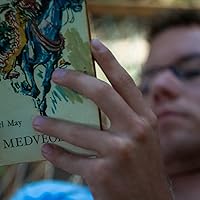
Petőfi Sándor ezen elbeszélő költeménye olyan, mintha népmese lenne, csak éppen versben előadva. Petőfi János vitéz és Iluska sorsán keresztül igazságot is szolgáltat, de művében a magyar nép vágyát is megfogalmazta. Majd száz évvel később egy másik magyar író, Szerb Antal mondta: " A János vitéz az, amit az ember szeretne odaajándékozni külföldi ismerőseinek, hogy megérezzék a magyar népjelleg melegségét, humorát, semmihez sem fogható báját, hogy megérezzék a magyar szív verését. Ebben a műben csodálatosan együtt van a magyar föld valósága és a magyar lélek álma."
People best know Hungarian lyric poet and revolutionary hero Sándor Petöfi, originally Sándor Petrovics, for his patriotic songs and the epic poem Janos the Hero (1845).
This key national of Serb and Slovak descent figured in the Hungarian revolution of 1848.
Petőfi started his career as a poet with "popular situation songs," to which his first published poem, A borozó ("The Winery", 1842), belongs. This song of a drinker praises the healing power of wine to drive away all troubles. Despite this not unusual kind of pseudo-folk song in Hungarian poetry of the 1840s, Petőfi quickly developed an original and fresh voice, which made him stand. He wrote many poems like folk song on the subjects of wine, love, romantic robbers et cetera. The love poem A virágnak megtiltani nem lehet ("You Cannot Forbid the Flower", 1843) exemplifies many of these classic early poems, and Befordultam a konyhára ("I Turned into the Kitchen", 1843) uses the ancient metaphor of love and fire in a playful and somewhat provocative way.
Folk poetry and 19th-century populism very significant influenced work of Petőfi' despite other also present influences: familiar with the works of major literary figures of his day, including Percy Bysshe Shelley, Pierre-Jean de Béranger and Heinrich Heine, Petőfi drew on sources, such as topoi of contemporary almanac-poetry, in an inventive way.
This has got to be among the most beautiful things I have ever read.
I liked the story, and I liked the poet's great imagination and creativity. He seems to be a bottomless well of ideas; it reminded me a bit of The Neverending Story in that respect. Great sense of humor, too. I liked the part where they are so high up on the mountain that the horses trip over stars. There were many fun parts like that. At other times, it is deeply touching - the despair János feels during his exile, the story of his and Iluska's childhood, and especially the parts that speak about their love for each other. And throughout all of it, the poetry is unspeakably beautiful. I was in awe of the poet's skill from beginning to end.
I don't know if the English translation is any good (couldn't find a copy), I can only comment on the original, which is online here: https://archive.org/stream/jnosvitz00...
This is a really fantastic, in both senses of the word, piece of narrative poetry, and honestly, maybe the most purely enjoyable poem I've ever read. Petofi's rough and inventive rhymes come across very well in the translation. It has the authentic, earned, elemental blend of humor, adventure, and fantasy that seems to exist only in myth. I especially enjoyed the passage describing the hussars' journey over the mountains, so high that they could wring water from the clouds and the horses tripped over the stars.
persze csak az iskolából (nem) emlékeztem rá, leginkább arra, hogy minek kellett megtanulni az első nemtomhány versszakot – de igazából, bármennyire is cukin olvasta fel a Törőcsik Mari, verstanilag azért elég kellemetlen, folyamatosan döcög, néha olyan általános iskolás rímek lepnek meg, amik már valszeg akkor is cikik voltak, és hát népmese ide vagy oda, azért durva, h az ötödikesek olvassák a 16, de inkább 18+-os részleteket.
A kő úgy a király homlokához koppant, Hogy az agyveleje azonnal kiloccsant. „Igy híj meg máskor is kőszikla-ebédre,” Szólt s kacagott János „ráforrt a gégédre!”
I read János vitéz by Sándor Petőfi as part of my project to read the mandatory and suggested literature taught in Hungarian schools from grades five to twelve. This was actually a reread for me because János vitéz is one of those books almost every Hungarian encounters at school. I first read it when I was about ten, so coming back to it as an adult was a very different experience.
János vitéz, which can be translated as John the Valiant, is a narrative epic poem written by Petőfi in 1844, when he was only twenty one years old. Considering that Petőfi died at only twenty six, basically everything he ever wrote was written when he was ridiculously young, and this poem is a particularly good example of just how much he had already developed his distinctive voice.
The story begins with a young shepherd called Kukorica Jancsi. His name is a little difficult to translate, although the traditional English translation calls him Johnny Corncob because he was found abandoned in a cornfield as a baby. Personally, Johnny Corncob sounds considerably less heroic to me than Kukorica Jancsi, but there you go.
At the beginning of the poem, Jancsi is supposed to be looking after his sheep when he spots his sweetheart, Iluska, washing clothes in the river. Iluska is a diminutive form of Ilona, so even her name has this affectionate, familiar quality to it. Jancsi persuades her to abandon the washing for a while so that they can have some lovey dovey time together, which Petőfi describes poetically enough that exactly what they are doing is open to interpretation. It could just be kissing. It could perhaps be something more. But when you read this at about ten years old, they are kissing. They are absolutely just kissing. That is what all of us assumed at school, and I am sticking with it.
Unfortunately, Iluska has the obligatory evil stepmother, who catches them together and drags her away. Jancsi then remembers that he was supposed to be looking after some sheep and discovers that half of them are gone. His foster father is understandably not delighted to learn that Jancsi has managed to lose a significant portion of his livelihood, so he throws him out. Jancsi says goodbye to Iluska and leaves the village, and that begins his enormous journey.
What I particularly enjoyed about János vitéz as an adult is the way the story gradually moves from the mundane into complete fairy tale fantasy. It begins in a recognisable Hungarian village landscape with sheep, washing in the river, young love and an angry foster father. Then Jancsi walks out into the wider world, and the scale of the story keeps growing around him. He encounters robbers, becomes a hussar, travels to distant countries, fights battles, meets giants and witches, and eventually reaches a world that has left ordinary reality completely behind.
It feels almost as though we are watching a Hungarian folk tale expand around him.
Jancsi himself is the archetypal folk tale hero. He begins with nothing. He is a foundling without wealth or status, and once he loses his home, he effectively has nothing except his own character and his love for Iluska. Yet he is brave, loyal and fundamentally good, and every new stage of his journey gives him another opportunity to prove himself. He does kill rather a lot of things along the way, admittedly, but eventually we are dealing with fairy tale creatures, so I think we can give him some leeway.
The thing I appreciated most on this reread, though, was Petőfi's language. The poem is genuinely beautiful. He draws heavily on Hungarian folk language, traditional imagery and the rhythms of folk tales, but elevates them into poetry without making the result feel artificial or disconnected from ordinary people. The opening landscape is particularly vivid because it feels so recognisably Hungarian, and then that familiar landscape slowly disappears as Jancsi travels farther from home and deeper into the fantastical.
That transition works particularly well because Petőfi does not begin by announcing that we are entering a magical world. We begin with sheep. We begin with a girl washing clothes in a river. We begin with a young man who neglects his work because he wants to spend time with his girlfriend. The supernatural elements become increasingly prominent as the journey continues, until giants, witches and magical kingdoms feel like a natural extension of the world we started in.
That also makes János vitéz a fascinating introduction to Hungarian folklore. It uses many elements that recur throughout Hungarian folk tales. There is the poor young hero setting out into the world, the seemingly impossible challenges, the distant kingdoms, the witches, the giants, the magical creatures and the repeated tests of the hero's courage and character. Read through a modern lens, it is essentially a fantasy adventure constructed from Hungarian folk tale traditions.
Rereading it as an adult also made me appreciate why this particular work has remained such an important part of Hungarian culture. As a child, it is very easy to concentrate on the adventure. Jancsi goes places, fights things and encounters increasingly strange creatures. As an adult, I was much more conscious of the structure underneath that adventure and of how Petőfi moves between the ordinary and the mythical while keeping Jancsi emotionally connected to the very small world he came from.
There is also something rather lovely about returning to a work that was simply "school reading" when I was a child and discovering that I actually like it. Mandatory reading has a way of turning literature into something you have to get through for the next lesson, especially when you are ten. Reading János vitéz now, without having to answer questions about it afterwards, allowed me to pay attention to how pretty it actually is.
And it is pretty. It is funny in places, romantic in others, occasionally violent, increasingly bizarre, and completely sincere about all of it. Petőfi takes a shepherd who loses his sheep because he is distracted by a girl and sends him into an adventure of heroic proportions without ever losing the folk tale simplicity at the heart of the story.
The importance of János vitéz in Hungarian culture also means that it has been adapted several times, including a very famous musical adaptation by Pongrác Kacsóh, which premiered in 1904. It is a daljáték, a Hungarian musical theatre form closely related to operetta, and it turned Petőfi's story into a stage work with music and songs.
I have never actually seen the whole thing, although something rather strange happened while I was rereading the poem. Certain passages started coming back to me with music attached to them. Apparently I heard enough of Kacsóh's adaptation at some point in my childhood for parts of it to lodge themselves in my brain without me consciously remembering where they came from.
I initially assumed the operetta had largely disappeared from the stage, but it turns out that it is still performed, including by the Budapest Operetta Theatre.
Another adaptation, and probably the one I find most interesting, is Marcell Jankovics's 1973 animated film. It has some historical importance of its own because it was the first Hungarian feature length animated film, and it was created for the 150th anniversary of Petőfi's birth.
Visually, it is absolutely fascinating. If you have seen Yellow Submarine, you will probably understand immediately why the two films are often compared. Jankovics's János vitéz is incredibly colourful and psychedelic, with Hungarian folk art mixed with the visual language of pop art and Art Nouveau. The result is unmistakably a product of the late 1960s and early 1970s, but it is also unmistakably Hungarian. It is a strange combination, but it works remarkably well with a story that becomes increasingly surreal as Jancsi travels farther from home.
The music is also a major part of the film, and I was particularly curious about what it did with Kacsóh's music. By 1973, the stage adaptation had already been around for almost seventy years, and its songs had become strongly associated with János vitéz. But the animated film does not simply reuse the operetta's score. Instead, it has its own original score composed by János Gyulai Gaál. In fact, creating a musical identity that would not simply evoke Kacsóh's enormously popular adaptation was one of the challenges Gyulai Gaál faced.
His music is closely connected to the visuals and changes along with Jancsi's journey rather than simply sitting behind the animation. There are elements of Hungarian musical tradition, but the score also reaches much further. Jankovics gave the composer specific classical references for certain scenes, including Wagner's Tristan und Isolde and Verdi's Otello for the love scene, while in other places he wanted something more reminiscent of Kodály. The result is music that participates in the storytelling rather than merely accompanying it.
There are also songs in the film, with lyrics written by József Romhányi and performed by Gjon Delhusa. These are used as transitions between parts of the story, giving the film another musical layer while still keeping it completely separate from Kacsóh's earlier adaptation.
The film also takes an interesting approach to adapting a poem. Much of Petőfi's descriptive narration disappears, while the dialogue is retained, which leaves the animation and music to provide much of the imagery and atmosphere that Petőfi originally created through language. That makes the film feel less like an illustrated version of the poem and more like a visual and musical interpretation of it. There are changes to the story, but the core of János vitéz is still very much there.
I actually think the sheer variety of these adaptations says something important about the original poem. János vitéz works as literature, but its structure and imagery are also remarkably adaptable. It became musical theatre at the beginning of the twentieth century, then became a psychedelic animated film with an entirely new musical language almost seventy years later. Its combination of romance, adventure, comedy, folk tradition and increasingly extravagant fantasy gives artists an enormous amount to work with, and each medium can emphasize something different about Petőfi's world.
I definitely recommend János vitéz, particularly if you are interested in reading literature from Hungary or exploring folk traditions outside the ones most commonly encountered in English language classics. It is not particularly long, English translations are available, and you get an enormous amount packed into its twenty seven cantos.
It begins beside a river with a shepherd, some missing sheep and a girl called Iluska. By the end, Petőfi has taken you somewhere else entirely. That journey from the ordinary Hungarian countryside into the impossible is exactly what makes János vitéz endure.
I have to admit that I wouldn't have read this Hungarian epic if I hadn't had John Ridland as my college advisor from 1998-2000. He was the translator of this edition and published it at the time he served as my mentor. It's a glorious book. It's not quite a fairy tale, but has many elements of one. It won't give you the best geography lessons, but I can imagine it being a good bedtime story read one night at a time.
Tündérországban csak híre sincs a télnek, Ott örökös tavasz pompájában élnek; S nincsen ott nap kelte, nap lenyugovása, Örökös hajnalnak játszik pirossága.
Benne tündérfiak és tündérleányok Halált nem ismerve élnek boldogságnak; Nem szükséges nekik sem étel, sem ital, Élnek a szerelem édes csókjaival.
Még ma is megvan lemezen. Gyerekkoromban napokig hallgattam újra meg újra. Hihetetlen volt, hogy egy hang hogyan személyesít meg ennyi figurát. Olvasni is hasonló élmény volt – szinte sodortak a rímek.
My take on translating poetry is that of Dr Johnson's on dogs walking on their hind legs: it's not done well, but I'm surprised is it done at all. Nevertheless, I enjoyed this tale in verse. The translator used a rolling metre that was enjoyable to read out loud - until I hit a sight rhyme - and that also helped to convey a tongue-in-cheekedness I hope is in the original. I look forward to reading it.