

What do you think?

Things Come Apart: A Teardown Manual for Modern Living
Welcome to Todd McLellan's unique photographic vision of the material world: fifty design classics--arranged first by size and then by intricacy--are beautifully displayed, piece by piece, exploding in midair and dissected in real-time, frame-by-frame video stills. This book makes visible the inner workings of some of the world's most iconic designs. From SLR camera to mantel clock to espresso machine, from iPad to bicycle to grand piano, every single component of each object is revealed. These disassembled objects show that even the most intricate of modern technologies can be broken down and understood, while beautifully illustrating the quality and elegance of older designs. Stunning photography is interspersed with essays by notable figures from the worlds of restoration, DIY, and design innovation who discuss historical examples of teardowns, disassembly, and reverse-engineering. Each photograph is itself a work of art and offers a reinterpretation of our familiar world. They connect people with the child-like joy of taking something apart to see how it works and will appeal to anyone with a curiosity about the material world.
128 pages, Hardcover
First published April 29, 2013
Ratings & Reviews
Friends & Following
Create a free account to discover what your friends think of this book!
Community Reviews
Displaying 1 - 30 of 35 reviews

November 9, 2019
Please make more of these!
Ingenius, spectacular. I loved this book so much, I'm going to buy it.
Consumer history is something I looooove reading about, being particularly fascinated by the post-war period in America, the 1950s and the invention of throwaway culture. This book was a perfect addition to books of its kind, but it focuses more on the photography than the written content. There are some really great essays in Things Come Apart, all worth reading, but it's the photographs tech and art lovers both will enjoy poring over.
There are some surprises in Things Come Apart, namely how well made some machines and objects USED to be. I was also shocked by the number of components in certain pieces, which McLellan details for each object. The accordion was amazing. The toilet was fun. The BlackBerry handheld device, familiar, a part of my own work history where I got to take them apart and re-assemble, test, deconstruct, and destroy. Walkmans and cassette tapes made me feel nostalgic, as I used to take apart old tapes, broken music players, and remember taking apart a compact disc in the mid-90s, too.
I could ramble on, because I loved Things Come Apart. It's unique, beautiful, informative. What else do you want from non-fiction?
Ingenius, spectacular. I loved this book so much, I'm going to buy it.
Consumer history is something I looooove reading about, being particularly fascinated by the post-war period in America, the 1950s and the invention of throwaway culture. This book was a perfect addition to books of its kind, but it focuses more on the photography than the written content. There are some really great essays in Things Come Apart, all worth reading, but it's the photographs tech and art lovers both will enjoy poring over.
There are some surprises in Things Come Apart, namely how well made some machines and objects USED to be. I was also shocked by the number of components in certain pieces, which McLellan details for each object. The accordion was amazing. The toilet was fun. The BlackBerry handheld device, familiar, a part of my own work history where I got to take them apart and re-assemble, test, deconstruct, and destroy. Walkmans and cassette tapes made me feel nostalgic, as I used to take apart old tapes, broken music players, and remember taking apart a compact disc in the mid-90s, too.
I could ramble on, because I loved Things Come Apart. It's unique, beautiful, informative. What else do you want from non-fiction?

August 15, 2013
Nice photographs, nice essays. The one problem with the large format is that the photos look great, but it's a little unwieldy when it comes to the reading portions. It feels like trying to hold a tombstone in your lap and read the inscription.
I have fond memories of childhood times when we would go to the thrift store, buy some old electronics or appliances, and then take them apart. It was interesting. You got to see what was inside, but more importantly you had the chance as a kid to use real tools and actually do something.
I'm not a parent. In fact, I don't know if there's a way for me to be LESS a parent. But if you have kids at home, I can't recommend enough that you take them to the ARC, let them pick out an old alarm clock or phone, and then let them take it apart. It costs you five bucks, it'll keep them busy for a while, and they'll actually learn something. Because believe me, when they get to school nobody is handing them a socket wrench at ANY point. They'll hold kids back who can't write their name in Kindergarten, but a kid can sail through high school and college having never used a saw in his life.
This book is also a sort of manifesto. Which sounds like a negative word because it usually esouses ideas like "Hey, you know what would fix all of our problems? Killing all of the [ethnicity]!"
This is not that kind of manifesto. I think. Unless there's a subliminal message in there that will trigger some kind of insane response the next time I see someone from the Azores.
Instead, the idea is that the average person has the power to fix things, learn how things are made, and to customize. That by taking things apart, you'll become familiar with how things work and start on the road to doing for yourself.
I think that's a really nice idea. I'm not a handyman. Maybe a semi-approaching-adept-infant-male, if I have to modify the handyman term. But the way I see it, if the toilet is broken, why not try and fix it myself? The goddamn thing is already broken. If I break it a little worse, so be it.
And for the most part, I've managed not to break it worse. And then you have more confidence and replace other things. You fix a dripping faucet. You snake a slow drain. You replace little pieces on your car. You maintain your own appliances.
The thing is, you're reading these words online. There's a little white bar where you can type in "How to change the oil on a 2000 250cc Honda Rebel" and get comprehensive text and video guides. Everyone says how awesome it is to live in this information age. Well, how about we actually USE some of that information?
I have fond memories of childhood times when we would go to the thrift store, buy some old electronics or appliances, and then take them apart. It was interesting. You got to see what was inside, but more importantly you had the chance as a kid to use real tools and actually do something.
I'm not a parent. In fact, I don't know if there's a way for me to be LESS a parent. But if you have kids at home, I can't recommend enough that you take them to the ARC, let them pick out an old alarm clock or phone, and then let them take it apart. It costs you five bucks, it'll keep them busy for a while, and they'll actually learn something. Because believe me, when they get to school nobody is handing them a socket wrench at ANY point. They'll hold kids back who can't write their name in Kindergarten, but a kid can sail through high school and college having never used a saw in his life.
This book is also a sort of manifesto. Which sounds like a negative word because it usually esouses ideas like "Hey, you know what would fix all of our problems? Killing all of the [ethnicity]!"
This is not that kind of manifesto. I think. Unless there's a subliminal message in there that will trigger some kind of insane response the next time I see someone from the Azores.
Instead, the idea is that the average person has the power to fix things, learn how things are made, and to customize. That by taking things apart, you'll become familiar with how things work and start on the road to doing for yourself.
I think that's a really nice idea. I'm not a handyman. Maybe a semi-approaching-adept-infant-male, if I have to modify the handyman term. But the way I see it, if the toilet is broken, why not try and fix it myself? The goddamn thing is already broken. If I break it a little worse, so be it.
And for the most part, I've managed not to break it worse. And then you have more confidence and replace other things. You fix a dripping faucet. You snake a slow drain. You replace little pieces on your car. You maintain your own appliances.
The thing is, you're reading these words online. There's a little white bar where you can type in "How to change the oil on a 2000 250cc Honda Rebel" and get comprehensive text and video guides. Everyone says how awesome it is to live in this information age. Well, how about we actually USE some of that information?

May 17, 2017
Who would have thought that my 5 year old found this book to be the most fascinating book ever. How to break stuff is what he called it as he strolled around carrying this oversized hardcover book. He would stare for hours like he was conjuring up an evil scheme to take apart my computer or heavens for sake my coffee machine. This book made me tingle inside wondering through the massive pages. Each page read like a hipsters Where's Waldo. Can you find the tiny Circuit board from the hair straightener or the spring from a Sony Walkman. Millions of little objects scattered upon a blank page. Making you curious on how we managed to fit all this into such small things.
My favorite of all has to be the typewriter. It's so dreamy and perfect. Something about the letter keys handles make me giddy inside. My sons favorite was the flip clock like the one from Ground Hogs Day. Keeps asking for me to buy him one. This cleaver book will help you escape reality. Much needed eye candy for the kids at heart.
My favorite of all has to be the typewriter. It's so dreamy and perfect. Something about the letter keys handles make me giddy inside. My sons favorite was the flip clock like the one from Ground Hogs Day. Keeps asking for me to buy him one. This cleaver book will help you escape reality. Much needed eye candy for the kids at heart.

October 27, 2018
De bijbel van de teardown-clan: het tot het kleinste onderdeel uit elkaar halen van dingen.
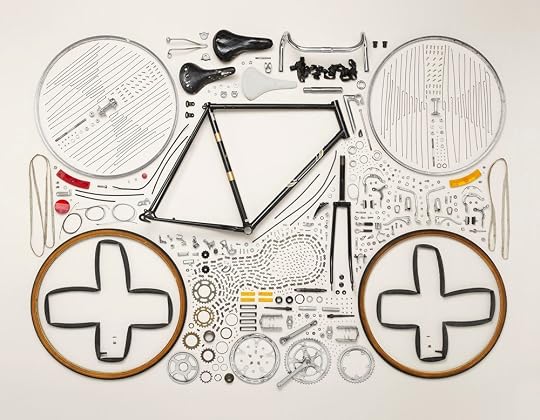
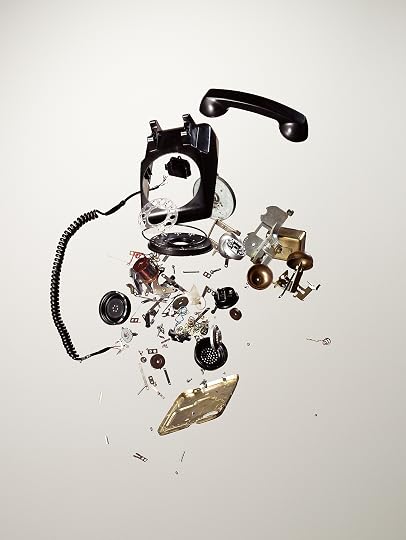
McLellan maakt van de gedeassembleerde objecten minitieus gerangschikte head shots. Er staan enkele van zijn fameuze 'drops' in: foto's die hij 'in de vlucht' neemt van de naar beneden vallende onderdelen. Poetry in motion.
Dit is zijn Raleigh-fiets:
En dit is een 'drop' van een telefoon met draaischijf:
McLellan maakt van de gedeassembleerde objecten minitieus gerangschikte head shots. Er staan enkele van zijn fameuze 'drops' in: foto's die hij 'in de vlucht' neemt van de naar beneden vallende onderdelen. Poetry in motion.
Dit is zijn Raleigh-fiets:
En dit is een 'drop' van een telefoon met draaischijf:

October 26, 2021
Another book to enjoy because of the photography. This genius takes apart everyday objects, places each (and EVERY) piece adjacent to other pieces and photographs the entirety. Want to see the components of a fire extinguisher? A computer mouse? An accordion? An upright piano? I didn’t know I did either! Some items in here will be foreign to the youngest among us – a rotary (!!) phone, a 2006 laptop, a handheld GPS Unit photographed in 2002, etc. The title page says, 175 color illustrations, and 21,959 components. I bet you find something you’ve never seen before. -Darcey

March 20, 2017
This is such a cool book! The photos are excellent. They have been organized from S (small things like a stapler and smart phone) to XL (extra-large things like two-seater light aircraft and a bicycle).
Bookending each photo section are essays from Todd McLellan (the creator of this book), Kyle Wiens (co-founder of iFixit), Gever Tulley (founder of Tinkering School) Penny Bendall (a freelance conservator), and Dr. Joseph Chiodo (inventor of Active Disassembly technology). I enjoyed the photos, but I enjoyed the essays even more-- especially Kyle Wiens', Penny Bendall's, and Dr. Joseph Chiodo's.
Bookending each photo section are essays from Todd McLellan (the creator of this book), Kyle Wiens (co-founder of iFixit), Gever Tulley (founder of Tinkering School) Penny Bendall (a freelance conservator), and Dr. Joseph Chiodo (inventor of Active Disassembly technology). I enjoyed the photos, but I enjoyed the essays even more-- especially Kyle Wiens', Penny Bendall's, and Dr. Joseph Chiodo's.

May 20, 2017
Very cool idea. I love both the exploded pictures and the organized pictures. I found myself spending most of my time trying to put the pieces together to imagine what the final product actually looks like. Plus, I loved comparing the number of parts for similar items.

November 14, 2020
The pictures of objects rendered into ordered disassembled components in this book are really quite compelling, and occasionally even informative. There are also pictures of the components being dropped, and I think those are interestingly composed and show a great hand at well photographic execution. I think this book might have been much more enjoyable for me had it seen fit to leave it there but I really didn't enjoy the way the essays framed that work. At this point, feel free to leave this review and enjoy the book by looking at the pictures and avoiding the text entirely.
The essays to me imparted a odd tone of nostalgic hostility. It placed hand-assembly and disassembly very much standing above other uses and design criteria.
One such bias is an insistence on the importance of disassembled components in understanding the design and engineering of the objects in question. I think that's largely flawed, there's progressively less information to be gained about the systems without understanding the roles of things fitting together, from maybe seeing how mechanical systems fit together, to having some idea from electrical components of what they might have done, to really almost nothing from integrated circuits. The educational content is much better for the disassembler than their audience.
Similarly, there was a suspicion that it being more common for devices to be difficult to disassemble was a deliberate business decision to prevent repair and legibility. The author didn't suppose that, as these devices were composed and manufactured with CAD/CAM, namely that they were less assembled by human hands in the first place, that they would naturally be not as accommodating towards simply reversing the process. Indeed, it might be more competitive to avoid costs of additional accessibility when it will rarely be used.
I'm sympathetic in the way to what is being said: our objects should be as open, accessible, repairable, and sustainable as possible, and most changes that would lead this to being the case are good things. However, this is a done with a tremendously snooty attitude for book with slow-motion pictures of dropping a piano.
Overall, a book that had skipped the drops and the essays, and shown these disassembly pictures with some surrounding content and diagrams about how these parts fit together and what common design metaphors they embody would have been fantastic. For my tastes, it's a missed opportunity.
The essays to me imparted a odd tone of nostalgic hostility. It placed hand-assembly and disassembly very much standing above other uses and design criteria.
One such bias is an insistence on the importance of disassembled components in understanding the design and engineering of the objects in question. I think that's largely flawed, there's progressively less information to be gained about the systems without understanding the roles of things fitting together, from maybe seeing how mechanical systems fit together, to having some idea from electrical components of what they might have done, to really almost nothing from integrated circuits. The educational content is much better for the disassembler than their audience.
Similarly, there was a suspicion that it being more common for devices to be difficult to disassemble was a deliberate business decision to prevent repair and legibility. The author didn't suppose that, as these devices were composed and manufactured with CAD/CAM, namely that they were less assembled by human hands in the first place, that they would naturally be not as accommodating towards simply reversing the process. Indeed, it might be more competitive to avoid costs of additional accessibility when it will rarely be used.
I'm sympathetic in the way to what is being said: our objects should be as open, accessible, repairable, and sustainable as possible, and most changes that would lead this to being the case are good things. However, this is a done with a tremendously snooty attitude for book with slow-motion pictures of dropping a piano.
Overall, a book that had skipped the drops and the essays, and shown these disassembly pictures with some surrounding content and diagrams about how these parts fit together and what common design metaphors they embody would have been fantastic. For my tastes, it's a missed opportunity.

April 14, 2024
"Things Come Apart: A Teardown Manual for Modern Living" is an absolute marvel for anyone intrigued by the inner workings of everyday objects. Todd McLellan's meticulous dissections reveal the beauty and complexity hidden beneath the surface of items we often take for granted. Each meticulously arranged photograph invites readers to explore the intricate details of everything from clocks to smartphones, offering a fascinating glimpse into the engineering marvels that shape our world.
McLellan's accompanying commentary provides insightful context, guiding readers through the evolution of design and technology. The book's layout is visually stunning, with crisp images and engaging narratives that make it difficult to put down. Whether you're an engineer, designer, or simply curious about how things work, "Things Come Apart" is a captivating journey that will leave you with a newfound appreciation for the inner workings of modern life. A definitive five-star masterpiece!
McLellan's accompanying commentary provides insightful context, guiding readers through the evolution of design and technology. The book's layout is visually stunning, with crisp images and engaging narratives that make it difficult to put down. Whether you're an engineer, designer, or simply curious about how things work, "Things Come Apart" is a captivating journey that will leave you with a newfound appreciation for the inner workings of modern life. A definitive five-star masterpiece!

July 25, 2021
I checked this book out from the library with no knowledge aside from the title (I placed it on hold online, so I wasn't able to investigate the book), and that's where my disconnect is. The word 'manual' in the title implies some sort of instruction; this is, in fact, a book of photographs.
I'm an advocate of the Right-to-Repair. I'm a fan of the Maker Movement. I was hoping for more usable information. The layout photos are interesting (and helpful, I suppose, if you're attempting to repair that or a similar item), but the 'dropped' photos did nothing for me. I found them uninspiring; they represent the chaos I'm trying to avoid.
I'm giving it an extra star because the text bits go more into the ideas I was hoping to explore through this book. Maybe someone will see these pictures, be inspired by the text, and begin to look at the objects around them differently.
I'm an advocate of the Right-to-Repair. I'm a fan of the Maker Movement. I was hoping for more usable information. The layout photos are interesting (and helpful, I suppose, if you're attempting to repair that or a similar item), but the 'dropped' photos did nothing for me. I found them uninspiring; they represent the chaos I'm trying to avoid.
I'm giving it an extra star because the text bits go more into the ideas I was hoping to explore through this book. Maybe someone will see these pictures, be inspired by the text, and begin to look at the objects around them differently.

November 18, 2020
You peer at the photos seeing how many of the pieces you can identify, trying to figure out what they do, what role they play in the bigger whole, wishing you also had a photo of the item complete several times before you read the essay on how emotionally disturbing it can be to see an item that is disassembled. This is one of the few art books were I took the time to read the text and it was well worth reading. I did wonder several times while reading this if it might not be even more enjoyable in digital formats where you might be able to zoom. Still, excited to keep this book and hope my kids will peer into it and get curious about what is inside the things that make their lives tick.

October 6, 2018
It's not only the exquisite pictures (both in laid out format and 'drop' format) but the essays included in the book explain the art of disassembly. 'Our real battle is with entropy, the universe's way of inexorably disassembling everything.'

December 2, 2018
While this is well compiled, it needs to be updated. For its time, it's probably great. But we've come too far out in terms of progression of the gadgets photographed in the book, and an updated version would be great!

August 21, 2022
This book is so much fun. You can see--and contemplate--every component of common gadgets spread out on the page. Definitely makes you stop to think what goes into all the devices we take for granted. Yes, the book is a little odd, but that's what makes it great.

January 29, 2018
Really cool photos. I especially liked the essays which make you think of the waste that comes with planned obsolescence and the externalized costs that come with our love of convenience.

April 27, 2019
A series of images / photographs of items that have been dismantled.
Some of the images were striking, but they all had a dated feel.
Reading / viewing time around forty-five minutes.
Some of the images were striking, but they all had a dated feel.
Reading / viewing time around forty-five minutes.

January 13, 2021
That huge piano spread is INCREDIBLE!!!
Read
January 15, 2022Although largely a picture book, there are some good written pieces in here as well. The pieces by Kyle Wiens and Dr. Joseph Chiodo were my favorites.

July 19, 2019
A very interesting photography project which involves taking daily objects apart
February 28, 2017
What a beautiful book. This mostly visual dictionary of the parts of complex modern day items and their disassembly is very well done. There is a visual poetry and an organizers delight to the way these images are captured and (some) explained. I say yeahhh!

December 7, 2013
This book review is for my semester project. In Things Come Apart, things tend to come apart...literally. The book is made up of lots of pictures of normal house hold objects on one page. Then on the next page the object is taken apart piece by piece. What I liked about the book was just how detailed it was, after every object was taken apart each little individual piece is carefully laid out so you can clearly see it. The book then talks more about the object how many pieces total, what model the object is, and how old it is. The thing I did not like about the book was that the objects and things chosen got much too common and at times boring or predictable. However with all the details and such the book still makes some of the most boring objects a little more interesting, but the book could have just done better if the objects picked out were more interesting.

December 15, 2013
"What comes in a tiny case may fill a surface 3 metres square, (32 square feet) so anticipating the size of the spread in advance is very difficult. This is especially true with the latest technology. As manufactured objects have evolved, they have become far more complex. Components are becoming more numerous, even as they decrease in size. The full size of the disassembly, with every single component laid out, can be huge in relation to the original object. It is as if the true scale of the object is revealed only when it is taken apart" (McLellan, pgs. #10–11).

December 5, 2013
A wonderful picture book. Like the author (and nearly everyone I know) I also took things apart when I was a kid. And was often able to put them back together. Doing so gave me an appreciation for manufactured goods that I think others don't have. I'm not afraid to explore. Quite handy when something's broken.
But if you don't want to take apart an accordion or upright piano then grab this book and dream...
But if you don't want to take apart an accordion or upright piano then grab this book and dream...

January 9, 2015
I enjoyed this read and find myself glad that I picked it up from the library on a whim. The photography was beautiful. Though I didn't love every essay by the contributors I did enjoy the majority of them. I wish those essays would have included photographs of that contributors work, that way the reader could have a visualization of how they fit into the issues discussed in the book. Overall I would recommend this, it proved to be a very quick read.

February 16, 2015
The pictures drew me to this book - amazing, As a typical consumer, I had no idea what "parts" make up the everyday items displayed in this book. The short chapters / text was fascinating. Everyone understands we live in a disposable society - use it until it breaks then buy a new "improved" one. It was very interesting to read about the future of "stuff" and what some are doing to ensure proper use and recycling of our resources.

December 4, 2013
Great photographs, and quite fascinating. Funny story: while I was reading this book, my nine-year-old brother came in my room to show off a toy helicopter remote control that he had pulled apart. Needless to say, I passed the book off to him as soon as I finished. I think he's going to like it. ;)

December 29, 2013
This is very unique and enjoyable book. McLellan had methodically taken all sorts of products apart and artfully displayed their pieces in this cool book. It helped me find my inner child that loved to do the same type of thing (albeit much less skillfully) decades ago. Really fun.

September 7, 2014
An extremely cool venture into the art of disassembly photography, combined with competent essays on the future of technology in regards to the human race, children, the environment, and how to preserve our past without sacrificing the future.
September 3, 2015
Cool, cool book. Photos are exquisite, and the essays (most of them) are thought-provoking. Made me want to take something apart; in fact, I dismantled and repaired an old computer instead of replacing it, partially because of this book. Never has disassembly been so chic.

September 22, 2013
Amazing photos & an idea! No one truly appreciates how much goes into the everyday devices we surround ourselves with.
Displaying 1 - 30 of 35 reviews