Sea Fever
"I must go down to the sea again, to the lonely sea and sky." John Masefield's poem, "Sea Fever", is one of innumerable literary examples of the fascination the sea has exerted over the ages. In his new book, "The Conquest of the Ocean: an Illustrated History of Seafaring" (2013), Brian Lavery offers an accessible history of the relationship between human beings and the ocean. Lavery, Curator Emeritus at the National Maritime Museum, Greenwich, London, has written more than 30 books about seafaring. He also served as a consultant on, among other things, the filming of Patrick O'Brian's novel, "Master and Commander".
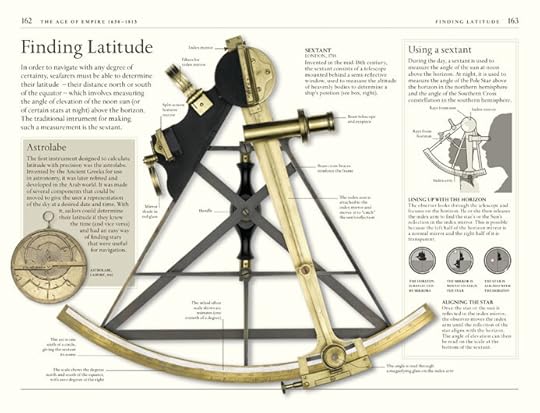
"The Conquest of the Ocean" is a glossy book of about 400 pages consisting of Lavery's text together with many illustrations of ships and sea scenes, seafarers, maps, maritime equipment, and more. The illustrations are in color and well reproduced. Lavery's text is clear and accessible to lay readers with maritime terms explained when they are used. Lavery writes with a lifelong enthusiasm for his subject, the most important factor in a historical overview of this type. The book consists of passages of history and of explanations of the oceans and of the technology of understanding the sea together with extended passages of storytelling.For example, Lavery tells the story of Matthew Maury, the first Superintendent of the Depot of Charts and Instruments in Washington, D.C. As a young naval officer riding a stagecoach late at night, Maury offered his seat to a lady and went to the top of the coach. When the coach overturned, Maury broke his leg, ending his naval seagoing career at once. Confined to a desk, Maury began the detailed scientific studies that soon brought him recognition as the founder of the science of oceanography.
The book offers an overview of sea fever beginning with prehistoric times and continuing to the present day. The many subjects covered include the exploration of the sea by different peoples, mapmaking, shipbuilding over the centuries, including sail, steam, submarines, and nuclear power, seafaring and commerce, the era of the slave ship, famous sea battles, sea disasters, the development of the science of oceanography, piracy, luxury ships, yachting, cruising, and more.
The book is arranged in six large chronological followed by a glossary and a brief bibliography. The photos, art, and diagrams are well-integrated with the text. The book includes material that many readers will find familiar in addition to material that will likely be known primarily to students of the sea. There are good discussions of, for example, the Vikings, Christopher Columbus, the Battle of Trafalgar, and the D-Day landings. The final section on "The Global Ocean" includes a treatment of the Cuban Missile Crisis and the Falklands War, among other things. Lavery treats the exploits of John Paul Jones and of the Confederate ship the Alabama during the Civil War. Among other disasters, the book considers extensively the wreck of the Royal Charter off the coast of Wales in 1852.
With the range of coverage, it is unsurprising that some things are left out. England's 1588 defeat of the Spanish Armada is covered in a short paragraph. Other lesser-known aspects of the Spanish-English conflict receive fuller treatment. Lavery includes a two-page painting of the sinking of the Titanic but virtually no textual explanation. The book includes a good treatment of commercial whaling but no treatment of Melville or of "Moby-Dick". The book on the whole is devoid of literary references.
The book is written for an informed lay audience more than for readers with a thorough knowledge of the sea and of seafaring. It manages to be informative, absorbing, and highly entertaining. This book will please readers with sea fever -- any kind of yearning for or interest in the sea.
Robin Friedman