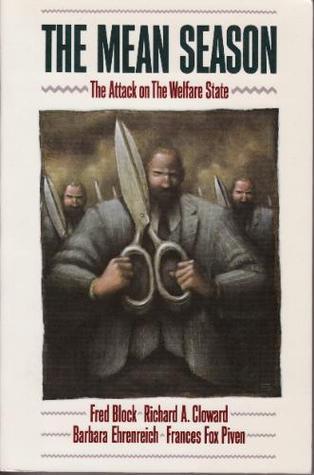
The Mean Season, published in 1987, is both dated and prescient. Many of the nightmares of the four authors (Fred Block, Richard A. Cloward , Barbara Ehrenreich, and Frances Fox Piven) came true in Bill Clinton's ending "welfare as we know it" in 1996 with bipartisan support in the Congress.
Piven and Cloward examine the history of cash assistance and the impact of that history on the debate in the 1970s and 1980s about welfare reform. Block begins: "In the current climate of American politics, anyone with the courage to argue in favor of an expansion of the welfare state will be immediately denounced . . ." And then, bless his heart, he argues for an expansion of the welfare state. Ehrenreich argues forcefully that "we cannot let the attack by the right foreclose the task of envisioning what a just and democratic American welfare state would look like."
If you read (or even skim) The Mean Season and then look at Clinton's welfare reform (Personal Responsibility and Work Opportunity Reconciliation Act of 1996), you will see that the title of this book is right on.
The Mean Season, published in 1987, is both dated and prescient. Many of the nightmares of the four authors (Fred Block, Richard A. Cloward , Barbara Ehrenreich, and Frances Fox Piven) came true in Bill Clinton's ending "welfare as we know it" in 1996 with bipartisan support in the Congress.
Piven and Cloward examine the history of cash assistance and the impact of that history on the debate in the 1970s and 1980s about welfare reform. Block begins: "In the current climate of American politics, anyone with the courage to argue in favor of an expansion of the welfare state will be immediately denounced . . ." And then, bless his heart, he argues for an expansion of the welfare state. Ehrenreich argues forcefully that "we cannot let the attack by the right foreclose the task of envisioning what a just and democratic American welfare state would look like."
If you read (or even skim) The Mean Season and then look at Clinton's welfare reform (Personal Responsibility and Work Opportunity Reconciliation Act of 1996), you will see that the title of this book is right on.
This was my first book reading in my "Political Economy and Social Change" program at The Evergreen State College. It was inspiring and an important criticism against Reagan's attack on the Welfare state. Thanks to Glenn Beck's big mouth, I was reminded of this book and am re-reading it.