Turbulence: A Log Book is an intricately produced artist's book that provides a narrative experience like no other. A tour of the vividly imagistic world of renowned illustrator Henrik Drescher, Turbulence follows one man through a troubled past, the uncertain future, and into the timeless realm of myth. A man boards a ship with a valise. In his cabin he opens the case, revealing a small replica of the boat he's on. Through its portholes he embarks on a journey filled with strange and terrible visions...Incorporating the symbolic language of Drescher's trademark illustration and collage style, Hindu mythology, and remarkable production elements, Turbulence is a rare occasion for a world-class artist to create a unique piece of art in book form, and a total immersion into a sophisticated visual experience.
Henrik Drescher was born in Copenhagen and immigrated to the United States in 1967. He began a career in illustration as a young man and has been traveling throughout the United States, Mexico, Europe and China, creating massive journals of notes and drawings wherever he went.
His books are held in the collections of the Library of Congress, the Museum of Modern Art, the Victoria and Albert Museum, and the Rijks Museum in Den Haag, Netherlands. He has received numerous other honors including two awards from the Society of Illustrators.
Now, you are probably wondering why I have changed the rating of Henrik Drescher’s log book, “Turbulence: A Log Book,” but before I get into that, I like to give out my opinion on this book. “Turbulence: A Log Book” is a graphic novel book written and illustrated by Henrik Drescher and it details the adventures of a man who goes through a mythical journey that reflects his life. “Turbulence: A Log Book” may have some really creative illustrations, but the story is a bit too confusing for many readers to understand.
Alright, so I practically have to go search all over the internet just to figure out what this book is all about and so here is the summary I have gathered from the internet:
The book starts off with a bespectacled man who is boarding a cruise ship and he brings an unknown valise with him on the ship. When the man opens the case, it turns out that a smaller version of the boat that he is on is in the case and the man starts taking a bath with the ship near him. The next few pages details the man’s strange journey through the eyes of the boat as the man’s adventures is portrayed through frightening visions that echoes Hindu mythology.
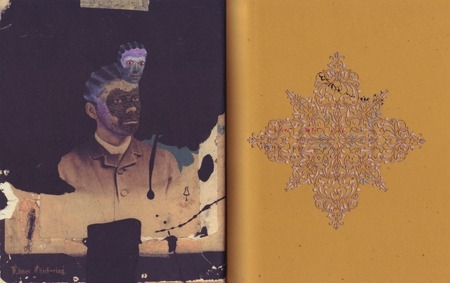
Now I have been reading Henrik Drescher’s works for many years now, but I have never read anything so DISTURBING, CONFUSING and dare I say it, SEXUAL from his work! This book was definitely different from any other book I have read from Henrik Drescher and I really did enjoy the darker shift that this book had since I love reading books that have a different style of their own. Henrik Drescher had done an excellent job at illustrating this book as he uses a mixture of both hand drawings and collage to tell the story and I loved the way that Henrik Drescher’s illustrations are so dark and disturbing and ADULT ORIENTED! The illustrations give this book a truly dark twist to what we perceive of Hindu mythology and I also loved the surreal feel of the illustrations, especially of the images of a man with another smaller head on his head and an image of a man with a cage full of skulls on his head. I loved the way that Henrik Drescher had woven Hindu mythology into the story, which helped give the story an extremely creative flair.
Just a little warning to anyone interested in reading this book…
THIS IS NOT A BOOK FOR CHILDREN!
Even the image of a green skinned man on the front of the cover is enough to warn children that this book is definitely not for them. The reason why this book is not geared towards children is because there are many sexual images in this book, including images of characters being naked and performing explicit sexual activities. Also, the illustrations are truly disturbing and nightmarish and even I had trouble trying to get through this book because of the nightmarish imagery, so small children might never be able to get through this book because of the imagery. Also, this book is difficult to understand since the story seems to be disjointed a bit on every page, which is why I moved the rating down from a five star rating to a four star rating. Also, anyone who does not have a clear understanding of Hindu mythology might be a bit confused by the premise of this book. I often had a difficult time understanding this book because the words were also written in a way that was making it difficult to read as they seem littered all over the pages and I could not see the text very well when it was set up like that.
Overall, “Turbulence: A Log Book” is a good read for adults who enjoy reading books that have disturbing and surreal imagery, but the story itself might be a bit too confusing for any reader to get through. However, I would recommend this book to anyone who is a fan of Henrik Drescher’s work and just want to look at the artwork.
Some super-wow die-cut cardstock pages interspersed with pages of eerie-weird drawings of people and possibly a narrative. It feels like the equivalent of an orchestra warming up.
[This review includes analysis of the illustration methods Drescher uses, but no spoilers of the story, as it were.]
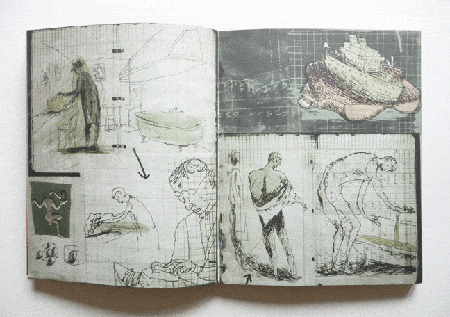
The first thing that I notice is the beautiful linework (maybe drypoint?) which is complimented by a minimal- but effective- monochromatic colour palette. He works on textured backgrounds to make this feel like a worn journal. Blocks of colour with minimal linework are used in the background elements, whilst the main subjects are really detailed. Isolated letters form the words in a collaged manner, flowing alongside the illustrations.
Some of the spreads are comprised of scanned sketchbook pages, again giving the aesthetic of a scrapbook.
The opening of the book gives an introduction that feels as if I have just stumbled upon an adventurer's diary- an adventurer lost to time, where this is the only carrier of his thoughts. There is a link to Hindu mythology, which is fascinating to me, and Drescher uses tip-ins of semi-transparent and die-cut papers, giving an interesting tactile dimension to the experience of reading the book. The 'jumbled' vibe to the scrapbook implies a sense of disorientation from the narrator, as one would expect for someone stranded on a deserted island.
There are few words, so it is largely a quiet visual novel, however what words Drescher does choose to use are clearly thoughtfully selected, and again collaged (although some are handwritten or typed passages). Some words are scribbled out- it's not perfect or neat, which compliments the scrapbook aesthetic. Colour is used to emphasise certain words/ themes (eg red for 'burnt'); meanwhile, other words are scrawled in that of an unpractised hand.
Some textures that I notice include: tapes (clear and opaque), graph paper (a range of different scanned surfaces, lined, rough cartridge, crumpled), rubbings, brush strokes, raised backgrounds (like stipple ceilings), glue, staples, fabrics (scrim?), moulded metals. Illustration materials I could identify include: biro, print (litho/ drypoint/ mono), ink, paint, pencil, collage, colour inversion.
He uses a mixture of monochromatic palettes and triadic (?). Sections are split by those tip-in pages, and marked by a colourful, full-page close up of a man's face pulling intense expressions. He makes the book flow through repeated motifs/ textures over the spreads, such as blots of paint or similar graph patterns. Collaged elements include photographs, which he has illustrated over. Some of the illustrations remind me of the crude (in a complimentary sense) paintings in ancient caves- think 'Lord of the Flies' or Lovecraftian vibes. Repeated faces with unsettling smiles create an uneasy feeling, which is a simple but effective way of doing so.
Final thoughts- a brilliant and immersive experience. Be warned, however, that the contents are for a mature audience.