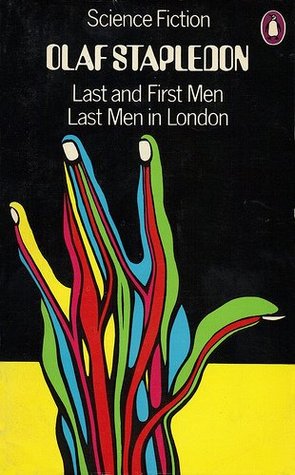
Last & First Men: A Story of the Near & Far Future is a future history sf novel written in 1930 by British author Olaf Stapledon. A genre work of unprecedented scale, it describes history from the present onwards across two billion years & 18 distinct human species, of which our own is the most primitive. Its conception of history is based on the Hegelian dialectic, following a repetitive cycle with many varied civilizations rising from & descending back into savagery over millions of years, but it's also one of progress, as later civilizations rise to far greater heights than the 1st. The book anticipates the science of genetic engineering & is an early example of the fictional supermind; consciousness composed of telepathically-linked individuals. In 1932, he followed Last & First Men with the less acclaimed Last Men in London. His other great novel, Star Maker (1937), may also be considered a sequel, but is even more ambitious in scope, being a history of the entire universe. Last Men in London (1932) is a sf novel by Stapledon. The narrator is the same member of the 18th & final human species who purportedly induced him to write Last & First Men. Last Men in London is the story of this being's exploration of the consciousness of a present-day Englishman named Paul, from childhood thru service with an ambulance crew in the WWI (mirroring Stapledon's own personal history) to adult life as a schoolteacher faced with a "submerged superman" in his class nicknamed Humpty. The inadequacies of Paul's character, the various dilemmas he has to face during his life & the occasional influence of the advanced being who shares his experiences, provide a semi-autobiographical platform on which to expound philosophical & moral beliefs.
Excerpted from wikipedia: William Olaf Stapledon was a British philosopher and author of several influential works of science fiction.
Stapledon's writings directly influenced Arthur C. Clarke, Brian Aldiss, Stanisław Lem, C. S. Lewis and John Maynard Smith and indirectly influenced many others, contributing many ideas to the world of science fiction.
This reader has been enthused by Starmaker, and thus he fell prey to going against the happiness rule of ‘lowering your expectations’ and came to Last and First Men euphoric, waiting for perfection to jump from every page, and when quite a few predictions do not seem to be accurate, the sense that The Far Future anticipating here would be also wrong became somewhat pervasive…well, perhaps not that, but still, trust is lower now.
Arthur C. Clarke is probably better known than Olaf Stapledon, at the very least that would be accurate for the average audience, familiarized with 2001 A Space Odyssey with the help of the stupendous adaptation of glorious Stanley Kubrick http://realini.blogspot.com/2016/08/2... and Arthur C. Clarke has said "No book before or since has ever had such an impact upon my imagination"
However, Olaf Stapledon has written his Story of the Near and Far Future in 1930 and we have the benefit of checking some of his predictions, well of the first part in fact, and therefore it could be…disappointing is not the word, but discouraging maybe to look at what the writer has to say about the Far Future, if the Near Future is not well described…and there are quite a few wrong guesses for the Prophet.
The author is fabulous in imagining that scientists will achieve genetic engineering, but he does think there will be a conflict between…The United States and Italy, when Americans are attacked in that country, and though the US would fight in the World War II against Mussolini, Hitler, they would be thrown into the conflict by Japan’s attack on Pearl Harbor, which happened at about the time when they also launched a big operation in Malaya and would place Singapore in peril…incidentally, I am reading Singapore Grip, part of the brilliant trilogy of J.G. Farrell http://realini.blogspot.com/2018/02/t...
It is evidently easier to write about historical events, where you have details recorded in documents, letters and then use artistic license to produce monumental Magnum opera http://realini.blogspot.com/2020/01/t... but Olaf Stapledon comes close in looking into the crystal globe and finding what will have happened in the Near Future and come close to reality…at times
Many people would die in the Near Future, in armed conflict and though the writer does not see the invention of the atomic bomb, he is accurate in foretelling that men (they take all these atrocious decisions, involving mass murder, The Holocaust and genocides) would be willing to use Weapons of Mass Destruction…gas in Last and First Men.
The conflict between France and Great Britain may appear as such a gross, enormous miss, thinking that they would fight alongside in World War II, but on deeper analysis, France starts the war on the right side, but after the Nazis use the effective, tremendous Blitz Krieg and outmaneuver the French, sitting ducks near the fortified defense lines that replicated the strategy of WWI, passé, redundant as the Panzers would show – by the way, the French also had had outdated weapons, the Renault tanks were inferior, such an easy target for the superior Nazi tanks – and watched powerless as the enemy troops went passed them, not at the trenches were they had been waiting, but advancing on difficult terrain.
Next thing we see, The French surrender, The ignominious Vichy Regime is in power and hence the French fight becomes one against their allies, the British…in the Far East and other places, there have been chances for the commanders there to take their men and weapons, ships and fight with the British, but as we can learn from Singapore Grip (and other sources) they would refuse to do that and choose the treasonous way of putting all those resources into the hands of the Nazis or the Japanese in the Far East.
For the Near Future, there is also the conflict that the French and British have right now, with Brexit, they have had quarrels over that major fuckup of Johnson and his band of fools (they have claimed victory and that the treaty is in the oven and cooked, only to keep changing things in it and talking of breaking international laws) who want the French to keep the immigrants from reaching the English shores, then to take back those arrived there already, they fight over fishing rights and may even compromise peace in Northern Ireland, if they end up with a border between the Republic of Ireland and the region that(still) belongs to Britain…so there is no bloody war there, but neither could we speak of love lost
For China and America, Stapledon looks again as if he makes a mistake when he envisages a period of collaboration between the two, but there has been a time when the USA had expected that prosperity would bring about a change in the regime, respect for human right and a decent country, so they had encouraged trade, buying merchandise in the trillions of millions over the years, hence making china rather prosperous, only to see the rise of a vicious state (to emphasize, this is not about those elite Chinese who see what the communists are, villains and scoundrels, albeit the majority seems to be happy with the nationalism, the power that these monsters project and feel that if they get Taiwan, put Hong Kong down, make Tibet just one of the regions with a Han majority, and if they have all these and eventually become world leaders, then they are satisfied with anything the party does) which is a sort of vile Godzilla now.
China (and Russia, but the latter has the nukes and it may well look at invading the Ukraine in the Near Future, but lacks the economic size of China…Russia’s economy is just about the size of Italy’s) will cause a lot of trouble in the Near and Distant Future, if they do not change their regime and communist system…as it is, their dictator, Xi, will clearly give the order to attack Taiwan and occupy that democratic country (Long Live Taiwan), which will be defeated by the giant Red Army, although a massive conflict with America may be coming, in a hot war, not just a clash of words, in effect right now…Olaf Stapledon anticipated at least some of this in his Story of the Near and Far Future…
"one conviction now stood out with certainty in Paul's mind, namely, that over all the trivial and inconsistent purposes that kept the tribes of men in conflict with one another, there was one purpose which should be the supreme and inviolate purpose of all men today, namely to evoke in every extant human being the fullest possible aliveness, and to enable all men to work together harmoniously for the making of a nobbler, a more alive human nature" - page 557-58.
The following review is only for Last Men in London.
I approached the 'sequel' to Stapledon's Last and First Men with a great deal of apprehension. Previous comments I had read about Last Men in London lead me to believe that the last-men-communicating-with-the-first-men-device that had been integral and fully utilised in Last and First Men, was utilised here purely for the sake of providing Stapledon with space in which to voice his comments on the First World War and to connect those comments to his larger body of fictional work.
Indeed, while Last Men in London is very much Stapledon's pronouncement on the First World War, its progenitors and his personal experiences within it, thankfully, the book offers up so much more! Far from being a brief afterword to Last and First Men, Last Men in London is a work that is equal in its scope of ideas and its further fleshing out of the Last Men's world, culture and mentality. The novel's focus by no means brushes aside the last men, but rather makes them an essential symbiotic presence alongside the first men.
Last Men in London is not the sequel to Last and First Men, it is its essential companion piece.
Last Men in London takes the ideas of Last and First Men and applies them to the realities of the everyday lives of the first men. Using this focus Stapledon is able to demonstrate just how important the full fulfilment and ongoing longevity of the human race is to me, you and every other first man, woman and child.
"Even though, in all his ages, he yearned to creep back into the warm close peace of the womb, he craved also to absorb into his blood the atmosphere of a wider world."
There's a lot of quotable existentialist/philosophical messages in this 2-for-1 #scifibook and they definitely do not read like typical scifi novels -- Last and First Men is a breathtaking grand scale journey of humankind's evolution through billions of years into the future, as told by godlike beings with a contemplative tone, often matter-of-fact and emotionally detached from some catastrophes that humans have faced. In Last Men in London these godlike beings go back to the 'past' and focus on an individual's life amid war in the early 20th century, similar to Vonnegut's Slaughterhouse Five, but without the sarcasm/humor/absurdism (detached contemplative tone continues). So, from feeling insignificant in the greater scheme of things in the first, to finding inner peace and coming to terms with that insignificance in the second. Not for everyone for sure due to the writing style and very dense concepts of human's place/purpose in the universe, and I find the second novel dry and less exciting (because it's more nuanced and 'down to earth' unlike the first, not scifi escapist enough lol), but has very important critiques about the Great War such as the pacifist hypocrisy of the Red Cross organization and collective survivors' guilt, among other unique glimpses on the Silent Generation ("...on the whole less trustworthy, less firm with themselves, less workmanlike, less rigorous in abstract thought, less fastidious in all spheres, more avid of pleasure, more prone to heartlessness, to brutality, to murder."). I am lightheartedly naming him the 'grandfather of cancel culture' lol as he pretty much criticized everyone in society e.g. the religious, scientists, philosophers etc.
Only read last and first men so far and need a break before moving onto the London one (will update when I get around to finishing that too).
Should maybe be a 2 star because I almost didn't finish it because it went on a bit, but there were some great little gems interspersed in there. I think a lot of interest came from reading a sci-fi book written in the 30s before WWII and the moon landing and atomic devices. He acknowledges he isn't going for accuracy and will be laughed at by future generations (in a very interesting foreword that is very worth reading). Because of this, he's very focused on biological and gas warfare, the most advanced civilisation he writes about is the only one to ever leave earth's atmosphere and they still use tiny film rolls to record their information (even if a very large amount of it).
I think the best moments come from descriptions of science or metaphysical things, or a mixture of the two, without any real hook in reality. And honestly the last section, the last of the last men really made it. This infinite struggle to survive despite knowing it's likely futility, at the expense of everything no less... What's more human than that.
And the last man may be a sign that they weren't as unsuccessful as the communicator may think.
I finished reading perfectly just as my song faded out, it felt kinda profound ngl...
This entire review has been hidden because of spoilers.
Both books are very entertaining, albeit dense and repetitive. I'd only recommend these if you loved Star Maker and want to read more grandiose, 2-billion year timeline Stapledon.
Originally published on my blog here and here in October 2001.
Last and First Men
Stapledon's classic novel purports to be a history of the human race from the thirties to the time when the destruction of the solar system and the species' end are near, as written by someone acting as a kind of medium for one of the last generation. It describes events on an epic scale, as catastrophes wipe out civilisation after civilisation, only for human culture to rise again (and for the human form to evolve).
Covering hundreds of millions of years, there is little space in this novel for individual characters, and this limits the appeal of Last and First Men. Women are almost completely ignored, given just about no role other than motherhood and only one being mentioned individually, and this is also potentially off-putting to modern readers. There are some dull or repetitious passages, though in the end the story is gripping enough.
Last Men in London
Stapledon's second book about the last generation of humanity is not a sequel to First and Last Men, which was a history of the human race from the 1930s across millions of years to the end, when the solar system is destroyed. What it is instead is a companion piece, describing the thoughts of the Last Men on the history of the early twentieth century.
The epic sweep of the earlier novel is replaced by human interest. The narrator from the future targets one man for his investigations, chosen for his sensitivity. Paul is observed (from inside his mind) and influenced from hie early childhood in the 1890s, though to his participation in the First World War, which is seen as the pivotal event which makes the eventual downfall of our civilisation inevitable.
As a novel, the human scale of Last Men in London makes it more immediately appealing than its predecessor. The device of showing the view that the Last Men take of contemporary society allows Stapledon to include parallels and commentary not normally accessible to the novelist writing about a time close to the date of composition; this does not always work (the story of the gentle lemurs is frankly silly), but can produce interesting effects. The best use of this is the major parallel between the Great War and the catastrophe foreseen in the last days of the human race, but the transfer of early twentieth century sexual taboos to a later culture's attitude to eating is also effective.
The purpose of Last Men in London is clearly to express a critical view of thirities culture; from a science fiction point of view, the problem with it is that the criticism is very much that of the intelligentsia of the time, as parodied, for example, in several Dorothy L. Sayers (among others). A lot of it reads like sub-Aldous Huxley, without Huxley's own insight and unwillingness to just accept a fashionable idea. So Lost Men in London is easier to relate to than Last and First Men, but ultimately has less to say.
Ok, this was more an appreciate than a like, but I really did enjoy the concepts...it was just the experience of reading that was the problem. I was assigned this and the Starmaker (in one combo volume) at the same time in a science fiction class, and these two books were the only ones that felt like homework. I kept dashing the book away from me, cursing the author. But I finished it and the other one and enjoyed talking about it later. So say it was an adventure!
I may have reviewed one or both of these extraordinary science fiction novels earlier under their separate covers and may in fact have read one of them as a stand-alone novel before acquiring this dual edition. Whatever the case, while I admire Stapledon for his ambition, I found his most far-reaching novels difficult to stick with, the human element being so distant, the canvas being so large. Far preferable to me was his Sirius, the protagonist of which is a dog.
Quite remarkable for an author to have the balls to try to write the complete future-history of humanity, through our evolution into various other species; even more remarkable that he pretty much pulls it off. The sheer scope of imagination is hard to put into words, so I won't try, I can only recommend giving it a go. It can be tough going at times, but your efforts will be rewarded.