Recreates Monet's life and artistic development during his years in the village of Giverny, reproducing eightyone of the finest paintings completed there
Found this book for less than 2€. What a steal! It features 81 of Monet's paintings from Giverny and an insightful introduction by Daniel Wildenstein (who wrote my favorite biography on Monet). Highly recommend if you're interested in Monet's work, particularly from his Giverny period (1883-1926).
Monet's "Waterlilies" and the "Japanese Bridge" will always be my favorite series of his but I found a new appreciation for his "Poplars" and the "Garden Path" through this book. They're truly magnificent! The only series I don't really care for are the Haystacks... maybe when I'm older. ;)
This book also made me desperately wanting to visit Monet's house and his gardens. Next time I'm in Paris I'm definitely doing a day trip to Giverny. (Giverny is located forty miles northwest of Paris, in case you didn't know!) My new all-time favorite Monet painting (which I re-discovered through this book) is "Flowering Arches" (1913) – I could look at it all day.
The format of this book is amazing (I'd guess 25x25cm) and the printing quality is sublime. The colors really pop and everything is sharp and in high resolution. Add to that the fantastic and insightful introduction and chronology, I have to bump up this rating to 5 stars. This book truly deserves it! (And to think I found it for 2€ – wicked!)
The book contains pictures from Monet's Giverny Years (1883-1926), organized by the Metropolitan Museum of Art for an exhibit around 1978 (pub. date). These are gorgeous paintings, of course. But the prints in this book, though clear, large scale, and in color, somehow utterly fail to express any of the vibrancy of the originals. They are flat -- and the colors so sloppy that many are of little value. Still, the collection of paintings is a nice one.
The volume contains some pictures from the 1880's, followed by selections from the following 'series': Haystacks, Poplars, Morning on the Seine, the Japanese Footbridge, the Garden Path at Giverny, Early and Late Water Lilies, Pond subjects, and some other material.
The Magpie (1868-69), one of my favorite Monets, and one that has nothing to do with Giverny (painted in ´Etretat), is not in this book, of course:
But the volume does include:
Spring in Giverny (1884):
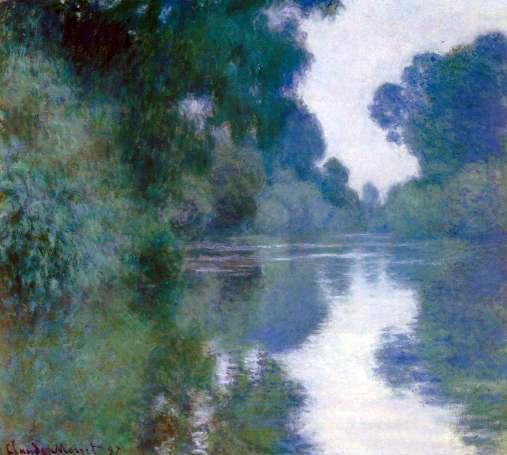
Branch of the Seine Near Giverny II (1897):
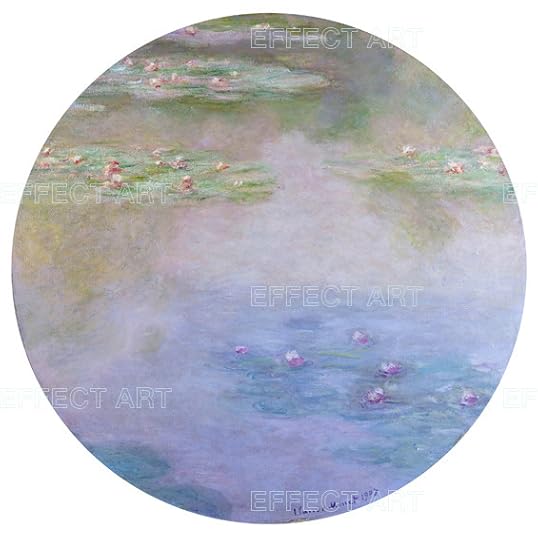
Water Lilies (1907):
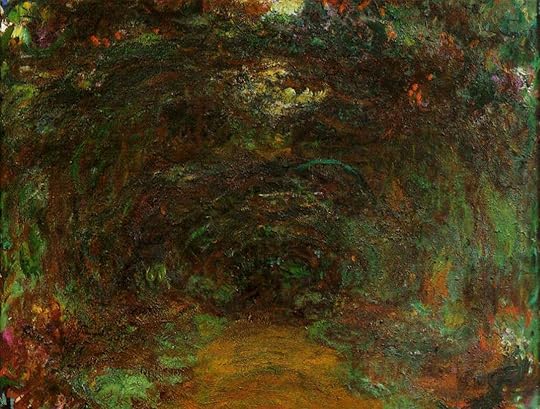
Path with Rose Trellises, Giverny (1922):
and much else. In addition, there is an informative essay on "Monet's Giverny" by Daniel Wildenstein (15-40), an even more interesting Introduction by Moffett and Wood (11-13), and a detailed Chronology. Finally, there are a large number of photographs (maybe 30-40) scattered throughout the volume -- many of which I've never seen -- that are probably more valuable than the actual prints.
Monet’s Years at Giverny: Beyond Impressionism (Abradale, 1978) was published to accompany an exhibition of Claude Monet’s work at The Metropolitan Museum of Art. If this book is any indication, it must have been an astounding display. The opening articles provide background on the paintings from Monet’s Giverny period, roughly the last forty years of his life. The thorough chronology contextualizes this body of work within the scope of Monet’s entire career. The heart of Monet’s Years at Giverny though is the full color art from the exhibition as these eighty paintings remind readers of the beauty, mystery, and drama of Monet’s vision.
Fantastic collection of 81 works from the artist’s years at Giverny where he concentrated on the motifs he had created in his garden - water lilies, the Japanese bridge, haystacks, poplars, wisteria, etc.
I love Monet. I was lucky enough to see some of his works in person at the Chicago Art Museum a few years ago in a special exhibit, and it was like seeing one of your favorite musicians in concert, finally - I was awestruck, which is not a word I use frequently. Anyway, this book was a quick read, giving a basic overview of his life, and of course most of that being when he was at Giverny, with some details here and there - the bulk of the book was of course his stunning paintings, along with a number of photographs taken of both the artist and his co-horts as well as of many of his paintings' subjects. It was interesting to see the painted landscapes compared to the photographed ones. So, it's a definite item for those who are fans of Monet, or just of classic impressionism overall. It's worth the quick read.
This collection of paintings and biography was published to accompany an exhibition of Claude Monet's work at The Metropolitan Museum of Art in 1978. This would’ve been an amazing exhibition to have seen in person!
This beautiful vintage book was part of my mother’s collection and her great love for Monet. I’m so glad later in life we had a chance to actually see so many of Monet‘s paintings in person and to visit Giverney with my mother. It is one of my most treasured memories and trips with her! She decorated a small sitting room in blue and yellow to match Monet’s kitchen decor and called it her blue room. It was filled with morning sunshine, Monet‘s paintings, her piano, and was the most cozy and comfortable spot in the whole house! This book sat on the white coffee table among the prized collection of books about Monet for as long as I can remember.
This was put together by the MoMA for an exhibition they were doing of Claude Monet's later works. As such, its main purpose is to celebrate and showcase these works, which it has done. The pictures of the art are lovely and the photographs of the artist and his garden are a sweet addition.
There is a short biography portion at the beginning and an easy to read timeline at the end of the book that give succinct details about Monet's personal and professional life. It's not exhaustive, but it's not intended to be. I especially liked the timeline since it put Monet's life in context of other historical events and people to provide perspective.
If you know much about Monet, the text probably won’t tell you much. But that’s not the reason for this book. Marvel at the 81 large color reproductions. Unfortunately, as another reader commented, they do lack the vibrancy of the originals.
Also—they are wheat stacks, not haystacks!
The quantity and sizes of the prints gives the book four 4 stars. Though hardly a definitive effort I still enjoyed looking at it.
Bought it on Vic book sale. Read to relax. Really great place to live though!! Really hope I can live somewhere like the Giverny garden in the future. Flowers, ponds, trees, bridges and people I loved.
This was a gift in college from my Aunt Alice Bonds. The photos of his art work were stunning. I don't remember now what I learned then, but I remember feeling accomplished that I had read it.
i already read it on April 23-24 but just updated the report now, the book is quite beautiful because it contains pictures (painting) by Claude Monet. i like the soft and aesthetic colors.
Spending much of my daily energy now for several years developing a landscape on an unfinished mountainside, I've found particular interest in Monet's passion for the blend of nature and art involved in planting gardens. While a world apart, his interest is not so very different from that of Frederick Law Olmsted, whose life works have so enlarged my own way of seeing.
In a book written to accompany a major exhibit of Monet's works at the Metropolitan Museum of Art, we have here a combination of economy and comprehensiveness in showing Monet's world. From brief but helpful maps and graphics, to a thoughtful timeline of important events in the artist's life, I finished reading this with an excellent sense of the man at the center of the story. The art works produced during this life are helpfully presented, via chronological order, with deep meaning and true appreciation.
Though I would only consider reading this book in full-size hardcover, well-printed format, even here I admit to the limitations of small, hand-held reproductions. Having seen some of these works in the Nelson-Atkins Art Museum in Kansas City, I well remember entering a gallery and being stunned into silence at the shocking juxtaposition of immensity and intimacy. These are works of extraordinary human genius.
It's also impossible to read this book without taking away a sudden realization of the vastness of the talent in Monet's world at the time: Manet, Pisarro, Renoir, Cezanne, Duret, Seurat, Sisley, Van Gogh, Rodin, Kandinsky, Sargent, Casatt, Matisse, Picasso, Degas--these are the names I recognize, all part of the same world, at the same time. And at the same time as Olmsted, Edison, Eiffel, and so many others, not even to mention those associated with political events--Teddy Roosevelt, for instance. What an extraordinary time in Western History.
Now back to my current project, transplanting ponderosa pines and currant bushes in a pile of weathered, lichen-covered granite boulders just recently stacked outside my entry gate.
While I continue to be inspired by giants, thinkers, artists.
Good variety of Monet's works while at Giverny. Also includes an essay on his time there and a chronology of his life. Pictures are clear and large enough to get a good appreciation of the detail.