

What do you think?

Stillwell and the American Experience in China 1911-1945
Barbara W. Tuchman won the Pulitzer Prize for Stilwell & the American Experience in China, 1911-45 in '72. She uses the life of Joseph Stilwell, the military attache to China in 1935-39 & commander of US forces & allied chief of staff to Chiang Kai-shek in '42-44, to explore the history of China from the revolution of 1911 to the turmoil of WWII, when China's right-wing Nationalist government faced attack from Japanese invaders & Communist revolutionaries. Her story is an account of both American relations with China & the experiences of one of the men on the ground.
Hardcover
First published January 1, 1971
About the author
Barbara W. Tuchman
58 books2,573 followersBarbara Wertheim Tuchman, historian, won a Pulitzer Prize for
The Guns of August
(1962) and for
Stilwell and the American Experience in China
(1971).
As an author, Tuchman focused on popular production. Her clear, dramatic storytelling covered topics as diverse as the 14th century and World War I and sold millions of copies.
https://en.wikipedia.org/wiki/Barbara...
As an author, Tuchman focused on popular production. Her clear, dramatic storytelling covered topics as diverse as the 14th century and World War I and sold millions of copies.
https://en.wikipedia.org/wiki/Barbara...
Ratings & Reviews
Friends & Following
Create a free account to discover what your friends think of this book!
Community Reviews
Displaying 1 - 30 of 259 reviews
April 30, 2023
Notes:
1. What a revelation it has been for me to read about the gross incompetence of Chiang Kai-shek. Not to mention his megalomania, lack of education, corruption, and timidity when it came to offensive operations. Chiang would never go on the offensive against the Japanese. He spent almost all of his time holed up in Nanking, and later farther west inChongqing, the Nationalist capitals, or fighting the Communists.
He hoarded matériel and men because he was more concerned about his stability as a leader, than fighting the Japanese, whom he saw as invincible. General Stilwell's confidence in him was anything but high. The general by contrast felt that the Japanese were highly efficient, but imitative and often confused when the enemy showed initiative and a capacity for surprise. That is, unpredictable tactical skill.
"This became clear as soon as the AMMISCA officers went to work beginning in October 1941. The mission's artillery expert, Colonel George Sliney, confirmed after an inspection tour what Stilwell had reported as Attache, that the will to fight an aggressive action 'does not yet exist in the Chinese army.' Their demand for war material was not 'for the purpose of pressing the war against Japan but was to make the Central Government safe against insurrection' after other nations had forced Japan out of China. 'The general idea in the U.S. that China has fought Japan to a standstill and has had many glorious victories,' he discovered, 'is a delusion.'" (p. 222)
2. I had always wondered how it was possible for America to march into Europe, and later into the Pacific theater, and fight and win, not without considerable losses. The answer is training. Stilwell was a terrific instructor on and off throughout his career. The discussion of the California war games in the summer of 1941, just months before Pearl Harbor, is an eyeopener. Of course, the army trained vigorously stateside, but this is the first glimpse I've had of that story.
3. Afterward FDR and Marshall sent General Stillwell back to China. He is made Chief of Staff to Chiang Kai-shek and told he will command two of the Chinese armies, but this is not true since the armies' preceding commanders are never told to stand down. The story of General Stilwell trying to motivate the Chinese troops to fight the Japanese in Burma will set your hair on fire. The Chinese under Chiang had no concept of command and control, no understanding of western fighting techniques whatsoever. Their main strategy was not to fight the enemy, but to retreat from him. When Stilwell fails for myriad reasons, he has to walk out of Burma with 100 others, 140 miles through jungle in 14 days. Here's a quote.
"At the head of the column he [Stilwell] set the pace at the regulation Army rate of 105 steps a minute. The ghost of General Castner walked with him but Stilwell himself was the only veteran of those long-ago forced marches of the 15th Infantry [WW1]. From the first day many among the Americans lagged and fell out, suffering from heat exhaustion. May in Burma, just before the monsoon, was the hottest time of year. Stilwell raged at the softness and the 'damn poor show of physique.' He allowed a five-minute rest every hour but otherwise would not slow or stop. Coming to a river he plunged in without a break in his stride, 'obstinately scrutinizing his watch and counting out 105 steps to the minute' while he slogged steadily through the water with the long column stretching out behind in a single file. As malaria and dysentery attacked the marchers, weakness spread and slowed the pace. Stilwell had to increase the rest to ten minutes, conscious that every extra hour lengthened the odds. Two officers collapsed from sunstroke and had to be loaded onto the overburdened pack mules. Colonel Williams' box of medicines was stolen at one encampment, 'a terrible loss.' Ants, thorns, broken packs, vanishing bearers, a rogue elephant, insects, leeches, leg sores, blisters, infections and the blazing sun plagued the march and shredded what was left of goodwill and fellowship." (p. 296)
4. "'Why doesn't the little dummy [Chiang] realize that his only hope is the 30 Division plan, and the creation of a separate, well-equipped, and well-trained force?' [Stilwell's diary entry]
"The answer to this exasperating question was to unfold only gradually. It was a long time before Stilwell could bring himself to admit that Chiang did not really want a well-trained, well-equipped fighting force; that such a force represented to him less a boon than a threat; that he feared that an effective 30 divisions might come under a new leader or group, undermining or challenging his own control, and that Stilwell's proposal to remove incompetent commanders would remove those loyal and beholden to him; that he was not interested in an army that could fight the Japanese but only in one that could sustain him internally; that for this he believed it sufficed to have more divisions and more guns, planes and tanks than the Communists. . ."
"'This is the most dreary type of maneuvering I've ever done,' Stilwell wrote home, 'Trying to guide and influence a stubborn, ignorant, prejudiced, conceited despot who never hears the truth except from me and finds it hard to believe.'" (p. 317)
5. John Keegan has a wonderful book called A History of Warfare. It is a cultural history of war from antiquity to the present day in a single volume. And the present book might be an extended chapter of Keegan's book. For the Americans trying to support the Chinese during World War II precipitated a cultural clash that put the two “Allies” at each others throats. It’s hard to believe, but true, how duped the American public was in favor of China, presenting Chiang Kai-shek as this master leader of a democratic country. China was nothing of the kind. If anything Chiang was a dictator of a one party system.
Chiang corruptly sold, through his minions, American Lend-Lease matériel to the Japanese, the very “enemy” he was supposed to be at war with. The book leads to much astonishment on the part of the reader. It reminds me of Neil Sheehan’s masterpiece A Bright Shining Lie: John Paul Vann and America in Vietnam, all about America's Vietnam folly. In fact, I have wondered if Mr. Sheehan did not learn from Stilwell and the American Experience in China and use it as a kind of model for his own wonderful book. For both books use biography as the thread or spine around which to build their detailed stories.
6. "Britain knew, Davies continued, that to whatever degree she joined the United States in actions designed to help China she would be acting contrary to her own interests [empire], while the United States should know that to whatever degree she joined Britain in helping to restore colonial rule and white supremacy would be acting contrary to American policy, sentiment and future relations with the countries of Asia."(p. 384)
1. What a revelation it has been for me to read about the gross incompetence of Chiang Kai-shek. Not to mention his megalomania, lack of education, corruption, and timidity when it came to offensive operations. Chiang would never go on the offensive against the Japanese. He spent almost all of his time holed up in Nanking, and later farther west inChongqing, the Nationalist capitals, or fighting the Communists.
He hoarded matériel and men because he was more concerned about his stability as a leader, than fighting the Japanese, whom he saw as invincible. General Stilwell's confidence in him was anything but high. The general by contrast felt that the Japanese were highly efficient, but imitative and often confused when the enemy showed initiative and a capacity for surprise. That is, unpredictable tactical skill.
"This became clear as soon as the AMMISCA officers went to work beginning in October 1941. The mission's artillery expert, Colonel George Sliney, confirmed after an inspection tour what Stilwell had reported as Attache, that the will to fight an aggressive action 'does not yet exist in the Chinese army.' Their demand for war material was not 'for the purpose of pressing the war against Japan but was to make the Central Government safe against insurrection' after other nations had forced Japan out of China. 'The general idea in the U.S. that China has fought Japan to a standstill and has had many glorious victories,' he discovered, 'is a delusion.'" (p. 222)
2. I had always wondered how it was possible for America to march into Europe, and later into the Pacific theater, and fight and win, not without considerable losses. The answer is training. Stilwell was a terrific instructor on and off throughout his career. The discussion of the California war games in the summer of 1941, just months before Pearl Harbor, is an eyeopener. Of course, the army trained vigorously stateside, but this is the first glimpse I've had of that story.
3. Afterward FDR and Marshall sent General Stillwell back to China. He is made Chief of Staff to Chiang Kai-shek and told he will command two of the Chinese armies, but this is not true since the armies' preceding commanders are never told to stand down. The story of General Stilwell trying to motivate the Chinese troops to fight the Japanese in Burma will set your hair on fire. The Chinese under Chiang had no concept of command and control, no understanding of western fighting techniques whatsoever. Their main strategy was not to fight the enemy, but to retreat from him. When Stilwell fails for myriad reasons, he has to walk out of Burma with 100 others, 140 miles through jungle in 14 days. Here's a quote.
"At the head of the column he [Stilwell] set the pace at the regulation Army rate of 105 steps a minute. The ghost of General Castner walked with him but Stilwell himself was the only veteran of those long-ago forced marches of the 15th Infantry [WW1]. From the first day many among the Americans lagged and fell out, suffering from heat exhaustion. May in Burma, just before the monsoon, was the hottest time of year. Stilwell raged at the softness and the 'damn poor show of physique.' He allowed a five-minute rest every hour but otherwise would not slow or stop. Coming to a river he plunged in without a break in his stride, 'obstinately scrutinizing his watch and counting out 105 steps to the minute' while he slogged steadily through the water with the long column stretching out behind in a single file. As malaria and dysentery attacked the marchers, weakness spread and slowed the pace. Stilwell had to increase the rest to ten minutes, conscious that every extra hour lengthened the odds. Two officers collapsed from sunstroke and had to be loaded onto the overburdened pack mules. Colonel Williams' box of medicines was stolen at one encampment, 'a terrible loss.' Ants, thorns, broken packs, vanishing bearers, a rogue elephant, insects, leeches, leg sores, blisters, infections and the blazing sun plagued the march and shredded what was left of goodwill and fellowship." (p. 296)
4. "'Why doesn't the little dummy [Chiang] realize that his only hope is the 30 Division plan, and the creation of a separate, well-equipped, and well-trained force?' [Stilwell's diary entry]
"The answer to this exasperating question was to unfold only gradually. It was a long time before Stilwell could bring himself to admit that Chiang did not really want a well-trained, well-equipped fighting force; that such a force represented to him less a boon than a threat; that he feared that an effective 30 divisions might come under a new leader or group, undermining or challenging his own control, and that Stilwell's proposal to remove incompetent commanders would remove those loyal and beholden to him; that he was not interested in an army that could fight the Japanese but only in one that could sustain him internally; that for this he believed it sufficed to have more divisions and more guns, planes and tanks than the Communists. . ."
"'This is the most dreary type of maneuvering I've ever done,' Stilwell wrote home, 'Trying to guide and influence a stubborn, ignorant, prejudiced, conceited despot who never hears the truth except from me and finds it hard to believe.'" (p. 317)
5. John Keegan has a wonderful book called A History of Warfare. It is a cultural history of war from antiquity to the present day in a single volume. And the present book might be an extended chapter of Keegan's book. For the Americans trying to support the Chinese during World War II precipitated a cultural clash that put the two “Allies” at each others throats. It’s hard to believe, but true, how duped the American public was in favor of China, presenting Chiang Kai-shek as this master leader of a democratic country. China was nothing of the kind. If anything Chiang was a dictator of a one party system.
Chiang corruptly sold, through his minions, American Lend-Lease matériel to the Japanese, the very “enemy” he was supposed to be at war with. The book leads to much astonishment on the part of the reader. It reminds me of Neil Sheehan’s masterpiece A Bright Shining Lie: John Paul Vann and America in Vietnam, all about America's Vietnam folly. In fact, I have wondered if Mr. Sheehan did not learn from Stilwell and the American Experience in China and use it as a kind of model for his own wonderful book. For both books use biography as the thread or spine around which to build their detailed stories.
6. "Britain knew, Davies continued, that to whatever degree she joined the United States in actions designed to help China she would be acting contrary to her own interests [empire], while the United States should know that to whatever degree she joined Britain in helping to restore colonial rule and white supremacy would be acting contrary to American policy, sentiment and future relations with the countries of Asia."(p. 384)

January 14, 2013
All the previous books of Barbara Tuchman that I’ve read have had a picture of the author, looking something like this:
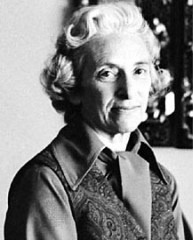
Older, with the Sandra Day O’Connor hairdo, well-heeled, professorial even. Nothing wrong with that, of course; but it does conjure up a certain delicacy, a life lived in equal parts libraries and privilege.
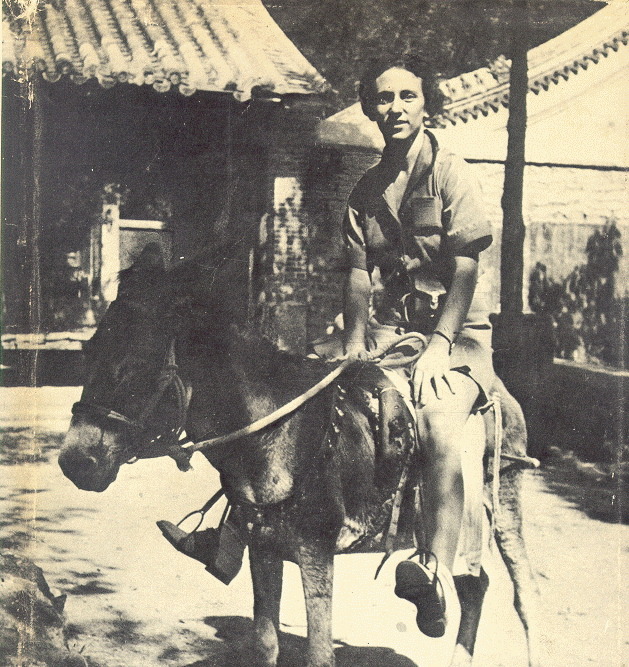
But on the back of this book, Stilwell and the American Experience in China, 1911-45, the author looks out at me from atop a burro, her means of transportation in the 1930s in China at the time of the Japanese invasion, looking very much like Christiane Amanpour without the makeup.
There even appears to be a pack of cigarettes in her shirt pocket (a dealbreaker now, of course, but kind of essential in that time and place).
Not that she needs pictorial validation. She is, after all, one of the greatest writers of history, with the awards to prove it. But, she was THERE. So, she has street cred (or village cred, or jungle cred).
However, this story is not told just on the basis of a lived experience. Tuchman managed to get Stilwell’s widow to let her see and use Stilwell’s journals. They are a treasure trove. And she convinced Mrs. Stilwell that it was important to use it all, warts and all.
Tuchman has this way of finding almost obscure characters and revealing an entire period of history through them. She did that through Enguerrand de Coucy VII (ever heard of him?) to explain the 14th Century. And now Stilwell - Vinegar Joe, Uncle Joe - to explain...well: 20th Century Chinese history; military bureaucracy; British imperialistic aims in WWII; why the Chinese hate the word ‘no’; why Mountbatten was a horse’s ass; why Chiang Kai-shek was a horse’s ass; why we picked the wrong horse; why you can’t be honest. No, I mean that, really. You’d be lucky just to have a very wise woman on a burro to set things right.
There was so much wisdom in this book: from Tuchman, from Stilwell, from others.
Stilwell: You will hear a lot of talk about how this or that generation messed things up and got us into war. What nonsense. All living generations are responsible for what we do and all dead ones as well.
Tuchman: The first essential in war is an army that will not run away.
And others: Nelson’s selection was the genesis of a principle of political appointment. “You get three years in Washington to find out whether or not you are a schlemiel,” Morgenthau said of him at the time to his assistant Harry Dexter White. “And if you are you get promoted,” White replied.
Stilwell is written as a brilliant military mind, with a love for China and its people, possessed of great, unselfish courage, but constitutionally incapable of suffering fools. And he wrote without a filter, which is so richly rewarding now but must have bedeviled the recipients of his missives. To one subordinate, he radioed, “Do not shoot yourself before notifying me three days in advance.”
Allow me to gush. This is a great book. This is an important book.
You have to read this book if you want to understand the gestation of the cold war; how stupid we were; how, unlike Stilwell, we never understood Asian Communism (wanna take a cruise to shop in Vietnam?); how politics poisons; and maybe why they hate us.
No one comes off worse than Chiang Kai-shek. But the powers that be chose him over Stilwell, even though they all knew better. I wanted to grab Roosevelt, grab Marshall, grab Hopkins, Churchill, Mountbatten, and say Will you open your eyes, forget self-interest and do the right thing. Which, by the way, is what Stilwell couldn’t stop himself from saying. And which is why, though he had “the most difficult assignment” and had great success, he was recalled; and every single person involved in that decision, even George C. Marshall (can you believe it?), should feel shame.
But the Americans? Americans find it difficult to remember Thomas Jefferson did not operate in Asia.
The Brits? No nation has ever produced a military history of such verbal nobility as the British. Retreat or advance, win or lose, blunder or bravery, murderous folly or unyielding resolution, all emerge alike clothed in dignity and touched with glory. Every engagement is gallant, every battle a decisive action. There is no shrinking from superlatives: every campaign produces a general or generalship hailed as the most brilliant of the war. Everyone is splendid: soldiers are staunch, commanders are cool, the fighting magnificent. Whatever the fiasco, aplomb is unbroken. Mistakes, failures, stupidities or other causes of disaster mysteriously vanish. Disasters are recorded with care and pride and become transmuted into things of beauty. Official histories record every move in monumental and infinite detail but the details serve to obscure. Why Singapore fell or how the Sittang happened remains shrouded. Other nations attempt but never quite achieve the same self-esteem. It was not by might but by the power of her self-image that Britain in her century dominated the world. That this was irrecoverable (and that no successor would inherit it) was not yet clear in 1944.
Barbara Tuchman can say that, of course. Because, like Stilwell, she tried to know a people, because, yes, she rode a burro and smoked Luckies, because she got a widow to share her memories. Because she was there.
Older, with the Sandra Day O’Connor hairdo, well-heeled, professorial even. Nothing wrong with that, of course; but it does conjure up a certain delicacy, a life lived in equal parts libraries and privilege.
But on the back of this book, Stilwell and the American Experience in China, 1911-45, the author looks out at me from atop a burro, her means of transportation in the 1930s in China at the time of the Japanese invasion, looking very much like Christiane Amanpour without the makeup.
There even appears to be a pack of cigarettes in her shirt pocket (a dealbreaker now, of course, but kind of essential in that time and place).
Not that she needs pictorial validation. She is, after all, one of the greatest writers of history, with the awards to prove it. But, she was THERE. So, she has street cred (or village cred, or jungle cred).
However, this story is not told just on the basis of a lived experience. Tuchman managed to get Stilwell’s widow to let her see and use Stilwell’s journals. They are a treasure trove. And she convinced Mrs. Stilwell that it was important to use it all, warts and all.
Tuchman has this way of finding almost obscure characters and revealing an entire period of history through them. She did that through Enguerrand de Coucy VII (ever heard of him?) to explain the 14th Century. And now Stilwell - Vinegar Joe, Uncle Joe - to explain...well: 20th Century Chinese history; military bureaucracy; British imperialistic aims in WWII; why the Chinese hate the word ‘no’; why Mountbatten was a horse’s ass; why Chiang Kai-shek was a horse’s ass; why we picked the wrong horse; why you can’t be honest. No, I mean that, really. You’d be lucky just to have a very wise woman on a burro to set things right.
There was so much wisdom in this book: from Tuchman, from Stilwell, from others.
Stilwell: You will hear a lot of talk about how this or that generation messed things up and got us into war. What nonsense. All living generations are responsible for what we do and all dead ones as well.
Tuchman: The first essential in war is an army that will not run away.
And others: Nelson’s selection was the genesis of a principle of political appointment. “You get three years in Washington to find out whether or not you are a schlemiel,” Morgenthau said of him at the time to his assistant Harry Dexter White. “And if you are you get promoted,” White replied.
Stilwell is written as a brilliant military mind, with a love for China and its people, possessed of great, unselfish courage, but constitutionally incapable of suffering fools. And he wrote without a filter, which is so richly rewarding now but must have bedeviled the recipients of his missives. To one subordinate, he radioed, “Do not shoot yourself before notifying me three days in advance.”
Allow me to gush. This is a great book. This is an important book.
You have to read this book if you want to understand the gestation of the cold war; how stupid we were; how, unlike Stilwell, we never understood Asian Communism (wanna take a cruise to shop in Vietnam?); how politics poisons; and maybe why they hate us.
No one comes off worse than Chiang Kai-shek. But the powers that be chose him over Stilwell, even though they all knew better. I wanted to grab Roosevelt, grab Marshall, grab Hopkins, Churchill, Mountbatten, and say Will you open your eyes, forget self-interest and do the right thing. Which, by the way, is what Stilwell couldn’t stop himself from saying. And which is why, though he had “the most difficult assignment” and had great success, he was recalled; and every single person involved in that decision, even George C. Marshall (can you believe it?), should feel shame.
But the Americans? Americans find it difficult to remember Thomas Jefferson did not operate in Asia.
The Brits? No nation has ever produced a military history of such verbal nobility as the British. Retreat or advance, win or lose, blunder or bravery, murderous folly or unyielding resolution, all emerge alike clothed in dignity and touched with glory. Every engagement is gallant, every battle a decisive action. There is no shrinking from superlatives: every campaign produces a general or generalship hailed as the most brilliant of the war. Everyone is splendid: soldiers are staunch, commanders are cool, the fighting magnificent. Whatever the fiasco, aplomb is unbroken. Mistakes, failures, stupidities or other causes of disaster mysteriously vanish. Disasters are recorded with care and pride and become transmuted into things of beauty. Official histories record every move in monumental and infinite detail but the details serve to obscure. Why Singapore fell or how the Sittang happened remains shrouded. Other nations attempt but never quite achieve the same self-esteem. It was not by might but by the power of her self-image that Britain in her century dominated the world. That this was irrecoverable (and that no successor would inherit it) was not yet clear in 1944.
Barbara Tuchman can say that, of course. Because, like Stilwell, she tried to know a people, because, yes, she rode a burro and smoked Luckies, because she got a widow to share her memories. Because she was there.

February 24, 2023
“Carrying their burdens of famine and drought, heavy rent and interest, squeezed by middlemen, absentee landlords, farmers naturally agitated for the readjustment of land ownership and this made them communists, or at least that is the label put on them. It’s not in the nature of Chinese to be communists.”
- General Joseph ‘Vinegar Joe’ Stilwell, 1936
“For a people being deprived of freedom the revolutionary task is not socialism, but the struggle for independence. We cannot even discuss communism if we are robbed of a country in which to practice it.”
- Mao Zedong interview in ‘Red Star Over China’, 1937
“Chiang will squeeze out of the US everything he can get to pay for the privilege of getting to Japan through China. He will do nothing to help unless forced to. No matter how much we may blame Chinese government agencies, the ultimate responsibility rests squarely on the shoulders of the Generalissimo. The choice seems to be to get realistic and insist on a quid pro quo or else restrict our effort in China to maintaining what American aviation we can. The latter course allows Chiang to to welsh on his agreements. It also lays the ultimate burden of fighting the Jap army on the USA.” - To George Marshall, Chief of Staff US Army from Joseph Stilwell, Chief of Staff to Chiang Kai-shek and US Commander in the China/Burma/India Theater in 1944
“As I had feared, the Japanese took advantage of the opportunity to launch an offensive in Henan and then Hunan. Owing to the Burma campaign no adequately trained and equipment reinforcements were available for these war areas. The forces brought to bear by the Japanese were six times as great as those confronting Stilwell in Burma and the consequences of defeat in China certain to outweigh all results of a victory in Burma. Stilwell exhibited complete indifference and refused to release Lend-Lease munitions in East China. In this General Stilwell cannot be released from grave responsibility.“ - Generalissimo Chiang Kai-shek to Patrick Hurley, US ambassador to China, 1944
“My opinion is that if you sustain Stilwell in this controversy you will lose Chiang Kai-shek and possibly lose China with him.” - Ambassador Hurley to President Franklin D. Roosevelt, 1944
“I have waited long for vengeance,
At last I've had my chance.
I've looked the Peanut in the eye
And kicked him in the pants.
The old harpoon was ready
With aim and timing true,
I sank it to the handle,
And stung him through and through.
The little bastard shivered,
And lost the power of speech.
His face turned green and quivered
As he struggled not to screech.
For all my weary battles,
For all my hours of woe,
At last I've had my innings
And laid the Peanut low.
I know I've still to suffer,
And run a weary race,
But oh! the blessed pleasure!
I've wrecked the Peanut's face.”
- Poem written by Joseph Stilwell in a personal diary about Chiang Kai-shek , during 1944 before loss of his command
************
Barbara Tuchman traces the American experience in China during the first half of the 20th century through the life of US General Joseph Stilwell who became commander of the Chinese theater in WWII. The book won a Pulitzer Prize in 1972, Tuchman’s second after “The Guns of August” in 1962. A Yankee from a wealthy New York family Stilwell graduated from West Point in 1904, where he’d been an underclassman to Douglas MacArthur, and chose a post in the Philippines. The conquest was winding down but the locals still resisted. After a year in the jungle he returned to West Point to teach language and history, spending summers in Guatemala and Mexico, learning Spanish and reconnoitering for the Army.
Philippines
Stilwell married his sister’s friend in 1910 and together they sailed to Ft. McKinley in Manila. In a year, with his wife Win pregnant, he took leave in Japan where he started to learn the language, continuing on to China while she went home. Disembarking on Shanghai’s Bund, with it’s broad sweep of western banks and hotels, touring the old city, the country was on the cusp of change. The republican revolution was underway and the Qing dynasty would be overthrown in 1912. Tuchman gives sketches of imperial crimes that came before, in the Opium Wars, Taiping and Boxer Rebellions, unequal treaties, extraterritorial laws, war reparations and concession ports of British, French, Russians and Japanese.
China
Stilwell shipped out to Hong Kong, following events across the bay in Canton, where the British and Qing officials were attacked by rebels, traveling upriver to see for himself. Sun Yat-sen during his exile to London and Tokyo had visited Bangkok, Singapore, San Francisco and Hanoi, gathering pan-Asian support for a Chinese republic. As the provinces declared independence from the Manchus, military leader Yuan Shih-kai switched allegiance from the Qing Empire to the Republic. Shortly after Stilwell sailed to Manila Sun was elected president. In 1912 Puyi abdicated the throne and Yuan took office, as Stilwell returned to the US at the end of the year while the world was poised on the brink of war.
America
Back at West Point Stilwell resumed his teaching duties and raising a family with Win. In 1914 he traveled to Madrid on an assignment, as the Austrian Archduke was assassinated and Sarajevo bombed, but sat out most of the war in the US with the army until 1917. A draft of a million men and 57,000 officers was increased over four times. Stilwell was sent to France as a staff officer due to his command of French. The tactics of John J. Pershing, the famed commander of the US Expeditionary Force, who insisted on a trained infantry for attack versus trench warfare, would be urged by Stilwell in East Asia. Japan took the opportunity to join the Allies and fight Germany in Shandong which it coveted as a colony.
Japan
Japan’s 21 Demands had been delivered to China in 1915; cession of land formerly occupied by Germany, control of railways, administration of Manchuria and Mongolia and a hand in China’s finances, security and government. Yuan conceded to most of the demands except for control of the economy, which was blocked by Britain and the US. He made himself an emperor but was driven from power by protests four months later. In the Paris Peace Talks failed hopes to end the unequal treaties and regain Shandong resulted in the May 4th political movement. Sun and the Kuomintang Party (KMT) declared the government illegitimate, and for the next decade regional warlords ruled in uneasy alliances.
France
As an intelligence officer in France Stilwell rankled at a desk job as other less capable colleagues were assigned line duty under Marshall and MacArthur. American entry into the war shortly before the armistice tipped the scales in the Allies favor and Stilwell was promoted. In this book Tuchman makes use of Stilwell’s diaries loaned by his widow. He emerges as intelligent but with a jaundiced opinion of the Allies, in particular of the British, but was a fan of French cuisine and camaraderie. After returning home in 1919 he secured a post as a language officer and attended Chinese classes in Beijing. Sun Yat-sen hoped to reunite Republican China and failing help from the West turned to the Soviets.
Between Wars
Following a famine in 1920 Stilwell worked on his leave for the Red Cross, overseeing road construction, becoming familiar with Chinese life and friends with the regional warlord Feng Yuxiang. The Nine Power Treaty during 1922 sought to insure territorial integrity of China and balance naval power in the region between the US, Britain and Japan. Japan agreed to return Shandong to China and remove troops from Siberia. Stilwell was sent to observe the evacuation and saw growing Japanese chauvinism in Korea and Manchuria. Tuchman had spent time in China in 1935 and gives a good description of the prewar environment. Stilwell traveled in the south, returning to the US for advanced officer training.
Britain
US Congress enacted the 1924 Japanese Exclusion Act to the aggrievement of Japan. The KMT, bolstered by Soviet funds, was led by Chiang Kai-shek after Sun’s death in 1925. A split between Chiang’s nationalists and KMT communist factions ensued. Protesters killed at a British mill in Shanghai caused anti-foreigner demonstrations across the country. Cantonese cadets were fired on by British troops with 150 casualties and a boycott of British goods began. In 1926 Chiang mobilized the Northern Expedition to wrest China away from warlords. Stilwell returned to a post with the 15th Infantry in Tianjin, turmoil outside concession walls. As Nationalists attacked treaty ports in Wuhan and Nanjing foreigners fled by boat.
Nationalists
Mao Zedong organized rent strikes in Hunan while Chiang pressed on to Beijing in 1928, the regional warlord in retreat to Manchuria. A Nationalist government was formed, based in Nanjing, with Chiang as Chairman and Commander-in-Chief. It was more military dictatorship than democracy Sun had envisioned but the western powers hoped it would bring stability. In the years ahead warlords persisted, unwilling to give up their armies. Stilwell returned to the US in 1929 to to organize an infantry training program under Gen. Marshall. Japan’s Kwantung Army planted a bomb on a railway in 1931, as excuse to invade Manchuria, formed a puppet state and installed Puyi, ex-Qing dynasty emperor as purported ruler.
Imperialists
The murder of a Japanese monk provided pretext for a 1932 aerial bombing of Shanghai as Japan pressed west, taking over Chinese provinces and crossing the Great Wall. Treaty and League were powerless to stop the violation of Chinese sovereignty, the US and Britain reluctant to support either. In Tokyo the militarists assassinated ministers and Chiang moved his army south to fight communists, forcing Mao on the Long March. Along the way Chiang used scorched earth tactics, burning villages and killing countless Chinese. Japan broke off treaties, declaring China in her sphere of influence. Stilwell was appointed as the US military attaché to Beijing in 1935 during the prologue to the Japanese invasion of 1937.
Communists
Before the war FDR was occupied with the Depression, while Japan demanded annexation of north China, and hesitant to get into the game. Russia was eager for China to engage the Japanese and deflect conflict from its borders while Chinese communists agitated for resistance. Stilwell traveled through China for information, from Xian to Nanjing, Chongqing to Canton, on readiness of Chiang’s troops to prepare for an invasion, finding it nonexistent. The KMT concentrated it’s forces to eradicate communists. Edgar Snow did interviews with Mao and wrote the account ‘Red Star Over China’ that favorably influenced American public opinion towards the Communists and their willingness to fight the Japanese.
Invasion
Chiang was kidnapped by warlords in a futile effort to make him fight the Japanese, but Moscow insisted on his release to avoid a civil war benefiting Japan. Chiang entered an alliance of convenience with Mao. A skirmish between Japanese and Nationalist troops at the Marco Polo Bridge began the start of war, Japan seizing Beijing within a week and bombing Tianjin. Chiang drew Japan into a battle in Shanghai for three months with a quarter million casualties, fighting in front of the foreign community in hopes for intervention. Retreating to Nanjing a massacre of 300,000 took place and the government withdrew to Wuhan. FDR was stymied from sanctions by isolationist legislators and public opinion.
Retreat
Tuchman recounts the reluctance of Chiang and his officers to engage the Japanese, as seen through the eyes of Stilwell. The prevailing attitude was to sit it out and wait for Japan to exhaust its men, money and matériel. With bombs pounding Wuhan and no effective air defense Nationalists retreated up the Yangtze to Chongqing. As Canton collapsed no sea access was left for Chiang. In 1939 the US and Britain followed a policy of appeasement towards Japan. Stilwell returned to America promoted to general as war broke out in Europe. In 1940 France fell to Germany and Japan began negotiations to join the Axis. Stilwell was promoted again, in charge to train a division of troops in Texas, using unorthodox tactics.
Advance
By 1941 the Burma Road had been reopened. With the help of US civilian support a lend-lease program was begun, to give China arms to fight Japan, but the program was hampered by corruption and lack of a will to fight. For its part the Allies did not include China as a full partner. Japan advanced south to Indochina as a US oil embargo was imposed. Near the end of the year a surprise attack on the Navy stationed in Hawaii ended strategies of delay and diplomatic maneuvers. On the same day Japan struck Guam, Hong Kong, the Philippines and Malaysia. Summoned by FDR to lead the Chinese theater alongside Chiang he returned to Chongqing in 1942. Unable to establish a working relationship with Chiang and the US Air Force leader he was relieved of his command in 1944.
Defeat
The story of Japan’s defeat is well known, fire bombing of cities, atomic bombs and emasculation of its military. There were many defeats in the east Asian war, millions of lives lost, liquidation of a British Empire, communist subjugation that has lasted three quarters of a century, and an American belief that it must help to extricate the world from its woes. Stilwell couldn’t abide Chiang’s lack of initiative in fighting Japan, which Chiang wagered Americans would eventually defeat. Tuchman quotes US Secretary of War Elihu Root in 1899 “The object of having an army is to provide for war.” It wasn’t provided for but surprisingly met the challenges of a world wide domination campaign on two separate fronts.
Requiem
‘Vinegar Joe’ was christened by one of his army trainees in a cartoon posted in the barracks, as he appeared spirited out of a bottle of soured wine. Stilwell took a photo and obtained a signed copy. He was annoyed by both the military and the civilian leadership, half a world away, who had no idea what he was doing or where he was. A strong supporter of Chinese people, versed in the language and culture, he was convinced China could redeem itself militarily given the proper leaders. He died in 1946 at the age of 63 from cancer, but lived long enough to see the world saved from fascism, or at least as it had been during the time. Chiang’s Nationalists were caught on the back foot by Communists, forced to flee to Taiwan.
So who “lost” China? It can still be found on a map. In this account it was Chiang, his KMT and the US. Little regard was given to frustrations of famine, warlords and incompetent leadership in the early 20th century. People who had enough were willing to give up on nationalists and try communists in hopes of a better day. Another half century propelled the newly conceived nation, under authoritarian rule, into the second largest economy in the world, after more famine, political chaos and repression. Say what one will but results have spoken for themselves. Few there remember the past but hope for a future in which to speak freely. The dream lives on but is fast fading in the twilight of a setting sun.
- General Joseph ‘Vinegar Joe’ Stilwell, 1936
“For a people being deprived of freedom the revolutionary task is not socialism, but the struggle for independence. We cannot even discuss communism if we are robbed of a country in which to practice it.”
- Mao Zedong interview in ‘Red Star Over China’, 1937
“Chiang will squeeze out of the US everything he can get to pay for the privilege of getting to Japan through China. He will do nothing to help unless forced to. No matter how much we may blame Chinese government agencies, the ultimate responsibility rests squarely on the shoulders of the Generalissimo. The choice seems to be to get realistic and insist on a quid pro quo or else restrict our effort in China to maintaining what American aviation we can. The latter course allows Chiang to to welsh on his agreements. It also lays the ultimate burden of fighting the Jap army on the USA.” - To George Marshall, Chief of Staff US Army from Joseph Stilwell, Chief of Staff to Chiang Kai-shek and US Commander in the China/Burma/India Theater in 1944
“As I had feared, the Japanese took advantage of the opportunity to launch an offensive in Henan and then Hunan. Owing to the Burma campaign no adequately trained and equipment reinforcements were available for these war areas. The forces brought to bear by the Japanese were six times as great as those confronting Stilwell in Burma and the consequences of defeat in China certain to outweigh all results of a victory in Burma. Stilwell exhibited complete indifference and refused to release Lend-Lease munitions in East China. In this General Stilwell cannot be released from grave responsibility.“ - Generalissimo Chiang Kai-shek to Patrick Hurley, US ambassador to China, 1944
“My opinion is that if you sustain Stilwell in this controversy you will lose Chiang Kai-shek and possibly lose China with him.” - Ambassador Hurley to President Franklin D. Roosevelt, 1944
“I have waited long for vengeance,
At last I've had my chance.
I've looked the Peanut in the eye
And kicked him in the pants.
The old harpoon was ready
With aim and timing true,
I sank it to the handle,
And stung him through and through.
The little bastard shivered,
And lost the power of speech.
His face turned green and quivered
As he struggled not to screech.
For all my weary battles,
For all my hours of woe,
At last I've had my innings
And laid the Peanut low.
I know I've still to suffer,
And run a weary race,
But oh! the blessed pleasure!
I've wrecked the Peanut's face.”
- Poem written by Joseph Stilwell in a personal diary about Chiang Kai-shek , during 1944 before loss of his command
************
Barbara Tuchman traces the American experience in China during the first half of the 20th century through the life of US General Joseph Stilwell who became commander of the Chinese theater in WWII. The book won a Pulitzer Prize in 1972, Tuchman’s second after “The Guns of August” in 1962. A Yankee from a wealthy New York family Stilwell graduated from West Point in 1904, where he’d been an underclassman to Douglas MacArthur, and chose a post in the Philippines. The conquest was winding down but the locals still resisted. After a year in the jungle he returned to West Point to teach language and history, spending summers in Guatemala and Mexico, learning Spanish and reconnoitering for the Army.
Philippines
Stilwell married his sister’s friend in 1910 and together they sailed to Ft. McKinley in Manila. In a year, with his wife Win pregnant, he took leave in Japan where he started to learn the language, continuing on to China while she went home. Disembarking on Shanghai’s Bund, with it’s broad sweep of western banks and hotels, touring the old city, the country was on the cusp of change. The republican revolution was underway and the Qing dynasty would be overthrown in 1912. Tuchman gives sketches of imperial crimes that came before, in the Opium Wars, Taiping and Boxer Rebellions, unequal treaties, extraterritorial laws, war reparations and concession ports of British, French, Russians and Japanese.
China
Stilwell shipped out to Hong Kong, following events across the bay in Canton, where the British and Qing officials were attacked by rebels, traveling upriver to see for himself. Sun Yat-sen during his exile to London and Tokyo had visited Bangkok, Singapore, San Francisco and Hanoi, gathering pan-Asian support for a Chinese republic. As the provinces declared independence from the Manchus, military leader Yuan Shih-kai switched allegiance from the Qing Empire to the Republic. Shortly after Stilwell sailed to Manila Sun was elected president. In 1912 Puyi abdicated the throne and Yuan took office, as Stilwell returned to the US at the end of the year while the world was poised on the brink of war.
America
Back at West Point Stilwell resumed his teaching duties and raising a family with Win. In 1914 he traveled to Madrid on an assignment, as the Austrian Archduke was assassinated and Sarajevo bombed, but sat out most of the war in the US with the army until 1917. A draft of a million men and 57,000 officers was increased over four times. Stilwell was sent to France as a staff officer due to his command of French. The tactics of John J. Pershing, the famed commander of the US Expeditionary Force, who insisted on a trained infantry for attack versus trench warfare, would be urged by Stilwell in East Asia. Japan took the opportunity to join the Allies and fight Germany in Shandong which it coveted as a colony.
Japan
Japan’s 21 Demands had been delivered to China in 1915; cession of land formerly occupied by Germany, control of railways, administration of Manchuria and Mongolia and a hand in China’s finances, security and government. Yuan conceded to most of the demands except for control of the economy, which was blocked by Britain and the US. He made himself an emperor but was driven from power by protests four months later. In the Paris Peace Talks failed hopes to end the unequal treaties and regain Shandong resulted in the May 4th political movement. Sun and the Kuomintang Party (KMT) declared the government illegitimate, and for the next decade regional warlords ruled in uneasy alliances.
France
As an intelligence officer in France Stilwell rankled at a desk job as other less capable colleagues were assigned line duty under Marshall and MacArthur. American entry into the war shortly before the armistice tipped the scales in the Allies favor and Stilwell was promoted. In this book Tuchman makes use of Stilwell’s diaries loaned by his widow. He emerges as intelligent but with a jaundiced opinion of the Allies, in particular of the British, but was a fan of French cuisine and camaraderie. After returning home in 1919 he secured a post as a language officer and attended Chinese classes in Beijing. Sun Yat-sen hoped to reunite Republican China and failing help from the West turned to the Soviets.
Between Wars
Following a famine in 1920 Stilwell worked on his leave for the Red Cross, overseeing road construction, becoming familiar with Chinese life and friends with the regional warlord Feng Yuxiang. The Nine Power Treaty during 1922 sought to insure territorial integrity of China and balance naval power in the region between the US, Britain and Japan. Japan agreed to return Shandong to China and remove troops from Siberia. Stilwell was sent to observe the evacuation and saw growing Japanese chauvinism in Korea and Manchuria. Tuchman had spent time in China in 1935 and gives a good description of the prewar environment. Stilwell traveled in the south, returning to the US for advanced officer training.
Britain
US Congress enacted the 1924 Japanese Exclusion Act to the aggrievement of Japan. The KMT, bolstered by Soviet funds, was led by Chiang Kai-shek after Sun’s death in 1925. A split between Chiang’s nationalists and KMT communist factions ensued. Protesters killed at a British mill in Shanghai caused anti-foreigner demonstrations across the country. Cantonese cadets were fired on by British troops with 150 casualties and a boycott of British goods began. In 1926 Chiang mobilized the Northern Expedition to wrest China away from warlords. Stilwell returned to a post with the 15th Infantry in Tianjin, turmoil outside concession walls. As Nationalists attacked treaty ports in Wuhan and Nanjing foreigners fled by boat.
Nationalists
Mao Zedong organized rent strikes in Hunan while Chiang pressed on to Beijing in 1928, the regional warlord in retreat to Manchuria. A Nationalist government was formed, based in Nanjing, with Chiang as Chairman and Commander-in-Chief. It was more military dictatorship than democracy Sun had envisioned but the western powers hoped it would bring stability. In the years ahead warlords persisted, unwilling to give up their armies. Stilwell returned to the US in 1929 to to organize an infantry training program under Gen. Marshall. Japan’s Kwantung Army planted a bomb on a railway in 1931, as excuse to invade Manchuria, formed a puppet state and installed Puyi, ex-Qing dynasty emperor as purported ruler.
Imperialists
The murder of a Japanese monk provided pretext for a 1932 aerial bombing of Shanghai as Japan pressed west, taking over Chinese provinces and crossing the Great Wall. Treaty and League were powerless to stop the violation of Chinese sovereignty, the US and Britain reluctant to support either. In Tokyo the militarists assassinated ministers and Chiang moved his army south to fight communists, forcing Mao on the Long March. Along the way Chiang used scorched earth tactics, burning villages and killing countless Chinese. Japan broke off treaties, declaring China in her sphere of influence. Stilwell was appointed as the US military attaché to Beijing in 1935 during the prologue to the Japanese invasion of 1937.
Communists
Before the war FDR was occupied with the Depression, while Japan demanded annexation of north China, and hesitant to get into the game. Russia was eager for China to engage the Japanese and deflect conflict from its borders while Chinese communists agitated for resistance. Stilwell traveled through China for information, from Xian to Nanjing, Chongqing to Canton, on readiness of Chiang’s troops to prepare for an invasion, finding it nonexistent. The KMT concentrated it’s forces to eradicate communists. Edgar Snow did interviews with Mao and wrote the account ‘Red Star Over China’ that favorably influenced American public opinion towards the Communists and their willingness to fight the Japanese.
Invasion
Chiang was kidnapped by warlords in a futile effort to make him fight the Japanese, but Moscow insisted on his release to avoid a civil war benefiting Japan. Chiang entered an alliance of convenience with Mao. A skirmish between Japanese and Nationalist troops at the Marco Polo Bridge began the start of war, Japan seizing Beijing within a week and bombing Tianjin. Chiang drew Japan into a battle in Shanghai for three months with a quarter million casualties, fighting in front of the foreign community in hopes for intervention. Retreating to Nanjing a massacre of 300,000 took place and the government withdrew to Wuhan. FDR was stymied from sanctions by isolationist legislators and public opinion.
Retreat
Tuchman recounts the reluctance of Chiang and his officers to engage the Japanese, as seen through the eyes of Stilwell. The prevailing attitude was to sit it out and wait for Japan to exhaust its men, money and matériel. With bombs pounding Wuhan and no effective air defense Nationalists retreated up the Yangtze to Chongqing. As Canton collapsed no sea access was left for Chiang. In 1939 the US and Britain followed a policy of appeasement towards Japan. Stilwell returned to America promoted to general as war broke out in Europe. In 1940 France fell to Germany and Japan began negotiations to join the Axis. Stilwell was promoted again, in charge to train a division of troops in Texas, using unorthodox tactics.
Advance
By 1941 the Burma Road had been reopened. With the help of US civilian support a lend-lease program was begun, to give China arms to fight Japan, but the program was hampered by corruption and lack of a will to fight. For its part the Allies did not include China as a full partner. Japan advanced south to Indochina as a US oil embargo was imposed. Near the end of the year a surprise attack on the Navy stationed in Hawaii ended strategies of delay and diplomatic maneuvers. On the same day Japan struck Guam, Hong Kong, the Philippines and Malaysia. Summoned by FDR to lead the Chinese theater alongside Chiang he returned to Chongqing in 1942. Unable to establish a working relationship with Chiang and the US Air Force leader he was relieved of his command in 1944.
Defeat
The story of Japan’s defeat is well known, fire bombing of cities, atomic bombs and emasculation of its military. There were many defeats in the east Asian war, millions of lives lost, liquidation of a British Empire, communist subjugation that has lasted three quarters of a century, and an American belief that it must help to extricate the world from its woes. Stilwell couldn’t abide Chiang’s lack of initiative in fighting Japan, which Chiang wagered Americans would eventually defeat. Tuchman quotes US Secretary of War Elihu Root in 1899 “The object of having an army is to provide for war.” It wasn’t provided for but surprisingly met the challenges of a world wide domination campaign on two separate fronts.
Requiem
‘Vinegar Joe’ was christened by one of his army trainees in a cartoon posted in the barracks, as he appeared spirited out of a bottle of soured wine. Stilwell took a photo and obtained a signed copy. He was annoyed by both the military and the civilian leadership, half a world away, who had no idea what he was doing or where he was. A strong supporter of Chinese people, versed in the language and culture, he was convinced China could redeem itself militarily given the proper leaders. He died in 1946 at the age of 63 from cancer, but lived long enough to see the world saved from fascism, or at least as it had been during the time. Chiang’s Nationalists were caught on the back foot by Communists, forced to flee to Taiwan.
So who “lost” China? It can still be found on a map. In this account it was Chiang, his KMT and the US. Little regard was given to frustrations of famine, warlords and incompetent leadership in the early 20th century. People who had enough were willing to give up on nationalists and try communists in hopes of a better day. Another half century propelled the newly conceived nation, under authoritarian rule, into the second largest economy in the world, after more famine, political chaos and repression. Say what one will but results have spoken for themselves. Few there remember the past but hope for a future in which to speak freely. The dream lives on but is fast fading in the twilight of a setting sun.

February 3, 2013
This book illustrates well the dangers of involvement in a foreign country – even during wartime when the cause appears justified.
Stillwell was obviously a good candidate to be America’s representative; he had already spent several years in China and spoke the language. He certainly was not someone, common in this day and age, who arrives at the airport hotel and is surrounded by an entourage of well-wishers. Stillwell was independent-minded and often clashed with both the Chinese government and those in Washington.
It did not take Stillwell long to realize that the Kuomintang and Chiang Kai-shek were not acting in the best interests of the Chinese people. The Chinese peasant had to pay a wide assortment of taxes to the Kuomintang ruling party, where corruption and graft were endemic. The soldiers in their army were not even being fed and the wounded and sick were left to die.
What is apparent is the vast disconnect between those in the foreign country and the illusions of those, in this case, the United States. Chiang was portrayed as a great and struggling democrat whose country was being invaded and ravaged by the Japanese; only the last part of this is true. Chiang and his wife were featured as the “Man and Wife” of the year in Time magazine.
It was only in 1943 that Roosevelt started to re-evaluate the enormous amount of Lend-lease funds and equipment that were being poured into China. Instead of using this to fight the Japanese, it was being hoarded and sold on the black market – the money disappearing at an alarming rate into the expanding coffers of the Kuomintang generals. Time and again Stillwell would attempt various methods to persuade Chiang and his generals to fight. Chiang and his wife were crafty politicians who knew how to manoeuvre between Stillwell and Washington and keep the Lend-Lease flow alive. They had there own powerful lobbyists in Washington pushing their “noble” fight against Japanese oppression. They could hardly mention that they were spending more time fighting the Chinese communists, and that these same Chinese communists were far more successful in reforming and improving the life of the masses of the Chinese peasants.
This is a long book, with the advantage that one gets a detailed look at foreign entanglements that are still valid to this day. I found the sections on the fighting in Burma (now Myanmar) belaboured. Given the wide scope of World War II, sadly, the sacrifices here, had little impact on Japan’s downfall.
Stillwell almost comes off as a masochist with his futile persistence in trying to get Chiang Kai-shek to reform his government and his army over many, many years. Stilwell’s dream was to have the Chinese army defeat and remove the Japanese army from China, and then participate in the invasion of Japan – this was an illusion on a grand scale.
I found a more interesting viewpoint of this entire dilemma in the book of Hannah Pakula, The Last Empress: Madame Chiang Kai-shek and the Birth of Modern China.
Stillwell was obviously a good candidate to be America’s representative; he had already spent several years in China and spoke the language. He certainly was not someone, common in this day and age, who arrives at the airport hotel and is surrounded by an entourage of well-wishers. Stillwell was independent-minded and often clashed with both the Chinese government and those in Washington.
It did not take Stillwell long to realize that the Kuomintang and Chiang Kai-shek were not acting in the best interests of the Chinese people. The Chinese peasant had to pay a wide assortment of taxes to the Kuomintang ruling party, where corruption and graft were endemic. The soldiers in their army were not even being fed and the wounded and sick were left to die.
What is apparent is the vast disconnect between those in the foreign country and the illusions of those, in this case, the United States. Chiang was portrayed as a great and struggling democrat whose country was being invaded and ravaged by the Japanese; only the last part of this is true. Chiang and his wife were featured as the “Man and Wife” of the year in Time magazine.
It was only in 1943 that Roosevelt started to re-evaluate the enormous amount of Lend-lease funds and equipment that were being poured into China. Instead of using this to fight the Japanese, it was being hoarded and sold on the black market – the money disappearing at an alarming rate into the expanding coffers of the Kuomintang generals. Time and again Stillwell would attempt various methods to persuade Chiang and his generals to fight. Chiang and his wife were crafty politicians who knew how to manoeuvre between Stillwell and Washington and keep the Lend-Lease flow alive. They had there own powerful lobbyists in Washington pushing their “noble” fight against Japanese oppression. They could hardly mention that they were spending more time fighting the Chinese communists, and that these same Chinese communists were far more successful in reforming and improving the life of the masses of the Chinese peasants.
This is a long book, with the advantage that one gets a detailed look at foreign entanglements that are still valid to this day. I found the sections on the fighting in Burma (now Myanmar) belaboured. Given the wide scope of World War II, sadly, the sacrifices here, had little impact on Japan’s downfall.
Stillwell almost comes off as a masochist with his futile persistence in trying to get Chiang Kai-shek to reform his government and his army over many, many years. Stilwell’s dream was to have the Chinese army defeat and remove the Japanese army from China, and then participate in the invasion of Japan – this was an illusion on a grand scale.
I found a more interesting viewpoint of this entire dilemma in the book of Hannah Pakula, The Last Empress: Madame Chiang Kai-shek and the Birth of Modern China.

August 14, 2011
Somehow in my reading experience, I missed this Barbara Tuchman book and I thought I had read all of her works. I am so glad I found it since it opens up some of the little known facts about China during WWII......a puzzle within a puzzle within a puzzle. At almost 700 pages one might think it would be a dry read but it is fascinating and certainly explodes some of the myths about China's role in WWII. Although American General "Vinegar" Joe Stilwell is featured, he is only a part of the overall history and much attention is given to Generalissimo Chiang Kai-Shek and his machinations to keep money and equipment flowing to China while doing nothing to advance the cause of the Allies against Japan.
This is an eye-opening book which I feel sets the record straight about the role of China which was less than honorable.
This is an eye-opening book which I feel sets the record straight about the role of China which was less than honorable.
Read
September 12, 2011I first read this book about 25 years ago. I recently read the Fenby biography of Chiang Kai Shek, and really felt the need to go back and re-read the Stilwell biography. Along with McCullough's Truman, this is one of the finest biographies I have ever read. The Stilwell biography relentlessly pounds home the lesson that we as Americans can never expect members of alien cultures to have the same goals and motivations that we have. Stilwell tried mightily to get Chiang to fight China's Japanese invaders, and utterly failed. As a result, Chiang lost the respect of the Chinese people, and became highly vulnerable to being ousted by the Communists. So the simple answer to the burning question of the 1950's (Who lost China?) is Chiang. Before the U.S. invests blood and treasure in any foreign country with the idea that we are going to somehow install a free and democratic poplitical system, we should ask hard questions about whether it is worth it to make the effort, and whether or not there is any serious hope of success.
April 15, 2024
Great book. There is something to be learned on almost every page.
Miles above the Meachams and Goodwins that pass for historians today.
Miles above the Meachams and Goodwins that pass for historians today.

April 28, 2011
Well-researched and well-written. This was the first general public history book I read after college and to tell the truth it scared me. Tuchman made the man clearly seen, not just the General. For the first time I saw war in the manner of watching how sausage is made, and while the horrors of war I was familiar with because of my friends in Vietnam, the very human top leadership being shown putting on their pants like the rest of us positively petrified me.
June 30, 2022
"In the end China went her own way, as if the Americans had never come." ---closing line.
A brilliant parable of the American experience in Viet Nam, and to be read alongside Barbara Tuchman's article for FOREIGN AFFAIRS, "If Mao Had Come to Washington in 1949."
A brilliant parable of the American experience in Viet Nam, and to be read alongside Barbara Tuchman's article for FOREIGN AFFAIRS, "If Mao Had Come to Washington in 1949."

April 27, 2008
It is difficult to decide whether this title is best categorized as history, for it is about China, or biography, for it China as seen through the career of Joseph Stilwell. Indeed, it is often through his eyes as Tuchman had access through his surviving family to Stilwell's correspondence, notes and voluminous journals.
In any case, you will learn about the man, the nation and about the eastern theatre of the second world war from reading this book. You will not have to know much in advance. Tuchman is a popular historian, not expecting much of her readers and adept at seamlessly filling in the historical and cultural backgrounds to events when necessary. You don't even need to care much about any of these subjects. Tuchman, at her best, writes a narrative as interesting as a novel. You'll learn despite yourself while enjoying the read.
In any case, you will learn about the man, the nation and about the eastern theatre of the second world war from reading this book. You will not have to know much in advance. Tuchman is a popular historian, not expecting much of her readers and adept at seamlessly filling in the historical and cultural backgrounds to events when necessary. You don't even need to care much about any of these subjects. Tuchman, at her best, writes a narrative as interesting as a novel. You'll learn despite yourself while enjoying the read.

November 29, 2023
Stilwell and the American Experience in China, 1911-45 is a history book about John Stilwell's experience in China and its impact on Sino-American relations. The book focuses on Stilwell's actions and thoughts in China, revealing the complexities of Sino-American relations and recommendations for China. It provides readers with insightful reflections and revelations about US-China relations.

January 12, 2017
Gave up on this book about half way through. The good things about this book are the parts about Stilwell and his experience in the American military. The bad parts are the dumb racism that Tuchman engages in.
By racism, I mean that she often discounts the ability of Asians to be democratic (or intelligent or comprehensible) just because they are Asian. When writing about J.O.P. Bland, a western leader in the treaty ports, she tells us that Bland stated that democracy is "wholly inaplicable because unitelligable, to the race mind of Asia." Tuchman's response: "That was true enough." Of course, this racism is reprehensible enough for its stupidity in anyone, but it is particularly unacceptable from a historian. By thinking that many of the actors in her story have a 'race mind' that does not allow them to comprehend universal values like democracy, she is not able to understand half of the people she talks about in her book, denuding much of her history of its ability to comprehend its subjects.
On the positive end, Tuchman is great at understanding the American military, and this half of her drama is well told. Still, it doesn't make up for the problems in the rest of her text.
By racism, I mean that she often discounts the ability of Asians to be democratic (or intelligent or comprehensible) just because they are Asian. When writing about J.O.P. Bland, a western leader in the treaty ports, she tells us that Bland stated that democracy is "wholly inaplicable because unitelligable, to the race mind of Asia." Tuchman's response: "That was true enough." Of course, this racism is reprehensible enough for its stupidity in anyone, but it is particularly unacceptable from a historian. By thinking that many of the actors in her story have a 'race mind' that does not allow them to comprehend universal values like democracy, she is not able to understand half of the people she talks about in her book, denuding much of her history of its ability to comprehend its subjects.
On the positive end, Tuchman is great at understanding the American military, and this half of her drama is well told. Still, it doesn't make up for the problems in the rest of her text.

July 9, 2019
Joseph Stilwell is most likely one of the least-known four-star generals in American history. The list is fairly short, yet very few people have probably heard of Stilwell, let alone know much if anything about him. Prior to reading Barbara Tuchman's book, I was in that group. I am sure I have ran across his name before in other history books or biographies, and it was vaguely familiar, but that's all. Why is that? For one, the man was loathe to bring attention to himself or what he did, preferring to toil in the background and let his work speak for itself. And two, he served in the least-publicized and least-important (viewed both contemporaneously and historically) theatre of WIII: China. The Germany-first strategy employed by Franklin Roosevelt, Winston Churchill, George Marshall and others immediately put the Pacific theatre on the back-burner. And of that back-burner, China received the least attention. So, it was not even on the stove, more like sitting off to the side on the counter.
Billed as a biography of Stilwell, I found it to be much more of a history book instead. I think that Tuchman uses Stilwell as the vehicle to examine American policy and attitudes towards China leading up to and during WWII. Stilwell had a long history in China, serving there early in his military career, becoming fluent in Chinese, and having a great appreciation for the land and its people (but not its leaders). The parts of Stilwell's life that do not involve China are went through rather quickly, and you get the sense that Tuchman wants to return to talking about China. Stilwell's time as one of the leaders for war games on American soil in 1941 are dispensed with quickly. The years 1942-1945 make up the dominant portion of the book.
Tuchman is a gifted writer, and uses her mastery of the pen to full effect. Here is an example, from page 460: “For a hundred years the Chinese had struggled to unburden themselves of misgovernment only to have each effort of reform or revolution turn itself back into oppression and corruption, as if the magic prince were bewitched in reverse to turn back into a toad.” This written fluency helps to keep the story moving, especially as she details Stilwell's battles with the supreme leader of China (at least the non-Communist portion of it), Chiang Kai-Shek. Chiang is a thorn in America's side throughout the war, and is especially difficult where Stilwell is concerned. Both men were stubborn, and Stilwell had difficulty holding his tongue, while Chiang had trouble hearing the truth from anyone. Chiang comes off looking really bad here: bumbling, incompetent, uninformed, pampered, overly cautious, deceitful, and corrupt. He was more concerned with holding onto his base of power than with actually fighting the Japanese on Chinese soil, let alone helping the Americans win the war. I recently read a biography of Mao Tse-Tung, in which Chiang was obviously a major character there too. It was written much more recently than Tuchman's book (1971), but the conclusions and portrait of Chiang were the same. The Americans hitched themselves to a petty tyrant who, while not intentionally cruel towards people like Mao was, nevertheless oversaw a regime that didn't care about its people, had no foresight, and tried to use American arms and funds to hang onto power.
Tuchman is especially good at cogently analyzing the situation from many sides: Stilwell, Chiang, the Americans (especially FDR and Marshall), and the British (particularly Churchill). She concludes that the Americans and the Chinese wanted different things. The Americans to have China try to bog the Japanese down and force them to use troops there instead of redeploying them to other areas of the Pacific where the U.S. was trying to encroach on Japan and winnow down her territory. But Chiang really didn't care about the Japanese. He was obsessed with worrying about the inevitable clash with the Communists, and hanging onto power. He did not want to use up his men and materiel in a battle with a foe that he knew, eventually, America and Britain would face head-on. With such divergent views, the partnership was bound to fail, and it did. China contributed very little to the war effort, despite getting massive loans from America. Marshall, and eventually FDR as well, became disenchanted with Chiang, and kept hoping that Stilwell could keep things from becoming a complete disaster there. Tuchman also discusses how, despite the intransigence by Chiang, China kept getting good (inaccurate) press coverage in America, and that this propaganda effort carried over after the war and became especially pronounced when Mao won the internal Chinese civil war in 1949 and turned China into a Communist hell for the Chinese people, prompting many right-wing Republicans to accuse Harry Truman of “losing” China.
So why am I not rating this book higher? Despite the high quality of the writing, as a biography I think Tuchman misses the mark. I did not get the sense that she was particularly interested in Stilwell himself. It definitely has biographical elements to it, but being interspersed as they were throughout the text, I did not find it cohesive. She, like Stilwell, gets bogged down in Chinese politics and geography. Also, despite describing a few photographs, none were included - always a disappointment in a biography or history book. Still, a worthwhile read for anyone interested in Chinese-American relations around this time, or who has a desire to know more about a little-known aspect of WWII.
Grade: B-
Billed as a biography of Stilwell, I found it to be much more of a history book instead. I think that Tuchman uses Stilwell as the vehicle to examine American policy and attitudes towards China leading up to and during WWII. Stilwell had a long history in China, serving there early in his military career, becoming fluent in Chinese, and having a great appreciation for the land and its people (but not its leaders). The parts of Stilwell's life that do not involve China are went through rather quickly, and you get the sense that Tuchman wants to return to talking about China. Stilwell's time as one of the leaders for war games on American soil in 1941 are dispensed with quickly. The years 1942-1945 make up the dominant portion of the book.
Tuchman is a gifted writer, and uses her mastery of the pen to full effect. Here is an example, from page 460: “For a hundred years the Chinese had struggled to unburden themselves of misgovernment only to have each effort of reform or revolution turn itself back into oppression and corruption, as if the magic prince were bewitched in reverse to turn back into a toad.” This written fluency helps to keep the story moving, especially as she details Stilwell's battles with the supreme leader of China (at least the non-Communist portion of it), Chiang Kai-Shek. Chiang is a thorn in America's side throughout the war, and is especially difficult where Stilwell is concerned. Both men were stubborn, and Stilwell had difficulty holding his tongue, while Chiang had trouble hearing the truth from anyone. Chiang comes off looking really bad here: bumbling, incompetent, uninformed, pampered, overly cautious, deceitful, and corrupt. He was more concerned with holding onto his base of power than with actually fighting the Japanese on Chinese soil, let alone helping the Americans win the war. I recently read a biography of Mao Tse-Tung, in which Chiang was obviously a major character there too. It was written much more recently than Tuchman's book (1971), but the conclusions and portrait of Chiang were the same. The Americans hitched themselves to a petty tyrant who, while not intentionally cruel towards people like Mao was, nevertheless oversaw a regime that didn't care about its people, had no foresight, and tried to use American arms and funds to hang onto power.
Tuchman is especially good at cogently analyzing the situation from many sides: Stilwell, Chiang, the Americans (especially FDR and Marshall), and the British (particularly Churchill). She concludes that the Americans and the Chinese wanted different things. The Americans to have China try to bog the Japanese down and force them to use troops there instead of redeploying them to other areas of the Pacific where the U.S. was trying to encroach on Japan and winnow down her territory. But Chiang really didn't care about the Japanese. He was obsessed with worrying about the inevitable clash with the Communists, and hanging onto power. He did not want to use up his men and materiel in a battle with a foe that he knew, eventually, America and Britain would face head-on. With such divergent views, the partnership was bound to fail, and it did. China contributed very little to the war effort, despite getting massive loans from America. Marshall, and eventually FDR as well, became disenchanted with Chiang, and kept hoping that Stilwell could keep things from becoming a complete disaster there. Tuchman also discusses how, despite the intransigence by Chiang, China kept getting good (inaccurate) press coverage in America, and that this propaganda effort carried over after the war and became especially pronounced when Mao won the internal Chinese civil war in 1949 and turned China into a Communist hell for the Chinese people, prompting many right-wing Republicans to accuse Harry Truman of “losing” China.
So why am I not rating this book higher? Despite the high quality of the writing, as a biography I think Tuchman misses the mark. I did not get the sense that she was particularly interested in Stilwell himself. It definitely has biographical elements to it, but being interspersed as they were throughout the text, I did not find it cohesive. She, like Stilwell, gets bogged down in Chinese politics and geography. Also, despite describing a few photographs, none were included - always a disappointment in a biography or history book. Still, a worthwhile read for anyone interested in Chinese-American relations around this time, or who has a desire to know more about a little-known aspect of WWII.
Grade: B-

November 2, 2020
I didn’t know I wanted to know so much about US involvement in China and in Burma (she tackles less in Burma but still delves significantly in the happenings there as well) from 1911-45, until I started this tomb. The research is impeccable. The style is engrossing. The history is fascinating. I cannot believe that this has not been turned into a mini series on some popular US network as it has all the ingredients; incredibly strong US characters during WWII that would take viewers into a familiar but yet very unknown dramatic history/story. Anyone that likes US history will love this and anyone interested in intervention and imperialism during the 20th century should definitely give it a read.

April 17, 2021
This account captures both a man and a world in an easily readable, enormously entertaining way. Stilwell's common sense, decency, and humility seems stunningly old fashioned.

April 29, 2011
Raise your hand if you ever heard the name Joseph Stilwell? How about Eisenhower? McArthur? George Marshall? Chester Nimitz? Yah, Stilwell was right up there with them as a 4-star general and commander of the China-Burma-India theater during World War II. He didn't become president (in fact, he died a year after the war ended). He didn't become Secretary of State like Marshall. He wasn't a demigod like McArthur. There's no nuclear-powered aircraft carrier named after him. Why?
Interesting story, actually.
He was Eisenhower's and McArthur's equal as a theater commander (Eisenhower in Europe, McArther in the Pacific, Stilwell in China-Burma-India). Europe was a predominantly Anglo-American-led theater. So was the Pacific. The Anglo-American approach to war is offensive/aggression. Take it to the enemy. China had been occupied to one degree or another by the Japanese for 9 years by the time Pearl Harbor was attacked. The Nationalist government's approach to the occupation and their part in the war was precisely the opposite: passive. Wait until others defeat the Japanese for us.
It was such a radically illogical outlook to war-fighting to the Americans that Stilwell had what was openly-acknowledged as an impossible job to train and command the Chinese forces. The Nationalist government was inept; Chiang Kai-shek's ineptitude stood out (or at least it stands out in retrospect). But his appeal to Americans, who were twitterpated with all things Chinese, blinded the U.S. to the futility of his leadership and their relationship with China. Stilwell was railroaded, manipulated, cornered, and misled by Chiang for three years until he was forced to be recalled.
The stall tactics of the Chinese prevented any major military campaign from ever taking place in the theater. Obviously this keeps C-B-I out of American war accounts. We hear about flying over the hump, which was arguably America's greatest, and maybe even its only, achievement in the theater. But we don't hear about Burma or the recapture of Rangoon by Stilwell who was the only theater commander to be personally involved in - much less lead - front-line fighting.
He was not a cuddly personality; Vinegar Joe was his nickname. He wasn't a collaborator like Eisenhower; he had no problem circumventing authority in order to fulfill missions. He wasn't conniving and domineering like McArthur. But he was a brilliant tactician. His wartime contributions were ultimately overshadowed by the uncontrollable circumstances of strategically less-important geography (which became expendable with the progress in the Pacific); an unnameable, yet indispensable foreign government; and a personality that won him no friends in important places (the White House, Chongqing, Delhi).
Interesting story, actually.
He was Eisenhower's and McArthur's equal as a theater commander (Eisenhower in Europe, McArther in the Pacific, Stilwell in China-Burma-India). Europe was a predominantly Anglo-American-led theater. So was the Pacific. The Anglo-American approach to war is offensive/aggression. Take it to the enemy. China had been occupied to one degree or another by the Japanese for 9 years by the time Pearl Harbor was attacked. The Nationalist government's approach to the occupation and their part in the war was precisely the opposite: passive. Wait until others defeat the Japanese for us.
It was such a radically illogical outlook to war-fighting to the Americans that Stilwell had what was openly-acknowledged as an impossible job to train and command the Chinese forces. The Nationalist government was inept; Chiang Kai-shek's ineptitude stood out (or at least it stands out in retrospect). But his appeal to Americans, who were twitterpated with all things Chinese, blinded the U.S. to the futility of his leadership and their relationship with China. Stilwell was railroaded, manipulated, cornered, and misled by Chiang for three years until he was forced to be recalled.
The stall tactics of the Chinese prevented any major military campaign from ever taking place in the theater. Obviously this keeps C-B-I out of American war accounts. We hear about flying over the hump, which was arguably America's greatest, and maybe even its only, achievement in the theater. But we don't hear about Burma or the recapture of Rangoon by Stilwell who was the only theater commander to be personally involved in - much less lead - front-line fighting.
He was not a cuddly personality; Vinegar Joe was his nickname. He wasn't a collaborator like Eisenhower; he had no problem circumventing authority in order to fulfill missions. He wasn't conniving and domineering like McArthur. But he was a brilliant tactician. His wartime contributions were ultimately overshadowed by the uncontrollable circumstances of strategically less-important geography (which became expendable with the progress in the Pacific); an unnameable, yet indispensable foreign government; and a personality that won him no friends in important places (the White House, Chongqing, Delhi).
June 14, 2020
I picked up this book for Asian / Pan Pacific History month and because I knew very little about early 20th century China (beyond Pearl Buck and her The Good Earth). And, yes, the story is told entirely from an American perspective, the diaries of an American general who did not have much respect for the pre-Communist government (and makes his argument very persuasively). The story is so negative on Chiang Kai-shek that I can see why some reviewers called it racist. But I don't agree with that.
History, of course, is always going to be like the 3 blind men taking on the elephant and no one point of view is ever the complete truth. I found the history of General Stilwell and his experiences in China fascinating and gave me a lot to think about. He was an excellent guide to take me through this period of history, without sugar coating anything.
History, of course, is always going to be like the 3 blind men taking on the elephant and no one point of view is ever the complete truth. I found the history of General Stilwell and his experiences in China fascinating and gave me a lot to think about. He was an excellent guide to take me through this period of history, without sugar coating anything.
March 21, 2009
WWII was Eurocentric. That is, American policy and conduct of the war in the Far East was largely determined by events in Europe. While Eisenhower, Patton, Bradley, and MacArthur became household names, folks either have to go to a war museum or read this book to learn about General Joseph (Vinegar Joe) Stilwell. Stilwell fought not only the Japanese, but all the maladies and dangers of jungle fighting. He did so with secondary or even tertiary priority for both troops and supplies, with mounting frustration over the fact that the US would not provide arms to the communists, who would fight the Japanese, and instead gave them to the Nationalists, who stockpiled them for a post-war fight with the communists. For a history book it is exceptionally easy to read.

May 31, 2015
This book was on the recommended reading list associated with a possible trip to China. It covers the period from the fall of the last Emperor of China through World War II, on the cusp of the civil war between Chiang Kai-shek's nationalist Kuomintang and Mao's insurgents.
It is a dense and thoroughly, almost incredibly so, researched work. It traces this fascinating period of Chinese history through the life and perspective of the colorful, plain spoken, effective, and ultimately sidelined character of General "Vinegar Joe" Stilwell.
Tuchman won a much deserved Pulitzer prize for this book. I was a bit dismayed when I saw the heft and small print of the tome. I was basically looking for a fairly quick read for background. But Tuchman's prose, and the scope of her research, pulls you in right away and sweeps you along with a great story. This is more than popular history.
The story is rich in detail and personalities. Stilwell witnessed much of the turmoil in China following the 1911 revolution, and he learned the language and developed an affection and respect for the good-humored, long suffering foot soldier. His knowledge and effectiveness culminated in assignments to Southeast Asia during World War II.
Stilwell and Chiang Kai-shek could not be more unlike. Stilwell's can-do attitude ran smack up against the Chinese concern with saving face. The two were thrust together as the US struggled to keep China as a defense against Japan. Chiang was concerned with protecting himself against the rising popular threat of the Maoists. Stilwell believed that with proper leadership and support, the Chinese could be magnificent soldiers. Chiang did everything he could to keep them as a personal protection, while blackmailing the US for increasing supplies to deter Japan. Incredibly, at one point, Roosevelt virtually ordered Chiang to accept Stilwell as the commander of Chinese forces, in the hopes of getting some assistance from the Chinese in the struggle with Japan.
Tuchman is not only good a telling a great story. She also is excellent at analyzing the motives and interests of the parties.
For example, American goals in China were thwarted by the Chinese certainty that by doing little or nothing, the Japanese and Western barbarians would eventually kill each other off, and the Chinese could then carry on. Roosevelt's and Stilwell's efforts to get the Chinese to act were stymied again and again. She also notes the differing motives of the Allies, especially Britain's concern with preserving the Empire, and Roosevelt's antipathy toward any action that would resemble neocolonialism.
This is a very good read. It bogs down a bit with the details of war, but if you are not faint-hearted, it is a winner.
It is a dense and thoroughly, almost incredibly so, researched work. It traces this fascinating period of Chinese history through the life and perspective of the colorful, plain spoken, effective, and ultimately sidelined character of General "Vinegar Joe" Stilwell.
Tuchman won a much deserved Pulitzer prize for this book. I was a bit dismayed when I saw the heft and small print of the tome. I was basically looking for a fairly quick read for background. But Tuchman's prose, and the scope of her research, pulls you in right away and sweeps you along with a great story. This is more than popular history.
The story is rich in detail and personalities. Stilwell witnessed much of the turmoil in China following the 1911 revolution, and he learned the language and developed an affection and respect for the good-humored, long suffering foot soldier. His knowledge and effectiveness culminated in assignments to Southeast Asia during World War II.
Stilwell and Chiang Kai-shek could not be more unlike. Stilwell's can-do attitude ran smack up against the Chinese concern with saving face. The two were thrust together as the US struggled to keep China as a defense against Japan. Chiang was concerned with protecting himself against the rising popular threat of the Maoists. Stilwell believed that with proper leadership and support, the Chinese could be magnificent soldiers. Chiang did everything he could to keep them as a personal protection, while blackmailing the US for increasing supplies to deter Japan. Incredibly, at one point, Roosevelt virtually ordered Chiang to accept Stilwell as the commander of Chinese forces, in the hopes of getting some assistance from the Chinese in the struggle with Japan.
Tuchman is not only good a telling a great story. She also is excellent at analyzing the motives and interests of the parties.
For example, American goals in China were thwarted by the Chinese certainty that by doing little or nothing, the Japanese and Western barbarians would eventually kill each other off, and the Chinese could then carry on. Roosevelt's and Stilwell's efforts to get the Chinese to act were stymied again and again. She also notes the differing motives of the Allies, especially Britain's concern with preserving the Empire, and Roosevelt's antipathy toward any action that would resemble neocolonialism.
This is a very good read. It bogs down a bit with the details of war, but if you are not faint-hearted, it is a winner.

November 1, 2011
This is very large book covering history I knew almost nothing about. World war II in China and Burma. A key reason I knew nothing about it is, I suppose, because it was so unimportant to the overall prosecution of the war and victory. After reading the book, I now realize that it was very important in a terrible sort of way.
The fact is that the huge amount of war material that was sent to China, in the belief that China would fight the Japs, was totally and completely wasted. The loss of this material probably prolonged the war in Europe for an extra year and led to 10's of thousands of extra allied deaths.
The reason this huge quatity was sent to China at enormous expense was President Roosevelt had gotten into his head that Chang Kai-Shek would defeat the Japs who occupied China and after the war, the four great powers, the U.S. Britain, Russia and China would from an alliance that would ensure world peace for the future.
Roosevelt had surrounded himself with yes men who did nothing to explain to their chief that Chang and his aides were a bunch of gangsters. Half of the material provided was sold in the black market and the other half was stored in warehouses to be ready for the civil war that would follow the defeat of Japan by the U.S.
General Stillwell was sent to China in 1942 to direct the use of the Chinese troops and the war material to fight the Japanese. This was a thankless task because Chang never had any intentions of actually fighting. Chang finally had Stillwell fired because he annoyed him so much with repeated efforts to get China to fight. At this point Roosevelt had to comply because Chang threatened to basically reveal to the public that all the materials had been wasted. This is a very sad read.
The fact is that the huge amount of war material that was sent to China, in the belief that China would fight the Japs, was totally and completely wasted. The loss of this material probably prolonged the war in Europe for an extra year and led to 10's of thousands of extra allied deaths.
The reason this huge quatity was sent to China at enormous expense was President Roosevelt had gotten into his head that Chang Kai-Shek would defeat the Japs who occupied China and after the war, the four great powers, the U.S. Britain, Russia and China would from an alliance that would ensure world peace for the future.
Roosevelt had surrounded himself with yes men who did nothing to explain to their chief that Chang and his aides were a bunch of gangsters. Half of the material provided was sold in the black market and the other half was stored in warehouses to be ready for the civil war that would follow the defeat of Japan by the U.S.
General Stillwell was sent to China in 1942 to direct the use of the Chinese troops and the war material to fight the Japanese. This was a thankless task because Chang never had any intentions of actually fighting. Chang finally had Stillwell fired because he annoyed him so much with repeated efforts to get China to fight. At this point Roosevelt had to comply because Chang threatened to basically reveal to the public that all the materials had been wasted. This is a very sad read.
December 5, 2017
My brother recommended, and got this book for me. As the title says, it is Chinese history from 1911 to 1945. This includes the eras of WW One and Two. It is clearly written and in English which is easy to understand. There isn't a bunch of jargon which needs to be looked up in order to keep up with the meaning. I think the best things I got out of it was what it was like in China, and what happened there during and after World war Two. When I was reading the book, I realized that in my grade school and high school times, I was never really taught anything about what happened in China in those times. In World War Two, Japan nearly overran China in it's entirety. The U.S. wasn't prepared for WW II at that time and tried to help in an advisory capacity which didn't work because of a kind of clash between cultures and leadership in those times. I also never got a real feel for how communism got its start in China. This book clearly covers that. The tale of Stilwell is a well described picture of the American general stationed in China during those times. A huge amount of the book comes from his notes which he constantly wrote through his life. He was an interesting character. All in all, if you are interested in these subjects, this book is for you. If not, then know that there is not a lot of drama, or even dramatic style. There is no buildup or climax. It is a straight forward history book, that tells the truth and doesn't try to hold back things that may put our country in a good or bad light.

September 22, 2021
Detailed and thorough, the book bogs down sometimes, but it's worth a read through for anyone who wants to know more about the US in China during WW2. It is one of the most critical takes on Chiang Kai Shek and the Nationalist I've ever read, and it spends quite some time on difficulties with corruption, apathy, and ignorance that Stilwell had to face in China. I am not sure how much of this is a historical view of the times the book was written in and how much of it is certain. The books narrative of these faults nicely lines up with the eventual collapse of the KMT, however that may be just as much by design/accident as historical fact. The book makes Stilwell out to be a prickly man with little personal tact put in a place where he could not succeed no matter his personality and where he was as much a politician as a military commander. Despite this, he also comes off as a smart commander and someone who knew more about the region and its people as anyone who could have been sent.

September 19, 2015
Focused on an oft ignored subject with mostly unknown, extremely charismatic characters. Incredible in its breadth and depth. Novelistic in its attention to detail and the interiority of its main subject, whose journals allow the reader to actually come to know Stilwell in ways that most histories never even approach. Stands with "A Bright Shining Lie" as one of the great works of American history.

August 20, 2009
I'm was not surprised to discover that Tuchman won her second Pulitzer for this book. A biography of General Joseph Stilwell as well as a chronicle of official American interaction with China, focused primarily on WWII. It's a very complex story which Tuchman makes extremely readable and interesting, and which sheds light on the military and political problems of our own time in Iraq and Afghanistan. First, the US always wants to promote democracy but ends up supporting regimes which cannot sustain democracy--in the name of stability. Secondly, the US, when lead to support a foreign power that is weak but critically important for some reason, gets itself entwined trying to change basic cultural assumptions not likely to be changed by foreigners and, in any case, likely to take a long time to change. China's revolution of 1911 had ended the Manchu dynasty and the long line of emperors who had ruled China for centuries. Sun Yat-sen who promised to bring a liberal Western-type democracy, became president and Nanking, the capital, though Yuan Shih-kai, supporting the old regime, ruled separately at Peking (Beijing now). In 1912 Dr. Sun retired and Yuan became president and moved the capital to Peking. Without a strong revolutionary leader or support from the public, the new Chinese republic was anything but promising.
Stilwell was the US General rated by Marshall (Chief of Staff at the beginning of the WWI) as his top field commander, who, were it not for his extensive knowledge of and experience in China, might have been one of the great (and well-known) US generals of WWII in Europe. (Stilwell was first slated to command a landing in French West Africa.) He had first visited China in the year of the revolution when, on duty in Manila, he and his wife traveled first to Japan and then to China--and Stilwell began learning the language. His idea of a "vacation" was to travel everywhere--dangerous in the chaotic China of the time--to observe and talk to people. He was independent, egalitarian, irascible, plain spoken and extremely loyal. After serving in WWI, he accepted the army's offer to learn Chinese and in 1920--after an unsatisfactory course of language study at Berkeley--set sail with his family for China. Once there, they found themselves in a fluid situation--bullets though the dining room once-- and Stilwell took every opportunity to get away from the diplomatic community (he hated stuffed shirts) to "see China", taking long walking holidays alone and once volunteering for a job building a road. He came to love China and the Chinese people and to understand them better than just about any other American. And he had little interest in or sympathy with other foreigners in China--especially with the British and other "treaty powers" whose goal he saw as merely to protect the economic interests they'd gained from treaties with emporers of the past. He also had little sympathy with the missionaries.
Flash forward from the twenties to 1941. Generalissimo ("the G-mo") Chiang Kai-shek (also "Peanut") head of the Kuomintang (Chinese Nationalist Party)--with no experience (philosophically or personally) of the West as had Sun Yet-sen--ruled China from Chungking (where they'd moved after the Japanese took Nanking in 1937). Stilwell was sent to China as a military attache and administrator for Lend Lease. WWII from Stilwell's position was more grim and certainly less rewarding than had he been a commander in the European theatre. Early on Chiang Kai-shek preached an old Chinese proverb to the effect that if you have a problem the best thing to do is nothing and it will solve itself. That's what Chiang did. He needed the US, primarily for the supplies he could get through Lend Lease and the international support that allowed China to emerge from the war as a "great power", though he always refused to fight, even when Stilwell trained his armies and commanded himself. (The men loved him because he didn't leave them to bleed to death on the battle field and actually fed them, which the Chinese did not do. Once men were airlifted "over the hump" to join a division about to go into action, but were made to fly naked because they'd need new uniforms when they arrived. Many died of the cold. One general told Stilwell that he didn't think 6000 dead in a small battle was significant--soldiers came from the worst class anyway--and that he wouldn't get concerned until combat deaths reached 50 million!). Stillwell was a hands-on commander who was familiar to all his men--he once led the remnant of a army out of Burma into India on foot and most men--Chinese and American--credited him personally with saving their lives, not the least with his personal example.
Chiang always refused to fight for fear of losing--when he'd then be vulnerable to takeover by the Communists in the north or replacement by some ambitious commander in his own army. The US needed China in the short term to control the Japanese who were coming from Manchuria to take over Burma aiming ultimately at India but also it envisioned China as an staging ground for the ultimate invasion of the Japanese home islands. The latter was not necessary, though whether the island-hopping approach to Japan replaced the China strategy as "better" or just "necessary" because of Chiang's refusal to fight is not clear. In any case, late in the war, millions of dollars of American war materiel was found cached in caves in southern China, weapons that American pilots had suffered and died to fly in.
But Stilwell was indiscreet. He was also truthful which at least he saw as by definition not diplomatic. Much of his frustration came out in his diaries, which Tuchman uses liberally in this book, but he always assumed if he could put the case as clearly as possible to Chiang he could get him to move decisively. In the end, the best course seemed to be to make common cause with the Communists (until after the war, communism was not the bugaboo it became afterwards). Chiang agreed but set impossible conditions. Chiang never did act on Stilwell's advice and eventually started agitating for his removal. Stilwell was protected by Marshall who knew of no other American officer as fitted for the China job. Roosevelt was not as understanding (FDR had initially been charmed by the Chiangs during their visit to the US but disillusioned by Chiang's indecision at the Cairo conference) and eventually Stillwell was removed, but not until nearly the end of the war. Those who replaced him did no better.
After the war, several American diplomats were hounded out of the State Department, accused of Communist sympathies for their part in trying to put together an alliance between Chiang and the communists in the North. Stilwell was also charged--by columnist Joseph Alsop who spent much of the war in China supporting General Chennault (a long story)--based on a misinterpreted public comment after the war. Stilwell died in 1946, before the full impact of the "communist scare".
I loved this book though knew so little of China's history that I'm determined to remedy that now. I liked Stilwell too, essentially a selfless man who was never out for his own glory or advancement, but possibly as a result, was not well equipped to deal with those who were.
Stilwell was the US General rated by Marshall (Chief of Staff at the beginning of the WWI) as his top field commander, who, were it not for his extensive knowledge of and experience in China, might have been one of the great (and well-known) US generals of WWII in Europe. (Stilwell was first slated to command a landing in French West Africa.) He had first visited China in the year of the revolution when, on duty in Manila, he and his wife traveled first to Japan and then to China--and Stilwell began learning the language. His idea of a "vacation" was to travel everywhere--dangerous in the chaotic China of the time--to observe and talk to people. He was independent, egalitarian, irascible, plain spoken and extremely loyal. After serving in WWI, he accepted the army's offer to learn Chinese and in 1920--after an unsatisfactory course of language study at Berkeley--set sail with his family for China. Once there, they found themselves in a fluid situation--bullets though the dining room once-- and Stilwell took every opportunity to get away from the diplomatic community (he hated stuffed shirts) to "see China", taking long walking holidays alone and once volunteering for a job building a road. He came to love China and the Chinese people and to understand them better than just about any other American. And he had little interest in or sympathy with other foreigners in China--especially with the British and other "treaty powers" whose goal he saw as merely to protect the economic interests they'd gained from treaties with emporers of the past. He also had little sympathy with the missionaries.
Flash forward from the twenties to 1941. Generalissimo ("the G-mo") Chiang Kai-shek (also "Peanut") head of the Kuomintang (Chinese Nationalist Party)--with no experience (philosophically or personally) of the West as had Sun Yet-sen--ruled China from Chungking (where they'd moved after the Japanese took Nanking in 1937). Stilwell was sent to China as a military attache and administrator for Lend Lease. WWII from Stilwell's position was more grim and certainly less rewarding than had he been a commander in the European theatre. Early on Chiang Kai-shek preached an old Chinese proverb to the effect that if you have a problem the best thing to do is nothing and it will solve itself. That's what Chiang did. He needed the US, primarily for the supplies he could get through Lend Lease and the international support that allowed China to emerge from the war as a "great power", though he always refused to fight, even when Stilwell trained his armies and commanded himself. (The men loved him because he didn't leave them to bleed to death on the battle field and actually fed them, which the Chinese did not do. Once men were airlifted "over the hump" to join a division about to go into action, but were made to fly naked because they'd need new uniforms when they arrived. Many died of the cold. One general told Stilwell that he didn't think 6000 dead in a small battle was significant--soldiers came from the worst class anyway--and that he wouldn't get concerned until combat deaths reached 50 million!). Stillwell was a hands-on commander who was familiar to all his men--he once led the remnant of a army out of Burma into India on foot and most men--Chinese and American--credited him personally with saving their lives, not the least with his personal example.
Chiang always refused to fight for fear of losing--when he'd then be vulnerable to takeover by the Communists in the north or replacement by some ambitious commander in his own army. The US needed China in the short term to control the Japanese who were coming from Manchuria to take over Burma aiming ultimately at India but also it envisioned China as an staging ground for the ultimate invasion of the Japanese home islands. The latter was not necessary, though whether the island-hopping approach to Japan replaced the China strategy as "better" or just "necessary" because of Chiang's refusal to fight is not clear. In any case, late in the war, millions of dollars of American war materiel was found cached in caves in southern China, weapons that American pilots had suffered and died to fly in.
But Stilwell was indiscreet. He was also truthful which at least he saw as by definition not diplomatic. Much of his frustration came out in his diaries, which Tuchman uses liberally in this book, but he always assumed if he could put the case as clearly as possible to Chiang he could get him to move decisively. In the end, the best course seemed to be to make common cause with the Communists (until after the war, communism was not the bugaboo it became afterwards). Chiang agreed but set impossible conditions. Chiang never did act on Stilwell's advice and eventually started agitating for his removal. Stilwell was protected by Marshall who knew of no other American officer as fitted for the China job. Roosevelt was not as understanding (FDR had initially been charmed by the Chiangs during their visit to the US but disillusioned by Chiang's indecision at the Cairo conference) and eventually Stillwell was removed, but not until nearly the end of the war. Those who replaced him did no better.
After the war, several American diplomats were hounded out of the State Department, accused of Communist sympathies for their part in trying to put together an alliance between Chiang and the communists in the North. Stilwell was also charged--by columnist Joseph Alsop who spent much of the war in China supporting General Chennault (a long story)--based on a misinterpreted public comment after the war. Stilwell died in 1946, before the full impact of the "communist scare".
I loved this book though knew so little of China's history that I'm determined to remedy that now. I liked Stilwell too, essentially a selfless man who was never out for his own glory or advancement, but possibly as a result, was not well equipped to deal with those who were.

September 3, 2025
I have previously read A Distant Mirror, The Guns of August, and The Proud Tower by Barbara Tuchman. Going into this book I knew very little of the CBI (China-Burma-India) theater of WWII.
What I liked about this book:
1. Learning about the strategic aims of US policy towards China before and during the Second World War.
2. Background history on China, Chiang Kai-shek, and the emergence of the communist movement.
3. Tuchman is one of my very favorite historians along with Doris Kearns Goodwin and Ron Chernow. It is a pleasure to read her prose.
4. Insight into FDR and George Marshall’s thinking, strategy, and preferences for the CBI theater.
What I didn’t enjoy as much:
1. Personally, I prefer reading about overall war strategy and political calculations. I don’t enjoy detailed descriptions of battalion level troop movements and dense accounts of individual battles. Because the story was told through the lense of Stilwell, the ground campaigns he participated in, specifically in Burma, were described in detail and I found those sections tedious.
2. I was craving a fuller explanation of the events in China after VJ Day. How did the Chinese communists gain the upper hand? I’ll have to find another book that focuses on answering this question.
Overall, very glad I read this book and would recommend to anyone interested in the CBI theater, Chinese history generally, and fans of other Tuchman books.
What I liked about this book:
1. Learning about the strategic aims of US policy towards China before and during the Second World War.
2. Background history on China, Chiang Kai-shek, and the emergence of the communist movement.
3. Tuchman is one of my very favorite historians along with Doris Kearns Goodwin and Ron Chernow. It is a pleasure to read her prose.
4. Insight into FDR and George Marshall’s thinking, strategy, and preferences for the CBI theater.
What I didn’t enjoy as much:
1. Personally, I prefer reading about overall war strategy and political calculations. I don’t enjoy detailed descriptions of battalion level troop movements and dense accounts of individual battles. Because the story was told through the lense of Stilwell, the ground campaigns he participated in, specifically in Burma, were described in detail and I found those sections tedious.
2. I was craving a fuller explanation of the events in China after VJ Day. How did the Chinese communists gain the upper hand? I’ll have to find another book that focuses on answering this question.
Overall, very glad I read this book and would recommend to anyone interested in the CBI theater, Chinese history generally, and fans of other Tuchman books.
January 29, 2017
Barbara Tuchman's Stilwell and the American Experience in China is one of the author's most ambitious works, and ranks among her best. As the title suggests, Tuchman's book is a dual narrative: part history of China's transition from monarchy to warlordism to Chiang Kai Shek's Kuomintang regime, part biography of Joseph Stilwell, the blunt, hard-driving general who spent much of his career witnessing that country's upheaval, culminating in his appointment as commander of American troops in China during World War II. Tuchman does a commendable job making a murky, event-filled period intelligible to lay readers: the decrepit Manchu dynasty swept away by Sun Yat Sen and his liberalizing followers, a scramble between warlords, generals and nationalists in the years that followed, culminating in Chiang's rise, and his regime's descent into corruption and civil war with Mao Tse Tung's communists. Of course, China's situation was not helped by the Open Door policy which allowed foreign powers concessions, economic rights and landholdings which further inflamed nationalist sentiment. Though all the major empires were complicit, the most rapacious became Imperial Japan, who gradually expanded their influence over Manchuria into annexation, and finally outright war. When the US entered the conflict, Stilwell was appointed chief of staff to Chiang, whom he came to despise as a corrupt quasi-fascist with no military sense, interested only in maintaining power. Eventually, Stilwell helped British commanders in India weld Allied troops in the CBI Theater (Chinese, British and eventually American) into a strong fighting force that defeated Japan. But the experience left Stilwell bitterly disillusioned: his friction with Chiang led to his relief from command. Shrewd enough to foresee that the Kuomintang would soon collapse, he urged Washington policymakers to withdraw support for Chiang before the alliance destroyed American credibility. They didn't listen, and the resulting "loss of China" led to decades of recriminations, at home and abroad.
Like all of Tuchman's work, Stilwell and the American Experience... is written for a popular audience. Specialists in Chinese history might find her treatment of the revolution and the Warlord Era superficial, particularly since they're viewed through a foreign perspective. On the other hand, she treats Chiang with some complexity, if not sympathy: in some ways an earnest modernizer who tried to raise his country above internal fraction and foreign dominance, but also an ambitious man who, rather than resolve China's problems, only exacerbated them. (He relied heavily on his charming, American-educated wife to bolster his image abroad.) She also emphasizes that the Sino-Japanese War, usually a sideshow in Western narratives, was a titanic conflict comparable to the Nazi-Soviet struggle in scope and brutality; and that while Chinese leadership was largely inept, their soldiers when competently led fought as well as any others. Certainly Roosevelt's recognition of China's importance was not misplaced, even if his trust in Chiang was; the bulk of Japan's forces remained tied down in Asia, freeing up American forces for their Pacific counteroffensive. Still, the portrait of Chiang's leadership is scathing, both incompetent and cruel in his management of the war, always with an eye towards his communist rivals. Whether the Kuomintang were "less bad" than the Communists seems beside the point; in Tuchman's estimation at least, Chiang's regime was so rotten it could not have long survived, regardless of what American policymakers did.
This reader found Tuchman's sympathetic treatment of Stilwell at odds with his abrasive personality: even in her telling, he seems like a thin-skinned egotist who seemed to relish provoking the Chinese leader he called "Peanut," the British (whom he viewed, not unjustly, as overly concerned with restoring their empire) and even his superiors (his venomous contempt for FDR seems enhanced with every encounter). But it's possible to view Stilwell as a blunt, straightforward soldier placed in a complex situation, where diplomatic niceties vied with military necessity. He had to reckon with America's sentimental attachment to China, which long predated the war: a combination of business concerns, missionary connections and liberal paternalism caused Americans to treat China as a little brother who needed protection, casting Chiang, Mao and other leaders in a far nobler light than they deserved. That spell was rudely broken after the war, when Communist China became one of America's chief economic and political rivals; Stilwell, in his acid views of Western meddling in the Far East, has largely been vindicated. The lesson Tuchman draws is not that America and China are inherently irreconcilable, but that their interactions have been laced with a fatal mixture of distrust, condescension and misunderstanding - none of which allow for a healthy relationship.
Like all of Tuchman's work, Stilwell and the American Experience... is written for a popular audience. Specialists in Chinese history might find her treatment of the revolution and the Warlord Era superficial, particularly since they're viewed through a foreign perspective. On the other hand, she treats Chiang with some complexity, if not sympathy: in some ways an earnest modernizer who tried to raise his country above internal fraction and foreign dominance, but also an ambitious man who, rather than resolve China's problems, only exacerbated them. (He relied heavily on his charming, American-educated wife to bolster his image abroad.) She also emphasizes that the Sino-Japanese War, usually a sideshow in Western narratives, was a titanic conflict comparable to the Nazi-Soviet struggle in scope and brutality; and that while Chinese leadership was largely inept, their soldiers when competently led fought as well as any others. Certainly Roosevelt's recognition of China's importance was not misplaced, even if his trust in Chiang was; the bulk of Japan's forces remained tied down in Asia, freeing up American forces for their Pacific counteroffensive. Still, the portrait of Chiang's leadership is scathing, both incompetent and cruel in his management of the war, always with an eye towards his communist rivals. Whether the Kuomintang were "less bad" than the Communists seems beside the point; in Tuchman's estimation at least, Chiang's regime was so rotten it could not have long survived, regardless of what American policymakers did.
This reader found Tuchman's sympathetic treatment of Stilwell at odds with his abrasive personality: even in her telling, he seems like a thin-skinned egotist who seemed to relish provoking the Chinese leader he called "Peanut," the British (whom he viewed, not unjustly, as overly concerned with restoring their empire) and even his superiors (his venomous contempt for FDR seems enhanced with every encounter). But it's possible to view Stilwell as a blunt, straightforward soldier placed in a complex situation, where diplomatic niceties vied with military necessity. He had to reckon with America's sentimental attachment to China, which long predated the war: a combination of business concerns, missionary connections and liberal paternalism caused Americans to treat China as a little brother who needed protection, casting Chiang, Mao and other leaders in a far nobler light than they deserved. That spell was rudely broken after the war, when Communist China became one of America's chief economic and political rivals; Stilwell, in his acid views of Western meddling in the Far East, has largely been vindicated. The lesson Tuchman draws is not that America and China are inherently irreconcilable, but that their interactions have been laced with a fatal mixture of distrust, condescension and misunderstanding - none of which allow for a healthy relationship.

June 2, 2018
I've probably read two dozen books on the Second World War, but I had never heard of General Stilwell before reading this book. He was considered the best corps commander in the services (over Eisenhower and others) but since he was the only one who spoke and read Chinese and knew China firsthand, he was sent to China to deal with Chiang Kai-shek.
The US used Lend-Lease to ship arms and materiel to China, in the hopes that they would keep Japan occupied. Chiang only fought enough to keep the money coming. Although Stilwell worked unceasingly to train China's soldiers, it was a failed mission because the canyon between the oriental and western mindset was unnavigable. Chiang and Stilwell had different aims which could never be reconciled.
The story was thrilling. quirky, and frustrating.
Stilwell's adventures were epic:
~ traveling solo as Military Attaché (without interpreter or companion) through three Chinese provinces in 1923;
~ on a 1927 fact-finding mission with one Chinese servant, they were travels as the Chinese Civil War erupted. As a foreigner, Stilwell was the object of hostility, susceptible to capture or lynching. They barely made it back to Shanghai alive.
~ After the fall of Burma to the Japanese in 1942, Stilwell took his Chinese soldiers, Burmese nurses, American and English staff on foot over a 7,000 ft. mountain pass to India. They traveled at the rate of 14-16 miles a day under brutal conditions, but he brought all 114 people to safety.
What Tuchman calls "one of the most memorable war pictures ever published", this photo of a crying baby at a bombed train station during the 1937 Chinese-Japanese War engendered strong American support for the Chinese people.
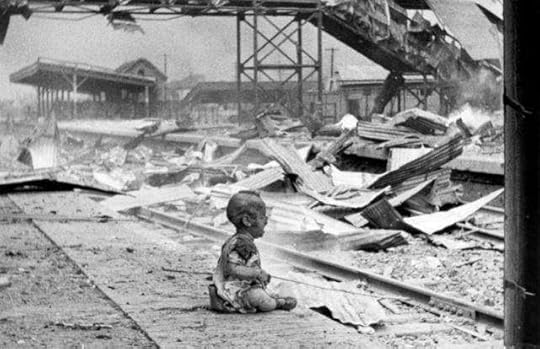
One side note: I found the role of American and English missionaries fascinating. In 1927 there were ~ 8,000 Protestant and 4,000 Catholic missionaries in China. Their presence and reports to home churches put China at the forefront of American thinking. Their influence had unusual manifestations. Soldiers sang hymns as they marched through the streets. "Hark the Herald Angels Sing" was sung around the theme of "save your ammunition" and the Doxology as an appeal to save the country from decadence.
This was a satisfying read-with-both-eyes-and-ears experience. Pam Ward's narration was excellent; all the Chinese names pronounced exquisitely.
The US used Lend-Lease to ship arms and materiel to China, in the hopes that they would keep Japan occupied. Chiang only fought enough to keep the money coming. Although Stilwell worked unceasingly to train China's soldiers, it was a failed mission because the canyon between the oriental and western mindset was unnavigable. Chiang and Stilwell had different aims which could never be reconciled.
The story was thrilling. quirky, and frustrating.
Stilwell's adventures were epic:
~ traveling solo as Military Attaché (without interpreter or companion) through three Chinese provinces in 1923;
~ on a 1927 fact-finding mission with one Chinese servant, they were travels as the Chinese Civil War erupted. As a foreigner, Stilwell was the object of hostility, susceptible to capture or lynching. They barely made it back to Shanghai alive.
~ After the fall of Burma to the Japanese in 1942, Stilwell took his Chinese soldiers, Burmese nurses, American and English staff on foot over a 7,000 ft. mountain pass to India. They traveled at the rate of 14-16 miles a day under brutal conditions, but he brought all 114 people to safety.
What Tuchman calls "one of the most memorable war pictures ever published", this photo of a crying baby at a bombed train station during the 1937 Chinese-Japanese War engendered strong American support for the Chinese people.
One side note: I found the role of American and English missionaries fascinating. In 1927 there were ~ 8,000 Protestant and 4,000 Catholic missionaries in China. Their presence and reports to home churches put China at the forefront of American thinking. Their influence had unusual manifestations. Soldiers sang hymns as they marched through the streets. "Hark the Herald Angels Sing" was sung around the theme of "save your ammunition" and the Doxology as an appeal to save the country from decadence.
This was a satisfying read-with-both-eyes-and-ears experience. Pam Ward's narration was excellent; all the Chinese names pronounced exquisitely.

April 2, 2026
“China was a problem for which there was no American solution... In the end China went her own way as if the Americans had never come.”
Chiang Kai-shek has long carried a complex and contradictory legacy in the West. To some, he was an arrogant and inept leader presiding over a crumbling, corrupt regime; to others—especially in more recent scholarship—he appears as a strategic actor, navigating extreme constraints and buying time where he could. Much of the American experience in China during World War II, for better or worse, was filtered through interactions with Chiang. A bulwark against Japanese expansion, China was the lynchpin of American policy in the Far East. Chiang became both the conduit for that relationship—a nominal security partner—and a lightning rod for American frustration with its many frustrations and failures. General Joseph Stilwell, first as military attaché and later as commander of the China-Burma-India (CBI) theater, emerged as the chief American intermediary—and ultimately the gadfly whose presence helped precipitate the relationship’s unraveling.
In the Pulitzer Prize–winning Stilwell and the American Experience in China, Barbara Tuchman, with her characteristic narrative command, traces the origins of that breakdown, situating personal antagonisms within the wider pressures of wartime strategy. Drawing heavily on Stilwell’s notoriously acerbic diary, she constructs a vivid portrait of the man known as “Vinegar Joe.” With caustic wit, relentless will, and a soldier’s instinct for action, Stilwell did not suffer fools gladly. He was, in Tuchman’s words, “a man of high performance and utter integrity, too quickly disgusted with anything less in others.” Temperamentally, he was ill-suited to diplomacy—least of all in a role requiring delicate coordination among uneasy allies. Yet his long experience in China—as a language officer in the 1920s, an observer during Chiang’s rise, military attaché during the early Sino-Japanese War, and eventually commander of U.S. Army Forces in the CBI—gave him an unusually deep familiarity with Chinese conditions. In Washington’s eyes, he was uniquely qualified to serve as the spearhead of efforts to push China into more active resistance. At Roosevelt’s direction, Stilwell became senior U.S. military adviser to the Nationalist government and commander of Chinese forces in Burma and beyond—the first American placed in such a role.
Even before assuming command, Stilwell had formed sharply critical views of Chinese leadership. Nationalist China, battered by a militarily superior Japan, was governed by a regime plagued by corruption, economic decay, and strategic incoherence. Chiang, as its central figure, became the focal point for American hopes of reform—and for Stilwell’s mounting frustration. Tuchman shows that Stilwell’s skepticism dated back to the mid-1930s, when he criticized Chiang’s passivity and lack of preparation. In his diary, he wrote that Chiang had “no intention of doing a thing or else is utterly ignorant” of how to fight Japan. Tuchman largely echoes this judgment, portraying Chiang as a “holder with no goal but to hold,” committed to the belief that China could outlast Japan and ultimately be saved by Allied intervention.
Stilwell, by contrast, arrived with a clear mission: to build a trained, equipped Chinese army capable of seizing the initiative. In Burma, he confronted one of the most complex challenges of the war—establishing a supply route to sustain Chinese resistance, “the greatest logistic challenge of the war, possibly of any war,” in Tuchman’s telling. As commander of Chinese forces in Burma, he led largely successful operations to reopen land routes into China, while also overseeing the chaotic retreat in 1942. Yet his efforts clashed fundamentally with Chiang’s priorities. To Chiang, a strengthened, independent army risked upsetting the fragile balance among regional commanders and threatening his hold on power. He preferred to emphasize air power and husband resources—partly, Tuchman suggests, to preserve strength for a future struggle against the Communists.
This divergence in strategy—offensive engagement versus strategic delay—lies at the heart of the conflict. Tuchman characterizes Chiang’s approach as akin to “a chess game of cunning and maneuver rather than a physical clash,” one designed to conserve strength rather than expend it. To Stilwell, this was intolerable. Combined with what he saw as Chiang’s poor leadership, resistance to unwelcome information, and detachment from battlefield realities—what he called “ignorance and fatuous complacency”—it drove him to increasingly bitter conclusions. Chiang, in his view, was “an unbalanced man with little education,” presiding over a “rotten regime.”
Tuchman’s achievement lies in weaving these personal judgments into a broader structural argument. The failure of the U.S.-China wartime partnership, she suggests, stemmed not merely from personalities but from irreconcilable objectives. The United States sought to build an effective fighting force against Japan; Chiang sought to preserve his regime, minimize risk, and prepare for the looming postwar struggle. As Tuchman succinctly concludes, “the American purpose was not the Chinese purpose.” China, in this sense, was a problem for which there was no American solution.
For Stilwell, Tuchman reserves clear admiration. Even where he failed, she emphasizes the nobility of his efforts, casting him as a tragic figure undone by forces beyond his control—above all, Chiang’s intransigence. Despite his abrasive temperament and frequent invective, Stilwell, in her telling, grasped the urgency of the moment with unusual clarity. She credits him with an “unusual talent…to understand a historical process while it was happening,” evident in his early recognition of Chiang’s weaknesses, his anticipation of war with Japan, his skepticism toward overreliance on air power, and his foresight regarding the coming Chinese civil war.
Chiang and the Nationalists receive harsher treatment. Tuchman depicts Chiang as fundamentally unpersuadable, insulated from the consequences of inaction by American support, and more concerned with preserving his position against Communist rivals than with prosecuting the war against Japan. In contrast to later revisionist historians, Tuchman is less inclined to credit Chiang’s strategic constraints or his efforts to balance competing pressures—internal divisions, the Communist threat, and the demands of great-power diplomacy. She describes the Nationalist regime as too fractured, too compromised, and too preoccupied with internal survival to serve as an effective vehicle for national resistance. She also casts a critical eye on Roosevelt’s China policy—his oscillations, his personal sympathy for Chiang, and his willingness to accept Chiang’s representations at face value.
Tuchman's account is, in many ways, both a defense of American activism and a lament for its limits: a paean to the determination of “a man of high performance and utter integrity” who “never slackened and never gave up,” and an indictment—shared by many earlier historians—of a regime too weak, divided, and self-protective to meet the moment.
Chiang Kai-shek has long carried a complex and contradictory legacy in the West. To some, he was an arrogant and inept leader presiding over a crumbling, corrupt regime; to others—especially in more recent scholarship—he appears as a strategic actor, navigating extreme constraints and buying time where he could. Much of the American experience in China during World War II, for better or worse, was filtered through interactions with Chiang. A bulwark against Japanese expansion, China was the lynchpin of American policy in the Far East. Chiang became both the conduit for that relationship—a nominal security partner—and a lightning rod for American frustration with its many frustrations and failures. General Joseph Stilwell, first as military attaché and later as commander of the China-Burma-India (CBI) theater, emerged as the chief American intermediary—and ultimately the gadfly whose presence helped precipitate the relationship’s unraveling.
In the Pulitzer Prize–winning Stilwell and the American Experience in China, Barbara Tuchman, with her characteristic narrative command, traces the origins of that breakdown, situating personal antagonisms within the wider pressures of wartime strategy. Drawing heavily on Stilwell’s notoriously acerbic diary, she constructs a vivid portrait of the man known as “Vinegar Joe.” With caustic wit, relentless will, and a soldier’s instinct for action, Stilwell did not suffer fools gladly. He was, in Tuchman’s words, “a man of high performance and utter integrity, too quickly disgusted with anything less in others.” Temperamentally, he was ill-suited to diplomacy—least of all in a role requiring delicate coordination among uneasy allies. Yet his long experience in China—as a language officer in the 1920s, an observer during Chiang’s rise, military attaché during the early Sino-Japanese War, and eventually commander of U.S. Army Forces in the CBI—gave him an unusually deep familiarity with Chinese conditions. In Washington’s eyes, he was uniquely qualified to serve as the spearhead of efforts to push China into more active resistance. At Roosevelt’s direction, Stilwell became senior U.S. military adviser to the Nationalist government and commander of Chinese forces in Burma and beyond—the first American placed in such a role.
Even before assuming command, Stilwell had formed sharply critical views of Chinese leadership. Nationalist China, battered by a militarily superior Japan, was governed by a regime plagued by corruption, economic decay, and strategic incoherence. Chiang, as its central figure, became the focal point for American hopes of reform—and for Stilwell’s mounting frustration. Tuchman shows that Stilwell’s skepticism dated back to the mid-1930s, when he criticized Chiang’s passivity and lack of preparation. In his diary, he wrote that Chiang had “no intention of doing a thing or else is utterly ignorant” of how to fight Japan. Tuchman largely echoes this judgment, portraying Chiang as a “holder with no goal but to hold,” committed to the belief that China could outlast Japan and ultimately be saved by Allied intervention.
Stilwell, by contrast, arrived with a clear mission: to build a trained, equipped Chinese army capable of seizing the initiative. In Burma, he confronted one of the most complex challenges of the war—establishing a supply route to sustain Chinese resistance, “the greatest logistic challenge of the war, possibly of any war,” in Tuchman’s telling. As commander of Chinese forces in Burma, he led largely successful operations to reopen land routes into China, while also overseeing the chaotic retreat in 1942. Yet his efforts clashed fundamentally with Chiang’s priorities. To Chiang, a strengthened, independent army risked upsetting the fragile balance among regional commanders and threatening his hold on power. He preferred to emphasize air power and husband resources—partly, Tuchman suggests, to preserve strength for a future struggle against the Communists.
This divergence in strategy—offensive engagement versus strategic delay—lies at the heart of the conflict. Tuchman characterizes Chiang’s approach as akin to “a chess game of cunning and maneuver rather than a physical clash,” one designed to conserve strength rather than expend it. To Stilwell, this was intolerable. Combined with what he saw as Chiang’s poor leadership, resistance to unwelcome information, and detachment from battlefield realities—what he called “ignorance and fatuous complacency”—it drove him to increasingly bitter conclusions. Chiang, in his view, was “an unbalanced man with little education,” presiding over a “rotten regime.”
Tuchman’s achievement lies in weaving these personal judgments into a broader structural argument. The failure of the U.S.-China wartime partnership, she suggests, stemmed not merely from personalities but from irreconcilable objectives. The United States sought to build an effective fighting force against Japan; Chiang sought to preserve his regime, minimize risk, and prepare for the looming postwar struggle. As Tuchman succinctly concludes, “the American purpose was not the Chinese purpose.” China, in this sense, was a problem for which there was no American solution.
For Stilwell, Tuchman reserves clear admiration. Even where he failed, she emphasizes the nobility of his efforts, casting him as a tragic figure undone by forces beyond his control—above all, Chiang’s intransigence. Despite his abrasive temperament and frequent invective, Stilwell, in her telling, grasped the urgency of the moment with unusual clarity. She credits him with an “unusual talent…to understand a historical process while it was happening,” evident in his early recognition of Chiang’s weaknesses, his anticipation of war with Japan, his skepticism toward overreliance on air power, and his foresight regarding the coming Chinese civil war.
Chiang and the Nationalists receive harsher treatment. Tuchman depicts Chiang as fundamentally unpersuadable, insulated from the consequences of inaction by American support, and more concerned with preserving his position against Communist rivals than with prosecuting the war against Japan. In contrast to later revisionist historians, Tuchman is less inclined to credit Chiang’s strategic constraints or his efforts to balance competing pressures—internal divisions, the Communist threat, and the demands of great-power diplomacy. She describes the Nationalist regime as too fractured, too compromised, and too preoccupied with internal survival to serve as an effective vehicle for national resistance. She also casts a critical eye on Roosevelt’s China policy—his oscillations, his personal sympathy for Chiang, and his willingness to accept Chiang’s representations at face value.
Tuchman's account is, in many ways, both a defense of American activism and a lament for its limits: a paean to the determination of “a man of high performance and utter integrity” who “never slackened and never gave up,” and an indictment—shared by many earlier historians—of a regime too weak, divided, and self-protective to meet the moment.

August 2, 2015
If you're not drinking Narragansett, you're still reading Stilwell and the American Experience in China. While this slogan might not sell much Narragansett Beer, if you finish this book you should be proud and reward yourself with your favorite indulgence -liquid, solid or otherwise.
I began reading this book on APRIL 23 and finally finished it this afternoon. It is truly a good book. Barbara Tuchman is a good historian, even if she does take untenable positions, as my late brother Philip the history teacher once accused her of. (Specifically in the First Salute: A View of the American Revolution.) I nearly gave up. My progress was as sluggish as Stilwell's early military career. Tuchman's verbosity was as frustrating to me as Chiang Kai-shek was to Stilwell. However, that was because I was reading it only during a twelve-minute subway ride twice a day. Between April and July I had struggled to read only half the book. Stil (sic), like the titular general, I hoped that with determination and sheer force of will things just had to improve. The solution was to take a vacation week, go to the beach four out of seven days and read all day by the sea. Although I failed to finish the book during my vacation, I had built up enough momentum for the final push. I am glad I endured.
Unfortunately, Barbara Tuchman has a vexing habit of introducing new characters and events in every paragraph which distracted my focus from the the story. By the end of reading a specifically titled chapter, the reader has learned more about everybody and every thing else other than the subject of the title. Otherwise, Stilwell and the American Experience in China is an interesting history of Sino-Western relations and how it was impacted by a lesser known theater of World War II.
When I walk the dogs tonight our first stop will be the overnight drop box at the public library so they can't accuse me of hoarding books like Chiang Kai-shek did with Lend-Lease Act weapons and equipment.
I began reading this book on APRIL 23 and finally finished it this afternoon. It is truly a good book. Barbara Tuchman is a good historian, even if she does take untenable positions, as my late brother Philip the history teacher once accused her of. (Specifically in the First Salute: A View of the American Revolution.) I nearly gave up. My progress was as sluggish as Stilwell's early military career. Tuchman's verbosity was as frustrating to me as Chiang Kai-shek was to Stilwell. However, that was because I was reading it only during a twelve-minute subway ride twice a day. Between April and July I had struggled to read only half the book. Stil (sic), like the titular general, I hoped that with determination and sheer force of will things just had to improve. The solution was to take a vacation week, go to the beach four out of seven days and read all day by the sea. Although I failed to finish the book during my vacation, I had built up enough momentum for the final push. I am glad I endured.
Unfortunately, Barbara Tuchman has a vexing habit of introducing new characters and events in every paragraph which distracted my focus from the the story. By the end of reading a specifically titled chapter, the reader has learned more about everybody and every thing else other than the subject of the title. Otherwise, Stilwell and the American Experience in China is an interesting history of Sino-Western relations and how it was impacted by a lesser known theater of World War II.
When I walk the dogs tonight our first stop will be the overnight drop box at the public library so they can't accuse me of hoarding books like Chiang Kai-shek did with Lend-Lease Act weapons and equipment.

Read
October 6, 2023When in 1940 Stilwell became Chief of Staff to Chang Kai Shek he appreciated right away that he had no chance of ever getting Chiang Kai Shek to cooperate. Stilwell perfectly understood the cultural, psychological and political reasons for CSK’s refusal to act upon Stilwell’s belief that the best means of defence was attack. And as time went by this understanding only became clearer.
And yet he never once gave up trying.
Or at least this is how Tuchman would have us understand it. I suspect that this was a contentious 1972 Pulitzer Prize winner in Taiwan. Chiang Kai Shek remained in power until 1975.
History being what it is, there's no objective truth. Nevertheless, Tuchman's ability to hang historical narrative biographically around the neck of General 'Vinegar' Joe Stilwell as he literally marches out through the jungles of northern Burma and then marches back in again, learns Chinese, meets with FDR, Louis Mountbatten, Chiang and a revolving door load of other historical luminaries is breathtakingly entertaining.
Yes he never really succeeds, or at least he never comes close to realising his own objectives. But in his extreme dedication and determination, she succeeds admirably in painting him as an honourable man driven by a sense of military duty and I think a love of the Chinese.
There's an interesting man who walks his dog in the woods near where I live. In conversation he told me that he was born in Southern China to parents who were missionaries. I think they may have been evacuated out over the Himalayas to India on one of the wartime transport planes that supplied CSK with millions of tons of aid.
He made me realise that my fascination with Central Europe is a bit myopic. I needed to refresh my memory about 20th Century China. This was the perfect book for that purpose. Fruity and invigorating. AJP Taylor eat your heart out. This is history the way I like it.
5 stars from me. Excellent.
And yet he never once gave up trying.
Or at least this is how Tuchman would have us understand it. I suspect that this was a contentious 1972 Pulitzer Prize winner in Taiwan. Chiang Kai Shek remained in power until 1975.
History being what it is, there's no objective truth. Nevertheless, Tuchman's ability to hang historical narrative biographically around the neck of General 'Vinegar' Joe Stilwell as he literally marches out through the jungles of northern Burma and then marches back in again, learns Chinese, meets with FDR, Louis Mountbatten, Chiang and a revolving door load of other historical luminaries is breathtakingly entertaining.
Yes he never really succeeds, or at least he never comes close to realising his own objectives. But in his extreme dedication and determination, she succeeds admirably in painting him as an honourable man driven by a sense of military duty and I think a love of the Chinese.
There's an interesting man who walks his dog in the woods near where I live. In conversation he told me that he was born in Southern China to parents who were missionaries. I think they may have been evacuated out over the Himalayas to India on one of the wartime transport planes that supplied CSK with millions of tons of aid.
He made me realise that my fascination with Central Europe is a bit myopic. I needed to refresh my memory about 20th Century China. This was the perfect book for that purpose. Fruity and invigorating. AJP Taylor eat your heart out. This is history the way I like it.
5 stars from me. Excellent.
Displaying 1 - 30 of 259 reviews