Three narratives, set in the fifth, fourteenth, and twentieth centuries, all revolving around an ancient text and each with a love story at its center, are the elements of this ingenious novel, a follow-up to the bestselling, An Instance Of The Fingerpost.
The centuries are the fifth (the final days of the Roman Empire); the fourteenth (the years of the Black Death); and the twentieth (World War II). The setting for each is the same--Provence--and each has at its heart a love story. The narratives intertwine seamlessly, but what joins them thematically is an ancient text--"The Dream of Scipio"--a work of neo-Platonism that poses timeless philosophical questions. What is the obligation of the individual in a society under siege? What is the role of learning when civilization itself is threatened, whether by acts of man or nature? Does virtue lie more in engagement or in neutrality? "Power without wisdom is tyranny; wisdom without power is pointless," warns one of Pears's characters.
Iain Pears is an English art historian, novelist and journalist. He was educated at Warwick School, Warwick, Wadham College and Wolfson College, Oxford. Before writing, he worked as a reporter for the BBC, Channel 4 (UK) and ZDF (Germany) and correspondent for Reuters from 1982 to 1990 in Italy, France, UK and US. In 1987 he became a Getty Fellow in the Arts and Humanities at Yale University. His well-known novel series features Jonathan Argyll, art historian, though international fame first arrived with his best selling book An Instance of the Fingerpost (1998), which was translated into several languages. Pears currently lives with his wife and children in Oxford.
I didn't know him, but the British author Iain Pears (°1955) apparently is a popular writer. For me, this first acquaintance was a satisfying one. This book is an ingeniously composed historical novel that combines numerous themes. The story takes place in 3 time layers: the end of the 5th century, the beginning of the 14th century and the middle of the 20th century, each with a central protagonist. Pears is constantly jumping from one period to the next, so you have to keep your head in the game. The connecting thread is the manuscript 'The Dream of Scipio', a Neoplatonic writing by the main character in the 5th century, that is rediscovered and interpreted by both the 14th century and the 20th century protagonists. There is also a spatially connecting element: the events in the 3 time layers all take place in the French Provence, more specifically around the village of Vaison.
And the themes (philosophical, romantic, political) are also common. The most important one is the question of how, as an individual, one can keep a civilization afloat in times of fundamental crisis. The many dialogues and the introspection of the protagonists constantly bring up this subject. And the message is: doing something is better than doing nothing, but it's tricky - if not impossible - to do the right thing. The protagonists in the three epochs each have to compromise to a great extent between good and evil, or rather, between the lesser good and the lesser evil. This immediately makes it clear that this novel essentially is about moral choices. And the common thread that Pears has put in his story does not appear to be so hopeful: in function of the higher goal (to save civilization), the three protagonists make very dubious choices, and even outright betray their ideals and their close ones. Afterwards, as a reader, you are left with a very uncomfortable feeling: a reliable moral compass cannot be found in the chaos of the present, and even the past does not seem to provide it. Pears says: act, defend the camp of civilization, do something, but know that you can never be sure that you are making the right choices, on the contrary, you can be sure you have to make some evil ones. Frustrating.
So, this indeed is quite an intriguing and compelling novel. But I must say there are a few weaknesses. I already mentioned all the awkward jumping back and forth between time layers, making it difficult to follow the thread. Also the Neo-Platonism that Pears introduces is also somewhat counterintuitive: the manuscript to which the title refers only occasionally is touched upon, the Neo-Platonian theses are not really integrated in the story line, and, in the end, it even appears that the 5th century author hit the ball completely wrong (adding to the very pessimistic undertone of this novel). The love stories that Pears presents in the 3 time layers are quite nice, but some passages (such as the brief meeting between Julia and Picasso) are superfluous. But hey, I don't complain, all in all this is quite a successful historical novel.
The Publisher Says: In The Dream of Scipio, the acclaimed author of An Instance of the Fingerpost intertwines three intellectual mysteries, three love stories�and three of the darkest moments in human history. United by a classical text called "The Dream of Scipio," three men struggle to find refuge for their hearts and minds from the madness that surrounds them...in the final days of the Roman Empire, in the grim years of the Black Death, and in the direst hours of World War II.
My Review: Pears explores well-trodden ground here...what is love, how does love cause us to act outside our own best interests, what does loyalty mean in the end, what relationship does the world have to the divine...through the lives and acts of three men widely separated in time, though united by the existence of a manuscript called "The Dream of Scipio", written by one, and read by the other two. The writer is Manlius Hippomanes, Roman aristocrat and chaste lover of the Alexandrine philosopheress Sophia; the manuscript is his final love-offering to the goddess of his idolatry, given after his faux conversion to Christianity which he undertakes in order to organize the salvation of his beloved Provence. In the time of the Papal Babylonian Captivity, also that of the Black Death, poet Olivier de Noyes discovers this manuscript, reads and fails to understand it, and consults Jewish philosopher Levi ben Gershon to come to terms with the many subtelties lost between the Roman days and his own, degenerate Christian era; thus comes Olivier to his fatal love for Jew Rebecca. And in the modern age, Julien Barneuve, French flaneur and Vichy-government fonctionnaire, writes draft after draft of his response to Manlius's manuscript, thinking all the while that he's analyzing and understanding the life of Olivier de Noyes, the object of his studies. All ends badly for each of these men, their lives, their loves, their very cultural roots are torn up, and grosser and grosser perversions of right and good thinking and living, fueled explicitly by Christians and their revolting religion, take hold and choke reason.
Well, no one can say it's not a subject I relate to and support. Too bad it's such a mess. The task of keeping three stories aloft while making sure that each is adding to the others is a daunting one. I don't think Pears did an especially good job of it. The transitions between narratives, all in third person limited PoV, are not keyed to anything that I can discern. I readily acknowledge that I could simply lack the cultural referents and/or the subtlety of mind to recognize them. I simply found the movement through time to be jarring and poorly handled.
But overall, this cautionary tale is one well worth considering. The role of "faith" in the decline of common sense in the public discourse is readily seen in our own time, and the horrifying results...teenagers bullied to death, consenting adults prevented from exercising their civil rights because of some ancient and culture-specific "divine" law irrelevant to modern times...surround us daily. Human beings cannot be trusted with piety. It's not something that becomes us as a species. It's quite the opposite of its stated goal, is piety: Instead of creating peace and harmony, it creates hatred and judgment. It certainly does so in me. And I am not a remarkable human being, but pretty darned average in my responses: I don't like people who don't like me.
Religion, sadly, in the hands of human beings, doesn't make that problem better, but rather creates a horrible echo chamber for the least worthy and most common feelings to be fed back upon themselves. Woe betide those who try to stand against this noisy tide...Pears points up the futility of this, while making sure we understand its absolute necessity.
I wish I believed that reading this book would change hearts and minds, so I could yodel a call to read it NOW from the housetops. It's too rareified, too precious, to make a general audience sit up and take notice. And it's not well enough executed to become the coffee-table adornment of the socially pretentious reader, either, so...here it is. Read it if you agree already, if not don't bother.
This book tells the three most tragic and beautiful stories I have ever read. Each takes place in Avignon, but in a different era of crisis - the loss of Gaul from the Roman Empire, the Black Death arriving during the split in the Roman Church, and the Occupation in WWII. Each successive narrator is aware of his predecessor(s), respects them and wishes to understand them, to better handle themselves in their own time of crisis and to better serve the incredible women they love. I think only one of them succeeds in being a truly great man, and that while it is never didactic in any way, there is a clear moral message delivered in this book. It is about how to do the greatest good, and I would love to discuss it with someone.
Iain Pears is everybody's fantasy of the ultimate history teacher. (At least for people whose fantasies extend to history teachers.) His popular mysteries, so intricately woven from the threads of the past, have given the genre more class and intellectual depth than it's ever had. His latest novel, "The Dream of Scipio," is another category-buster, a work of such philosophical and cultural complexity that its greatest mystery is "How can Pears know so much?"
Pears's canvas has never been larger (Western culture), or his concerns more profound (What is civilization?). Summarizing this complicated story risks intimidating readers away, but -- while it's good to be prepared for some work -- this is another wildly entertaining novel.
He follows three historians in Provence at three moments when Western civilization seemed ready to shatter:
* Manlius Hippomanes, the Bishop of Vaison, who struggles to slow the fall of Rome in the 5th century.
* Olivier de Noyen, a poet and collector of manuscripts, who serves Cardinal Ceccani during the Black Death of the 14th century.
* Julien Barneuve, a classical historian, who reluctantly works for the French government after the Nazi occupation in the 20th century.
Pears has constructed a kind of literary Rubik's Cube, spinning these stories through each other in short chapters that produce fascinating patterns and parallels. All three men are captivated by the Neoplatonic philosophy of Sophia, a stoic Greek woman whose father was literally killed by the fall of Rome, when the ceiling of his classroom collapsed.
At a time when classical philosophy is fighting weakly against the onslaught of Christian dogma, Sophia serves as Manlius's mentor. Even after his conversion, a merely political declaration, Sophia struggles to instill the logic of her ancient virtue. As a show of reverence, Manlius composes a dialogue called "The Dream of Scipio." He hopes to demonstrate to his teacher how well he understands her radical notion that the soul is a reflection of the divine, trapped in a material body, eager to reunite after a journey of understanding.
One of the dazzling pleasures of this novel is Pears's ability to follow the bumblebee flight of an idea through the ravages of time. At his death, Bishop Manlius's scandalous library is burned to protect his reputation, but "The Dream of Scipio" survives, mistaken for a Christian text. It's transferred to a church archive, where it sits for 300 years until that library, too, burns. But before that disaster, "The Dream" is transcribed, badly, so that Olivier de Noyen, a clerical courtier in the 14th century, can make a copy of it that ends up in the Vatican library, where Julien Barneuve translates it again as the Nazis destroy Europe.
How each of these men uses the wisdom of Sophia to respond to their different, though equally terrifying, circumstances provides the intellectual axis that runs through the novel. But each story also revolves around a delicate romance rendered impossible by the crisis of the day. Sophia, for instance, is too removed from this world to give her heart to Manlius, and in any case, his political expediency repels her. In the 14th century, as the plague dissolves bodies and morals, Olivier falls in love with a servant girl, and in the 20th century, Julien is captivated by a Jewish painter. Pears handles these relationships -- like everything in this novel -- with extraordinary delicacy, capturing the full tragedy and beauty of thwarted affection.
Each era is unimaginably different from the other, and yet in each, virtue is tested in remarkably similar ways. Again and again, anti-Semitism serves as the dry timber for a resulting holocaust. Manlius, Olivier, and Julien, so unlike in position and knowledge, must choose between their responsibility to those around them and their duty to those who will come after them -- even in the twilight of civilization, when it seems likely that no one will come after them at all.
As the barbarians threaten to invade, Manlius reassures a nervous friend: "We are the civilized world, you and I. As long as we continue to stroll through my garden arm in arm, civilization will continue." But 1500 years later, as German tanks grind toward the same spot, Julien takes a much more proactive view: "Civilization needs to be nurtured, cosseted, and protected from those who would damage it.... It needs constant attention."
By the end of this remarkable novel, all three men find the problem of preserving the best of their worlds vastly more complicated than they ever imagined. What keeps this cerebral story from pixelating into abstraction, though, is Pears's bifocal vision, an ability to perceive the precise details of ordinary life and the broad sweep of history with equal clarity.
There's something sad and fascinating about his God's-eye view of how documents survive or don't, how history is recorded or lost, how truth is preserved or perverted. Each of these three story lines is so compelling that every break inspires a little regret that you have to leave one and a little thrill that you get to rejoin another.
Civilization survives or revives in every case, but the hideous cost detailed here leaves little solace. This is a novel for our time about all time. Those who ignore Iain Pears are doomed to repeat the past.
Three timelines and stories across significant historical eras set in and around Avignon, the end of the Roman Empire, the Papal Schism, and the Vichy collaboration. Scheming men, women as props, no real depth of feelings. I was intrigued but disappointed, and towards the end it became a slog and I struggled to finish.
I bought and read The Dream of Scipio because I really enjoyed Pears's An Instance of the Fingerpost, which was a thoroughly engaging, immersive historical mystery. In comparison, The Dream of Scipio - while ambitious just like its predecessor - falls a little short.
The Dream of Scipio follows the life of three very different men, all of whom lived in Provence in three different centuries, during various times of great and important historical change: Manlius Hippomanes, a wealthy Roman aristocrat bound on preserving the Roman Empire from decay and destruction, as Gaul is lost to the Visigoths; Manlius is the author of The Dream of Scipio, a treatise on his decisions taken during that fateful period. Hundreds of years later, Manlius's writings are discovered by Olivier de Noyen - a poet and a scholar in the service of a Papal Cardinal, in the mid 1300's, when the Black Death killed one third of all population in Europe. Olivier's poems are discovered by Julien Barneuve, a classics scholar in the middle of the 20th century, as France fell to the Nazis during the Second World War. Each of these men has been placed in history's most tragic and defining moments; and each of them is powerfully, hopelessly, and fatally in love.
This is not an uplifting book to read. Everybody in this novel is dead - the book begins with Julien's death in a fire, and both Manlius and Oliver have been turned to dust centuries before he was even born. Jewish suffering is a common theme, and the book could have just as well been titled antisemitism throughout the ages; tracing the roots of the great tragedy of the 20th century all the way back to the early pogroms. Each of the protagonists faces a difficult choice, with no clear good outcome; and their choices permeate throughout the centuries, influencing lives of three seemingly disconnected and distant persons.
However, all that said, the novel is not as effective as Fingerpost: the set-up is intricate and the narrative switches constantly between the three characters, which will make it hard to keep up for some readers, as there are no chapter breaks in the three parts of the text. I think that the structure of Fingerpost - each narrator having his own, separate section - offered a specific advantage: the setting for the book could have been established in much greater detail. In comparison, the three periods of France in The Dream of Scipio look awfully pale - there is just enough detail for us to know in which period the said section is taking place, but only barely. I wished to be fully transported into the time and place, as was the case with Fingerpost, but unfortunately it didn't happen. And since we know from the beginning that every protagonist of the book is dead, the novel lacks the sense of mystery that Pears's earlier book had in spades.
In Pears's credit this might not have been his intention in the first place - rather he might have wanted to create a complex and byzantine book which would raise important philosophical question: can you preserve civilization with barbarism? What is the price we are willing to pay for our emotions, and ultimately - what is the meaning of life itself? These are good and important questions and this is a less-mystery driven, often diffcult but ultimately interesting book. Still. I'd recommend readers interested in Pears to start with reading An Instance of the Fingerpost.
Historical novels always are a risky business for me. In most cases I quickly find myself frustrated by historical errors, simplifications and incorrect contexts. The British art historian Iain Pears (° 1955) appears to belong to the right school, one who does his homework well and has an eye for detail and nuance. But in this novel he has not made it easy on himself, because he evokes no fewer than three time periods: the crumbling of the Western Roman Empire at the end of the 5th century, the early Renaissance and the plague epidemic of the 14th century, and collaboration and resistance in World War II. And he pulls it off well, see the review in my general account on Goodreads: https://www.goodreads.com/review/show....
The reason why I speak of it here in my historical account is that Pears demonstrates, - I suspect deliberately -, how difficult it is to talk about the past. For example, he presents events and people from that late 5th century from an objectifying 3rd person perspective, and has the characters from the 14th and 20th centuries look back on them, based on their flawed information. Regularly it is striking how wrongly those later figures interpret the earlier events, that is, wrongly from that objectifying perspective that we received earlier. Even the 20th century characters, such as the collaborator Marcel, are portrayed in such a way that completely alternative moral judgments about them are possible. Pears nowhere says that it is impossible to know the historical truth and to make a conclusive judgment about past events and people. But this novel does show how difficult that is. Well done.
L’inizio mi aveva infiammato: Julien Barneuve spirò alle 3.28 di pomeriggio del 18 agosto 1943. Per morire ci mise ventitré minuti esatti, il tempo che passò tra l'inizio dell'incendio e l'ultima boccata d'aria immessa nei polmoni riarsi
Dopo una decina di righe mi è arrivata una secchiata d’acqua In un certo senso, il suo destino fu deciso nel momento in cui, di fronte alla chiesa di St. Agricole, nei pressi del nuovo palazzo dei papi ad Avignone, Olivier de Noyen posò per la prima volta gli occhi sulla donna che avrebbe immortalato nelle sue poesie
Altri dieci righe e l’autore ha aperto la manichetta Il testo che Olivier citava era stato originariamente scritto da Manlio Ippomane durante i mesi da lui trascorsi nella sua villa a una dozzina di leghe dall'attuale città di Vaison
Tre piani temporali: seconda guerra mondiale, medioevo, quinto secolo dopo Cristo. Una dannazione. Neppure districarsi fra i patronimici russi avrebbe potuto essere altrettanto impegnativo. I personaggi che operano nelle tre epoche distinte si assomigliano, l’autore li interfaccia volutamente, ha chiaro in testa il suo progetto. Il problema è per il lettore, perché da un capoverso al successivo si passa da un’epoca ad un'altra senza preavviso. C’è Oliver ma ci sono anche Julian e Julia (Justo per semplificare le cose) poi ci sono Marcel e Bernard e Sofia. L’unica certezza è Manlio. Conoscente qualcuno che si chiami così? Quando si narra di Manlio si può esser sicuri di trovarci nell’Impero romano d’occidente. Attenzione però perché l’opera alla base del racconto (Il Sogno di Scipione), scritta proprio da Manlio Ippomane, ha lo stesso titolo di un’opera ancora più vecchia, composta da Marco Tullio Cicerone nel 54 a.C. Il libro di Pears non è semplicemente un romanzo storico, è un trattato politico, religioso, filosofico, un romanzo a tesi con disquisizioni sull’impegno civile, l’amore, l’amicizia, il tradimento e non ultima l’arte. C’è veramente troppo, almeno per me, che non facevo in tempo a figurarmi la tunica di Manlio ed ero costretto a pensare se Marcel indossasse un panciotto. È andata a finire che nell’antica Roma fumavano le Gauloises senza filtro, e nella Francia occupata organizzavano banchetti filosofici; questo solo nella mia testa, non in quella di Pears dove il progetto (come detto) era chiaro e la situazione nei tre livelli temporali tendeva a dimostrare una certa immutabilità delle azioni umane nel tempo. Non posso dire di essermi divertito, però Pears mi ha fatto riflettere in più di un’occasione con la sua parabola millenaria sull’umanità. Copio un virgolettato che credo non lascerà indifferenti neppure voi. «Credevo in questa semplice contrapposizione tra civiltà e barbarie, ma mi sbagliavo. I veri barbari sono gli esseri civilizzati e i tedeschi ne sono semplicemente l'espressione suprema. Sono il nostro più insigne risultato»
So the other day Yann and I were talking about food (as one does here) and the in-laws. The conversation centered around the kiwi question, which is as follows:
I do not particularly like kiwis, but neither do I particularly dislike them. I am happy to eat a kiwi which is placed in front of me, without objection or disgust, but I do not necessarily take great pleasure in eating them either. They're fine. They're moyen. They're edible, but I wouldn't cross the street for one.
I am unable to successfully communicate this position to my mother-in-law, who dedicates considerable time to spoiling us both, particularly on the food front. She continues to think I don't like kiwi, and that I should never have to eat one, having only and always things I like better to eat (they are legion).
In discussing the kiwi question with Yann, he suggested that this is perhaps a small but important cultural difference. He argues that the French, dedicated to good food and non-puritanical about the harmless pleasures of the body, see no reason why each and every thing you eat should not fall well above the limit of "it's okay but not my favorite" and belong instead to the category "YUM!" That, in fact, I should not have to eat kiwi when so many better options are available. That "meh" may not be the same as disgusting, but it's nonetheless not good enough.
And indeed, leaving aside the case of finishing something so as to not waste food, which I do think is a virtue, I think he and his mother and the French are right, and I and the diet-shake drinking, mcdonald's eating, if you don't eat it now you'll see it again at goûter you'll eat it whether you like it or not choke it down already american model are, perhaps, wrong.
Why do I talk to you of kiwis and in-laws? Because this book, my friends, is a kiwi. And I think perhaps it is time that I integrated, left book puritanism (I've never left a book unfinished no matter how bad!!!!) behind me, and ditched all that is not wondrous, delightful, delicious. I think it is time to take Iain Pears, and quite possibly the bulk of mainstream historical fiction, back to the library from whence it came, admit I won't finish it, blame neither the book nor myself, and move on with my life. I just counted, and this year, so far, I have met 15 new authors, all of whom have filled me with delight and happiness. I think my time is perhaps better spent with them.
This was one of the most remarkable novels I have ever read. The theme introduced is how one participates in epochs of change. Set in three different time periods in Provence, France, the novel explores how three different men make decisions about the preservation of culture. They are Manlius Hippomanes, living in the decline of the Roman empire; Olivier de Noyen living during the Italian Renaissance with the exiled papacy and Julien Barneuve a scholar during the Nazi occupation. I am familiar with the Dream of Scipio, but the novel takes it's title from the reflections of Manlius who is cannonized as a Christian saint, regardless of his neoplatonic loyalties. Similarly his platonic or non consumated lover, Sophia is also revered as a saint, when she is acutally an echo of Hypatia, the philosophical 'queen' of Alexandria. Their stories, completely rearranged by Christianity are picked up by the manuscript hunter Olivier de Noyen. His story is complicated by plague and persecution of heretics, Jews, etc. I have not mentioned his false history lest I spoil the novel, but at each opportunity we are confronted with the voids in documentation which would reveal the irrational side of history replete in the life of Julien. Prejudice is also pilloried here; why wouldn't you want to poison the well if your family died because of the well owners actions. The message here is the sympathy for persecuted people-each of the dead has it's own face and web of relationships. Each man makes choices based on his intellectual leanings and loyalties, but is also influenced by the women they love. Each decision leads to unexpected influences on the future. Great read-I am inspired to return to rereading the Instance of a Fingerpost by the same author and to seek out his other works.
»Das Böse, das Menschen guten Willens tun, ist das größte aller Übel«
Manlius Hippomanes, Olivier de Noyen und Julien Barneuve sind die Hauptdarsteller dieses philosophisch-historischen Romans und alle drei sind in Vaison in der Provence geboren. Der erste ein Aristokrat und Bischof im 5.Jh. zum Ende der römischen Reichs, der zweite ein Poet, 900 Jahre später zur Zeit der Päpste und der Pest in Avignon, und der letzte ein Historiker in den dunklen Jahren der ersten Hälfte des 20. Jahrhunderts. Alle drei leben in einer jener Epochen, in denen die Barbarei die Zivilisation auszulöschen droht, alle drei verbindet eine Leidenschaft zur antiken Philosophie und zu alten Schriften. Und alle drei stehen am Ende vor der folgenschweren Entscheidung zwischen Loyalität und Verrat, vor der Entscheidung auf die Vernunft zu hören oder auf den Rat des Herzens.
Der Dichter Olivier de Noyen trifft auf den sagenumwobenen jüdischen Gelehrten Gersonides oder Levi Ben Gershom: »Die alte Handschrift, die du mir gebracht hast, die von diesem Bischof … Darin steht, der Verstand sei wichtiger als das Handeln. Alles Handeln könne nur als Tugend angerechnet werden, wenn es von einem klaren Verstand gelenkt wird. Denn zur Tugend gelange man nur durch den Verstand, nicht durch das Handeln.« Olivier runzelte die Stirn. »Und?« »Nun, mein lieber Junge, ich glaube, ich sollte dir ein Geheimnis anvertrauen.« »Und das wäre?« »Ich glaube zu wissen, dass das falsch ist.«
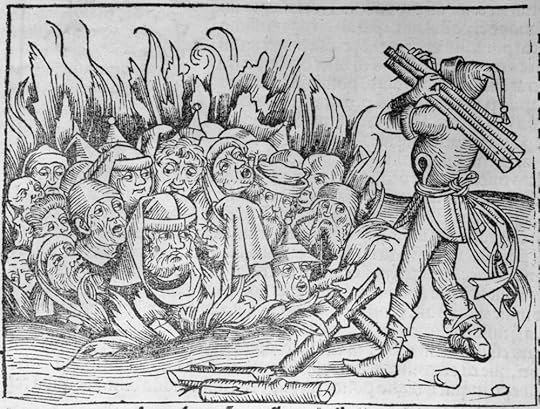
[Judenverbrennung zur Zeit der schwarzen Pest im 14.Jh.]
Der Roman überzeugt durch seine Form und die kunstvolle Konstruktion der Handlung. Pears erzählt die drei Lebensgeschichten parallel in kurzen Abschnitten, immer wieder ergeben sich überraschende Analogien und Querverbindungen, der Bezug zur neuplatonischen Philosophie ist allgegenwärtig und hält alles zusammen. Auch die Figuren, sowohl historisch wie fiktional, sind lebendig und überzeugend in ihrem Denken und Handeln.
Das Buch ist klug, erregt Neugier und Interesse und weckt immer wieder Assoziationen zu aktuellen Ereignissen. Im letzten Drittel legen Handlung und Dramatik nochmals ordentlich zu, so dass auch 600 Seiten nicht zu viel werden. Allerdings stelle ich fest, dass mir eine noch so gute Geschichte zunehmend zu wenig ist, wenn die Sprache zwar gekonnt, aber ganz neutral eingesetzt wird und gar keine Ambition zur Eigenständigkeit zeigt.
Beautiful book that deals mainly with the question of how to preserve civilisation set in various times of great trouble, disease, war and stress. The conclusion or essence of the book, and an excerpt that stuck with me, I found on page 370-371, when Julien talks to Marcel during WWII:
I thought in this simple contrast between the civilised and the barbaric, but I was wrong. It is the civilised wo are truly barbaric, and the Germans are merely the supreme expression of it. They are our greatest achievement. They are building a monument which will never be dismantled [...] What they are doing goes far beyond the war. Something unparalleled in human history. The ultimate achievement of civilisation. Just think about it. How do you annihilate so many people. You need contributions to so many quarters. Scientists to prove Jews are inferior; theologians to provide the moral tone. Industrialists to build the trains and the camps. Technicians to design the guns Administrators to solve the vast problems of identifying and moving so many people. Writers and artists to make sure nobody notices or cares. Hundreds of years spent honing skills and developing techniques have been necessary before such a thing can even be imagined, let alone put into effect. And now is the moment. Now is the time for all the skills of civilisation to be put to use.
This is that rare thing - a book I gave up on. I realised after 100 pages or so that I was actually dreading reading it.... a disappointment, as I loved An Instance of the Fingerpost A Novelby the same author.
What a nice surprise this was. I had never heard about the book or the author. It was given to me to be released through Bookcrossing; I was intrigued by the synopsis and decided to read it before. And I am glad I did.
There are three storylines which perfectly intertwine despite their large temporal gap: the final days of the Roman Empire, the Middle Ages hit by the plague and the second world war. There is history, mystery, drama and a great deal of philosophy and discussion about moral choices. A great story with a lot of substance.
A question of civilized values, he told himself. A question of whether or not one is to take a stand and insist that, despite the times, barbarism must not hold sway. How do we justify calling ourselves civilized, after all? Is it the books we read? The delicacy of our tastes? Our place in continuing a line of belief and of common values that stretch back a thousand years and more? All this, indeed, but what does it mean? How does it show itself? Are you civilized if you read the right books, yet stand by while your neighbours are massacred, your lands laid waste, your cities brought to ruin?
Define your goal and exert reason to accomplish it by virtuous action; success or failure is secondary. The good man, the philosopher (…) would strive to act rightly and discount the opinion of the world.
Some books we read for pleasure, some for intrigue, some for thought-provoking stimulus. Given the nature of this book--three interwoven stories across three time periods--fall of the roman empire, the black plague in 1350s, and WWII France--I find it required a lot of concentration--especially during my early morning commute and late at night. Occasionally, I'd have to back track a few pages to figure out where some character or detail first appeared--not easy to do when the stories change every two paragraphs (and this from a former-academic). The stories and time periods are fascinating, and neo-platonism is sprinkled throughout, but I felt no real enlightenment on issues of Anti-Semitism, nor felt it was true that christianity was simply barbaric and blind faith--this in the late Roman Empire after Christians had been persecuted for years. I guess what I'm saying is that complicated things like socio-religious (even artistic) belief systems set in a historical time period were presented as too black and white. Bottom line--I enjoyed the cleverness of connecting the 3 stories, but this book fell flat for me at times.
I think I’ll join the consensus here that, while this is a perfectly good book and better than many, it is still not as good as An Instance of the Fingerpost (1998) by the same author, which I read long ago, in the happy age before I felt obligated to inflict my opinions via this platform. I remember that Fingerpost left me absolutely flabbergasted at, among other things, the author’s ability to write what was essentially four different consecutive books, and construct the plot of each so it clearly built on the previous, even in the moments where the narrators contradicted each other. This book, by comparison, is merely very good, but not astonishing.
Both books were recommended to me (a decade apart) by the Long-Suffering Wife, and in both cases I hesitated for a while before reading them because they seemed too, well, um, girly. (There, I said it. Don’t @ me, brah, as the kids say nowadays.) By girly, I mean, the characters are more interested in love than sex, spirituality and ideas are actually mentioned, and senseless violence occurs but is not celebrated or lovingly lingered-over.
I mean, for this book, there’s even a picture of a girl on the cover -- with clothes on! How girly can you get?
I read about a all-male book club a few months ago which NEVER reads books by women. I wish I could join it and slip this book in on them, just to see the look on their dopey faces.
Sorry, I got off topic.
This is a pretty brainy novel, with three separate storylines, and will test either your ability either to recall European history or, alternately, to refresh your memory via Wikipedia and similar. The Long-Suffering Wife said she believes the author leaned heavily on A Distant Mirror by Barbara Tuchman for the portions which take place during The Black Plague, so maybe a working knowledge of the Tuchman book will help this one go a little more smoothly. I slogged through without the benefit of this knowledge.
A lot of people here have taken a stab at expressing what they think the book is really about, but I’m going to suggest something different from most of the other readers. I think this is a book about getting things wrong. People in all three historical periods portrayed here are constantly misunderstanding and misinterpreting things, whether they happened hundreds of years or a few hours ago. The results are from, at best, a completely erroneous and foolish view of the past, to, at worst, colossal amounts of excess violence and senseless death in the present.
Being trapped in the current age of willful misunderstanding and misinterpretation, I felt that this book was pretty relevant, even if the stories portrayed in it are decades or centuries old.
1- According to Wikipedia, "The Dream of Scipio (Latin, Somnium Scipionis), written by Cicero, is the sixth book of De re publica, and describes a fictional dream vision of the Roman general Scipio Aemilianus, set two years before he commanded at the destruction of Carthage in 146 BCE."
2-Some critics consider Raphael's painting Vision of a Knight to be a depiction of Scipio's Dream.
Themis-Athena wrote a great review about this book.
Reading Cicero's The Dream of Scipio (versions are on-line for the Google proficient) helped this half-blind reader better understand Pear's intent in his own recounting of The Dream of Scipio.
Ciscero's DoS recounts a recognition that humans have been "given souls made out of the undying fire which make up stars and constellations." Each is "animated by the divine mind, each moving with marvelous speed, each in its own orbit and cycle. It is destined that you and other righteous men suffer your souls to be imprisoned with your bodies."
This description provides a clear framework for Pears' story. Each of the three pairs are embodied souls traveling through historical upheavals (the collapse of the Roman Empire, the plague and it's social influence, and the eruption of Nazi Germany). Pears' dream takes the story a step further however by creating a masculine-feminine dynamic. In the first story, featuring Manilius and Sophia (the Gnostic keeper of the ocean of life was named Sophia), Pears' Sophia is tied to Hypatia and her circumstances reflect the historical character. Sophia/Hypatia is a teacher and keeper of wisdom. She repudiates her student Manlius (Man-li-ness) for corrupting her teachings, resulting in the slaughter of the Jews and others, rather than chose the honorable course and leave behind the vestige of something noble as Manlius's father did (p.388-9). Manlius is blind.
In the middle story, Rachel (a Biblical name bringing to mind compassion, caring more for the other than one's self) and Olivier (Olive=peace) achieve a degree of unity of masculine and feminine aspects that Manlius and Sophia did not. (I loved the scene where Manlius goes to Sophia to profess his love, and she takes him to her midden and asks if he loves her manure, too, pointing out that if he loves her, he loves that aspect of her also.)
By the final incarnation of these three characters, Julien sees both preceding stories in the context of one another, and sees how his own story and that of his love Julia (note the similarity, masculine and feminine of the same name) fit into the two stories that preceded them. At the end, Julien sees in Julia's paintings a triple portrait of the three couples (p.382). In reviewing Julia's restoration work in the shrine to Sophia, "He went into the chapel and looked at the pictures she had studied, and saw them through her eyes...She had lost herself in this old work, her personality dissolving into it, so that she had been set free. The immortality of the soul lies in its dissolution." (p.384) Julien's soul is shortly released when he immolates himself. It seems to me that in Julien/Julia, we have a true unity of the masculine and feminine souls.
I've read and reread this book and it continually rewards the effort.
Some time ago I finished The Dream of Scipio by Iain Pears and it has continued to drift around my mind ever since. Simply put, it is a wonderful book that, if you are anything like me, you will savor as the rare delicacy that it is. I literally forced myself to put it down several times in order to prolong the pleasure of reading it. My first Pears novel and already I am in awe of the fellow.
I cannot think of the last book I read where parallels among characters were drawn with such subtlety and grace. We have a landowning philosopher turned Bishop in the twilight of Rome, a poet in the employ of a Cardinal as the Great Mortality reaches Avignon, and a historian in France as World War II consumes Europe layered atop one another in such a damnably intelligent and skillful manner that even the greats must hang their head and consider a career in technical writing upon discovering this bit of genius. Pears is seriously fucking good, and I intend to wait at least six months before taking up his An Instance of the Fingerpost so as to properly absorb the nuances of a text I finished back in June.
As an aside, this is about the deepest I plumb when discussing plot in reviews; I naively read the back of Lovecraft’s At the Mountains of Madness before starting it in early high school and have since developed a pathological fear of revealing surprises to the uninitiated when discussing stories of any medium. I know many people do not mind spoilers—indeed, some incomprehensible sorts even court them—but I have something of an allergy in their regard and do as most humans do in such cases; I assume everyone else shares my aversion. If you do not, or would ever simply like to discuss a work in more detail than I put forth in these brief critiques, simply shoot me an email.
But Pears. Oh sweet breastmilk of a seraphim, Iain Pears. His style reminded me in the best fashion of a nonfiction historical writer—no one in particular, just something about the narration engaged me more in a manner like Barbara Tuchman or A. Roger Ekirch rather than Umberto Eco. As far as the last goes, I assume much scholarship has contrasted Eco to Pears but that sort of thing strikes me as simultaneously simplicity itself in the broad and cruelly unfair towards two wholly different artists in the specific. Just read it and thank me later.
Очень умный и грустный роман, затрагивающий несколько важных тем, актуальных независимо от времени. Три сюжетные линии разворачиваются в переломные моменты истории: гибель Римской империи в 5 веке, эпидемия чумы 14 века и немецкая оккупация Франции во время Второй мировой войны. И, независимо от эпохи, от религии, от общественных норм и правил, проблемы героев очень похожи. Всем им не раз придется делать выбор, который будет менять и их жизнь, и жизни многих людей. Автор задает нам вопрос о мере ответственности за компромиссы, о том, насколько масштабными могут быть эти компромиссы. Ответы у каждого, наверное, будут разные. Кроме того, что роман дает возможность подумать и попереживать, еще одно его достоинство - то, как автор описывает события. Каждая сюжетная линия раскручивается с нарастающим ритмом, от медленного описания к напряженному эмоциональному финалу. В начале книги сложно предположить насколько ярким будет окончание и как сложно потом будет сформулировать ответ на вопрос о том, где граница между тем, что можно сделать во имя благой цели и тем, что делать нельзя ни при каких обстоятельствах.
The three stories of a fifth century Roman bishop, a Medieval court person and a twentieth century historian blend nicely together and have a tension brought on by three turning points in world history: the fall of the Roman Empire, the plague and the Holocaust. Tied together is the will to survive and the scourge of collapse. The three stories are really one story as the more modern person looks back on the Medieval person, who in turn examines the Bishop and each tries to understand their moral and ethical choices in surviving. History is about how each of us copes as the world turns (sometimes over us) and how it turns out later. Not everything is seen at face value.
Tied together are three women central to each time period. Before the Roman became a bishop, he was a noble man who has a platonic relationship with a woman philosopher, who becomes a recluse and eventually saint. The modern-day historian falls for a woman artist who spends time in the Saint's chapel studying the art done by the Medieval artist Pisano. Her curse is she has Jewish parents and WWII begins. The Medieval court person serves a man whose ambition is to usurp the pope, who lives in Avignon, Clement VI and he also falls for a servant of a well-known and well-read Jew he is called in to help find the source of the plague.
These interlinked time periods amazed me and sometimes I became lost in the stories. The story never becomes melodramatic and I enjoyed the philosophical arguments.
The Dream of Scipio opens with the death of one of the main characters, Julien, an academic who has spent much of his life studying one of the other main characters, Oliverio, who in turn had during his life a hunger for learning which drew him to study the third main character, Manlius. Julien was a soldier in WWI and becomes a bureaucrat in occupied France during WWII. Oliverio is a poet and a secretery for a Cardinal in Avignon during the time of Pope Clement before and as the Plague strikes. Manlius is an intellectual Roman aristocrat and politician in the last days of Roman Gaul who writes the Dream of Scipio and is later remembered as a Christian saint.
The different storylines fit so perfectly into one another, not only because one character investigates the others in the course of his desire to learn (Julien and Oliviero), but because all three men have similar challenges to meet. What is civilization? When is a compromise a victory and when is it a defeat? What is the value of friendship? What does eternity actually mean? What is love? Each man's life is changed by a love story which isn't quite possible because of the conventions of their time and the ambitions of those involved, but I felt that each was real and important. I felt that about all the friendships and rivalries in the Dream of Scipio, which is interesting because when I think about the book I don't see very many villains. I see people who are on the same side and are caught in a moment of history when what was status quo is being forced to change and become something other, and yet the personal conflicts of each story mostly arise from personality and character action.
This book is just perfect. There's a literary and historical whodunnit aspect to Oliverio's tale and it is maintained until it's time to learn whodunnit. Manlius's decision to become a bishop in the Christian church (although he himself is Pagan) maintains a tension: What will happen? Will he manage to preserve the knowledge and learning that he wants to preserve? And Julien, well, we open with his death in a house-fire, and when we return to his death in a house-fire, it is perfect and heartbreaking.
Po daugelio metų nežinia kodėl kilo noras pakartotinai perskaityt „Scipiono sapną“. Kažkiek gal prisibijojau, kad atsiminimai piešia geresnį vaizdą, kad kažkiek galiu nusivilt. Anaiptol. Trys pagrindiniai romano personažai gyvena visiškai skirtingais laikais: tai V a. vyskupas Manlius, civilizuotas žmogus, širdy ne krikščionis, bet priėmęs krikščionių tikėjimą, kad apsaugotų tai, kas jam brangu; tai XIV a. mokslininkas ir trubadūras Olivier de Noyen; ir Julien Barneuve, XX a. vidurio de Noyeno tyrinėtojas, kuris jo dėka atranda nuostabų Manliuso rankraštį, pavadintą „Scipiono sapnas“. Visi trys vyrai kilę iš to paties mažo Provanso miestelio, tačiau būtent šis rankraštis, gautas iš išmintingos moters pamokymų, sujungia tris Pearso pasakojimo gijas. Visiems trims personažams teks pabandyti išsaugoti trapų civilizacijos kiautą tada, kai pasaulis, regis, kraustosi iš proto. Visiems teks rinktis. Ir pasirinkimai anaiptol nebus lengvi. Meilė, draugystė, išdavystė vardan kilnaus tikslo – stygos, kurios čia skamba garsiausiai. Prasideda viskas gana vangiai, tačiau kuo toliau, tuo labiau įtraukia. Ir verčia susimąstyti. Ypač šiais laikais, kurie tokie panašūs į Manliuso, de Noyeno ar Barneuve‘o laikus.
„Kai viskas pasibaigs, žmonės pabandys dėl visko apkaltinti vien tik vokiečius, o vokiečiai – vien tik nacistus, o nacistai – vien tik Hitlerį. Jie užkraus jam visas pasaulio nuodėmes. Bet tai bus ne taip. Tu įtarei, kas vyksta, ir aš taip pat.“
Pears delivered an excellent novel, but I expected this when I picked it up.
The dream of Scipio is a novel about three men living in three separate times whose only connection to each other is a manuscript, that was written by a philosopher years before. The manuscript is inspired by a female philosopher, and in each subsequent time, each man is inspired to understand her teachings and the manuscript itself through their own work, their own love lives, and the political upheaval in each of their lifetimes.
Pears has a way of writing about history while bringing something of poetry and love into his writing. As far as I know he never truly seems to write happy endings, which makes sense. When has history had a happy ending? But we get something of this in The Dream of Scipio, when in the end we realize that one of the greatest lessons offered by Sophia's philosophy is that the soul is eternal, and that love is a function of a soul, thus rendering it also eternal. Fated to meet again, and again. In turn, soul mates. It was a thought that consoled me and buffered the harshness of the ending for me.
I also love how he wrote about what it means to be a philosopher in a time where it seems that philosophy is constantly pushed aside in favor of religious zealotry, or the materialism of politics. We are always asked to choose. To choose between a life of quiet study, the need to understand the seen and unseen, and the rules and laws of the unseen, if those exist, or a life of focused on materialism, the flesh and all that comes with it. For some reason, it's true that poets and philosophers are always asked to make this choice.
I would recommend this book. Although I would probably double check a lot of the philosophical interpretations. This is still a work of fiction and not necessarily a book on philosophy.
This book has an interesting premise. Three different characters who live in Provence at three different points in history, are faced with the same moral dilemna: in times of chaos and uncertainty, how much should a good man compromise with evil, in the attempt to protect something or someone that he values? Manlius Hippomanes lives at the time of the fall of the Roman Empire, and has to decide how much he will compromise with the barbarians and the rising Christian church, to protect the classic civilization that he cherishes. He writes a philosophical treatise called The Dream of Scipio which the later characters reference in their own dilemnas. Olivier de Noyen is a poet and a servant of a powerful cardinal, at the time of the plague in the 14th century. His poetry is read 500 years later by Julien Barneuve, a scholar living at the time of the Nazi occupation of France. Each of them loves an unconventional woman and tries to protect her. Each of them is faced with the choice of whether or not to betray a friend and/or mentor. Persecution of the Jews figures into each of their dilemnas. The moral choices are serious and interesting, and the book did hold my interest. I definitely wanted to keep reading and see how it ended. But, I thought the execution was weak in a lot of ways. There was a TON of exposition in place of scenes that would have made the characters more real and appealling. Also, the transitions between the 3 stories were often awkward and confusing, and that made it hard to keep track of the 3 separate stories.
Much more serious – and much slower going than Pears' art history mysteries; unlike those, this book definitely has literary aspirations. The Dream of Scipio actually tells three different stories, (slightly) intertwined by the device of a philosophical manuscript influenced by Cicero, and by the themes of love, political maneuvering, friendship, betrayal – and Europe's persistent anti-Semitism. As Pears describes the titular document, the book is "partly... a discourse on love and friendship and the connection between those and the life of the soul and the exercise of virtue." It repeatedly, from different angles, examines the questions of whether evil done by those with good intentions is a greater evil than others, or whether evil committed for a greater good can be justified. The reader explores these themes through the stories of: Manlius, a powerful Roman at the age of the decline of the Empire, and his love/muse, the philosopher Sophia. Olivier, a medieval seeker after knowledge and the girl from the Jewish ghetto that he falls in love with Rebecca. Julien, a European at the outbreak of WWII and his love, Julia, also Jewish. Not an easy or lighthearted book, but many may find it worth the time.
This is a book that I read slowly and carefully. I will most likely reread The Dream of Scipio, not so much because I feel that I missed something, although I probably did, but to revisit a perpetual dilemma well presented.
Three stories overlap and intertwine, one set during the fall of the Roman Empire, the second during the years of the black plague and the removal of the papacy to Avignon and the third takes place in the years of the Second World War. The stories have in common the setting in the south of France, around the city of Avignon, an "ideal" woman, and a protagonist coming to grips with the chaos enveloping his world.
A literary historical fiction that weaves the lives of three men around the classic work, The Dream of Scipio that explores the relevance of the work to three completely different time periods.





 by
by
 Iain Pears


