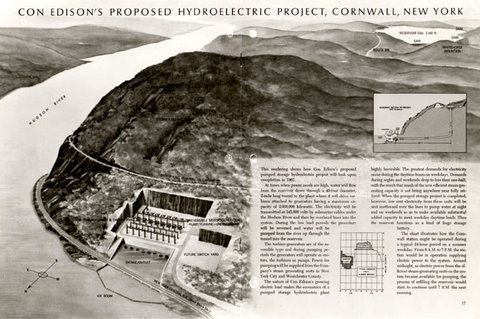
When Consolidated Edison, the giant electric and gas utility, announced its plans to build a pumped-storage plant on Storm King Mountain on the west bank of the Hudson River, it brought to a head a conflict in values that had been simmering throughout the history of the Hudson River, and of America itself. In direct confrontation were New York City's burgeoning needs for electric power and the determination of conservationists to preserve the scenic and natural wonders of the Hudson River.
In the Storm King case of 1965, the courts held for the first time that citizens with no economic interest in the property under dispute could nonetheless be considered to have a legitimate role to play in decisions regarding the use of that property. This case marked the entrance of environmentalism into the national consciousness as part of the conflict over America's priorities.
The book begins with the fascinating background to the Storm King case - the early history of the mountain, America's love affair with engineering marvels that began with the Erie Canal, and the role of the robber barons in putting together the giant utility that became Consolidated Edison. Talbot then reveals how the opposition to Con Edison's plan, starting with eight Hudson River neighbors, blossomed into a national crusade, engaging the efforts of a high-powered public relations organization, stars of the legal profession, top political figures, and theatrical celebrities.
Power Along the Hudson is not a tract for conservationists, however. It deals sympathetically with the problems facing utilities in filling the power needs of Americans still wedded to gadgets and economic growth, and asks some hard questions about the values of our civilization. The book concludes with the legal and political battles that have followed the Storm King case, including the defeat of the Hudson River Expressway and the Mineral King case in California.
A landmark book that will have an essential place in the library of conservationists, lawyers, and engineers, Power Along the Hudson is also a perceptive and enjoyable introduction to a key ideological conflict in American history.
In the years 1962-1965 the electrical utility Con Edison developed a plan to build a pumped-storage hydroelectric plant in Cornwall, New York, on, in, alongside, and under Storm King Mountain, a rural, mostly undeveloped area just north of the West Point Military Academy on the west bank of the Hudson. The power generated by the plant would go to New York City, whose electricity needs were quickly increasing. The plant would be able to store electricity during low-use times, and release it at peak times. This book details the resistance to the plan from citizen activist groups concerned about the environmental and scenic impacts. In court, ultimately, Con Edison won, and the protest groups lost. In 1972 the U.S. Supreme Court refused to hear the environmentalists' final appeal.
(The book was published in 1972, so you wouldn't know this from reading it, but the plant never got built. According to riverkeeper.org, under the 1980 Hudson River Settlement Agreement (HRSA), "Con Ed agreed to abandon its Storm King project in exchange for the environmentalists’ agreement to not immediately force the utilities to use closed-cycle cooling which would eliminate 95% of the fish kills.")
Talbot's book is hampered by too loose a focus. He goes off on tangents about the building of the Erie Canal, and the defeat of a proposed expressway across the river from Storm King. He finishes with a chapter oddly titled "Fishing" in which he proposes that the Hudson would do much better if New York state governors were always anglers.
This particular book has vanished into the mists of time, but a very good summary of the Storm King issue can be found here: