Lose yourself in this classic prize-winning memoir of life in 1950s Cyprus on the brink of revolution by the legendary king of travel writing and real-life family member of The Durrells in Corfu.
Lose yourself in this classic prize-winning memoir of life in 1950s Cyprus on the brink of revolution by the legendary king of travel writing and real-life family member of The Durrells in Corfu.
'Stunning. ' André Aciman
'Masterly ... Casts a spell.' Jan Morris
'Invades the reader's every sense ... Remarkable.' Victoria Hislop
'These days I am admiring and re-admiring Lawrence Durrell.' Elif Shafak
'Our last great garlicky master of the vanishing Mediterranean.' Richard Holmes
'Exceptional ... Revelatory ... A master.' Observer
'He writes as an artist, as well as a poet . Profoundly beautiful.' New Statesman
Cyprus, 1953. As the island fights for independence from British colonial rule, ancient conflicts between Turkish and Greek Cypriots trouble the glittering Mediterranean waters. Into the brewing political storm enters Lawrence Durrell, yearning for the idyllic island lifestyle of his youth in Corfu.
He settles into a dilapidated villa, and with his poet's eye for beauty - and passable Greek - vividly captures the moods and atmospheres of island life in a changing world. Whether collecting folklore or wild flowers, describing the brewing revolution or eccentric local characters, Durrell is a magician with and the result is not only a classic travel memoir, but an intimate portrait of a community lost forever.
WINNER OF THE DUFF COOPER MEMORIAL PRIZE
'Brilliant ... Never for a moment does Durrell lose the poet's touch.' New York Times
Lawrence George Durrell was a critically hailed and beloved novelist, poet, humorist, and travel writer best known for The Alexandria Quartet novels, which were ranked by the Modern Library as among the greatest works of English literature in the twentieth century. A passionate and dedicated writer from an early age, Durrell’s prolific career also included the groundbreaking Avignon Quintet, whose first novel, Monsieur (1974), won the James Tait Black Memorial Prize, and whose third novel, Constance (1982), was nominated for the Booker Prize. He also penned the celebrated travel memoir Bitter Lemons of Cyprus (1957), which won the Duff Cooper Prize. Durrell corresponded with author Henry Miller for forty-five years, and Miller influenced much of his early work, including a provocative and controversial novel, The Black Book (1938). Durrell died in France in 1990.
The time Lawrence spent with his family, mother Louisa, siblings Leslie, Margaret Durrell, and Gerald Durrell, on the island of Corfu were the subject of Gerald's memoirs and have been filmed numerous times for TV.
Initially my reaction as an Hellenophile is one of sadness and sorrow at the short sighted-ness of the British Government at the time.
I shall think on this review for a while 😔
I am at rather a loss as to where to start with this review. I finished the book, which was in my opinion, superbly written, very poignant and at times witty, with tears in my eyes. Why, well as i have said above, I have a great love of anything Greek, as I think did Lawrence Durrell, and so I found the stupidity of mainly the British Government, unbelievably sad in that it negatively affected so many lives over the next 3 years, 20 years, 40 years, and some would say even to today in Cyprus. The loss of life (as ever such a waste), the resigned fate of the Cypriots, both Greek and Turkish, was heart rending, as even the most peaceful and English loving of them, could see no solution. Some reviews have suggested that Lawrence Durrell was a racist and a bigot, and looked down upon the Cypriot “peasants” who he professed to be friends with. I didn’t see that at all, I was given a picture of a man who sympathised with, who loved spending time with and wished he could have done more to help the Cypriot people who were his friends, whether peasant of bar tender, carpenter or government worker. I saw a man who didn’t discriminate between Greek or Turkish Cypriot, who would happily help or just "chew the fat" with either. I saw a man who ultimately understood how stupid his government was being and tried to do what he could to help but to no avail, the wheels of British Government policy ground forward slowly but inexorably without seeing people or communities, just an island that was in a useful position, economically and militarily, in the Mediterranean.
I am aware what happened to Cyprus after Lawrence Durrell returned briefly to the UK (before living out the rest of his life in France) but I shall never know what happened to some of the Cypriot characters who helped and befriended him in the few years he called Cyprus home, and that to me is also sad. Whilst this all happened 5 years or so before I was even born, what happened to those characters was of interest to me, as I see some of their traits, behaviours, spirit, friendliness, and generosity in the Greek (mostly Cretan) people that I have the honour to call my friends today.
I read this many years ago and loved it. Rereading it has just confirmed how brilliant Lawrence Durrell is. If you want to hear all about Cyprus, well this is the book for you. All said and done!
This is not a political book, but simply a somewhat impressionistic study of the moods and atmospheres of Cyprus during the troubled years 1953-56 or to be more precise during the armed struggled against the British. Lawrence Durrell, 1957
A British perspective of the 1950's in Cyprus
I've chosen to write in English, because English is a window to the world, like it or not.
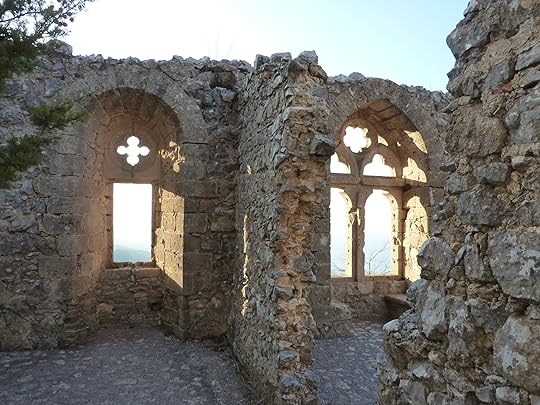
His descriptions of the Pentadaktylos mountains are eerie and romantic (with romantic I don't mean romantic as in St. Valentine's and shite like that but in the sense of aesthetic experience with feelings of awe, and apprehension while experiencing the sublimity of nature). I have never seen Pentadactylos' castles as Gothic before reading this book. In addition all the chapters that didn't have to do with the bitter struggle were the ones I loved. Buffavento, Saint Hilarion, Kantara, all these castles were built one after the other along the narrow Pentadaktylos mountains, but sadly when you search for them on Google you see them as castles in Northern Cyprus.
Let's be political for a little while. EOKA started as a patriotic struggle against the British and eventually turned as a struggle for Union with Greece, turned against Turkish-Cypriots, Pacifist Cypriots, Communist Cypriots and thank's to EOKA the Turkish Nationalism was rekindled and the Pogroms in Constantinople occurred in September 1955. Thanks to EOKA Cypriots were divided, thanks to EOKA Cyprus began a journey down to Hades. We got independence (1959/1960) but in 3 years' time (1963) we were divided (unofficially) waiting for the official division (1974) And we are still waiting, divided in discord; TuCy VS GrCy, right-wing GrCy VS left-wing GrCy, divided like cancerous cells, 2 multiplied by 2 equals 4. and 4 by 2 =8 and so on.
Without this armed struggled against the British, Cyprus would have gained her independence probably 10-20 years later during the rise of decolonisation in Africa. But we were impatient and as a Greek proverb says Whoever rushes stumbles and we did. and we are still in the ditch.
British view on Cyprus/Cypriots The British underestimated Cypriots because most of them knew Cypriots as lethargic subhuman beings, and Durrell has for chapter's 11 epigraph a very racist and vile paragraph taken from W. Hepworth Dixon's book British Cyprus
"What they are they were; and what they were they are - [Cypriots are] an indolent[νωχελικός] careless & mimetic people, but without a spark of Turkish fire, without a touch of Grecian taste. With neither beauty of body nor sense of beauty in mind, with neither personal restlessness[ανησυχία] nor pride of origin. They live on a limpid[διαυγές] state, like creatures of lower types clinging[που προσκολλούνται] to life. Holding on by simple animal tenacity [ζωικό πείσμα] through which have wrecked the nobler [ευγενέστερες] races of mankind.
Truly racist views, but I'm not surprised because the Europeans were always racist towards their subjects, the 'negroids' of Africa, the 'heathens' of the Pacific, the 'ape-like' Australian aborigines and so on. But I was shocked by the unnecessary hate this man had for us. Did it crossed his mind that Cypriots were not beautiful because they were slaves of races for centuries and centuries, did he realise that Cypriots were indolent because they were illiterate thanks to the dozens of masters they had above them and worst of all the Franks (yes, not the Ottoman Turks; you are surprised, yes, if you read the History of Cyprus you'll realised that Cyprus suffered worse hardships under the (Christian) Franks and Venetians and less under the (Muslim) Ottoman Turks?)
One of the first schools in Cyprus open in 1812 (under Ottoman rule) in the capital, Nicosia, the Pancyprian Gymnasium. The first school in my town opened in 1900, more than a century later. BUT and I say this looking towards Dixon's rotten corpse: We still speak Greek which is less unchanged than your English that mutated in a French sounding language after 1066. We were indolent but thanks to EOKA we became known (the only good thing the organisation did.) And no matter how many masters will pass we will stay alive because Greekness is as old as the world η ρωμιοσύνη εν φυλή συνότζαιρη του κόσμου Βασίλης Μιχαηλίδης, 9η Ιουλίου.
Now let's go back to the book. Lawrence Durrell a poet/novelist comes to stay in Cyprus and chooses not a very ideal period and he buys a house near the beautiful abbey of Bellapaix ( meaning beautiful peace in French, ironic isn't it)...
...and for almost three years we see the people of Cyprus and the struggle through his eyes. The descriptions of nature are beautiful, but his views on Cypriots a bit biased. Hence 4 stars Costas Montis a renowned Cypriot poet wrote a book as an answer to Durrell's Bitter Lemons called Closed Doors: An Answer To Bitter Lemons By Lawrence Durrell A similar thing happened in Algeria recently. Kamel Daud wrote The Meursault Investigation as an (Algerian) answer to Camu's The Stranger
If you want to learn more about Cyprus (the British Perspective won't ruin the experience that much) this is a nice place to start, and the description of Cyprus' landscapes and nature are idyllic/romantic; need to stop writing. . . .
Commandaria - Κουμανδαρία. Cypriot wine. Sweet, quite different from all the other things you've been hearing about Cyprus lately. Lovely stuff, similar raisiny flavor profile to a PX sherry, but less syrupy and cloying--you can drink this without fear of developing type-2 diabetes. People in Bitter Lemons are always slipping off for a glass of the stuff on some terrace or another. I had to try it.
Although the title gives the game up, this book is like a perfume whose opening notes of neroli and lemon give way to something uncomfortable and off-putting, like strong imortelle. In the first third, helped immeasurably by his knowledge of Greek, Durrell is getting settled in, and it's a sort of Cypriot Under a Tuscan Sun. The chapter in which he buys a house aided by the wonderfully cunning Turk Sabri is alone worth the price of admission. He is a memorable character. Memorable enough to be eulogized in the New York Times, of all places. Sabri died only in 2000, apparently gunned down.
Durrell teaches fourth form English and later accepts a job as press advisor with the colonial administration. The question of Enosis--independence from Britain and union with Greece begins to overwhelm all the other questions, including those of safety. Eventually, Durrell packs his bags and leaves.
Bitter Lemons is written in that wonderful mid-century English style that, to my mind, is unequaled.
This is the first Lawrence Durrell book I have read and he is certainly a superb writer. A description of his time spent in Cyprus during "Enosis", Greek Cypriots demand for union with mainland Greece, this made fascinating reading. I had spent a week in Cyprus in 2000 and his description of the people and places had me recalling a pleasant week time.
For all my enjoyment of this very fine read I suspect that like another author I admire, Patrick Leigh Fermor, I may not be in agreement with a few of his views. He writes early that he was not going to make political observations. Well he did; "As a conservative, I fully understand, namely; 'If you have an Empire, you just can't give away bits of it as soon as asked.'" he states at one point. He is clearly a colonialist of the higher order and yes he loved the locals but to me there was a fair bit of paternalism that could be at times condescending. At one point wrote that he thought the locals were cowards! And then "I knew at once that the Empire was all right by the animation of three African dignitaries". Good grief.
In the end though it is a very good read, at times wonderfully descriptive and very interesting. It has also made me realise that I should read some Cypriot history as I had decided to do many years back but never had.
Published just after the time Lawrence Durrell spent in Cyprus first as a school teacher and then as a press agent for the British government (Cyprus then under British colonial rule). He spent about three years there in the mid 1950s. Durrell was looking for a congenial Mediterranean lifestyle and a place to spend time writing the first novel in his famous Alexandria Quartet.
This is not a travel book per se, although the first half fits that description to a degree. Initially he discusses his desire to own a traditional Cypriot house and ends up in a village (Bellapaix/Bellapais today), uphill from the northern port of Kyrenia. He speaks of his neighbors in a somewhat paternalistic but not dismissive way but because he speaks Greek they are hospitable and friendly, at least at first. Enosis (independence from Britain movement) is heating up. Durrell is an excellent writer and his descriptions are not only beautiful but often hilarious. For instance, the story of how his Turkish “real estate agent” and the Cypriot Greek family who own the house that catches his fancy come to an agreement is vivid and so funny. I also love the stories of the travails of getting remodeling done. Certainly a universal problem.
Midway through, the dark clouds begin to roll in. Enosis has turned terrorist and the British leave. Durrell must leave too as well as other friends and family. One friend is murdered, he’s saddened at the state of things but gets out long before Cyprus was divided horizontally between the Turks and the Greeks. The area Durrell lived in was captured by the Turkish government in 1974, so that means his primarily Greek Cypriot neighbors would have been abruptly forced to leave their homes and flee south. It was violent but not as bad as the partition in India approximately 25 years earlier.
I learned a new word. Durrell has a wonderfully expansive vocabulary for someone who was essentially home schooled and who skipped university. The word—“anfractious—sinuous or circuitous. Love his writing.
This book has taken me an extraordinarily long time to complete, part of that is the fact that it felt to me as though it had separate sections that did not always tie together.
First, let us talk about the writing itself: gorgeous, of course. At time a little over the top, always evocative and very visually descriptive with the ability to make both the island of Cyprus and it's inhabitants spring to life. I think the first person narrative gives one an excellent character to follow through the story (though whether it might be a close portrayal of the author I have no idea) and see the countryside through, as it were.
That element, the lovely writing was what kept me going.
After he has settled into his village and is modifying his house however, that was when my issues began. Lawrence became involved in the politics of Cyprus which through Enosis or EOKA ended up in the Cypriots being drawn into terrorism in order to.... something? Get freedom from England? Become subjects of Greece INSTEAD of England? self government never seems to be mentioned.... Anyhow, whatever it was it obviously led to the Cyprus being divided, as it was when I visited in the 80's, into Greek and Turkish halves. It all sounds very sad.
Because I am not really up to date of Cyprus history, Lawrence's descriptions while sensitive and non-accusatory kind of fly over my head. The only moral of the story I can draw out of it, is that wherever Britain tried to empire build they screwed up due to a kind of self satisfied blindness. Look at the revolution in India? Or the never ending troubles in the Middle East today, largely caused by Rule Britannica's meddling. So to with Cyprus, apparently, but I could not follow it at all, I crept through that part, a paragraph at a time and almost gave it up as a DNF.
Then, right at the end, it redeems itself. The ending is purely brilliant, sad and brilliant, but definitely I am happy I read to the end. The story of the last time his left the village was poetry.
İyice anladım ki Durrell pek çok açıdan eşsiz bir yazar, özellikle mekan ve atmosfer yaratma konusunda hakikaten eşi benzeri yok. Öyle bir yazıyor ki nereyi anlatsa sihirli bir yer oluveriyor orası: İskenderiye’nin ardından bu kez kendisiyle Kıbrıs’a gittim ve yine büyülenmiş şekilde döndüm. Durrell, 1952-56 arasında adada geçirdiği günleri, kurduğu ilişkileri, Enosis meselesinin doğuşunu her zamanki gibi kelimelerle dans ederek anlatıyor. Kıbrıs’ın geride kalmış huzurlu, ışıltılı, dingin günlerine bir ağıt gibi, epey hüzünlü bir kitap “Kıbrıs’ın Acı Limonları”. Kitabın siyaseten eleştirilecek yanları olabilir, var da, Durrell’in pozisyonu kolonyel bulunabilir, tek yanlı bir bakış denebilir… Ama bu kitabı bir politik tarih çalışması gibi değil de, adaya içten bir sevgi duyan bir yabancının hisleri ve izlenimleri gibi okumak lazım bence. Bu izlenim sözcüğünden yola çıkıp şunu ekleyeyim: bir büyük izlenimci (empresyonist) ressamın tablosu gibi bir kitap işte bu. Sarılar, turuncular, maviler… Sonra da akmaya başlayan kanın kırmızısı. Öyle. Çok etkilendim, çok sevdim.
beautifully written, this book helps you understand Cyprus and more broadly how people go from somehow getting along to civil war, sort of... Here is a citation from the opening of the book about the value of travel, that I love:
“Journeys, like artists, are born and not made. A thousand differing circumstances contribute to them, few of them willed or determined by the will--whatever we may think. They flower spontaneously out of the demands of our nature-- and the best of them lead us not only outwards in space, but inwards as well. Travel can be one of the most rewarding forms of introspection.” ( p.15, first paragraph of the book)
then a few pages later, this gem:
“We had become, with the approach of night, once more aware of loneliness and time-- those two companions without whom no journey can yield us anything.” (p.19)
I don't agree that artists are born not made, but do love the end of the first quote from "and the best of them..." as I think Durrell captures one of the essences of why travel is so captivating-- it is shuttling back and forth from the outward journey to the inward journey of discovery and back again, that keeps each so endlessly captivating.
I love reading memoirs and books on travelling, not because of “I learn new stuff about new places” nonsense, but because they help me to understand the stand of the writer; since those kind of books reveal how their writers perceive people and the world around them more readily and personally than say, a novel they design. So, when I got The Bitter Lemons of Cyprus out of a Kindle deal (I was planning to read the infamous Alexandria Quartet for a while and thought it would be nice to get the feel of Durrell’s writing beforehand), I was curious, to say the least. But then the grinding started.
A little tip for you: If I grind my teeth while reading, it's usually a bad sign - believe it or not. This was the case with The Bitter Lemons of Cyprus. At some point, I started to grind my teeth and hell broke after that.
I must admit though, I had been quite prejudiced against Lawrence Durrell. How could one not be, after reading his brother's delightful report on his family and other animals? As it was aimed in his brother's book, my opinion of Lawrence Durrell was quite firmly set and low, and I was sure that I would find him an unbearable, pompous person who genuinely lacks genuine genuineness, full of pose and airs. Of course I was aware of sibling rivalry and how my feelings were being manipulated craftily (and charmingly if I may add) in My Family and Other Animals by the playful little brother against the insufferable know-it-all elder. Therefore, I was quite determined to be as open-minded and just as possible before I started this book. I was so determined that I ignored the "oh-the-joyous-simple-men-living-wonderfully-simple-lives-in-an-eden/like-setting-while-I-the-sophisticated-Renaissance-man-with-a-tormented-mind-full-of-Ovid-am-blessing-their-existence-with-my-being" attitude of the writer line after line, page after page. Ah, all those silly, hilarious things that simple, ignorant, overtly gesticulating, lovely, loud and poor folk did. Please, kindly notice how cunning I am acting among the beasts though sometimes I am beyond perplexed with their barbarously goofy acts. And, that was the better part of the book. I managed to thump through it, mostly for the sake of Cyprus which didn't fail to charm Durrell, much to his credit I must say. Well, his prose might be drier that the Sahara and his presumably tongue-in-the-cheek style (which in fact is just plain snobbery and not the masterful irony he assumes he achieves) just as tiresome but for all it's worth he is not a writer for nothing.
If you survive through the house renovations and teenage girls fawning over a scrubby git namely their English teacher (who by the way gives a spookily detailed account of their adoration), you are rewarded with the worse part the book or what I choose to name as `How We Rule Imperially`. At this point, I was doggedly making further allowances for Durrell, reminding myself that the book was written on the second half of the 20th century, that men were then permitted, hell, even expected to think and act like they knew everything about everything even or especially when they were clueless, that that was the way cookie crumbled then, that Durrell was trying his best to be fair and understanding in his own snobbish way; but I am not going to play it down, Bitter Lemons is one of the most frustrating, ignorant and equivalently arrogant piece of work written by a member of an occupying power about the place they had occupied I have ever had the misfortune of laying my eyes upon. And this is quite telling, because I am from Turkey and when it comes to fascism in text, being objected to horrible instances of it since I was quite young, I lamentably know my stuff.
I still haven’t finished the book, I don’t believe I can muster enough patience at any time soon to do so, but here are some examples for your immediate pleasure:
“What does amaze one however is that the Turks, perhaps through lack of a definite cultural pattern of their own, or of one worth imposing on the Greeks, left them freedom of religion, language and even local government- and indeed vested in them a large part of the Imperial administration: a recognition perhaps of the enviable qualities of restlessness and imagination which they themselves lacked.” (location 1812)
(Gasp! Oh! Greeks were let to keep their own religion and freedom and language and even local government! How can that be? It must be only because Turks did not have a superior culture to enforce upon others. Seriously, Mr. Durrell? This is how you read the political situation at the Mediterranean or at any place? Turks didn't impose their culture, language and religion upon others forcibly –unlike British- just because they'd assumed what they had was not worthy of imposing? Your friends must find your firm faith in human modesty quite refreshing, I am sure. The nerve of the clueless imperialist who readily accepts the first explanation that comes to his mind, off the top of his head.)
Here’s another. That one made me quite sad:
(A students asks) “Will England force us to fight for our freedom here? I registered astonishment. “I have been reading an essay,” he said, “in which it says that freedom has never been given, but always taken, always earned at the cost of blood. A people that is not willing to accept the price is not ready for freedom. Perhaps England understands this and is waiting for us to prove ourselves ready to die for freedom?”
Durrel had been five years in Serbia and really wasn’t sure if he wanted to live in the Mediterranean anymore. He couldn’t afford to live in Athens so the next best thing after that was Cyprus. Decision made he makes his way to Venice to get the boat there. Falling into conversation with a man there, he questions why Durrell wants to go there at all: ‘It is not much of a place’, the man says, ‘Arid and without water. The people drink to excess.’ To Durrell, it sounded perfect.
As they depart, they are shadowed by a grey destroyer for a while before it turns abruptly and fades into the horizon. He opens the book that he had acquired from an overturned bookstall in Trieste, A Lady’s Impression of Cyprus by Mrs Lewis. It offered a splendid picture of the island and confirmed that he had made the right decision.
They docked at a town with a desolate silhouette, and he was overcharged portage to disembark. Passing through the customs check is an early eye-opener as to what the people of this island are going to be like. Most are surprised that he is fluent in Greek and it is in conversation with a man over the glass of the heavy red wine that he is provided with a man who could take him to the village of Kyrenia. One scary journey later and he is ready to spend his first night on the island.
Lodging with a friend, Panos, he can begin to get a measure of the people and culture. It is idyllic sitting on the terrace drinking wine before heading down to the harbour to watch the ‘sunset melt’. It was with this friend that he truly came to understand the meaning of the word ‘kopiaste’, or Cypriot hospitality. It was also the best way to see if he could really afford to buy a small place to live in. It would be.
The process of him buying a house there is one of the most entertaining passages that I have read in a while. He first charms the local rogue, Sabri, in the village into helping him. Between them, they agree on a budget and a few days later he is informed that there is a property that may be suitable in the village Bellapix. They visit on a rare wet day but the property is sound and dry but does require some work. Negotiations begin between Sabri and the feisty owner of the property and they are protracted and heated.
Eventually, it is resolved to all parties satisfaction and the essential renovation works begin. Soon after he moves in his visitors begin to arrive, Freya Stark, Patrick Leigh Fermor and Sir Harry lake. They bring wine, laughter and books and conversations that go deep into the night. AS he settles into life on the island other opportunities present themselves, he is first offered a position as a teacher and then the post of Press Advisor to the Colonial secretary is advertised. Much to his surprise, he gets the job.
The timing of this is unfortunate though as this is just as there is growing civil unrest in Cyprus. Students are joining the rebellion and there are small acts of terror from grenades and homemade bombs. The British (as usual) misjudged the situation and made a bad situation much worse.
Lamplight, wine and good conversation sealed in the margins of the day so that one slept at night with a sense of repletion and plenitude, as if one were never more to wake.
This is the first Laurence Durrel book that I have ever read even though I have had a few of them languishing on my shelves at home. I thought that his writing is very evocative as he writes about the people and place of this island. It was good to see the brief appearances from Gerald and his mother, Louisa in the book too. The later part of the book turns more serious as the civil unrest grows, and it loses the warmth that is very much evident in the first part of the book. I did find that he has a traditional perspective with regards to colonialism and dealing with the local population, which I was a little surprised about. It is a book of its time though. All that said, it is a really good read and I can highly recommend it.
"Bitter Lemons" is a book with many charms and few merits. Although I have not read it twice with great pleasure I wish that it was better than it was. As the winner of the 1957 Duff Cooper Prize it is definitely overrated. In the book Durrell tells the story of the four years from 1952 to 1956 during which he was a resident of Cyprus. After roughly ten years service as a British diplomat, Durrell's intention was to concentrate full time on his career as a writer. "Bitter Lemons" starts out like a book by Peter Mayle and then finishes as an account of the beginning of the "Cyprus Emergency", that is to say a terrorist campaign intended to end British rule on the Island. Durrell who spoke Greek fluently loved the Greek Islanders and their culture. He enjoyed living with them and accepted his status as an outsider much in the same way that Mayle was happy to be bilingual Englishman residing in Provence. Durrell has a very long chapter in the first half of the book entitled "Buying a House" that is very similar in tone to Mayle's "Year in Provence". The Cypriots like the Provençaux emerge as charming, bucolic yokels. It appears that more than writer can make the same formula work. How can anyone not like warmth and sunshine. In addition to the delightful Cypriots, the reader is also treated to snapshots of familiar writers. During his stay on the island, Durrell will be visited by Patrick Balfour, Patrick Leigh Fermor and of course his own brother. The second half of "Bitter Lemons" deals with Durrell's experiences during the terrorist attacks of EOKA, a Greek Cypriot nationalist guerrilla organisation, intent on ending British colonial rule and the unification of Cyprus and Greece ("enosis"). Durrell will be called back into the diplomat service where he will be given the responsibility for press relations. Durrell's book becomes passionate. While strongly in favour of "enosis", Durrell will be outraged by the murders committed by EOKA. A Cypriot teacher will be assassinated for the simple reason that was he was a friend of Durrell. Durrell states repeatedly that the root cause of the emergency was the British had given the Colonial Office rather than the Foreign Office the responsibility for Cyprus. Durrell argues that what should have been done was for Britain to agree to union of Cyprus with Greece and in collaboration with the Greek government establish a plan for the hand-over. Instead, the Colonial Office administrators in Cyprus simply chose to do nothing in the belief that problems with residents of colonies were best dealt with through force. The Colonial Office allowed matters to drift. The violence broke out on the island. This caused Turkey to get involved in order to protect the Turkish minority on the island. Because Turkey was a key member of NATO, Britain had to find a solution to the Turks. This meant that there could be no "Enosis" (union of Greece Cyprus). Thus in 1960, four years after Durrell was gone, a the Republic Cyprus was created. The problem with Durrell's chapters on "Enosis" was that as a former member of the British Diplomatic service, he was highly restricted in what he could say. He laments that his dream failed but he can neither properly say how nor identify those who made the errors. "Bitter Lemons" has many interesting passages but does not come together as a whole. It is a book that is only for fans of Lawrence Durrell who want to know more about his life experiences.
Bitter Lemons of Cyprus captures the trials and tribulations of the Greek Cypriot fight for self determination from the British Empire. Told from one man's perspective - a Brit who initially moves to Cyprus for a change of scenery and warm weather and ends up working as a public affairs officer for the foreign office - it is a story that is insightful, charming and sad. Well worth the read for those interested in this period of history, or have an interest in mid 20th Century life on Cyprus.
It was a wonderful experience reading this book. How often does one read a memoir, written by a poet, set in a tumultuous period among a beautiful backdrop of landscape and people? It is, unfortunately, all too rare. But what a pleasant surprise. The very first paragraph of the book is so masterfully written that I was drawn in from the start and didn't want to put it down. Having said that it is not a fast read, for I found I got caught up in the poetic descriptions of a village and region I have had the pleasure to experience myself, and I would have to reread passages to remember where I was in the story. Durrell can move the reader through various emotions, given the political instability that turns to terrorism among the peaceful villages of the island full of beautiful and kind people, and in contrast the humorous characters and experiences he encounters during his time in Cyprus.
The only thing missing is an epilogue telling of his return to Cyprus - but after some searching I have found more evidence that he never returned, and none suggesting he did. I stood outside his home in Bellapais before reading this novel, and am now yearning to return. I cannot imagine how he did not.
Lawrence Durrell recounts his time in the mid-1950s in Cyprus - an island divided by religion and turmoil, yet so similar across the spectrum. We experience the beauty of the island and the warmth of family and community. In Cyprus during the nationalist violence - a move to become part of Greece - he ended up leaving the island after becoming a target of assassination attempts as political upheaval continued in his wake. But despite the fact that Durrell lived there for a few years, as a teacher and then as an employee of the British government, I never got the sense that he attempted to become part of the community - the seeming lack of connection and the sometimes detached writing felt heavy and "ploddy". Although I learned more about Cyprus and its history, which is why I gave the book three stars. I haven't become a fan of Durrell's writing with this book.
Lawrence Durrell’s memoir about his life in Cyprus from 1953 to 1956, a time when the island was still under British colonial rule. Durrell moved to Cyprus seeking a quiet, rural life to focus on his writing. He bought a house in a remote village and began to immerse himself in the culture and daily activities of the Cypriot people. However, what started as a peaceful retreat soon became fraught with political turmoil, leading to violence and division on the island, which arose from a faction that desired unification with Greece. In this book, Durrell weaves together history, culture, politics, and personal anecdotes.
When Durrell first arrives in Cyprus, he is captivated by its beauty, the warmth of its people, and the simplicity of rural life. His initial impressions are romantic and somewhat idealistic, as he hopes to escape the complications of modern life. There is a quite humorous scene involving a local magnate helping him buy a villa. As a British expatriate living in a colony, Durrell is aware of his position as both an outsider and a representative of the ruling power. He expresses sympathy for the Cypriots’ desire for self-determination, but at the same time, he recognizes the challenges of maintaining order in a divided society. Durrell is critical of some aspects of British policy, but also understands the difficult position of British officials, and must personally deal with the challenges of a divided society after joining the administration for a short period.
Durrell’s prose is lively and lyrical. He paints a vivid picture of a complex, multifaceted society with both Greek and Turkish leanings. The structure of the memoir is loosely chronological, with each chapter focusing on a different aspect of Durrell’s experiences in Cyprus. One of the highlights of this memoir is the author’s ability to call to mind a sense of place. Through Durrell’s eyes, the reader “sees” Cyprus as a land of both beauty and conflict. I particularly enjoyed gaining understanding about the island’s history, political background, and cultural identities.
(FROM MY BLOG) Israel is again accused of killing and otherwise abusing innocent civilians in its attempt to control the Gaza strip. Israeli commanders, according to today's New York Times, admit that people have been shot and houses destroyed unjustifiably, but claim that overall they have been judicious in their use of force.
Israel's posture in its conflict with the Palestinians calls to mind a book I just finished re-reading: Bitter Lemons, by Lawrence Durell. Durell is best known as the author of the Alexandria Quartet, a series of sensuous, dream-like books about life just before World War II in that coastal Egyptian city. But he also wrote a number of books that can be found in the "Travel" section of your favorite bookstore, as well as a body of poetry.
Bitter Lemons is an account of Durrell's life on Cyprus in the early 1950's, while the Mediterranean island was still a British crown colony. The first part of the book is a hymn to the beauty of the island, where he bought and remodeled a house in the remote village of Bellapaix, as well as a celebration -- both humorous and moving -- of the idiosyncratic villagers, both Greek and Turkish ethnically, whom he met and dealt with daily. The book thus starts off as a mid-twentieth century version of Frances Mayes's Under a Tuscan Sun, another British writer's account of adapting to life in a different and more laid-back culture.
But unlike Mayes, by the 1950's, Durell was a well-known writer, and a man with wartime experience working for the British government. And in 1953, when Durrell moves to Cyprus, the local demands for Enosis, or union with Greece, are becoming increasingly strident. Durrell is politically conservative, and a supporter of the British Empire -- an empire still largely intact in 1953, despite the recent loss of India. He ultimately becomes the colonial government's Press Adviser, as the demands for Enosis become more violent and the rest of the world watches with increased concern.
He views the increasingly violent campaign for Enosis from a different perspective, perhaps, than would most Americans today. His love for the Cypriot people is clear, but he firmly views them as a rural, somewhat childlike people who are far happier under British rule than they would be under union with an increasingly dynamic and urban Greek nation. Cypriot self-government apart from Greece does not even occur to him as an option. He perceives the Cypriot desire for Enosis as a vague goal the residents love to ponder and discuss, but one stirred into violent ferver only by agitation and arms from political zealots in Greece. He notes, in addition, the strong opposition to Enosis by the island's significant Turkish minority population -- a fault line between the ethnic Greeks and Turks that continues to this day.
And so, the second half of the book becomes increasingly political, as he observes the rise in influence of EOKA, a local terrorist organization whose tactics and goals were similar to those of the IRA in Northern Ireland. Step by step, the people become radicalized in their opposition to the colonial government of Cyprus -- first the students and urban residents, and then the general population, including, ultimately, the friends Durrell had formed in Bellapaix.
Meanwhile, the colonial government dreams on, the dreamy inertia of bureaucracy, throwing away its opportunities to defuse the crisis politically by promising to hold an eventual plebiscite on the question ... at some vague future date. The government instead persists in treating the movement as merely the obsession of a few isolated hotheads -- first to be ignored and then, to be put down with force.
When I read today about the Israeli army's resort to killing and destruction in order to control the Palestinians, or our own efforts in Iraq and Afghanistan, I recall Durrell's acute observation that the goal of terrorism is to incur these very reprisals:
"The slender chain of trust upon which all human relations are based is broken -- and this the terrorist knows and sharpens his claws precisely here; for his primary objective is not battle. It is to bring down upon the community in general a reprisal for his wrongs, in the hope that the fury and resentment roused by punishment meted out to the innocent will gradually swell the ranks of those from whom he will draw further recruits."
Durrell found a great, almost incomprehensible love for the British among Greek Cypriots, who, as did mainland Greeks, viewed the English as the people who had supported the Greek struggle for independence against the Ottomans. Greek Cypriots repeatedly assured him of this love, assured him that their struggle for Enosis in no way represented a hatred of the British. But by the end of Durrell's stay in Cyprus, in 1956, these old bonds between the two peoples were being broken -- tragically and unnecessarily broken in Durrell's opinion.
In that year, the British began a "war on terrorism" -- and lost the traditional affection of the people they governed -- by hanging a quiet, seemingly well behaved young man who had worked in the colonial government's tax department. It was time for Durrell to leave this warm and beautiful land; his neighbors and close friends could no longer look him in the eye.
"The eyes which avoided mine, flickering shyly away from my glance "like vernal butterflies" -- I cannot say that they were full of hate. No. It was simply that the sight of me pained them. The sight of an Englishman had become an obscenity on that clear honey-gold spring air."
Lawrence Durrell left his house and village behind -- and his book ends -- in 1956. In 1960, Britain surrendered sovereignty over Cyprus. Fighting between Greeks and Turks broke out in 1974, when a military junta tried to force union with Greece, and the island was effectively partitioned between the two groups. The government to this day has no control over the Turkish area. Enosis never occurred. Instead, Cyprus eventually joined Greece as another EC member, and adopted the Euro as its currency.
So were the events described in Bitter Lemons actually tragic? In the long run, things have more or less worked out. Cyprus, although still ethnically divided, is prosperous. I suspect that Bellapaix is still a friendly, sleepy village, and that Lawrence Durrell's hillside home with the wonderful views still exists. The medieval ruins still dot the landscape, the flowers still flower, and the dazzling sun still shines over the cerulean sea.
But for Durrell, of course, the idyll had ended. He left Cyprus and died in 1990 without returning to Bellapaix. In the "long run," we are all dead.
Given the lyrical prose of the Alexandria Quartet, I was expecting Durrell's nonfiction -- especially about someplace as quintessentially Mediterranean as Cyprus -- to be something rapturous to accompany my recent habit of drinking homemade liqueurs of orange blossom, mastic, frankincense, and apricot on my patio.
Well, sort of. Lawrence Durrell loves Grecian-ness almost as much as he disparages actual, flesh-and-blood Greeks. He loves classical Greek thought, and certain modern iterations, such as a reverence for the poems of Seferis and Cavafy. But at the end of the day, he's a repulsive reactionary, a proud imperialist, and even though he's smart enough to see all the contradictions of the colonial regime in Cyprus -- the deliberate underdevelopment, the dimwitted little-Englander officials, the way repressive measures invariably give credibility to the anticolonial fighters, an honest respect for the idealism of the Cypriot youth who want freedom -- he still can't escape the notion that an abstract empire is the best steward of his much-adored classical civilization, and like his mentor T.S. Eliot, he far preferred myth to reality.
Is it worth reading? Yes, with that caveat. Durrell is not only a fine prose stylist, but an empathetic reporter as well, even when that empathy gets in the way of his worldview.
I read Bitter Lemons in the 60s or 70s. It introduced me to the cultural clash between Greeks and Turks. Oh, I had studied history and I knew there had been wars between them, but I didn't know the length or depth of their antipathy. (Surprisingly, I have since visited both Greece and Turkey and was struck with how similar their cultures are on the surface.)
This book also awakened me to the difficulty of an outside power (in Crypus' case, the United Kingdom) trying to impose peace on a population who would really rather fight among themselves--or, at least, have animosity. And when religion is mixed into the clash, the results are all the more volatile. It was sad then; it's sad now. But wishing it was otherwise does not make peace any easier.
Having said that, this story was an engaging tale of life so far removed as to be in a galaxy far, far away. (My family experienced a similar immersion when we spent a week, without a car, on the island of Crete in the 1990s. Walking, using public transportation, eating and shopping along side the natives gives one a very different perspective than blasting through on a bus, boat, train or plane full of fellow tourists sipping prepared experiences, meals and tours of a locality.)
A writer/government worker tells his story about living in Cyprus in the 1950’s during the Enosis movement.
It begins with his arrival on the island followed by his efforts to find a nice home in a rural village. The story is told in a constant poetic way. Every cliff, mountain and patch of wild flowers is enriched with beautiful words.
The book slowly transitions into some insight of Enosis, having acquired a job in the political scene. He shapes his views based his interaction with the rural villagers and distant views from Greece and England. This aspect, whilst thoroughly informative drags on a bit.
I learned so much about Cyprus from this book - the geography, village life, city life, ancient history, modern history, 1950’s history. It mentions the shifting of rulers over the centuries, largely due to the countries location being so close to Mediterranean empiress and the Suez.
I would recommend this book to older readers who enjoy in depth, personal historic stories.
I am reading this again many years later and i love it.The descriptions of Cyprus and the cypriots is just beautiful,and the landscape, the sea ,and the house he buys and fixes.The dark cloud of war hangs over this memoir ,some accept the englishman and some do not.Lawrence Durrell lived in Egypt and Greece and England and Cyprus for some years.He speaks Greek and that makes him a more welcome figure in the tiny village he chooses to settle in. Now i want to go back and read his other books and travel a bit ,been reading a lot of fiction and mystery time for another place to wander.This book seems to require a glass of red wine with it- he does drink rather a lot as he moves from character to character-
Fabulous writer . Such a lyrical style and shows intense affection for his compatriots ( the natives of Cyprus ) and a definite embarrassment for his fellow Englishmen . Not a light book ; cannot be read quickly . I enjoyed this re read even more than the first few , and will definitely read it again .
"Journeys, like artists, are born and not made. A thousand differing circumstances contribute to them, few of them willed or determined by the will—whatever we may think. They flower spontaneously out of the demands of our natures—and the best of them lead us not only outwards in space, but inwards as well. Travel can be one of the most rewarding forms of introspection.…"
Durrell was an extensive travel writer who has lived in several Greek and Italian islands, and also wrote books about them. His most famous and critically acclaimed work is the Alexandria quartet which I'm planning to read for Egypt. He was born in Jalandhar, British India, but didn't stay here for long.
After moving a few times among other Mediterranean islands, he comes to Cyprus, which was a British colony from 1925. He takes work teaching English in a gymnasium and later as a public relations officer for the British government. The book covers a few years leading up to the Cypriot freedom movement. It captured the life and changing political mindset of the people well, from which I felt was an unbiased point of view. It became a bit dry somewhere along the way, but that can't be helped considering it had to delve into history. The writing reminded me of Ruskin Bond from time to time, which I liked.
I think this is really good book if you want to get a basic understanding of Cyprus, its people and history.
Five stars for Durrell’s elegant writing and loving evocation of the beauty of Cyprus, the character and personalities of its Greek and Turkish residents, and his great pleasures during his three years living there (1953–1956). He leaves, sad and dismayed, as a result of the Greek rebellion against British rule. Four stars for the story, which was too short. I wanted more! Audio narrator perfect; he could not have been better.
A man with the self-awareness of a kakapo writes beautifully about nothing at all while deliberately ignoring anything that could be even remotely interesting and choosing instead to document at length the taste of every wine he sampled while in the country. Would be a gorgeous book had the author a decent editor, perspective, or political constitution.
I first encountered Laurence Durrell as the bossy older brother in Gerald Durrell's books about his family's life on the Greek island of Corfu (My Family and Other Animals; Birds, Beasts, and Relatives; The Garden of the Gods). Later I came to know of him as the author of The Alexandria Quartet (still haven't read that) and other books. Bitter Lemons of Cyprus is Durrell's account of his time spent living on Cyprus in the 1950s. Written in an erudite yet graceful style, the book describes the beauty of the island, the leisurely pace of life there, and some of the colorful local inhabitants. The British are still holding the island as a colonial possession but things are peaceful and largely positive until Greece begins agitating for the "return" of the island (many of the Cypriots are of Greek origin or ancestry) bringing the issue of ENOSIS (union) before the new United Nations. This causes the Turkish Cypriots to call for independence, not because they dislike the British but because they want a voice in what happens to the island.
Durrell was asked to take up a position as public information officer for the colonial administration which puts him in a position to see the problem from many perspectives. The terrorism (which the Greeks learned in the Balkans during WWII and which is remarkably like contemporary terrorism) that ensues is destructive and sad and almost impossible to stop.
The reportage on the civil unrest contrasts sharply with the lyrical passages about the island's beauty and long history, and this brings the book to a poignant conclusion as Durrell prepares to leave the island and a way of life he so clearly loves.
With an index and a select bibliography of sources of Cypriot history.
Nie wiem czemu przyszło mi do głowy, że czytanie książki o Cyprze z lat 50 napisanej z perspektywy Brytyjczyka będzie dobrym pomysłem. Pierwsze rozdziały, skupione głównie na opisach wyspy, jej przyrody, zabytków i lokalnych społeczności czytało się świetnie, ale później z każdą stroną było coraz gorzej, a smród imperializmu był już trudny do wytrzymania. Perspektywa Durrella była niesamowicie snobistyczna i pełna pogardy dla mieszkańców wyspy. Aż smutno było czytać jakim szacunkiem i przyjaźnią darzyli go sąsiedzi, których regularnie wyśmiewał jako głupich, leniwych i o ograniczonym światopoglądzie. Mam wrażenie, że przez miłość do Cypru i znajomość mieszkańców, autor czasami ocierał się o jakieś objawienia (może nie powinien krytykować braku wykształcenia u Cypryjczyków, skoro Brytyjczycy nie otworzyli na wyspie uniwersytetu?), ale szybko mu przechodziło i wracał do rozważań o *moralnym prawie* imperium do Cypru. Nieziemsko frustrująca lektura - a przy rozmowie autora z izraelskim dziennikarzem, który radził jak radzić sobie z Cyprem, tak jak oni musieli poradzić sobie z Palestyną, już prawie zrezygnowałam z czytania. Lawrence Durrell w ogóle nie rozumiał dlaczego ludziom może przeszkadzać kolonializm, skoro nikomu nie dzieje się krzywda, a administracja działa sprawnie. A zakaz organizowania wyborów w kraju? Przecież mieszkańcy i tak są za głupi, żeby wiedzieć na kogo zagłosować! Można usprawiedliwiać książkę i autora, bo "takie były czasy", ale po co? Lepiej poszukać lepszych tekstów o historii Cypru.
Durrell's memoirs of the years spent in Cyprus start as a comedy but, alas, end in tragedy. Inevitable, perhaps because the clock was ticking for the British Empire and in the great scheme of things, the Mediterranean outlet was bound to drift away from the crown.
Durrell was a sympathetic observer for as long as he could remain an observer, but the tide turned against the English. So he had to take off leaving behind good friends, a beautiful house.
Some parts of the story are hilarious – in finest prose. Some are unpolished. Even so, a great travel companion to me on a trip to Larnaca and Nicosia.