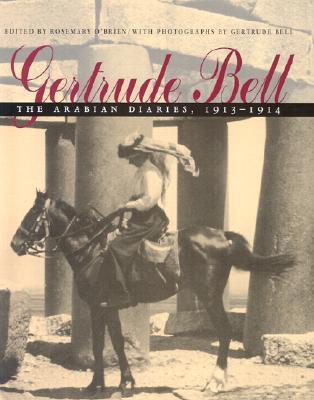
The Englishwoman Gertrude Bell lived an extraordinary life. Her adventures are the stuff of she rode with bandits; braved desert shamals; was captured by Bedouins; and sojourned in a harem. Called the most powerful woman in the British Empire, she counseled kings and prime ministers. Bell’s colleagues included Lloyd George and Winston Churchill, who in 1921 invited Bell—the only woman whose advice was sought—to the Cairo Conference to “determine the future of Mesopotamia.” Bell numbered among her closest friends T.E. Lawrence, St. John Philby, and Arabian sheiks. In this volume of three of her notebooks, Rosemary O’Brien preserves Bell’s elegant, vibrant prose, and presents Bell as a brilliant tactician fearlessly confronting her own vulnerability. The fundamental themes of her life—reckless behavior; a divided self which combined brilliance of intellect with a passionate nature; a sense of history; and the fatal gift of falling in love with a married man—are all here in remarkable detail. Her journey to northern Arabia in 1914 earned Bell professional recognition from the Royal Geographical Society, and solidified her reputation as a canny political analyst of Middle Eastern affairs. In addition to Bell’s own photographs, O’Brien has provided us an unprecedented first access to excerpts of the Bell/Richard Doughty-Wyllie love letters, the married British army officer with whom she was in love and for whom her diaries were written.
This is really a disappointment for many reasons. Bell's diary is full of romanized transliterations of Arabic words and phrases, many of which the editor leaves untranslated, and because the diction is apparently Arabic dialect, it's hard to find them in an Arabic dictionary. There is a glossary of Arabic terms in the back, but it is too short to be of use. For Bell's diaries to be intelligible, the editor really should have done the hard work of translating every single stinking phrase and word. Also, the thicket of tribal designations is just confusing. It would have been nice for the editor to have written an introduction explaining the major tribal divisions and their clans which appear in the book, plus a map showing the migration and grazing areas of each tribal entity, plus a more detailed map showing major landmarks along Bell's route would have been really helpful. It is curious that a book like this also has so few footnotes. It really needed a LOT of footnotes to make it understandable. The editor really should have put more work into interpreting Bell's observations on Arab geography and customs. Without that, the reader ends up having to put a lot more work into trying to figure out what's going on. Too bad, because this could have been a fascinating window onto a lost world that has since begun to disappear. Instead, I found myself bored and wishing I was reading Doughty's account of his wanderings in Arabia. A couple of stray thoughts: if you want more primary-source material relating to Bell's journey to Ha'il and back in 1913-1914, you can read this (http://gutenberg.net.au/ebooks04/0400...), and also take a look at the collection of photos she took during the trip (http://gertrudebell.ncl.ac.uk/photos_...).
As with the Georgia O'Keeffe book, this isn't the book about Gertrude Bell I was looking for, it was the one I settled for. I guess I'd like a more objective view of her life than her besotted diaries provide. She sure is an intriguing woman: Exploring Arabia at the time of Lawrence of, all on her own! (Well, accompanied by guides, etc.) I gave it up half way through.
This is a great book - it is diary entries so do be aware when you pick it up. This is a personal diary she kept for her married love aside from her serious and scholarly diaries. For more detail on her life prior to reading this one for background I'd recommend Loritz and Wallach, but they are all good.