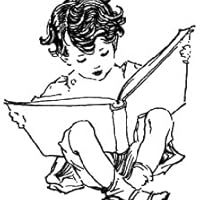
Introductory volume in the series of Reading-Literature readers, whose purpose is to train children in reading and appreciating literature through the reading of literature. Contains nine of the best folk tales, true to the original, and yet written in such a simple style that children can quickly begin reading the real story. Includes The Little Red Hen, The Gingerbread Boy, The Old Woman and Her Pig, The Boy and the Goat, The Pancake, Chicken Little, Three Billy Goats Gruff, Little Tuppens, and Little Spider's First Web. Attractive black and white illustrations are appealing to children.
Harriette Taylor Treadwell was born in 1870 in Williamstown, NY to Delia C. Taylor and Hiram Taylor. She married Charles H. Treadwell in 1897, who died in 1918. She had a son, Charles H. Treadwell, Jr. In the 1920 census, Harriette Taylor Treadwell was listed as widowed and living in Chicago Ward 7, Illinois. She died in 1931 in Hammond, Lake County, Indiana.
After graduating from Oswego High School and Normal School, Harriette Treadwell move to Chicago in 1911 to complete her education at the University of Chicago. She was principal at the West Pullman School, Chicago, and in 1905 she was president of the Teachers' Federation of Chicago. As president, she announced that the local Letter-Carriers' Association of Oswego would adopt a woman suffrage resolution. She was also president of the Chicago League of Women Voters in 1913 and president of the Illinois Women's Legislative Congress in 1915.
In 1911, Harriette Treadwell was part of the Federated Marketing Clubs movement that influenced the health and the finances of every family in the USA. The focus was on food quality, which was required to be good to be sold, as well as guaranteed weights and measures, and fair prices.
Harriette Treadwell and Harriet Strokes Thompson lead the Political Equity League in 1914. This league had more than 2000 dues-paying members, did important suffrage work, kept a steady educational campaign in civics, held study, and kept watch over politics and the city council.
Harriette Treadwell, along with Margaret Free, published their first book in 1910, The Primer, which focused on teaching children from 5 to 8 years old to read and appreciate literature. All the books they wrote were specialized for children of a certain age group and each one had a different purpose. For instance, The First Reader (1911) contains rhymes and jingles suitable for children from 6 to 8 years old; The Second Reader (1912) introduces fables and fairy stories so that the children can associate related literature and organize it, and the Third Reader (1912) has fairy tales that highlight the interest of children ages 8 to 9 with a focus animals and nature. In 1913 Treadwell wrote a book for teachers to show how simple the essential principles of teaching were when teaching young children to read. She believed that the best literature was introduced in the early years of a child's life.
--from Biographical Database of NAWSA Suffragists, 1890-1920
Good primer reader -- the repetitive structure is purposeful and helpful for early readers. I do wish that there had been a little more variety in the stories. Two of the "gingerbread man" formula and two "pig and the stile" ones. Ian had no complaints, though.
I taught my son to read with this, but honestly this is just a book with a handful of very easy to read stories with an almost-awkward repetitive text focus, and any book(s) like that will do the same job. Something more closely connected to your life might even do better. My son has no idea what threshing is, and isn't going to see a field of wheat or a mill any time soon, so that wasn't particularly helpful. And forget about sixpence. :-D
Anyway. My point is that you still need to know how to teach a person to read (whether DIYing it with this or using a packaged curriculum) ... hindsight being 20/20, I now realize I could have used my DIY method of choice with Dr Seuss and/or one of the nursery rhyme books we owned already. Certainly, for free reading practice that keeps the learner excited, this would not be my pick. Or my son's.
It's fine! But the printing isn't particularly attractive and the stories aren't mind-blowing. If you don't have anything already, you could do a lot worse imo, but this is not a must-buy despite its popularity in homeschooling circles. It's fine.
I appreciated the fact that this book has some very popular tales and are simple enough for beginner readers. While the lack of decent illustrations wasn't that bad, some of the tales were so inappropriate for beginner readers. I was reading one of the tales that talked about a woman asking for someone to hang a character. Ummm, no thank you.
This book is quite a departure from contemporary image saturated children's books -- and my son adores it. This book is meant to act as a simple primer for young readers, in the fashion of historically popular primers/readers used by generations past in their quest to learn to read. These short stories are classics, with sparse, simple illustrations. My three year old begs to read from this book and I never mind obliging him. Be aware that these classics haven't been sweetened, the gingerbread boy and other characters meet their fate, if you're concerned about that for your young readers.
A very useful Primer, little children reading these stories get the feel for reading real literature. As opposed to "twaddle" - however caution is advised, due to the outdated nature of the material the values/content presented at times is not suitable for modern sensibilities.