This is a rather important and influential book that has somehow become extremely obscure. Actually, if you read it, you'll understand how modern English has evolved along the simpler, more conversational way it has become. This book is so influential, if you go on spell check on Microsoft Word, you click in the box that says, "readability", and get the Flesch scale which is based off this book.
Aside from it's importance, it was a smooth and insightful read. If you're looking to improve your writing, don't just pick up Strunk and Wagnel, pick this up, too.
In this straightforward guide to clear, readable writing, Flesch instructs four essential guidelines: • know your audience • be concrete and specific • incorporate anecdote • write simply as if conversing
There are a number of examples and refinements on each of these principles, and they are presented in just the manner he preaches. His points are no less valid today than they were when the book was published in 1949.
Photo of Rulolf Flesch, The author of this beautiful book (Source)
This little 1949 jewel is a wonderful and mandatory tool that anyone who wants to enjoy reading and writing should review heartily at least once in her life, but honestly, at least once every certain amount of time; because the advice is timeless and extremely useful.
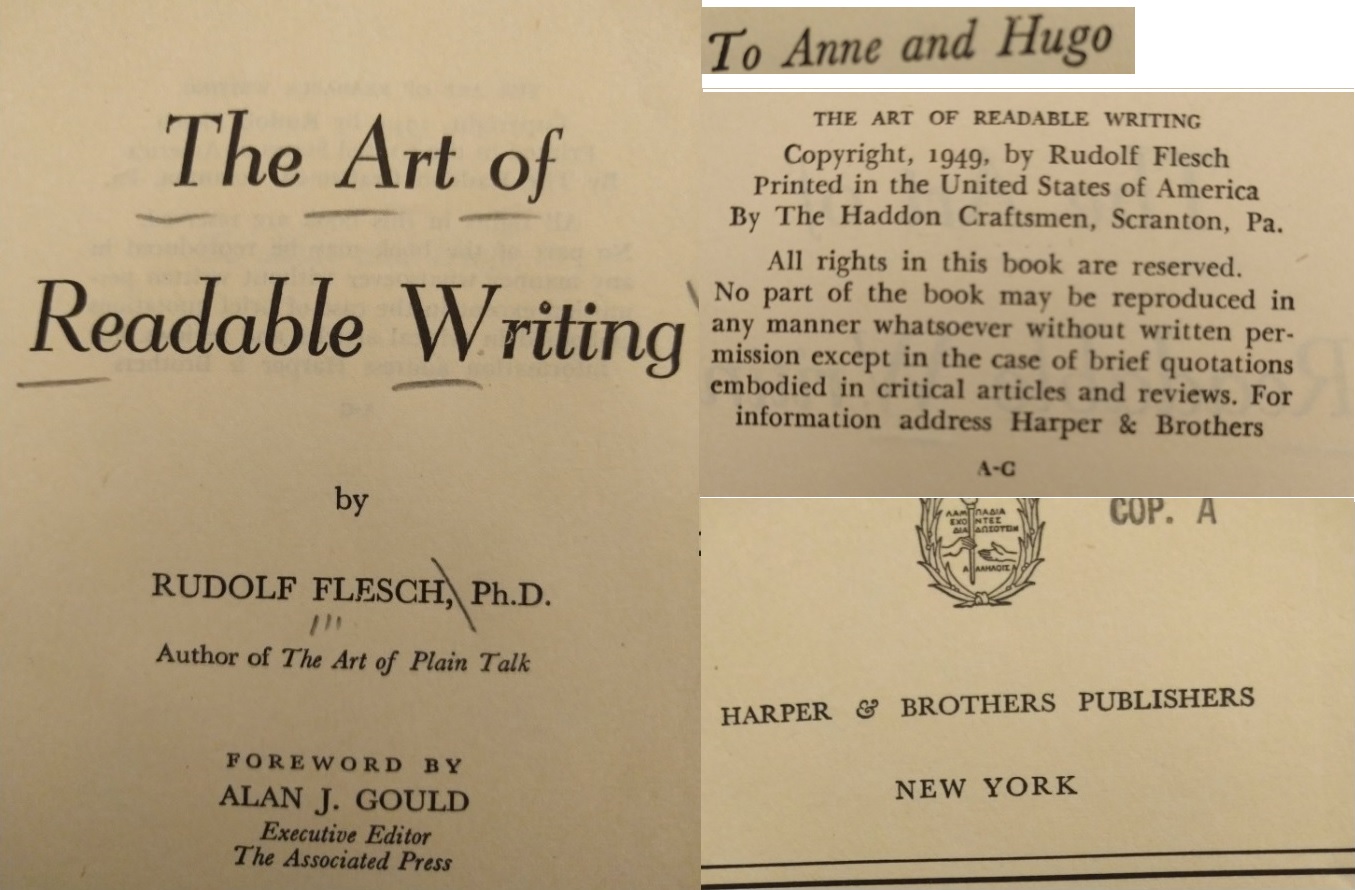
The following image is a picture of the cover pages of the book I read:
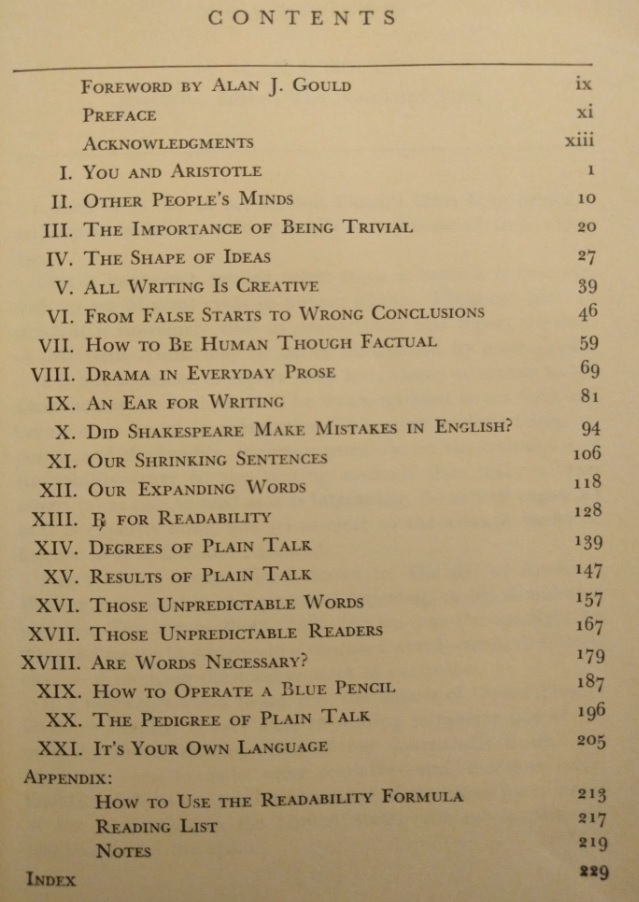
The following is a photo of the table of contents page of the book. Flesch is a very thorough author, and he left nothing outside of his dissertation. Starting with the philosophers, going through the journey of finding your own voice, and mentioning the art of plain talk and communication so useful and intuitive for all those who want to read and write better with every attempt.
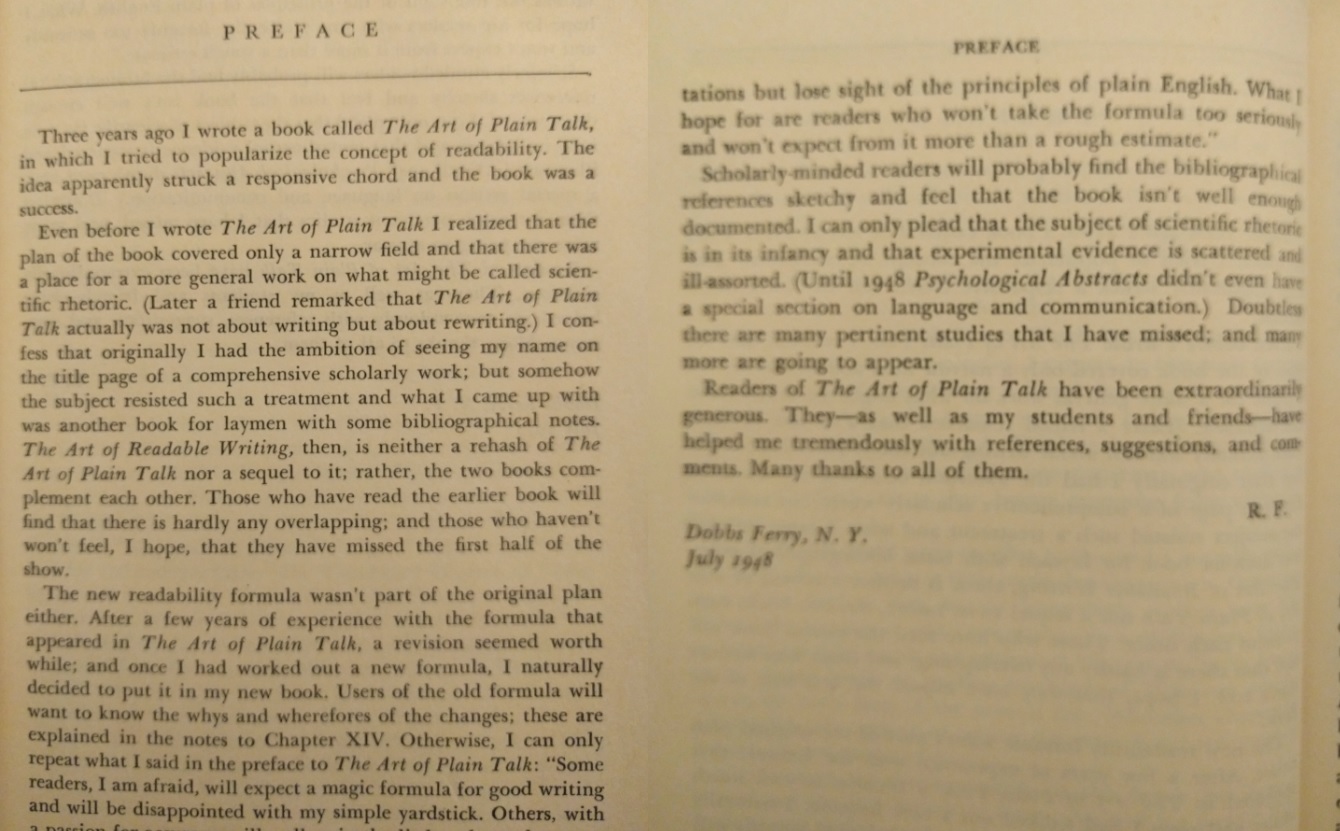
In the preface, the author mentions his earlier book, The art of plain talk. I have reviewed that one before and I can repeat here that I loved it. Here in the preface, the author says that this new book is an evolution from that one. Here is a picture of the preface. It is worth reading it:
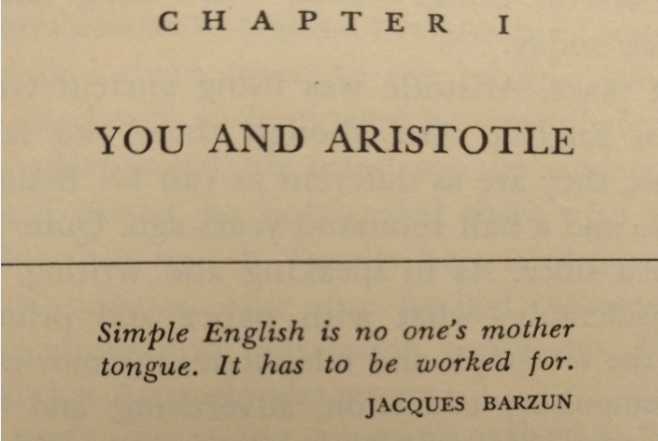
This is a quote from Jacques Barzun. I just loved it "Simple English is not a mother tongue. It has to be worked for". Here is the image of the quote. I just couldn't resist writing it at least once:
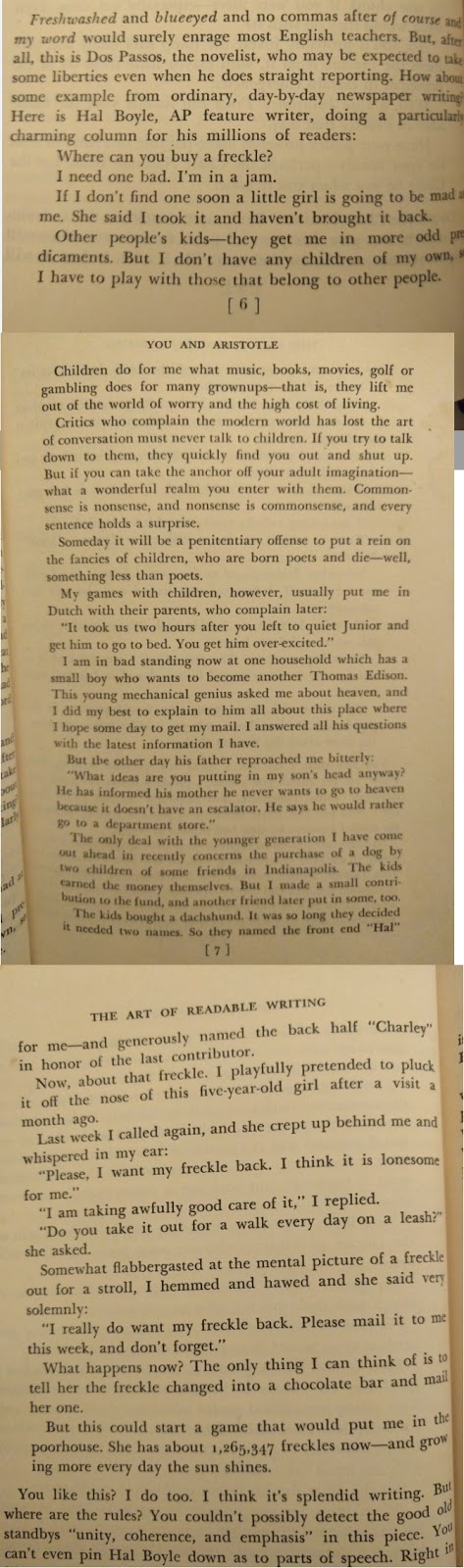
The following image is the reproduction of a very beautifully-written story. Like they don't write any more. Mr Flesch analyzes it and gives us hints on how it has became so good:
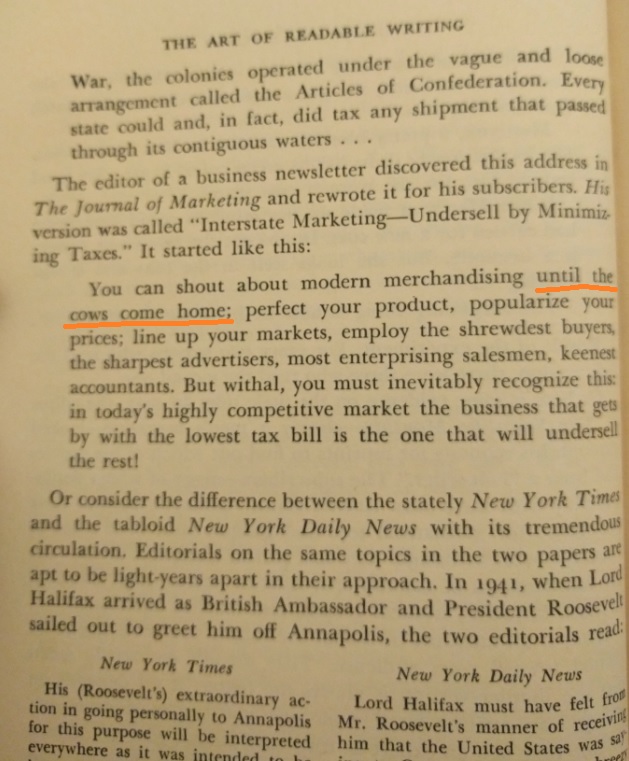
I love the expression "You can shout until the cows come home". Here is a photo of an example of its usage. I just loved it:
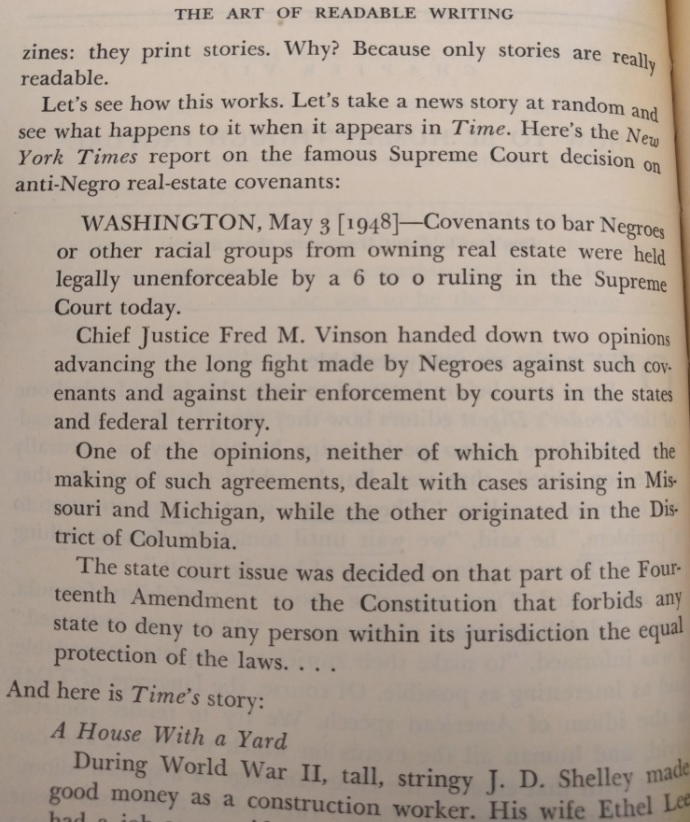
The following photo is is an example of a 1948 article on certain laws concerning real state property rights based on race and skin color. The author analyzes several news articles to find out how simple and understandable they are.
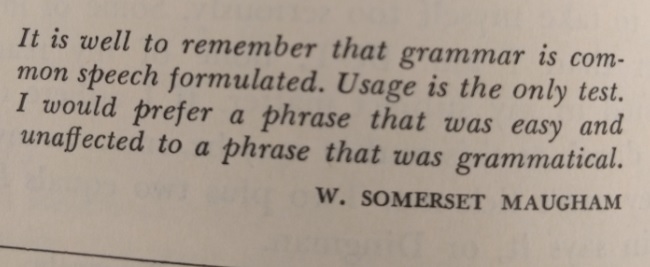
Below, there is the image of one powerful quote by W. Somerset Maugham. It basically says that if it sounds good, then forget grammar. The most important thing is to be understandable.
Here are a set of very valuable tips on how to write something that is extremely readable. Take a look and really own it, because it is golden advice:
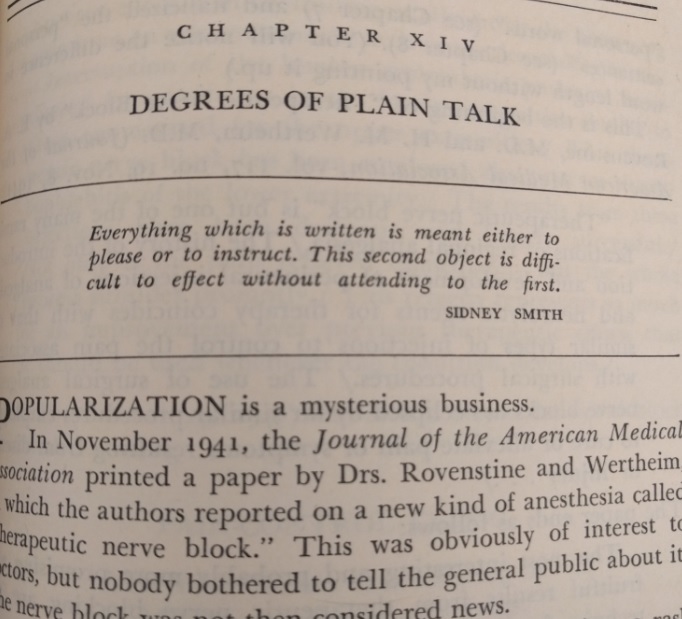
Here is the photo of the introduction to the chapter on popularization of your writing. This was one of the most interesting sections of the book:
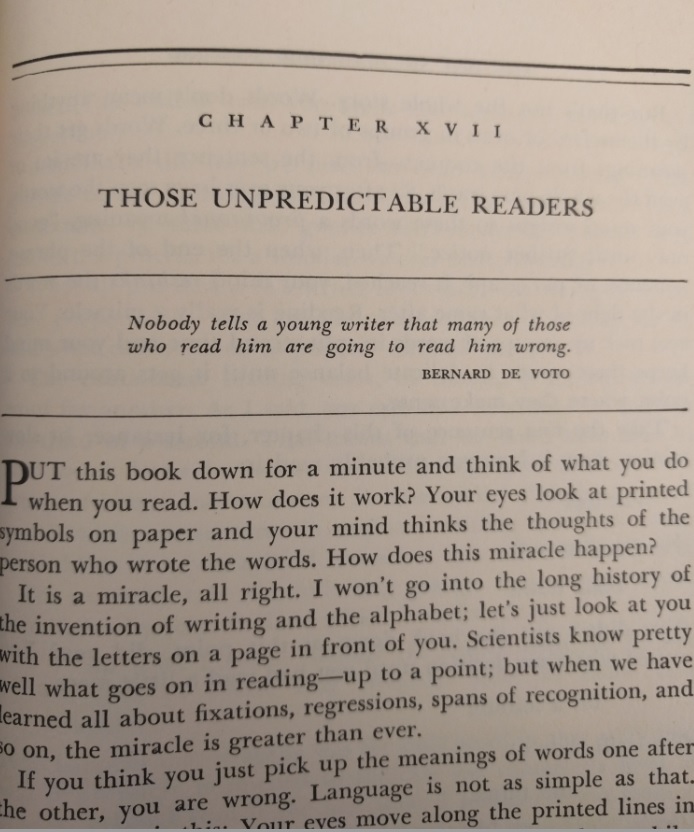
Chapter VII is another jewel. It starts with a quote that is so true it hurts: "Nobody tells a young writer that many of those who read him are going to read him wrong" (Bernard de Voto). Here is a picture of the quote and the first lines of this very interesting chapter:
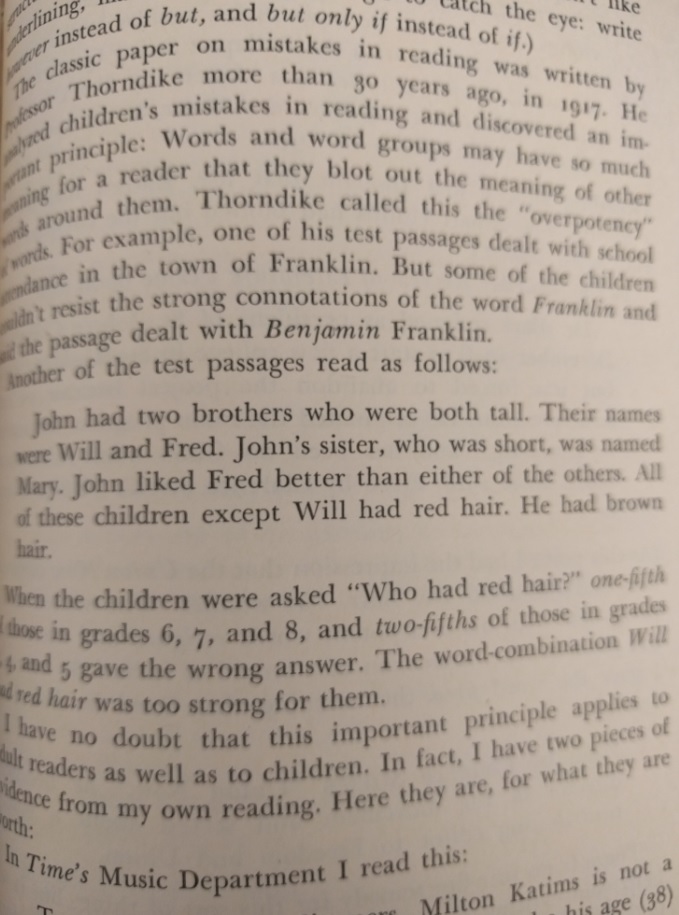
Here is a photo of a helpful reading exercise. It illustrates how word-placing is a powerful tool when trying to convey the correct message. You should try it:
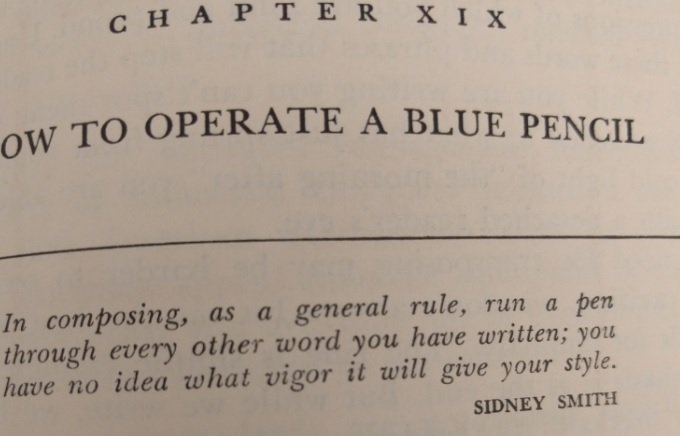
Here is the image of another very juicy quote by Sidney Smith advising a writer to cross out every other word of what they write. It promises to give you a good style:
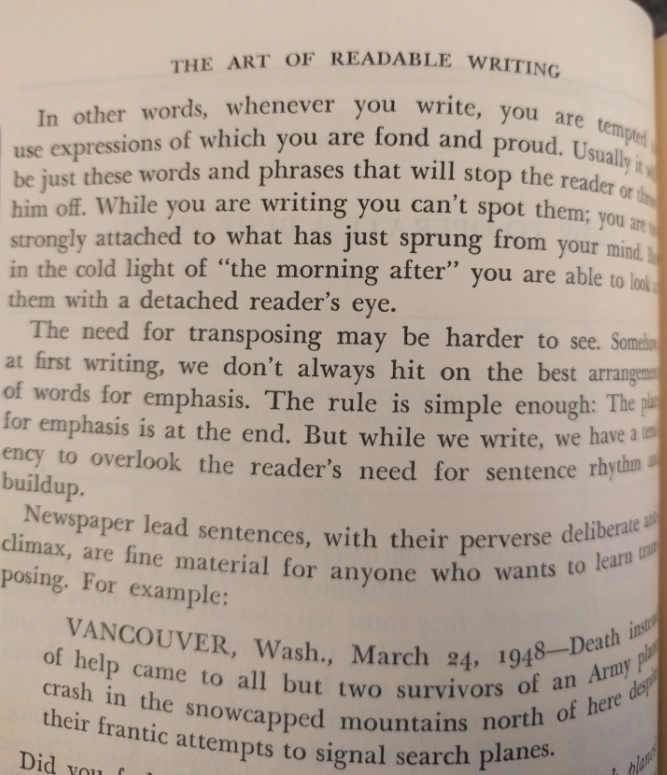
Below is an example of transposition for the sake of effect and engagement. A resource that sometimes makes simplicity a real challenge:
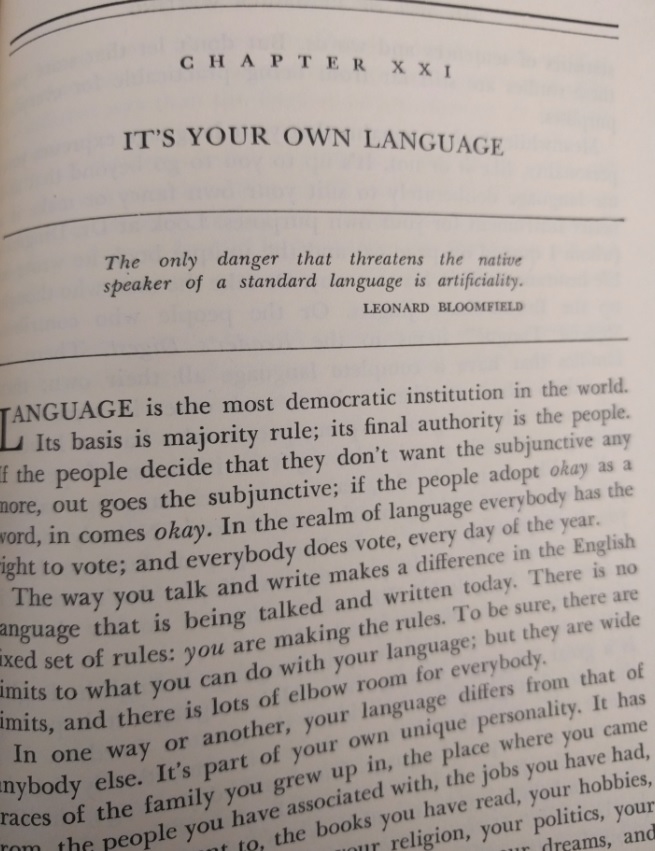
This is an image of the first lines of chapter XXI, on language. It starts by saying that language is the most democratic institution in the world, because this one is truly made by the people. It is a powerful idea:
The following is a fragment of the final words of the book. It is a reflection on how grammar can sometimes be uncomfortable, but we abide by it anyway because we need to accommodate to social conventions, and language is social:
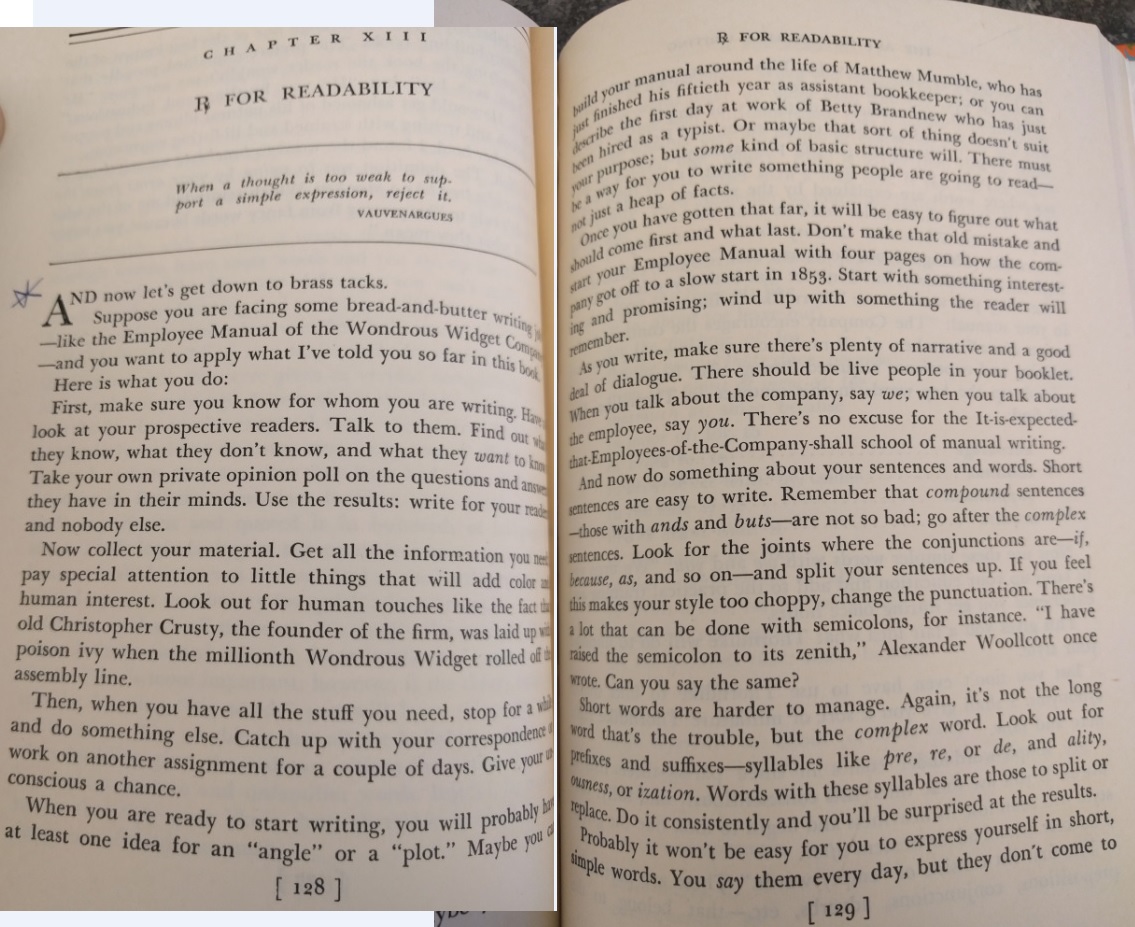
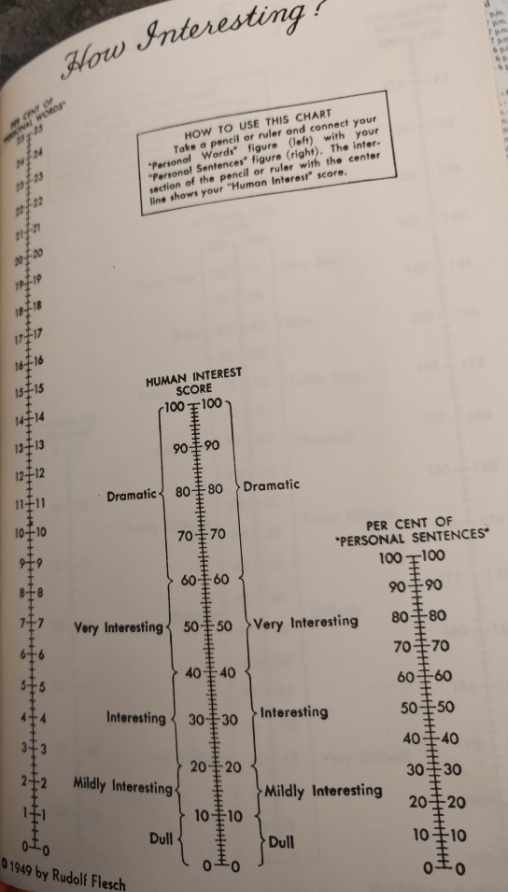
The following image is a tool that the author named "Interestimometer". Any writer can use it to analyze his text and decide how interesting it is:
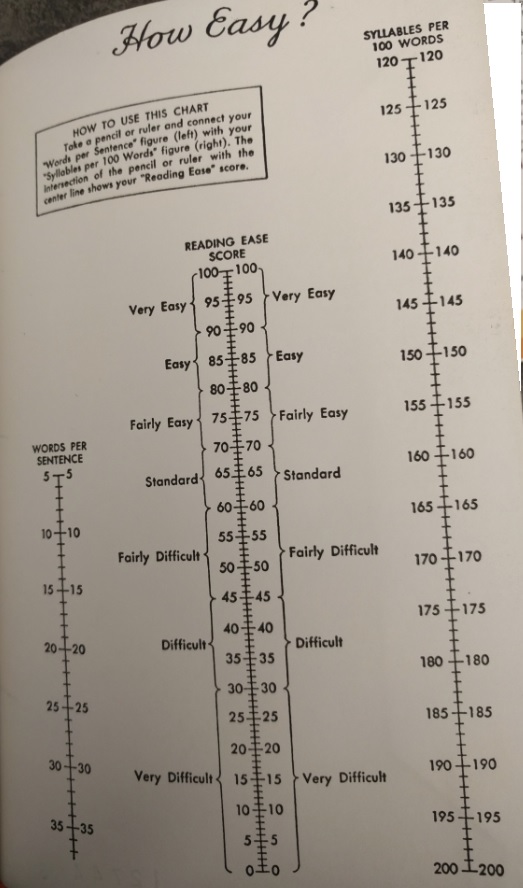
And here is another tool: the easymometer; a tool to determine -you guessed it- how easy to read a text is:
In sum, this is a fantastic and useful book that everyone should have as a reference on their shelves.
My academic training had left me with an inability to write texts with high readability. I have been using the readability tests to measure and improve my writing for some time. As soon as I saw Flesch's name on the cover, I grabbed it. I should have read it during my school days; it could have helped me a lot.
I assess the degree of usefulness of a book by noting the number of highlights that I make. Higher number of highlights means I found several interesting things. Following that logic, this book ranks among the most useful books that I have read.
The examples from wide range of publications helped to make his arguments clearer. Especially the side-by-side display of articles about the same topic from competing publications.
People often misunderstand the relevance of readability statistic. You can find online posts where people trash the readability tests. They cite the high scores of some difficult novels. Those novels would have been more difficult if the readability was also low. The critics of the tests should read this book.
Required reading for anyone who writes extensively. Considering most people have service-sector jobs that's basically everyone. This book took me awhile to read because each chapter alone is so packed with information that I would wait to absorb before moving on. I wouldn't worry so much about the statistical analysis the author proposes; it's reasonable but not important to me. What was important was each chapter's clear piece of advice.
As a result I would instead consider this book a textbook. Maybe one of the best textbooks anyone can have. I can go to the list of chapters to review something I barely remember. I can use a piece of advice as a reference for others. I don't even need rationale because the advice is common sense. That's why this book is five stars: it is always _useful_.
I thought the first third of the book good. The rest where he gets into his Flesch reading method was ok but nothing I cared for. After reading what its purpose was, I decided I would not use it for my creative writing ever again -- it was geared towards business and academic.
Terrific book. Anyone who likes words should read it. Practical and very fun to read. He makes clear why some books are such dull tomes and why others are such a pleasure to read that you don’t want them to end.
I bought this 1949 book on writing randomly at a used book store and picked it up to read equally randomly almost a year later. I don't think I'll ever apply Flesch's readability and human interest formulas, but they and the rest of the book are quite interesting.
Flesch gives intelligent advice, most of which still holds true if you remember that he is describing “readable writing,” which frequently overlaps with but does not always equal “great writing” or “academic writing.” His suggestions and examples are sound, and his criticisms of the incomprehensible writing churned out by psychology researchers, legal minds, and the like are spot on. I even agreed with many (though not all) of his criticisms of the established "rules" of composition. The only place he seems totally off is his misuse of Shakespearean examples to prove that certain rules should be broken, often ignoring the fact that Shakespeare was writing (1) within the constraints of poetic lines and (2) during a time when sentence structure and punctuation were significantly different than they are today.
Flesch is an entertaining instructor throughout, both intentionally and unintentionally. I was highly amused, for example, by the gender roles in the example passages – which are from the 1940s or earlier – such as the assumption that The Scientific Monthly is “clearly a men’s magazine” and a bank advertisement that comforted men who would of course never trust their wives with more than a small allowance and are worried about what the widows would do with a large life insurance sum. I can sense Flesch cringing a bit at the low readability level of that last sentence, so I'll end my review here.
This book contained a wealth of information on writing. The books title makes it obvious as to the intent of the author, such as many points within the pages. I was challenged in many areas of my writing and will refer to this book for many years to come. The reading took the reader into the "whys" of writing.
Loved this book. I never thought about writing in such a scientific way as Rudolf Flesch approaches it. It's very interesting that it's possible to measure the level of readability and human interest. I read the 1949 edition. Got it for 1 Euro but what it teaches you is priceless.
This is my fifth or sixth time through the book. It's the smartest and easiest-to-read book about writing ever. There's an entire graduate degree in style in this one book. My own John Maguire's College Writing Guide draws heavily from it.